
Modul 6: Oral Exams B2/C1: Part 1 Set 1. Topics 1-12
Keegan (Maine, USA) 12db egyszerű, hétköznapi témában mondja el gondolatait. Ezek a témák a nyelvvizsgák tipikus bevezető témái. Egy-egy videó mindössze pár percnyi anyag, sok-sok érdekes információval az amerikai kultúrával, élettel kapcsolatban.
Fontos, hogy a kézikönyvekben leírtak szerint dolgozz az anyagon. A videók össz hossza kb. 15 perc.
01 Work (steps 1, 2 and 4)
- 01 What is your job?
Presently I make videos for an English course, but prior to that, I have been a farmer.
presently: at the time you are speaking or writing; now; currently | I am presently not able to talk to anyone on the phone because I am in a library.
prior to that: before a particular (= a given) time or event | She fell down and broke her leg, but three weeks prior to that, she had been dancing in a competition.
- 02 Where do you work?
When farming, I work in the fields. When making the videos, I work in this barn.
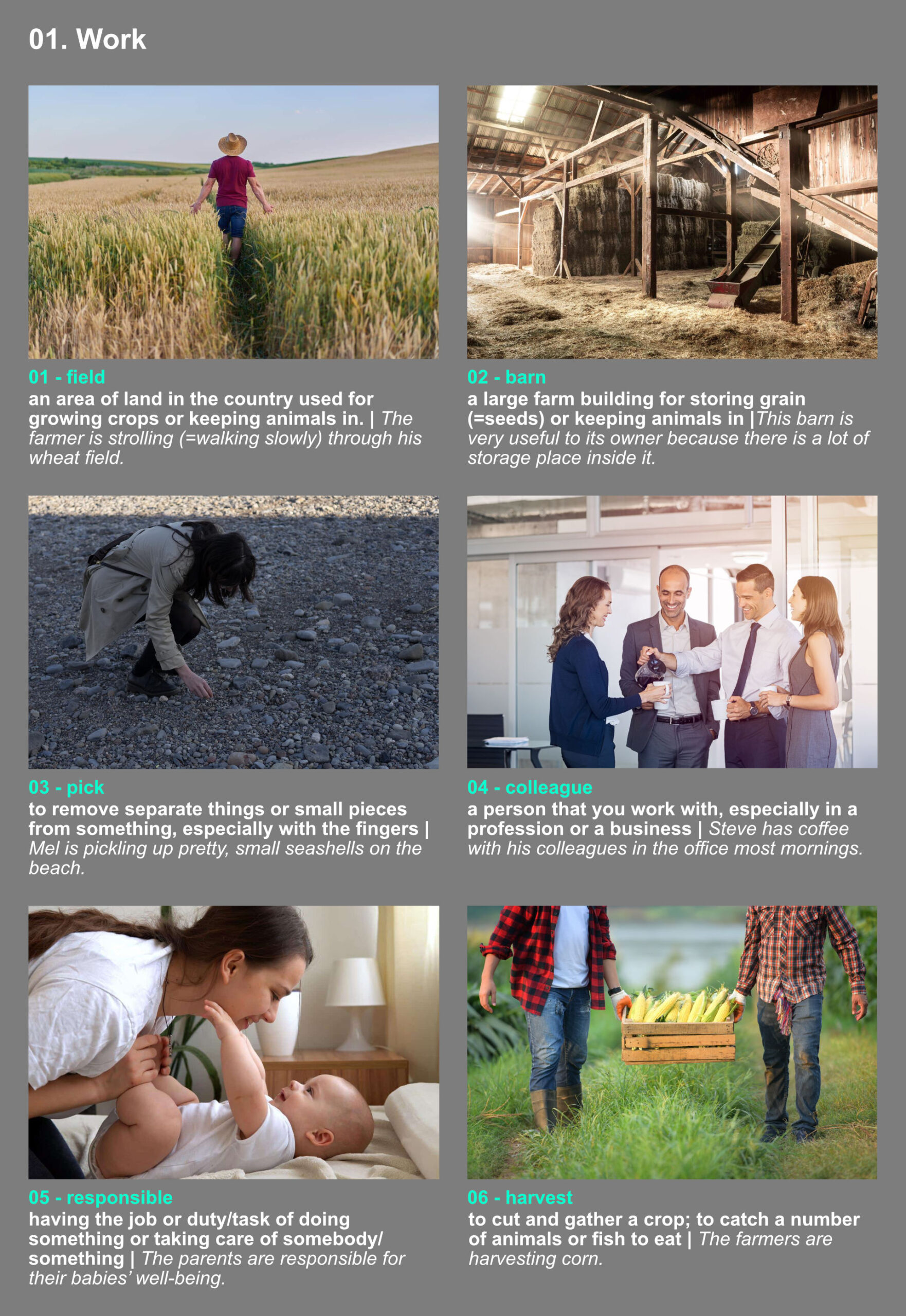
field1: an area of land in the country used for growing crops or keeping animals in. | The farmer is strolling (=walking slowly) through his wheat field.
barn2: a large farm building for storing grain (=seeds) or keeping animals in |This barn is very useful to its owner because there is a lot of storage place inside it.
- 03 Why did you choose that job?
I didn’t choose farming. Farming chose me, but as for making these videos, I chose that because I got to work with my best friend’s father.
as for: used to start talking about somebody/something | I got to school 5 minutes early, but as for Mike, his bus was stuck in traffic, so he was half an hour late.
get to (do sth): have the opportunity to do | I enjoy going to the mall because of all the free food samples that I get to taste.
- 04 Is it a popular job in your country?
Most people in my country don’t like farming, unfortunately, though many of them do farm.
- 05 Do you like your job?
Yes, I like both jobs of mine very much except when it’s incredibly hot and I have to pick rocks.
incredibly: extremely | It is incredibly difficult to walk through the snow and icy roads in Norway in the wintertime.
pick3: to remove separate things or small pieces from something, especially with the fingers | Mel is pickling up pretty, small seashells on the beach.
- 06 Do you get on well with your colleagues?
I get on very well with my colleagues.
get on very well: If you get on with someone, you have a friendly relationship with them. | Lisa gets on very well with her neighbours.
colleague4: a person that you work with, especially in a profession or a business | Steve has coffee with his colleagues in the office most mornings.
- 07 What was your first day like?
I do not remember my first day of farming, but I would assume it was very hot. Most farming is very hot.
assume: to think or accept that something is true but without having proof of it | Chris assumed that it was not going to rain today and left without an umbrella.
- 08 What responsibilities do you have at work?
With farming, I am responsible for harvesting the vegetables and making sure the chickens don’t get eaten by anyone other than us. With my video making job, my responsibility is to get the videos out as fast as I can, with as few mistakes as possible.
responsible5: having the job or duty/task of doing something or taking care of somebody/something | The parents are responsible for their babies’ well-being.
harvest6: to cut and gather a crop; to catch a number of animals or fish to eat | The farmers are harvesting corn.
other than: except | The legal document cannot be signed by anyone other than you (= you are the only one to sign it).
responsibility: a duty to deal with or take care of somebody/something | According to some, the responsibility for looking after the planet lies with all of us (= we are all responsible).
- 09 If you had the chance, would you change your job?
No, I intend to keep going with both of my jobs for as long as I possibly can.
intend: to have a plan when you do something; want | I intended to have a walk outside after work, but it began to rain heavily.
- 10 Do you plan to continue with your job in the future?
I do plan to continue with my jobs, for as long as I can.
What is your job?
Presently I make videos for an English course, but prior to that, I have been a farmer.
Where do you work?
When farming, I work in the fields. When making the videos, I work in this barn.
Why did you choose that job?
I didn’t choose farming. Farming chose me, but as for making these videos, I chose that because I got to work with my best friend’s father.
Is it a popular job in your country?
Most people in my country don’t like farming, unfortunately, though many of them do farm.
Do you like your job?
Yes, I like both jobs of mine very much except when it’s incredibly hot and I have to pick rocks.
Do you get on well with your colleagues?
I get on very well with my colleagues.
What was your first day like?
I do not remember my first day of farming, but I would assume it was very hot. Most farming is very hot.
What responsibilities do you have at work?
With farming, I am responsible for harvesting the vegetables and making sure the chickens don’t get eaten by anyone other than us. With my video making job, my responsibility is to get the videos out as fast as I can, with as few mistakes as possible.
If you had the chance, would you change your job?
No, I intend to keep going with both of my jobs for as long as I possibly can.
Do you plan to continue with your job in the future?
I do plan to continue with my jobs, for as long as I can.
02 Study (steps 1, 2 and 4)
- 01 What did you study?
Well, I don’t study anything now, but when I was in college not too long ago, I studied welding.
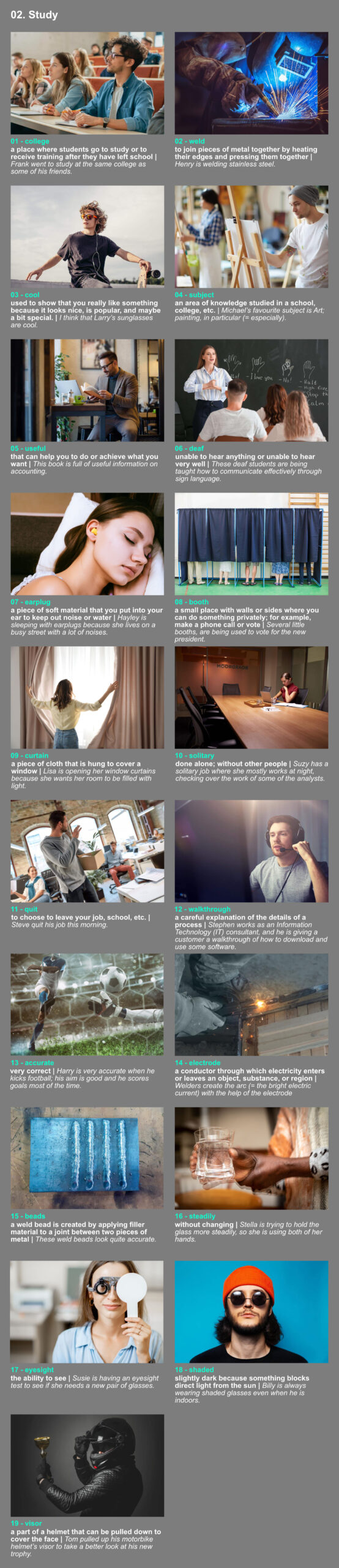
college1: a place where students go to study or to receive training after they have left school | Frank went to study at the same college as some of his friends.
weld2: to join pieces of metal together by heating their edges and pressing them together | Henry is welding stainless steel.
- 02 Where did you study that?
I studied it at a college, and because welding was so much cooler than everyone else, we had our own building.
cool3: used to show that you really like something because it looks nice, is popular, and maybe a bit special. | I think that Larry’s sunglasses are cool.
- 03 Why did you choose that subject?
I chose that subject for one reason and one reason alone: that reason is that welders get paid more money than most people; however, there is significant risk to it, which is why they get paid more.
subject4: an area of knowledge studied in a school, college, etc. | Michael’s favourite subject is Art; painting, in particular (= especially).
significant: large or important enough to have an effect or to be noticed | Stress may have a significant effect on the physical health of a person.
risk: a situation that could be dangerous or have a bad effect | Health risks can be reduced by daily walks.
- 04 Is it a popular subject in your country?
It is not a very popular subject in my country because there is a high demand for welders, but a lot of people do study it.
demand: the desire (= wish/want) or need of customers for goods or services | The demand for smartphones significantly increased in the 2010’s as they became a cool item to have.
- 05 Do you like the subject?
I like it fairly well, though I would much prefer to do something else. I like it, and it is very useful to me, because I like to make things, but at the same time, I don’t prefer it.
useful5: that can help you to do or achieve what you want | This book is full of useful information on accounting.
- 06 Did you get on with your colleagues/classmates?
I got on as well with my colleagues as one possibly can, though in welding it is hard to get to know one’s classmates because most people are fairly deaf, and you spend most of the day with earplugs in and a mask on, in a little booth with a curtain. It’s a fairly solitary job. I knew most of my classmates by reputation, and I became good friends with one of them who I am still good friends with today, but he quit. He was no longer in the welding class.
fairly: to some extent but not very; quite | The IQ test was a fairly simple one to do but the last questions were hard.
deaf6: unable to hear anything or unable to hear very well | These deaf students are being taught how to communicate effectively through sign language.
earplug7: a piece of soft material that you put into your ear to keep out noise or water | Hayley is sleeping with earplugs because she lives on a busy street with a lot of noises.
booth8: a small place with walls or sides where you can do something privately; for example, make a phone call or vote | Several little booths are being used to vote for the new president.
curtain9: a piece of cloth that is hung to cover a window | Lisa is opening her window curtains because she wants her room to be filled with light.
solitary10: done alone; without other people | Suzy has a solitary job where she mostly works at night, checking over the work of some of the analysts.
reputation: the opinion that people have about what somebody/something is like, based on what has happened in the past | John has an excellent reputation as a lawyer, which he’s built over the last 10 years.
quit11: to choose to leave your job, school, etc. | Steve quit his job this morning.
- 07 What was your first day like?
My first day at welding was very easy with just a walkthrough of what would be taught in the class. What’s far more interesting was my second day. My class was in fact the first class in the decades of my teacher having taught there to have gone straight into welding and actually operating the machines the second day.
walkthrough12: a careful explanation of the details of a process | Stephen works as an Information Technology (IT) consultant, and he is giving a customer a walkthrough of how to download and use some software.
decade: ten years | I haven’t played tennis for at least two decades.
be to: used to say what will happen at a later time | Her classmates never dreamt that she was to become the prime minister one day.
- 08 What are the main aspects of your subject?
The main aspects of it would be getting more accurate with the electrode to be able to put down better beads and being able to keep it up more steadily. Another aspect of it is eyesight. You have to be able to see the thing very well because, remember, you are wearing a shaded visor, so seeing anything at all is extremely hard.
aspect: a particular part or feature of a situation, an idea, a problem, etc. | The politicians focused on the small details of the issue (= problem) and missed the most important aspects of it.
accurate13: very correct | Harry is very accurate when he kicks football; his aim is good and he scores goals most of the time.
electrode14: a conductor through which electricity enters or leaves an object, substance, or region | Welders create the arc (= the bright electric current) with the help of the electrode.
(weld) bead15: a weld bead is created by applying filler material to a joint between two pieces of metal | These weld beads look quite accurate.
steadily16: without changing | Stella is trying to hold the glass more steadily, so she is using both of her hands..
eyesight17: the ability to see | Susie is having an eyesight test to see if she needs a new pair of glasses.
shaded18: slightly dark because something blocks direct light from the sun | Billy is always wearing shaded glasses even when he is indoors.
visor19: a part of a helmet that can be pulled down to cover the face | Tom pulled up his motorbike helmet’s visor to take a better look at his new trophy.
(not) at all: in any way; to any degree | It is usually difficult to understand advanced Quantum Physics at all; even if it is just on a single page.
- 09 If you had the chance, would you have changed your subject?
I would absolutely change subject if I had the chance. I like welding. It’s a useful skill to have, but I do not want to work as welder. I would much prefer to have studied framing.
subject: an area of knowledge studied in a school, college, etc. | Music was one of my favourite subjects in school.
- 10 Do you plan to get a job in the same field as your subject?
I do not plan to get a job in the same field as my subject. I do not want to work as a welder. It’s a good skill to have because I like making stuff on my own time, but I don’t want to work that as a job.
field: a professional area that someone works in or is interested in | Lance works in the field of catering (= providing food and drinks for meetings or social events).
skill: a particular ability or type of ability | Frank’s colleagues have excellent technical skills; for example, they are able to code very well.
stuff: used to refer to things when you do not know the name, when the name is not important or when it is obvious what you are talking about | I have lost my school bag and all my stuff with it.
What did you study?
Well, I don’t study anything now, but when I was in college not too long ago, I studied welding.
Where did you study that?
I studied it at a college, and because welding was so much cooler than everyone else, we had our own building.
Why did you choose that subject?
I chose that subject for one reason and one reason alone: that reason is that welders get paid more money than most people; however, there is significant risk to it, which is why they get paid more.
Is it a popular subject in your country?
It is not a very popular subject in my country because there is a high demand for welders, but a lot of people do study it.
Do you like the subject?
I like it fairly well, though I would much prefer to do something else. I like it, and it is very useful to me, because I like to make things, but at the same time, I don’t prefer it.
Did you get on with your colleagues/classmates?
I got on as well with my colleagues as one possibly can, though in welding it is hard to get to know one’s classmates because most people are fairly deaf, and you spend most of the day with earplugs in and a mask on, in a little booth with a curtain. It’s a fairly solitary job. I knew most of my classmates by reputation, and I became good friends with one of them who I am still good friends with today, but he quit. He was no longer in the welding class.
What was your first day like?
My first day at welding was very easy with just a walkthrough of what would be taught in the class. What’s far more interesting was my second day. My class was in fact the first class in the decades of my teacher having taught there to have gone straight into welding and actually operating the machines the second day.
What are the main aspects of your subject?
The main aspects of it would be getting more accurate with the electrode to be able to put down better beads and being able to keep it up more steadily. Another aspect of it is eyesight. You have to be able to see the thing very well because, remember, you are wearing a shaded visor, so seeing anything at all is extremely hard.
If you had the chance, would you have changed your subject?
I would absolutely change subject if I had the chance. I like welding. It’s a useful skill to have, but I do not want to work as welder. I would much prefer to have studied framing.
Do you plan to get a job in the same field as your subject?
I do not plan to get a job in the same field as my subject. I do not want to work as a welder. It’s a good skill to have because I like making stuff on my own time, but I don’t want to work that as a job.
03 Hometown (steps 1, 2 and 4)
- 01 Where is your hometown?
My hometown is Hangzhou, a small town in China just south of the line between north and south.
- 02 Do you like your hometown?
Yes, I like my hometown quite a lot.
- 03 Do you often visit your hometown?
No, I have not been to my hometown in many years. I live in a different country now.
- 04 What is your hometown like?
It’s a smaller city by Chinese standards, more cultural than the rest of China, in my opinion and the opinion of most people there.
- 05 What is the oldest place in your hometown?
The oldest place in my hometown is probably the outskirts as the city centre has been torn down and rebuilt many times.
probably: used to say that something is likely to happen or to be true | The shop will probably be open tomorrow morning because it is a weekday and it is usually open on weekdays.
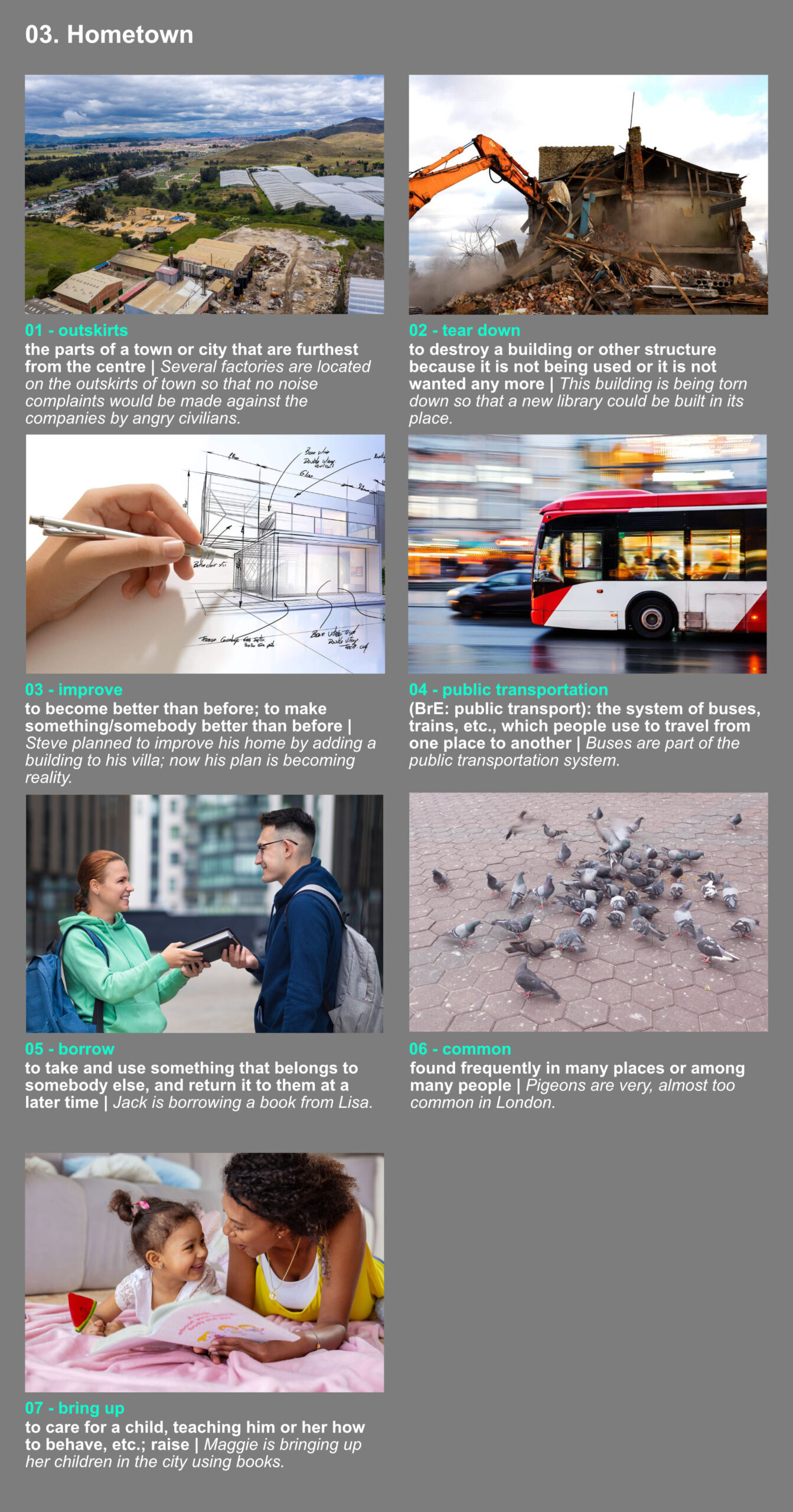
outskirts1: the parts of a town or city that are furthest from the centre | Several factories are located on the outskirts of town so that no noise complaints would be made against the companies by angry civilians.
tear down2: to destroy a building or other structure because it is not being used or it is not wanted any more | This building is being torn down so that a new library could be built in its place.
- 06 What is there for a foreigner to do or see in your hometown?
There are many things for them to do. They can visit West lake, a large lake in the centre of town that they considered to be quite pretty, or they could visit a Guazhou restaurant on the outskirts of town.
consider: to think of somebody/something in a particular way | Michael Jordan is considered to be one of the greatest basketball players to ever live.
- 07 How could your town be improved?
I’m not sure how my hometown could be improved as I haven’t been there in a long while. It was fairly good when I left.
improve3: to become better than before; to make something/somebody better than before | Steve planned to improve his home by adding a building to his villa; now his plan is becoming reality.
in a long while: a long time | I have not seen Mario in a long while.
fairly: quite but not very | Dennis thinks that the answer to the last Physics exam question is fairly obvious.
- 08 Has your hometown changed much since you were a child?
Many of the buildings in the centre were torn down and rebuilt, but I also have not been there since I was a child, so I don’t know that well.
- 09 Is there good public transportation in your hometown?
It has a very good public transportation system. There are bikes to be borrowed, and there are also buses, I believe. Taxis are also quite common.
public transportation4 (BrE: public transport): the system of buses, trains, etc., which people use to travel from one place to another | Buses are part of the public transportation system.
borrow5: to take and use something that belongs to somebody else, and return it to them at a later time | Jack is borrowing a book from Lisa.
common6: found frequently in many places or among many people | Pigeons are very, almost too common in London.
- 10 Do you think your hometown is a good place to bring up children?
I’m not familiar enough with my hometown to know whether it is or is not a good place to bring up children as my family moved away when I was 2.
bring up7: to care for a child, teaching him or her how to behave, etc.; raise | Maggie is bringing up her children in the city using books.
Where is your hometown?
My hometown is Hangzhou, a small town in China just south of the line between north and south.
Do you like your hometown?
Yes, I like my hometown quite a lot.
Do you often visit your hometown?
No, I have not been to my hometown in many years. I live in a different country now.
What is your hometown like?
It’s a smaller city by Chinese standards, more cultural than the rest of China, in my opinion and the opinion of most people there.
What is the oldest place in your hometown?
The oldest place in my hometown is probably the outskirts as the city centre has been torn down and rebuilt many times.
What is there for a foreigner to do or see in your hometown?
There are many things for them to do. They can visit West lake, a large lake in the centre of town that they considered to be quite pretty, or they could visit a Guazhou restaurant on the outskirts of town.
How could your town be improved?
I’m not sure how my hometown could be improved as I haven’t been there in a long while. It was fairly good when I left.
Has your hometown changed much since you were a child?
Many of the buildings in the centre were torn down and rebuilt, but I also have not been there since I was a child, so I don’t know that well.
Is there good public transportation in your hometown?
It has a very good public transportation system. There are bikes to be borrowed, and there are also buses, I believe. Taxis are also quite common.
Do you think your hometown is a good place to bring up children?
I’m not familiar enough with my hometown to know whether it is or is not a good place to bring up children as my family moved away when I was 2.
04 Home (steps 1, 2 and 4)
- 01 Where is your home?
My home is in a farmhouse which is on a backroad of a backroad out in the countryside but near to a city. We are across the river from a big city, so we’re close enough that we can get to it but far enough that it doesn’t bother us.
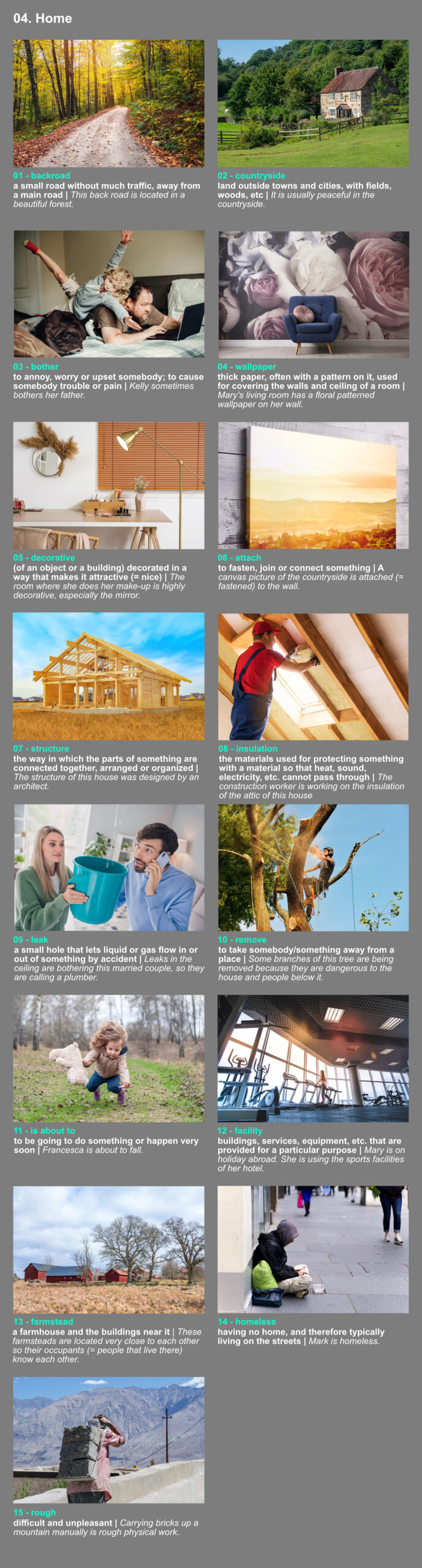
backroad1: a small road without much traffic, away from a main road | This back road is located in a beautiful forest.
countryside2: land outside towns and cities, with fields, woods, etc | It is usually peaceful in the countryside.
bother3: to annoy, worry or upset somebody; to cause somebody trouble or pain | Kelly sometimes bothers her father.
- 02 Do you live in a house or a flat?
I live in a house.
- 03 Who do you live with?
I live with my family. My father, my mother, my brother and 2 of my sisters. Sometimes my nephew lives with us as well.
nephew: the son of your brother or sister; the son of your husband’s or wife’s brother or sister | Steve has three nephews.
- 04 Are there many rooms in your home?
There are quite a few rooms in my house. It can fit a lot of people in it.
fit: to be the right size or shape for someone or something | I went shopping for shoes and tried to buy a size 10 trainer, but it didn’t fit me.
- 05 What is your favourite room?
My room is my favourite room because it is mine.
- 06 How are the walls decorated?
Most of the walls are just painted, but some have wallpaper. As for what is on the walls, some of them have decorative objects attached to them, and some of them have pictures of our relatives.
wallpaper4: thick paper, often with a pattern on it, used for covering the walls and ceiling of a room | Mary’s living room has a floral patterned wallpaper on her wall.
as for (someone/something): used to start talking about somebody/something | Everyone is going to eat in the restaurant; as for Jimmy, he has already had breakfast, so he will not be hungry or eat there
decorative5: (of an object or a building) decorated in a way that makes it attractive (= nice) | The room where she does her make-up is highly decorative, especially the mirror.
attach6: to fasten, join or connect something | A canvas picture of the countryside is attached (= fastened) to the wall.
relative: a person who is in the same family as somebody else | Tammy and Kathy are relatives; they are sisters.
- 07 What would you change about your home?
I would build the structure of the house a lot stronger. I would put better insulation in the roofs specifically, and I would stop all of the leaks and remove the large tree that is about to fall over our house. Those are the things I would change about this house.
structure7: the way in which the parts of something are connected together, arranged or organized | The structure of this house was designed by an architect.
specifically: connected with one particular thing only | Some books are specifically designed for small children: they have very colourful pictures in them and not much text.
insulation8: the materials used for protecting something with a material so that heat, sound, electricity, etc. cannot pass through | The construction worker is working on the insulation of the attic of this house.
leak9: a small hole that lets liquid or gas flow in or out of something by accident | Leaks in the ceiling are bothering this married couple, so they are calling a plumber.
remove10: to take somebody/something away from a place | Some branches of this tree are being removed because they are dangerous to the house and people below it.
is about to11: to be going to do something or happen very soon | Francesca is about to fall.
- 08 Do you plan to live there in the future?
I plan to live here for some time, but I don’t plan to live here forever. I intend to get my own house at some point.
forever: used to say that a particular situation will never change | Spring will not last forever because the seasons change.
intend: to have a plan and want to do something | Frank intends to rest (= to relax/sleep) today.
- 09 What facilities are there near your home?
There are not really any facilities anywhere near us, as we live pretty much away from everything. There is maybe a 20-minute walk to the nearest grocery store, but there is a sort of a grocery store about a 20-minute walk down the road.
facility12: buildings, services, equipment, etc. that are provided for a particular purpose | Mary is on holiday abroad. She is using the sports facilities of her hotel.
pretty much: very much | Jack pretty much loves chocolate cakes.
a sort of: used for describing something in a not very exact way | “What colour was his shirt?” “It was a sort of dark orange.”
down the road: further along this same road | Our dog likes to run down the road when it manages to jump over our gate.
- 10 What is your neighbourhood like?
I live on a farmstead, so we don’t really have a neighbourhood.
farmstead13: a farmhouse and the buildings near it | These farmsteads are located very close to each other so their occupants (= people that live there) know each other.
- 11 Do most people live in houses in your country?
Well, we do have a significant homeless population in my country. Most people live in houses, and unfortunately, the people who do not live in houses have a very rough time of things, given this six-month winter here.
significant: large or important enough to have an effect or to be noticed | We had a significant amount of rain this spring, so we will harvest a good bunch of vegetables soon.
homeless14: having no home, and therefore typically living on the streets | Mark is homeless.
rough15: difficult and unpleasant | Carrying bricks up a mountain manually is rough physical work.
given: when you consider (= carefully think about) something | Given that Fred is a great tennis player, the 15-year-olds gave him a run for his money (= made him try very hard in order to beat them).
Where is your home?
My home is in a farmhouse which is on a backroad of a backroad out in the countryside but near to a city. We are across the river from a big city, so we’re close enough that we can get to it but far enough that it doesn’t bother us.
Do you live in a house or a flat?
I live in a house.
Who do you live with?
I live with my family. My father, my mother, my brother and 2 of my sisters. Sometimes my nephew lives with us as well.
Are there many rooms in your home?
There are quite a few rooms in my house. It can fit a lot of people in it.
What is your favourite room?
My room is my favourite room because it is mine.
How are the walls decorated?
Most of the walls are just painted, but some have wallpaper. As for what is on the walls, some of them have decorative objects attached to them, and some of them have pictures of our relatives.
What would you change about your home?
I would build the structure of the house a lot stronger. I would put better insulation in the roofs specifically, and I would stop all of the leaks and remove the large tree that is about to fall over our house. Those are the things I would change about this house.
Do you plan to live there in the future?
I plan to live here for some time, but I don’t plan to live here forever. I intend to get my own house at some point.
What facilities are there near your home?
There are not really any facilities anywhere near us, as we live pretty much away from everything. There is maybe a 20-minute walk to the nearest grocery store, but there is a sort of a grocery store about a 20-minute walk down the road.
What is your neighbourhood like?
I live on a farmstead, so we don’t really have a neighbourhood.
Do most people live in houses in your country?
Well, we do have a significant homeless population in my country. Most people live in houses, and unfortunately, the people who do not live in houses have a very rough time of things, given this six-month winter here.
05 Art (steps 1, 2 and 4)
- 01 Are you good at art?
I’ve tried many types of art, and I’m not particularly good at any of them.
particularly: more than usual or more than others; very | Kathy is particularly good at drawing realistic portraits of people.
- 02 Did you learn art at school when you were a child?
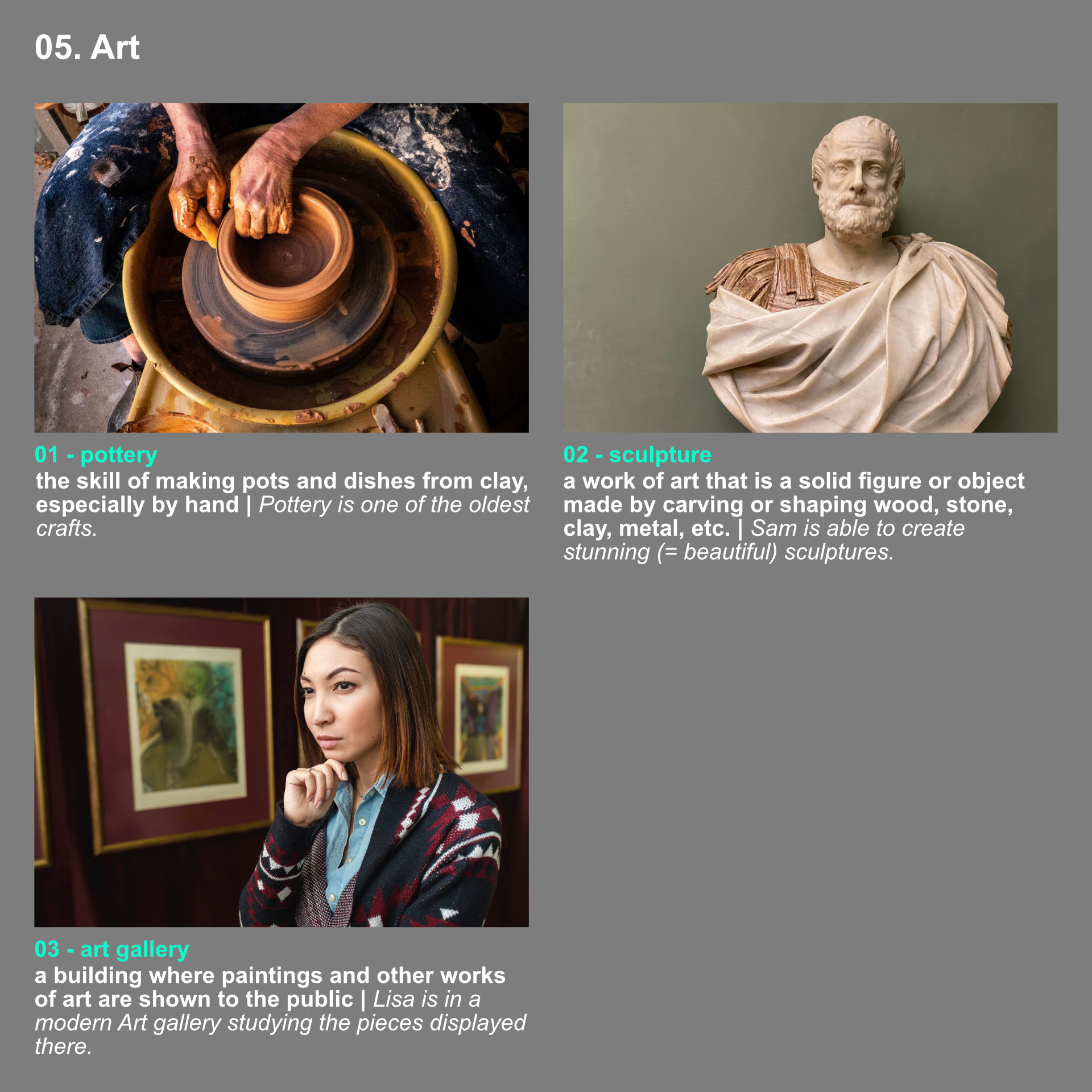
Yes, I studied art in high school. I studied painting and pottery.
pottery1: the skill of making pots and dishes from clay, especially by hand | Pottery is one of the oldest crafts.
- 03 What kind of art do you like?
I like very detailed paintings and sculptures that are realistic.
detailed: giving many details and a lot of information | The report provided detailed examination of the problem from multiple different perspectives.
sculpture2: a work of art that is a solid figure or object made by carving or shaping wood, stone, clay, metal, etc. | Sam is able to create stunning (= beautiful) sculptures.
- 04 Is art popular in your country?
In the cities, some art is popular. Everywhere else, it’s not very popular.
- 05 Have you ever been to an art gallery?
The only art gallery I’ve ever been to has been one in the local airport.
art gallery3: a building where paintings and other works of art are shown to the public | Lisa is in a modern Art gallery studying the pieces displayed there.
- 06 Do you think children can benefit from going to art galleries?
I don’t think children will benefit from going to art galleries because they’ll just get bored and not actually get anything out of it.
benefit: to be useful to somebody or improve their life (= make their life better/more comfortable) in some way | The council is creating new homes which should benefit poor citizens.
get something out of it: to enjoy something or think something is useful | I attended the concert, but I didn’t get anything out of it.
Are you good at art?
I’ve tried many types of art, and I’m not particularly good at any of them.
Did you learn art at school when you were a child?
Yes, I studied art in high school. I studied painting and pottery.
What kind of art do you like?
I like very detailed paintings and sculptures that are realistic.
Is art popular in your country?
In the cities, some art is popular. Everywhere else, it’s not very popular.
Have you ever been to an art gallery?
The only art gallery I’ve ever been to has been one in the local airport.
Do you think children can benefit from going to art galleries?
I don’t think children will benefit from going to art galleries because they’ll just get bored and not actually get anything out of it.
06 Bicycles (steps 1, 2 and 4)
- 01 Do you have a bike?
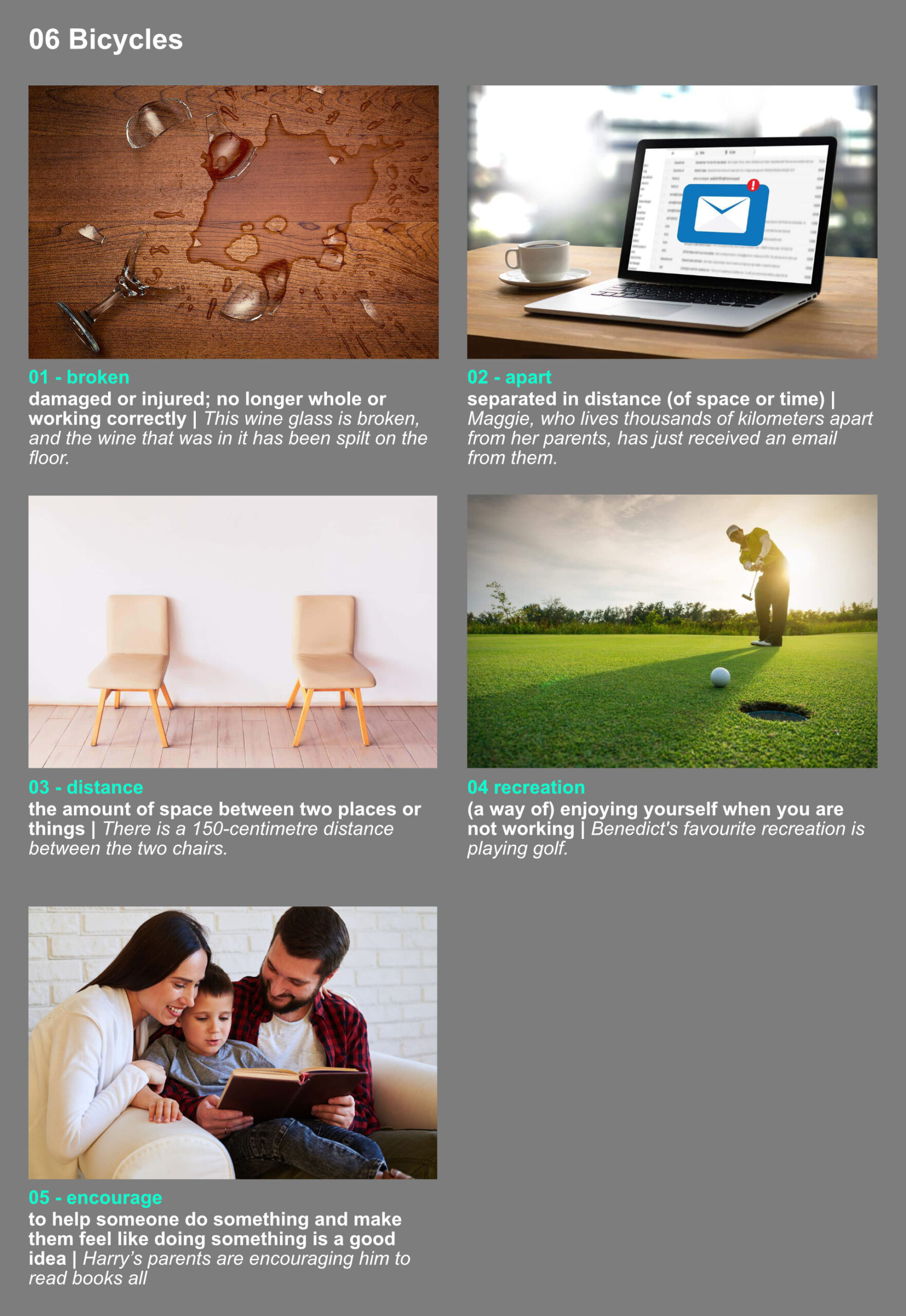
I do have a bike, but it’s broken, so I don’t use it much.
broken1: damaged or injured; no longer whole or working correctly | This wine glass is broken, and the wine that was in it has been spilt on the floor.
- 02 How often do you use it?
I don’t use my bike much because it’s broken.
- 03 How old were you when you learned to ride a bike?
I was around ten when I learned how to ride a bicycle.
- 04 Do many people in your country use bicycles?
Most people in my country do not use bicycles because everything is too far apart; they wouldn’t be able to get anywhere. They only use them when they’re going short distances around their house, usually for recreation.
apart2 :separated in distance (of space or time) | Maggie, who lives thousands of kilometers apart from her parents, has just received an email from them.
distance33: the amount of space between two places or things | There is a 150-centimetre distance between the two chairs.
recreation4: (a way of) enjoying yourself when you are not working | Benedict’s favourite recreation is playing golf.
- 05 Do you think using bicycles should be encouraged?
I don’t think using bicycles should be encouraged because I think people will use them however much they are needed.
encourage5: to help someone do something and make them feel like doing something is a good idea | Harry’s parents are encouraging him to read books all.
Do you have a bike?
I do have a bike, but it’s broken, so I don’t use it much.
How often do you use it?
I don’t use my bike much because it’s broken.
How old were you when you learned to ride a bike?
I was around ten when I learned how to ride a bicycle.
Do many people in your country use bicycles?
Most people in my country do not use bicycles because everything is too far apart; they wouldn’t be able to get anywhere. They only use them when they’re going short distances around their house, usually for recreation.
Do you think using bicycles should be encouraged?
I don’t think using bicycles should be encouraged because I think people will use them however much they are needed.
07 Birthdays (steps 1, 2 and 4)
- 01 Do you usually celebrate your birthdays?
My family generally celebrates our birthdays.
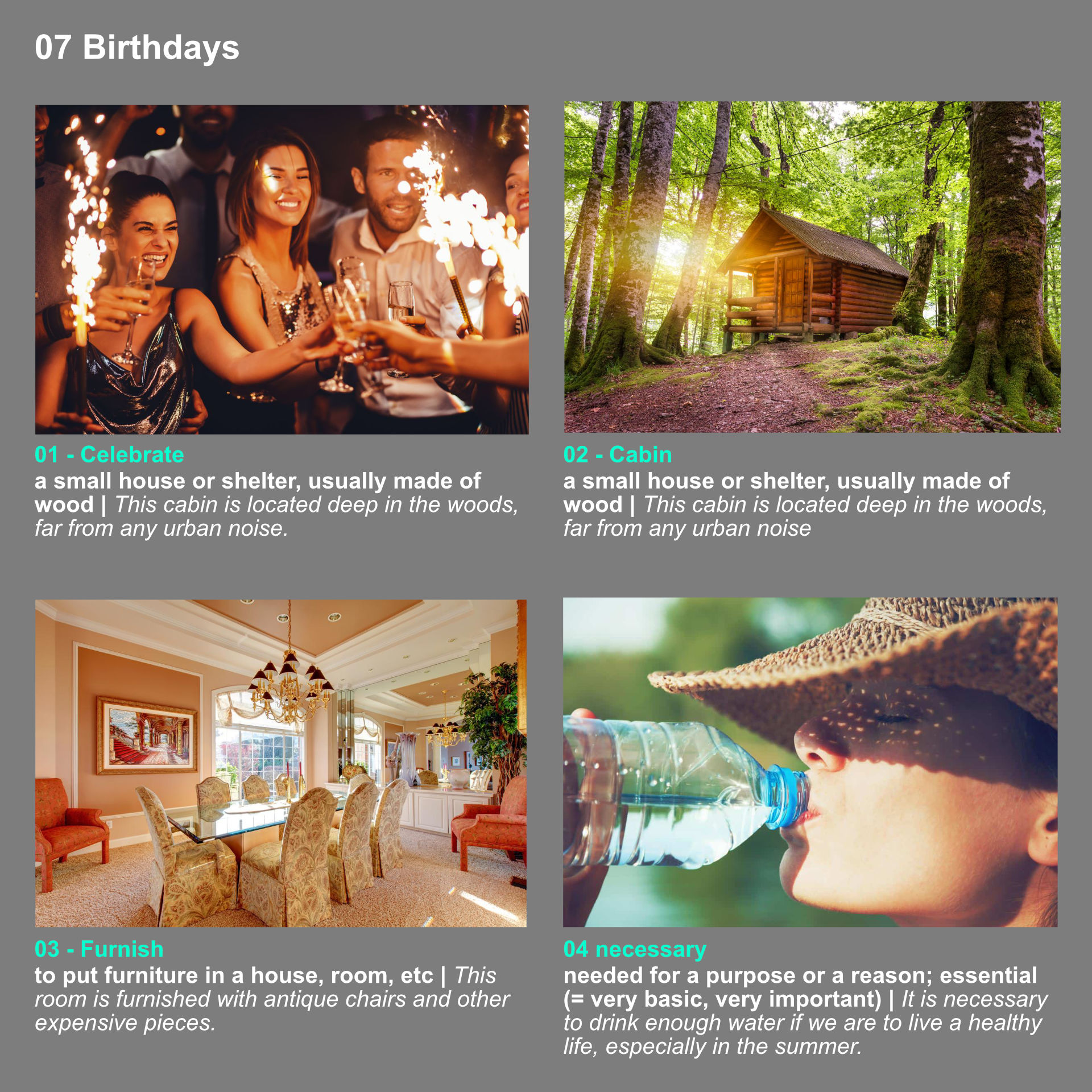
celebrate1: to show that a day or an event is important by doing something special on it | These friends are celebrating New Years Eve (= Dec 31st) together.
- 02 How did you celebrate your last birthday?
I don’t remember much of my last birthday, but I know that I built a sauna cabin and furnished it that day, and I know that my family ate a lot of food. Other than that, I can’t remember anything.
cabin2: a small house or shelter, usually made of wood | This cabin is located deep in the woods, far from any urban noise.
furnish3: to put furniture in a house, room, etc | This room is furnished with antique chairs and other expensive pieces.
other than that: not another thing | I have brought some pencils with me to do the exam with, but other than that, I have nothing else here (i.e. I have no pen, calculator,rubber or ruler with me).
- 03 Which birthdays are considered important in your country?
In my country, the 18th and 21st birthdays are the most important because, upon reaching these birthdays, you gain more privileges as a citizen.
upon: when/after | Upon your arrival (= when you arrive), please turn your phone off and sit down in one of these chairs.
gain: to get something good or helpful from something else | Steve gained at least 2 hours by replacing his old computer to a modern one. (= He finished the task 2 hours faster.)
privilege: a special right or advantage that a particular person or group of people has | The access to clean water should be a fundamental right and not a privilege.
- 04 Do you think children should celebrate their birthdays with a party?
I think that doing so is nice if it is possible, but it’s not necessary by any means.
necessary4: needed for a purpose or a reason; essential (= very basic, very important) | It is necessary to drink enough water if we are to live a healthy life, especially in the summer.
by any means: in any way | She isn’t happy with his cooking, not by any means; he always burns the food.
Do you usually celebrate your birthdays?
My family generally celebrates our birthdays.
How did you celebrate your last birthday?
I don’t remember much of my last birthday, but I know that I built a sauna cabin and furnished it that day, and I know that my family ate a lot of food. Other than that, I can’t remember anything.
Which birthdays are considered important in your country?
In my country, the 18th and 21st birthdays are the most important because, upon reaching these birthdays, you gain more privileges as a citizen.
Do you think children should celebrate their birthdays with a party?
I think that doing so is nice if it is possible, but it’s not necessary by any means.
08 Childhood (steps 1, 2 and 4)
- 01 Did you enjoy your childhood?
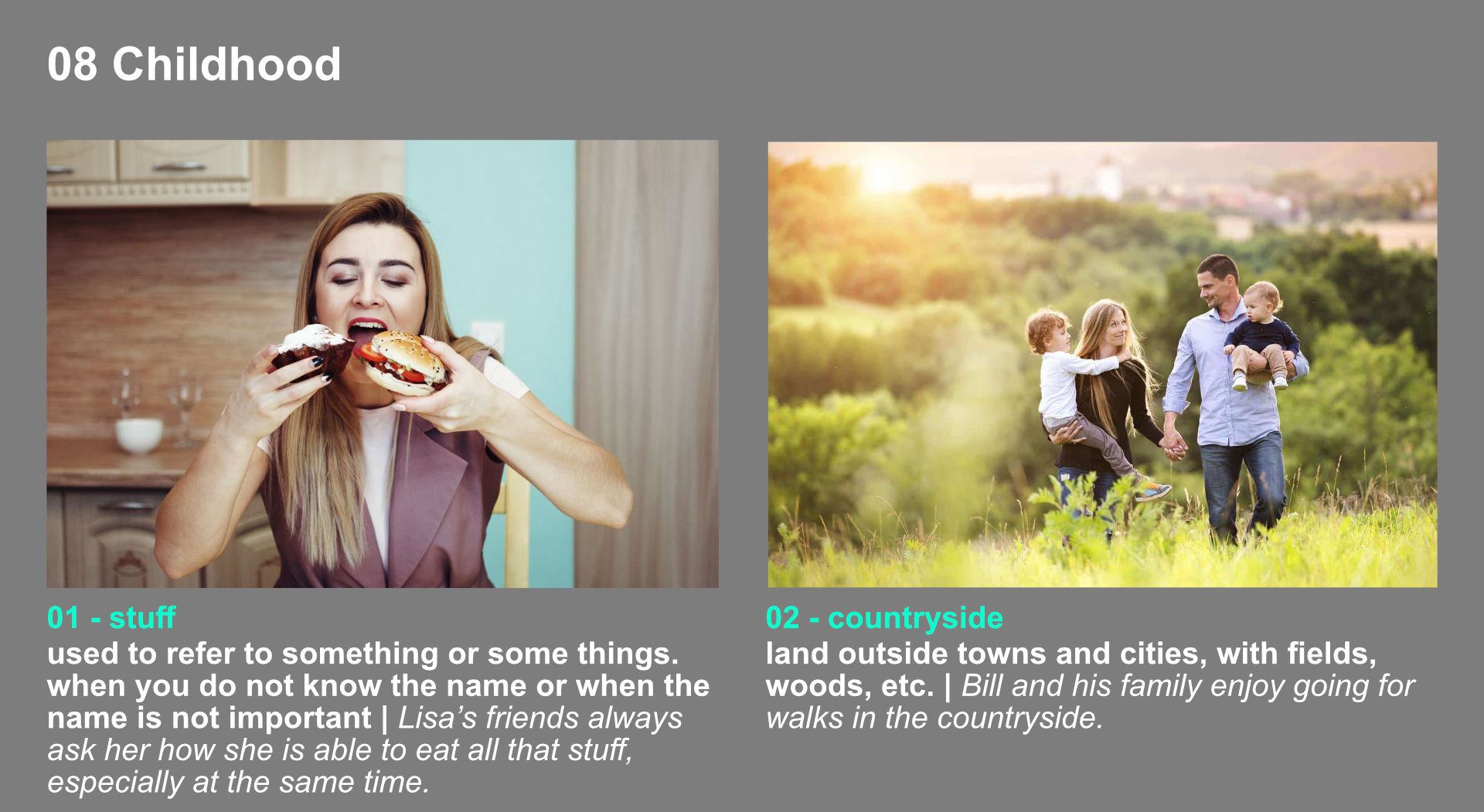
Yes, I enjoyed my childhood quite a lot. I had a lot of friends, (and) I learned a lot of *stuff, and I did a lot of running around.
stuff1: used to refer to something or some things. when you do not know the name or when the name is not important | Lisa’s friends always ask her how she is able to eat all that stuff, especially at the same time.
- 02 What is your first memory of your childhood?
My first memory of my childhood is of my father talking to me.
- 03 Did you have a lot of friends as a child?
Yes, I had a lot of friends when I was a child. I was friends with most of the people in the area.
- 04 What did you enjoy doing as a child?
I enjoyed running as fast as I could and jumping off of tall objects.
- 05 Do you think it’s better for children to grow up in the city or in the countryside?
I think that both growing up in the city and in the countryside teach different lessons to children and create very different people. I think that people growing up in the city and in the countryside are both important.
countryside2: land outside towns and cities, with fields, woods, etc. | Bill and his family enjoy going for walks in the countryside.
Did you enjoy your childhood?
Yes, I enjoyed my childhood quite a lot. I had a lot of friends, (and) I learned a lot of *stuff, and I did a lot of running around.
What is your first memory of your childhood?
My first memory of my childhood is of my father talking to me.
Did you have a lot of friends as a child?
Yes, I had a lot of friends when I was a child. I was friends with most of the people in the area.
What did you enjoy doing as a child?
I enjoyed running as fast as I could and jumping off of tall objects.
Do you think it’s better for children to grow up in the city or in the countryside?
I think that both growing up in the city and in the countryside teach different lessons to children and create very different people. I think that people growing up in the city and in the countryside are both important.
09 Clothes (steps 1, 2 and 4)
- 01 Are clothes important to you?
Clothes are sometimes important to me, but they are especially important to me when winter comes.
especially: shows that something is more common or important compared to others | It takes very long to get to the other side of our city, especially if there is a traffic jam (= in traffic jams it is even longer).
- 02 What kind of clothes do you usually wear?
I usually wear a tough pair of trousers and some sort of a shirt, usually a tartan-coloured one.
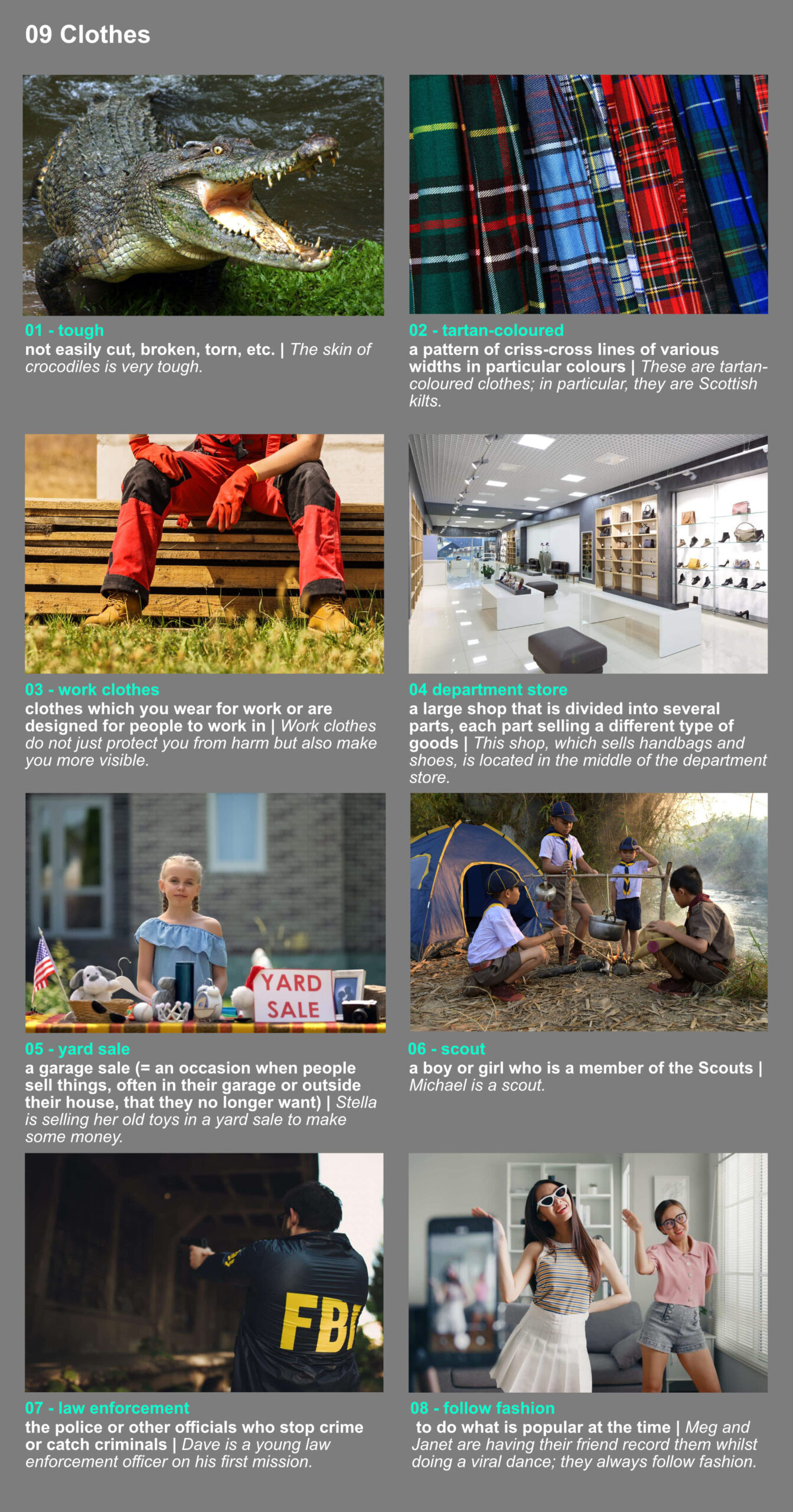
tough1: not easily cut, broken, torn, etc. | The skin of crocodiles is very tough.
some sort of: used for describing something in a not very exact way | Harry was running around like some sort of an excited animal when he received his present.
tartan-coloured2: a pattern of criss-cross lines of various widths in particular colours | These are tartan-coloured clothes; in particular, they are Scottish kilts.
- 03 Do you ever wear the traditional clothes of your country?
Yes, I sometimes wear the traditional clothes of my country. Our traditional clothes are mainly just tough work clothes.
traditional: things that a group of people have always done or believed in the same way for a very long time | In the USA, the traditional meal on Thanksgiving Day is turkey.
work clothes3: clothes which you wear for work or are designed for people to work in | Work clothes do not just protect you from harm but also make you more visible.
- 04 Where do you usually buy your clothes?
I usually buy my clothes at either a department store or a yard sale.
department store4: a large shop that is divided into several parts, each part selling a different type of goods | This shop, which sells handbags and shoes, is located in the middle of the department store.
yard sale5: a garage sale (= an occasion when people sell things, often in their garage or outside their house, that they no longer want) | Stella is selling her old toys in a yard sale to make some money.
- 05 Have you ever worn a uniform?
I’ve worn several uniforms in my time. I’ve worn the uniform of the scouts, and I’ve worn the uniform of a law enforcement class that I studied at.
the Scouts: an organization originally for boys, which trains young people in practical skills and does a lot of activities with them, for example camping.
scout6: a boy or girl who is a member of the Scouts | Michael is a scout.
law enforcement7: the police or other officials who stop crime or catch criminals | Dave is a young law enforcement officer on his first mission.
Do most people in your country follow fashion?
Sometimes they follow fashion, sometimes they don’t. It largely depends on whether they live in the city or out of the city.
follow fashion8: to do what is popular at the time | Meg and Janet are having their friend record them whilst doing a viral dance; they always follow fashion.
largely: to a great extent; mostly or mainly | Her fame (= being famous) is largely a result of her extraordinary talent as an actress.
primarily: mainly | The problem is not primarily financial. We also have to audit our management system.
depend on sth: be affected by something | Whether or not I am going out tonight depends on the weather. If it’s dry, I will go, but if it rains, I’ll stay at home.
Are clothes important to you?
Clothes are sometimes important to me, but they are especially important to me when winter comes.
What kind of clothes do you usually wear?
I usually wear a tough pair of trousers and some sort of a shirt, usually a tartan-coloured one.
Do you ever wear the traditional clothes of your country?
Yes, I sometimes wear the traditional clothes of my country. Our traditional clothes are mainly just tough work clothes.
Where do you usually buy your clothes?
I usually buy my clothes at either a department store or a yard sale.
Have you ever worn a uniform?
I’ve worn several uniforms in my time. I’ve worn the uniform of the scouts, and I’ve worn the uniform of a law enforcement class that I studied at.
10 Computers (steps 1, 2 and 4)
- 01 Do you often use a computer?
Yes, I use a computer quite often.
- 02 How do you usually get online?
I usually use an Internet browser.
- 03 Do you prefer desktops or laptops?
I usually prefer desktops because I don’t need to move them around that much.
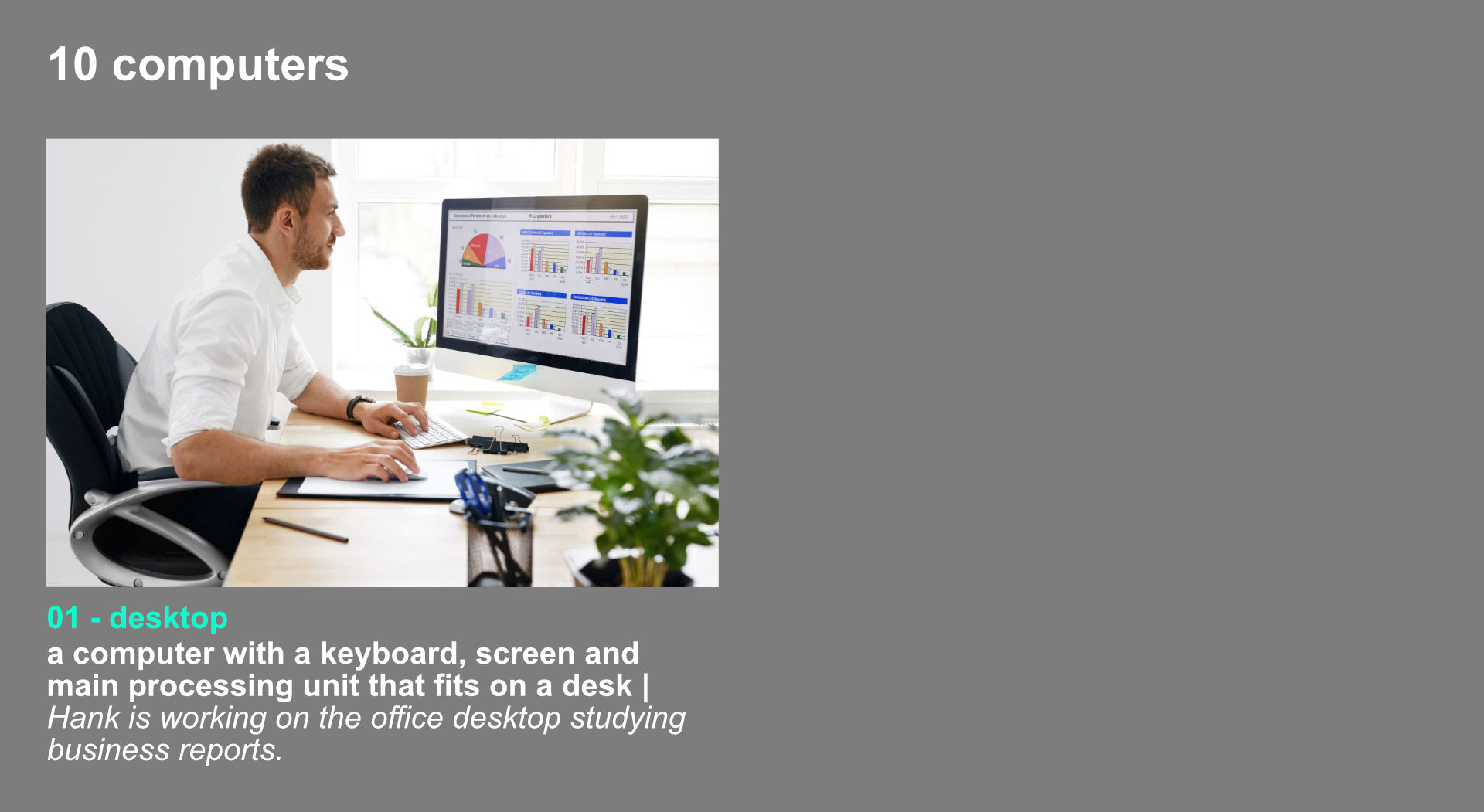
desktop1: a computer with a keyboard, screen and main processing unit that fits on a desk | Hank is working on the office desktop studying business reports.
- 04 What do you use your computer for?
I use my computer for work and to communicate with friends and to learn things.
- 05 Do you think it’s important to learn how to use a computer?
I do not think it’s important to learn how to use a computer. I haven’t had one for a very long time, and I don’t think they’re strictly necessary.
strictly: exactly; absolutely | Drinking alcohol is strictly forbidden on the train and the train station.
necessary: that is really needed for a reason or to do sometnhing; essential | Maggie had the knowledge necessary to answer all the questions in the quiz.
Do you often use a computer?
Yes, I use a computer quite often.
How do you usually get online?
I usually use an Internet browser.
Do you prefer desktops or laptops?
I usually prefer desktops because I don’t need to move them around that much.
What do you use your computer for?
I use my computer for work and to communicate with friends and to learn things.
Do you think it’s important to learn how to use a computer?
I do not think it’s important to learn how to use a computer. I haven’t had one for a very long time, and I don’t think they’re strictly necessary.
11 Daily Routine (steps 1, 2 and 4)
- 01 When do you usually get up in the morning?
It depends on how late I stayed up the night before. If I went to sleep at a proper time, then I usually get up at 4:00 in the morning. If I did not though, then I usually get up around 9:00.
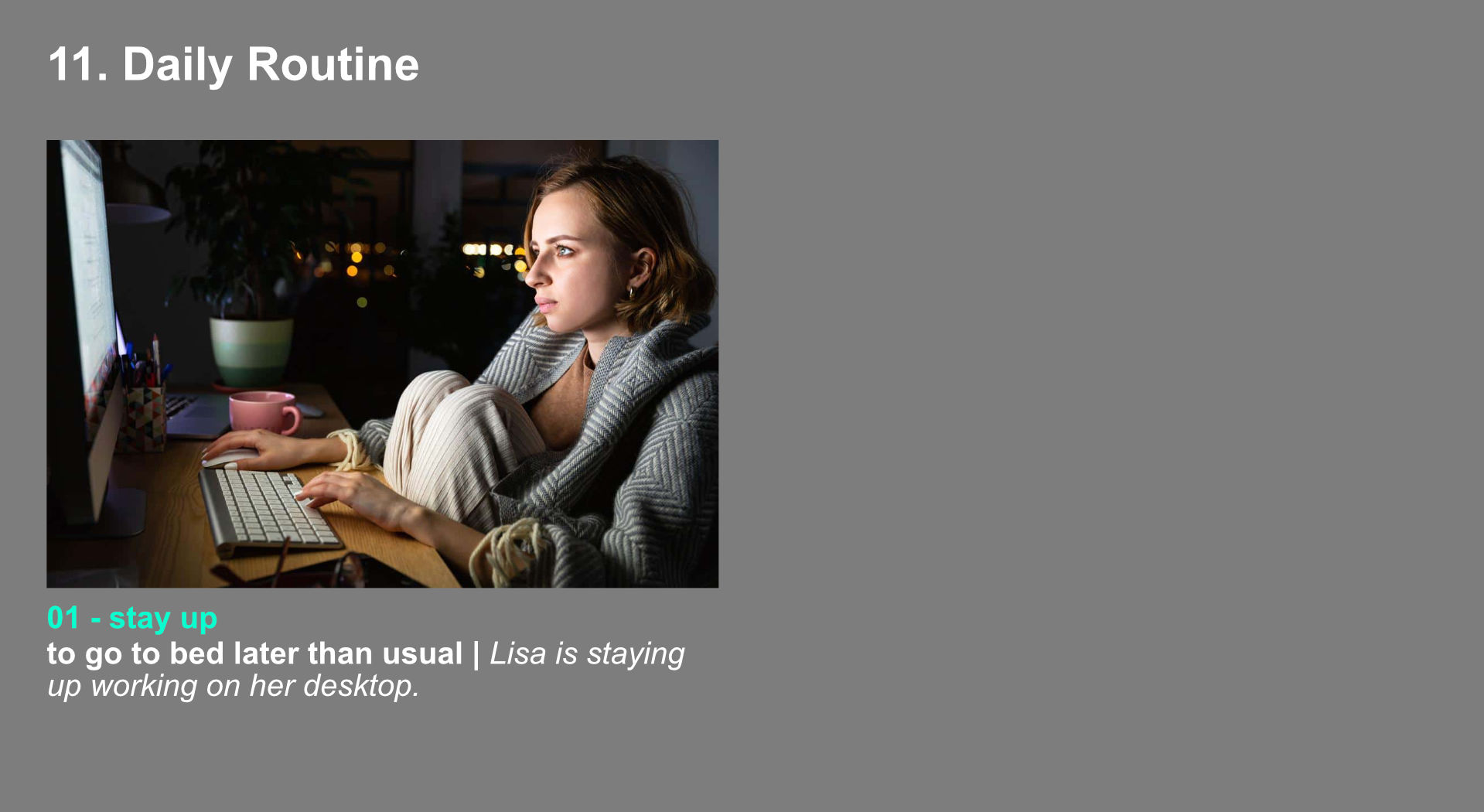
stay up1: to go to bed later than usual | Lisa is staying up working on her desktop.
proper: right, appropriate or correct | We should have a proper discussion before making a big decision about the future of the company.
- 02 Do you usually have the same routine every day?
For a long time I did, but more recently I have gotten out of my routine.
recently: not long ago | I have recently gotten a new car as the old one stopped working.
- 03 What is your daily routine?
I get up, drink some water, put some clothes on, eat breakfast and do whatever work is needed to be done that day.
need: must have or really want something or someone because they are very important or essential | “Frank, don’t go too far away. I’m going to need you in the shop. A bunch of customers might come in at any moment.”
- 04 Do you ever change your routine?
I’ve changed my routine a number of times, though I’m always trying to get back to the same one that I had before.
- 05 Is your routine the same as it was when you were a child?
No, my routine is very different from when I was a child because when I was a child, I did very different things.
- 06 Do you think it is important to have a daily routine?
I think it is very important to have a daily routine because otherwise you get off track and things start going sideways.
otherwise: used to state (= tell) what would happen if things were different or if something didn’t happen; or else | Remember to make your breakfast for tomorrow tonight, otherwise you will go to work hungry.
get off track: not doing what you’re supposed to do (= not doing what you should do) | Focus on the task today, otherwise you will get off track and not finish work on time.
going sideways: something didn’t go as planned or something went wrong | It was supposed to be a simple business deal but things went sideways. (= The deal failed.)
When do you usually get up in the morning?
It depends on how late I stayed up the night before. If I went to sleep at a proper time, then I usually get up at 4:00 in the morning. If I did not though, then I usually get up around 9:00.
Do you usually have the same routine every day?
For a long time I did, but more recently I have gotten out of my routine.
What is your daily routine?
I get up, drink some water, put some clothes on, eat breakfast and do whatever work is needed to be done that day.
Do you ever change your routine?
I’ve changed my routine a number of times, though I’m always trying to get back to the same one that I had before.
Is your routine the same as it was when you were a child?
No, my routine is very different from when I was a child because when I was a child, I did very different things.
Do you think it is important to have a daily routine?
I think it is very important to have a daily routine because otherwise you get off track and things start going sideways.
12 Dictionaries (steps 1, 2 and 4)
- 01 Do you often use a dictionary?
I use dictionaries quite often for a number of things, usually just looking up things in English. However, since I speak several other languages regularly, I also use bilingual dictionaries quite often.
however: used to introduce a statement that contrasts with something that has just been said; but | Dennis is not a professional football player; however, he does have good skills in the sport.
bilingual: able to use two languages equally well | Stephen is actually bilingual as he lived in another country for some years and learnt his second language, French, there.
- 02 What do you use dictionaries for?
I use dictionaries for looking up the meanings of words.
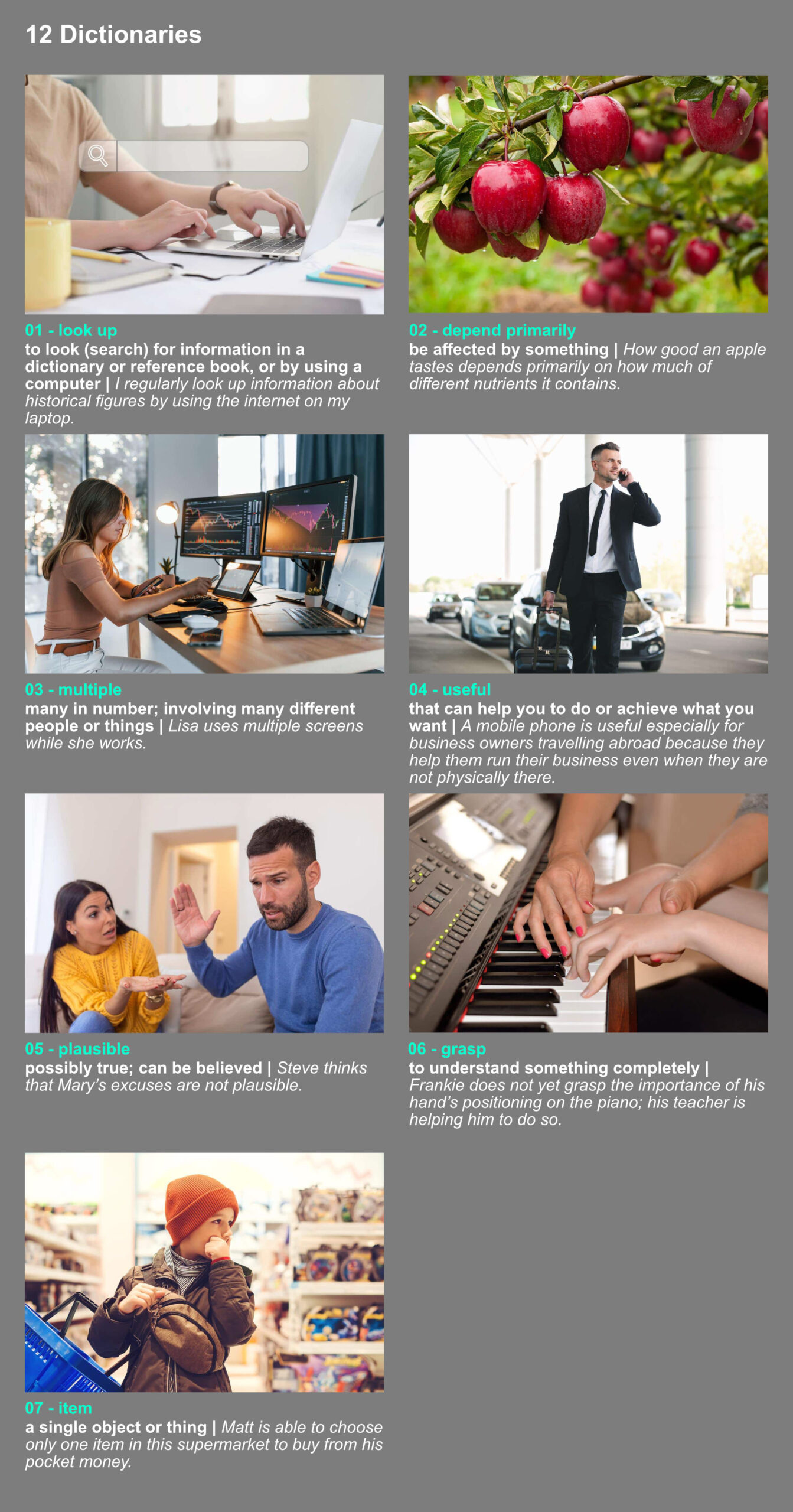
look up1: to look (search) for information in a dictionary or reference book, or by using a computer | I regularly look up information about historical figures by using the internet on my laptop.
- 03 What kinds of dictionaries do you think are most useful?
That would depend primarily on what you’re doing with it. If all you’re doing is communicating in one language, then a mono-lingual dictionary is all you need, but if you communicate in *multiple languages, then bilingual dictionaries are more useful.
primarily: mainly | The problem is not primarily financial. We also have to audit our management system.
depend on sth2: be affected by something | How good an apple tastes depends primarily on how much of different nutrients it contains.
mono-lingual: speaking or using only one language | Dan is monolingual; he only speaks French and never leaves the country.
multiple3: many in number; involving many different people or things | Lisa uses multiple screens as she works.
- 04 Do you think dictionaries are useful for learning a language?
I think dictionaries are useful for learning a language, but I do not think that one can learn a language only from dictionaries. Maybe, it’s plausible, but harder than it needs to be. Dictionaries are useful once you already have a basic grasp of a language and want to expand your vocabulary, but other than that, they’re not the most useful item for learning a language.
useful4: that can help you to do or achieve what you want | A mobile phone is useful especially for business owners travelling abroad because they help them run their business even when they are not physically there.
one: used to mean ‘people in general’ or ‘I’, when the speaker is referring to himself or herself | One should never stop growing and learning.
plausible5: possibly true; can be believed | Steve thinks that Mary’s excuses are not plausible.
grasp6: to understand something completely | Frankie does not yet grasp the importance of his hand’s positioning on the piano; his teacher is helping him to do so.
other than that: except for something; besides something | The colour of the phone matters as a fashion statement, but other than that it is generally not very important.
item7: a single object or thing | Matt is able to choose only one item in this supermarket to buy from his pocket money.
- 05 What kind of information can you find in a dictionary?
A dictionary is used to find the meanings of words. However, some specialised dictionaries are made to allow you to change words from one language to another (and) find meanings between languages.
specialised: made or used for one specific job or thing, not for everything | Doctors usually need specialised equipment when they perform surgeries.
allow: to let somebody/something do something; to let something happen or be done | Electric scooters allow people that live in cities to travel greener. (= With the help of electric scooters they can travel greener.)
That was a really weird way of saying it, but it was technically correct. So I’m going to keep it.
Do you often use a dictionary?
I use dictionaries quite often for a number of things, usually just looking up things in English. However, since I speak several other languages regularly, I also use bilingual dictionaries quite often.
What do you use dictionaries for?
I use dictionaries for looking up the meanings of words.
What kinds of dictionaries do you think are most useful?
That would depend primarily on what you’re doing with it. If all you’re doing is communicating in one language, then a mono-lingual dictionary is all you need, but if you communicate in *multiple languages, then bilingual dictionaries are more useful.
Do you think dictionaries are useful for learning a language?
I think dictionaries are useful for learning a language, but I do not think that one can learn a language only from dictionaries. Maybe, it’s plausible, but harder than it needs to be. Dictionaries are useful once you already have a basic grasp of a language and want to expand your vocabulary, but other than that, they’re not the most useful item for learning a language.
What kind of information can you find in a dictionary?
A dictionary is used to find the meanings of words. However, some specialised dictionaries are made to allow you to change words from one language to another (and) find meanings between languages.
That was a really weird way of saying it, but it was technically correct. So I’m going to keep it.