
Modul 6: Oral Exams B2/C1: Part 2 Set 3. Topics 15-19
Keegan (Maine, USA) 6db hétköznapi, mégis komplex témában mondja el gondolatait. Ezek a témák a nyelvvizsgák tipikus “nagy témái”. Az IELTS nyelvvizsgán 5 percen át kell tudnod beszélni a témáról. Keegan ezt helyenként átlépi, de mivel a tartalom nyelvtanulói szempontból is értékes, nem beszélve az amerikai kultúrával, élettel kapcsolatos sok-sok érdekes információval, így a tananyagban az 5 percet liberálisan kezeltük.
Fontos, hogy a kézikönyvekben leírtak szerint dolgozz az anyagon. A videók össz hossza kb. 28 perc.
15 Old people (steps 1, 2 and 4)
Describe an old person you know. You should say:
who this person is;
how old he/she is;
what this person is like;
and explain why you like this person.
01
My father is quite an amazing man. Now, I know a lot of people would say that about their fathers, and it’s usually true. Your father has been around for longer than you have, so he has more of a chance to do interesting things then you have. So, unless you are a thoroughly extraordinary person, your father is probably very incredible, especially when compared to you.
quite: to a great degree; very | Jane is able to play the piano quite well because she has had a lot of practice with it.
amazing1: very impressive; excellent | Lucy was ststanding still and watching what she thought was an amazing painting for an hour because she is passionate about art (= she loves art so much).
around2: present in a place; available | Although there is a turned-on laptop on the table, there is no one around in the living room at the moment.
thoroughly: very much; completely | Steven finished reading the newest book by his favourite author, but he is still thoroughly confused about the message of the book.
extraordinary3: not normal or ordinary; greater or better than usual | Frank thinks that his friends climbing a mountain is an extraordinary achievement.
incredible4: extremely good; amazing | Nick found the experience of being able to feed a kangaroo in a zoo incredible.
compare5: to examine people or things to see how they are similar and how they are different | Stella is comparing two light bulbs because she is looking for the best one for her baby’s room.
02
My Father has had 70 years, nearly, to rack up achievements. However, he’s chosen to do something even more extraordinary than to do that.
rack up6: to collect something, such as profits or losses in a business, or points in a competition | After some changes to the business strategy, Harry’s business has been racking up profits.
achievement7: a thing that somebody has done successfully, especially using their own effort and skill | Rosa’s research into biochemistry is about to lead to a great medical breakthrough; this is going to be one of the biggest achievements of her field in recent years.
03
He is a thoroughly extraordinary man. He has lived in most of the countries in East-Asia, he has travelled all over the world, he has worked dozens of jobs, and yet he has always been very quiet and humble about it.
all over the world8: everywhere on earth | One of the aims of the United Nations (UN) is to achieve internet connectivity all over the world by 2030.
and yet: in spite of something previously mentioned; but | Frank said he hated watching TV, and yet I heard he watched TV all through Saturday morning.
humble: showing you do not think that you are as important as other people; modest | Only a humble person can learn from their own mistakes.
04
When he was young he went to trade school to learn to be a television repairman. He wanted to do this because he wanted to get into tech, into working with it, maybe even designing it; not just fixing it and not just televisions, he wanted to work on all kinds of stuff. So he chose television repair school. Unfortunately, television repair school was not what he thought it would be. It was actually just teaching him how to be a television repairman and nothing else.
repairman: a person whose job is to repair things | Steve works part-time both as a repairman and as a musician.
05
So he did a number of things. In fact, he was one of the first people to get into private computers, and he would buy them cheaply, fix them, and sell them to people, which was very cool. He also worked for the telephone company, and he had a pair of hooks and he would climb the telephone poles to work on them. Very cool. Eventually, though, he left his home country of Kentucky and went to many, many places.
in fact: actually | I heard that Stella is in fact a millionaire now; she has won the lottery.
would: used to | As a kid, Frank would spend a large part of his afternoons in his huge garden practising baseball with his friends.
a pair of hooks9: two hooks with a spring snap in their ends to prevent the accidental unhooking of a rope, cord, or other target line | Michael uses a pair of hooks similar to these ones when he climbs in order to ensure his safety.
telephone pole10 (BrE- telegraph pole): a tall, straight piece of wood used for carrying phone or telegraph wires high above the ground | These telephone poles can work even in extreme weather conditions.
eventually: at the end of a period of time or a series of events | The bus eventually arrived, but it was half an hour late because it had got stuck in heavy traffic in the city.
06
Now, I am the youngest son, I have not heard all of the stories of him, but of the ones I have heard, I have heard enough. He lived in Australia for a time; he also spent a lot of time in Indonesia, and he speaks the language, or he certainly did before; he was a missionary– he went all over. All over East-Asia, specifically. He’s been to Malaysia, Indonesia, Singapore, China, Australia– if I thought more I could probably think of more that he’s been to. Thailand, he’s been to Thailand.
certainly: without doubt; definitely | Nancy certainly hopes to see her distant relatives from Sweden again; she always talks about how much she misses them when they are not around.
missionary: a person who is sent to a foreign country to teach people about religion, especially Christianity | Frank does a lot of missionary work in Thailand because he is passionate about it.
specifically: connected with or intended for one particular thing only | The history lessons taught by Mr Smith covered World War 2, specifically.
07
My father was a missionary, and as such he had to learn many different skills. He had started out with trying to learn tech skills. He has, in his time, built entire houses almost entirely by himself, just on his own. He’s a carpenter, he’s a framer, he’s a plumber, he’s an electrician; he can do all these different jobs. He was also very very good at acquiring food. So, when he was in Thailand, his job was to go around and ask for donations, and he would go to businesses and various places to do this, and he was very good at it. He was very good at persuading people to help. In fact, he got so much food, one time he asked for donations and someone gave him an entire tuna. A tuna is a big fish. They gave him an entire, whole tuna.
in his/her time: when one was younger; in one’s younger days | Stella, who is now 86, has travelled the world many times in her time.
entire: including everything, everyone or every part, whole | When the teacher entered his class to teach music, he was happy to see that the entire class was sitting quietly.
carpenter11: a person whose job is making and repairing wooden objects and structures | Harry is an experienced carpenter who is making a wooden chair for a client that appreciates (= that is grateful for) quality work.
plumber12: a person whose job is to fit and repair things such as water pipes, toilets, etc. | Dan, who works part-time as a plumber, was called in to fix the broken sink.
electrician13: a person whose job is to connect, repair, etc. electrical equipment | The family had to call an electrician to their home because the electricity in their entire house had got cut off (=stopped working).
acquire: to obtain (= to have or get) something by buying or being given | Stella acquired land in two foreign countries so that she could build hotels in those places.
various14: several different | The white T-shirt came in various sizes in the supermarket, so Mark bought three of these for his children for various reasons, one of which was that they were cheap.
persuade: to make somebody do something by giving them good reasons for doing it | Janet managed to persuade her friends to go to the cinema wearing similar-coloured clothing. She thought it would be easier to find each other in the mall, and it would be quite funny too.
tuna15: a large sea fish that is used for food | These are giant tuna swimming in the ocean.
08
On one occasion, he persuaded a pizza restaurant to give us a large amount of pizza – this was before I was born, by the way. We had so much pizza and we had so much food that we delivered it to all the missionaries in Thailand. So my father, who, now seems, anyone who would meet him now would just think that he is a handyman, a farmer, a tech person. They would never suspect that he did so many more things than just that. It was his job to supply food to all of the missionaries in Thailand.
on one occasion: once; at one time | Steve managed to jump over a big chair on one occasion.
deliver16: to take goods, letters, etc. to the person or people they have been sent to | Mike is almost finished delivering the parcels to Suzy.
handyman17: a man who is good at doing practical jobs inside and outside the house, either as a hobby or as a job | Frank is a handyman, so he usually doesn’t call repairmen to his house but fixes things himself instead.
suspect: to think or believe something to be true or probable (= likely to happen) | Mike suspects that someone may have stolen his wallet whilst he was on a crowded bus in a foreign country.
supply18: to provide somebody/something with something that they need or want, especially in large quantities | This warehouse will supply the locals with new heaters during the winter season.
09
So, what is my father like? Well, one word I would use to describe him is resourceful. As I mentioned, he fed the missionaries in Thailand from his work. In addition, he learns very quickly. Before we came to America, my father had never farmed before. My family had done many things, but farming was one of the things that we had not done. But we came to America, my father bought a farm and, in the time between when we decided we were going to move to America and when we actually did, my father acquired large numbers of books on farming and read through them all. He studied farming very thoroughly, and despite having no experience at all about farming, he farmed quite successfully when we came here, and in fact, his interest in technology helped him greatly in that respect.
resourceful19: good at finding ways of doing things and solving problems, etc. | Steve and his team are resourceful, and this helps make the company successful.
feed: to give food to a person or an animal | Emily is feeding her dog because it has not eaten since yesterday and is very hungry.
acquire21: to obtain something by buying or being given it | Mike and his wife have just acquired a new car.
thoroughly22: completely and with great attention to detail | Michael always washes his hands thoroughly because he is very careful, given his sensitive nature.
despite: used to show that something happened or is true although something else might have happened to prevent it | Despite not sleeping at all for 24 hours, Danny was able to pay close attention to the book he was reading. (= Although he didn’t sleep at all for 24 hours, Danny was able to pay close attention to the book he was reading.)
experience23: the knowledge and skill that you have gained through doing something for a period of time; the process of gaining this | Johnny is a professional motocross rider; he has over 10 years of experience in the sport.
in that respect: in that matter | Many of the locals loved to ride their bicycles to work and were very stubborn (= determined not to change their opinion or attitude) in that respect; they avoided driving, taking a bus, and walking whenever they could.
10
For example, he could think of new ways to farm. He used a lot of newer technologies that he had heard about, and other things that he thought of himself. He built a device to monitor the chicken coop, and it kept track of a bunch of different variables: temperature, humidity, all sorts of different things so that he could keep track of the chicken coop. Same thing with the greenhouse, so he was able to use that with farming. He did a lot of different things like that. In fact, whenever he wants to learn anything, he will learn it. He generally gets interested in a topic and then very, very rapidly researches it thoroughly and studies and studies and studies, and he becomes an expert in it very quickly.
device24: an object or a piece of equipment that has been designed to do a particular job | Many of these modern electronic devices are used by people in Europe every single day because they provide entertainment, are useful, or both.
chicken coop25: a cage or pen in which chickens are kept | This chicken coop was built in the back of the chicken owner’s garden.
keep track26: to continue to be informed or know about someone or something | Maggie keeps track of her heart rate and the distance she runs with a smart watch.
variable: a number, amount, or situation that can change | Many variables about countries’ economies are published by the World Bank. Examples include data about poverty and citizen education levels.
humidity: the amount of water in the air | There is usually low humidity in the desert.
rapidly27: very quickly; at a great rate | This car accelerates (= speeds up) rapidly from 0 to 100 km/h.
research28: to study something carefully and try to discover new facts about it | Steven is researching European medieval literature in the library because it is one of his classes at university.
expert: a person with a high level of knowledge or skill relating to a particular subject or activity | Mary is an expert in cybersecurity.
11
Why do I like my father? It is not right to explain why one likes one’s father. There are many reasons why I like him, but most importantly, I like my father because he is, in fact, my father.

Describe an old person you know. You should say
who this person is;
how old he/she is;
what this person is like;
and explain why you like this person.
My father is quite an amazing man. Now, I know a lot of people would say that about their fathers, and it’s usually true. Your father has been around for longer than you have, so he has more of a chance to do interesting things then you have. So, unless you are a thoroughly extraordinary person, your father is probably very incredible, especially when compared to you.
My Father has had 70 years, nearly, to rack up achievements. However, he’s chosen to do something even more extraordinary than to do that.
He is a thoroughly extraordinary man. He has lived in most of the countries in East-Asia, he has travelled all over the world, he has worked dozens of jobs, and yet he has always been very quiet and humble about it.
When he was young he went to trade school to learn to be a television repairman. He wanted to do this because he wanted to get into tech, into working with it, maybe even designing it; not just fixing it and not just televisions, he wanted to work on all kinds of stuff. So he chose television repair school. Unfortunately, television repair school was not what he thought it would be. It was actually just teaching him how to be a television repairman and nothing else.
So he did a number of things. In fact, he was one of the first people to get into private computers, and he would buy them cheaply, fix them, and sell them to people, which was very cool. He also worked for the telephone company, and he had a pair of hooks and he would climb the telephone poles to work on them. Very cool. Eventually, though, he left his home country of Kentucky and went to many, many places.
Now, I am the youngest son, I have not heard all of the stories of him, but of the ones I have heard, I have heard enough. He lived in Australia for a time; he also spent a lot of time in Indonesia, and he speaks the language, or he certainly did before; he was a missionary– he went all over. All over East-Asia, specifically. He’s been to Malaysia, Indonesia, Singapore, China, Australia– if I thought more I could probably think of more that he’s been to. Thailand, he’s been to Thailand.
My father was a missionary, and as such he had to learn many different skills. He had started out with trying to learn tech skills. He has, in his time, built entire houses almost entirely by himself, just on his own. He’s a carpenter, he’s a framer, he’s a plumber, he’s an electrician; he can do all these different jobs. He was also very very good at acquiring food. So, when he was in Thailand, his job was to go around and ask for donations, and he would go to businesses and various places to do this, and he was very good at it. He was very good at persuading people to help. In fact, he got so much food, one time he asked for donations and someone gave him an entire tuna. A tuna is a big fish. They gave him an entire, whole tuna.
On one occasion, he persuaded a pizza restaurant to give us a large amount of pizza – this was before I was born, by the way. We had so much pizza and we had so much food that we delivered it to all the missionaries in Thailand. So my father, who, now seems, anyone who would meet him now would just think that he is a handyman, a farmer, a tech person. They would never suspect that he did so many more things than just that. It was his job to supply food to all of the missionaries in Thailand.
So, what is my father like? Well, one word I would use to describe him is resourceful. As I mentioned, he fed the missionaries in Thailand from his work. In addition, he learns very quickly. Before we came to America, my father had never farmed before. My family had done many things, but farming was one of the things that we had not done. But we came to America, my father bought a farm and, in the time between when we decided we were going to move to America and when we actually did, my father acquired large numbers of books on farming and read through them all. He studied farming very thoroughly, and despite having no experience at all about farming, he farmed quite successfully when we came here, and in fact, his interest in technology helped him greatly in that respect.
For example, he could think of new ways to farm. He used a lot of newer technologies that he had heard about, and other things that he thought of himself. He built a device to monitor the chicken coop, and it kept track of a bunch of different variables: temperature, humidity, all sorts of different things so that he could keep track of the chicken coop. Same thing with the greenhouse, so he was able to use that with farming. He did a lot of different things like that. In fact, whenever he wants to learn anything, he will learn it. He generally gets interested in a topic and then very, very rapidly researches it thoroughly and studies and studies and studies, and he becomes an expert in it very quickly.
Why do I like my father? It is not right to explain why one likes one’s father. There are many reasons why I like him, but most importantly, I like my father because he is, in fact, my father.
16 Photograph (steps 1, 2 and 4)
Describe a photograph you like. You should say:
what can be seen in that photo;
when it was taken;
who took it;
and explain why you like it.
01
A photograph that I like was taken 5 years ago when I was in high school. It shows myself and my classmate in our law enforcement uniforms at a tech school that we were going to at the time studying law enforcement.
high school: (in the US and some other countries) a school for young people between the ages of 14 and 18 | Stephanie and her friends will start going to high school after the summer holidays end. Some of them cannot wait to go.
law enforcement1: the activity of making certain that the laws of an area are obeyed | Frank became a law enforcement official because he is passionate about protecting his neighbourhood.
02
We are both sitting at a desk, the same desk. I’m sitting on my classmate’s lap and we are handcuffed to each other. The photograph was taken by my instructor. Why was this photograph taken is a question that was not asked, but that I shall answer.
lap2: the top part of your legs that forms a flat surface when you are sitting down | The cat fell asleep on Jane’s lap and is enjoying her patting its back.
handcuff3: to put handcuffs on somebody or to fasten somebody to something/somebody with handcuffs | Jordan is being handcuffed by a police officer because he was caught stealing from a jewellery store.
instructor: a person whose job is to teach somebody a practical skill or sport | Many of Kaylee’s friends are people who work as ski instructors on ski resorts in the winter. They enjoy teaching the sport to others while earning money.
03
So, what led up to the photo being taken was that we were all issued our belts, our tool belts at the time, and these had various things on them: our batons, our handcuffs, our rubber gloves and various things like that. Some of them (i.e. the tool belts) had different stuff on them. And, one of my other classmates had decided that she was going to mess with my classmate, Stephen, who is the one on whose lap I am sitting in the photograph by handcuffing him. Unfortunately for her, she only got halfway through. She only put one of the cuffs on him. I can’t remember what led up to my being in the other cuff, but I suspect that something happened, and she somehow managed to get the other cuff on me. So now there are the two of us handcuffed together.
lead up to: to be an introduction to or the cause of something | The events that lead up to Timmy deciding that it is time he got a new desk were funny: his old table simply collapsed right after he placed his retro TV on it.
issue: to give something to somebody, especially officially | Tammy was issued both her visa and driver’s licence on the same day, so she was very excited all day.
belt4: a long narrow piece of leather, cloth, etc. that you wear around the middle part of your body | These are various belts that Stephen wears regularly when he goes to work in a suit.
tool belt5: a belt for carrying tools | Frank’s tool belt always carries numerous tools because he practically fixes various parts in a house.
various: several different | Jack likes to study various different subjects in his spare time; these include music, history and physics
baton6: a short thick stick that police officers carry as a weapon | The riot police are lined up (= stood in a line) with batons in their hands; they are ready to use them if necessary.
handcuffs7: a pair of metal rings joined by a chain, used for holding the wrists of a prisoner together | The handcuffs and the key to them are laid on the table.
rubber glove8: a glove made out of natural rubber or Synthetic rubber | Mary is using yellow rubber gloves to disinfect her kitchen.
stuff: used to refer to a substance, material, group of objects, etc. when you do not know the name, when the name is not important or when it is obvious what you are talking about | I do not understand how you can drink that stuff; it is disgusting.
mess with someone: tease someone (= make jokes about them) , especially in a playful or good-natured way | Frank often chooses to mess with family members on New Year’s Eve because he enjoys it.
lead up to: to be an introduction to or the cause of something | The days leading up to Sam’s business trip to Thailand were very stressful for him because he had to get everything ready for the trip.
suspect: to have an idea that something is probably true or likely to happen, especially something bad, but without having definite proof | I suspect that there are many more different types of pizza available in Italy than there are here.
04
My instructor, well, being a very good instructor was something of a prankster. He liked to play pranks on us. As such, he saw the situation and immediately ordered us all to get to our desks. This was a problem, given that my desk was on the other side of the room from Steven’s desk. Since we were handcuffed together and the seat directly next to his was taken, it resulted in us sitting in the same desk. When the photo was taken it did not show the full length of what happened because this was immediately before the lunch break, and my instructor continuing on his prank had conveniently misplaced the only handcuff key. As such, we then had to go to lunch handcuffed together still. I don’t know how she did it, but the same girl that had caused this trouble to begin with somehow found a second pair of handcuffs. She somehow again – I don’t know how she managed it – she managed to put the other cuff on Steven’s other hand.
prankster: a person who plays tricks on people as a joke | Julie is a prankster so I have to watch out every time I go to meet her to avoid her tricks.
prank9: a trick that is played on somebody as a joke | John is only 9 years old but he already plays pranks on his father; he especially enjoys drawing on his face or clothes.
order10: to use your position of authority to tell somebody to do something or say that something must happen | Jack’s father is ordering him to take his plate to the sink and to clean the kitchen before he does anything else.
immediately: next to or very close to a particular place or time | If you want to get to the supermarket, just turn left immediately after the parking lot; it is right there.
lunch break11: the period in the middle of the day when people stop work to have lunch | Lucy and her co-workers are eating their food because it is their lunch break now.
conveniently: in a way that is useful, easy or quick to do; in a way that does not cause problems | The pizza was conveniently cut into different slices, so we did not have to cut it ourselves.
misplace12: to put something somewhere and then be unable to find it again, especially for a short time | Stella misplaced her laptop charger while she was away from home yesterday.
still: continuing until a particular point in time and not finishing | The flowers in our back garden are still alive despite the fact that there were storms every day last week.
cause trouble13: to act or behave in a troublesome manner; to cause problems or issues | Several cars at the mechanic had the same issue with wires. It turned out that an animal, a marten, caused this trouble by chewing on them.
to begin with: at first | In our Chemistry class, we learned the basics, to begin with, before moving on to more complex ideas.
05
Fortunately, we then overpowered her and slapped the 2nd cuff on her. So now she was caught in her own trap. Unfortunately, that meant there were now 3 of us all handcuffed together all going to lunch all without a key. This is a very funny situation.
overpower: to defeat or gain control over somebody completely by using greater strength | Our favourite football team was overpowered during the match so much so that the resulting loss is one of the worst ones in our team’s history: 12-0.
slap: to put something on a surface in a quick, careless and often noisy way, especially because you are angry | Janet slapped the book on the table, irritated.
trap14: A) a piece of equipment for catching animals | This mouse trap has some cheese placed inside it to trick mice into it.
- B) a clever plan designed to trick somebody, either by capturing them or by making them do or say something that they did not mean to do or say |Steven was trapped by the lawyer interrogating him about the robbery, and he inadvertently (= unintentionally, accidentally) admitted to something he did not want to.
06
I like this photo because it reminds me of the story behind it and what led up to it, and it reminds me of all of my old friends. That’s why I like that photograph.
remind15: to make someone remember something forgotten or possibly forgotten, or to bring back a memory to someone | Harry likes to remind himself of how he beat a chess champion when he was young by replaying parts of the game from memory.
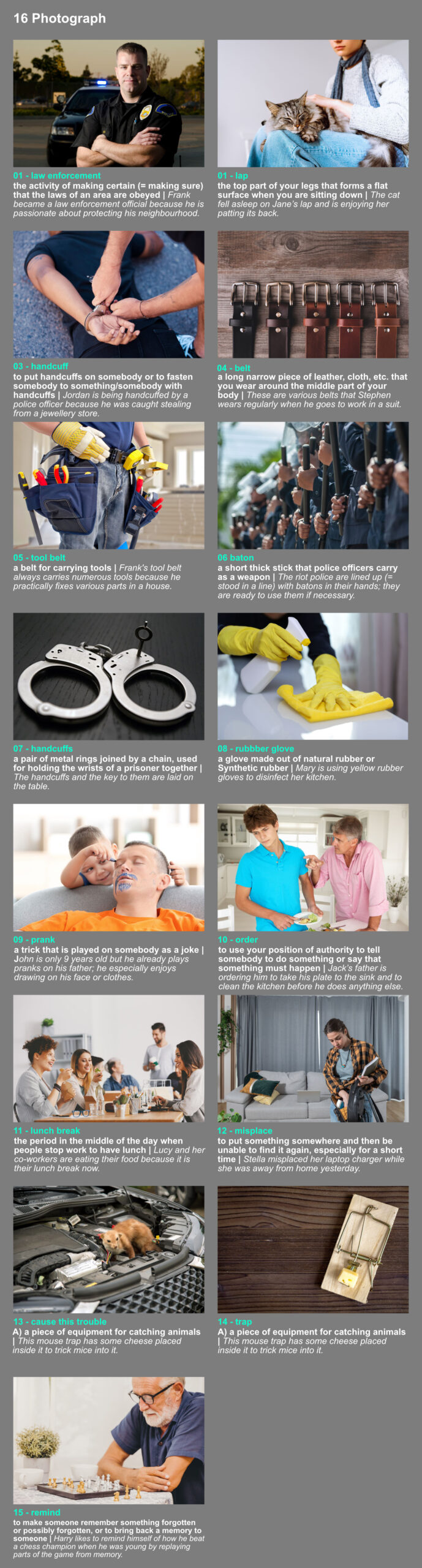
- Describe a photograph you like. You should say:
what can be seen in that photo;
when it was taken;
who took it;
and explain why you like it.
A photograph that I like was taken 5 years ago when I was in high school. It shows myself and my classmate in our law enforcement uniforms at a tech school that we were going to at the time studying law enforcement.
We are both sitting at a desk, the same desk. I’m sitting on my classmate’s lap and we are handcuffed to each other. The photograph was taken by my instructor. Why was this photograph taken is a question that was not asked, but that I shall answer.
So, what led up to the photo being taken was that we were all issued our belts, our tool belts at the time, and these had various things on them: our batons, our handcuffs, our rubber gloves and various things like that. Some of them (i.e. the tool belts) had different stuff on them. And, one of my other classmates had decided that she was going to mess with my classmate, Stephen, who is the one on whose lap I am sitting in the photograph by handcuffing him. Unfortunately for her, she only got halfway through. She only put one of the cuffs on him. I can’t remember what led up to my being in the other cuff, but I suspect that something happened, and she somehow managed to get the other cuff on me. So now there are the two of us handcuffed together.
My instructor, well, being a very good instructor was something of a prankster. He liked to play pranks on us. As such, he saw the situation and immediately ordered us all to get to our desks. This was a problem, given that my desk was on the other side of the room from Steven’s desk. Since we were handcuffed together and the seat directly next to his was taken, it resulted in us sitting in the same desk. When the photo was taken it did not show the full length of what happened because this was immediately before the lunch break, and my instructor continuing on his prank had conveniently misplaced the only handcuff key. As such, we then had to go to lunch handcuffed together still. I don’t know how she did it, but the same girl that had caused this trouble to begin with somehow found a second pair of handcuffs. She somehow again – I don’t know how she managed it – she managed to put the other cuff on Steven’s other hand.
Fortunately, we then overpowered her and slapped the 2nd cuff on her. So now she was caught in her own trap. Unfortunately, that meant there were now 3 of us all handcuffed together all going to lunch all without a key. This is a very funny situation.
I like this photo because it reminds me of the story behind it and what led up to it, and it reminds me of all of my old friends. That’s why I like that photograph.
17 Respect (steps 1, 2 and 4)
Describe someone you respect. You should say:
who this person is;
how you know about this person;
what this person does;
what this person is like;
and explain why you respect this person.
01
A man I respect greatly is Doug, one of the elders of my church. I met him when I first went to the church.
respect: a strong feeling of approval of somebody/something because of their good qualities or achievements | Martha respects the efforts of Martin Luther King to abolish (= to officially end) slavery.
elder: an official (= a person in high position) in some Christian churches | Mike was an elder at the local church until he passed away (= until he died).
02
Doug does a lot of things. One of the things he does is he teaches the group of younger people on Sundays in the afternoon. He teaches us things, but what’s more important is what he does when the group isn’t gathered together. If any of us need advice, we can come to him and he’ll give it to us, and he gives good advice.
gather1: to come together, or bring people together, in one place to form a group | Marc’s entire family gathered to celebrate his birthday.
advice: an opinion or a suggestion about what somebody should do in a particular situation | Dan often received advice from his grandfather about various topics such as the best ways to tie shoe laces and later, when he was older, about how to buy and sell cars.
03
Another thing that Doug does is he helps out he had run it but now he only helps out at a place in town that takes care of homeless people during the winter. Now in my country, we have a long winter sometimes up to 6 months, and if you don’t have a home, it’s very rough on the streets. And, a lot of the people on the streets are kind of rough people too. Some of them are on the streets because they got into drugs, for example. And, what he does at this place is they take them in, they give them a place to stay at night where it’s warm, they get them food, if they need clothes, they get them clothes, they get them anything they could need, and they let them stay the night there so they don’t freeze, which is a very genuine risk here.
homeless2: having no home, and therefore typically living on the streets | Harvey is homeless, so he often sleeps on benches.
rough3: difficult and unpleasant | Frank finds his construction work really rough during the hot months of July, not only due to the physical challenges but also because of the heat.
rough4: not gentle or careful; violent | As soon as the fight broke out, Mark found that the other kids on the beach were very rough.
freeze5: A) to become hard, and often turn to ice, as a result of extreme cold; to make something do this | This lake has frozen so hard that people are able to go ice fishing on it and also build cabins on it.
- B) to be very cold; to be so cold that you die |There are quite a few mountaineers who have frozen on Everest in the history of the sport
genuine risk: real harm that often results in a given situation, which is therefore dangerous | Falling asleep while driving is a genuine risk if you start the journey feeling tired.
04
And, in order to do this, he has to stay there, he has to stay awake all night at this place to make sure that no one causes trouble. Usually, a lot of the time they sleep, and they don’t cause trouble, but sometimes they have trouble there because there’s a lot of rough people in that place, and they have to keep them quiet not causing trouble all night. They have to confiscate any drugs they might have so they can’t do anything like that, and it’s a serious job, and he does that regularly. He’s not a young man. He’s got to be in his sixties, and he’s not in the best of health either, but he does this. I respect him for that. He’s helped a lot of other people just on a 1-on-1 basis. I don’t know everything he’s done; God only does. I only know what he’s done for me, and he was giving me good advice many times when I needed it.
awake: not asleep (especially immediately before or after sleeping) | Jenny is finally awake and ready to get out of bed.
confiscate6: to officially take something away from somebody, especially as a punishment | Sam is confiscating Sally’s smartphone because she has been spending too much time on it.
serious: requiring much thought or work |Steven considers his role as an accountant for a large company to be a serious job, so he is always very careful with his work.
have got to be: (used only in the present form) something must be true, must happen, or must be done | When I received my gas bill and saw the required amount, I thought to myself: “It’s got to be a joke, right?”
in the best of health: very healthy | Jonah is in the best of health, probably because he eats quality food and exercises regularly.
respect: a strong feeling of approval of somebody/something because of their good qualities or achievements | Dan respects his teacher’s skill in breaking down challenging ideas into simpler pieces, making them easily understandable for him.
on a 1-on-1 basis7: when one person deals directly with only one other person | Stella often visits her therapist on a 1-on-1 basis to discuss how she is doing in life.
05
Also, in order to get a driver’s licence, I have to have a certain number of hours driving, but I wasn’t able to get them because my family doesn’t go out much. He took me and let me stay in his home with him for a week, and he took me out driving so that I could get my hours so I can get my driver’s license. If it weren’t for him, I still would not be able to have my license. I’m very grateful for that.
in order to: with the aim or purpose of doing something | Mike got up very early in the morning in order to get the earliest bus available to his school because he had an important exam that he did not want to be late for.
a certain number of: a given number of something | Frank believes that a certain number of days must be spent training to become a chef.
if it weren’t for sb/sth: used to say that somebody/something stopped somebody/something from happening | If it weren’t for the firefighters, Larry’s house would now be completely burnt down. (= They stopped the fire.)
grateful8: feeling or showing thanks because somebody has done something kind for you or has done as you asked | Max is grateful to the doctor for taking care of his health while he was in the hospital, so he is thanking her formally by shaking her hand.
06
What is he like? Well, as I mentioned, he’s an older man. His body is very very broken. He’s done a lot of things, and his body is not (in) the best of health, but his mind … his mind is young. He’s a very interesting man in that respect. He feels very youthful for how old he actually is, but he is simultaneously very experienced. It’s an interesting combination.
broken9: that has been damaged or injured; no longer whole or working correctly | This broken plate has been on the ground for a while, but no one in the house seems to want to clean it up.
mind: the part of a person that makes them able to be aware of things, to think and to feel | Thoughts of guilt and shame ran through Billy’s mind as he thought about how he broke a plate in the kitchen and just left it there.
in that respect (or: in that regard): relating to what has just been mentioned | Maxine loves playing poker, and in that respect, she is able to beat most people who play with her. (= Her love for playing poker is connected to her proficiency and success in the game.)
youthful: young or seeming younger than you are | Aunt Grace seems youthful even at age 71!
simultaneously: at the same time as something else | Jack simultaneously likes both contemplative (= slow, meditative, deep) classical and happy pop music.
experienced10: having knowledge as a result of doing something for a long time, or having had a lot of different experiences | Steve is an experienced sailor; he has been doing it since he was 10 years old.
07
I respect Doug because he helps everyone he possibly can going out of his way and expecting nothing in return. He’s helped a lot of people, and I think he still will continue to do that for a long time to come as long as he’s able to. He’s helped a lot of people.
going out of one’s way: to make a special effort to do something | Mark went out of his way to make sure Frank got home on time, calling him at least four times to warn him about the time.
expect11: to demand (= wish/want) that somebody will do something because it is their duty or responsibility | Dan expects the train to arrive in exactly one minute, as he has been told it arrives at the station then.
in return: as a way of thanking somebody or paying them for something they have done | The bank has lent some money to Jonah, but they expect him to pay back 5% more than he borrowed in return.
as long as: providing that or on condition that; if | As long as Lucy gets a good grade for her history exam, she will receive more pocket money than usual.
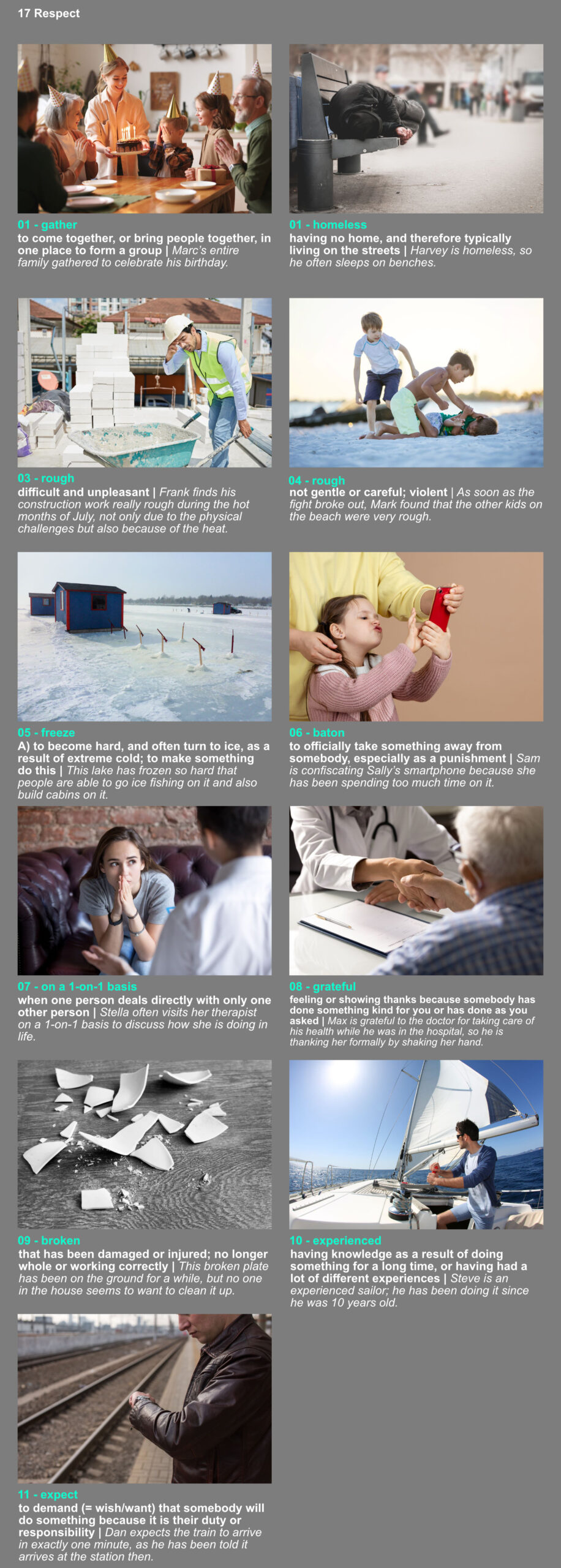
Describe someone you respect. You should say:
who this person is;
how you know about this person;
what this person does;
what this person is like;
and explain why you respect this person.
A man I respect greatly is Doug, one of the elders of my church. I met him when I first went to the church.
Doug does a lot of things. One of the things he does is he teaches the group of younger people on Sundays in the afternoon. He teaches us things, but what’s more important is what he does when the group isn’t gathered together. If any of us need advice, we can come to him and he’ll give it to us, and he gives good advice.
Another thing that Doug does is he helps out he had run it but now he only helps out at a place in town that takes care of homeless people during the winter. Now in my country, we have a long winter sometimes up to 6 months, and if you don’t have a home, it’s very rough on the streets. And, a lot of the people on the streets are kind of rough people too. Some of them are on the streets because they got into drugs, for example. And, what he does at this place is they take them in, they give them a place to stay at night where it’s warm, they get them food, if they need clothes, they get them clothes, they get them anything they could need, and they let them stay the night there so they don’t freeze, which is a very genuine risk here.
And, in order to do this, he has to stay there, he has to stay awake all night at this place to make sure that no one causes trouble. Usually, a lot of the time they sleep, and they don’t cause trouble, but sometimes they have trouble there because there’s a lot of rough people in that place, and they have to keep them quiet not causing trouble all night. They have to confiscate any drugs they might have so they can’t do anything like that, and it’s a serious job, and he does that regularly. He’s not a young man. He’s got to be be in his sixties, and he’s not in the best of health either, but he does this. I respect him for that. He’s helped a lot of other people just on a 1-on-1 basis. I don’t know everything he’s done; God only does. I only know what he’s done for me, and he was giving me good advice many times when I needed it.
Also, in order to get a driver’s licence, I have to have a certain number of hours driving, but I wasn’t able to get them because my family doesn’t go out much. He took me and let me stay in his home with him for a week, and he took me out driving so that I could get my hours so I can get my driver’s license. If it weren’t for him, I still would not be able to have my license. I’m very grateful for that.
What is he like? Well, as I mentioned, he’s an older man. His body is very very broken. He’s done a lot of things, and his body is not (in) the best of health, but his mind … his mind is young. He’s a very interesting man in that respect. He feels very youthful for how old he actually is, but he is simultaneously very experienced. It’s an interesting combination.
I respect Doug because he helps everyone he possibly can going out of his way and expecting nothing in return. He’s helped a lot of people, and I think he still will continue to do that for a long time to come as long as he’s able to. He’s helped a lot of people.
18 Sport (steps 1, 2 and 4)
Describe a sport you would like to learn. You should say:
what it is;
what equipment is needed for it;
how you would learn it;
and explain why you would like to learn this sport.
01
A sport I would like to learn is Zweihander fencing. Zweihander is a long two-handed sword from the early modern period. It was often used by bodyguards or by mercenaries. Zweihander fencing is a form of HEMA. It’s actually one of the more common ones and for good reason, in my opinion.
fencing1: the sport of fighting with long thin swords | Frank and James are in a fencing tournament.
sword2: a weapon with a long metal blade (= sharp cutting part) and a handle | Harry is holding a heavy sword with both of his hands. Two-handed swords like this one are also called “greatswords”.
bodyguard3: a person or a group of people who are employed to protect somebody | Franklin is a very important businessman who had to go to a foreign country for a meeting, so he had hired two bodyguards to look after him while he was there.
mercenary4: a soldier who will fight for any country or group that offers payment | Jack has been a mercenary for the past 5 years.
common: happening often; existing in large numbers or in many places | 3-wheeled cars seem to be much less common than 4-wheeled ones in the West.
and for good reason: because something has already been proven to be true or justified | Jen thinks that most people who live a long life eat a balanced diet, and for good reason: it helps them continue being healthy.
02
It is a very flashy and beautiful form, in my opinion, because it uses very large sweeping movements. In addition, it’s one of the easier ones to learn because there are existing manuals for it from the time period it’s from. The reason why Zweihander fencing is flashier than other styles is because its purpose is not in 1-on-1 fencing, and it’s not on battlefield stuff where your goal is to take up as little space as possible and you’re in formation and things like that. Its purpose is to take up a large area and not let anyone into it. So, for example, one very common thing that one does with a Zweihander is one will take it and make very large spinning motions with it around while walking in circular patterns. And this could be used with other forms of fencing, for example, sabre fencing, rapier fencing … They’re usually used in duels and things like that: 1 person fighting 1 person.
flashy5: intended to impress by appearing to show a lot of skill | Debby’s dance routine featured numerous flashy hand movements to highlight her most impressive dance skills.
sweeping6: moving or moving something quickly and smoothly in a particular direction | Ann is using large sweeping motions to move the water across the floor with a broom.
purpose: the intention, aim or function of something; the thing that something is supposed to achieve | The purpose of a pillow is to provide easier and more comfortable sleep for a person.
1-on-1: consisting of or involving direct individual competition, confrontation, or communication | As a therapist, Sally prefers to talk with Steve 1-on-1 instead of in a large group because she is only interested in what he has to say.
battlefield stuff: things related to the place where a battle is being fought or has been fought | Military strategists may often think carefully about “battlefield stuff” before sending their forces out to attack.
take up space7: to occupy or fill up space | The large white couch and the grand piano take up a lot of space in this room.
in formation8: in a particular arrangement (= in an organised position ) or pattern | The planes, which are part of the air show, are flying in formation because they want to show parts of their training to the public to impress them.
spin9: to turn round and round quickly; to make something do this | This father is spinning around both of his sons in the park to have fun.
pattern: a regular arrangement of lines, shapes, colours, etc. for example as a design on material, carpets, etc. | Some people enjoy wearing T-shirts with floral patterns in the spring for obvious (= clear, easy to see/understand) reasons: flowers bloom in spring.
circular pattern10: regular arrangement of circles | A single drop of water has created this circular pattern on the water’s surface.
duel11: a formal fight with weapons between two people who disagreed, especially over a matter of honour | These two warriors are engaged in (= take part in) a duel right now.
03
Zweihander fencing is very different. It is specifically designed for one person to fight many other people at the same time. So, by doing the large spinning motions, and it’s a very, very intricate set of moves, by the way, very hard to learn. That’s why I want to learn it. You don’t let anyone get close to you, and it gives you time to go into whatever strike you’re going to do to slowly take them out 1 by 1.
specifically: connected with or intended (= planned/designed) for one particular thing only | The first three books focus specifically on Harry’s childhood.
intricate: having a lot of different parts and small details that fit together | The design of the T-shirt was full of intricate geometric patterns.
strike12: to attack somebody/something, especially suddenly | This Roman soldier is striking fiercely (= with great strength).
take them out: to kill somebody or destroy something | The soldiers were able to take out their enemies easily because they were undertrained.
04
One thing that people would do is if you were in small groups. For example, say, you’re guarding a merchant caravan, so maybe it’s 6 people against a group of 6 bandits. Well, your goal as the person with the Zweihander is to take up a bunch of area while your friends go and actually do the fighting. Another thing it can do: I mentioned it was used by bodyguards a lot. There is one specific move in Zweihander fencing that I find very interesting. It is specifically designed to protect a person.
say: to suggest or give something as an example or a possibility | My team is better than any other team; take any team, say, the “Sheffield Tornadoes”: my team has won more championships than they have.
merchant13: a person who buys and sells goods in large quantities, especially one who imports and exports goods | Herry is a merchant of jumpers; he is getting ready to export theses boxes containing jumpers.
caravan14: a painted wooden vehicle that is pulled by a horse and in which people live | People actually used to live in this is beautifully decorated green caravan.
bandit15: a member of an armed group of thieves who attack travellers | Frank is being robbed by a bandit while sitting in his parked car somewhere abroad.
a bunch of: a large amount of something; a large number of things or people | Frankie has a whole bunch of things to cross off his to-do-list; these include him having 4 separate meetings at work and having to pick up one of his kids from school after work.
mention: to write or speak about something/somebody, especially without giving much information | Frankie briefly mentioned that she will be late to today’s meeting because she has to take a bus to work; her car is being repaired.
protect16: to make sure that somebody/something is not harmed, injured, damaged, etc. | The male bees are protecting the beehive, the queen and the honey from outsiders.
05
Let’s say that you’re the bodyguard of an important noble in medieval Italy. Well, a bunch of bandits appear and attack them. You‘ve got to defend your person. So the move involves you telling them to get down, and you do this spinning dance with your sword while walking in a circle around them. You sort of make a dome around them with your sword to protect them from the enemies. It’s a very interesting fighting style, and I like it quite a lot.
noble17: belonging to a family of high social rank (= belonging to the nobility) | This is a photo of a woman belonging to a Scottish noble family who lived during the 18th century
medieval18: connected with the Middle Ages (about AD 1000 to AD 1450) | These people are drinking and eating dinner in a medieval castle.
have got to: (used only in the present perfect form) used to show that you must do something; have to | If Harriet wants to get a good grade in physics then she has got to do her homework assignments.
involve19: if a situation, an event or an activity involves something, that thing is an important or necessary part or result of it | Playing football successfully involves the ability to control the ball masterfully.
get down: move your body from standing position to a lower position (e.g. kneeling, lying down etc.) | When Dan, who is a soldier in a warzone, heard gunshots hitting the wall behind him, he immediately got down (= dropped to the ground) and instructed his fellow soldiers to do the same.
sort of: to some extent but in a way that you cannot easily describe | Frank, who just started studying Physics at university, sort of understood Einstein’s General Theory of Relativity but not fully.
dome20
: a round roof with a circular base | These two buildings are geodesic domes; they look very futuristic.
06
Now, to actually learn it, you don’t need too much equipment to start out with. I mentioned that there are existing textbooks for it from the period. If I were to go about learning it, the first thing I would do would be to procure several textbooks teaching how to do it and read them. Once I did that, I would maybe buy a practice one. You can get replicas of them made of steel or plastic, and they let you practise with the weapon with other people without anyone getting hurt. So, if you’re going to do that, then you need your practice weapon and you’ll need protection.
equipment21: the things that are needed for a particular purpose or activity | Steve has some workout equipment in his garage gym so that he can work out whenever he is at home.
be to (do something): used to say what must or should be doner | Dan is to go to the shop that afternoon because his fridge is empty, and he is hungry.
go about (something): to start working on something | Stacy does not seem to go about the job the right way; she is missing some key details in her report.
procure22: to obtain (= to get) something, especially with difficulty | Vivien has managed to procure this rare collection of antique copper rings over the past 25 years by visiting various Asian and African countries.
replica23: a very good or exact copy of something | These replicas of the Oscar awards are available to the public; but not in gold plated (= covered with gold) bronze like the original ones.
protection: a thing that protects somebody/something against something | Rain jackets can provide protection from the rain but usually not from hail (= small balls of ice that fall like rain).
07
You need usually you The most important thing is a fencing mask and padding and gloves. Gloves are very important because hands are fragile, and even a blunt sword will absolutely break fingers. I know this because I do fencing without gloves. If you don’t want to spend money on a sort of expensive replica sword though, you could simply make your own out of wood. And that will serve you decently well. So, you can do it with a lot of equipment or very little equipment. It all depends on what your budget is and how much you are willing to put into it.
fencing mask24: a face mask made of fine mesh (= material made of a network of wire or plastic threads) that is worn over a fencer’s face | This is a fencing mask which has been used for years, so it looks rather worn.
padding25: material that is worn to protect the body from impact or other types of injury | Lisa is putting on padding to protect her elbows in the possible event that she falls.
glove26: a piece of clothing for the hand, made of wool, leather, etc. with separate parts for each finger and the thumb | This metalworker is wearing red and black rubber gloves to protect his hands.
fragile27: easily broken or damaged | This box contains porcelain vases, so it has been labeled as ‘fragile’ to ensure that those delivering it do not break it.
blunt28: without a sharp edge or point | Anna is using her blunt toy scissors, which her parents gave to her to ensure she avoids accidentally hurting herself with a sharper one.
decently: well enough; to a good enough standard or quality | Steve performed decently on the piano in front of his family members; no one even noticed any of the mistakes he made.
budget: the money that is available to a person or an organization and a plan of how it will be spent over a period of time | Freddy’s budget for the month is £1200, which is hardly enough (= not really enough or just enough) to cover all his expenses.
08
After reading the manuals and practising with other people, it’s best to find a club to join. HEMA clubs are … in some places, they have them; in some places, they don’t. Where I am, they don’t have any HEMA clubs that do Zweihander fencing, unfortunately. The best way is to learn from a textbook, practise a bit yourself – you can just practise the moves alone in a field somewhere -, and then you actually get into sparring and practising with other people, and that’s when you start getting good. If you have sparred a good bit with only yourself and your friends, if you want to learn more about it, you can find an actual master of it and get them to teach you. Such people do still exist, usually in HEMA clubs.
spar29: to practice the sport of boxing (or another combat sport) without hitting hard | Christopher has been sparring with his coach once a week for a year.
09
I’m interested in this sport because I find it absolutely fascinating and it’s great exercise.
fascinating: extremely interesting and attractive | Jackie’s and Phil’s dance moves were absolutely fascinating to watch; they were very skilled.

Describe a sport you would like to learn. You should say:
what it is;
what equipment is needed for it;
how you would learn it;
and explain why you would like to learn this sport.
A sport I would like to learn is Zweihander fencing. Zweihander is a long two-handed sword from the early modern period. It was often used by bodyguards or by mercenaries. Zweihander fencing is a form of HEMA. It’s actually one of the more common ones and for good reason, in my opinion.
It is a very flashy and beautiful form, in my opinion, because it uses very large sweeping movements. In addition, it’s one of the easier ones to learn because there are existing manuals for it from the time period it’s from. The reason why Zweihander fencing is flashier than other styles is because its purpose is not in 1-on-1 fencing, and it’s not on battlefield stuff where your goal is to take up as little space as possible and you’re in formation and things like that. Its purpose is to take up a large area and not let anyone into it. So, for example, one very common thing that one does with a Zweihander is one will take it and make very large spinning motions with it around while walking in circular patterns. And this could be used with other forms of fencing, for example, sabre fencing, rapier fencing … They’re usually used in duels and things like that: 1 person fighting 1 person.
Zweihander fencing is very different. It is specifically designed for one person to fight many other people at the same time. So, by doing the large spinning motions, and it’s a very, very intricate set of moves, by the way, very hard to learn. That’s why I want to learn it. You don’t let anyone get close to you, and it gives you time to go into whatever strike you’re going to do to slowly take them out 1 by 1.
One thing that people would do is if you were in small groups. For example, say, you’re guarding a merchant caravan, so maybe it’s 6 people against a group of 6 bandits. Well, your goal as the person with the Zweihander is to take up a bunch of area while your friends go and actually do the fighting. Another thing it can do: I mentioned it was used by bodyguards a lot. There is one specific move in Zweihander fencing that I find very interesting. It is specifically designed to protect a person.
Let’s say that you’re the bodyguard of an important noble in medieval Italy. Well, a bunch of bandits appear and attack them. You‘ve got to defend your person. So the move involves you telling them to get down, and you do this spinning dance with your sword while walking in a circle around them. You sort of make a dome around them with your sword to protect them from the enemies. It’s a very interesting fighting style, and I like it quite a lot.
Now, to actually learn it, you don’t need too much equipment to start out with. I mentioned that there are existing textbooks for it from the period. If I were to go about learning it, the first thing I would do would be to procure several textbooks teaching how to do it and read them. Once I did that, I would maybe buy a practice one. You can get replicas of them made of steel or plastic, and they let you practise with the weapon with other people without anyone getting hurt. So, if you’re going to do that, then you need your practice weapon and you’ll need protection.
You need usually you The most important thing is a fencing mask and padding and gloves. Gloves are very important because hands are fragile, and even a blunt sword will absolutely break fingers. I know this because I do fencing without gloves. If you don’t want to spend money on a sort of expensive replica sword though, you could simply make your own out of wood. And that will serve you decently well. So, you can do it with a lot of equipment or very little equipment. It all depends on what your budget is and how much you are willing to put into it.
After reading the manuals and practising with other people, it’s best to find a club to join. HEMA clubs are … in some places, they have them; in some places, they don’t. Where I am, they don’t have any HEMA clubs that do Zweihander fencing, unfortunately. The best way is to learn from a textbook, practise a bit yourself – you can just practise the moves alone in a field somewhere -, and then you actually get into sparring and practising with other people, and that’s when you start getting good. If you have sparred a good bit with only yourself and your friends, if you want to learn more about it, you can find an actual master of it and get them to teach you. Such people do still exist, usually in HEMA clubs.
I’m interested in this sport because I find it absolutely fascinating and it’s great exercise.
19 Travel (steps 1, 2 and 4)
Describe a place you have recently visited. You should say:
where you went;
who you went with;
how you got there;
and explain why you enjoyed it.
01
Recently I went to the Bureau of Motor Vehicles with my father, in order to take a driving exam.
bureau: (in the US) a government department or part of a government department | Sally has worked for the Federal Bureau of Investigation (FBI) for over ten years.
02
I’ve been driving for nearly 2 years now. Actually, over 2 years now, and my permit was about to expire, so this was the last chance I’d have to take my driving exam to get my license. In those 2 years, I’d had times of driving a lot and times of driving not at all.
permit1: an official document that gives somebody the right to do something, especially for a limited period of time | Mark is applying for a work permit to work in a foreign country as an accountant.
expire: (of a document, an agreement, etc.) to be no longer legally acceptable because the period of time for which it could be used has ended | Jen’s passport will expire in 15 days; she is going to be travelling abroad next week, and so she is planning to renew it very soon.
03
When I was going to college, I’d drive myself to college every day, and I would drive a lot, in fact, and I was very well-practised, and I was a very good driver at that time. Unfortunately, there were then times in which I did no driving at all. I had no chance to go driving because my family doesn’t go out much, so I didn’t have much chance to drive them anywhere.
04
I’d finally gotten enough hours because before you can take a driving exam, you’re required to drive for a certain number of hours with a registered driver in the car with you, and I’d recently gotten the rest of the hours I needed because I needed 10 hours at night in order to take the exam, and I recently got that because a good friend of mine, Doug, took me out driving at night with him. However, after that, I didn’t get much driving at all.
go out2: to leave your house to go to a social event | Mary and her friends like to go out to celebrate New Year’s Eve every year.
require3: to ask someone to do or have something, especially because it is necessary according to a particular law or set of rules | Drivers are required to divert their attention (= take their attention away) from their phones while driving.
recently: not long ago | Sammy has recently bought himself a new dark blue motorbike to ride to work because he hates public transport.
the rest of something: the remaining ( = not used or not mentioned earlier) parts of something or the remaining things in a group | Harry allowed the pine tree to grow in his garden for the rest of the decade before fully cutting it down.
05
The last week though, before the exam, I did a lot of driving, practising, driving here and there, driving all over in the worst places I could find just to get some practice. So, I drove my father and [me] to the Bureau of Motor Vehicles, which is on the outside of town – it’s actually pretty hard to get to itself -and I got ready to take the test.
06
When they ushered us in for our appointment, there were 3 of us, and there was only one driving tester, so we had to take turns. Now, fortunately, there were only 3 of us, so it wasn’t that long. There was myself and a young boy and a girl. The young boy went first. Now, at the end of the test, you are required to do parallel parking in which you drive your car up to another car and then park behind it. Now, this is often cited as the thing that’s hard to do, that a lot of people fail. In fact, my father, when he was around my age taking the driving exam, he failed that the first time himself.
usher4: to take or show somebody where they should go | Hannah’s job is to usher customers; she is now telling someone that they should go to the first floor of the building to meet the president of the company.
appointment5: a formal arrangement to meet or visit somebody at a particular time, especially for a reason connected with their work | Jack has a dentist appointment on the 21st of August; he has written it down in his calendar so he would not forget.
take turns6: if people take turns, they do something one after the other to make sure it is done fairly | The family members are taking turns pulling out individual Jenga pieces from the tower, trying not to make it fall.
parallel parking7: parking a car or other vehicle parallel to (= next to and along the same line as) the pavement | Matt is practising parallel parking with his white car, but he finds it challenging when the space is tight between two cars.
cite: to mention something as a reason or an example, or in order to support what you are saying | Unusually hot weather has been cited by some people as the reason for many of the recent storms.
07
It’s quite a common thing to fail. However, I’d been practising it with my father quite a lot. I was already good at it, but I got extra practice on top of that just to stay up-to-date. Practice went very well except for the one time in which I backed off a cliff over a wall. I wish I were kidding about that. That was interesting. Apart from that, I was sure that I could do the parallel parking part.
on top of that: in addition to something; also | Janet is an excellent cook; on top of that, she throws great dinner parties.
up-to-date: having or including the most recent information | All of the apps on my mobile devices and the software on my laptop are up-to-date. I’ve updated them recently.
backed8: to move or make something move backwards | Mike backed against the wall because he was very scared of someone trying to hurt him.
cliff9: a high area of rock with a very steep side, often at the edge of the sea or ocean | Jack is at the top of a cliff in Norway, looking at the beautiful view.
kid: to tell somebody something that is not true, especially as a joke | The news reporter was not kidding; a monkey escaped from the zoo last night and is running around freely in the city.
apart from that: except for that | Danielle enjoys taking walks in her garden; apart from that, she dislikes going outside because she finds the streets a bit too noisy.
08
Unfortunately, while we were waiting for the examiner to come, someone decided that they would park their truck in a very bad place. Now the BMV had set out a car in the parking in their own parking lot in a reserved area so that you could take the test. So, you are supposed to drive up to their car and back behind it.
truck10 (BrE- lorry): a large vehicle for carrying heavy loads by road | These trucks (lorries) are transporting new fridges to the shops where they will be sold.
parking lot11: an area where people can leave their cars | There are still a few free spaces available in this part of the parking lot, so some people can use them to park their cars.
reserve12: to keep something for somebody/something, so that it cannot be used by any other person or for any other reason | Three seats at the front of the conference were reserved for special guests.
be supposed to: to be expected to do something; should | The travellers are supposed to arrive just before eight to the train station so that we can pick them up and drive them to the restaurant.
09
Unfortunately, someone who clearly did not know what was going on decided that they would park a truck behind the car such that you could not drive up next to the car, or at least it really did not look like you could. It was in a very bad spot, and the poor guy who had to go up first, he did not do well. He parked way too far away from the car, and he backed in and was very crooked and far from where he was supposed to be.
such that: in a way that | Warships are painted such that it makes them difficult to see clearly from a distance.
spot13: a particular area or place | The driver was surprised to find that the spot where he usually sped through was now filled with other cars, and he couldn’t use it as a shortcut as usual.
way too far: much further in distance than expected | Tim tried to score in a game of football but kicked the ball way too far to the right of the goal post, so he missed.
crooked14: not in a straight line; bent or twisted | Steve occasionally has his glasses on his face crooked to make people laugh.
10
I felt sorry for the guy because he had bad conditions to start with with that truck there. He failed. You’re required to park your vehicle in a specific line of parking spots, so I and the girl were both watching him do this, and I remember as he did it, she looked over to me and mouthed the word “failed”, and I nodded. Very sad, but he very clearly failed.
condition: the physical situation that affects how something happens | The conditions to go windsurfing are great today because the wind is neither too strong nor too weak for the sport.
mouth15: to move your lips as if you were saying something, but without making a sound | Sally’a mouthing that it was Stella who loudly fell down the stairs this morning.
nod: if you nod, nod your head, or your head nods, you move your head up and down to show agreement, understanding, etc. | Max often nods instead of agreeing verbally, which annoys a lot of people around him.
11
Then, it was her turn, and she went out. She passed. She did well. She was still a bit far away from the car, but she did fine. Then it was my turn to go, and if I’d known how easy the test was, I wouldn’t have worried so much. It’s much easier than I thought it’d be, but somehow a lot of people fail it, which means maybe it was actually very hard, and I just got lucky.
pass: to achieve the required standard in an exam, a test, etc. | Francine passed the qualification needed to become an accountant, so she is in a good mood today.
a bit: a short time or distance | Janet should have waited a bit for her burger; instead, she complained and left the store.
someone’s turn16: someone’s opportunity or duty (= job/task) to do something before or after other people | The children are going around one by one answering questions their teacher is giving them on the board; it is now Jimmy’s turn.
12
So, I went out, and it was mostly uneventful. However, on one occasion, I was driving along; I had a green light. Two people ran a red light in front of me right as I was just going in front of them, but I managed to stop and did not hit them. My instructor was impressed with that, and I’m glad that I managed to stop.
uneventful: in which nothing interesting, unusual or exciting happens | “How was your weekend?” “Uneventful.”
run a red light17: [BrE jump the lights] to fail to stop at a red traffic light | The white car ran a red light, and it was caught on camera.
manage: to succeed in doing something, especially something difficult | There were no hotels open at that time. Still, we managed to find somewhere to stay in.
instructor18: a person whose job is to teach somebody a practical skill or sport | Ken is a successful snowboarding instructor; he teaches kids the basics of snowboarding.
impressed19: admiring somebody/something because you think they are particularly good, interesting, etc. | Stella is impressed at how well-made and delicious the slice of cake looks.
glad20: pleased; happy | Sally is glad that her speech went so well that the audience applauded (= clapped their hands) loudly when she finished it.
13
The rest of it went fairly uneventfully. When it came to the parallel parking, I managed to sweep around the truck and get in close enough and back in perfectly. I passed the test. Having passed the test, I got my temporary driver’s license, which I then had to go into the building (with) and exchange it for a long-term driver’s license.
sweep21: to move, especially quickly and powerfully | Frank is confidently sweeping towards his office, though he is running late.
temporary: lasting or being used only for a short time; not permanent | The painkillers only provided temporary relief to Maggie, who had a terrible headache throughout the day.
exchange22: an act of giving something to somebody or doing something for somebody and receiving something in return | These two friends are exchanging books that they like with each other.
long-term: lasting or having an effect over a long period of time | The business has modified parts of its long-term strategy in the last couple of years in response to customer calls for environmental changes.
14
Unfortunately, by then, it was late in the afternoon. The office closes at 4:30, and I believe it was sometime around 3:30. In addition, there were, I believe, 50 to 70 other people – I did actually know the exact number of people, but I’ve forgotten now – in the office in line ahead of us at this time. As such, my father and I had to sit in the waiting room for several hours well past the closing time of the office. We were among the last 10 people in the building. But at last, almost literally, we managed to get in, and they gave me the driver’s license, though we’d sat there for a long time by that point.
in line23: in a queue of people | These people are all waiting in line to access the museum.
literally: using the real or original meaning of a word or phrase | He was literally dressed like a clown to the party; perhaps, he thought it was funny.
though: used to add a fact or an opinion that makes the previous statement less strong or less important; | If I play poker with Jason and John, I will probably lose some money, though trying it once may be fun.
Despite all of the long waiting, I greatly enjoyed that trip because now I have my driver’s licence, and I am able to drive where I like.
despite: something still happened or is true, even if something else could have stopped it | Despite her efforts to be serious, she kept laughing at Jen’s jokes. (= She tried hard to be serious but couldn’t. She kept laughing anyway.)
greatly enjoy: getting a lot of satisfaction from something | Sammy greatly enjoyed her time at the summer camp because of the interesting activities that she was able to take part in.

Describe a place you have recently visited. You should say:
where you went;
who you went with;
how you got there;
and explain why you enjoyed it.
Recently I went to the Bureau of Motor Vehicles with my father, in order to take a driving exam.
I’ve been driving for nearly 2 years now. Actually, over 2 years now, and my permit was about to expire, so this was the last chance I’d have to take my driving exam to get my license. In those 2 years, I’d had times of driving a lot and times of driving not at all.
When I was going to college, I’d drive myself to college every day, and I would drive a lot, in fact, and I was very well-practised, and I was a very good driver at that time. Unfortunately, there were then times in which I did no driving at all. I had no chance to go driving because my family doesn’t go out much, so I didn’t have much chance to drive them anywhere.
I’d finally gotten enough hours because before you can take a driving exam, you’re required to drive for a certain number of hours with a registered driver in the car with you, and I’d recently gotten the rest of the hours I needed because I needed 10 hours at night in order to take the exam, and I recently got that because a good friend of mine, Doug, took me out driving at night with him. However, after that, I didn’t get much driving at all.
The last week though, before the exam, I did a lot of driving, practising, driving here and there, driving all over in the worst places I could find just to get some practice. So, I drove my father and [me] to the Bureau of Motor Vehicles, which is on the outside of town – it’s actually pretty hard to get to itself -and I got ready to take the test.
When they ushered us in for our appointment, there were 3 of us, and there was only one driving tester, so we had to take turns. Now, fortunately, there were only 3 of us, so it wasn’t that long. There was myself and a young boy and a girl. The young boy went first. Now, at the end of the test, you are required to do parallel parking in which you drive your car up to another car and then park behind it. Now, this is often cited as the thing that’s hard to do, that a lot of people fail. In fact, my father, when he was around my age taking the driving exam, he failed that the first time himself.
It’s quite a common thing to fail. However, I’d been practising it with my father quite a lot. I was already good at it, but I got extra practice on top of that just to stay up-to-date. Practice went very well except for the one time in which I backed off a cliff over a wall. I wish I were kidding about that. That was interesting. Apart from that, I was sure that I could do the parallel parking part.
Unfortunately, while we were waiting for the examiner to come, someone decided that they would park their truck in a very bad place. Now the BMV had set out a car in the parking in their own parking lot in a reserved area so that you could take the test. So, you are supposed to drive up to their car and back behind it.
Unfortunately, someone who clearly did not know what was going on decided that they would park a truck behind the car such that you could not drive up next to the car, or at least it really did not look like you could. It was in a very bad spot, and the poor guy who had to go up first, he did not do well. He parked way too far away from the car, and he backed in and was very crooked and far from where he was supposed to be.
I felt sorry for the guy because he had bad conditions to start with with that truck there. He failed. You’re required to park your vehicle in a specific line of parking spots, so I and the girl were both watching him do this, and I remember as he did it, she looked over to me and mouthed the word “failed”, and I nodded. Very sad, but he very clearly failed.
Then, it was her turn, and she went out. She passed. She did well. She was still a bit far away from the car, but she did fine. Then it was my turn to go, and if I’d known how easy the test was, I wouldn’t have worried so much. It’s much easier than I thought it’d be, but somehow a lot of people fail it, which means maybe it was actually very hard, and I just got lucky.
So, I went out, and it was mostly uneventful. However, on one occasion, I was driving along; I had a green light. Two people ran a red light in front of me right as I was just going in front of them, but I managed to stop and did not hit them. My instructor was impressed with that, and I’m glad that I managed to stop.
The rest of it went fairly uneventfully. When it came to the parallel parking, I managed to sweep around the truck and get in close enough and back in perfectly. I passed the test. Having passed the test, I got my temporary driver’s license, which I then had to go into the building (with) and exchange it for a long-term driver’s license.
Unfortunately, by then, it was late in the afternoon. The office closes at 4:30, and I believe it was sometime around 3:30. In addition, there were, I believe, 50 to 70 other people – I did actually know the exact number of people, but I’ve forgotten now – in the office in line ahead of us at this time. As such, my father and I had to sit in the waiting room for several hours well past the closing time of the office. We were among the last 10 people in the building. But at last, almost literally, we managed to get in, and they gave me the driver’s license, though we’d sat there for a long time by that point.