Modul 6: PragerU Videos Set 4. Videos 43-56
Ez a videóválogatás 14db izgalmas, gondolatébresztő témát jár körül 5 perces prezentációkban. A gyakorlat végeztével közel 600 szóval növeled szókincsedet. Fontos, hogy a kézikönyvekben leírtak szerint dolgozz az anyagon.
43 Follow the Science (steps 1, 3 and 5)
I’m an astrophysicist at a major university. Science is my life. But when I hear somebody somberly intone, “science says” or “follow the science,” I get very nervous.
Science doesn’t belong to any ideology. Science is the never-ending search for new knowledge.
That’s what science means in Latin, by the way—knowledge. Not wisdom. Not morality. Not social policy. Knowledge. What we do with that knowledge is where wisdom, morality, and social policy enter the picture.
Knowledge, it turns out, isn’t so easy to come by. And sometimes what we think we know for certain (the earth sure does look flat when we’re standing on it) turns out not to be so certain.
Of course, I trust in basic scientific truths—those things for which there is overwhelming evidence like, say, gravity; even that humans play a role in the warming of the planet.
But scientists—even the best ones—can get things wrong.
The brilliant astrophysicist Sir Fred Hoyle believed the universe existed in a steady state forever and had no beginning. But his view, once held sacrosanct by all astrophysicists, no longer holds. It’s been superseded by the Big Bang theory that the universe had a beginning and is still expanding.
In the 20th century, some of the most respected scientists in the world, including Nobel Prize winners, believed in eugenics—the reprehensible idea that the human race could be improved by selective breeding. The National Academy of Sciences, the American Medical Association, and the Rockefeller Foundation supported it. By the middle of the century, it had been thoroughly rejected as quackery. No reputable scientist would have anything to do with this idea.
So, we all need to get over this notion that just because someone—be it a politician, a bureaucrat, or even a scientist—employs the phrase “science says” means whatever they’re saying is right.
It might be right. But it might also be wrong. And if it’s wrong, it won’t necessarily be a bunch of scientists who say it’s wrong. It might be one guy.
Ask Einstein. One hundred scientists wrote a book explaining why his theory of relativity was wrong. He quipped, “If I were wrong, then one would’ve been enough.”
It takes a lot to convince scientists to accept a new theory, especially if that new theory refutes what they have always believed—in some cases, what they’ve staked their entire careers on. As Richard Feynman, one of the most eminent physicists of the 20th century, famously said, “Science is the belief in the ignorance of experts…” What Feynman is saying is that a good scientist should always maintain a healthy amount of skepticism. Science is, by its nature, provisional. Science would stagnate if we merely accepted proclamations of past authorities.
So how do we do good science? This is not a new question. Since the 17th century, scientists have employed the so-called scientific method to guide their work. It’s not a perfect guide by any means, but it’s pretty darn good.
The method involves: 1. Formulating a theory. 2. Predicting the evidence that should be found if the theory is true. 3. Collecting data. 4. Analyzing the data. 5. Refining the theory and presenting evidence to other experts.
The philosopher Karl Popper added one more item to this list. Popper said that a subject is scientific if, and only if, it can be falsified. In other words, if your theory can’t be tested—if it can’t be proven wrong, it’s probably not good science.
This is just one reason why we have to be very careful about putting too much faith in “models.” They often can’t be tested. Models are predictions of the future based on current data. They can easily get things wrong.
First of all, the future (in case you hadn’t noticed) is very hard to predict. And the further out you go into the future, the less secure the prediction.
Second, the data may be incomplete or even erroneous. It’s human nature to want definitive answers. But science can’t always offer those. Furthermore, science is not concerned with fashion, authority, or majority opinion. “Case closed” is not a scientific expression.
Science is never closed. If it was closed after Newton, you’d never have Einstein. Science has to be, first and always, about pursuing knowledge—not about advancing a social agenda, no matter how noble it might be. Science has no political party.
Of course, politicians should use the best available science to help them make informed decisions. But remember, scientific knowledge is not the same as wisdom. As the saying goes: Knowledge is knowing a tomato is a fruit. Wisdom is knowing not to put it in a fruit salad.
So let’s continue to look to science for knowledge—knowledge we can use to improve the world. But let’s not fool ourselves that science has all the answers to all our problems.
It doesn’t.
That’s one bit of wisdom this scientist can give you.
I’m Brian Keating, professor of physics at the University of California, San Diego and author of Losing the Nobel Prize, for Prager University.
I’m an astrophysicist at a major university. Science is my life. But when I hear somebody somberly intone, “science says” or “follow the science,” I get very nervous.
somberly1: in a way that is serious, sad, and without humor or entertainment | The family walked somberly across the graveyard after the funeral ceremony.
intone: to say something slowly and seriously in a voice that does not rise or fall much | The priest intoned the final prayer.
Science doesn’t belong to any ideology. Science is the never-ending search for new knowledge.
ideology: a set of beliefs or principles, especially one on which a political system, party, or organization is based | Mr Smith is very much in favour of capitalist ideology.
That’s what science means in Latin, by the way—knowledge. Not wisdom. Not morality. Not social policy. Knowledge. What we do with that knowledge is where wisdom, morality, and social policy enter the picture.
wisdom2: the ability to use your knowledge and experience to make good decisions and judgments | Gary is sharing his wisdom with his grandson.
policy3: a set of ideas or a plan of what to do in particular situations that has been agreed to officially by a group of people, a business organization, a government, or a political party | Social distancing is a policy used by most governments in 2020 to fight the spread of covid.
Knowledge, it turns out, isn’t so easy to come by. And sometimes what we think we know for certain (the earth sure does look flat when we’re standing on it) turns out not to be so certain.
easy to come by4: easy to obtain/get or find | Antibiotics were quite easy to come by 1938.
Of course, I trust in basic scientific truths—those things for which there is overwhelming evidence like, say, gravity; even that humans play a role in the warming of the planet.
overwhelming5: very great or very strong; so powerful that you cannot resist it or decide how to react | Lucas is being arrested because the police have found overwhelming evidence showing that he committed the robbery.
But scientists—even the best ones—can get things wrong.
The brilliant astrophysicist Sir Fred Hoyle believed the universe existed in a steady state forever and had no beginning. But his view, once held sacrosanct by all astrophysicists, no longer holds. It’s been superseded by the Big Bang theory that the universe had a beginning and is still expanding.
steady6: not changing and not interrupted | Lisa is keeping her arms, legs and breath steady so that she can balance her body.
sacrosanct7-8: that is considered to be too important to change or question | Spenser always works every day; however, his weekend is sacrosanct to him: he always spends it on picnics with his family.
supersede9-10: to replace something, especially something older or more old-fashioned | The old building on my street has been superseded by a brand new block of flats.
In the 20th century, some of the most respected scientists in the world, including Nobel Prize winners, believed in eugenics—the reprehensible idea that the human race could be improved by selective breeding. The National Academy of Sciences, the American Medical Association, and the Rockefeller Foundation supported it. By the middle of the century, it had been thoroughly rejected as quackery. No reputable scientist would have anything to do with this idea.
thoroughly: very much; completely | Mike and Larry thoroughly enjoyed themselves at football practice.
quackery: the methods or behaviour of somebody who pretends to have medical knowledge | George, who says he is a doctor, believes in medical ideas which have been labelled by others as quackery.
reputable11: that people consider to be honest; having a good reputation | Mother Teresa was a reputable woman.
So, we all need to get over this notion that just because someone—be it a politician, a bureaucrat, or even a scientist—employs the phrase “science says” means whatever they’re saying is right.
It might be right. But it might also be wrong. And if it’s wrong, it won’t necessarily be a bunch of scientists who say it’s wrong. It might be one guy.
Ask Einstein. One hundred scientists wrote a book explaining why his theory of relativity was wrong. He quipped, “If I were wrong, then one would’ve been enough.”
quip: to make a quick and clever remark | One of the reasons why Oscar Wilde became famous was his ability to quip.
It takes a lot to convince scientists to accept a new theory, especially if that new theory refutes what they have always believed—in some cases, what they’ve staked their entire careers on. As Richard Feynman, one of the most eminent physicists of the 20th century, famously said, “Science is the belief in the ignorance of experts…” What Feynman is saying is that a good scientist should always maintain a healthy amount of skepticism. Science is, by its nature, provisional. Science would stagnate if we merely accepted proclamations of past authorities.
refute12: to prove that something is wrong | Einstein’s Special Theory of Relativity refuted parts of Classical Physics.
stake13: to risk money or something important on the result of something; bet | Ron staked £224 of his money on his favourite horse.
ignorance: a lack of knowledge or information about something | Ray was angry about his own ignorance about European history.
provisional: for the present time but likely to change; temporary | A new provisional government took power.
proclamations: an official announcement | In 2021 January, Biden signed a presidential proclamation about who can and cannot enter the USA.
So how do we do good science? This is not a new question. Since the 17th century, scientists have employed the so-called scientific method to guide their work. It’s not a perfect guide by any means, but it’s pretty darn good.
The method involves: 1. Formulating a theory. 2. Predicting the evidence that should be found if the theory is true. 3. Collecting data. 4. Analyzing the data. 5. Refining the theory and presenting evidence to other experts.
predict14: to say that something will happen in the future | Matt is predicting the weather on TV.
refine15: A) to make a substance pure by taking other substances out of it | Oil and gas need to be refined so we can use them.
- B) to improve something by making small changes to it | Johnny refined his guitar playing skills over the years.
The philosopher Karl Popper added one more item to this list. Popper said that a subject is scientific if, and only if, it can be falsified. In other words, if your theory can’t be tested—if it can’t be proven wrong, it’s probably not good science.
falsify16: to change a written record or information so that it is no longer true | Flat earth theory has been falsified.
This is just one reason why we have to be very careful about putting too much faith in “models.” They often can’t be tested. Models are predictions of the future based on current data. They can easily get things wrong.
prediction: a statement about what you think will happen in the future | Stacy made a correct prediction about who would win the presidential election.
First of all, the future (in case you hadn’t noticed) is very hard to predict. And the further out you go into the future, the less secure the prediction.
Second, the data may be incomplete or even erroneous. It’s human nature to want definitive answers. But science can’t always offer those. Furthermore, science is not concerned with fashion, authority, or majority opinion. “Case closed” is not a scientific expression.
erroneous: not correct; based on wrong information | Jenna’s idea that her new pet would be calm during the storm was erroneous.
furthermore: in addition; moreover | I fell down whilst playing for my school’s football team. Furthermore, our team lost the match.
Science is never closed. If it was closed after Newton, you’d never have Einstein. Science has to be, first and always, about pursuing knowledge—not about advancing a social agenda, no matter how noble it might be. Science has no political party.
pursue17: A) to follow someone or something, usually to try to catch him, her, or it | Some dogs like to pursue butterflies.
- B) try to do or achieve a plan, activity, or situation, usually over a long period of time | Francis was pursuing a career in law.
noble: having or showing fine personal qualities that people admire, such as courage, honesty and care for others | According to the tales, Matthias was a noble king.
Of course, politicians should use the best available science to help them make informed decisions. But remember, scientific knowledge is not the same as wisdom. As the saying goes: Knowledge is knowing a tomato is a fruit. Wisdom is knowing not to put it in a fruit salad.
So let’s continue to look to science for knowledge—knowledge we can use to improve the world. But let’s not fool ourselves that science has all the answers to all our problems.
It doesn’t.
That’s one bit of wisdom this scientist can give you.
I’m Brian Keating, professor of physics at the University of California, San Diego and author of Losing the Nobel Prize, for Prager University.
44 The Chicago Fire: America at Its Best (steps 1, 3 and 5)
The most famous fire in American history happened in Chicago on October 8, 1871. But it’s not the fire that is so remarkable. It’s what happened afterwards. To understand why, we first need to know something about the city’s history.
In 1840, Chicago was a small town of forty-five hundred souls. It ranked 92nd in population in the United States. Yet, only three decades later, by 1870–just a year before the great fire–Chicago was closing in on a population of 300,000, making it the fifth-biggest city in America and the fastest-growing city in the world.
What led to all this rapid growth? In three words: location, location, location.
“Chicago was near the center of the country, and near where the waterways and railways met,” city historian Tim Samuelson notes. “It was a perfect place for anything and anyone to get anywhere…”
Timing had a lot to do with it, too. America was moving from a rural to an industrial power. Chicago was right in the middle of the action. Ironically, its rapid growth was almost its undoing. “[Chicago] had to build, and build quickly, and so they built it out of wood,” explained Sarah Marcus of the Chicago History Museum. “It was quick, it was easy, and it was cheap.”
And, as it turned out, very flammable.
By most accounts, the fire started on the city’s West Side, near the De Koven Street barn of Patrick and Catherine O’Leary. No one is sure of the cause, but it could have been anything, from vandals to a drunken neighbor to that clumsy cow of urban legend.
Within minutes, the blaze roared out of control, tearing through Chicago’s business district. The fire was so hot, it created its own tornado of flame. By 3:30 a.m., all hope of saving large parts of the city was gone. Nearly 30 hours later, the fire finally died. The reason? There was nothing left to burn.
The losses were staggering: The fire claimed nearly 300 lives, destroyed over 17,000 buildings covering almost 3.5 square miles, and caused damage of over $200 million-about 3.8 billion today. Roughly a third of the city lay in ruins, and one out every three people living in Chicago–nearly 100,000 residents–became homeless overnight.
“All the law offices were destroyed, all the major hotels were destroyed, all the major department stores were destroyed, and all the major banks were destroyed,” Chicago weather historian Tom Skilling notes.
In those days, there were no national or state agencies to help. Chicago was on its own.
What was to be done? To most of Chicago’s citizens, the answer was obvious: Rebuild. Make the city better than ever. Yes, there were many victims of the fire, but there was no sense of victimhood. Even before the bricks stopped smoking, the people of Chicago went to work.
First, the damage had to be assessed. The death and destruction were obvious. But there were some major pluses as well. The stockyards and meat packing plants had been spared. Two-thirds of the grain elevators survived. And most importantly, the railway and rail stock escaped major damage. This was critical because it would allow shipments of building materials and private relief aid to come pouring in from across the country and around the world.
The banking community quickly rallied. Within 48 hours, 12 of the 29 banks that had burned to the ground were operating in makeshift facilities. Merchants–large and small–immediately set up temporary shops. Local financier Henry Greenbaum sent letters to investment bankers all over the globe. This wasn’t the time to give up on the city; it was the time, he told them, to buy in. Many agreed.
Among them were creative young architects attracted to the nearly blank slate the city presented to them. They would raise a new city from a new product: steel. Their work, praised and copied all over the world, came to be known as the Chicago School.
By 1890, only 20 years after the fire, Chicago’s population passed the one-million mark, becoming the second-biggest city in America. The population had more than tripled since the Windy City’s darkest night.
Why is this all important to know? Because the government didn’t rebuild Chicago. Chicago rebuilt Chicago. And with astonishing speed and energy. A can-do spirit, devotion to community and free-market capitalism made it happen. It’s impossible to look at this achievement without admiration–and more than a bit of nostalgia.
Could we summon that same spirit today?
Yes. We can. But only if we proudly retell stories like this one that remind us the greatness of America is not a product of government, but a product of self-government–empowered citizens pursuing their own best interests.
I’m Lee Habeeb, host of “Our American Stories,” for Prager University.
The most famous fire in American history happened in Chicago on October 8, 1871. But it’s not the fire that is so *remarkable. It’s what happened afterwards. To understand why, we first need to know something about the city’s history.
remarkable1: unusual or surprising in a way that causes people to take notice | The striped elephant in the middle of this picture is remarkable.
In 1840, Chicago was a small town of forty-five hundred souls. It ranked 92nd in population in the United States. Yet, only three decades later, by 1870–just a year before the great fire–Chicago was closing in on a population of 300,000, making it the fifth-biggest city in America and the fastest-growing city in the world.
soul: the spiritual part of a person, believed to exist after death | Maggie believes that her grandmother’s soul now rests in peace.
yet: (and) despite that; used to add something that seems surprising because of what you have just said; however | Max never studies for his exams, yet he always gets the highest grades in his class.
What led to all this rapid growth? In three words: location, location, location.
“Chicago was near the center of the country, and near where the *waterways and railways met,” city historian Tim Samuelson notes. “It was a perfect place for anything and anyone to get anywhere…”
waterway2: a river, canal, etc. along which boats can travel | Tourist boats use the waterway to show different sights of the city.
Timing had a lot to do with it, too. America was moving from a *rural to an industrial power. Chicago was right in the middle of the action. Ironically, its rapid growth was almost its undoing. “[Chicago] had to build, and build quickly, and so they built it out of wood,” explained Sarah Marcus of the Chicago History Museum. “It was quick, it was easy, and it was cheap.”
rural3: connected with or like the countryside | Some people prefer to live in rural villages because these villages are peaceful.
undoing: the reason why somebody fails at something or is unsuccessful in life | Xavier’s arrogance was his undoing.
And, as it turned out, very *flammable.
flammable4: burns easily | Gas is flammable.
By most accounts, the fire started on the city’s West Side, near the De Koven Street barn of Patrick and Catherine O’Leary. No one is sure of the cause, but it could have been anything, from vandals to a drunken neighbor to that *clumsy cow of urban legend.
clumsy5: (of people and animals) moving or doing things in a way that is not smooth or steady or careful | Jerry was clumsy and spilt his coffee on his laptop.
Within minutes, the *blaze roared out of control, *tearing through Chicago’s business district. The fire was so hot, it created its own tornado of *flame. By 3:30 a.m., all hope of saving large parts of the city was gone. Nearly 30 hours later, the fire finally died. The reason? There was nothing left to burn.
blaze6: a large, strong fire | Firefighters fought the blaze by dropping water on it from a helicopter.
roar7: (of a fire) to burn brightly with a lot of flames, heat and noise | The fire roared for hours destroying everything in its way.
tear through8 : to cause a great amount of destruction while moving rapidly through something or some place | The tornado is tearing through the city.
flame9: a hot bright stream of burning gas that comes from something that is on fire | These flames are burning.
The losses were staggering: The fire claimed nearly 300 lives, destroyed over 17,000 buildings covering almost 3.5 square miles, and caused damage of over $200 million-about 3.8 billion today. Roughly a third of the city lay in *ruins, and one out every three people living in Chicago–nearly 100,000 residents–became homeless overnight.
staggering: so great, shocking or surprising that it is difficult to believe | Jack paid a staggering £300K for his new sports car.
ruins10: the broken parts that are left of a building or town that has been destroyed by bombs, fire, etc | Larry’s neighbourhood was left in ruins after the tornado hit his town.
“All the law offices were destroyed, all the major hotels were destroyed, all the major department stores were destroyed, and all the major banks were destroyed,” Chicago weather historian Tom Skilling notes.
In those days, there were no national or state agencies to help. Chicago was on its own.
What was to be done? To most of Chicago’s citizens, the answer was obvious: Rebuild. Make the city better than ever. Yes, there were many *victims of the fire, but there was no sense of victimhood. Even before the bricks stopped smoking, the people of Chicago went to work.
victim11: a person who has been attacked, injured or killed as the result of a crime, a disease, an accident, etc. | Rachel has been the victim of a robbery.
victimhood: the condition of having been hurt, damaged, or made to suffer, especially when you want people to feel sorry for you because of this or use it as an excuse for something | Gary broke his leg during the race; however, he kept running without a hint of victimhood.
First, the damage had to be assessed. The death and destruction were obvious. But there were some major pluses as well. The *stockyards and meat packing plants had been spared. Two-thirds of the *grain elevators survived. And most importantly, the railway and *rail stock escaped major damage. This was critical because it would allow shipments of building materials and private *relief aid to come *pouring in from across the country and around the world.
assess: to judge or decide the amount, value, quality, or importance of something | After the flood, the damage to the city was assessed.
stockyard12: a place where farm animals are kept for a short time before they are sold at a market or killed | The cattle in the stockyard are ready for being sold.
spare: to allow somebody/something to escape harm, damage or death, especially when others do not escape it | Only a few soldiers were spared during the war.
grain elevator13: a tall building used to store grain and that contains equipment to move it | These grain elevators are able to store large amounts of grain.
rail stock14: a supply of railway materials | This railway is stock kept in a factory.
shipment: a load of goods that are sent from one place to another | The arms (= military) shipment arrived today.
relief aid15: money, food, etc. that is sent to help countries in difficult situations | Kevin and Lisa are packing relief aid.
pour16: to come or go somewhere continuously in large numbers | Protesters poured into the streets.
The banking community quickly rallied. Within 48 hours, 12 of the 29 banks that had burned to the ground were operating in *makeshift *facilities. Merchants–large and small–immediately set up temporary shops. Local financier Henry Greenbaum sent letters to investment bankers all over the globe. This wasn’t the time to give up on the city; it was the time, he told them, to buy in. Many agreed.
rally: to come together or bring people together in order to help or support somebody/something | The people have rallied behind the president.
makeshift17: used temporarily for a particular purpose because the real thing is not available; improvised | This makeshift tent was made out of tree branches by a survivor in the forest.
facility18: a place, especially including buildings, where a particular activity happens | A military officer is giving a presentation in a top secret military facility.
Among them were creative young architects attracted to the nearly *blank slate the city presented to them. They would *raise a new city from a new product: steel. Their work, praised and copied all over the world, came to be known as the Chicago School.
blank slate19: a person or thing that has the potential to be developed or changed in many different ways | This brand new house is a blank slate for an investor to buy it, improve it, and sell it for even more to make a lot of money.
raise20: to build something | The bricklayer is raising a wall.
By 1890, only 20 years after the fire, Chicago’s population passed the one-million mark, becoming the second-biggest city in America. The population had more than tripled since the Windy City‘s darkest night.
Why is this all important to know? Because the government didn’t rebuild Chicago. Chicago rebuilt Chicago. And with astonishing speed and energy. A can-do spirit, *devotion to community and free-market capitalism made it happen. It’s impossible to look at this *achievement without admiration–and more than a bit of nostalgia.
Windy City: a name for the US city of Chicago | The family moved to Windy City from Los Angeles.
astonishing: very surprising | Danny achieved astonishing success in her career as an architect.
devotion21: support and affection | Marie’s devotion to her child can clearly be seen.
achievement22: a thing that somebody has done successfully, especially using their own effort and skill | These student’s achievement of getting a university degree is marked by a ceremony.
Could we summon that same spirit today?
Yes. We can. But only if we proudly retell stories like this one that remind us the greatness of America is not a product of government, but a product of self-government–empowered citizens pursuing their own best interests.
empower: to give somebody more control over their own life or the situation they are in | There is a movement to empower women.
I’m Lee Habeeb, host of “Our American Stories,” for Prager University.

45 Celebrating Columbus (steps 1, 3 and 5)
He ventured where no other man of his age dared to go. He saw things no other man of his age had ever seen. He discovered a New World.
For centuries, he was universally admired as a hero. Now he’s widely considered to be a despoiler of paradise, an enslaver, and a genocidal maniac.
I’m talking, of course, about Christopher Columbus. So which is true? Is he a hero—or a villain?
The truth is complicated, as the truth often is—especially when you have to go back 500 years to find it. But let’s try to get as close as we can.
Columbus was born in 1451 in the port city of Genoa, Italy. At a time when birth often determined destiny, his origins were entirely unremarkable. His father was a middle-class wool weaver who expected his son to follow the same path. But Columbus had different plans. The Age of Discovery was dawning. The future belonged to the bold. And the bold went to sea.
By the time he turned 30, Columbus had sailed to Iceland, Ireland, and Africa. Somewhere on his many voyages, he became obsessed with the idea that there was a westward sea route from Europe to India. But there were no maps to consult, only wild rumors of sea monsters and endless ocean.
He put together the 15th-century version of a PowerPoint presentation for the king of Portugal, then the world’s leading sea power. But the king, heeding the advice of his experts, turned him down. It simply couldn’t be done, the experts told the king. It was pure speculation, and an expensive one at that.
So Columbus took his plans to Spain. But King Ferdinand and Queen Isabella weren’t interested either—at least, not at first.
Columbus persevered. After eight years, they finally relented. They gave the explorer three small ships. There was a time when every schoolkid knew their names—the Niña, the Pinta, and the Santa Maria—and the year in which Columbus set sail: 1492.
Except for a compass and the stars, Columbus had virtually no navigation tools at his disposal. He was, to mix metaphors, flying blind. He was heading west. That’s about all he knew.
Once the ships left the Canary Islands, they were on their own. His crews stayed loyal for the first week, but by the third week, they had lost their nerve. Columbus, however, never lost his. By sheer force of will, he kept his men in line.
Finally, after 10 long weeks at sea, on the night of October 11, Columbus spotted land.
He called it San Salvador. Today we know it as the Bahamas.
There Columbus and his men encountered the Taino tribe. The first encounter between Europe and the Americas went well. The Taino were curious and helpful. Columbus was emphatic that his crew treat them with kindness and respect.
Lest you think that Columbus stumbled on the Garden of Eden, the islands were also inhabited by the Caribs, a tribe of cannibals for whom, according to Pulitzer Prize-winning historian Samuel Eliot Morison, babies were a delicacy—or, in Morison’s words, “a…toothsome morsel.” Like every place else on Earth, in every time in history, the local peoples were a mixed bag. Some good, some not so good.
Upon his return to Spain, word of the Italian explorer’s successful voyage quickly spread throughout Europe. A New World had been discovered, and the Old World would never be the same.
Columbus was a man meant for the sea. On land, he was easily outmaneuvered and betrayed by professional politicians and bureaucrats. It is on their dubious, self-serving accounts that modern attacks on Columbus’s reputation are based. In his own day, these attacks made the explorer’s life a misery.
Columbus was not blameless. He sold natives into slavery. But the explorer did not invent slavery, which was common around the world long before and long after Columbus’s time.
As for the charge of genocide, there was no genocide. There were atrocities—most occurring after Columbus was dead and gone. There was also widespread intermarriage between the Spaniards and the natives, which eventually led to the people we now call Hispanic or Latino. You don’t marry people you seek to destroy.
It’s unfair to focus only on Columbus’s sins. It’s also unfair to judge someone who lived 500 years ago by today’s standards.
His own assessment of his actions is much more revealing: “Let those who are fond of blaming and finding fault, while they sit safely at home, ask, ‘Why did you not do thus and so?’”
There’s a reason why Columbus has so long been celebrated—why so many statues, schools, towns, cities, a national holiday, an Ivy League university, and even a country bear his name.
It’s this simple fact:
When we celebrate Columbus, we celebrate the arrival of Western Civilization to the Western Hemisphere. And if you can’t celebrate that, it says much more about your moral compass than about history’s greatest explorer.
I’m Michael Knowles, host of The Michael Knowles Show, for Prager University.
He *ventured where no other man of his age *dared to go. He saw things no other man of his age had ever seen. He discovered a New World.
venture1: to risk going somewhere or doing something that might be dangerous or unpleasant, or to risk saying something that might be criticized | Joe ventured into the jungles of Vietnam alone.
dare2: to be brave enough to do something difficult or dangerous | The group of climbers dared to climb Everest without oxygen tanks.
For centuries, he was universally admired as a hero. Now he’s widely considered to be a *despoiler of paradise, an *enslaver, and a genocidal maniac.
universally: by everyone | Muhammad Ali is universally considereted to be one of the greatest boxers that has ever lived.
despoiler3: someone who steals something valuable from a place; who makes a place less attractive by damaging or destroying it | The mob acted as a despoiler of this shop.
enslaver4: someone who makes a slave of someone | John’s enslaver is a local gangster.
genocidal: connected with or intending the murder of a whole group of people, especially a whole nation, race, or religious group | Hitler was a genocidal leader.
I’m talking, of course, about Christopher Columbus. So which is true? Is he a hero—or a *villain?
villain5: a bad person who harms other people or breaks the law | Larry is a villain.
The truth is complicated, as the truth often is—especially when you have to go back 500 years to find it. But let’s try to get as close as we can.
Columbus was born in 1451 in the port city of Genoa, Italy. At a time when birth often determined destiny, his origins were entirely unremarkable. His father was a middle-class *wool weaver who expected his son to follow the same path. But Columbus had different plans. The Age of Discovery was *dawning. The future belonged to the bold. And the bold went to sea.
destiny: the things that will happen in the future | Michael’s destiny depended on how he would respond to the crisis.
unremarkable: ordinary; not special in any way | At the start of her career, Sally was an unremarkable architect.
wool weaver6: a person whose job is weaving cloth and other materials (= making them by crossing threads over and under each other) | Lisa is a wool weaver.
dawn7: A) the period in the day when light from the sun begins to appear in the sky | It is now dawn. / The morning is dawning.
- B) (of a day or a period of time) to begin | The industrial age has dawned.
bold: not frightened of danger | Marcus is always bold.
By the time he turned 30, Columbus had sailed to Iceland, Ireland, and Africa. Somewhere on his many voyages, he became *obsessed with the idea that there was a westward sea route from Europe to India. But there were no maps to *consult, only wild rumors of sea monsters and endless ocean.
obsessed8: unable to stop thinking about something; too interested in or worried about something | Joseph and Evelyn are both obsessed with their social media accounts.
westward: towards the west | The train went in a westward direction.
consult9: to get information or advice from a person, book, etc. with special knowledge on a particular subject | Mark is consulting the GPS to find his way to his friend’s house.
He put together the 15th-century version of a PowerPoint presentation for the king of Portugal, then the world’s leading sea power. But the king, heeding the advice of his experts, *turned him down. It simply couldn’t be done, the experts told the king. It was pure speculation, and an expensive one at that.
heed: to pay attention to something, especially advice or a warning | Most of the citizens heeded the advice of the police to stay indoors during the tornado alert.
turn down10: to refuse to accept or agree to something, or to refuse someone’s request | Mary turned down Fred’s marriage proposal.
So Columbus took his plans to Spain. But King Ferdinand and Queen Isabella weren’t interested either—at least, not at first.
Columbus persevered. After eight years, they finally relented. They gave the explorer three small ships. There was a time when every schoolkid knew their names—the Niña, the Pinta, and the Santa Maria—and the year in which Columbus *set sail: 1492.
persevere: to try to do or continue doing something in a determined way, despite having problems | Joseph received little support from the press to run for the presidency; however, he might actually succeed if he perseveres.
relent: to finally agree to something after refusing | After weeks of saying no, Denise’s parents relented and let her go to the party .
set sail11: to begin a trip on a ship or boat | Mary’s boat is setting sail.
Except for a *compass and the stars, Columbus had virtually no navigation tools at his disposal. He was, to mix metaphors, *flying blind. He was heading west. That’s about all he knew.
compass12: an instrument for finding direction, with a needle that always points to the north | This brand new compass has only been used by sailors to navigate the sea for a few months.
virtually: almost or very nearly, so that any slight difference is not important | After his plane crashed on an island, Tom had virtually no tools for survival.
at somebody’s disposal: available to someone | The US soldiers have the latest technology at their disposal.
flying blind13: A) to be flying an aircraft somewhere without being able to see where you are going | Although the pilot was flying blind- because of the snow storm- he managed to land the plane without anyone being hurt.
- B) to be doing something without having any experience of doing it before or without having important information about what you are doing | Dan is flying blind in his new role as CEO of a large company.
Once the ships left the Canary Islands, they were on their own. His crews stayed loyal for the first week, but by the third week, they had *lost their nerve. Columbus, however, never lost his. By sheer force of *will, he *kept his men in line.
lose one’s nerve14: to become afraid | Olivia lost her nerve at the dentist.
sheer: not mixed with anything else; pure or complete | The room became filled with sheer panic as the robber came into the bank with a gun.
will15: what someone wants to happen | Mary got her dog to sit with the force of her will.
keep someone in line16: to make certain that someone behaves properly or in a certain way | The military trainer is keeping Jack and the others there in line.
Finally, after 10 long weeks at sea, on the night of October 11, Columbus *spotted land.
spot17: to see or notice a person or thing, especially suddenly or when it is not easy to do so | After much searching, Mark spotted Lisa, who was standing still, in the middle of the crowd.
He called it San Salvador. Today we know it as the Bahamas.
There Columbus and his men *encountered the Taino tribe. The first encounter between Europe and the Americas went well. The Taino were curious and helpful. Columbus was emphatic that his crew treat them with kindness and respect.
encountered18: to meet somebody, or discover or experience something, especially somebody/something new, unusual or unexpected; come across | The adventurers encountered a white tiger in the jungle.
emphatic: (of a person) making it very clear what you mean by speaking with force | Robin is emphatic in his preference to driving only sports cars.
Lest you think that Columbus *stumbled on the Garden of Eden, the islands were also *inhabited by the Caribs, a tribe of cannibals for whom, according to Pulitzer Prize-winning historian Samuel Eliot Morison, babies were a *delicacy—or, in Morison’s words, “a…toothsome morsel.” Like every place else on Earth, in every time in history, the local peoples were a mixed bag. Some good, some not so good.
lest: in order to prevent something from happening | Lest someone says that I did not attend the conference, I took a picture of myself in front of the building before going in.
stumble on19: to discover something by chance, or to meet someone by chance | Gary stumbled on an underground lake in the cave.
inhabited20: with people or animals living there | The small island was inhabited by small wild animals only; it is not inhabited by humans.
delicacy21: something especially rare or expensive that is good to eat | The North German Hamburg Labskaus is a delicacy.
toothsome: (of food) tasting good; delicious | The toothsome pasta is my favourite recipe.
morsel22-23: a small amount or a piece of food | Bella left some morsels of cake on her plate. / A representative of the new restaurant was offering morsels of the new hamburger as samples.
mixed bag: a collection of things or people of very different types | The students at Jack’s primary school were a mixed begs.
Upon his return to Spain, word of the Italian explorer’s successful voyage quickly spread throughout Europe. A New World had been discovered, and the Old World would never be the same.
Columbus was a man meant for the sea. On land, he was easily outmaneuvered and *betrayed by professional politicians and bureaucrats. It is on their dubious, self-serving accounts that modern attacks on Columbus’s reputation are based. In his own day, these attacks made the explorer’s life a *misery.
outmaneuver: to do better than an opponent by acting in a way that is cleverer or shows more skill | Sadly, the local football team was outmaneuvered both physically and strategically.
betray24: to hurt somebody who trusts you, especially by lying to or about them or telling their secrets to other people | Max is about to betray Stephen.
dubious: probably not honest | Harry bought tickets to the football match, minutes before it was about to start from a man of dubious character.
on someone’s account/on account of sth: because of that person or thing | The principal retired early on account of ill health.
make someone’s life a misery25: to make somebody feel very unhappy | Depression made Jenny’s life a misery.
Columbus was not blameless. He sold natives into slavery. But the explorer did not invent slavery, which was common around the world long before and long after Columbus’s time.
blameless: doing no wrong; free from responsibility for doing something bad; innocent | Stuart was not blameless in the situation.
As for the charge of genocide, there was no genocide. There were atrocities—most occurring after Columbus was dead and gone. There was also widespread intermarriage between the Spaniards and the natives, which eventually led to the people we now call Hispanic or Latino. You don’t marry people you seek to destroy.
charge: a statement accusing somebody of doing something wrong or bad; allegation | Lisa denied the charge that she constantly lied.
intermarriage: the act of marrying somebody of a different race or from a different country or a different religious group | There is intermarriage between some black and white people.
seek: to try or attempt | “Seek first to understand (others), then to be understood.”
It’s unfair to focus only on Columbus’s sins. It’s also unfair to judge someone who lived 500 years ago by today’s standards.
His own *assessment of his actions is much more revealing: “Let those who are *fond of blaming and finding fault, while they sit safely at home, ask, ‘Why did you not do thus and so?’”
assessment26: the act of judging or forming an opinion about somebody/something | Fred gave a positive assessment of the wine.
fond27: liking to do something that other people find annoying or unpleasant, and doing it often | Sophia is fond of loudly telling John what to do.
There’s a reason why Columbus has so long been celebrated—why so many statues, schools, towns, cities, a national holiday, an Ivy League university, and even a country bear his name.
bear: to show something; to carry something so that it can be seen | The official document for the loan bears the signature of the person taking out the loan (= the person’s name is written/shown on the document).
It’s this simple fact:
When we celebrate Columbus, we celebrate the arrival of Western Civilization to the Western Hemisphere. And if you can’t celebrate that, it says much more about your moral compass than about history’s greatest explorer.
I’m Michael Knowles, host of The Michael Knowles Show, for Prager University.

46 Building Resilience: 5 Ways To A Better Life (steps 1, 3 and 5)
In case you hadn’t noticed, life is difficult, complex and unpredictable. You can’t change this. It’s the nature of things. But you can prepare yourself for the next unwelcome surprise.
How? By building resilience.
Resilience is the ability to bounce back from life’s inevitable disappointments, failures, and pains.
Let me use an analogy here.
If cars didn’t have shock absorbers, every ride would be a miserable experience. The ride through life without shock absorbers – that is, resilience – would be the same. So, without building resilience – your own internal shock absorbers – it’s not possible to lead a happy and productive life.
Resilience is the opposite of fragility. To be fragile means that just about everything upsets you. And if just about everything upsets you, you will spend a lot of time angry and hurt. And if you spend a lot of time angry and hurt, you will not be a happy person.
Here, I’m not focusing on severe illness, the death of a loved one or any crushing life-changing event. In such cases, people usually need help to recover. But for most of us, such situations are rare – while the slights and disappointments of ordinary life are not. And for those, we need resilience.
OK, then. How do you develop resilience? Here are some suggestions to get you started, drawn from my forty-plus years as a psychiatrist.
First, get some perspective.
Step back and assess your situation with as much objectivity as you can. “How bad is this problem?” “Have I overstated it?”
Sometimes my patients think an unhappy occurrence is much more serious than it really is – usually because it’s amplified by evoking a painful childhood issue. Often getting perspective is as simple as asking yourself this question: “What’s the worst thing that can happen?” Usually you’ll discover the worst thing isn’t that bad – and isn’t even likely to happen.
Second, compare the undeserved bad things that have happened to you with the unearned good things that have happened to you.
When I ask my patients to do this, they invariably conclude that the unearned good in their life far outweighs the undeserved bad. I’d say the ratio is at least 10 to 1. In my own case, I didn’t earn the incredibly good fortune of my grandparents moving to America, or that life-saving penicillin was available to me in my childhood when I was sick. I could go on and on. And so could you.
In light of this, maybe things aren’t so bad after all. In fact, they’re probably pretty good.
Third, toughen up.
Life hits you from all directions – health, personal relationships, work challenges, family issues. To deal with them, you need to build up your mental toughness. The earlier in life one starts this process, the better.
That’s why parents who coddle their children and protect them from every hurt and failure are not doing them any favors. Nor are colleges that provide students with so-called “safe spaces.” To toughen up, you need to push yourself. How do you know what you’re capable of if you don’t do that?
I was a sickly child. I saw myself as physically fragile. But the grueling hours in medical school and treating patients with serious illnesses during my residency showed me I was much tougher than I thought. You, too, probably have more strength than you realize.
Find out. Finding that strength will give you resilience.
Fourth, be the architect of your own fate.
Although there are many times in life when we can’t control circumstances, there are very few times when we can’t control how we react to them.
The late Pulitzer Prize-winning columnist Charles Krauthammer provides an inspiring example of this. Krauthammer became a quadriplegic in medical school following a freak diving accident. Rather than wallow in self-pity, Krauthammer resolved to finish his medical studies from his hospital bed. He did – and without missing a single semester!
Fifth, take an honest inventory of your life.
Make a real effort to discover how you have contributed to your own misery. In other words, how many of your life’s speed bumps have you created? This will help you see that the ability to change your life lies as much within you as in external circumstances.
You can then avoid those behaviors that expose you to failure or difficulty. Focus on your power, not your helplessness. And the greatest power anyone has is the capacity to change.
You can certainly experience happy moments without resilience. But to lead a happy life, it’s essential.
I’m Dr. Stephen Marmer, psychiatrist, UCLA Medical School, for Prager University.
In case you hadn’t noticed, life is difficult, complex and *unpredictable. You can’t change this. It’s the nature of things. But you can prepare yourself for the next unwelcome surprise.
predict: to say that something will happen in the future | Weathermen try to predict (forecast) the weather in the near future.
unpredictable1: that cannot be predicted because it changes a lot or depends on too many different things | The tsunami that came right after the earthquake was unpredictable.
How? By building resilience.
Resilience is the ability to bounce back from life’s inevitable disappointments, failures, and pains.
bounce back: to become healthy, successful or confident again after being ill or having difficulties; recover | Mary was able to bounce back from cancer.
inevitable: that you cannot avoid or prevent; unavoidable | It was inevitable that Sally would be sad when her favourite pet died.
Let me use an analogy here.
If cars didn’t have *shock absorbers, every ride would be a *miserable experience. The ride through life without shock absorbers – that is, resilience – would be the same. So, without building resilience – your own internal shock absorbers – it’s not possible to lead a happy and productive life.
shock absorbers2: a device that is fitted to each wheel of a vehicle in order to reduce the effects of travelling over rough ground, so that passengers can be more comfortable | Shock absorbers are an important part of motorcycles.
miserable3: very unhappy or uncomfortable | Victoria is miserable because she is lonely. Her friends are not allowed to play outside with her at the playground.
Resilience is the opposite of fragility. To be fragile means that just about everything *upsets you. And if just about everything upsets you, you will spend a lot of time angry and hurt. And if you spend a lot of time angry and hurt, you will not be a happy person.
fragility: the fact of being weak and uncertain; the fact of being easy to destroy or harm | Lola’s fragility can be easily seen because she is a newborn baby.
upset4: to make somebody/yourself feel unhappy, anxious or annoyed | Elena’s husband upset her.
Here, I’m not focusing on *severe illness, the death of a loved one or any *crushing life-changing event. In such cases, people usually need help to *recover. But for most of us, such situations are rare – while the slights and disappointments of ordinary life are not. And for those, we need resilience.
severe5: extremely bad or serious | Nick has severe chest pain.
crushing6: used to emphasize how bad or severe something is | Larry’s favourite candidate suffered a crushing defeat in the US senate elections.
recover7: to get well again after being ill, hurt, etc. | Emily has fully recovered from the coronavirus.
slight: an act or a remark that criticizes something or offends somebody; insult | Jenny could not ignore the slights made by her classmate.
OK, then. How do you develop resilience? Here are some suggestions to get you started, drawn from my forty-plus years as a psychiatrist.
draw: to have a particular idea after you have studied something or thought about it | James had drawn some lessons, about how to make students pay attention during his lessons from his many years of teaching experience.
First, get some perspective.
Step back and *assess your situation with as much objectivity as you can. “How bad is this problem?” “Have I overstated it?”
assess8: to judge or decide the amount, value, quality, or importance of something | The engineers are assessing the dam.
overstate: to describe or explain something in a way that makes it seem more important or serious than it really is | Lisa’s leg was slightly hurt, but when she called the ambulance, she overstated how bad the injury was.
Sometimes my patients think an unhappy occurrence is much more serious than it really is – usually because it’s amplified by *evoking a painful childhood issue. Often getting perspective is as simple as asking yourself this question: “What’s the worst thing that can happen?” Usually, you’ll discover the worst thing isn’t that bad – and isn’t even likely to happen.
occurrence: something that happens | Bank robberies were an everyday occurrence in the country because it had no proper police force.
evoke9: to bring a feeling, a memory or an image into your mind | Mary saw children playing outdoors, and this evoked memories of her own happy childhood.
Second, compare the *undeserved bad things that have happened to you with the *unearned good things that have happened to you.
deserve10: to do something or show qualities that mean a particular reaction, reward or punishment is appropriate | John deserves his punishment for breaking the teapot.
undeserved: that somebody does not deserve and therefore unfair | Lisa’s top marks in her exam were undeserved as she copied off of someone.
earn11: to get something that you deserve, usually because of something good you have done or because of the good qualities you have | Mark earned his promotion in the company.
unearned: earned or obtained without having been worked for | Fred, who does not work at all, has an unearned fortune that he inherited from his parents.
When I ask my patients to do this, they invariably conclude that the unearned good in their life far outweighs the undeserved bad. I’d say the ratio is at least 10 to 1. In my own case, I didn’t earn the incredibly good fortune of my grandparents moving to America, or that life-saving penicillin was available to me in my childhood when I was sick. I could go on and on. And so could you.
invariably: always | Whenever I ask my nephew if he wants a chocolate bar, he invariably says “Yes!”.
outweigh something: to be greater or more important than something | The benefits of using X rays outweighs the risk of using them.
fortune: chance or luck, especially in the way it affects people’s lives | The director had the fortune of working with great actors.
In light of this, maybe things aren’t so bad after all. In fact, they’re probably pretty good.
Third, *toughen up.
toughen up12: to make someone stronger | His construction job is toughening Timmy up.
Life hits you from all directions – health, personal relationships, work challenges, family issues. To deal with them, you need to build up your mental toughness. The earlier in life one starts this process, the better.
toughness: the strength to deal successfully with difficult conditions or situations | Blake had the physical toughness to finish the marathon in winter without any problems.
That’s why parents who *coddle their children and protect them from every hurt and failure are not doing them any favors. Nor are colleges that provide students with so-called “safe spaces.” To toughen up, you need to push yourself. How do you know what you’re *capable of if you don’t do that?
coddle13: to treat somebody with too much care and attention | Lisa and Mark always coddle their child.
capable14: able to do things effectively and skilfully, and to achieve results | Mary is capable of multitasking unlike anyone else I know.
I was a sickly child. I saw myself as physically fragile. But the *grueling hours in medical school and treating patients with serious illnesses during my *residency showed me I was much tougher than I thought. You, too, probably have more strength than you realize.
grueling15: very difficult and making you very tired, needing great effort for a long time | Dan spent a grueling night studying for his exam the next day.
residency16: the period of time when a doctor working in a hospital receives special advanced training | Lee is following an older doctor around the hospital as a part of his residency.
Find out. Finding that strength will give you resilience.
Fourth, be the *architect of your own fate.
architect17: a person whose job is designing buildings | Steven, who is an architect, is working on a new building design with his coworkers.
fate: what happens to a particular person or thing, especially something final or negative, such as death or defeat | She broke her ankle before the big match, then suffered the same fate a month later.
Although there are many times in life when we can’t control circumstances, there are very few times when we can’t control how we react to them.
circumstances: the conditions and facts that are connected with and affect a situation, an event or an action | The police are investigating the circumstances of his death.
The late Pulitzer Prize-winning columnist Charles Krauthammer provides an inspiring example of this. Krauthammer became a *quadriplegic in medical school following a freak *diving accident. Rather than *wallow in *self-pity, Krauthammer resolved to finish his medical studies from his hospital bed. He did – and without missing a single semester!
quadriplegic18: a person who is permanently unable to use their arms and legs | Maggie is quadriplegic.
freak: (of an event or the weather) very unusual and unexpected | There was a freak accident in the nuclear power plant.
diving19: the sport or activity of diving into water with your head and arms first | Susie is diving into the swimming pool.
wallow20 in something: A) (of large animals or people) to lie and roll about in water or mud, to keep cool or for pleasure | This elephant likes to wallow in the mud.
- B) (often disapproving) to enjoy something that causes you pleasure | Mark wallowed in the luxury of the 5-star hotel.
self-pity21: a feeling of sadness for yourself, especially because of something unpleasant or unfair that has happened to you | Jenna is ill, and she is wallowing in self-pity.
resolve to do something: to make a definite decision to do something | Mark resolved not to leave the luxury hotel unless he absolutely has to.
Fifth, take an honest *inventory of your life.
inventory22: a detailed list of all the things in a place | Lisa is taking an inventory of all the materials in the factory.
Make a real effort to discover how you have contributed to your own misery. In other words, how many of your life’s *speed bumps have you created? This will help you see that the ability to change your life lies as much within you as in external circumstances.
contribute to sth: to be one of the causes of something | The failure of the motor of the car contributed to the car accident.
speed bump23: a raised area across a road that is put there to make traffic go slower | Marie’s car is about to go through a speed bump.
You can then avoid those behaviors that expose you to failure or difficulty. Focus on your power, not your helplessness. And the greatest power anyone has is the capacity to change.
You can certainly experience happy moments without resilience. But to lead a happy life, it’s essential.
I’m Dr. Stephen Marmer, psychiatrist, UCLA Medical School, for Prager University.

47 What you need to do about planned parenthood (steps 1, 3 and 5)
Imagine there’s an organization that claims to stand for one thing, but actually stands for another.
Imagine this organization calls itself a “health care provider,” but it’s not involved in preserving life; it’s involved in ending it.
And imagine that you help finance this organization – whether you want to or not.
Well, you don’t have to imagine. This organization exists. And it has a name with which you are very familiar. It calls itself “Planned Parenthood,” and the deception begins right there. Planned Parenthood doesn’t help people plan for parenthood; it helps people escape it.
And that’s only the start of its deceptions.
Planned Parenthood tells you it’s one of the nation’s “leading women’s health care providers,” but it provides very little healthcare.
It tells you it provides adoption referrals, but the only adoption advice it is likely to offer is, “Google it.”
Most deceptive of all, Planned Parenthood tells you that abortions are a small part of what it does, but it performs more abortions than anyone else in America.
Here are the facts.
The folks who run Planned Parenthood boast that they provide life-saving cancer screenings. And they do. Just not that many of them – less than 2% of the nation’s screenings each year.
They talk about providing breast exams. They do, but just not that many of them—again, less 2% of the nation’s total.
They talk about providing ultrasounds, but the last thing they want to do is show a pregnant woman an image of her growing child. So, they don’t. The ultrasound is only for Planned Parenthood’s use—to better facilitate patients’ abortions.
In other words, abortion – not women’s health – is Planned Parenthood’s reason for being.
Every year it does more than a third of all abortions in America—over 321,000 of them. That’s equivalent to every inhabitant of St. Louis or Pittsburgh – wiped out, every year. That’s over 880 abortions every day. An abortion every 98 seconds.
And while the number of total abortions in the United States is going down, Planned Parenthood’s market share of abortions has increased from 23% in 2006 to 34% in 2016.
So, when Planned Parenthood says it’s devoted to women’s reproductive rights, what it means is it’s devoted to aborting as many babies as possible.
And here’s the biggest deception of them all: Planned Parenthood would like you to believe that abortion is only 3% of the total services they provide.
Three percent. Doesn’t sound like very much, does it?
But here’s how they get to that 3%: They count every “discrete clinical interaction” as its own service. What is a “discrete clinical interaction”? Pretty much anything you do from the moment you walk into one of their clinics.
I’ll give you an example. Let’s say a woman comes into Planned Parenthood for one service—an abortion. Before providing an abortion, Planned Parenthood has to confirm that the woman is pregnant, right? So, they administer another service—a pregnancy test. That’s two services! Then, after the abortion, on your way out the door, they hand you a prescription. That’s three services!
And there are many other services provided during the abortion process that Planned Parenthood claims as “discrete clinical interactions.”
In this way, Planned Parenthood is able to rack up 9.5 million of these so-called “services” each year. Divide the number of abortions—321,000—by 9.5 million, and you get 3%. Even the Washington Post, a Planned Parenthood ally, declared this 3% figure “very misleading.”
Rich Lowry of National Review nicely illustrated this phony statistic: It would be like Major League Baseball saying they sell 20 million hot dogs, but only play 2,430 games, so baseball is only .012% of what they do.
So, why does Planned Parenthood engage in all these deceptions?
Well, as they say, follow the money. According to federal law, the United States government is not permitted to spend taxpayer money on abortions. But Planned Parenthood receives over $500 million a year in federal funding. Not for abortions, mind you. But for those other “discreet clinical interactions.”
Over the last 10 years, its annual clientele has dropped 23%—almost a quarter. But during this time, its taxpayer funding has skyrocketed from $336 million in 2006 to $543 million in 2016.
The reality is, just about everything about Planned Parenthood is a deception. Its purpose, its funding, its very name.
That’s why Planned Parenthood’s biggest enemy isn’t conservatives or religious people. Its biggest enemy is truth.
I’m Lila Rose founder and President of Live Action for Prager University.
Imagine there’s an organization that claims to stand for one thing, but actually stands for another.
claim: to say that something is true although it has not been proved and other people may not believe it | John claims to have travelled to every country in the world.
Imagine this organization calls itself a “health care provider,” but it’s not involved in *preserving life; it’s involved in ending it.
(be) involved: taking part in something; being part of something or connected with something | John is involved in criminal activities.
preserve1: to keep somebody/something alive, or safe from harm or danger | The Golden Lion Tamarin, which is an endangered animal, is being preserved in zoos.
And imagine that you help finance this organization – whether you want to or not.
Well, you don’t have to imagine. This organization exists. And it has a name with which you are very familiar. It calls itself “Planned Parenthood,” and the deception begins right there. Planned Parenthood doesn’t help people plan for parenthood; it helps people escape it.
deception: the act of deliberately making somebody believe something that is not true (= of deceiving them) | Hitler was a master of deception in the period before World War 2.
And that’s only the start of its deceptions.
Planned Parenthood tells you it’s one of the nation’s “leading women’s health care providers,” but it provides very little healthcare.
It tells you it provides *adoption referrals, but the only adoption advice it is likely to offer is, “Google it.”
adoption2: the act of legally taking a child to be taken care of as your own | Since Mark and Kelly couldn’t have a child, they decided that adoption was the best choice for them if they wanted a family.
referral: the act of sending somebody who needs professional help to a person or place that can provide it | John got a referral to therapy from his doctor.
Most deceptive of all, Planned Parenthood tells you that abortions are a small part of what it does, but it performs more abortions than anyone else in America.
Here are the facts.
The folks who run Planned Parenthood *boast that they provide life-saving cancer *screenings. And they do. Just not that many of them – less than 2% of the nation’s screenings each year.
boast3: to talk in a way that shows you are too proud of something that you have or can do | John always boasts about what he managed to do in his business.
screening4: a test or examination to discover if there is anything wrong with someone | Blake had a screening for cancer at the hospital today.
They talk about providing breast exams. They do, but just not that many of them—again, less 2% of the nation’s total.
breast: either of the two round soft parts at the front of a woman’s body that produce milk when she has had a baby | Hailey put her breast to her baby.
They talk about providing ultrasounds, but the last thing they want to do is show a pregnant woman an image of her growing child. So, they don’t. The ultrasound is only for Planned Parenthood’s use—to better facilitate patients’ abortions.
facilitate: to make an action or a process possible or easier | A new economic policy was implemented to facilitate economic growth.
In other words, abortion – not women’s health – is Planned Parenthood’s reason for being.
Every year it does more than a third of all abortions in America—over 321,000 of them. That’s equivalent to every *inhabitant of St. Louis or Pittsburgh – *wiped out, every year. That’s over 880 abortions every day. An abortion every 98 seconds.
inhabitant5: a person or an animal that lives in a particular place | This bear is the inhabitant of this cave.
wipe out6: to destroy completely; annihilate | The entire Dodo population had been wiped out so that now only their bones remain.
And while the number of total abortions in the United States is going down, Planned Parenthood’s *market share of abortions has increased from 23% in 2006 to 34% in 2016.
market share7: usually a percentage (%) showing how much value a company has sold in services or products to a given market in relation to its competitors | Joe’s company has 15% of the market share; his two major competitor companies (shown as the blue and red parts of the chart) have most of the remaining market share.
So, when Planned Parenthood says it’s *devoted to women’s reproductive rights, what it means is it’s devoted to aborting as many babies as possible.
devoted8 to something/someone: to give most of your time, energy, attention, etc. to someone or something | These protesters are devoted to stopping animal cruelty.
reproductive: connected with reproducing babies, young animals or plants | The biology books included sections on reproductive organs.
And here’s the biggest deception of them all: Planned Parenthood would like you to believe that abortion is only 3% of the total services they provide.
Three percent. Doesn’t sound like very much, does it?
But here’s how they get to that 3%: They count every “discrete clinical *interaction” as its own service. What is a “discrete clinical interaction”? Pretty much anything you do from the moment you walk into one of their clinics.
discrete: independent of other things of the same type; separate | Fish can be organised into discrete categories.
interaction9: an occasion when two or more people or things communicate with or react to each other | Larry has an interaction with his boss every morning.
I’ll give you an example. Let’s say a woman comes into Planned Parenthood for one service—an abortion. Before providing an abortion, Planned Parenthood has to confirm that the woman is pregnant, right? So, they *administer another service—a pregnancy test. That’s two services! Then, after the abortion, on your way out the door, they hand you a *prescription. That’s three services!
administer10: to give or to provide something, especially in a formal way | A stranger is administering first aid to Mark.
prescription11: an official piece of paper on which a doctor writes the type of medicine you should have, and which enables you to get it from a chemist’s/pharmacy | The doctor is writing Joseph’s prescription.
And there are many other services provided during the abortion process that Planned Parenthood claims as “discrete clinical interactions.”
provide: to give something to somebody or make it available for them to use; supply | The government provides free healthcare to its residents in the UK.
In this way, Planned Parenthood is able to rack up 9.5 million of these so-called “services” each year. Divide the number of abortions—321,000—by 9.5 million, and you get 3%. Even the Washington Post, a Planned Parenthood ally, declared this 3% figure “very misleading.”
ally: a person or group that helps and supports somebody who is in a difficult situation | His sister was his ally against their grandparents.
misleading: giving the wrong idea or impression and making you believe something that is not true | There’s a lot of misleading information on the Internet.
Rich Lowry of National Review nicely illustrated this phony statistic: It would be like Major League Baseball saying they sell 20 million hot dogs, but only play 2,430 games, so baseball is only .012% of what they do.
phony: not real or true; false, and trying to trick people | He is a phony lawyer.
So, why does Planned Parenthood *engage in all these deceptions?
engage12 in sth: to take part in something | Marcus is engaging in criminal activities.
Well, as they say, follow the money. According to federal law, the United States government is not *permitted to spend taxpayer money on abortions. But Planned Parenthood receives over $500 million a year in federal funding. Not for abortions, mind you. But for those other “discrete clinical interactions.”
permit13: to allow somebody to do something or to allow something to happen | Smoking is not permitted in this building.
mind you: used to add something to what you have just said, especially something that makes it less strong | I’ve heard they’re getting divorced. Mind you, I’m not surprised—they were always arguing.
Over the last 10 years, its annual clientele has dropped 23%—almost a quarter. But during this time, its taxpayer funding has *skyrocketed from $336 million in 2006 to $543 million in 2016.
clientele: all the customers of a business when they are considered as a group | The bookshop has elderly clientele.
skyrocket14: (of prices, etc.) to rise quickly to a very high level | The price of bitcoin has skyrocketed from December 2020.
The reality is, just about everything about Planned Parenthood is a deception. Its purpose, its *funding, its very name.
purpose: the intention, aim or function of something | The main purpose of hospitals is to help injured or sick people.
funding15: money for a particular purpose | This laboratory is getting government funding to find a cure for a disease.
That’s why Planned Parenthood’s biggest enemy isn’t conservatives or *religious people. Its biggest enemy is truth.
religious16: having a strong belief in a god or gods | Religious people have gathered in this Catholic church.
I’m Lila Rose founder and President of Live Action for Prager University.
48 Is California Going Up in Flames? (steps 1, 3 and 5)
California—the Golden State.
Home to Hollywood…Silicon Valley…Napa Valley.
Glitz…Glamour…and now…blackouts.
In 2019, California became the first state ever to intentionally deny electricity to its own citizens. No power for your home, your Tesla, your cell phone or, maybe, your oxygen tank.
This is California we’re talking about—not some impoverished third-world country. California.
If it were a sovereign nation, it would be the fifth-largest economy in the world—ahead of the UK and France! But in the hot, dry months of late summer and early fall, it can no longer provide electricity to its own citizens. It has to shut down its aging power lines or risk starting another catastrophic fire.
In 2018, the town of Paradise burned to the ground. Over 10,000 homes were destroyed; 85 people died. In 2017, the Redwood fire killed nine people.
California has always had wildfires. But now the fire threat is worse than ever. Why?
For the answer, we should look to one of the state’s leading citizens—Leonardo Di Caprio: “The reason these wildfires have worsened is because of climate change.” Case closed? Well, not quite.
But Leo isn’t wrong. Climate change has made the problem worse. He’s just not right in the way he thinks he is.
Let’s get into it.
Long before “global warming” became “climate change,” Californians had to deal with fires. The hot, bone-dry summer and fall winds, thick forests, and dense brush that cover good portions of the state made sure of that.
As the state’s population grew, the citizens, always aware of fire risk, took steps to mitigate that risk—sometimes intentionally, sometimes not. First, there were large-scale logging operations. These helped thin the forest. Then there were “controlled burns”—fires purposely set to clear areas of brush in fire zones which were then quickly extinguished.
As the influence of the environmental movement grew more pronounced at the end of the last century and into this one, the state’s policy changed. First, new regulations sharply curtailed logging operations. Cutting down trees for lumber was depicted as almost an act of cruelty. Even clearing dead trees was frowned upon.
Controlled burns were viewed the same way. It was much better, the environmentalists contended, to let nature do its thing. And, as housing became more expensive in the big cities, developers started to build homes further from metropolitan areas and closer to the wilderness.
Parallel to this was the state’s green energy mandate. Governor Jerry Brown declared that California would be powered entirely by renewable energy—mostly wind and solar—by 2045. Tremendous pressure was put on Pacific Gas and Electric, the state’s largest energy company, to get started on this project.
Here’s where Leo gets it right, if unintentionally.
The green energy mandate turned the power company’s attention and resources away from the power grid and to wind and solar. How did this lead to new and deadlier fires? Let’s put the pieces of the puzzle together.
Wildfires can be started in all sorts of ways: lightning strikes, campfires not properly put out, a cigarette carelessly tossed away or, sometimes, straight-up arson. But the worst culprit of all is power lines. In 2018, fully half of California’s wildfires were started by power lines or related electrical problems. It’s not hard to figure out why: California’s power grid is ancient. Most of its towers were built before 1950. Some of the lines are so old they qualify for the National Registry of Historic Places. The lines that are failing and sparking fires? No surprise—the old ones.
The deadliest fire in California history—the 2018 Camp Fire that burned down Paradise—was caused by equipment that dates back to 1921. One hundred-year-old equipment! It’s not that the power company didn’t know there was a problem. They knew. But they were focused on more pressing political priorities. Like green energy.
That’s where PG&E, a public utility—which just means it’s the politicians who call the shots—put its money and resources.
In 2018, PG&E spent $2.4 billion on renewables. By comparison, in 2017 it spent $1.4 billion on existing infrastructure.
So let’s review: The forests grow ever more dense…brush builds up because controlled burns are not permitted…developers build in wilderness areas…and the dominant power company chases its renewable energy mandate at the expense of nuts-and-bolts line maintenance. Such are the things uncontrollable fires are made of.
Where are we now? PG&E is in bankruptcy—sued into oblivion, with no viable plan to fix the grid. Instead of bringing vital infrastructure into the 21st century, California is voluntarily turning itself into a third-world country. That’s what happens when progressives and environmentalists run things.
The Golden State isn’t going green. It’s going broke, and it’s going dark.
When that happens, maybe a light bulb will finally turn on in the heads of California voters.
I’m John Kobylt for Prager University.
California—the Golden State.
Home to Hollywood…Silicon Valley…Napa Valley.
Glitz…Glamour…and now…*blackouts.
blackout1-2: a period when there is no light as a result of an electrical power failure | There was a blackout in the entire city, so Mary was forced to use candles to light up her living room.
In 2019, California became the first state ever to intentionally *deny electricity to its own citizens. No power for your home, your Tesla, your cell phone or, maybe, your oxygen tank.
intentionally: deliberately; wanting to | Luke intentionally made Mary sad.
deny3: to refuse to allow somebody to have something that they want or ask for | New people with the virus were denied entry to the hospital because it was full.
This is California we’re talking about—not some *impoverished third-world country. California.
impoverished4: very poor; without money | There are impoverished people who are hungry most of the day.
If it were a sovereign nation, it would be the fifth-largest economy in the world—ahead of the UK and France! But in the hot, dry months of late summer and early *fall, it can no longer provide electricity to its own citizens. It has to shut down its *aging power lines or risk starting another catastrophic fire.
sovereign: (of a country or state) free to govern itself; completely independent | Austria is a sovereign state.
fall5: autumn | Last fall, I was in a forest and saw as the leaves fell down to the ground.
provide: to give something to somebody or make it available for them to use; supply | Drinks will be provided at the party.
aging6-7: becoming older, and not as modern or powerful as before | Jane is ageing: she is not able to move as well as she used to. / The ageing chair has flowers on top of it.
In 2018, the town of Paradise burned to the ground. Over 10,000 homes were destroyed; 85 people died. In 2017, the Redwood fire killed nine people.
California has always had *wildfires. But now the fire *threat is worse than ever. Why?
wildfire8: a very big fire that spreads quickly and burns natural areas like woods, forests and grassland | This wildfire was started by people.
threat9: a person or thing that is likely to cause trouble, danger, etc. | There is a terrorist threat in the town.
For the answer, we should look to one of the state’s leading citizens—Leonardo Di Caprio: “The reason these wildfires have worsened is because of climate change.” Case closed? Well, not quite.
worsen: to become or make something worse than it was before | I have seen the weather worsen.
But Leo isn’t wrong. Climate change has made the problem worse. He’s just not right in the way he thinks he is.
Let’s get into it.
Long before “global warming” became “climate change,” Californians had to deal with fires. The hot, *bone-dry summer and fall winds, *thick forests, and *dense brush that cover good *portions of the state made sure of that.
deal with: to take appropriate action in a particular situation; handle | Primary school teachers have to deal not only with teaching the curriculum (= the learning materials) but also with the kids’ personal needs.
bone-dry10: completely dry | The land here is bone-dry.
thick11: growing closely together in large amounts or numbers | This is a thick forest.
dense12: contains a lot of things or people in a small area. | This is a dense crowd.
brush13: land covered by small trees or bushes | We were driving through the brush in our new Land Rover.
portion14: one part of something larger | The pumpkin cake is divided into equal-sized portions; three people are each taking a single portion.
As the state’s population grew, the citizens, always aware of fire risk, took steps to mitigate that risk—sometimes intentionally, sometimes not. First, there were large-scale *logging operations. These helped thin the forest. Then there were “controlled burns”—fires purposely set to clear areas of brush in fire zones which were then quickly *extinguished.
aware: knowing or realizing something | Johnny was aware that Mary was lying about why she was late to the picnic.
mitigate: to make something less harmful, serious, etc. | The UN takes actions to mitigate poverty.
logging15: the work or business of cutting down trees for their wood | Logging companies are partly responsible for the reduction in the number of trees.
extinguish16: to make a fire stop burning or a light stop shining; put out | The fire is being extinguished by Bill.
As the influence of the environmental movement grew more pronounced at the end of the last century and into this one, the state’s policy changed. First, new regulations sharply curtailed logging operations. Cutting down trees for *lumber was depicted as almost an act of cruelty. Even clearing dead trees was *frowned upon.
pronounced: very obvious, easy to notice or strongly expressed | Lisa has a very pronounced English accent when she tries to speak Chinese.
curtail: to limit something or make it last for a shorter time | The Prime Minister’s speech was curtailed by the shouts of an angry protester in the crowd.
lumber17: wood that is prepared for use in building, etc. | The lumber is kept in the warehouse.
depict: to describe something in words, or give an impression of something in words or with a picture | The movie depicted violent gangsters as the good guys.
frown upon18: to think somebody/something is bad | Larry’s idea was frowned upon by his three coworkers.
Controlled burns were viewed the same way. It was much better, the environmentalists contended, to let nature do its thing. And, as housing became more expensive in the big cities, developers started to build homes further from metropolitan areas and closer to the *wilderness.
contend: to say that something is true, especially in an argument | The mothers contended that it was unsafe for the teenagers to go to the rock concert.
wilderness19: a large area of land that has never been developed or used for growing crops because it is difficult to live there | The wilderness looks good in spring.
Parallel to this was the state’s green energy mandate. Governor Jerry Brown *declared that California would be powered entirely by renewable energy—mostly wind and solar—by 2045. Tremendous pressure was put on Pacific Gas and Electric, the state’s largest energy company, to get started on this project.
mandate: the authority to do something, given to a government or other organization by the people who vote for it in an election | The government was given a mandate to cut taxes.
declare20: to say something officially or publicly | The prime minister declared that government spending on police would be cut.
tremendous: very great | Lisa has put tremendous effort into studying for her medical school exams.
Here’s where Leo gets it right, if unintentionally.
unintentionally: in a way that is not deliberate (= not planned, not wanted), but happens by accident | One of the parents unintentionally told her daughter that Santa didn’t exist.
The green energy mandate turned the power company’s attention and resources away from the *power grid and to wind and solar. How did this lead to new and deadlier fires? Let’s put the pieces of the puzzle together.
power grid21: network of power lines and associated equipment used to transmit and distribute electricity over a geographic area | This high-voltage power line is part of the power grid.
Wildfires can be started in all sorts of ways: lightning strikes, campfires not properly put out, a cigarette carelessly *tossed away or, sometimes, straight up arson. But the worst culprit of all is power lines. In 2018, fully half of California’s wildfires were started by power lines or related electrical problems. It’s not hard to figure out why: California’s power grid is *ancient. Most of its towers were built before 1950. Some of the lines are so old they qualify for the National Registry of Historic Places. The lines that are failing and *sparking fires? No surprise—the old ones.
toss away22: to discard or dispose of something that is unwanted or no longer needed | Janet is tossing a bottle away.
straight up: for real (= seriously; not joking) | I got the highest marks for my homework, straight up!
arson: the crime of deliberately setting fire to something, especially a building | Fred was charged with arson.
culprit: a person or thing responsible for causing a problem | The main culprit for the illness is bacteria.
ancient23: very old; having existed for a very long time | This fridge is ancient.
qualify: to have the right qualities to be described as a particular thing | He qualifies to be called a hero after what he has done during World War 2.
spark24: to produce small flashes of fire or electricity | The overloaded socket sparked a fire.
The deadliest fire in California history—the 2018 Camp Fire that burned down Paradise—was caused by equipment that dates back to 1921. One hundred-year-old equipment! It’s not that the power company didn’t know there was a problem. They knew. But they were focused on more pressing political priorities. Like green energy.
priority: something that you think is more important than other things and should be dealt with first | Making sure the virus doesn’t spread in crowds is a priority.
That’s where PG&E, a public utility—which just means it’s the politicians who call the shots—put its money and resources.
utility: basic services your home, flat or business needs to keep it comfortable and functioning properly; for example, electricity, water, gas etc. | The laws were intended to relax the regulation on privatised utilities.
In 2018, PG&E spent $2.4 billion on *renewables. By comparison, in 2017 it spent $1.4 billion on existing infrastructure.
renewables25: types of energy that can be replaced naturally such as energy produced from wind or water etc | The firm invested into renewables such as solar energy.
So let’s review: The forests grow ever more dense…brush builds up because controlled burns are not permitted…developers build in wilderness areas…and the dominant power company *chases its renewable energy mandate at the expense of *nuts-and-bolts line *maintenance. Such are the things uncontrollable fires are made of.
chase26: to try to obtain (= have/get) or achieve something, for example money, work or success | Sally is chasing money.
nuts-and-bolts27: the practical facts about a particular thing, rather than theories or ideas about it | Darren is focusing on the nuts-and-bolts of building a simple chair.
maintenance28: the act of keeping something in good condition by checking or repairing it regularly | Jack was paid for heating maintenance (i.e. for the maintenance of radiators).
Where are we now? PG&E is in *bankruptcy—sued into oblivion, with no viable plan to fix the grid. Instead of bringing vital infrastructure into the 21st century, California is voluntarily turning itself into a third-world country. That’s what happens when progressives and environmentalists run things.
bankruptcy29: a situation in which a business or a person becomes unable to pay their debts | Steve’s business is in bankruptcy: its income was falling until it was not able to pay its debts.
sue: to make a claim against a person or an organization in court about something that they have said or done to harm you | Jason, who has a nut allergy, sued the restaurant for stating that their food contains no nuts when in fact it does.
oblivion: a state in which something has been completely destroyed | During World War 2, the Germans bombed many buildings in London into oblivion.
viable: able to work as intended or able to succeed | Obama’s plan to become elected as president was viable.
progressive: a person who is in favour of new ideas, modern methods and change | It seems that conservatives and progressives disagree on some big issues.
environmentalist: a person who is interested in the natural environment and wants to improve and protect it | After she heard about Global Warming, Michael became an environmentalist.
The Golden State isn’t going green. It’s going *broke, and it’s going dark.
broke30: having no money | Lincoln is always broke by the end of the month.
When that happens, maybe a light bulb will finally turn on in the heads of California voters.
I’m John Kobylt for Prager University.

49 Does it feel good or does it do good? (steps 1, 3 and 5)
A fundamental difference between Left and Right concerns how each assesses public policies. The Right asks, “Does it do good?” The Left is more likely to ask a different question.
Take the minimum wage, for example. In 1987, the New York Times editorialized against any minimum wage. The title of the editorial said it all — “The Right Minimum Wage: $0.00.”
“There’s a virtual consensus among economists,” wrote the Times editorial, “that the minimum wage is an idea whose time has passed. Raising the minimum wage by a substantial amount would price working people out of the job market…Why did the New York Times editorialize against the minimum wage? Because it asked the question: “Does it do good?”
But 27 years later, the New York Times editorial page wrote the very opposite of what it had written in 1987, and called for a major increase in the minimum wage. In that time, the Times editorial page had moved further and further left and was now preoccupied not with the question, “does it do good?” — but with the question, “does it feel good?” And it feels good to raise poor people’s minimum wage.
A second example is affirmative action. Study after study — and, more importantly, common sense and facts — has shown the negative effects that race-based affirmative action has had on many black students. Lowering college admissions standards for black applicants has ensured a number of awful results.
Just to cite one, more black students fail to graduate college. Why? Because too many have been admitted to a college that demands more academic rigor than they are prepared for. Rather than attend a school that matches their academic skills, a school where they might thrive, they too often fail at the more demanding school that lowered its standards to admit them.
It’s clear that supporters of race-based affirmative action ask, “Does it feel good?” rather than, “Does it do good?”
A third example is pacifism and other forms of “peace activism.”
Many people on the Left have a soft spot for pacifism — the belief that killing another human being is always wrong. Not all leftists are pacifists, but pacifism almost always emanates from the Left, and just about all leftists support “peace activism,” “peace studies,” and whatever else contains the word “peace.”
The Right, on the other hand, while just as desirous of peace as the Left — what conservative parent wants their child to die in battle? — knows that pacifism and most “peace activists” increase the chances of war, not peace.
Nothing guarantees the triumph of evil like refusing to fight it. Great evil is therefore never defeated by peace activists, but by superior military might. The Allied victory in World War II is an obvious example. And violent Islamists today need to be killed before they behead, enslave, and torture more innocents.
Supporters of pacifism, peace studies, American nuclear disarmament, and American military withdrawal from countries in which it has fought do not ask, “Does it do good?” Because it almost never does good.
Did the total withdrawal of America from Iraq do good? Of course not. It led to the rise of Islamic State with its mass murder and torture. Did the American withdrawal from Vietnam do good? No. It led to the violent Communist takeover of South Vietnam. On the other hand, because American troops did not leave South Korea, Japan, and Germany, those countries have become three of the most prosperous and free countries in the world.
So, then, why do liberals support a higher minimum wage if it doesn’t do good? Because it makes them feel good about themselves: We liberals, unlike conservatives, care about the poor.
Why do liberals support race-based affirmative action? For the same reason. It makes liberals feel good about themselves. They appear to be righting the wrongs of historical racism.
And, the same holds true for left-wing peace activism. It’s nice to think of oneself as a peace activist.
All this helps to explain why young people are so much more likely to be liberal than conservative. They haven’t lived long enough to really know what does good. But they do know what feels good.
As society moves further and further to the left, so does the preoccupation with feeling good over doing good. The world is getting worse and worse, but many people are feeling better and better about themselves while it does.
I’m Dennis Prager.
A fundamental difference between Left and Right concerns how each assesses public policies. The Right asks, “Does it do good?” The Left is more likely to ask a different question.
concerns: to be about something | The movie concerns the adventures of five friends.
assess: to make a judgement about the nature or quality of somebody/something | The professors assessed the effects of environmental policies in the past 10 years.
Take the minimum wage, for example. In 1987, the New York Times *editorialized against any minimum wage. The title of the editorial said it all — “The Right Minimum Wage: $0.00.”
editorialize1: to express your opinions rather than just reporting the news or giving the facts | The Annual Review 2020 editorialized about covid.
“There’s a virtual consensus among economists,” wrote the Times editorial, “that the minimum wage is an idea whose time has passed. Raising the minimum wage by a *substantial amount would price working people out of the job market…Why did the New York Times editorialize against the minimum wage? Because it asked the question: “Does it do good?”
substantial2: large in amount, value or importance | Lisa always drinks a substantial amount of water after she finishes running.
price out: to charge such a high price for your goods, services, etc. that nobody wants to buy them | Some TV firms have priced themselves out of the market.
But 27 years later, the New York Times editorial page wrote the very opposite of what it had written in 1987, and *called for a major increase in the minimum wage. In that time, the Times editorial page had moved further and further left and was now preoccupied not with the question, “does it do good?” — but with the question, “does it feel good?” And it feels good to raise poor people’s minimum wage.
called for3: to say publicly that something should happen or is necessary | The protestors called for more clean energy policies to save the planet.
preoccupied: thinking and/or worrying continuously about something so that you do not pay attention to other things | Mary was preoccupied with where her teenage daughter is.
A second example is affirmative action. Study after study — and, more importantly, common sense and facts — has shown the negative effects that race-based affirmative action has had on many black students. Lowering college *admissions standards for black applicants has ensured a number of awful results.
affirmative action: the practice or policy of making sure that a particular number of jobs, etc. are given to people from groups that are often treated unfairly because of their race, sex, etc ; positive discrimination | Mary believes in affirmative action.
admissions standards4: criteria to decide which people get places in a school etc. | One of the admission standards to get into a specific private school is completing and getting high marks on a multiple choice test; other ones include having good grades from school and a recommendation from a teacher.
Just to cite one, more black students fail to graduate college. Why? Because too many have been admitted to a college that demands more academic *rigor than they are prepared for. Rather than attend a school that matches their academic skills, a school where they might *thrive, they too often fail at the more demanding school that lowered its standards to admit them.
cite: to mention something as a reason or an example, or in order to support what you are saying | Mary cited being ill as the reason for her not attending school on Monday.
rigor5: the fact of being careful and paying great attention to detail | Matt is making sure that his research partner’s work has scientific rigor.
thrive:6 to become, and continue to be, successful, strong, healthy, etc. | Chris’ new business is thriving.
It’s clear that supporters of race-based affirmative action ask, “Does it feel good?” rather than, “Does it do good?”
A third example is *pacifism and other forms of “peace activism.”
pacifism7: the belief that war and violence are always wrong | Mary is a supporter of pacifism.
Many people on the Left have a soft spot for pacifism — the belief that killing another human being is always wrong. Not all leftists are pacifists, but pacifism almost always *emanates from the Left, and just about all leftists support “peace activism,” “peace studies,” and whatever else contains the word “peace.”
soft spot: a strong liking for something or someone | Jenna had a soft spot for luxury handbags.
emanate from8: to come from something or somewhere | Dan’s confidence emanates from his well-established career.
The Right, on the other hand, while just as desirous of peace as the Left — what conservative parent wants their child to die in battle? — knows that pacifism and most “peace activists” increase the chances of war, not peace.
desirous: having a wish for something; wanting something | Sam was desirous of more money.
Nothing guarantees the triumph of evil like refusing to fight it. Great evil is therefore never *defeated by peace activists, but by superior military might. The Allied victory in World War II is an obvious example. And violent Islamists today need to be killed before they behead, *enslave, and torture more innocents.
therefore: used to introduce the logical result of something that has just been mentioned | He is 18 years old and therefore able to vote in the election.
defeated9: having been beaten in a battle or contest | Gary has been defeated in the boxing match; he was KO’d.
might: great strength, energy or power | The people were in awe of America’s military might.
behead: to cut off somebody’s head, especially as a punishment | McLaud – the main character in the movie Highlander – went to behead his enemy.
enslave10: to make somebody a slave | These people were enslaved.
torture: the act of causing somebody severe pain in order to punish them or make them say or do something | In Guantanamo Bay, prisoners were routinely tortured.
innocent: not guilty of a crime, etc.; not having done something wrong | Innocent people often get injured or killed during wars.
Supporters of pacifism, peace studies, American nuclear *disarmament, and American military *withdrawal from countries in which it has fought do not ask, “Does it do good?” Because it almost never does good.
disarmament11: the fact of a country reducing the size of its armed forces or the number of weapons, especially nuclear weapons, that it has | There was disarmament after the war; many weapons were thrown away and not used anymore.
withdrawal12: the act of moving or taking something away or back | The withdrawal of the US combat troops from Afghanistan has led to some soldiers being allowed to go home and see their families.
Did the total withdrawal of America from Iraq do good? Of course not. It led to the rise of Islamic State with its mass murder and torture. Did the American withdrawal from Vietnam do good? No. It led to the violent Communist takeover of South Vietnam. On the other hand, because American troops did not leave South Korea, Japan, and Germany, those countries have become three of the most prosperous and free countries in the world.
mass murder: the act of killing a lot of people | At times, some dictators in history commited acts of mass murder to stay in power.
So, then, why do liberals support a higher minimum wage if it doesn’t do good? Because it makes them feel good about themselves: We liberals, unlike conservatives, care about the poor.
Why do liberals support race-based affirmative action? For the same reason. It makes liberals feel good about themselves. They appear to be righting the wrongs of historical racism.
right: to correct something that is wrong or not in its normal state | Danny tried to right a terrible situation with his friend.
And, the same holds true for left-wing peace activism. It’s nice to think of oneself as a peace activist.
All this helps to explain why young people are so much more likely to be liberal than conservative. They haven’t lived long enough to really know what does good. But they do know what feels good.
As society moves further and further to the left, so does the preoccupation with feeling good over doing good. The world is getting worse and worse, but many people are feeling better and better about themselves while it does.
I’m Dennis Prager.
50 Nuclear Energy: Abundant, Clean, and Safe (steps 1, 3 and 5)
France gets 70% of its power from one carbon-free source. Sweden 40%. Switzerland 36%. The United States 20%.
For those who wish to create a world free of carbon emissions, France is clearly the role model.
That source of energy, by the way, is not solar or wind. It’s not coal, oil, or natural gas, either.
It’s nuclear.
Nuclear energy is not only cleaner than all other forms of energy. It’s also cheaper to create, abundant, and safe.
Yes, safe.
So, if the world is going to end in a few years because of global warming due to rising CO2 levels, why aren’t we going all out to produce this abundant, clean, and safe form of energy? Why aren’t there dozens of nuclear power plants in development all over the world?
Well, we all know the answer, right? Nuclear energy is just too risky… too dangerous.
So, even though we’re told we’re facing an “existential crisis”, which means humans may cease to exist—even though we might all wither away in unbearable heat; or starve because of world-wide droughts; or drown in rising seas; or be killed in Mad Max-style riots—nuclear energy is off the table, because… it’s too darn risky.
Hmmm.
I want to be sure I have this right. The goal is to save humanity. There’s a way to save humanity. And we won’t take it. Because we’re afraid there might be a bad accident… or something.
Does that make sense to you? Because it doesn’t to me.
But maybe I’m not giving enough weight to the safety argument, so let’s take a closer look at that since no one, not even the most radical environmentalist, disputes that nuclear power produces massive amounts of energy cleanly and efficiently.
Safety, like everything else, is a matter of context. So, here’s some context. 1.4 million people die worldwide every year in traffic accidents, 2.3 million in work-related accidents, 4.2 million from air pollution. Deaths directly related to nuclear power? Under 200—not annually but in the entire history of the nuclear power industry.
But what about those famous nuclear disasters we’ve all heard so much about? Didn’t they poison untold thousands? Three Mile Island in 1979, Chernobyl in 1986, and Fukushima in 2011.
Okay, let’s deal with each one.
Three Mile Island:
There was an accident at the plant, yes, but the amount of radiation that leaked was no more than one might receive taking a chest x-ray. The Nuclear Regulatory Commission acknowledged as much four weeks after the initial media hysteria died down. “We goofed,” the commission told Congress. “There was no danger of any hydrogen explosion.” But that didn’t grab the headlines.
Chernobyl:
The accident developed into a catastrophe only because of pitiful safety procedures unique to the Soviet Union. It would never have occurred in the West. Even so, initial reports of radiation leakage turned out to be grossly exaggerated. According to the World Health Organization, “As of mid-2005”—that’s 19 years after the explosion—“fewer than 50 deaths had been directly attributed to radiation from the disaster.”
Fukushima:
In 2011, as a result of an earthquake and tsunami, the Fukushima Nuclear Power Plant was destroyed, and nuclear radiation was released. Yet, despite the media hysteria, not one person at the nuclear plant died because of radiation leaks. The deaths that occurred in the area were the result of the tsunami.
Well, what about nuclear waste? Surely that’s terribly harmful.
Actually, no. All the nuclear waste ever generated in the US can fit on a single football field stacked less than seventy feet high. It’s easily and safely buried in steel canisters encased in concrete.
All this information is easily available. But the anti-nuclear movement with the help of their media allies have spent a tremendous amount of time and money obscuring the facts. They’re more interested in filing lawsuits against this particular form of clean energy than telling the truth about it.
Those endless lawsuits have helped make it prohibitively expensive to build new plants or even to keep older ones running.
Ironically, one of the anti-nuclear groups that now litigates against nuclear energy, the Sierra Club, was once a great proponent. The legendary early leader of the club, Will Siri, saw it as the best chance to preserve wildlife.
“Cheap [nuclear] power in unlimited quantities is one of the chief factors in allowing a large rapidly growing population to preserve wildlands, open space, and land of high scenic value,” he told the club in 1966.
He was right then and he’s right now. It would take dozens of wind and solar farms, covering thousands of acres of land, to match the energy a single nuclear power plant could produce. From both an environmental and clean energy point of view, there’s no contest.
If you want to save the planet, then you want to go nuclear. If you want to save the planet and you don’t want to go nuclear, then you’re just full of hot air.
I’m Michael Shellenberger, founder and president of Environmental Progress and the author of Apocalypse Never, for Prager University.
France gets 70% of its power from one *carbon-free source. Sweden 40%. Switzerland 36%. The United States 20%.
carbon1: used when referring to the gas carbon dioxide (CO2) in terms of the effect it has on the earth’s climate in causing global warming | The pipes of the thermal power plant are not carbon free as they are releasing carbon dioxide.
For those who wish to create a world free of carbon *emissions, France is clearly the role model.
emission2: gas, etc. that is sent out into the air | Some eco-friendly cars have no emissions, unlike regular cars which do.
That source of energy, by the way, is not solar or wind. It’s not coal, oil, or natural gas, either.
It’s nuclear.
Nuclear energy is not only cleaner than all other forms of energy. It’s also cheaper to create, *abundant, and safe.
abundant3: existing in large quantities; more than enough | Fish are abundant in this lake.
Yes, safe.
So, if the world is going to end in a few years because of global warming due to rising CO2 levels, why aren’t we going all out to produce this abundant, clean, and safe form of energy? Why aren’t there dozens of nuclear power plants in development all over the world?
Well, we all know the answer, right? Nuclear energy is just too risky… too dangerous.
So, even though we’re told we’re facing an “existential crisis”, which means humans may cease to exist—even though we might all *wither away in unbearable heat; or *starve because of world-wide *droughts; or *drown in rising seas; or be killed in Mad Max-style *riots—
cease: to stop happening or existing; to stop something from happening or existing | It is believed that dinosaurs ceased to exist after a meteor hit earth.
wither away4: to become weak and dry and decay | The flowers have withered away.
unbearable: too painful, annoying or unpleasant to deal with | Francis felt unbearable pain after he broke his leg.
starve5: to suffer or die because you do not have enough food to eat; to make somebody suffer or die in this way | Craig is starving.
drought6: a long period of time when there is little or no rain | There is a drought, so plants are not growing.
drown7: to die because you have been underwater too long and you cannot breathe; to kill somebody by holding them underwater | Matt is drowning in the lake.
riot8: a situation in which a group of people behave in a violent way in a public place, often as a protest | Bill is a part of a riot; there are many others behind him who are ready to face the police.
Nuclear energy is off the table, because… it’s too darn risky.
off the table: if a topic is off the table at a formal discussion, people are not willing or allowed to discuss it | Negotiating with terrorists is off the table.
darn: used as a mild (= not too strong) swear word, to emphasize something | Get off my darn property before I call the police.
Hmmm.
I want to be sure I have this right. The goal is to save humanity. There’s a way to save humanity. And we won’t take it. Because we’re afraid there might be a bad accident… or something.
Does that make sense to you? Because it doesn’t to me.
But maybe I’m not giving enough weight to the safety *argument, so let’s take a closer look at that since no one, not even the most radical environmentalist, disputes that nuclear power produces massive amounts of energy cleanly and efficiently.
give weight: to consider something important or especially relevant | The students gave a lot of weight to the teacher’s opinions.
argument9: a reason or set of reasons that somebody uses to show that something is true or correct | Johnny drew the argument for why Einstein’s equation gave birth to the atom bomb.
dispute: to question whether something is true or legally or officially acceptable | Mary disputes that the earth is round.
Safety, like everything else, is a matter of context. So, here’s some context. 1.4 million people die worldwide every year in traffic accidents, 2.3 million in work-related accidents, 4.2 million from air pollution. Deaths directly related to nuclear power? Under 200—not annually but in the entire history of the nuclear power industry.
But what about those famous nuclear disasters we’ve all heard so much about? Didn’t they *poison untold thousands? Three Mile Island in 1979, Chernobyl in 1986, and Fukushima in 2011.
poison10: to harm or kill a person or an animal by giving them poison | Dan is poisoning some food for rats.
untold: used to emphasize how large, great, unpleasant, etc. something is | Slavery has created untold misery (= physical or mental pain; unhappiness).
Okay, let’s deal with each one.
Three Mile Island:
There was an accident at the plant, yes, but the amount of radiation that *leaked was no more than one might receive taking a chest x-ray. The Nuclear Regulatory Commission acknowledged as much four weeks after the initial media hysteria died down. “We goofed,” the commission told Congress. “There was no danger of any hydrogen explosion.” But that didn’t *grab the headlines.
leak11: (of a liquid or gas) to get in or out through a small hole in something | The rusty pipe is leaking water.
goof: to make a stupid mistake | I goofed, sorry Stephen.
grab the headlines12: to be an important item of news in the media | The world leader’s meeting in London grabbed the headlines.
Chernobyl:
The accident developed into a catastrophe only because of pitiful safety procedures unique to the Soviet Union. It would never have occurred in the West. Even so, initial reports of radiation leakage turned out to be grossly exaggerated. According to the World Health Organization, “As of mid-2005”—that’s 19 years after the explosion—“fewer than 50 deaths had been directly *attributed to radiation from the disaster.”
grossly: extremely, very | The dictatorship was grossly unfair.
exaggerated: to make something seem larger, better, worse or more important than it really is| His painting skills were grossly exaggerated by the public.
attribute13: to say or believe that something is the result of a particular thing | Architects attribute the collapse of the building to two things: the recent earthquake and poor building design.
Fukushima:
In 2011, as a result of an earthquake and tsunami, the Fukushima Nuclear Power Plant was destroyed, and nuclear radiation was *released. Yet, despite the media hysteria, not one person at the nuclear plant died because of radiation leaks. The deaths that occurred in the area were the result of the tsunami.
release14: to give freedom or free movement to someone or something | The little birds are being released.
Well, what about nuclear waste? Surely that’s terribly *harmful.
harmful15: causing damage or injury to somebody/something, especially to a person’s health or to the environment | The sun’s UV radiation is potentially harmful unless protection (sun cream) is used.
Actually, no. All the nuclear waste ever generated in the US can fit on a single football field stacked less than seventy feet high. It’s easily and safely buried in steel *canisters *encased in concrete.
canister16: a container with a cover, used for storing foods or objects | This canister is made of metal.
encase17: to surround or cover something completely, especially to protect it | Fred’s right elbow is completely encased in a bandage.
All this information is easily available. But the anti-nuclear movement with the help of their media allies have spent a tremendous amount of time and money obscuring the facts. They’re more interested in filing lawsuits against this particular form of clean energy than telling the truth about it.
obscure: to make it difficult to see, hear or understand something | The politicians allowed small details to obscure the main problem.
Those endless lawsuits have helped make it prohibitively expensive to build new plants or even to keep older ones running.
prohibitively: at such a high price that people are prevented from buying something or doing something | Houses in London tend to be prohibitively expensive for first buyers.
Ironically, one of the anti-nuclear groups that now litigates against nuclear energy, the Sierra Club, was once a great proponent. The legendary early leader of the club, Will Siri, saw it as the best chance to *preserve wildlife.
litigate: to take a claim or disagreement to court | It may not always be beneficial to litigate every dispute (=disagreement).
proponent: a person who supports an idea or course of action | Mary is a proponent of gay marriage.
preserve18: to keep something as it is, especially in order to prevent it from decaying or being damaged or destroyed | Putting varnish on wood is a way of preserving it.
“Cheap [nuclear] power in unlimited quantities is one of the chief factors in allowing a large rapidly growing population to preserve wildlands, open space, and land of high *scenic value,” he told the club in 1966.
scenic19: having beautiful natural scenery | I found a scenic spot near the mountains
He was right then and he’s right now. It would take dozens of wind and solar farms, covering thousands of *acres of land, to match the energy a single nuclear power plant could produce. From both an environmental and clean energy point of view, there’s no *contest.
acre20: (in Britain and North America) a unit for measuring an area of land; 4 840 square yards or about 4 050 square metres | John inherited acres of land.
contest21: a competition to do better than other people, usually in which prizes are given | Lisa won the high jump contest in her school.
there’s no contest: used to say that one side in a competition is so much stronger or better than the other that it is sure to win easily | I won the match, there was no contest.
If you want to save the planet, then you want to go nuclear. If you want to save the planet and you don’t want to go nuclear, then you’re just full of hot air.
full of hot air: full of lies, exaggerations, or nonsense | Don’t believe what she says; she is full of hot air.
I’m Michael Shellenberger, founder and president of Environmental Progress and the author of Apocalypse Never, for Prager University.

51 What’s Wrong With The 1619 Project? (steps 1, 3 and 5)
Have you heard of The 1619 Project? It was published by the New York Times in August of 2019. It won the Pulitzer Prize for Commentary in 2020.
Its thesis: The United States was founded in 1619, when the first slave was brought to North America.
Wait—that brings up some questions…
What happened to 1776? To July 4th? The Declaration of Independence? George Washington, Thomas Jefferson, and James Madison?
According to The 1619 Project, the Founding Fathers pushed for all that “Life, Liberty and the Pursuit of Happiness” stuff to protect their slave holdings. Independence from England? That was just a smoke screen.
To them, everything that’s wrong with America is tied to her “original sin” of slavery: from segregation to traffic jams (yes—traffic jams!). For The 1619 Project authors, racism is not a part of the American experience; it is the American experience.
Is this true? Let’s look at three of the project’s major claims:
- Preserving slavery was the real cause of the American Revolution.
If you asked the Founders why they no longer wanted to be a British colony, they would have given you a long list of reasons: Taxation without representation, conflicts over debts from the French and Indian War, and the Stamp Act would be just a few.
Probably most important was the burning desire to be free—to chart their own destiny as a sovereign nation. Protecting slavery? Slavery was not under threat from the British. In fact, Britain didn’t free the slaves in its overseas colonies until 1833—57 years later, after the Declaration of Independence.
Yes, the subject of slavery was hotly debated at the Constitutional Convention, but that was after the war was won.
- Slavery made America rich.
Slavery made some Americans rich—true enough. Eli Yale, for example, made a fortune in the slave trade. He donated money and land for the university that is named after him. But the institution of slavery didn’t make America rich. In fact, the slave system badly slowed the economic development of half the country.
As economist Thomas Sowell points out, in 1860, just one year before the Civil War began, the South had only one-sixth as many factories as the North. Almost 90% of the country’s skilled, well-paid laborers and professionals were based in the North. Banking, railroads, manufacturing—all were concentrated in the North. The South was an economic backwater.
And the cost of abolishing slavery was enormous—not merely in terms of dollars (Lincoln borrowed billions to pay for it), but also in terms of human life: 360,000 Union soldiers died in order to free 4 million slaves. That works out to about one soldier in blue for every ten slaves freed. It’s hard to look at that butcher’s bill and conclude that the nation turned a profit from slavery.
And many things have happened since 1865. In the almost 200 years since the Civil War, the population of the country has grown almost 900% and our national GDP has increased 12,000%. Slavery did not make America rich.
- Racism is an unchangeable part of America.
This argument is more philosophical than scholarly, but it undergirds the entire 1619 Project. It’s also pernicious because it suggests that the United States is an inherently racist country that can’t overcome its flaws. Yet that’s exactly what it’s done.
Today, America is the most successful multi-racial country in history, the only white majority country to elect a black President—twice. Of course, progress has not always been smooth. There have been terrible setbacks. But to compare American attitudes about race today to America a hundred years ago, let alone to 1619, is absurd.
Here’s a fact that should be better known: Two million black Africans have come to America as legal immigrants—from countries like Nigeria—in the last 50 years, and have become one of the most successful groups in the country. Why would these folks move to what is often called an evil, racist country? Because, unlike many people lucky enough to be born here, they know that America is a land of opportunity for everyone.
It’s also only fair to note that while blacks have heroically fought for our rights, often against great odds, we haven’t done it alone. A vast number of decent whites have also advanced the cause of racial equality. To cite one of countless examples, the U.S. Senate that passed the landmark Civil Rights Act in 1964 contained 98 whites and two men of color (and they were Asian).
The great black leaders of the past—Harriet Tubman, Frederick Douglass, Booker T. Washington, Martin Luther King—never lost faith in America’s promise that all people are created equal. None of them believed that racism was America’s defining characteristic.
They were right.
Shortly after The 1619 Project was published, a group of distinguished historians—almost all on the left—wrote a public letter condemning the work. They called it a “displacement of historical understanding by ideology.”
They were right, too.
I’m Wilfred Reilly, associate professor of political science at Kentucky State University, for Prager University.
Have you heard of The 1619 Project? It was published by the New York Times in August of 2019. It won the Pulitzer Prize for Commentary in 2020.
commentary: a criticism or discussion of something | James makes a living by creating weekly written political commentary in a newspaper.
Its thesis: The United States was founded in 1619, when the first slave was brought to North America.
thesis: a statement or an opinion that is discussed in a logical way and presented with evidence in order to prove that it is true | The basic thesis of his new book is that Einstein was wrong.
Wait—that brings up some questions…
What happened to 1776? To July 4th? The Declaration of Independence? George Washington, Thomas Jefferson, and James Madison?
declaration: an official or formal statement, especially about the plans of a government or an organization; the act of making such a statement | The country’s declaration of war was met with surprise.
According to The 1619 Project, the Founding Fathers pushed for all that “Life, Liberty and the Pursuit of Happiness” stuff to protect their slave holdings. Independence from England? That was just a *smoke screen.
pursuit: the act of looking for or trying to get something | Gina was always preoccupied with (= thinking and/or worried about) the pursuit of happiness.
smoke screen1-2: A) a cloud of smoke used to hide soldiers, ships, etc. during a battle | Protesters often use smokescreens to cause chaos.
- B) something that hides the truth about a person’s actions or intentions | The friendly handshake that Jonah gave was just a smoke screen.
To them, everything that’s wrong with America is *tied to her “original sin” of slavery: from segregation to traffic jams (yes—traffic jams!). For The 1619 Project authors, racism is not a part of the American experience; it is the American experience.
tie3: A) to attach or hold two or more things together using string, rope, etc.; to fasten somebody/something with string, rope, etc. | These three people have been tied together.
- B) to connect or link somebody/something closely with somebody/something else | Salary increases may be tied to inflation.
Is this true? Let’s look at three of the project’s major claims:
- *Preserving slavery was the real cause of the American Revolution.
preserve4: A) to prevent something, especially food, from decaying (= being destroyed by natural processes) by treating it in a particular way | These foods are being preserved in jars.
- B) to keep a particular quality, feature, etc.; to make sure that something is kept | Mark wanted to preserve his reputation (= people’s opinion about him).
If you asked the Founders why they no longer wanted to be a British colony, they would have given you a long list of reasons: Taxation without representation, conflicts over *debts from the French and Indian War, and the Stamp Act would be just a few.
taxation: money that has to be paid as taxes | I have to set money aside for taxation.
representation: a person or organization that speaks, acts, or is present officially for someone else | Larry has no legal representation in court (= he hasn’t got a lawyer).
debt5: a sum of money that somebody owes | Susan has credit card debts: she used her credit cards to shop and hasn’t paid back the money to them.
Stamp Act: a British Act of Parliament in 1765. It stated that all publications and legal documents in British colonies (= parts of the empire) in America must have official stamps, sold by the British government. | The Stamp Act was one of the reasons for the American Revolution.
Probably most important was the burning *desire to be free—to chart their own destiny as a sovereign nation. Protecting slavery? Slavery was not under threat from the British. In fact, Britain didn’t free the slaves in its overseas colonies until 1833—57 years later, after the Declaration of Independence.
burning: very strong; extreme | Jonah had the burning ambition to work for a Silicon Valley firm.
desire6: a strong wish to have or do something | Bill has a desire to eat the vanilla ice cream in front of him.
chart: to plan a course of action | The company members charted the company’s route to become the top internet provider.
destiny: what happens to somebody or what will happen to them in the future, especially things that they cannot change or avoid | The two nations’ destinies were linked: what happens to one of them will strongly impact what happens to the other.
Yes, the subject of slavery was hotly debated at the Constitutional Convention, but that was after the war was won.
- Slavery made America rich.
Slavery made some Americans rich—true enough. Eli Yale, for example, made a *fortune in the slave *trade. He donated money and land for the university that is named after him. But the institution of slavery didn’t make America rich. In fact, the slave system badly slowed the economic development of half the country.
fortune7: a large amount of money | Mary made a fortune in the real estate business (= housing and land business).
trade8: the activity of buying and selling or of exchanging goods or services between people or countries | Max is trading stocks on the stock market.
As economist Thomas Sowell points out, in 1860, just one year before the Civil War began, the South had only one-sixth as many factories as the North. Almost 90% of the country’s skilled, well-paid *laborers and professionals were based in the North. Banking, railroads, *manufacturing—all were concentrated in the North. The South was an economic *backwater.
one-sixth: one part in six equal parts; 1/6 | One-sixth of the birthday cake went to Mary.
laborer9 (BrE labourer): worker | Nathan was a farm labourer.
manufacturing10: the business or industry of producing goods in large quantities in factories, etc. | This is a car manufacturing factory.
backwater11: A) a part of a river away from the main part, where the water only moves slowly | These are the backwaters of the Pilica River.
- B) a place that is away from the places where most things happen, and is therefore not affected by events, progress, new ideas, etc. | The region has become an economic backwater.
And the cost of *abolishing slavery was enormous—not merely in terms of dollars (Lincoln borrowed billions to pay for it), but also in terms of human life: 360,000 Union soldiers died in order to free 4 million slaves. That works out to about one soldier in blue for every ten slaves freed. It’s hard to look at that butcher’s bill and conclude that the nation turned a profit from slavery.
abolish12: to officially end a law, a system or an institution | Chris thinks that child labor laws should be abolished.
butcher’s bill: the list of casualties in a battle or war (= the death toll); (also occasionally) the financial cost of a war | The World War 1 butcher’s bill was too high.
And many things have happened since 1865. In the almost 200 years since the Civil War, the population of the country has grown almost 900% and our national GDP has increased 12,000%. Slavery did not make America rich.
- Racism is an unchangeable part of America.
This argument is more philosophical than scholarly, but it *undergirds the entire 1619 Project. It’s also pernicious because it suggests that the United States is an inherently racist country that can’t overcome its flaws. Yet that’s exactly what it’s done.
scholarly: connected with academic study; academic | James was the editor of a scholarly journal.
undergird13: to support something by forming a strong base for it | The undergird of this bridge is very important in preventing the bridge from collapsing.
pernicious: having a very harmful effect on somebody/something, especially in a way that is not easily noticed | Some people believe that violence on TV has a pernicious effect on children.
flaw: a fault, mistake, or weakness, especially one that happens while something is being planned or made | There were many flaws in John’s character.
Today, America is the most successful multi-racial country in history, the only white majority country to elect a black President—twice. Of course, progress has not always been *smooth. There have been terrible setbacks. But to compare American attitudes about race today to America a hundred years ago, let alone to 1619, is absurd.
smooth14: A) completely flat and even, without any rough areas or holes | The marble table in the kitchen is smooth.
- B) happening or continuing without any problems | My workday had an extremely smooth start.
setback: a difficulty or problem that delays or prevents something, or makes a situation worse | At work I had a major setback in the afternoon.
Here’s a fact that should be better known: Two million black Africans have come to America as legal immigrants—from countries like Nigeria—in the last 50 years, and have become one of the most successful groups in the country. Why would these folks move to what is often called an evil, racist country? Because, unlike many people lucky enough to be born here, they know that America is a land of opportunity for everyone.
It’s also only fair to note that while blacks have *heroically fought for our rights, often against great odds, we haven’t done it alone. A vast number of decent whites have also *advanced the cause of racial *equality. To cite one of countless examples, the U.S. Senate that passed the *landmark Civil Rights Act in 1964 contained 98 whites and two men of color (and they were Asian).
heroically15: in a way that shows extreme courage and that is admired by many people | The firefighter heroically went into the burning building to save Lisa.
against all/great odds: the achievement of something although there were a lot of problems and success was not likely | Against all odds, Jack finished the marathon even though he’d broken his leg 4 months before the race.
vast number: unusually large in number | The vast number of parents want their children to be educated.
advance16: A) to move forward towards somebody/something | The troops are advancing towards their checkpoint.
- B) to help something to succeed | The people worked together to advance the cause of democracy.
equality17: the fact of being equal in rights, status, advantages, etc. | There is racial equality between these friends.
landmark18: A) something, such as a large building, that you can see clearly from a distance and that will help you to know where you are | Big Ben and the Palace of Westminster are landmarks in London.
- B) an event, a discovery, an invention, etc. that marks an important stage in something | The invention of electricity is a landmark event in human history.
The great black leaders of the past—Harriet Tubman, Frederick Douglass, Booker T. Washington, Martin Luther King—never lost faith in America’s promise that all people are created equal. None of them believed that racism was America’s defining characteristic.
They were right.
Shortly after The 1619 Project was published, a group of distinguished historians—almost all on the left—wrote a public letter *condemning the work. They called it a “*displacement of historical understanding by ideology.”
distinguished: very successful and admired by other people | Einstein was/is a distinguished physicist.
condemn19: to say or express very strongly that you think something is bad, usually for moral reasons | Lucy is condemning violence against Asian Americans.
displacement20: the removal of something from its usual place or position by something which then takes that place or position | The displacement of an employee by a new employee was overseen by Dan.
ideology: a set of ideas that an economic or political system is based on | There has been a rise in the popularity of anti-capitalist ideology since the Financial Crisis in 2008.
They were right, too.
I’m Wilfred Reilly, associate professor of political science at Kentucky State University, for Prager University.
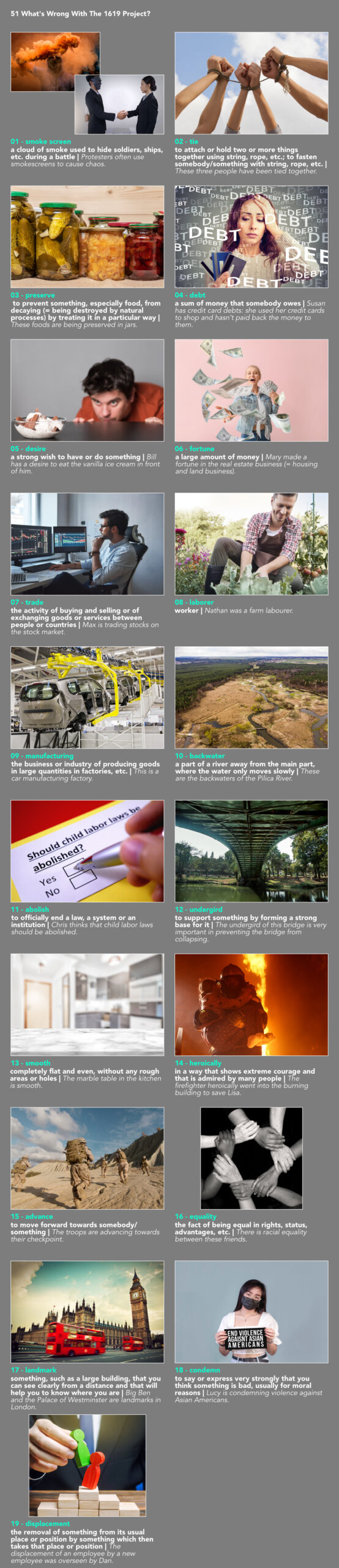
52 Greater leap of faith: Multiverse vs. God (steps 1, 3 and 5)
How did we get here? I mean, literally. Not just you and me, but the whole shebang. How is any kind of life possible? The universe is a hostile place—solar flares, cosmic rays, asteroids flying about. The odds against our existence are truly astronomical.
Take it from me—I’m an astrophysicist. My job is to look out into space, at stars and galaxies, trying to answer these basic how-did-the-universe-come-to-be questions.
Well, those who have a religious faith have an answer: God.
The earth’s distance from the sun, the size of the atom, and a thousand other things large and small that allow us to live and to breathe and to think all seem perfectly tuned for our existence. To many, this design suggests a designer. But from a purely scientific point of view, the faithful have a big problem: They can offer no indisputable proof for this belief.
Because of the lack of hard evidence, it’s probably not surprising that over 70% of the members of the National Academy of Sciences declare themselves to be atheists.
But they have a big problem, too.
Absent a creator, how do they account for the existence of the universe, of planet earth, of human consciousness? How do they account for the existence of …anything?
Well, turns out they have an answer. And it’s become all the rage in scientific circles.
It’s called the “multiverse,” and according to many scientists, our universe isn’t the whole ball game; far from it. These scientists argue that there are an awful lot of universes out there—not just one or two, but an infinite number.
Let me explain:
13.8 billion years ago, there was a Big Bang—from something unimaginably small (we don’t know exactly what), the universe exploded into existence. How did it happen? Why did it happen? Doesn’t matter. ‘Cause it happened.
Immediately after the Big Bang, the universe underwent a rapid expansion. Think of a gush of bubbles exploding from a seriously shaken soda can just after it’s popped open. Cosmologists call this the Theory of Inflation.
As the universe inflates and expands—the bubble universes grow and separate to become their own distinct entities, each with their own unique properties. In other words, new universes are spawned—and not just a handful…an infinite number of them.
Some of these universes would be too cold for life, and some too hot. But, with an infinite number, surely one is bound to get it just right. In short, you and I are just an accident that, given enough universes, was inevitable.
But, wait—there’s more. Because there are so many universes, it’s very likely, according to the multiverse scenario, that everything that could possibly happen does happen in one universe or another. That girlfriend who broke up with you? You’re married to her in another universe.
Does this sound a bit far-fetched? A little science-fictiony?
Well, not to Nobel Prize-winning scientists like Steven Weinberg or the famed cosmologist Stephen Hawking, as well as a myriad of others who whole-heartedly endorse it.
But here’s what’s really surprising: They endorse it knowing there’s not a single shred of hard scientific evidence that supports it. And how can there be? There’s no way we can access another universe.
In short, a vast number of the world’s most eminent scientists believe in something that hasn’t been, and in all likelihood, will never be proven. How does that sound to you?
Probably the same way it sounds to the distinguished physicist Paul Davies:
“Invoking an infinity of unseen universes to explain the unusual features of the one we do see is just as [made up] as invoking an unseen Creator. The multiverse theory may be dressed up in scientific language, but in essence it requires the same leap of faith.”
Or, as G.K. Chesterton quipped: “When men stop believing in God, they don’t believe in nothing; they believe in anything.” For multiverse believers, this is literally true: the same scientists who reject God’s existence due to lack of evidence pin their hopes on a theory so all-inclusive and vague it can never be refuted.
Those who believe God created the universe are intellectually honest enough to admit that they do so on the basis of faith. But those who believe in the multiverse are also keeping the faith. They just don’t admit it.
So, let me ask you, who’s taking the bigger leap?
I’m Brian Keating, Professor of Physics at the University of California, San Diego, for Prager University.
How did we get here? I mean, literally. Not just you and me, but the whole shebang. How is any kind of life possible? The universe is a hostile place—solar *flares, cosmic *rays, asteroids flying about. The odds against our existence are truly astronomical.
the whole shebang: the whole thing; everything | 2 burgers, fries and chips: you can buy the whole shebang for just £8.
hostile: aggressive or unfriendly and ready to argue or fight | The employees were hostile to the new working conditions.
flare1: to burn brightly, but usually for only a short time or not steadily | The match flared.
ray2: a narrow line of light, heat or other energy | Many rays of light entered the cave through the holes above.
existence: the state or fact of being real or living or of being present | Lucy was not aware of Patrick’s existence until they met at school.
Take it from me—I’m an astrophysicist. My job is to look out into space, at stars and galaxies, trying to answer these basic how-did-the-universe-come-to-be questions.
Well, those who have a religious faith have an answer: God.
The earth’s distance from the sun, the size of the atom, and a thousand other things large and small that allow us to live and to *breathe and to think all seem perfectly *tuned for our existence. To many, this design suggests a designer. But from a purely scientific point of view, the faithful have a big problem: They can offer no indisputable proof for this belief.
breathe3: to take air into your lungs and send it out again through your nose or mouth | Mark is breathing in fresh air.
tune4: A) to make changes to a musical instrument so that it plays at the correct pitch (= not higher or lower) | Fred is tuning his guitar.
- B) to prepare or change something so that it is suitable for a particular situation | The president’s speech was tuned to what the audience wanted to hear.
purely: only; completely | I saw the president in a local shop purely by chance.
indisputable proof: a fact or piece of information that shows that something exists or is true, and impossible to doubt | There is indisputable proof for the existence of gravity.
Because of the lack of *hard evidence, it’s probably not surprising that over 70% of the members of the National Academy of Sciences *declare themselves to be atheists.
hard evidence5: facts that are definitely true and do not need to be questioned | Matt, who robbed a bank and fired shots with a gun, left hard evidence with his fingerprints on the crime scene.
declare6: to announce something clearly, firmly, publicly, or officially | Jerry declared that he was in love.
But they have a big problem, too.
*Absent a creator, how do they account for the existence of the universe, of planet earth, of human consciousness? How do they account for the existence of …anything?
absent7: without | Absent a new plan, the project Steve is working on is going to be given to someone else.
account (for sth): to be the explanation or cause of something | The rainy weather accounted for the lack of ice cream vans in our neighbourhood.
consciousness: the state of being able to use your senses and mental powers to understand what is happening | Humans have higher levels of consciousness than animals.
Well, turns out they have an answer. And it’s become *all the rage in scientific *circles.
turn out: to be known or discovered finally and surprisingly | The truth turned out to be very weird.
(be) all the rage8: to be very popular and fashionable | In the 2010s, the iPhone was all the rage.
circle9: a group of people who are connected because they have the same interests, jobs, etc. | Lucy is favoured in her circle of friends.
It’s called the “multiverse,” and according to many scientists, our universe isn’t the whole ball game; far from it. These scientists argue that there are an awful lot of universes out there—not just one or two, but an *infinite number.
the whole ball game: the main or decisive factor, event, etc. | Luck is the whole ball game when it comes to winning national lotteries with a single ticket.
infinite10: without limits; without end | It is argued that there are an infinite number of galaxies and so an infinite number of stars.
Let me explain:
13.8 billion years ago, there was a Big Bang—from something unimaginably small (we don’t know exactly what), the universe exploded into existence. How did it happen? Why did it happen? Doesn’t matter. ‘Cause it happened.
unimaginably: in a way that is impossible to imagine | The size of space is unimaginably large.
Immediately after the Big Bang, the universe underwent a rapid *expansion. Think of a *gush of bubbles exploding from a seriously shaken soda can just after it’s popped open. Cosmologists call this the Theory of Inflation.
undergo: to experience something, especially a change or something unpleasant | Lisa underwent laser eye surgery .
expansion11: an act of increasing or making something increase in size, amount or importance | Larry’s business is expanding to other countries all over the globe.
gush12: to flow or pour suddenly and quickly out of a hole in large amounts | Water is gushing out of the fire hydrant.
As the universe *inflates and expands—the bubble universes grow and separate to become their own *distinct entities, each with their own unique properties. In other words, new universes are spawned—and not just a handful…an infinite number of them.
inflate13: to fill something or become filled with gas or air | Mary is inflating the balloon.
distinct14: clearly different | Even though these leaves look the same at first sight, they are all distinct from each other.
entity: something that exists separately from other things and has its own identity | Hip hop is a major commercial entity now (= it is a business, not just a type of music).
property: a quality or characteristic that something has | Some plants, such as the Aloe Vera, have medical properties.
spawn: to cause something new, or many new things, to grow or start suddenly | The death of Kennedy spawned many books.
Some of these universes would be too cold for life, and some too hot. But, with an infinite number, surely one is bound to get it just right. In short, you and I are just an accident that, given enough universes, was *inevitable.
bound: certain or likely to happen, or to do or be something | We have worked so hard on the school project that we are bound to get a good grade.
given: when you consider something | Given his age, he is very engaged in sports.
inevitable15: that you cannot avoid or prevent | At this point in time, it is inevitable that the ball will hit the baseball bat.
But, wait—there’s more. Because there are so many universes, it’s very likely, according to the multiverse scenario, that everything that could possibly happen does happen in one universe or another. That girlfriend who broke up with you? You’re married to her in another universe.
scenario: an outline for a series of events, real or imagined | Under the worst case scenario, Marie will get into a car crash.
Does this sound a bit far-fetched? A little science-fictiony?
far-fetched: very difficult to believe | Michael’s story about his afternoon seems far-fetched; he says he’s stopped two bank robberies.
Well, not to Nobel Prize-winning scientists like Steven Weinberg or the *famed cosmologist Stephen Hawking, as well as a myriad of others who whole-heartedly *endorse it.
famed16: very well known | Las Vegas is famed for its casinos.
myriad: extremely large in number | Mary faced a myriad of problems in her school.
endorse17: A) to say in an advertisement that you use and like a particular product so that other people will want to buy it | Georgina is endorsing a perfume.
- B) to say publicly that you support a person, statement or course of action | Bill endorsed a ban on American civilians having guns.
But here’s what’s really surprising: They endorse it knowing there’s not a single *shred of hard scientific evidence that supports it. And how can there be? There’s no way we can access another universe.
shred18: A) a small thin piece that has been torn or cut from something | Shreds of cheese are being dropped into the wooden bowl.
- B) a very small amount of something | There isn’t a shred of evidence to support Johnny’s claim.
access: to reach, enter or use something | There was access to the garage through a door in the living room.
In short, a vast number of the world’s most *eminent scientists believe in something that hasn’t been, and in all likelihood, will never be proven. How does that sound to you?
eminent19: famous and respected, especially in a particular profession | Sir Winston Churchill is an eminent politician in the West.
Probably the same way it sounds to the distinguished physicist Paul Davies:
distinguished: very successful and admired by other people | Daryl is a distinguished architect.
“Invoking an infinity of unseen universes to explain the unusual features of the one we do see is just as [made up] as invoking an unseen Creator. The multiverse theory may be dressed up in scientific language, but in essence it requires the same leap of faith.”
invoke: to mention a person, a theory, an example, etc. to support your opinions or ideas | Lisa likes to invoke distinguished professors to back up her theories.
leap of faith: a belief in something that is not known or has not been done before | Danny’s theories required a leap of faith.
Or, as G.K. Chesterton quipped: “When men stop believing in God, they don’t believe in nothing; they believe in anything.” For multiverse believers, this is literally true: the same scientists who reject God’s existence due to lack of evidence *pin their hopes on a theory so all-inclusive and vague it can never be refuted.
pin20: a short thin piece of stiff wire with a sharp point at one end and a round head at the other, used especially for fastening together pieces of cloth when sewing | These are different pins.
pin your hopes: to hope very much that something or someone will help you to achieve what you want | The soldiers pinned their hopes on the president to stop the war.
vague: not having or giving enough information or details about something | Katie was vague about what she would do next Christmas.
refute: to prove that something is wrong | Mark wants to refute Einstein’s theories.
Those who believe God created the universe are intellectually honest enough to *admit that they do so on the basis of faith. But those who believe in the multiverse are also keeping the faith. They just don’t admit it.
admit21: to agree, often unwillingly, that something is true | Joseph admitted his mistake and he is asking for forgiveness.
So, let me ask you, who’s taking the bigger leap?
I’m Brian Keating, Professor of Physics at the University of California, San Diego, for Prager University.

53 War on Boys (steps 1, 3 and 5)
Being a normal boy is a serious liability in today’s classroom. Boys tend to be disorganized and restless. Some have even been known to be noisy and hard to manage. Sound like any boy you know?
But increasingly, our schools have little patience for what only a couple of decades ago would have been described as “boyishness.” As psychologist Michael Thompson has aptly observed: “Girls behavior is the gold standard in schools. Boys are treated like defective girls.”
As a result, these “defective girls” are not faring well academically. Compared with girls, boys earn lower grades, win fewer honors they’re are far less likely to go to college. Boys are languishing academically, while girls are prospering. In an ever more knowledge-based economy, this is not a recipe for a successful society.
We need to start thinking about how we can make our grade school classrooms more boy-friendly. Well, here are four reforms that would make a very good start.
- Turn boys into readers.
In all age groups, across all ethnic lines, boys score lower than girls on national reading tests. Good reading skills — need I say? — are critical to academic and workplace success. A major study in the UK discovered, not surprisingly, that girls prefer fiction, magazines, and poetry while boys prefer comics and non-fiction. Boys whose eyes glaze over if forced to read Little House on the Prairie may be riveted by the Guinness Book of Records. Boys will read if given materials that interest them. If you’re looking for suggestions for books that have proved irresistible to boys go to guysread.com.
- Inspire the male imagination.
Celebrated writing instructor Ralph Fletcher contends that too many teachers take what is called “the confessional poet” as the classroom ideal. Personal narratives full of emotions and self-disclosure — these are stories girls commonly write — and these are prized; whereas action stories describing, say, a skateboard competition or a monster devouring a city, these are not. I recently read about a third-grader in Southern California named Justin who loved science-fiction, pirates, and battles.
An alarmed teacher summoned his parents to school to discuss the picture the 8-year-old had drawn of a sword fight — which included several decapitated heads. The teacher expressed grave “concern” about Justin’s “values.” The boy’s father was astonished, not by his son’s drawing which to him was typical boy stuff, but by the teacher’s overwrought — and female-centered — reaction.
If boys are constantly subject to disapproval for their interests and enthusiasms they are likely to become disengaged and lag further behind. Our schools need to work with, not against, the kinetic imaginations of boys.
- Zero out zero-tolerance.
Boys are nearly five times more likely to be expelled from preschool than girls. And in grades K-12, boys account for nearly 70% of suspensions, now this is often for minor acts of insubordination and sometimes for entirely innocent behavior. Hardly a week goes by without a news story about a young boy running afoul of a school’s zero-tolerance policy.
Josh Welch, age 7, was recently sent home from his Maryland school for nibbling off the corners of a strawberry Pop-Tart into shape it into a gun. Josh — like many other boys punished for violating zero-tolerance policies — was guilty of nothing more than being a typical 7-year old boy.
- Bring back recess.
Believe it or not, recess may soon be a thing of the past. According to research summarized by Science Daily, since the 1970s, schoolchildren have lost close to 50% of their unstructured outdoor playtime. And much-loved games have vanished from school yards. In schools throughout the country, games like dodge ball, red rover, even tag have all but disappeared; too damaging to self-esteem or too “violent” being the usual excuse. One popular classroom guide suggests tug-of-war be replaced with “tug of peace.” Boys need to work off their energy. They need to be free to play games they enjoy. And keeping them cooped up inside all day will not help them learn.
As our schools become more feelings centered, more competition-free, more sedentary, they move further away from the needs of boys. We need to reverse the boy-averse trends. Male underachievement is everyone’s concern. These are our sons. These are the young men with whom our daughters will build a future. If boys are in trouble, so are we all.
I’m Christina Hoff Sommers of the American Enterprise Institute for Prager University.
Being a normal boy is a serious liability in today’s classroom. Boys tend to be disorganized and *restless. Some have even been known to be noisy and hard to manage. Sound like any boy you know?
liability: anything that hurts your/someone’s chances of success or that causes difficulties | Not having a website for our business is a serious liability in our company.
tend (to do/be): to be likely to do something or to happen because this is what often or usually happens | James tends to have a sarcastic reply to questions in discussions with his friends.
restless1: unable to stay still or be happy where you are, because you are bored or need a change | Linda’s children are being restless on this Saturday morning.
But increasingly, our schools have little patience for what only a couple of decades ago would have been described as “boyishness.” As psychologist Michael Thompson has aptly observed: “Girls behavior is the gold standard in schools. Boys are treated like *defective girls.”
aptly: in a way that is suitable or appropriate in the circumstances | In 1975 the US carried out the aptly named “Operation Babylift”: children (including babies) were evacuated from South Vietnam by military airplanes.
treat: to behave in a particular way towards somebody/something | His parents treated him like a child.
defective2: having a fault or faults; not perfect or complete | The wire of my phone charger is defective.
As a result, these “defective girls” are not faring well academically. Compared with girls, boys earn lower *grades, win fewer honors, they’re are far less likely to go to college. Boys are languishing academically, while girls are *prospering. In an ever more knowledge-based economy, this is not a recipe for a successful society.
fare well, badly, better, etc. : to be successful/unsuccessful in a particular situation | Lisa fared much better in her maths exams than everyone else in her class: she got better grades than everyone else.
grade3: a mark given in an exam or for a piece of school work | Jack has just got his homework back from the teacher; his grade for it is an A+.
honors: The term “honors course” is a common label applied to courses, predominantly at the high school level, that are considered to be more academically challenging (= harder) and prestigious | Fred took an honors course in high school and did well in it.
languish: to be weak or fail to improve | The steel industry in the UK languished after the 1980s.
prospering4: (of a person or a business) to be or become successful | Tom’s business is prospering now that they got a big new client.
We need to start thinking about how we can make our grade school classrooms more boy-friendly. Well, here are four reforms that would make a very good start.
- Turn boys into readers.
In all age groups, across all ethnic lines, boys score lower than girls on national reading tests. Good reading skills — need I say? — are critical to academic and workplace success. A major study in the UK discovered, not surprisingly, that girls prefer fiction, magazines, and *poetry while boys prefer comics and non-fiction. Boys whose eyes *glaze over if forced to read Little House on the Prairie may be *riveted by the Guinness Book of Records. Boys will read if given materials that interest them. If you’re looking for suggestions for books that have proved irresistible to boys go to guysread.com.
poetry5: poems in general | I found an old vintage poetry book on a park table.
glaze over6: if a person’s eyes glaze or glaze over, the person begins to look bored or tired | Jonah’s eyes glazed over as he listened to Tom.
rivet7: to hold somebody’s interest or attention so completely that they cannot look away or think of anything else | Caleb is riveted by a new business book.
irresistible: so strong that it cannot be stopped or resisted | Johnny’s arguments were irresistible, so I could not argue with any of them. / The cake looked irresistible to me, so I had to eat it.
- Inspire the male imagination.
Celebrated writing instructor Ralph Fletcher contends that too many teachers take what is called “the confessional poet” as the classroom ideal. Personal narratives full of emotions and self-disclosure — these are stories girls commonly write — and these are *prized; whereas action stories describing, say, a skateboard competition or a monster *devouring a city, these are not. I recently read about a third-grader in Southern California named Justin who loved science-fiction, *pirates, and battles.
contend: to say that something is true or is a fact | Jack’s lawyer contended that he was nowhere near the bank at the time of the robbery.
confessional: a private place in a church where a priest listens to people making confessions (= a private statement to a priest about the bad things that you have done) | Church members mostly go to the confessional on Sundays.
confessional poet: a poet that writes poems focusing on the poet’s personal psychological experiences and battles – often from childhood – or battles with mental illness or breakdown | Martha, my aunt, is a confessional poet.
self-disclosure: the act of making something about yourself known | Some believe that self-disclosure is an important part in making new relationships.
prized8: very valuable to somebody | Larry’s coin collection is prized among coin collectors.
devour9: to destroy somebody/something | The flames are devouring the house.
pirate10: a person who sails in a ship and attacks other ships in order to steal from them | Steve is a pirate.
An alarmed teacher summoned his parents to school to discuss the picture the 8-year-old had drawn of a sword fight — which included several decapitated heads. The teacher expressed grave “concern” about Justin’s “values.” The boy’s father was astonished, not by his son’s drawing which to him was typical boy stuff, but by the teacher’s *overwrought — and female-centered — reaction.
summon: to order someone to come to or be present at a particular place | When Sarah was 15, she was summoned to the headmaster’s office.
decapitate: to cut off somebody’s head | The criminal was decapitated in the movie.
grave: (of situations, feelings, etc.) very serious and important; giving you a reason to feel worried | The consequences will be grave if we do not prepare for the tornado.
overwrought11: very worried and upset; excited in a nervous way | Sally is overwrought about her job interview the next day.
If boys are constantly subject to disapproval for their interests and enthusiasms they are likely to become *disengaged and lag further behind. Our schools need to work with, not against, the kinetic imaginations of boys.
subject to sth: to make somebody/something experience, suffer or be affected by something, usually something unpleasant | Danny is subject to ridicule on schooldays.
disengaged12: not involved with somebody/something or not interested in them/it | Evelyn and Lucy are disengaged from the lesson.
lag: to move or develop slowly or more slowly than other people, organizations, etc. | Kevin lags behind his classmates in physics.
kinetic imagination: the creation of the feeling of movements while physically moving. For example, a skier may imagine the feel of the course while standing, shifting weight, and moving the shoulders etc. | Johnny often uses his kinetic imagination while reading an interesting book. (= He often plays out what he reads by doing some movements.)
- Zero out zero-tolerance.
Boys are nearly five times more likely to be expelled from preschool than girls. And in grades K-12, boys account for nearly 70% of suspensions, now this is often for minor acts of insubordination and sometimes for entirely innocent behavior. Hardly a week goes by without a news story about a young boy *running afoul of a school’s zero-tolerance policy.
expel: to officially make somebody leave a school or an organization | Mark has been expelled .
K-12: (in the US) relating to education from kindergarten (= the class that prepares children for school) to 12th grade | John and his siblings are all in K-12.
suspension: the act of officially removing somebody from their job, school, team, etc. for a period of time, usually as a punishment | The threat of suspension never stops Timmy from acting badly in school.
insubordination: the act of refusing to obey orders or show respect for somebody who has a higher rank | Jenna and Mike were sent to the headmaster for insubordination in their math class (= they misbehaved and disrespected their teacher).
innocent: not guilty of a crime, etc.; not having done something wrong | Someone has robbed the bank, but Greg is innocent.
running afoul of sth13: to do something that is not allowed by a law or rule, or to do something that people in authority think is bad | Mike is running afoul of the theft laws of the UK.
Josh Welch, age 7, was recently sent home from his Maryland school for *nibbling off the corners of a strawberry *Pop-Tart into shape it into a gun. Josh — like many other boys punished for violating zero-tolerance policies — was guilty of nothing more than being a typical 7-year old boy.
nibble14: to bite something with small bites, especially food | The squirrel is nibbling on a seed.
- Bring back recess.
Believe it or not, recess may soon be a thing of the past. According to research summarized by Science Daily, since the 1970s, schoolchildren have lost close to 50% of their unstructured outdoor playtime. And much-loved games have vanished from school yards. In schools throughout the country, games like *dodgeball, *red rover, even *tag have all but disappeared; too damaging to *self-esteem or too “violent” being the usual excuse. One popular classroom guide suggests *tug-of-war be replaced with “tug of peace.” Boys need to work off their energy. They need to be free to play games they enjoy. And keeping them *cooped up inside all day will not help them learn.
recess: a period of time between lessons at school | Most children cannot wait until their lessons end so that they can get to recess because they may then talk with their friends.
unstructured: without structure or organization | Lisa’s essay was unstructured. / Don went to an unstructured interview.
dodgeball15: a game in which teams of players form circles and try to hit other teams with a ball | These girls are playing dodgeball during recess.
red rover16: a game where two teams with each team hold hands to form a line; team one decides who from the other team they want to call over, and shouts, “red rover, red rover, send (name) on over!” The chosen player then runs toward the other team, trying to break through the clasped hands of two teammates. If the runner can’t do so, s/he has to join that team. But if s/he breaks the link, one of the two people from the broken link is taken to the other team. | The children are playing red rover outside.
tag17: a children’s game in which one child runs after the others and tries to touch one of them | Sarah and Michael are playing tag in the park.
all but: almost | The movie was all but finished when Jerry arrived.
self-esteem18: a feeling of being happy with your own character and abilities | The cat has an exaggerated (seeming larger, more important, better than it really is) self-esteem.
tug-of-war19: a sporting event in which two teams pull at opposite ends of a rope until one team drags the other over a line on the ground | Tug-of-war is being played on the field by a group of friends.
cooped up20: kept inside, or kept in a place that is too small | Larry feels like he is cooped up too much in the office.
As our schools become more feelings centered, more competition-free, more *sedentary, they move further away from the needs of boys. We need to reverse the boy-averse trends. Male underachievement is everyone’s concern. These are our sons. These are the young men with whom our daughters will build a future. If boys are in trouble, so are we all.
sedentary21: (of work, activities, etc.) in which you spend a lot of time sitting down | Jeremy has a sedentary lifestyle. He watches TV all day.
boy-averse: strongly disliking or opposed to boys | The education system is boy-averse according to some.
underachievement: the fact of doing less well than you could do, especially in school work | The headmaster of my school is trying to eliminate (= remove or get rid of; stop) underachievement among her school’s students.
I’m Christina Hoff Sommers of the American Enterprise Institute for Prager University.

54 How to Steal an Election: Mail-In Ballots (steps 1, 3 and 5)
Is there a problem with universal mail-in balloting?
Sounds simple enough: You fill out a ballot, stick it in the mail; somebody counts it on Election Day. In fact, we already do that with absentee ballots, right? So why would universal mail-in balloting be any different?
Well, the biggest difference is that with absentee ballots, the voter specifically asks for a ballot.
With universal mail-in balloting, ballots are mailed out en masse. Millions of people who would normally go to the polls vote by mail instead.
No national election has ever been conducted this way. And there are very good reasons to be concerned that one ever should.
Reason #1:
Bureaucratic incompetence.
I don’t think I have to sell you on the idea that when the government bureaucracy takes on a big new project with little preparation, the results aren’t pretty. We’ve seen those results as it relates to mail-in balloting already.
Wisconsin was one of the first states to hold a primary in the coronavirus era. It saw an influx in mail-in votes as a result. Predictably, this led to serious snafus: Thousands of requested ballots were not sent; 1,600 ballots were found in a mail processing center the day after the election; 23,000 votes were rejected due to missing signatures or other missing information.
And those are the mistakes we know about in just one state and in one primary election, when fewer people than in the general election typically bother to cast a vote.
In Pennsylvania, where they delayed the date of their primary to get better prepared for the expected increase in mail-in balloting, they still couldn’t handle the volume. Half of Philadelphia’s votes were still uncounted a week after the election.
In Virginia, more than half a million applications for ballots were mailed with incorrect information. Some of the applications went to the wrong addresses, some went to dead voters, one even went to a pet.
Under the best of circumstances, the bureaucracy struggles with mail-in balloting. Under less than the best of circumstances? That’s not a scenario we want to face.
Which brings us to reason #2 for concern: shoddy security.
Here’s what the New York Times said about voting by mail in an article in 2012. Keep in mind, they were talking about traditional absentee balloting, not a mass-mailing of ballots.
“There is a bipartisan consensus that voting by mail, whatever its impact, is more easily abused than other forms.”
No kidding.
In May 2020, New Jersey conducted its first ever all-mail election. One month later, two elected officials were among four charged with criminal conduct involving mail-in ballots. One operative confessed to stealing ballots, both completed and uncompleted, out of mailboxes. Other operatives compiled a database of signatures of prospective voters, and then used them to fill out ballots on behalf of their preferred candidates.
And we only know about it because they got caught.
Election fraud only figures to get easier because of a new weapon in the cheater’s arsenal— ballot harvesting. This is the term for when a third party—usually a campaign worker or activist—goes to people’s homes and collects their ballots.
With ballot harvesting, you don’t even have to put your ballot in the mailbox; vote harvesters will pick it up for you. The opportunities for mischief—say, pressuring people to vote a certain way, destroying ballots, or filling out ballots for those who didn’t bother to vote—are endless.
Vote harvesting that targets senior citizens for their ballots even has its own name: “granny farming.”
Reason #3 to be concerned:
The likelihood of long delays in determining final results.
Americans are used to knowing who won and who lost within hours of the polls closing on Election Day. Of course, some close races take longer to sort out. But the longer it takes, the less legitimate an election seems.
That is exactly what happened in the 2000 presidential election—Bush v. Gore. Then, the dispute was focused on a single state: Florida. It was finally settled by the Supreme Court over a month later.
If we have a national election that relies heavily on mail-in voting, we’re almost certain to see a significant delay before we get the final results. From the post office to the vote counters, the system is just not set up for it.
In a close contest involving massive mail-in voting, lawsuits disputing the results are inevitable. This could delay final results even longer. And instead of involving a single state, it’s likely to involve multiple states. This is a recipe for civil unrest as frustration and fear of a stolen election grips voters.
Bureaucratic incompetence. Shoddy security. Long delays.
These are just some of the concerns any reasonable person should have over universal mail-in balloting.
What’s the solution?
Simple. If you need to vote absentee, request a ballot. Otherwise, vote like you always have: in person.
I’m Eric Eggers, investigative reporter for the Government Accountability Institute, for Prager University.
Is there a problem with universal mail-in *balloting?
ballot1: to vote secretly about something | Susie is balloting for a new President.
Sounds simple enough: You fill out a ballot, stick it in the mail; somebody counts it on Election Day. In fact, we already do that with absentee ballots, right? So why would universal mail-in balloting be any different?
absentee: someone who is not at work or at the place where they are supposed to be | There are usually a lot of absentees from the classroom in winter because of illness.
Well, the biggest difference is that with absentee ballots, the voter specifically asks for a ballot.
specifically: in a detailed and exact way | Mark, a parent of a high school student, had specifically asked his son’s teacher to keep an eye on his son (= to take care of him/make sure the son is not harmed).
With universal mail-in balloting, ballots are mailed out *en masse. Millions of people who would normally go to the *polls vote by mail instead.
en masse2: all together, and usually in large numbers | Sheep walked out to the middle of the road en masse.
the polls3: the places where people vote in a political election | Lisa and her friends are at the polls.
No national election has ever been conducted this way. And there are very good reasons to be *concerned that one ever should.
concerned4: worried | Stephen is concerned about his financial troubles.
Reason #1:
Bureaucratic incompetence.
incompetence: the lack of skill or ability to do your job or a task as it should be done | Police incompetence can cause major problems.
I don’t think I have to sell you on the idea that when the government bureaucracy takes on a big new project with little preparation, the results aren’t pretty. We’ve seen those results as it relates to mail-in balloting already.
Wisconsin was one of the first states to hold a primary in the coronavirus era. It saw an *influx in mail-in votes as a result. Predictably, this led to serious snafus: Thousands of requested ballots were not sent; 1,600 ballots were found in a mail processing center the day after the election; 23,000 votes were *rejected due to missing signatures or other missing information.
primary: (in the US) an election in which people in a particular area vote to choose a candidate for a future important election | The presidential primary elections will be starting soon.
influx5: the fact of a lot of people, money or things arriving somewhere | There was an influx of zebras and antelopes in the area.
snafu: a situation in which nothing happens as planned | Michael was to blame for the snafu that nearly bankrupted the airline company.
reject6: to refuse to accept, use, or believe something or someone | Fred rejected the envelope full of extra money that a person tried to bribe him with in his office.
And those are the mistakes we know about in just one state and in one primary election, when fewer people than in the general election typically bother to *cast a vote.
bother: to spend time and/or energy doing something | “Should we wait for Thomas to arrive before we start the meeting?” “No, don’t bother.”
cast7: to throw somebody/something somewhere | Danny cast the anchor into the sea.
cast a vote: to vote | Maggie did not cast her vote on the day of the election because she completely forgot about it.
In Pennsylvania, where they delayed the date of their primary to get better prepared for the expected increase in mail-in balloting, they still couldn’t handle the volume. Half of Philadelphia’s votes were still uncounted a week after the election.
In Virginia, more than half a million applications for ballots were mailed with incorrect information. Some of the applications went to the wrong addresses, some went to dead voters, one even went to a pet.
Under the best of circumstances, the bureaucracy struggles with mail-in balloting. Under less than the best of circumstances? That’s not a scenario we want to face.
circumstances: the conditions and facts that are connected with and affect a situation, an event or an action | Under normal circumstances, a doctor is able to give good advice to ill patients.
Which brings us to reason #2 for concern: shoddy security.
shoddy: (of goods, work, etc.) made or done badly and with not enough care | I paid for a luxury chair on the internet but received a shoddy chair instead.
Here’s what the New York Times said about voting by mail in an article in 2012. Keep in mind, they were talking about traditional absentee balloting, not a mass-mailing of ballots.
“There is a bipartisan consensus that voting by mail, whatever its impact, is more easily abused than other forms.”
bipartisan: involving two political parties | The new government policy has got bipartisan support. (= both of the biggest political parties support it)
consensus: an opinion that all members of a group agree with | The Smith family has managed to reach consensus about which hotel they will stay in.
impact: an effect on somebody/something | Living a healthy lifestyle may have a positive impact on how long someone lives.
No kidding.
In May 2020, New Jersey conducted its first ever all-mail election. One month later, two elected officials were among four *charged with criminal conduct involving mail-in ballots. One operative *confessed to stealing ballots, both completed and uncompleted, out of mailboxes. Other operatives *compiled a database of signatures of prospective voters, and then used them to fill out ballots on behalf of their preferred candidates.
conduct: to organize and/or do a particular activity | The university conducts research into the effect that different vitamins have on sleep length.
charge8: to accuse somebody formally of a crime so that there can be a trial in court | The police are charging Matt with the robbery of a large bank.
confess9: to admit, especially formally or to the police, that you have done something wrong or illegal | Craig is confessing in writing to robbing a house.
compile10: to collect information in order to produce a book, list, etc. | Mick has compiled his favorite music hits ( successful pop songs) from the 1980s onto this audio cassette.
prospective: expected to do something or to become something; potential, possible | NIck is looking for prospective buyers for his old car.
And we only know about it because they got caught.
Election *fraud only figures to get easier because of a new weapon in the cheater’s arsenal— ballot harvesting. This is the term for when a third party—usually a campaign worker or activist—goes to people’s homes and collects their ballots.
fraud11: the crime of cheating somebody in order to get money, goods, etc illegally | Mary is a victim of credit card fraud; she is giving her credit card details to a person who wants to steal money from her.
With ballot harvesting, you don’t even have to put your ballot in the mailbox; vote harvesters will pick it up for you. The opportunities for mischief—say, pressuring people to vote a certain way, destroying ballots, or filling out ballots for those who didn’t bother to vote—are endless.
mischief: damage or harm | Joseph caused criminal mischief to the company.
Vote harvesting that targets senior citizens for their ballots even has its own name: “granny farming.”
Reason #3 to be concerned: The likelihood of long delays in determining final results.
likelihood: the chance of something happening; how likely something is to happen/ probability | The likelihood of rain is very high in the afternoon. (= it will probably rain)
Americans are used to knowing who won and who lost within hours of the polls closing on Election Day. Of course, some close races take longer to sort out. But the longer it takes, the less legitimate an election seems.
legitimate: allowed and acceptable according to the law; legal | “Is Joey’s business legitimate?”
That is exactly what happened in the 2000 presidential election—Bush v. Gore. Then, the dispute was focused on a single state: Florida. It was finally settled by the Supreme Court over a month later.
dispute: an argument between two people, groups or countries; discussion about a subject on which people disagree | The dispute between the company and people who bought its product was about customer rights; the customers wanted to get their money back.
If we have a national election that relies heavily on mail-in voting, we’re almost certain to see a significant delay before we get the final results. From the post office to the vote counters, the system is just not set up for it.
In a close *contest involving massive mail-in voting, lawsuits disputing the results are inevitable. This could delay final results even longer. And instead of involving a single state, it’s likely to involve multiple states. This is a recipe for civil *unrest as frustration and fear of a stolen election *grips voters.
contest12: a struggle to gain control or power | There is a contest between two people for the leadership of the company as only one of them can get the job.
dispute: to question whether something is true or legally or officially acceptable | No one in the company disputed that there is a problem in the company.
inevitable: that you cannot avoid or prevent; unavoidable | Some say that conflict in the Middle East is inevitable.
unrest13: a political situation in which people are angry and likely to protest or fight | There is growing unrest in North England.
grip14: A) to hold something tightly | Greg is gripping his hammer.
- B) (of an emotion or a situation) to have a powerful effect on somebody/something | Panic always grips Nancy when she has to take an airplane to travel.
Bureaucratic incompetence. Shoddy security. Long delays.
These are just some of the concerns any reasonable person should have over universal mail-in balloting.
What’s the solution?
Simple. If you need to vote absentee, request a ballot. Otherwise, vote like you always have: in person.
I’m Eric Eggers, investigative reporter for the Government Accountability Institute, for Prager University.
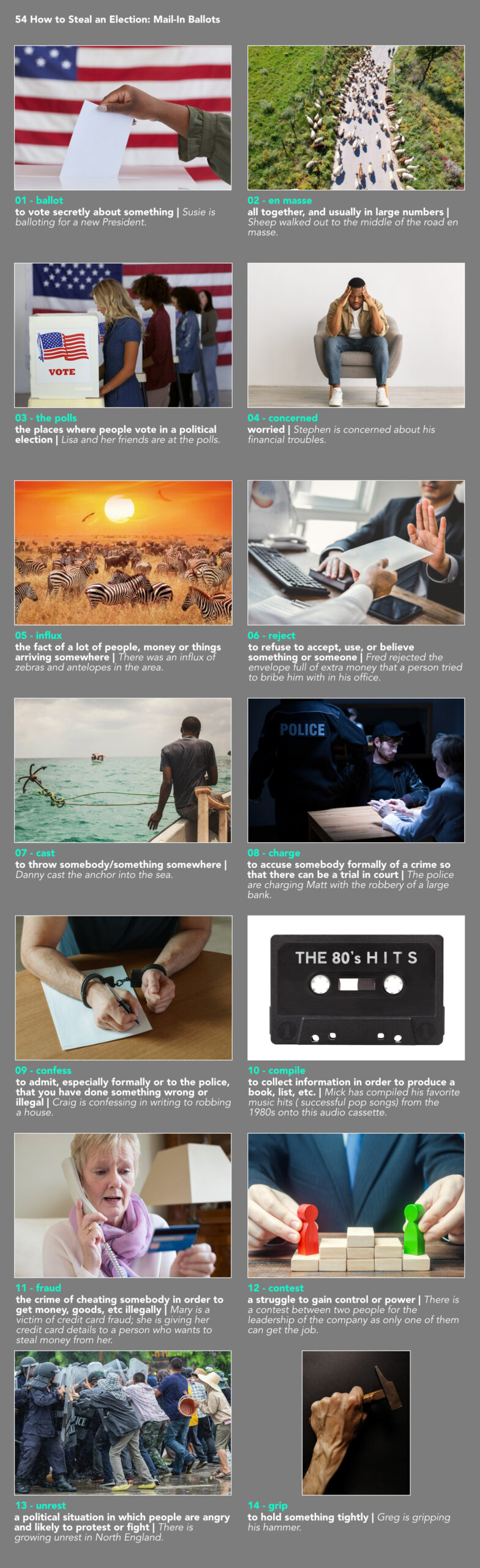
55 Who is Booker T. Washington? (steps 1, 3 and 5)
There have been many influential black leaders since the Civil War. They include Frederick Douglass, W.E.B. Du Bois and, of course, Martin Luther King.
But none had more influence in their time than Booker T. Washington did in his.
Known by his admirers as the “Modern Moses,” his role in helping blacks establish themselves after their liberation from slavery is a testament to the man and to America.
Booker T. Washington was born into slavery in 1856. He did not know the day or month of his birth, who his father was, or his last name. As a child, he was known only as Booker. He chose the name Washington.
He was nine years old when a Union soldier arrived on the plantation and announced that all slaves were free. The initial reaction to this announcement, Washington recalled, was elation and then…shock.
Yes, the Civil War was over; they were free. But free to do what?
The freed slaves, through no fault of their own, were simply unprepared for freedom. They needed to learn not only basic academic skills—reading, writing and arithmetic—but basic life skills like hygiene: how and why to bathe and brush their teeth.
The cause to which Washington dedicated his life was education. Practical education.
His journey began in 1872, seven years after the Civil War ended. He traveled 500 miles, most of it on foot, to a small Virginia school dedicated to the education of freed blacks, the Hampton Normal and Agricultural Institute.
Forced to spend all his meager funds on the grueling journey, he arrived only with the clothes on his back. The headmistress viewed his suitability as a student with open skepticism, but he wouldn’t budge. She finally gave him a chance to prove his worth in the form of a broom and a cleaning assignment. He passed her test and earned admission. He graduated with top honors.
Several years later, he was invited to begin what would become his life’s work, heading the Tuskegee Institute in Alabama. When he arrived, he assumed he’d walk onto a campus. But there was no campus—only a few shacks and a chicken coop. The school had almost no money. But it did have 30 eager students. And for Booker T. Washington, that was enough.
Under his leadership, they got to work. Every building, every desk, was built by the students themselves—brick by brick, piece by piece. This tied in perfectly with Washington’s philosophy of a practical education: students at Tuskegee, in addition to academic studies, had to master a trade.
He believed this led not only to racial uplift among blacks but to respect for blacks. His graduates would go out into the world with sought-after skills. They would be useful to their neighbors and become invaluable members of their communities.
“The individual who can do something that the world wants done,” Washington said, “will, in the end, make his way regardless of race.”
Washington distilled his philosophy into what became one of the most important speeches of the late 19th century, an address he delivered at the Atlanta Exposition in 1895. His theme was that blacks needed time to develop educationally and economically. Whites, Washington suggested, should help them in every way possible. This would be in the best interests of both races.
He also emphasized that blacks needed to recognize that social equality would not come swiftly. It could not be forced through political action alone. The civil rights the Constitution promised would evolve naturally from black achievement.
As he put it: “No race that has anything to contribute to the markets of the world is long in any degree ostracized.”
When he ended his speech, the large audience, a mix of blacks and whites, broke out in loud and sustained cheering. W.E.B. Du Bois, a leading black intellectual, captured the sentiment. He wrote in the black newspaper, the New York Age, that Washington’s speech “might be the basis of a real settlement between whites and blacks in the South.”
Sadly, it was not to be. In the ensuing years, southern whites put up more obstacles to black progress, not less. Among others, DuBois became increasingly impatient. A speech he had celebrated, he now belittled as “the Atlanta Compromise.”
So which opinion was correct? Du Bois’s initial praise, or his later criticism?
Washington himself remained resolute. He was first, last and always a pragmatist. He believed gradual improvements—improvements that blacks would earn through education, entrepreneurship, and personal responsibility—were the keys to black empowerment and ending racism.
It wasn’t fair. But it was reality.
Today, in an America that is open to and accepting of all races, Washington’s prescription for black success is more relevant than ever.
That made him a great leader—and a prophet.
I’m Derryck Green, fellow at Project 21, for Prager University.
There have been many influential black leaders since the Civil War. They include Frederick Douglass, W.E.B. Dubois and, of course, Martin Luther King.
influential: having a lot of influence on somebody/something | Kennedy was one of the most influential presidents of all time.
But none had more influence in their time than Booker T. Washington did in his.
Known by his *admirers as the “Modern Moses,” his role in helping blacks establish themselves after their liberation from *slavery is a testament to the man and to America.
admirer1: a person who finds someone or something attractive and pleasant to look at, especially a well-known person or thing | Michael is an admirer of Rudens’ paintings.
establish: to cause something or someone to be accepted in a place, position, etc. | With much hard work, Lisa has established herself as an expert in the field of cybersecurity.
slavery2: the activity of legally owning other people who are forced to work for or obey you | Slavery was common in the 1700s; these slaves had to crush coffee.
testament: proof of something | Danny is a living testament to the power of luck; he found the winning lottery ticket on the street.
Booker T. Washington was born into slavery in 1856. He did not know the day or month of his birth, who his father was, or his last name. As a child he was known only as Booker. He chose the name Washington.
He was nine years old when a Union soldier arrived on the *plantation and *announced that all slaves were free. The initial reaction to this announcement, Washington recalled, was elation and then…shock.
plantation3: a large area of land, especially in a hot country, where crops such as coffee, sugar, rubber, etc. are grown | This peanut plantation in Alabama has tens of thousands of peanut plants in it.
announce4: to make something known or tell people about something officially | Billy is using a megaphone to announce to the world that he is going on holiday.
recall: to remember something | Jeffrey happily recalled when he first used a jet-ski.
elation: a state of extreme happiness or excitement | There was a sense of elation on the streets of Brazil, when their football team won the World Cup in 2002.
Yes, the Civil War was over; they were free, but free to do what?
The freed slaves, through no fault of their own, were simply unprepared for freedom. They needed to learn not only basic academic skills—reading, writing and arithmetic—but basic life skills like *hygiene: how and why to *bathe and brush their teeth.
fault: the responsibility for something wrong that has happened or been done | The car accident was Billy’s fault; he was texting while driving.
unprepared: not prepared; not ready | Francesca was unprepared for her mathematics exam.
arithmetic: the type of mathematics that deals with the adding (e.g. 12+3), subtracting (108-56); multiplying (e.g. 3×8) and dividing (27/3) of numbers | Diana was great at arithmetic from a very young age.
hygiene5: the degree of cleanliness (= how clean you or your environment is) | Personal hygiene involves washing your hands.
bathe6: to wash something with water, especially a part of your body | If you bathe after a stressful day, it may calm you down.
The cause to which Washington dedicated his life was *education. Practical education.
cause: an idea or principle strongly supported by some people | Mother Teresa devoted herself to charitable causes.
dedicate his/her life: to give all of his/her energy, time, etc | Alfred dedicated his life to the pursuit of knowledge (= to try to get more knowledge).
education7: a process of teaching, training and learning, especially in schools, colleges or universities, to improve knowledge and develop skills | It is essential for kids to have a good education from a young age.
His journey began in 1872, seven years after the Civil War ended. He traveled 500 miles, most of it on foot, to a small Virginia school dedicated to the education of freed blacks, The Hampton Normal and Agricultural Institute.
Forced to spend all his meager *funds on the grueling journey, he arrived only with the clothes on his back. The *headmistress viewed his suitability as a student with open skepticism, but he wouldn’t budge. She finally gave him a chance to prove his worth in the form of a *broom and a cleaning assignment. He passed her test and earned admission. He *graduated *with top honors.
meager: (of amounts or numbers) very small or not enough | Jenna had a meager salary.
funds8: money that is available to be spent | Jared puts his emergency funds into a jar.
grueling: extremely tiring and difficult, and demanding great effort and determination | Mt Everest is a grueling climb.
headmistress9: a female teacher who is in charge of a school, especially a private school | Mark and his father are meeting the headmistress.
suitability: the fact of being acceptable (= good enough) or right for something or someone | No one doubted Janet’s suitability for the job.
open skepticism: open skepticism is not hidden | The idea that Matt could carry the fridge on his own was met with open skepticism from his wife.
budge: to change your opinion about something; to make somebody change their opinion | My uncle won’t budge on any of his political views.
broom10: a brush with a long handle, used for cleaning the floor | Mary is using a broom to clean her backyard patio.
assignment: a task or piece of work that somebody is given to do | Julie is required to complete all the assignments given in her class to pass her university course.
admission: permission to enter a place | Few people were given admission to the party.
graduate11: to get a degree, especially your first degree, from a university or college | All these students are excited because they are graduating today.
graduate with top honors12: graduate with the highest overall grades | Both Harry and his friend graduated with top honors in Physics.
Several years later he was invited to begin what would become his life’s work, heading the Tuskegee Institute in Alabama. When he arrived, he assumed he’d walk onto a *campus. But there was no campus—only a few *shacks and a *chicken coop. The school had almost no money. But it did have 30 *eager students. And for Booker T. Washington that was enough.
assume: to think or accept that something is true but without having proof of it | Wilson assumed that his daughter already cleaned her room; he was wrong.
campus13: the buildings of a college or university and the land that surrounds them | Many students study and live at the Radcliffe Quadrangle, Harvard’s undergraduate campus.
shack14: a small building, usually made of wood or metal, that has not been built well | Some people still have to live in shacks.
chicken coop15: a cage or building where you keep chickens | Some chickens are resting outside the chicken coop.
eager16: very interested and excited by something that is going to happen or about something that you want to do; showing this | Mary is so eager to see what her present is that she is peeking through her fingers.
Under his leadership, they got to work. Every building, every desk was built by the students themselves, *brick by brick, piece by piece. This tied in perfectly with Washington’s philosophy of a practical education: students at Tuskegee, in addition to academic studies, had to master a trade.
brick17: a rectangular block of hard material used for building walls and houses | According to the children’s story The Three Little Pigs, the big bad wolf could not destroy the house that was built of bricks.
tie in: to match or agree with something | What Johnny believed in perfectly tied in with the actions he took.
trade: a particular type of business | Bobby was a carpenter by trade.
master a trade: learn a trade | Some people believe that it takes years of deliberate practice to master a trade.
He believed this led not only to racial uplift among blacks but to respect for blacks. His graduates would go out into the world with sought-after skills. They would be useful to their neighbors and become invaluable members of their communities.
uplift: improvement of a person’s moral or spiritual condition | The pastor’s speech gave some moral uplift to those hearing the service.
(unsure if above def fits with context)
respect: a strong feeling of approval of somebody/something because of their good qualities or achievements | The leaders of the company were much respected by the workers.
sought-after: wanted by many people and usually of high quality or rare | He was one of the most sought out experts on cyber security.
invaluable: extremely useful | LeBron is an invaluable player for his basketball.
“The individual who can do something that the world wants done,” Washington said, “will, in the end, make his way regardless of race.”
regardless of: paying no attention to something/somebody; treating something/somebody as not being important | Regardless of what the critics say, our team will win today.
Washington distilled his philosophy into what became one of the most important speeches of the late 19th century, an address he *delivered at the Atlanta Exposition in 1895. His theme was that blacks needed time to develop educationally and economically. Whites, Washington suggested, should help them in every way possible. This would be in the best interests of both races.
distilled: to get or show only the most important part of something | The life of rockstars is often distilled to a page in a rock and roll magazine.
address: a formal speech that is made in front of an audience | In the United Kingdom, The Royal Address to the nation is a speech given by the Queen during significant national events.
delivered18: to give, direct, or aim something | Susie delivered a professional speech to the business leaders present in the audience.
exposition: a clear and full explanation of an idea or theory | The professor gave an exposition of his new theory about DNA.
He also emphasized that blacks needed to recognize that social equality would not come swiftly. It could not be forced through political action alone. The civil rights the Constitution promised would evolve naturally from black achievement.
emphasize: to show that something is very important or worth giving attention to | Johnny emphasized that he could not have been the thief because he was at home and he has an alibi.
social equality: a situation in which people of all races are treated fairly and in the same way | The group promoted social equality within the USA.
swiftly: quickly; after a very short time | The dog moved swiftly to his master.
forced: happening or done against somebody’s will | Jenny forced her teenage daughter to go to sleep at 6pm everyday.
evolve: to develop gradually, especially from a simple to a more complicated form; to develop something in this way | The idea for the company’s logo evolved from a comic book character.
achievement: a thing that somebody has done successfully, especially using their own effort and skill | Getting a university degree was one of Hannah’s highest achievements.
As he put it: “No race that has anything to contribute to the markets of the world is long in any degree ostracized.”
“No race that has anything to contribute to the markets of the world is long in any degree ostracized.” : To put it simply: races that contribute to the markets cannot be rejected for long.
When he ended his speech, the large audience, a mix of blacks and whites, broke out in loud and sustained cheering. W.E.B. DuBois, a leading black intellectual, *captured the sentiment. He wrote in the black newspaper the New York Age that Washington’s speech “might be the basis of a real settlement between whites and blacks in the South.”
sustained: continuing for a period of time without becoming less | Johnny was hiking at a sustained pace.
capture19 A: catch | Lisa captured some butterflies.
B: to succeed in accurately expressing a feeling, an atmosphere, etc. in a picture, piece of writing, film, etc. | The photographer captured their joy on camera.
sentiment: a feeling or an opinion, especially one based on emotions | Public sentiment was on the side of the president.
settlement: an official agreement that finishes an argument | There was a settlement between the two families.
Sadly, it was not to be. In the ensuing years, southern whites put up more *obstacles to black progress, not less. Among others, DuBois became increasingly impatient. A speech he had celebrated, he now belittled as the “the Atlanta Compromise.”
ensuing: happening after something and because of it | Johnny won the lottery and in the ensuing days he was extremely excited.
obstacle20: a situation, an event, etc. that makes it difficult for you to do or achieve something | Sometimes we can break through obstacles, and achieve our goals, just by trying hard enough.
belittled: to make somebody, or the things that somebody does, seem unimportant | Danny felt that his friend constantly belittled his achievements.
So, which opinion was correct? Du Bois’s initial praise or his later criticism?
Washington himself remained resolute. He was first, last and always a pragmatist. He believed gradual improvements—improvements that blacks would earn through education, entrepreneurship and personal responsibility—were the keys to black empowerment and ending racism.
resolute: strong and determined | His voice during his speech sounded resolute.
pragmatist: someone who deals with problems in a sensible way that suits the conditions that really exist, rather than following fixed theories, ideas, or rules | Evelyn was a political pragmatist.
entrepreneurship: the activity of making money by starting or running businesses, especially when this involves taking financial risks; the ability to do this | The government promoted entrepreneurship in schools.
It wasn’t fair. But it was reality.
Today, in an America that is open to and accepting of all races, Washington’s *prescription for black success is more relevant than ever.
prescription21: the act of telling someone else what they must have or do | Jack’s GP has written out a prescription of medicine that Jack is now collecting at the pharmacy.
That made him a great leader…and a prophet.
I’m Derryck Green, fellow at Project 21, for Prager University.

56 Facts don’t care about your feelings (steps 1, 3 and 5)
Vanderbilt University, November 2015: 200 students rise up to protest the white privilege and micro aggressions of the “racist,” “bigoted” Vanderbilt administration. The protestors don’t offer any specific examples of discrimination, but that doesn’t matter – what matters is that they feel victimized. The next day, a bag of dog poop shows up at the front door of the university’s Black Cultural Center. All hell breaks loose. Full of righteous indignation, student activist groups rush to Facebook to denounce the racist act. The police investigate; they quickly find the person responsible, but nobody is arrested.
You know why? Because it turns out that the bag of excrement wasn’t a racist attack. It was left by a blind girl with a service dog. She couldn’t find a trash can, so, wanting to do the responsible thing, she left the bag outside the door of a nearby building, knowing a janitor would pick it up and throw it away.
The student group did apologize – but then they added another charge against the administration: “The needs of students with disabilities on this campus are also marginalized.” Seriously – this is not a joke.
On the college campus today, feelings rule facts and victims are heroes. According to the left, all inequality in America is due to victimization. They start by claiming that all non-white people in America are victims of “white privilege.” Then come women. They’re all victims of the patriarchy. Then come gays, and lesbians and the transgendered – they’re all victims of our “heteronormative” and “homophobic” society.
But what if you haven’t actually been victimized by anybody? It doesn’t matter. To the left, so long as you feel victimized, you’re a victim. Even if you have never actually experienced discrimination, you’ve surely been targeted by “micro aggressions.” You know – nasty little words and phrases that weren’t meant to be insults, but just are.
If somebody asks you, “where are you from?” that’s considered a xenophobic micro aggression. They’re implying that you are a foreigner! If a man holds open a door for a woman – which, but the way, you’re supposed to do – that’s a sexist micro aggression because he’s treating her like she’s a helpless female. Of course, he’s also treating her like she’s a woman – but how would he know? And heaven forbid anybody address you by your biologically accurate pronoun. What if she identifies as a man?!?
In short, everyone is a victim – except, of course, straight, white males… Also, anybody who dares to disagree with the left. If you’re guilty of either of those crimes, you must be confronted, even if doing so requires actual aggression – like, say, a riot.
Here’s a trick the left plays to justify their violence: First, they say it’s okay to punch Nazis. Then, they say that every conservative – in fact, everybody they disagree with – is a Nazi. But here’s the biggest problem with the left’s argument: They’re based on feelings, not facts.
Take “white privilege.” The only real privilege in America is American privilege. Everybody in America has it – more than citizens of any other country in the world: the privilege to make your own decisions and live the life you choose.
According to the liberal Brookings Institution, if you make just these three decisions, you’ll do fine. And with drive and ambition, you’ll probably do better than fine. First, finish high school. Second, don’t have babies before you’re married. Third, hold down a job. If you do these three things, you’ll be on your way to the privilege of middle-class life, regardless of race, ethnicity, sexual-orientation, or gender.
Also, there’s no “patriarchy.” Women already make up the majority of college graduates, according to Time Magazine; young, single women without kids already earn more than their male counterparts. Oh, and gay and lesbian couples – they earn more than their straight counterparts, too.
These are facts, and facts don’t care about your feelings. Neither will your employer, if you get a job after you leave school. The moment you graduate, reality is going to hit you like a truck. People who give you a paycheck expect you to produce. They expect you to work. Hard. And all the claims of victimhood, all the whining – well, nobody cares.
So, stop worrying so much about your feelings, and start worrying a little more about being a good person, doing your best, and not getting in your own way.
If you don’t, the only thing you’ll be a victim of is yourself.
I’m Ben Shapiro, editor of The Daily Wire, for Prager University.
Vanderbilt University, November 2015: 200 students rise up to protest the white privilege and micro aggressions of the “racist,” “bigoted” Vanderbilt administration. The protestors don’t offer any specific examples of discrimination, but that doesn’t matter – what matters is that they feel victimized. The next day, a bag of *dog poop shows up at the front door of the university’s Black Cultural Center. All hell breaks loose. Full of righteous indignation, student activist groups rush to Facebook to denounce the racist act. The police investigate; they quickly find the person responsible, but nobody is arrested.
micro aggression: an act or a remark that discriminates against one or more members of a minority group, either deliberately or by mistake | “Stop with those micro aggressions.”
victimize: to make somebody suffer unfairly because you do not like them, their opinions, or something that they have done | Stuart victimizes his classmates regularly. /John was victimized by Stuart in school.
dog poop1: a child’s word for the solid waste that is passed through the bowels | There is dog poop on the floor.
“all hell breaks loose”: when a situation suddenly becomes violent and noisy, especially with people arguing or fighting | When the criminal entered the building all hell broke loose.
indignation: a feeling of anger and surprise caused by something that you think is unfair or unreasonable | The release of a violent criminal led to indignation among the citizens.
denounce: to strongly criticize somebody/something that you think is wrong, illegal, etc. | They denounced the president for sending soldiers to Vietnam.
You know why? Because it turns out that the bag of excrement wasn’t a racist attack. It was left by a blind girl with a service dog. She couldn’t find a trash can, so, wanting to do the responsible thing, she left the bag outside the door of a nearby building, knowing a *janitor would pick it up and throw it away.
excrement: solid waste matter that is passed from the body through the bowels | There was excrement in the toilet, so Max flushed it.
janitor2: a person whose job is to take care of a building such as a school or a block of flats or an apartment building | The janitor is cleaning the corridor.
The student group did apologize – but then they added another charge against the administration: “The needs of students with disabilities on this campus are also marginalized.” Seriously – this is not a joke.
charge: a statement accusing somebody of doing something wrong or bad | Some citizens said that the prime minister was a bad person; their main charge was that he took the country to war.
marginalize: to make somebody feel as if they are not important and cannot influence decisions or events; to put somebody in a position in which they have no power | Some of the women workers were marginalized in the decision making process of the company.
On the college campus today, feelings *rule facts and victims are heroes. According to the left, all inequality in America is due to victimization. They start by claiming that all non-white people in America are victims of “white privilege.” Then come women. They’re all victims of the patriarchy. Then come gays, and lesbians and the transgendered – they’re all victims of our “heteronormative” and “homophobic” society.
rule3: to be the main thing that influences and controls somebody/something | Jerry’s life was ruled by chasing money.
inequality: the unfair difference between groups of people in society, when some have more wealth, status or opportunities than others | Some governments work to reduce inequality between their citizens.
victimization: the action of making somebody suffer unfairly because you do not like them, their opinions, or something that they have done | Victimization by colleagues may lead to reduced productivity at the workplace.
patriarchy: a society, system or country that is ruled or controlled by men | Some people believe that we live in a patriarchy.
But what if you haven’t actually been victimized by anybody? It doesn’t matter. To the left, so long as you feel victimized, you’re a victim. Even if you have never actually experienced discrimination, you’ve surely been targeted by “micro aggressions.” You know – nasty little words and phrases that weren’t meant to be insults, but just are.
mean: to intend to say something | Sally meant to tell her friend a compliment about her dress, but she was misunderstood as being sarcastic.
If somebody asks you, “where are you from?” that’s considered a xenophobic micro aggression. They’re implying that you are a foreigner! If a man holds open a door for a woman – which, but the way, you’re supposed to do – that’s a sexist micro aggression because he’s *treating her like she’s a helpless female. Of course, he’s also treating her like she’s a woman – but how would he know? And heaven forbid anybody address you by your biologically accurate pronoun. What if she identifies as a man?!?
imply: to suggest that something is true or that you feel or think something, without saying so directly | Susie’s voice implies that she is angry right now: her voice is loud and aggressive as she speaks.
supposed to do: to be expected to be/do something | “Gary, you are supposed to be nice to your brother.”
treat4: to behave in a particular way towards somebody/something | Stephen is treating his car well.
“heaven forbid”: used to say that you hope that something will not happen | “Heaven forbid you buy a cheap phone for her birthday.”
pronoun: a word that is used instead of a noun or noun phrase, for example he, it, hers, me, them, etc | Lisa always takes great care to call a person by their preferred pronoun.
In short, everyone is a victim – except, of course, straight, white males… Also, anybody who dares to disagree with the left. If you’re guilty of either of those crimes, you must be confronted, even if doing so requires actual aggression – like, say, a *riot.
straight: heterosexual (a person who is sexually attracted to people of the opposite sex) | Max is straight.
dare: to be brave enough to do something | She dared to be different from everyone else and to express it.
confront: to face somebody so that they cannot avoid seeing and hearing you, especially in an unfriendly or dangerous situation | The manager confronted Fred about his bad behaviour in the office.
riot5: a situation in which a group of people behave in a violent way in a public place, often as a protest | Protesters are attacking the police in this riot.
Here’s a trick the left plays to justify their violence: First, they say it’s okay to *punch Nazis. Then, they say that every conservative – in fact, everybody they disagree with – is a Nazi. But here’s the biggest problem with the left’s argument: They’re based on feelings, not facts.
justify: to give an explanation or excuse for something or for doing something; defend | Kids often justify themselves for fighting with their classmates with the statement “They started it” .
punch6: to hit somebody/something hard with your fist (= closed hand) | Larry punched Stephen in the face.
Take “white privilege.” The only real privilege in America is American privilege. Everybody in America has it – more than citizens of any other country in the world: the privilege to make your own decisions and live the life you choose.
According to the liberal Brookings Institution, if you make just these three decisions, you’ll do fine. And with drive and ambition, you’ll probably do better than fine. First, finish high school. Second, don’t have babies before you’re married. Third, hold down a job. If you do these three things, you’ll be on your way to the privilege of middle-class life, regardless of race, ethnicity, sexual-orientation, or gender.
drive: a strong desire to do things and achieve something; great energy | Jack’s drive to get into uni was greater than his classmates’, so he studied a lot harder.
hold down a job: to keep a job for some time | Max couldn’t hold down a job and soon became unemployed.
regardless: paying no attention, even if the situation is bad or there are difficulties | It started to rain but we kept walking in the forest regardless. (= We didn’t care much about the rain and continued our hike.)
Also, there’s no “patriarchy.” Women already make up the majority of college *graduates, according to Time Magazine; young, single women without kids already earn more than their male counterparts. Oh, and gay and lesbian couples – they earn more than their straight counterparts, too.
majority: the largest part of a group of people or things | The majority of voters voted for the new president.
graduate7: a person who has a university degree | Lisa and her friends are new graduates.
counterparts: a person or thing that has the same position or function as somebody/something else in a different place or situation | There are female birds, which, like their male counterparts, fly across the sea.
These are facts, and facts don’t care about your feelings. Neither will your employer, if you get a job after you leave school. The moment you graduate, reality is going to hit you like a truck. People who give you a paycheck expect you to produce. They expect you to work. Hard. And all the claims of victimhood, all the *whining – well, nobody cares.
whine8: to complain in an annoying, crying voice | Lisa’s child is whining, asking for candy. / Mark is whining about his friends.
So, stop worrying so much about your feelings, and start worrying a little more about being a good person, doing your best, and not getting in your own way.
get in your own way: to act in a way that is against your own goals or interests | Lisa keeps getting in her own way when she tries to get good grades in school while missing some classes on purpose.
If you don’t, the only thing you’ll be a victim of is yourself.
I’m Ben Shapiro, editor of The Daily Wire, for Prager University.