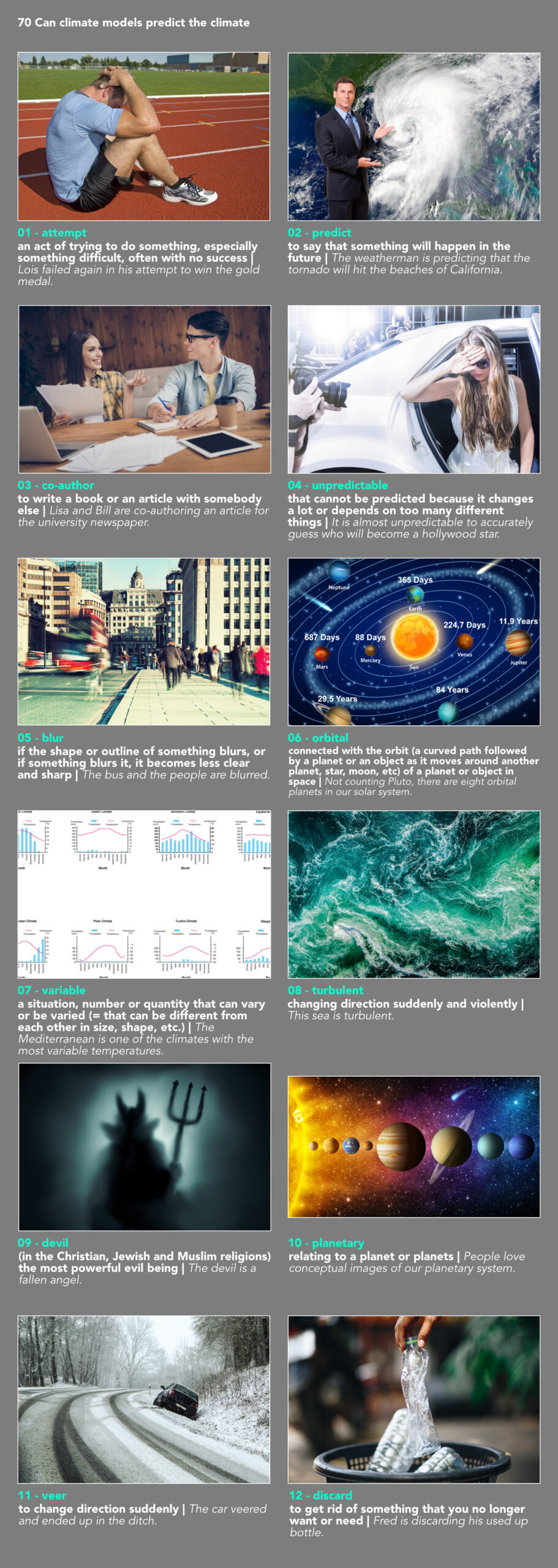
Modul 6: PragerU Videos Set 5. Videos 57-70
Ez a videóválogatás 14db izgalmas, gondolatébresztő témát jár körül 5 perces prezentációkban. A gyakorlat végeztével közel 600 szóval növeled szókincsedet. Fontos, hogy a kézikönyvekben leírtak szerint dolgozz az anyagon.
57 Are Fathers Necessary? (steps 1, 3 and 5)
Are fathers necessary?
For all of recorded history, the need to explain why fathers are necessary would have been regarded as, well, unnecessary. It would have been like explaining why water, or air, is necessary.
But we live at a time in which the obvious is routinely denied.
There have been articles in the most prestigious journals denying the importance of fathers:
The Atlantic Magazine, for example, published an article titled: “Are Fathers Necessary? A paternal contribution may not be as essential as we think.”
The New York Times published a discussion among five intellectuals titled, “What Are Fathers For?” One of them, Hanna Rosin, an editor at New York Magazine, opened her response by stating: “I’m not sure whether a child needs a father.”
I could give dozens of such examples. I’ll just give one more.
HuffPost published a piece titled: “Fathers Are Not Needed.”
Fortunately, this dismissal of the importance of fathers is not universal.
In a 2008 Father’s Day speech, a few months before his election as president of the United States, Barack Obama said, fathers are “critical” to the foundation of each family, that “they are teachers and coaches; they are mentors and role models; they are examples of success; and they are the men who constantly push us toward it.”
What makes his comments particularly noteworthy is that Barack Obama grew up without a father.
Both boys and girls need fathers.
We’ll begin with boys. A boy has no built-in understanding about how to be a man — meaning a good and responsible man. Male nature is wild — most obviously regarding sex and violence. If a boy does not have a father who models how a man controls himself, he will most likely not know how to control himself — let alone want to. That’s why most males in prison for violent crimes grew up without a father.
After days of riots in the UK in 2011, quite like the 2020 riots in America, Cristina Odone wrote a column for The London Telegraph whose title says it all: “London riots: Absent fathers have a lot to answer for.” In the column, she wrote, “The majority of rioters are gang members… Like the overwhelming majority of youth offenders behind bars, these gang members have one thing in common: no father at home.”
There is no question that many mothers have done an excellent job raising a boy without their son’s father. But common sense alone suggests that a mother simply cannot model what a boy should be any more than a man can model to a girl what a woman should be.
And, then there is the issue of controlling boys and their wild natures. Again, there are mothers who are able to do this. But if a boy is at all difficult — as so many are — as he gets older, most mothers will find it more and more difficult to control their son: because unruly boys listen to their fathers much more than they listen to their mothers. Which is precisely why most violent criminals grew up in fatherless homes. They obviously did not listen to their mothers.
As regards daughters, the father is the man girls learn to relate to. Without a father to relate to and bond with, there are at least two destructive consequences. First, she will not know how to choose a man wisely. She will not know how a man should treat her, and she may well end up with a man who mistreats her. Second, to fulfill her desire to bond with a man — as primal a yearning in most women as bonding with a woman is in most men — she will go from man to man. Girls without fathers in their lives are far more likely to be sexually promiscuous, and to begin sexual activity at an earlier age, which in turn are reasons many young women are depressed. Few women find sleeping with man after man fulfilling. Most find it ultimately depressing.
Finally, fathers give both sons and daughters the thing children need most: a sense of safety and security. As much as children need love, they need a sense of security even more. And in general, Moms give love and Dads give security.
I learned how necessary fathers are, not only by having one and being one, but by the many people — men and women, of all ages — who have told me that they see me as a “father-figure.” I am honored to fill that role. The good news is that many men can fill it: grandfathers, uncles, teachers, mentors, clergy, and yes, even a man on the radio.
But some man has to be your father.
I’m Dennis Prager.
Are fathers necessary?
necessary: that is needed for a purpose or a reason | Electricity is necessary to use mobile phones.
For all of recorded history, the need to explain why fathers are necessary would have been regarded as, well, unnecessary. It would have been like explaining why water, or air, is necessary.
regard as: to consider or have an opinion about something or someone | Jackie Chan is regarded as one of the most famous martial artists in Hollywood.
But we live at a time in which the obvious is routinely denied.
obvious: easy to see or understand | It is obvious that you are alive, reading this.
deny: to say that something is not true | Some bank robbers deny that they were close to the crime scene. / Some bank robbers deny that they ever committed a crime.
There have been articles in the most prestigious journals denying the importance of fathers:
prestigious: respected and admired as very important or of very high quality | Johnny managed to get into the prestigious Harvard University.
The Atlantic Magazine, for example, published an article titled: “Are Fathers Necessary? A paternal contribution may not be as essential as we think.”
paternal: connected with being a father; behaving or feeling as a father does toward his child | Some men give paternal advice to young boys.
contribution: an action or a service that helps to cause or increase something, usually (but not necessarily) something good or valuable | Einstein made significant contributions to scientific knowledge.
The New York Times published a *discussion among five intellectuals titled, “What Are Fathers For?” One of them, Hanna Rosin, an editor at New York Magazine, opened her response by stating: “I’m not sure whether a child needs a father.”
discussion1: a conversation about somebody/something | The architects are having a discussion about what materials to use to make the house.
response: a spoken or written answer | After the teacher asked the question, he waited for the response of the class.
I could give dozens of such examples. I’ll just give one more.
HuffPost published a piece titled: “Fathers Are Not Needed.”
piece: an article in a newspaper or magazine or a broadcast on television or radio | Bill remembered a long piece he read about the presidential elections.
Fortunately, this dismissal of the importance of fathers is not universal.
dismissal: the failure to consider something as important; not considering something important | Sally’s dismissal of Eve’s opinion about physics seemed rude to everyone around Eve.
In a 2008 Father’s Day speech, a few months before his election as president of the United States, Barack Obama said, fathers are “critical” to the foundation of each family, that “they are teachers and *coaches; they are mentors and role models; they are examples of success; and they are the men who constantly push us toward it.”
coach2: a person who is employed by somebody to give them advice about how to achieve the things they want in their life and work | Lisa is a coach to people in the organisation; she teaches them to make better business decisions.
role model: a person that people admire and try to copy | A lot of people look at Hollywood stars as their role models.
What makes his comments particularly noteworthy is that Barack Obama grew up without a father.
noteworthy: deserving to be noticed or to receive attention because it is unusual, important or interesting; significant | My friend having different coloured shoes is a noteworthy thing about him.
Both boys and girls need fathers.
We’ll begin with boys. A boy has no built-in understanding about how to be a man — meaning a good and responsible man. Male nature is *wild — most obviously regarding sex and violence. If a boy does not have a father who models how a man controls himself, he will most likely not know how to control himself — let alone want to. That’s why most males in prison for *violent crimes grew up without a father.
wild3: having no discipline or control | Jerry’s parents think that he is wild everytime he raises his voice (= speak loudly; shout).
regarding: in relation to; about | JIm was questioned by his older brother regarding the last time he smoked a cigarette in the house.
let alone: used after a statement to emphasize that because the first thing is not true or possible, the next thing cannot be true or possible either | Jenna cannot read simple letters, let alone read complicated novels.
violent4: involving physical force that is intended to hurt or kill somebody | Bill has a violent dog.
After days of riots in the UK in 2011, quite like the 2020 riots in America, Cristina Odone wrote a column for The London Telegraph whose title says it all: “London riots: *Absent fathers have a lot to answer for.” In the column, she wrote, “The majority of rioters are gang members… Like the *overwhelming majority of youth *offenders *behind bars, these gang members have one thing in common: no father at home.
absent5: not present (in something) | Fred’s work colleague is absent from the office today.
overwhelming6: very great or very strong; so powerful that you cannot resist it or decide how to react | John’s work for today is overwhelming.
offender7: a person who commits a crime | Harry is a violent offender.
behind bars8: in prison | Stephen is behind bars.
in common: in the same way as someone or something | India has many things in common with other developing countries. Or: India and other developing countries have many things in common.
There is no question that many mothers have done an excellent job raising a boy without their son’s father. But common sense alone suggests that a mother simply cannot model what a boy should be any more than a man can model to a girl what a woman should be.
common sense: correct judgement based on a simple understanding of a situation or facts | Come on Jimmy. Use your common sense when you eat something.
And, then there is the issue of controlling boys and their wild natures. Again, there are mothers who are able to do this. But if a boy is at all difficult — as so many are — as he gets older, most mothers will find it more and more difficult to control their son: because unruly boys listen to their fathers much more than they listen to their mothers. Which is precisely why most violent criminals grew up in fatherless homes. They obviously did not listen to their mothers.
unruly: difficult to control or manage | The teacher found it hard to teach the unruly class of teenagers.
As regards daughters, the father is the man girls learn to relate to. Without a father to relate to and *bond with, there are at least two *destructive consequences. First, she will not know how to choose a man wisely. She will not know how a man should treat her, and she may well end up with a man who *mistreats her. Second, to fulfill her desire to bond with a man — as primal a *yearning in most women as bonding with a woman is in most men — she will go from man to man. Girls without fathers in their lives are far more likely to be sexually promiscuous, and to begin sexual activity at an earlier age, which in turn are reasons many young women are depressed. Few women find sleeping with man after man fulfilling. Most find it ultimately depressing.
bond with9: form a connection between people or groups, such as a feeling of friendship or shared ideas and experiences | Lisa has a bond with Janet.
destructive10: causing damage | A nuclear bomb is very destructive.
consequence: a result of something that has happened, especially an unpleasant result | One consequence of not eating for a very very long time is dying.
treat: to behave in a particular way towards somebody/something | Max felt like he was treated unfairly by his teacher.
end up with: to finish with the possession of someone or something or in the company of someone or something | Johny could not afford a new car so he ended up with an old Toyota.
mistreat11: to treat a person or an animal in a cruel, unkind or unfair way | This police officer is mistreating Vinny.
fulfill: to do or achieve what was hoped for or expected | Jack fulfilled his dream of becoming a businessman.
yearning12: a strong and emotional desire | Maggie is yearning for a boyfriend.
promiscuous: having many sexual partners | Jimmy is promiscuous.
in turn: one after the other in a particular order | Some argue that kids playing too many video games may in turn lead to them failing in school.
ultimately: in the end; finally | Hendrix had achieved much in his life but ultimately died young.
Finally, fathers give both sons and daughters the thing children need most: a sense of safety and *security. As much as children need love, they need a sense of security even more. And in general, Moms give love and Dads give security.
security13: the state of feeling happy and safe from danger or worry | The parents provide their kids with a sense of security.
I learned how necessary fathers are, not only by having one and being one, but by the many people — men and women, of all ages — who have told me that they see me as a “father-figure.” I am honored to fill that role. The good news is that many men can fill it: grandfathers, uncles, teachers, mentors, *clergy, and yes, even a man on the radio.
honored: to feel proud and happy | Most of the presidents of the USA were honored to have been elected.
clergy14: the priests or ministers of a religion, especially of the Christian Church | Jonah is part of the clergy.
But some man has to be your father.
I’m Dennis Prager.
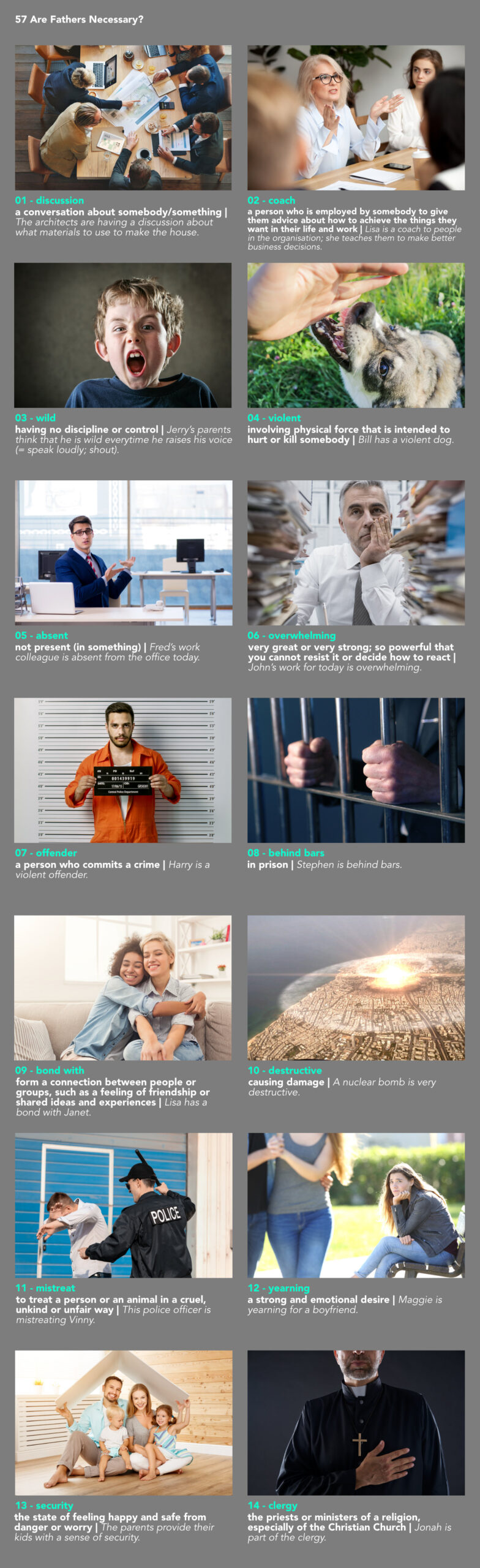
58 Hollywood wants your mind (steps 1, 3 and 5)
Imagine a group of activists so powerful that they could beam their propaganda directly into your brain. Now also imagine that they’re so sophisticated, they actually get you to pay them to do it.
Unfortunately, you don’t have to imagine it. It’s real. It’s Hollywood.
As big as the internet has become, Hollywood—and here, I’m talking specifically about television—is still king. Not only does it reach hundreds of millions of people with its messaging, it embeds that messaging in seemingly innocuous stories—stories that distract us from the hardships of daily life; stories that make us feel good, compassionate, and decent.
We watch TV, in other words, because we like it. And just as Americans didn’t think much about the carcinogens in the cigarettes they smoked for decades, most Americans don’t think much about the toxic politics in the television they watch.
But those who create that content do. They spin out hour after hour of slickly-produced left-wing propaganda and give themselves awards for doing it. They applaud each other’s “courage,” even though all their friends think exactly as they do.
I spoke with nearly a hundred members of the Hollywood community when I wrote my book, Primetime Propaganda, and many of them openly admitted they inserted “social justice” messages into their shows.
How they do it is both clever and effective.
Hollywood writers, producers, directors, actors create characters we keep wanting to spend time with, then have those characters act in ways most of us would judge wrong. Then, in effect, they ask us a question: Isn’t it really okay that Rachel from Friends decided to have a baby without first marrying Ross? After all, you like Ross and you like Rachel! How can what they do be bad?
It hasn’t always been this way. For decades, Hollywood promoted traditional American values. That changed, as did so much else in the late 1960s and ‘70s, when Hollywood stopped celebrating American values and started transforming them.
For example, in the early 1970s, abortion was a hotly-contested issue. A year before the Roe v. Wade Supreme Court case, the top-rated TV sitcom, Maude, featured a storyline in which the title character of the show has an abortion. The LA Times described it as “a watershed moment” in TV history. Why? Well, because it removed the stigma of abortion. Millions of Americans, sitting in their living rooms, saw a beloved character do something they did not approve of—and felt sympathy.
Something similar happened in the early 2000s. Vice President Joe Biden was right when he said that Will & Grace had a major impact on how Americans think about same-sex marriage. Before the hit NBC show, though most Americans had a live-and-let-live attitude toward private sexual behavior, few supported the idea of men marrying men or women marrying women. But seeing the charming and funny Will Truman live his life week after week paved the way for a much wider acceptance of same-sex marriage.
Current shows like Orange Is the New Black and Transparent are trying to affect the same change on the issue of transgenderism.
You may think these are all good things. Or that some are, and some aren’t. That’s not my point. My point is that Hollywood has had a tremendous influence on our culture, and that influence has been all to the left side of the political spectrum.
And it isn’t just social issues. Chevy Chase likes to boast that he helped Jimmy Carter defeat Gerald Ford in 1976. He may be right. Week after week on Saturday Night Live, Chase portrayed Ford, probably the most athletic president in American history, as a bumbling, uncoordinated idiot. In the early 2000s, Comedy Central had a show, That’s My Bush!, that openly mocked the 43rd president. And, of course, Hollywood despises Donald Trump. From crime dramas to the late-night comedy shows, he’s relentlessly ridiculed.
Somehow, Hollywood managed to take an eight-year hiatus from mocking presidents during the Obama years. But maybe that’s just a coincidence.
All of this programming has an effect. Scientific studies suggest that watching TV acts like a “habit-forming drug.” According to the market research firm Childwise, teenage boys spend 8 hours per day in front of screens, much of it consuming Hollywood propaganda.
Dedicated religious parents might expose their children to two hours a week of religious instruction. Hands-on parents might spend thirty minutes a day discussing essential values with their kids. Hollywood gets up to forty hours a week. Every week.
By all means, enjoy television. I do! But remember, the people making TV don’t merely want to entertain you; they want to influence you. They want you to think like they think. And, unless you’re aware of what they’re trying to do, chances are, you will.
I’m Ben Shapiro, editor of the Daily Wire, for Prager University.
Imagine a group of activists so powerful that they could *beam their propaganda directly into your brain. Now also imagine that they’re so *sophisticated, they actually get you to pay them to do it.
beam1: A) to produce a stream of light and/or heat | The sun beams through the trees.
- B) to send radio or television signals over long distances using electronic equipment | The presidential election is being beamed around the USA.
sophisticated2: (of a machine, system, etc.) clever and complicated in the way that it works or is presented | This mechanical watch is sophisticated.
Unfortunately, you don’t have to imagine it. It’s real. It’s Hollywood.
As big as the internet has become, Hollywood—and here, I’m talking specifically about television—is still king. Not only does it reach hundreds of millions of people with its messaging, it embeds that messaging in seemingly innocuous stories—stories that distract us from the hardships of daily life; stories that make us feel good, compassionate, and decent.
embed: to insert into (= to put into) | The newspaper embeds propaganda into its stories.
innocuous: not harmful or dangerous | Our new puppy is innocuous.
compassionate: feeling or showing sympathy for people or animals who are suffering | Mother Teressa was a compassionate person.
decent: (of people or behaviour) honest and fair; treating people with respect | Nancy thought of herself as a decent person.
We watch TV, in other words, because we like it. And just as Americans didn’t think much about the *carcinogens in the cigarettes they smoked for decades, most Americans don’t think much about the toxic politics in the television they watch.
carcinogen3: a substance that can cause cancer | In agriculture, there are commonly used carcinogens, like some types of pesticides (= chemicals that kill insects and bugs), so they have to be handled with care.
But those who create that content do. They spin out hour after hour of slickly-produced left-wing propaganda and give themselves awards for doing it. They *applaud each other’s “*courage,” even though all their friends think exactly as they do.
content: the subject matter of a book, speech, programme, etc. | The cartoon had no political content at all.
spin: to present information in a particular way, especially in a way that makes something seem good or less bad | The government sponsored newspaper always tried to put a positive spin on the tragedies happening in the country.
slickly: in a way that is clever and efficient but often does not seem to be sincere or lacks important ideas | The newspaper is slickly produced.
applaud4: to show your approval of somebody/something by clapping your hands | The company managers applauded themselves.
courage5: the ability to do something dangerous, or to face pain or opposition, without showing fear; bravery | This firefighter has courage.
I spoke with nearly a hundred members of the Hollywood community when I wrote my book, Primetime Propaganda, and many of them openly admitted they inserted “social justice” messages into their shows.
social justice: the fair distribution (= sharing; giving out) of wealth and opportunities within a society | To Tim, the most important thing is to have social justice in his country.
How they do it is both clever and effective.
Hollywood writers, producers, directors, actors create characters we keep wanting to spend time with, then have those characters act in ways most of us would judge wrong. Then, in effect, they ask us a question: Isn’t it really okay that Rachel from Friends decided to have a baby without first marrying Ross? After all, you like Ross and you like Rachel! How can what they do be bad?
judge: to give your opinion about somebody, especially when you think they are bad | Suzy always judges people who are cruel to animals.
It hasn’t always been this way. For decades, Hollywood *promoted traditional American values. That changed, as did so much else in the late 1960s and ‘70s, when Hollywood stopped celebrating American values and started transforming them.
promote6: to encourage people to like, buy, use, do, or support something | These protesters are promoting awareness about climate change.
For example, in the early 1970s, abortion was a hotly-contested issue. A year before the Roe v. Wade Supreme Court case, the top-rated TV sitcom, Maude, featured a storyline in which the title character of the show has an abortion. The LA Times described it as “a *watershed moment” in TV history. Why? Well, because it removed the stigma of abortion. Millions of Americans, sitting in their living rooms, saw a beloved character do something they did not approve of—and felt sympathy.
contest: to formally oppose a decision or statement because you think it is wrong (= strongly disagree) | The divorce was not contested by anyone.
sitcom: a regular comedy programme on television that shows the same characters in different funny situations | ‘Friends’ was a very popular sitcom.
watershed moment7: an event or a period of time that marks an important change | The moon landing was a watershed moment in the history of mankind.
Something similar happened in the early 2000s. Vice President Joe Biden was right when he said that Will & Grace had a major impact on how Americans think about same-sex marriage. Before the hit NBC show, though most Americans had a live-and-let-live *attitude toward private sexual behavior, few supported the idea of men marrying men or women marrying women. But seeing the charming and funny Will Truman live his life week after week paved the way for a much wider *acceptance of same-sex marriage.
attitude8: the way that you behave towards somebody/something that shows how you think and feel | Mary has a positive attitude towards her work.
acceptance9: the act of agreeing with something and approving of it | Jimmy experiences acceptance in his new school’s football team.
Current shows like Orange Is the New Black and Transparent are trying to affect the same change on the issue of transgenderism.
affect: to have an influence on someone or something, or to cause a change in someone or something | Weather affects the way we dress.
transgenderism: the condition of someone feeling that they are not the same gender (= sex) as the one they had at birth | Transgenderism is becoming more and more accepted in today’s society.
You may think these are all good things. Or that some are, and some aren’t. That’s not my point. My point is that Hollywood has had a tremendous influence on our culture, and that influence has been all to the left side of the political spectrum.
And it isn’t just social issues. Chevy Chase likes to *boast that he helped Jimmy Carter defeat Gerald Ford in 1976. He may be right. Week after week on Saturday Night Live, Chase portrayed Ford, probably the most athletic president in American history, as a *bumbling, uncoordinated idiot. In the early 2000s, Comedy Central had a show, That’s My Bush!, that openly mocked the 43rd president. And, of course, Hollywood *despises Donald Trump. From crime dramas to the late-night comedy shows, he’s relentlessly *ridiculed.
boast10: to speak too proudly or happily about what you have done or what you own | Steve often boasts about his wealth.
bumble11: to act or move in a way that is not smooth or steady; or behave in a confused way, often making careless mistakes | On his way home, Harry was bumbling because he was drunk.
despise12: to dislike and have no respect for somebody/something | Lisa despises Mark.
relentlessly: in an extreme way that continues without stopping | Tom relentlessly requested a raise from his boss.
ridicule13: to make somebody/something look silly by laughing at them/it in an unkind way | Meghan’s classmates are ridiculing her.
Somehow, Hollywood managed to take an eight-year hiatus from *mocking presidents during the Obama years. But maybe that’s just a coincidence.
hiatus: a break in activity when nothing happens | After months of hiatus, the peace talks between the two countries continued.
mocking14: (of behaviour, an expression, etc.) showing that you think somebody/something is silly; it includes laughing at someone | Sally is being mocked.
coincidence: the fact of two things happening at the same time by chance, in a surprising way | It was by pure coincidence that John met his classmate while on holiday in Spain.
All of this programming has an effect. Scientific studies suggest that watching TV acts like a “habit-forming drug.” According to the market research firm Childwise, teenage boys spend 8 hours per day in front of screens, much of it consuming Hollywood propaganda.
Dedicated religious parents might *expose their children to two hours a week of religious instruction. *Hands-on parents might spend thirty minutes a day discussing essential values with their kids. Hollywood gets up to forty hours a week. Every week.
expose15: to let somebody find out about something by giving them experience of it or showing them what it is like | Sam has never used a trampoline before in his life. His parents have exposed him to the joys of a trampoline today.
hands-on16: doing something rather than just talking about it | Stephen is a hands-on manager.
By all means, enjoy television. I do! But remember, the people making TV don’t merely want to *entertain you; they want to *influence you. They want you to think like they think. And, unless you’re aware of what they’re trying to do, chances are, you will.
entertain17: to keep a group of people interested or enjoying themselves | Mike, who is a stand up comedian, is entertaining the crowd with his jokes.
influence18: to have an effect on the way that somebody behaves or thinks, especially by giving them an example to follow | Jim’s father influenced him to become a professional golfer.
I’m Ben Shapiro, editor of the Daily Wire, for Prager University.
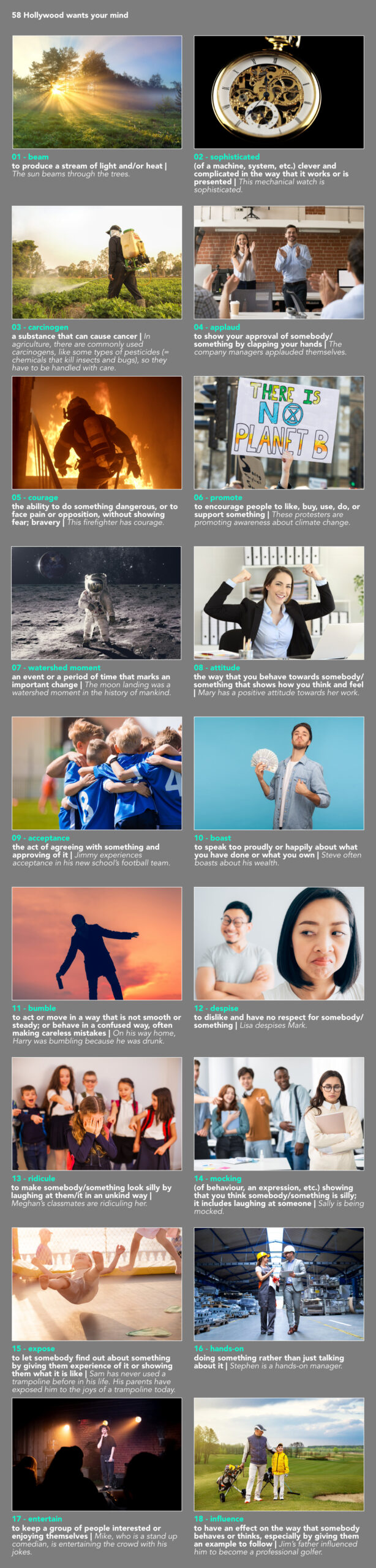
59 Why are so many Americans in prison (steps 1, 3 and 5)
Our prisons are crowded with people who shouldn’t be there, the victims of a racist justice system. This is the popular progressive narrative. But it’s wrong in every respect—dangerously wrong.
The U.S. does have a very large prison population—not because too many innocent people are incarcerated, but because too many people commit serious—usually violent—crimes. With rare exceptions, that’s why most people are imprisoned in America. Period. Full stop.
Before presenting the facts, let me add these caveats: It’s unacceptable that any innocent person is behind bars. Punishment must always fit, not exceed, the crime. We should do everything we can to reduce the rates of recidivism—committing more crime after release. And finally, everyone in prison should be treated humanely.
But let’s not fool ourselves that our prisons are full of people who shouldn’t be there. That’s simply not the case.
Let’s start with those convicted of drug offenses, the source of so much of the “mass incarceration” myth. While it’s true that about half of federal prisoners are incarcerated on drug charges, federal inmates constitute only about 12% of the American prison population. Almost nine of every ten prison inmates are in state facilities. And very few of them—less than 15%—are there for drug-related offenses.
Four times that number are behind bars for one of the following serious crimes:
Murder—14%
Rape or sexual assault—13%
Robbery—13%
Aggravated or simple assault—11%
And burglary—9%
In short, violent criminals make up the clear majority of the state prison population. What’s more, drug offenders who do end up in prison don’t actually serve very much time—almost half are released within a year.
The truth is that most criminals probably spend less time in prison than you think—even for the most violent crimes. According to the Bureau of Justice Statistics, almost 40% of released state prisoners served less than a year in prison. Even 20% of murderers and nearly 60% of those convicted of rape or sexual assault served less than five years of their sentences in prison.
What explains the short stays? Answer: plea bargaining.
Most prosecutions never go to court. Instead, a deal is made between the defendant’s attorney and the prosecutor to avoid going to trial. These negotiations often involve the offender agreeing to plead guilty in exchange for a reduced sentence, or dropping or downgrading the most serious charges. As a result, a prisoner’s conviction record often understates the crime that landed him behind bars in the first place.
For example, an armed burglar who, when arrested, was found to be in possession of illegal drugs might go to prison not for his worst crime—the armed burglary, but for a plea-bargained charge of, say, trespass and drug possession. But the media and the activists don’t tell us about this rather important detail. Instead, all we hear about is the poor fellow who’s serving time “for selling a small amount of cocaine.”
This assumes, of course, that the convicted criminal does any time at all. Studies done by the Justice Department show that only about 40% of felony convictions lead to a prison sentence. Yes, many are given probation, sentenced to home confinement, or given credit for time served in pretrial detention. But most of the time, convicted criminals don’t go to prison.
Do we really want even more criminals out on the street? Activists say yes. Scholars at the left-leaning Brennan Center have called for an immediate 40% reduction in the number of inmates. CNN host Van Jones, founder of the #Cut50 initiative, tops that. He wants a 50% reduction. But if the activists get their way, the costs would be high—and would likely be paid by the most vulnerable. Most crimes are committed by a small fraction of the population who primarily victimize their own communities.
Here’s an all-too-common example: In the spring of 2019, two men were charged with the murder of a Chicago woman who was shot while holding her baby. One of the men charged, according to the Chicago Tribune, had “nine felony convictions, including for a 2004 second-degree murder charge.”
A January 2017 University of Chicago Crime Lab study found that, on average, someone arrested for a homicide or shooting in that city had nearly 12 prior arrests. Almost 20% had more than 20.
If we cut prison rolls by 20, 40 or 50%, it won’t be politicians and media celebrities living in gated communities who will pay the price; it will be the law-abiding citizens in underserved neighborhoods struggling to get ahead who will pay.
When it comes to debates about criminal justice policy, these people—not criminals—should come first.
I’m Rafael Mangual, deputy director of legal policy at the Manhattan Institute, for Prager University.
Our prisons are crowded with people who shouldn’t be there, the victims of a racist justice system. This is the popular progressive narrative. But it’s wrong in every respect—dangerously wrong.
(criminal) justice system: the system in a society by which people who are accused of crimes are judged in court | Citizens rely on the justice system to punish the criminals for their actions.
narrative: a way of explaining events to illustrate a set of aims or values | Some politicians often create a narrative that has little to do with facts.
in every respect: in every way | The TV show was outstanding in every respect.
The U.S. does have a very large prison population—not because too many innocent people are *incarcerated, but because too many people commit serious—usually violent—crimes. With rare exceptions, that’s why most people are imprisoned in America. Period. Full stop.
incarcerate1: to put somebody in prison or in another place from which they cannot escape | Jack has been incarcerated since last week.
rare exceptions: an uncommon person or thing that is not included in a general statement | Most children enjoy chocolate, of course there are rare exceptions.
Period/ Full stop: used at the end of a sentence to emphasize that there is nothing more to say about a subject (asserting that an argument or opinion is undoubtedly true) | Di Caprio is one of the greatest actors of our generation. Period.
Before presenting the facts, let me add these caveats: It’s unacceptable that any innocent person is behind bars. Punishment must always fit, not *exceed, the crime. We should do everything we can to reduce the *rates of recidivism—committing more crime after release. And finally, everyone in prison should be treated humanely.
caveat: a warning that particular things need to be considered before something can be done | The creation of a new flavour of ice cream must come with the caveat of how much people will like it.
innocent: not guilty of a crime, etc.; not having done something wrong | Sometimes innocent people go to jail.
exceed2: to be greater than a number or amount, or to go past an allowed limit | This red coat exceeds Lily’s entire budget.
rate3: the amount of something, or the number of times something happens in a particular period | The employment rate has been steadily falling over the months.
recidivism: the act or habit of continuing to commit crimes, and seeming unable to stop, even after being punished | Recidivism has been high among some violent offenders.
But let’s not fool ourselves that our prisons are full of people who shouldn’t be there. That’s simply not the case.
Let’s start with those *convicted of drug offenses, the source of so much of the “mass incarceration” myth. While it’s true that about half of federal prisoners are incarcerated on drug *charges, federal *inmates constitute only about 12% of the American prison population. Almost nine of every ten prison inmates are in state facilities. And very few of them—less than 15%—are there for drug-related offenses.
convict4: to decide and state officially in court that somebody is guilty of a crime | John was convicted of stealing many luxury cars.
charge5: an official claim made by the police that somebody has committed a crime | The chief of police is charging Matt with drug possession.
inmate6: one of the people living in an institution such as a prison or a psychiatric hospital | John and David, who are both inmates in jail, like to play chess in their spare time.
constitute: to be the parts that together form something; make up | People older than 60 constituted 25% of the voters in the election.
Four times that number are behind bars for one of the following serious crimes:
Murder—14%
Rape or sexual assault—13%
Robbery—13%
Aggravated or simple *assault—11%
And burglary—9%
rape: to force somebody to have sex when they do not want it or are not able to agree to it | Lucy was raped.
aggravated: an aggravated crime involves further unnecessary violence or unpleasant behaviour | Jack was convicted of aggravated burglary.
assault7: to attack somebody violently, especially when this is a crime | Dan assaulted Joseph.
In short, violent criminals make up the clear majority of the state prison population. What’s more, drug offenders who do end up in prison don’t actually serve very much time—almost half are released within a year.
serve: to spend a period of time in prison | Harry served 7 years in prison.
(do) time: to spend time in prison | (S)he did time in prison.
The truth is that most criminals probably spend less time in prison than you think—even for the most violent crimes. According to the Bureau of Justice Statistics, almost 40% of *released state prisoners served less than a year in prison. Even 20% of murderers and nearly 60% of those convicted of rape or sexual assault served less than five years of their sentences in prison.
release8: to let somebody or something come out of a place where they have been kept or stuck and unable to leave or move | The birds were released.
sentences: a punishment given by a law court to a person or organization that is guilty of a crime | Jonah served a five year prison sentence (he was locked in jail for 5 years).
What explains the short stays? Answer: plea *bargaining.
plea: a statement made by somebody or for somebody who is accused of a crime | There was a plea of not guilty from Fred.
bargaining9: discussion of prices, conditions, etc. with the aim of reaching an agreement that is acceptable; negotiation | Bargaining was an important part of reaching a business deal.
plea bargaining: the process of making an arrangement in court by which a person admits to being guilty of a smaller crime in the hope of receiving less severe punishment for a more serious crime | Carl received a smaller sentence after plea bargaining by his lawyer.
Most prosecutions never go to *court. Instead, a *deal is made between the defendant’s attorney and the prosecutor to avoid going to *trial. These *negotiations often involve the offender agreeing to *plead guilty in exchange for a reduced sentence, or dropping or downgrading the most serious charges. As a result, a prisoner’s conviction record often understates the crime that landed him behind bars in the first place.
prosecution: the act of prosecuting someone (= officially accusing someone of committing an illegal act, and to bring a case against that person in a court of law) | A few of the cases have resulted in successful prosecutions.
court10: the place where legal trials take place and where crimes, etc. are judged | Ted is in court.
deal11: an agreement or an arrangement, especially in business | There was a deal between the business owners.
attorney: a lawyer, especially one who can act for somebody in court | Dan could afford the best attorney in the city.
prosecutor: a public official who charges somebody officially with a crime and prosecutes them in court | .
trial12: a formal examination of evidence in court by a judge and often a jury, to decide if somebody accused of a crime is guilty or not | The trial of Benjamin is about to end.
negotiations:13 formal discussion between people who are trying to reach an agreement | Negotiations are taking place between these businessmen.
plead14: to state in court that you are guilty or not guilty of a crime | Fred is pleading not guilty.
drop (something): to stop doing or discussing something; to not continue with something | I dropped my French class once I was 15.
downgrade: to move somebody/something down to a lower rank or level | Jen was downgraded from headmaster to teacher.
understate: to state that something is smaller, less important or less serious than it really is | Lizzy fell and broke her arm but she understated the seriousness of the injury.
For example, an *armed burglar who, when arrested, was found to be in possession of illegal drugs might go to prison not for his worst crime—the armed burglary, but for a plea-bargained charge of, say, *trespass and drug possession. But the media and the activists don’t tell us about this rather important detail. Instead, all we hear about is the poor fellow who’s serving time “for selling a small amount of cocaine.”
armed15: carrying a weapon, especially a gun | This is an armed robber.
trespass16: to enter land or a building that you do not have permission or the right to enter | This sign outside the building showed that no one should trespass.
This assumes, of course, that the convicted criminal does any time at all. Studies done by the Justice Department show that only about 40% of felony convictions lead to a prison sentence. Yes, many are given probation, sentenced to *home confinement, or given credit for time served in pretrial *detention. But most of the time, convicted criminals don’t go to prison.
assume: to think or accept that something is true but without having proof of it | John assumed that Lisa was being late to the meeting because of traffic.
felony: the act of committing a serious crime such as murder or rape; a crime of this type | Marcus was convicted of a felony.
probation: a system that allows a person who has committed a crime not to go to prison if they behave well and if they see an official (called a probation officer) regularly for a fixed period of time | The prisoner was put on probation.
home confinement17: the state of being a prisoner in your own house rather than in a prison | Jack is in home confinement; to make sure he stays there he has to have an ankle bracelet on him at all times.
pretrial: in or connected with the time before a court case begins | Some of the witnesses were called to testify at a pretrial hearing (official meeting in court).
detention18: the state of being kept in a place, especially a prison, and prevented from leaving | Cory was sentenced to 4 months detention.
Do we really want even more criminals out on the street? Activists say yes. *Scholars at the left-leaning Brennan Center have called for an immediate 40% reduction in the number of inmates. CNN host Van Jones, founder of the #Cut50 initiative, tops that. He wants a 50% reduction. But if the activists get their way, the costs would be high—and would likely be paid by the most *vulnerable. Most crimes are committed by a small fraction of the population who primarily victimize their own communities.
scholar19: a person who knows a lot about a particular subject because they have studied it in detail | Daniel is a famous scholar.
vulnerable20: weak and easily hurt physically or emotionally | This newborn baby duck is vulnerable.
victimize: to make somebody suffer unfairly because you do not like them, their opinions, or something that they have done | Bullies in schools victimize some of their classmates.
Here’s an all-too-common example: In the spring of 2019, two men were charged with the murder of a Chicago woman who was shot while holding her baby. One of the men charged, according to the Chicago Tribune, had “nine felony convictions, including for a 2004 second-degree murder charge.”
A January 2017 University of Chicago Crime Lab study found that, on average, someone arrested for a homicide or shooting in that city had nearly 12 prior arrests. Almost 20% had more than 20.
homicide: the crime of killing somebody deliberately; murder | Often there may be more homicides in cities than in villages.
prior: happening or existing before something else or before a particular time | Visits are by prior agreement.
If we cut prison rolls by 20, 40 or 50%, it won’t be politicians and media celebrities living in *gated communities who will pay the price; it will be the *law-abiding citizens in underserved neighborhoods *struggling to get ahead who will pay.
gated21: having gates to control the movement of traffic, people or animals | This is a gated community.
law-abiding22: obeying and respecting the law | This law abiding citizen is keeping the speed limit of 50kph.
underserved: (of an area or group of people) not getting enough help, products or services | Healthcare is very bad in underserved areas of the country.
struggle23: to try very hard to do something when it is difficult or when there are a lot of problems | Winnie is struggling with his homework assignments.
When it comes to debates about criminal justice policy, these people—not criminals—should come first.
I’m Rafael Mangual, deputy director of legal policy at the Manhattan Institute, for Prager University.

60 John Adams: American Founder and Second President (steps 1, 3 and 5)
Everybody knows what happened on July 4th, 1776: America was born. But three days earlier, on July 1st, independence hung in the balance.
There was a great case to be made not to secede from Great Britain. The colonists had no army, no navy, and almost no money. England had a lot of all three. It would have made perfect sense to bend to the will of the Crown, pay some extra taxes, and call it a day. There were plenty of people in Philadelphia prepared to make that case. They could have easily prevailed. Yet, they didn’t. They didn’t because of the words of one man: John Adams.
At a key moment in the congressional debate, when the forces against independence appeared to have the upper hand, Adams rose to his feet. Without notes and without any preparation, he made the case for independence. By the time he sat down, the case had been won. We don’t have a transcript of what he said. If we did, Adams might rank even higher than he does now among the Founding Fathers. Thomas Jefferson said years later that the speech was so powerful in “thought and expression” that it “moved us from our seats.” Adams was, Jefferson said, “our Colossus on the floor.”
If Washington was the sword of the American Revolution, and Jefferson the pen, then Adams was its engine. Brilliant, demanding, meticulous, but often irascible, he was not an easy man to love. At some point in his life, he irritated, if not alienated, everyone with whom he worked. Yet these same people would invariably come to appreciate him. That included Washington and especially Jefferson, with whom he sometimes fought bitterly.
Ironically, for all his cantankerousness, his marriage to Abigail Adams stands as one of the great love stories of American history. Their correspondence, spanning five decades, is a vibrant, living history of the nation’s early years. Abigail frankly described her husband as “short, thick, and fat.” But what he lacked in good looks and physical stature, he made up in intellect, personal integrity, and clarity of thought.
Born in 1735 near Boston, Adams relentlessly pushed himself to rise early, work hard, and live a moral life. He strove—in the language of the day—for a life of virtue over vice. He first came to public attention in 1765, when he issued a stirring rebuke of the much-hated Stamp Act. For the next 18 years, he fought unceasingly against British tyranny and for American liberty, dedicating his life, his fortune, and his sacred honor to the struggle.
These were not idle words. In his forties by the time of the Revolution, he didn’t fight in the war; instead, he crossed the Atlantic four times on diplomatic missions, braving winter storms, diseases such as pneumonia and dysentery, and British war ships. Capture would have meant summary execution.
In Europe, as befit his character, he was all business. He helped Benjamin Franklin bring the French into the war on the American side, and he arranged critical loans from Dutch banks. When the war ended, it was Adams, along with Franklin and John Jay, who negotiated the treaty in which England officially recognized the new United States.
For all these efforts, Adams was paid virtually nothing. But fortune was never his aim. Creating a new, better, freer country than the world had ever known was all that he cared about. As one delegate to the Continental Congress said, “The man to whom the country is most indebted for the great measure of independence is Mr. John Adams.”
Following the war, Adams served two terms as vice president under George Washington and then one term as the second President of the United States. Taking over for Washington was a thankless task. Everyone deferred to the great general. To put it mildly, Adams was not granted the same courtesy. Still, the new president was able to distinguish his time in high office with two significant achievements: one marked by something he did do; the other, by something he did not do.
What he did was convince the Congress to build a navy. Given the strong opposition to any kind of standing military, this was no mean feat. But Adams was adamant that the United States could not become a great nation without a great navy. He pushed through the legislation that made it possible.
What he did not do was get the country involved in the war in Europe. France insisted that America join it in its fight against England. France had come to America’s aid during the fight for independence, the French argued. Here was America’s chance to repay the debt. Adams firmly declined. The infant nation was in no position to wage war for or against anyone.
As the fiftieth anniversary of the Declaration of Independence approached, a 91 year-old Adams was asked to provide a toast for the upcoming celebration. He offered two words: “independence forever.” It turned out to be his last public utterance.
How fitting.
I’m Brad Thompson, professor of political science at Clemson University and author of America’s Revolutionary Mind, for Prager University.
Everybody knows what happened on July 4th, 1776: America was born. But three days earlier, on July 1st, independence hung in the balance.
hang in the balance: if the future of something/somebody, or the result of something hangs in the balance, it is not certain | Tim’s future as a professional football player hung in the balance.
There was a great case to be made not to secede from Great Britain. The colonists had no army, no navy, and almost no money. England had a lot of all three. It would have made perfect sense to bend to the will of the Crown, pay some extra taxes, and *call it a day. There were plenty of people in Philadelphia prepared to make that case. They could have easily prevailed. Yet, they didn’t. They didn’t because of the words of one man: John Adams.
case: a set of facts or arguments that support one side in a trial, a discussion, etc. | The case for reducing taxation was a strong one.
secede (from something): (of a state, country, etc.) to officially leave a larger state or organization of states and become independent | The Republic of Panama seceded from Colombia in 1903.
call it a day1: to decide or agree to stop doing something | After 50 years in corporate business, Jeff thinks it’s time to call it a day (= retire).
prevail: (of ideas, opinions, etc.) to be accepted, especially after a struggle or an argument; triumph | The ideas of democracy prevailed in most European countries.
At a key moment in the congressional *debate, when the forces against independence appeared to have the upper hand, Adams rose to his feet. Without notes and without any preparation, he made the case for independence. By the time he sat down, the case had been won. We don’t have a transcript of what he said. If we did, Adams might rank even higher than he does now among the Founding Fathers. Thomas Jefferson said years later that the speech was so powerful in “thought and expression” that it “moved us from our seats.” Adams was, Jefferson said, “our Colossus on the floor.”
debate2: a formal discussion of an issue at a public meeting or in a parliament | There was a debate between the two political parties over the issue of government spending.
have the upper hand3: to get an advantage over somebody so that you are in control of a particular situation | Jesse usually has the upper hand in chess because he is much more practiced at chess.
rank: to give somebody/something a particular position on a scale according to quality, importance, success, etc.; to have a position of this kind | Messi is a top ranked football player.
If Washington was the sword of the American Revolution, and Jefferson the pen, then Adams was its engine. Brilliant, demanding, meticulous, but often irascible, he was not an easy man to love. At some point in his life, he irritated, if not alienated, everyone with whom he worked. Yet these same people would invariably come to appreciate him. That included Washington and especially Jefferson, with whom he sometimes fought bitterly.
demanding4: (of a person) expecting a lot of work or attention from others; not easily satisfied | Chris had a demanding father.
meticulous: paying careful attention to every detail | Dorothy is meticulous when it comes to planning her holidays.
irascible5: becoming angry very easily; irritable | Joseph is an irascible man.
alienate: to make somebody less friendly towards you | The political party of the Liberal Democrats in the UK alienated a lot of young voters.
invariably: always | Mary invariably went to her favourite coffee shop every morning.
Ironically, for all his cantankerousness, his marriage to Abigail Adams stands as one of the great love stories of American history. Their correspondence, spanning five decades, is a vibrant, living history of the nation’s early years. Abigail frankly described her husband as “short, thick, and fat.” But what he lacked in good looks and physical stature, he made up in intellect, personal integrity, and clarity of thought.
cantankerousness6: the state of often being angry, always complaining | Sally’s cantankerousness resulted in a break-up with her fiancé.
correspondence: the letters, emails, etc. a person sends and receives | The newspaper editor encourages correspondence from all its readers.
span: to last all through a period of time or to cover the whole of it | Madison’s career in law spanned 39 years.
stature7: a person’s height | Mary had a small stature. (= She was short.)
integrity: the quality of being honest and having strong moral principles | Spencer was a man of integrity.
Born in 1735 near Boston, Adams relentlessly pushed himself to rise early, work hard, and live a moral life. He strove—in the language of the day—for a life of virtue over vice. He first came to public attention in 1765, when he issued a stirring rebuke of the much-hated Stamp Act. For the next 18 years, he fought unceasingly against British tyranny and for American liberty, dedicating his life, his fortune, and his sacred honor to the struggle.
relentlessly: in a way that continues strongly, without stopping, giving up or getting less strong | Summer in Africa is relentlessly hot.
strive: to try very hard to achieve something | Mary strove to get into the best medical school in her city.
virtue: behaviour or attitudes that show high moral standards | Mother Teresa led a life of virtue.
vice: behaviour that is evil or immoral; a quality in somebody’s character that is evil or immoral | Greed is Rory’s greatest vice.
stirring: causing strong feelings; exciting | The new adaptation of Shakespeare’s plays are stirring.
rebuke8: the act of speaking severely to somebody because they have done something wrong | Mary was rebuked by her mother.
fortune: a large amount of money | Janet inherited a large fortune from her parents.
sacred: very important and treated with great respect; that must not be changed or challenged | Human life is sacred.
honor: the quality of knowing and doing what is morally right | Greg is a man of honor.
These were not idle words. In his forties by the time of the Revolution, he didn’t fight in the war; instead, he crossed the Atlantic four times on diplomatic missions, braving winter storms, diseases such as pneumonia and dysentery, and British war ships. Capture would have meant summary execution.
idle: with no particular purpose or effect | Jack sometimes engages in idle chat.
pneumonia: a serious illness affecting one or both lungs that makes breathing difficult | Mary died of pneumonia.
dysentery: an infection of the bowels (= the lower part of the stomach) that causes severe diarrhoea (= an illness in which waste matter is emptied from the bowels frequently and in liquid form) with loss of blood | The deaths were a result of some form of dysentery.
capture: to catch a person or an animal and keep them as a prisoner or shut them in a space that they cannot escape from | Some soldiers in the VIetnam War were captured.
summary: done immediately, without paying attention to the normal process that should be followed | Without any working court system in his country, Jackson faced a summary justice.
execution: the act of killing somebody, especially as a legal punishment | There were one thousand executions last year in the USA.
In Europe, as befit his character, he was all business. He helped Benjamin Franklin bring the French into the war on the American side, and he arranged critical loans from Dutch banks. When the war ended, it was Adams, along with Franklin and John Jay, who negotiated the treaty in which England officially recognized the new United States.
befit: to be suitable or right for someone or something | Queen Elizabeth’s breathtaking wedding befitted her royal status as a princess back then.
all business: only thinking about work, not playing around, being totally serious about a task; straight to the point | Stella is all business once she gets in her work office / Mike is all business in conversations.
loan: money that an organization such as a bank lends and somebody borrows | Jackie took out a loan.
negotiate: to try to reach an agreement by formal discussion | The government refuses to negotiate with terrorists.
treaty: a formal agreement between two or more countries | The treaty of Versailles was an important treaty in bringing World War 1 to an end.
For all these efforts, Adams was paid virtually nothing. But fortune was never his aim. Creating a new, better, freer country than the world had ever known was all that he cared about. As one delegate to the Continental Congress said, “The man to whom the country is most indebted for the great measure of independence is Mr. John Adams.”
virtually: almost or very nearly | For a long time, people thought that it was virtually impossible for a human to run 100 metres in less than 10 seconds.
indebted: grateful to somebody for helping you | Carla said that she was forever indebted to her friend for helping her through her divorce.
great measure (of): a good amount; a lot | Spielberg owes a great measure of his success to the great actors who played in his movies.
Following the war, Adams served two terms as vice president under George Washington and then one term as the second President of the United States. Taking over for Washington was a thankless task. Everyone deferred to the great general. To put it mildly, Adams was not granted the same courtesy. Still, the new president was able to distinguish his time in high office with two significant achievements: one marked by something he did do; the other, by something he did not do.
defer (doing) sth: to delay something until a later time | The decision to hire a new candidate for the job was deferred for one year.
to put it mildly: used to show that what you are talking about is much more extreme, etc. than your words suggest | I am disappointed in your performance, to put it mildly.
courtesy: polite behaviour that shows respect for other people | Some say that his courtesy is one of his major character strengths.
distinguish: to recognize or understand the difference between two things, or to provide a quality that makes someone or something different or special | Meryl Streep distinguished herself as an actor by playing in movies such as Mama Mia. / You can easily distinguish a tornado from a hurricane.
significant: important or noticeable | Mike made a significant business decision.
What he did was convince the Congress to build a navy. Given the strong opposition to any kind of standing military, this was no mean feat. But Adams was adamant that the United States could not become a great nation without a great navy. He pushed through the legislation that made it possible.
navy: the part of a country’s armed forces that fights at sea, and the ships that it uses | Jack joined the navy when he was 18 years old.
no mean feat: to be a great achievement | Winning a gold medal in swimming at the Olympics was no mean feat.
adamant9: determined not to change your mind or to be persuaded about something | Jackie was adamant about buying an acoustic guitar instead of an electric one.
legislation: a law or a set of laws passed by a parliament | New legislation about immigration was recently passed.
What he did not do was get the country involved in the war in Europe. France insisted that America join it in its fight against England. France had come to America’s aid during the fight for independence, the French argued. Here was America’s chance to repay the debt. Adams firmly declined. The infant nation was in no position to wage war for or against anyone.
aid10: to help somebody/something to do something, especially by making it easier; assist | Ambulances come to aid seriously injured people.
repay the debt: pay back the money, favour, etc. that you owe to the person who you borrowed or took it from | Marry repaid the debt that she owed to the bank. / Sally cooked Fred dinner last night, so he repaid the debt by cooking breakfast for her.
decline11: to say no; to refuse politely to accept or to do something | Jack declined the whiskey because he was about to drive home.
infant: new and not yet developed | The country was still an infant nation without a strong army.
wage war: to begin and continue a situation in which two or more countries or groups of people fight against each other over a period of time | Germany waged war on the USA.
As the fiftieth anniversary of the Declaration of Independence approached, a 91 year-old Adams was asked to provide a toast for the upcoming celebration. He offered two words: “independence forever.” It turned out to be his last public utterance.
utterance: something that you say | In his public utterances the politician called for a reduction in taxes.
How fitting.
how fitting: very appropriate (= contextually correct) | Jim was a doctor who helped people live a long life; he himself died when he was 90 years old. How fitting.
I’m Brad Thompson, professor of political science at Clemson University and author of America’s Revolutionary Mind, for Prager University.
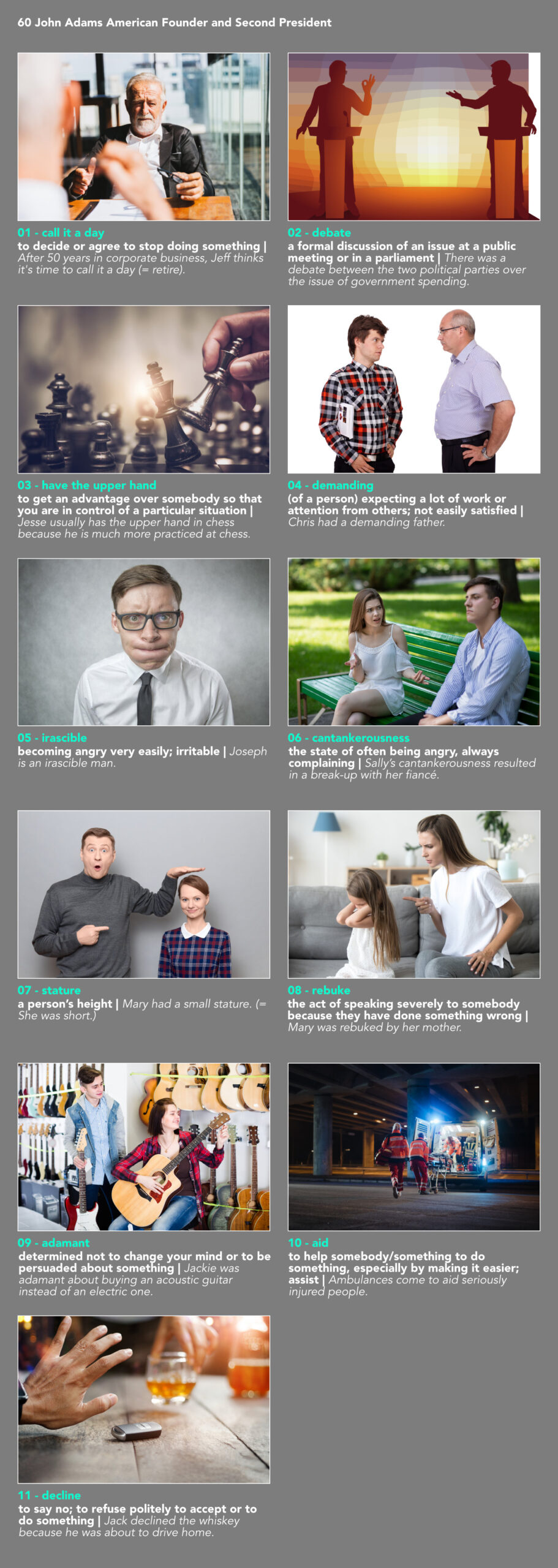
61 Do You Understand the Electoral College? (steps 1, 3 and 5)
I want to talk you about the Electoral College and why it matters.
Alright, I know this doesn’t sound the like most sensational topic of the day, but, stay with me because, I promise you, it’s one of the most important.
To explain why requires a very brief civics review.
The President and Vice President of the United States are not chosen by a nationwide, popular vote of the American people; rather, they are chosen by 538 electors. This process is spelled out in the United States Constitution.
Why didn’t the Founders just make it easy, and let the Presidential candidate with the most votes claim victory? Why did they create, and why do we continue to need, this Electoral College?
The answer is critical to understanding not only the Electoral College, but also America.
The Founders had no intention of creating a pure majority-rule democracy. They knew from careful study of history what most have forgotten today, or never learned: pure democracies do not work.
They implode.
Democracy has been colorfully described as two wolves and a lamb voting on what’s for dinner. In a pure democracy, bare majorities can easily tyrannize the rest of a country. The Founders wanted to avoid this at all costs.
This is why we have three branches of government — Executive, Legislative and Judicial. It’s why each state has two Senators no matter what its population, but also different numbers of Representatives based entirely on population. It’s why it takes a supermajority in Congress and three-quarters of the states to change the Constitution.
And, it’s why we have the Electoral College.
Here’s how the Electoral College works.
The Presidential election happens in two phases. The first phase is purely democratic. We hold 51 popular elections every presidential election year: one in each state and one in D.C.
On Election Day in 2012, you may have thought you were voting for Barack Obama or Mitt Romney, but you were really voting for a slate of presidential electors. In Rhode Island, for example, if you voted for Barack Obama, you voted for the state’s four Democratic electors; if you voted for Mitt Romney you were really voting for the state’s four Republican electors.
Part Two of the election is held in December. And it is this December election among the states’ 538 electors, not the November election, which officially determines the identity of the next President. At least 270 votes are needed to win.
Why is this so important?
Because the system encourages coalition-building and national campaigning. In order to win, a candidate must have the support of many different types of voters, from various parts of the country.
Winning only the South or the Midwest is not good enough. You cannot win 270 electoral votes if only one part of the country is supporting you.
But if winning were only about getting the most votes, a candidate might concentrate all of his efforts in the biggest cities or the biggest states. Why would that candidate care about what people in West Virginia or Iowa or Montana think?
But, you might ask, isn’t the election really only about the so-called swing states?
Actually, no. If nothing else, safe and swing states are constantly changing.
California voted safely Republican as recently as 1988. Texas used to vote Democrat. Neither New Hampshire nor Virginia used to be swing states.
Most people think that George W. Bush won the 2000 election because of Florida. Well, sort of. But he really won the election because he managed to flip one state which the Democrats thought was safe: West Virginia. Its 4 electoral votes turned out to be decisive.
No political party can ignore any state for too long without suffering the consequences. Every state, and therefore every voter in every state, is important.
The Electoral College also makes it harder to steal elections. Votes must be stolen in the right state in order to change the outcome of the Electoral College. With so many swing states, this is hard to predict and hard to do.
But without the Electoral College, any vote stolen in any precinct in the country could affect the national outcome — even if that vote was easily stolen in the bluest California precinct or the reddest Texas one.
The Electoral College is an ingenious method of selecting a President for a great, diverse republic such as our own — it protects against the tyranny of the majority, encourages coalition building and discourages voter fraud. Our Founders were proud of it! We can be too.
I’m Tara Ross for Prager University.
I want to talk to you about the Electoral College and why it matters.
Alright, I know this doesn’t sound like the most sensational topic of the day, but, stay with me because, I promise you, it’s one of the most important.
To explain why requires a very brief civics review.
The President and Vice President of the United States are not chosen by a nationwide, popular vote of the American people; rather, they are chosen by 538 electors. This process is *spelled out in the United States Constitution.
popular vote: if someone wins the popular vote in an election, they get the most single votes | Johnny won the Electoral College but did not win the popular vote.
electors: (in the US) a member of an electoral college (= a group of people whose job is to choose a political leader) | The US President is officially elected by electors from each state.
spell out1: to explain something in a simple, clear way | In her speech, Molly spelled out what her business was doing to help locals.
Why didn’t the Founders just make it easy, and let the Presidential candidate with the most votes claim victory? Why did they create, and why do we continue to need, this Electoral College?
claim: to state that you have done, gained or achieved something | Nobody claimed responsibility for the terrorist attack.
The answer is critical to understanding not only the Electoral College, but also America.
The Founders had no intention of creating a pure majority-rule democracy. They knew from careful study of history what most have forgotten today, or never learned: pure democracies do not work.
intention: what you plan to do; your aim | Susan’s intention is to become like Mother Teressa.
They *implode.
implode2: to collapse into the centre | The building imploded.
Democracy has been colorfully described as two wolves and a lamb voting on what’s for dinner. In a pure democracy, bare majorities can easily *tyrannize the rest of a country. The Founders wanted to avoid this at all costs.
bare: just enough; the most basic or simple | The lawyer focused on the bare facts of the case.
tyrannize3: to use your power to treat somebody in a cruel or unfair way | This police officer is tyrannizing Harry.
at all cost(s): whatever is needed to achieve something | Billy wants to avoid getting a bad grade in his class at all costs.
This is why we have three branches of government — Executive, Legislative and Judicial. It’s why each state has two Senators no matter what its population, but also different numbers of Representatives based entirely on population. It’s why it takes a supermajority in Congress and three-quarters of the states to change the Constitution.
Executive (branch): (in the US) the part of the government that is controlled by the president | In the USA, the Executive is responsible for governing the state (USA).
Legislative (branch): (in the US) the part of the government, consisting of the House of Representatives and the Senate, that has the power to make laws | Some members of the Legislative branch are elected.
Judicial (branch): (in the US) the part of the government consisting of judges and courts that interpret the laws | The Judicial branch is made up of a supreme court and lower, local courts.
supermajority: a number that is much more than half of a total, especially in a vote | Republicans had a supermajority in Congress.
constitution: the system of laws and basic principles that a state, a country or an organization is governed by | The Constitution of the United States, created on September 17, 1787, has twenty-seven amendments as of 2021.
And, it’s why we have the Electoral College.
Here’s how the Electoral College works.
The Presidential election happens in two phases. The first phase is purely democratic. We hold 51 popular elections every presidential election year: one in each state and one in *D.C.
D.C.4: Washington D.C.; the capital city of the USA | The White House is in D.C.
On Election Day in 2012, you may have thought you were voting for Barack Obama or Mitt Romney, but you were really voting for a slate of presidential electors. In Rhode Island, for example, if you voted for Barack Obama, you voted for the state’s four Democratic electors; if you voted for Mitt Romney you were really voting for the state’s four Republican electors.
slate: a list of the candidates in an election | She was the only woman on the Democratic slate this year.
Part Two of the election is held in December. And it is this December election among the states’ 538 electors, not the November election, which officially determines the identity of the next President. At least 270 votes are needed to win.
Why is this so important?
Because the system *encourages coalition-building and national campaigning. In order to win, a candidate must have the support of many different types of voters, from various parts of the country.
encourage5: A) to persuade somebody to do something by making it easier for them and making them believe it is a good thing to do | Tim’s father encourages him to become a professional basketball player by teaching him how to play and motivating him.
- B) to make something more likely to happen or develop | In large supermarkets, music is used to encourage shopping.
Winning only the South or the Midwest is not good enough. You cannot win 270 electoral votes if only one part of the country is supporting you.
But if winning were only about getting the most votes, a candidate might concentrate all of his efforts in the biggest cities or the biggest states. Why would that candidate care about what people in West Virginia or Iowa or Montana think?
But, you might ask, isn’t the election really only about the so-called swing states?
swing state: (in an election for president in the US) a state where none of the candidates can be certain of getting the most support | Ohio may be a swing state.
Actually, no. If nothing else, safe and swing states are constantly changing.
California voted safely Republican as recently as 1988. Texas used to vote Democrat. Neither New Hampshire nor Virginia used to be swing states.
Most people think that George W. Bush won the 2000 election because of Florida. Well, sort of. But he really won the election because he managed to flip one state which the Democrats thought was safe: West Virginia. Its 4 electoral votes turned out to be *decisive.
decisive6: very important for the final result of a particular situation | The goal that Jimmy scored in the last five minutes of the match was decisive.
No political party can ignore any state for too long without *suffering the consequences. Every state, and therefore every voter in every state, is important.
suffer7: to be badly affected by a disease, pain, sad feelings, a lack of something, etc. | Rey is suffering from depression.
consequence: a result of something that has happened, especially an unpleasant result | The consequence of the dictatorship was the death of millions.
suffer the consequence: to be punished for what one has done | Sam broke the law, so he has to suffer the consequences.
The Electoral College also makes it harder to steal elections. Votes must be stolen in the right state in order to change the outcome of the Electoral College. With so many swing states, this is hard to predict and hard to do.
But without the Electoral College, any vote stolen in any *precinct in the country could affect the national outcome — even if that vote was easily stolen in the bluest California precinct or the reddest Texas one.
precinct8: one of the parts into which a town or city is divided in order to organize elections | Democrats and Republicans are battling for control of this precinct.
The Electoral College is an ingenious method of selecting a President for a great, diverse republic such as our own — it protects against the tyranny of the majority, encourages coalition building and discourages voter *fraud. Our Founders were proud of it! We can be too.
ingenious: (of an object, a plan, an idea, etc.) very suitable for a particular purpose and resulting from clever new ideas | Mark invented an ingenious device to save energy.
fraud9-10: the crime of cheating somebody in order to get money, goods or power illegally | Sally is falling victim to credit card fraud.
I’m Tara Ross for Prager University.
62 Where Do You Want to Live: Red State or Blue State? (steps 1, 3 and 5)
We’re supposed to be the United States of America. But in many ways, we’re now divided into two very different nations.
There is red state America.
And there is blue state America.
The red states favor conservative, small government, free market policies: low taxes, light regulation, tough-on-crime policing, and worker freedom. Think Florida, Texas, Tennessee, Arizona, and Utah.
The blue states favor a liberal/left, big government approach: high taxes, heavy regulations, high minimum wages, and mandatory union membership. Think New York, New Jersey, Connecticut, Massachusetts, Illinois, Oregon, and, of course, California.
Progressives like to argue that their big-government, high tax policies are economically superior and thus better for the poor, minorities and working-class Americans than those of red states. Conservative policies, progressives contend, are culturally backward, and tilted to benefit the rich.
Let’s test this thesis by comparing three of the largest red states: Florida, Texas, and Tennessee with three of the largest blue states: California, New York, and Illinois.
If progressive policies really work, then Americans should be rushing to get into the blue states.
But just the opposite is happening.
Americans are packing up their U-Hauls and heading to the red states. According to the New York Times, in August 2020, so many people wanted to leave New York City that moving companies were turning away business. They just couldn’t handle the demand.
This exodus may be accelerating, but it’s not new.
Over the last decade the three big blue states each lost an average of one million people to other states, while the three big red states gained almost a million from other states.
Makes perfect sense. Americans like freedom. Small government means more freedom.
And freedom means opportunity.
Let’s say you’re looking for a job. Over the last decade, Florida, Texas and Tennessee have gained twice as many jobs as the progressive states.
Not only that, but your money goes further in red states. According to a 2019 Tax Foundation study, your $100 stretches to $111 in purchasing power in Tennessee, while in New Jersey it shrinks to $89.
If you’re a big corporation or a small company looking for a business-friendly environment, affordable housing or maybe just a better quality of life, where are you going to go?
The tough decision is not choosing a red state or a blue state. The tough decision is which red state to move to.
Progressives like to say that this isn’t about economics, it’s about weather. The red states tend to be in the South and southwest where the weather is warmer.
But that doesn’t explain why so many people are leaving California which has the best weather in the country.
So, what does explain the migration from blue states?
Start with taxes. The two most populous blue states — California and New York — have the highest tax rates in America, while the two most populous red states — Texas and Florida — have no income tax at all.
When taxes get too high, people move to where taxes are lower. The problem for the high-tax states is that these people take their money, their ambition, and their employees with them.
Then, there is crime.
Do blue cities do better than red cities?
The answer, of course, is no. Of the twenty cities with the highest murder rates, 18 are run by left-leaning Democrats — and for the most part, have been for decades. And these cities aren’t getting safer; they’re getting more dangerous.
A good chunk of Minneapolis was burned to the ground as a result of riots, following the death of George Floyd.
Portland had over 90 consecutive nights of rioting — not peaceful protests, rioting.
Seattle allowed an entire section of the city to declare itself an autonomous zone — a first in American history!
Progressive governors, progressive mayors, progressive police chiefs run all these cities and states.
Ask any resident of Los Angeles or San Francisco about the rise in homelessness and you’ll get a litany of horror stories. Both cities, of course, have a long history of progressive mayors.
How about keeping us healthy and safe? Surely the progressive states, with their strict lockdowns, did a better job saving lives from the coronavirus.
Nope.
Adjusted for population, as a resident of New York, New Jersey or Illinois, you were three, four or even five times more likely to die of the virus than if you lived in a red state like Florida, Texas, Georgia, Utah or Arizona.
Progressives and liberal Democrats may mean well. They certainly talk a lot about how much they care about the poor, minorities and the working class.
Yet somehow, it’s always the poor, minorities, and the working class who pay the price for their bad policies. That’s why those who can move, move. Those who can’t get stuck with the short end of the stick.
Red state America is prospering. Blue state America is in meltdown.
So, where do you want to live?
I’m Stephen Moore, economist at FreedomWorks, for Prager University.
We’re supposed to be the United States of America. But in many ways, we’re now divided into two very different nations.
(be) supposed to do/be sth: to be expected or required to do/be something according to a rule, a custom, an arrangement, etc. | You were supposed to arrive an hour ago. (= You should have arrived but you didn’t. You’re an hour late.)
There is red state America.
And there is blue state America.
The red states *favor conservative, small government, free market policies: low taxes, light regulation, *tough-on-crime policing, and worker freedom. Think Florida, Texas, Tennessee, Arizona, and Utah.
favor1 (BrE favour): to prefer one system, plan, way of doing something, etc. to another | Maggie favours healthy eating.
regulation: controlling something by rules | Some people are getting frustrated by the government’s regulation of their everyday lives.
tough2: demanding that particular rules be obeyed; strict | Mary is extremely tough on her daughter when she makes a mistake.
The blue states favor a liberal/left, big government approach: high taxes, heavy regulations, high minimum wages, and mandatory union membership. Think New York, New Jersey, Connecticut, Massachusetts, Illinois, Oregon, and, of course, California.
approach: a way of dealing with somebody/something; a way of doing or thinking about something such as a problem or a task | Some parents take the wrong approach to raising children.
mandatory: required by law | The crime of murder carries a mandatory life sentence.
Progressives like to *argue that their big-government, high tax policies are economically superior and thus better for the poor, minorities and working-class Americans than those of red states. Conservative policies, progressives contend, are culturally backward, and tilted to benefit the rich.
Let’s test this thesis by comparing three of the largest red states: Florida, Texas, and Tennessee with three of the largest blue states: California, New York, and Illinois.
progressive: a person who is in favour of new ideas, modern methods and change | Progressives may disagree with conservatives on many issues.
argue3: to give reasons why you think that something is right/wrong, true/not true, etc., especially to persuade people that you are right | The company owner looks annoyed while the department leaders are arguing about what strategy the company should follow.
contend: to say that something is true, especially in an argument (= a set of reasons) | Many contend that Michael Jordan is the greatest basketball player that has ever lived.
tilt: to make something/somebody change slightly so that one particular opinion, person, etc. is preferred or more likely to succeed than another; to change in this way | Popular opinion has tilted in favour of the socialists.
If progressive policies really work, then Americans should be rushing to get into the blue states.
But just the opposite is happening.
Americans are packing up their U-Hauls and heading to the red states. According to the New York Times, in August 2020, so many people wanted to leave New York City that moving companies were *turning away business. They just couldn’t handle the *demand.
turn away4: to refuse to allow somebody to enter a place | Car drivers were turned away from the beach.
demand5: the desire or need of customers for goods or services that they want to buy or use | The cafe is full; due to the fact that there is high demand for its coffee.
This *exodus may be *accelerating, but it’s not new.
exodus6: a situation in which many people leave a place at the same time | In 1910, there was a mass exodus of Italian citizens to New York.
accelerate7: A) (of a vehicle or person) to start to go faster | Tom’s car is accelerating.
- B) to happen faster or earlier; to make something happen faster or earlier | Inflation continues to accelerate.
Over the last decade the three big blue states each lost an average of one million people to other states, while the three big red states gained almost a million from other states.
Makes perfect sense. Americans like freedom. Small government means more freedom.
And freedom means opportunity.
Let’s say you’re looking for a job. Over the last decade, Florida, Texas and Tennessee have *gained twice as many jobs as the progressive states.
gain8: to get something that is useful, that gives you an advantage, or that is in some way positive, especially over a period of time | The speech gained the approval of all the country leaders that were present in the meeting.
Not only that, but your money goes further in red states. According to a 2019 Tax Foundation study, your $100 *stretches to $111 in purchasing power in Tennessee, while in New Jersey it *shrinks to $89.
your money goes further: your money lasts longer; you can buy more for your money | “Move to Asia, your money goes further there.”
stretch9: A) to cause something to reach, often as far as possible, in a particular direction | Larry stretches his body a few times every week.
- B) to go as far as or past the usual limit of something | “We can’t work any harder, Paul. We’re already fully stretched.”
purchasing power: the value of money considered as the amount of goods it will buy i.e. how many goods you can buy for your money | The purchasing power of the US dollar has fallen.
shrink10: to become or to make something smaller in size or amount | Jerry’s jumpers always shrink when he washes them in his faulty washing machine.
If you’re a big corporation or a small company looking for a business-friendly environment, *affordable housing or maybe just a better quality of life, where are you going to go?
affordable11: cheap enough that people can pay it or buy it | Lily can buy local groceries which are affordable.
The tough decision is not choosing a red state or a blue state. The tough decision is which red state to move to.
Progressives like to say that this isn’t about economics, it’s about weather. The red states tend to be in the South and southwest where the weather is warmer.
But that doesn’t explain why so many people are leaving California which has the best weather in the country.
So, what does explain the migration from blue states?
Start with taxes. The two most *populous blue states — California and New York — have the highest tax rates in America, while the two most populous red states — Texas and Florida — have no income tax at all.
populous12: where a large number of people live | New York state is one of America’s most populous states.
When taxes get too high, people move to where taxes are lower. The problem for the high-tax states is that these people take their money, their ambition, and their employees with them.
Then, there is crime.
Do blue cities do better than red cities?
The answer, of course, is no. Of the twenty cities with the highest murder rates, 18 are run by left-leaning Democrats — and for the most part, have been for decades. And these cities aren’t getting safer; they’re getting more dangerous.
A good chunk of Minneapolis was burned to the ground as a result of *riots, following the death of George Floyd.
a good chunk: a large amount or part of something | Rent is a good chunk of her monthly expenses.
riot13: a situation in which a group of people behave in a violent way in a public place, often as a protest | “There is a riot outside your street.”
Portland had over 90 consecutive nights of rioting — not peaceful *protests, rioting.
consecutive: following one after another in a continuous series | Maddie was absent from school for 60 consecutive days.
protest14: the expression of strong dislike of or opposition to something; a statement or an action that shows this | These people have gone to the streets to protest.
Seattle allowed an entire section of the city to *declare itself an autonomous zone — a first in American history!
declare15: to say something officially or publicly | Sam is declaring that his company is releasing a new product.
Progressive governors, progressive mayors, progressive police chiefs run all these cities and states.
Ask any resident of Los Angeles or San Francisco about the rise in homelessness and you’ll get a litany of horror stories. Both cities, of course, have a long history of progressive mayors.
litany: a long list spoken or given to someone, esp. to someone who has heard or seen it before or finds it boring | There were a litany of complaints about the company’s new product.
How about keeping us healthy and safe? Surely the progressive states, with their strict lockdowns, did a better job saving lives from the coronavirus.
Nope.
Adjusted for population, as a resident of New York, New Jersey or Illinois, you were three, four or even five times more likely to die of the virus than if you lived in a red state like Florida, Texas, Georgia, Utah or Arizona.
adjust: to change figures slightly according to inflation, the time of year, etc. so that they can be compared in a useful way with other figures | Payouts from the fund, when adjusted for inflation, are much lower compared to last year.
Progressives and liberal Democrats may mean well. They certainly talk a lot about how much they care about the poor, minorities and the working class.
mean: intend; want | Most parents mean well when they punish their child.
Yet somehow, it’s always the poor, minorities, and the working class who pay the price for their bad policies. That’s why those who can move, move. Those who can’t get stuck with the short end of the stick.
get stuck with the short end of the stick: to come off worst in a bargain or contest | Jerry got stuck with the short end of the stick when he tried to sell his new idea for a fortune to a competitor.
Red state America is *prospering. Blue state America is in *meltdown.
prosper16: to develop in a successful way; to be successful, especially in making money | Sandra’s business is prospering.
meltdown17: a situation where something fails or becomes weaker in a sudden or dramatic way | The value of the company stock is in meltdown.
So, where do you want to live?
I’m Stephen Moore, economist at FreedomWorks, for Prager University.
63 The Great Texas Freeze of 2021 (steps 1, 3 and 5)
The week of Valentine’s Day, 2021, the temperature dropped below zero.
Nobody could remember it being this cold for this long.
This was Texas, not Siberia.
But Texas is the energy state. There was nothing to fear. Just go home, turn on the heat, and hunker down.
That’s how it should have gone.
Instead, over five days, four million Texans lost power during what turned out to be the coldest winter storm in a half a century. Hundreds died, including an 11-year-old boy who froze to death in his sleep.
The state’s electric grid operator, the Electric Reliability Council of Texas, ERCOT, later reported the state was just four minutes away from total grid collapse.
The media was quick to blame the state government for not being fully prepared and not acting fast enough.
This may be true, but ERCOT’s mistakes were symptoms, not the cause, of the problem.
The real cause is decades of misguided policies that have left the Lone Star State with an unreliable energy infrastructure.
It’s a cautionary tale that the rest of the country needs to learn from.
From 2010 to 2020, the population of Texas increased by 4 million people, and the state’s economy grew 35%. But while all this growth was happening, the state’s reliable energy capacity was actually shrinking. Meanwhile, its unreliable energy capacity was surging. In fact, it almost tripled.
Let’s break this down.
Reliable energy is fossil fuels—coal and natural gas—and nuclear. These fuels produce a near-constant flow of electricity. Unreliable, or variable energy, is renewable energy—wind and solar. They’re unreliable because they depend on the whims of Mother Nature.
In 2020, Texans got 25% of their energy from renewables. During the February storm, however, that fell to 8%, at one point reaching a deadly low of just 1.5%.
The reason? Renewable energy only works when the weather cooperates, but it’s useless when it doesn’t—like when it conjures up a giant snowstorm. Solar panels don’t capture sunlight and wind turbines don’t spin when covered in snow and ice.
Given renewables’ unreliability, how is it that Texas, of all places, became so dependent on them?
That story begins in 1999, when Texas politicians on the left and the right fell in love with the idea that they could turn the state into a green energy powerhouse. It sounded like a great idea at the time: Instead of passing any new mandates, they would do it by offering massive subsidies, marketed as “incentives,” to produce wind and solar power. This ended up working out great for wind and solar companies, but not so great for reliable energy providers.
To illustrate this, imagine that you own a restaurant. One day you learn that your competitor down the street is getting government support. He gets so much help that, instead of charging his customers, he can pay them to eat his food. Not surprisingly, your customers abandon your restaurant for his. Your competitor prospers off the taxpayers’ backs while your business withers.
Let’s apply this analogy to the real world of renewable energy. Wind and solar get so much in subsidies they’re guaranteed a profit. And unlike fossil fuel producers, they’re not even required to provide reliable power. It’s no wonder fossil fuel plants are closing, and nuclear plants are not being built.
The wind and solar companies are protected from the laws of supply and demand. They can’t lose, and the fossil fuel plants can’t compete. That’s how out of whack the Texas electricity market has become.
Since 2006, the state has subsidized renewable energy to the tune of $19 billion. All of this came right out of Texans’ wallets, courtesy of ever-increasing electric bills and rising property taxes. And what does Texas have to show for it? An electric grid that failed when Texans needed it most.
Unfortunately, this scenario is playing out across America.
Over the past decade, the federal government has spent over $230 billion on energy subsidies, and that doesn’t even include subsidies the states give away.
It’s true that Uncle Sam also grants favors to fossil fuel companies. Renewable energy advocates love to point this out, but here’s what they neglect to mention: compared to fossil fuel companies, for every unit of electricity generated, Washington subsidizes wind 17 times and solar 75 times more.
Yet, despite all this aid, renewables provide just 4 percent of the country’s total energy supply.
The verdict is in: renewable energy is expensive and unreliable. And if it can render America’s leading power producer powerless, it can do the same to your state.
Government meddling got us into this mess. It’s time for politicians to step aside and let the free market get us out of it.
I’m Jason Isaac from the Texas Public Policy Foundation, for Prager University.
The week of Valentine’s Day, 2021, the temperature dropped below zero.
Nobody could remember it being this cold for this long.
This was Texas, not Siberia.
But Texas is the energy state. There was nothing to fear. Just go home, turn on the heat, and *hunker down.
hunker down1: to prepare yourself to stay somewhere, keep an opinion, etc. for a long time | Many families prepare for famine (= a lack of food for a long period of time) by hunkering down: they put lots of food away for the future.
That’s how it should have gone.
Instead, over five days, four million Texans lost power during what turned out to be the coldest winter storm in half a century. Hundreds died, including an 11-year-old boy who froze to death in his sleep.
The state’s *electric grid operator, the Electric Reliability Council of Texas, ERCOT, later reported the state was just four minutes away from total grid *collapse.
electric grid2: a network of transmission lines, substations, transformers and more, that deliver electricity from power plants to consumers | This substation is part of the USA’s electric grid.
collapse3: A) to fall down or fall in suddenly, often after breaking apart | The building is collapsing.
- B) to fail suddenly or completely | The talks between the USA and the Soviet Union collapsed for a while during the Cuban Missile Crisis.
The media was quick to blame the state government for not being fully prepared and not acting fast enough.
This may be true, but ERCOT’s mistakes were symptoms, not the cause, of the problem.
The real cause is decades of misguided policies that have left the Lone Star State with an unreliable energy infrastructure.
misguided: wrong because you have understood or judged a situation badly | Jerry gave a misguided attempt (= try) at trying to fix the problem in the office.
unreliable: that cannot be trusted or depended on | Joseph’s local taxi drivers are unreliable. They always charge more than a fair price.
It’s a cautionary tale that the rest of the country needs to learn from.
cautionary: giving advice or a warning | Joseph’s story about how he bought a car from a second-hand dealership is a cautionary tale.
From 2010 to 2020, the population of Texas increased by 4 million people, and the state’s economy grew 35%. But while all this growth was happening, the state’s reliable energy capacity was actually shrinking. Meanwhile, its unreliable energy capacity was *surging. In fact, it almost tripled.
surge4: (of prices, profits, etc.) to suddenly increase in value | Maggie, who likes to invest on her phone, is seeing that some of the stock prices are surging.
Let’s break this down.
Reliable energy is fossil fuels—*coal and natural gas—and nuclear. These fuels produce a near-constant *flow of electricity. Unreliable, or variable energy, is renewable energy—wind and solar. They’re unreliable because they depend on the *whims of Mother Nature.
coal5: a hard black mineral that is found below the ground and burnt to produce heat | Coal is used less and less due to environmental regulations.
flow6: (of liquid, gas or electricity) to move steadily and continuously in one direction | This is a fast flowing stream (of water).
whim7: a sudden wish to do or have something, especially when it is something unusual or unnecessary | Steve is going on vacation to another part of his country, in the middle of January, on a whim.
In 2020, Texans got 25% of their energy from renewables. During the February storm, however, that fell to 8%, at one point reaching a deadly low of just 1.5%.
The reason? Renewable energy only works when the weather cooperates, but it’s useless when it doesn’t—like when it *conjures up a giant snowstorm. Solar panels don’t *capture sunlight and wind turbines don’t spin when covered in snow and ice.
conjure up8: to make somebody/something appear by using magic | Steve conjured up a coin out of thin air.
capture9: collecting a natural product so that it can be stored or used | Solar panels and wind turbines are used to capture sunlight and wind.
Given renewables’ unreliability, how is it that Texas, of all places, became so dependent on them?
That story begins in 1999, when Texas politicians on the left and the right fell in love with the idea that they could turn the state into a green energy powerhouse. It sounded like a great idea at the time: Instead of passing any new mandates, they would do it by offering massive subsidies, marketed as *”incentives,” to produce wind and solar power. This ended up working out great for wind and solar companies, but not so great for reliable energy providers.
mandate: an official order given to somebody to perform a particular task | The bank had a mandate not to honor cheques. (= The bank couldn’t take cheques.)
subsidy: money that is paid by a government or an organization to reduce the costs of services or of producing goods so that their prices can be kept low; financial help from the government | The government has increased agricultural subsidies.
incentive10: something that encourages you to do something | This plant shop gives an incentive for people to shop in it by having a “buy one get one free” deal.
To illustrate this, imagine that you own a restaurant. One day you learn that your competitor down the street is getting government support. He gets so much help that, instead of charging his customers, he can pay them to eat his food. Not surprisingly, your customers *abandon your restaurant for his. Your competitor *prospers off the taxpayers’ backs while your business *withers.
abandon11: to leave a place, thing, or person, usually for ever | A red bike was abandoned in the forest by its owner.
prosper12: to develop in a successful way; to be successful, especially in making money | Lisa’s business is prospering: she makes a lot of money in a day.
wither13: A) if a plant withers or something withers it, it dries up and dies | This plant withered away because it did not get enough water.
- B) to become less or weaker, especially before disappearing completely | Fred’s hope withered away.
Let’s apply this analogy to the real world of renewable energy. Wind and solar get so much in subsidies they’re guaranteed a profit. And unlike fossil fuel producers, they’re not even required to provide reliable power. It’s no wonder fossil fuel *plants are closing, and nuclear plants are not being built.
plant14: a factory or place where power is produced or an industrial process takes place | This is an atomic power plant.
The wind and solar companies are protected from the laws of supply and demand. They can’t lose, and the fossil fuel plants can’t compete. That’s how out of whack the Texas electricity market has become.
supply and demand: the relationship between the amount of goods or services that are available and the amount that people want to buy, especially when this controls prices | For some people it is important to know the laws of demand and supply.
out of whack: no longer correct or working properly | The system is clearly out of whack.
Since 2006, the state has subsidized renewable energy to the tune of $19 billion. All of this came right out of Texans’ wallets, courtesy of ever-increasing electric bills and rising property taxes. And what does Texas have to show for it? An electric grid that failed when Texans needed it most.
Unfortunately, this scenario is playing out across America.
to the tune of something: used to emphasize how much money something has cost | The business bought equipment to the tune of a million pounds.
courtesy of sb/sth: as the result of a particular thing or situation | Sally became rich, courtesy of a large inheritance.
scenario: a description of possible actions or events in the future | The worst case scenario would be starting World War 3.
Over the past decade, the federal government has spent over $230 billion on energy subsidies, and that doesn’t even include subsidies the states give away.
It’s true that Uncle Sam also *grants favors to fossil fuel companies. Renewable energy *advocates love to point this out, but here’s what they *neglect to mention: compared to fossil fuel companies, for every unit of electricity generated, Washington subsidizes wind 17 times and solar 75 times more.
Uncle Sam: a way of referring to the United States of America or the US government (sometimes shown as a tall man with a white beard and a tall hat) | Jack owed $15 000 in tax to Uncle Sam.
grant15: to agree to give somebody what they ask for, especially formal or legal permission to do something | The bank granted me a £500 loan.
advocate16: a person who supports or speaks in favour of somebody or of a public plan or action | Daniella is an advocate of free speech.
neglect17: to fail or forget to do something that you ought to do | Mike neglected to turn a factory machine off, so now he is being told off.
Yet, despite all this aid, renewables provide just 4 percent of the country’s total energy supply.
The verdict is in: renewable energy is expensive and unreliable. And if it can render America’s leading power producer powerless, it can do the same to your state.
verdict: a decision that you make or an opinion that you give about something, after you have tested it or considered it carefully | Mary was asked about her verdict about the performance of the president.
in: popular | Leather pants are in.
the verdict is in: the decision has been made; the decision is widely popular | “So, what do his classmates think about Steven? Well, the verdict is in.”
render: to cause somebody/something to be in a particular state or condition; make | Many people were rendered jobless after the economic crisis.
Government *meddling got us into this mess. It’s time for politicians to *step aside and let the free market get us out of it.
meddling18: the activity of involving yourself in something that should not really involve you; interference | Steve thinks that bureaucratic meddling in the day to day running of his department is too much.
step aside19: to leave an important job or position and let somebody else take your place | The marketing manager has stepped aside, and someone else will come in tomorrow to replace him.
I’m Jason Isaac from the Texas Public Policy Foundation, for Prager University.
64 Can a desert nation solve the world’s water shortage (steps 1, 3 and 5)
Is the world going into a water crisis? It certainly seems that way.
The U.S. government predicts that by 2025, 60 percent of the world’s landmass, and 40 of our 50 U.S. states will experience water shortages— some of them extreme.
The U.S. intelligence community sees worldwide water shortages as a major national security risk. Water scarcity helped trigger the Syrian civil war and has been a key reason why Africans have migrated in large numbers to Europe. More of this can be expected.
But there is cause for optimism. And it comes from a very unlikely place—a country in the middle of a desert.
That country is Israel.
Compelled by necessity and powered by remarkable technological innovations, Israel has become the world’s water superpower. By reusing waste water, by making desalination affordable, by rethinking irrigation, and by developing an array of sophisticated water conservation techniques, Israel not only has a sufficiency of water, but an abundance of it.
What Israel has done, other nations can do, too, including its Mideast neighbors. And while it’s a lot to hope for, cooperation on water issues could become the basis for cooperation on other issues as well.
For Israel, an obsession with water is not new. The word “water” appears 600 times in the Hebrew Bible. For over 2,000 years daily prayers for rain in the land of Israel have been a part of traditional Jewish ritual. For the founders of the modern State of Israel, water was not only a daily concern, but a paramount question of future survival. Vast quantities of water would be needed for the millions of immigrants who would make their way to the new country. Without plenty of water, economic growth would be impossible.
But where was the water going to come from? It was a daunting challenge, but one which Israel overcame.
Today, while other nations, even ones with far more natural water resources, struggle with water management, Israel has a surplus of useable water. The desert, as Israel’s founders dreamed, is blooming.
Not only does the country supply its own population with an array of fruits and vegetables, but it exports billions of dollars worth of produce to nations around the world.
So, how does a small country with little annual rainfall, with only one freshwater lake, and with no major rivers do this?
It begins with a nothing-wasted attitude that extends from the government to private industry to farming to consumers. Israel charges its citizens the market price for water—no subsidies. You can have as much water as you want, but you have to pay for it. And when you pay for something, you tend to be more careful with how you use it.
This also extends to the nation’s infrastructure. In virtually every country, massive amounts of water are wasted every year in leaky pipes. Israel has developed technology that tells it when and where a pipe is leaking, so that it can be fixed immediately. This not only saves water, but it saves homeowners and industry money on their water bills.
The biggest user of water in Israel and everywhere is agriculture. To get maximum use of its water, Israel developed the revolutionary farming technique known as drip irrigation—the process of applying micro amounts of water to individual plants at their roots. This is much more water efficient than the traditional method, still widely used around the world, of flood irrigation—flooding fields with water. Israeli scientists have also developed drought-resistant crops that need less water to grow.
Sewage is usually thought of as a nuisance, but in Israel it is now a highly valuable resource. Israel takes nearly all of its sewage, treats it to an ultra-pure level, and then reuses it in agriculture. No other country utilizes sewage as comprehensively as does Israel.
Israel has also pioneered the use of desalination, turning seawater into drinking water. Once it was thought to be prohibitively expensive. No longer. Israel built five giant desalination plants along its Mediterranean coast that together provide the equivalent of 80 percent of the water piped into Israeli homes.
Putting all of these practices and techniques together, Israel has grown into a water superpower, as well as a global center of water innovation.
As the world grows drier and thirstier, those who want solutions will look to a little country in the middle of a desert for answers.
Israel is ready with them.
I’m Seth Siegel for Prager University.
Is the world going into a water crisis? It certainly seems that way.
The U.S. government predicts that by 2025, 60 percent of the world’s landmass, and 40 of our 50 U.S. states will experience water *shortages— some of them extreme.
predict: to say that something will happen in the future | Emily predicts that a new prime minister will be elected.
shortage1: a situation when there is not enough of the people or things that are needed | There is a food shortage in supermarkets.
The U.S. intelligence community sees worldwide water shortages as a major national security risk. Water *scarcity helped trigger the Syrian civil war and has been a key reason why Africans have migrated in large numbers to Europe. More of this can be expected.
But there is cause for optimism. And it comes from a very unlikely place—a country in the middle of a desert.
scarcity2: if there is a scarcity of something, there is not enough of it and it is difficult to obtain it; shortage | For many young people, there is a scarcity of affordable houses in London.
That country is Israel.
Compelled by *necessity and powered by remarkable technological innovations, Israel has become the world’s water superpower. By reusing wastewater, by making *desalination affordable, by rethinking *irrigation, and by developing an array of sophisticated water conservation techniques, Israel not only has a sufficiency of water, but an *abundance of it.
compel: to force somebody to do something; to make something necessary | His teacher compelled Jimmy to finish his coursework in the classroom.
necessity3: the fact that something must happen or be done; the need for something | Having electricity is a necessity for an office. (Without electricity it is impossible to do any work.)
remarkable: unusual or surprising in a way that causes people to take notice | Rachel has a remarkable musical talent.
desalination4: the process of removing salt from seawater | The largest water desalination facility in the world is in Hadera, Israel.
irrigation5: the practice of supplying water to an area of land through pipes or channels so that crops will grow | Sprinkler irrigation is one type of irrigation which is commonly used today.
array: a group or collection of things or people, often one that is large or impressive | There was a large array of talented singers in the opera.
sufficiency (of sth): an amount of something that is enough for a particular purpose | There is a sufficiency of police officers in the countryside.
abundance (of sth)6: a large quantity that is more than enough | Jerry has an abundance of food on the table.
What Israel has done, other nations can do, too, including its Mideast neighbors. And while it’s a lot to hope for, cooperation on water issues could become the basis for cooperation on other issues as well.
For Israel, an *obsession with water is not new. The word “water” appears 600 times in the Hebrew Bible. For over 2,000 years daily prayers for rain in the land of Israel have been a part of traditional Jewish ritual. For the founders of the modern State of Israel, water was not only a daily concern, but a *paramount question of future survival. Vast quantities of water would be needed for the millions of immigrants who would make their way to the new country. Without plenty of water, economic growth would be impossible.
obsession7: the state in which a person’s mind is completely filled with thoughts of one particular thing or person in a way that is not normal | Mellinda has an unhealthy obsession with shoes.
concern: a feeling of worry, especially one that is shared by many people | “The cost of the new project is a major concern.”
paramount8: more important than anything else | Security is paramount for Stephen; he’s installed cameras everywhere in his home.
plenty: a large amount; as much or as many as you need | There are plenty of spices in the kitchen.
But where was the water going to come from? It was a *daunting challenge, but one which Israel *overcame.
daunting9: making somebody feel nervous and less confident about doing something; intimidating | Having to make 15 wedding cakes per day is a daunting task for Sally.
overcome10: to succeed in dealing with or controlling a problem | Larry has wanted to visit Thailand all his life; however, he has always been afraid of flying; he is now overcoming this fear.
Today, while other nations, even ones with far more natural water resources, struggle with water management, Israel has a surplus of usable water. The desert, as Israel’s founders dreamed, is *blooming.
surplus: an amount that is extra or more than you need | “We could give the food surplus we have to charity.”
bloom11: A) when a flower blooms, it opens or is open, and when a plant or tree blooms it produces flowers | When flowers bloom, they attract bees.
- B) to grow or develop successfully | Mozart’s musical genius bloomed early in his childhood.
Not only does the country supply its own population with an array of fruits and vegetables, but it exports billions of dollars worth of produce to nations around the world.
supply: to provide somebody/something with something that they need or want, especially in large quantities | The country supplies its own citizens with free medicine for some illnesses.
So, how does a small country with little annual rainfall, with only one freshwater lake, and with no major rivers do this?
It begins with a nothing-wasted attitude that extends from the government to private industry to farming to consumers. Israel charges its citizens the market price for water—no subsidies. You can have as much water as you want, but you have to pay for it. And when you pay for something, you tend to be more careful with how you use it.
extend: to make a business, an idea, an influence, etc. cover more areas or operate in more places | The school is extending the range of subjects taught.
subsidy: money that is paid by a government or an organization to reduce the costs of services or of producing goods so that their prices can be kept low; financial help from the government | The EU has decreased agricultural subsidies.
This also extends to the nation’s infrastructure. In virtually every country, massive amounts of water are wasted every year in *leaky pipes. Israel has developed technology that tells it when and where a pipe is leaking, so that it can be fixed immediately. This not only saves water, but it saves homeowners and industry money on their water bills.
leaky12: having holes that allow liquid or gas to escape | Having a leaky pipe can be expensive to fix.
The biggest user of water in Israel and everywhere is *agriculture. To get maximum use of its water, Israel developed the revolutionary farming technique known as *drip irrigation—the process of applying micro amounts of water to individual plants at their *roots. This is much more water efficient than the traditional method, still widely used around the world, of *flood irrigation—flooding fields with water. Israeli scientists have also developed *drought–resistant crops that need less water to grow.
agriculture13: the science or practice of farming | Combine harvesters are important tools used in agriculture .
drip14: (of liquid) to fall in small drops | Water is dripping from the old water tap.
roots15: the part of a plant that grows under the ground and takes in water and minerals that it sends to the rest of the plant | Grass has roots in the soil.
flood16: a large amount of water covering an area that is usually dry | The rice field is flooded. Flood irrigation is preferred in Asia.
drought17: a long period of time when there is little or no rain | The drought in Thailand has left the land completely dried out.
(something)-resistant: not damaged by the thing mentioned | Fire fighters wear fire-resistant clothes.
*Sewage is usually thought of as a *nuisance, but in Israel it is now a highly valuable resource. Israel takes nearly all of its sewage, treats it to an ultra-*pure level, and then reuses it in agriculture. No other country utilizes sewage as comprehensively as does Israel.
sewage18: used water and waste substances that are produced by human bodies, that are carried away from houses and factories through special pipes (= sewers) | This is a sewer tunnel.
nuisance19: a thing, person or situation that is annoying or causes trouble or problems | Steve is a nuisance to everyone in the cinema; he’s talking loudly on the phone while the movie is playing.
resource: a supply of something that a country, an organization or a person has and can use, especially to increase their wealth | Some countries have abundant (= plenty of) energy resources.
pure20: clean and not containing any harmful substances | Having pure natural water is rather rare (= not typical/usual).
comprehensively: completely; in a careful and detailed way | The workers have comprehensively discussed the issue of having to wear a uniform to work.
Israel has also *pioneered the use of desalination, turning seawater into drinking water. Once it was thought to be prohibitively expensive. No longer. Israel built five giant desalination plants along its Mediterranean coast that together provide the equivalent of 80 percent of the water piped into Israeli homes.
pioneer21: when somebody pioneers something, they are one of the first people to do, discover or use something new | The nuclear bomb was pioneered by scientists working in the Manhattan Project.
prohibitively : at such a high price that does not seem reasonable | Diesel has become prohibitively expensive in some countries.
Putting all of these practices and techniques together, Israel has grown into a water superpower, as well as a global center of water innovation.
As the world grows drier and thirstier, those who want solutions will look to a little country in the middle of a desert for answers.
Israel is ready with them.
I’m Seth Siegel for Prager University.

65 Why is Modern Art so Bad? (steps 1, 3 and 5)
“The Mona Lisa”… “The Pieta”… “The Girl with a Pearl Earring.” For a score of centuries, artists enriched Western society with their works of astonishing beauty. “The Night Watch”… “The Thinker”… “The Rocky Mountains.” Master after master, from Leonardo, to Rembrandt, to Bierstadt, produced works that inspired, uplifted, and deepened us. And they did this by demanding of themselves the highest standards of excellence, improving upon the work of each previous generation of masters, and continuing to aspire to the highest quality attainable.
But something happened on the way to the 20th Century. The profound, the inspiring and the beautiful were replaced by the new, the different, and the ugly. Today the silly, the pointless, and the purely offensive are held up as the best of modern art.
Michelangelo carved his “David” out of a rock. The Los Angeles County Museum of Art just offers us a rock, — a rock — all 340 tons of it. That’s how far standards have fallen. How did this happen? How did the thousand-year ascent towards artistic perfection and excellence die out?
It didn’t. It was pushed out. Beginning in the late 19th century, a group dubbed The Impressionists rebelled against the French Academie des Beaux Arts and its demand for classical standards. Whatever their intentions, the new modernists sowed the seeds of aesthetic relativism — the “beauty is in the eye of the beholder” mentality.
Today everybody loves the Impressionists. And, as with most revolutions, the first generation or so produced work of genuine merit. Monet, Renoir, and Degas still maintained elements of disciplined design and execution, but with each new generation standards declined until there were no standards. All that was left was personal expression.
The great art historian Jacob Rosenberg wrote that quality in art “is not merely a matter of personal opinion but to a high degree . . . objectively traceable.” But the idea of a universal standard of quality in art is now usually met with strong resistance if not open ridicule.
“How can art be objectively measured?” I’m challenged. In responding, I simply point to the artistic results produced by universal standards compared to what is produced by relativism. The former gave the world “The Birth of Venus” and “The Dying Gaul,” while the latter has given us “The Holy Virgin Mary,” fashioned with cow dung and pornographic images, and “Petra,” the prize-winning sculpture of a policewoman squatting and urinating — complete with a puddle of synthetic urine.
Without aesthetic standards we have no way to determine quality or inferiority. Here’s a test I give my graduate students, all talented and well educated. Please analyze this Jackson Pollock painting and explain why it is good. It is only after they give very eloquent answers that I inform them that the painting is actually a close up of my studio apron. I don’t blame them; I would probably have done the same since it’s nearly impossible to differentiate between the two.
“And who will determine quality?” is another challenge I’m given. If we are to be intellectually honest, we all know of situations where professional expertise is acknowledged and depended upon. Take figure skating in the Olympics, where artistic excellence is judged by experts in the field. Surely we would flinch at the contestant who indiscriminately threw himself across the ice and demanded that his routine be accepted as being as worthy of value as that of the most disciplined skater.
Not only has the quality of art diminished, but also the subject matter has gone from the transcendent to the trashy. Where once artists applied their talents to scenes of substance and integrity from history, literature, religion, mythology, etc., many of today’s artists merely use their art to make statements, often for nothing more than shock value. Artists of the past also made statements at times, but never at the expense of the visual excellence of their work. It’s not only artists who are at fault; it is equally the fault of the so-called art community: the museum heads, gallery owners, and the critics who encourage and financially enable the production of this rubbish. It is they who champion graffiti and call it genius, promote the scatological and call it meaningful. It is they who, in reality, are the naked emperors of art, for who else would spend $10 million dollars on a rock and think it is art.
But why do we have to be victims of all this bad taste? We don’t.
By the art we patronize at museums or purchase at galleries, we can make our opinions not only known but felt. An art gallery, after all, is a business like any other. If the product doesn’t sell, it won’t be made. We can also support organizations like The Art Renewal Center that work to restore objective standards to the art world. And we can advocate the teaching of classical art appreciation in our schools.
Let’s celebrate what we know is good and ignore what we know is not.
By the way, the white background you see behind me is not simply a white graphic backdrop. It is a pure white painting by noted artist Robert Rauschenberg at the San Francisco Museum of Modern Art.
I’m Robert Florczak for Prager University.
“The Mona Lisa”… “The Pieta”… “The Girl with a Pearl Earring.” For a *score of centuries, artists *enriched Western society with their works of astonishing beauty. “The Night Watch”… “The Thinker”… “The Rocky Mountains.” Master after master, from Leonardo, to Rembrandt, to Bierstadt, produced works that inspired, *uplifted, and deepened us. And they did this by demanding of themselves the highest standards of excellence, improving upon the work of each previous generation of masters, and continuing to *aspire to the highest quality attainable.
a score of1: a lot of people or things | There were scores of people in front of me at the concert.
enrich2: to improve the quality of something, often by adding something to it | Science has enriched our personal and work lives in some ways through the creation of new technologies.
uplift3: to make somebody feel happier or give somebody more hope | Rosie is uplifted by the playfulness of her granddaughter whenever she sees her.
deepen: to improve your knowledge or understanding of something | Students deepen their understanding of physics in school and extracurricular courses. (= extra courses that students can choose to attend)
aspire4: to have a strong desire to achieve or to become something | Jared is aspiring to be the greatest basketball player ever.
attain: to succeed in getting something, usually after a lot of effort | Only a few students attained top marks in the final Physics exam.
attainable: that you can achieve | John set himself attainable objectives (=goals) in his business.
But something happened on the way to the 20th Century. The profound, the inspiring and the beautiful were replaced by the new, the different, and the ugly. Today the silly, the *pointless, and the purely offensive are held up as the best of modern art.
profound: very great; felt or experienced very strongly | Janet’s sense of sadness was profound after her favourite cat had died.
pointless5: having no purpose; not worth doing | Collecting water with a colander is pointless.
Michelangelo *carved his “David” out of a rock. The Los Angeles County Museum of Art just offers us a rock, — a rock — all 340 tons of it. That’s how far standards have fallen. How did this happen? How did the thousand-year *ascent towards artistic perfection and excellence die out?
carve6: to make objects, patterns, etc. by cutting away material from a piece of wood or stone, or another hard material | Jackson carved the pumpkin.
ascent7: A) the act of climbing or moving up; a journey that goes up something | The mountain climber’s ascent was very difficult.
- B) the process of moving forward to a better position or of making progress | Hitler’s rapid ascent to power was surprising.
It didn’t. It was pushed out. Beginning in the late 19th century, a group dubbed The Impressionists rebelled against the French Academie des Beaux Arts and its demand for classical standards. Whatever their intentions, the new modernists *sowed the seeds of aesthetic relativism — the “beauty is in the eye of the beholder” mentality.
dub: to give somebody/something a particular name, often in a humorous or critical way | Genetically modified products have been dubbed ‘Frankenfoods’ in the popular press.
rebel: to fight against or refuse to obey an authority, for example a government, a system, your parents, etc. | A lot of teenagers rebel against their parents.
sow the seeds8: A) to plant or spread seeds in or on the ground | Matt went to sow the seeds into his garden during spring.
- B) to start the process that leads to a particular situation or result | Listening to Beethoven’s works sowed the seeds in Timmy’s mind to become a classical composer (= music writer).
aesthetic: connected with beauty and art and the understanding of beautiful things | Some works of art are judged on purely aesthetic grounds.
behold: to look at or see somebody/something | Her face was a joy to behold (= to look at).
“beauty is in the eye of the beholder”: people all have different ideas about what is beautiful | “Look at this painting, Chris. It’s wonderful, isn’t it?” “Well, I don’t know. Beauty is in the eye of the beholder.”
Today everybody loves the Impressionists. And, as with most revolutions, the first generation or so produced work of genuine merit. Monet, Renoir, and Degas still maintained elements of *disciplined design and execution, but with each new generation, standards *declined until there were no standards. All that was left was personal expression.
merit: the quality of being good and of deserving praise or reward; worth | Fred’s work had merit. (= His work was of high quality.)
disciplined9: trained to obey rules and orders and behave in a way that shows control | The soldiers are disciplined.
execution: the act of doing or performing something, especially in a planned way | Great managers require advanced skills in design, planning, and execution.
decline10: to become smaller, fewer, weaker, worse etc. | Steve’s memory is slowly declining.
The great art historian Jacob Rosenberg wrote that quality in art “is not merely a matter of personal opinion but to a high degree . . . objectively traceable.” But the idea of a universal standard of quality in art is now usually met with strong resistance if not open *ridicule.
to a high degree: to a great extent, to a large extent | Jonas believes that the USA losing the Vietnam war was the fault of the political leaders to a high degree.
traceable: if something is traceable, you can find out where it came from, where it has gone, when it began or what its cause was | Her bad habit is traceable back to her childhood. (= she started doing it as a child)
ridicule11: unkind comments that make fun of somebody/something or make them look silly; mockery | Bill is an object of ridicule in his school.
“How can art be objectively measured?” I’m challenged. In responding, I simply point to the artistic results produced by universal standards compared to what is produced by relativism. The former gave the world “The Birth of Venus” and “The Dying Gaul,” while the latter has given us “The Holy Virgin Mary,” *fashioned with cow dung and pornographic images, and “Petra,” the prize-winning *sculpture of a policewoman *squatting and urinating — complete with a puddle of synthetic urine.
challenge: to question whether a statement or an action is right, legal, etc.; to refuse to accept something | The politician’s story was challenged by the public.
fashion12: to make or shape something, especially with your hands | She fashioned a pot from the clay.
sculpture13: a work of art that is a solid figure or object made by carving or shaping wood, stone, clay, metal, etc. | Ancient style sculptures are very well appreciated by some people.
squat14: to position yourself close to the ground balancing on the front part of your feet with your legs bent under your body | Mike squatted down to take a look at his car tyres.
Without aesthetic standards we have no way to determine quality or inferiority. Here’s a test I give my graduate students, all talented and well educated. Please analyze this Jackson Pollock painting and explain why it is good. It is only after they give very eloquent answers that I inform them that the painting is actually a close up of my studio apron. I don’t blame them; I would probably have done the same since it’s nearly impossible to differentiate between the two.
inferiority: the state of not being as good as somebody/something else | Jonas has a sense of inferiority.
eloquent: able to use language and express your opinions well, especially when you are speaking in public | The president was an eloquent speaker.
“And who will determine quality?” is another challenge I’m given. If we are to be intellectually honest, we all know of situations where professional expertise is acknowledged and depended upon. Take figure skating in the Olympics, where artistic excellence is judged by experts in the field. Surely we would *flinch at the contestant who *indiscriminately threw himself across the ice and demanded that his routine be accepted as being as worthy of value as that of the most disciplined skater.
acknowledge: to accept that somebody/something has a particular authority or status; recognise | Fatima was acknowledged as one of the best poker players in the world.
depend: to be influenced or determined by something else | How well Jack does in the Olympics partly depends on how well he trains compared to other athletes.
flinch15: to make a sudden movement with your face or body as a result of pain, fear, surprise, etc. | The couple flinched many times during the horror movie.
indiscriminately16: in a way that does not show careful choice or planning, usually with harmful results | Chlorine bleach kills most bacteria indiscriminately.
Not only has the quality of art *diminished, but also the subject matter has gone from the transcendent to the trashy. Where once artists applied their talents to scenes of substance and integrity from history, literature, religion, mythology, etc., many of today’s artists merely use their art to make statements, often for nothing more than shock value. Artists of the past also made statements at times, but never at the expense of the visual excellence of their work. It’s not only artists who are at fault; it is equally the fault of the so-called art community: the museum heads, gallery owners, and the critics who encourage and financially enable the production of this rubbish. It is they who champion graffiti and call it genius, promote the scatological and call it meaningful. It is they who, in reality, are the naked emperors of art, for who else would spend $10 million dollars on a rock and think it is art.
But why do we have to be victims of all this bad taste? We don’t.
diminish17: to become smaller, weaker, etc.; to make something become smaller, weaker, worse etc. | Earlier jeans were durable, but over time their quality has diminished.
transcendent: going beyond the usual limits; extremely great | John was an actor of transcendent genius.
at the expense of: with loss or damage to somebody/something | Janet built her career at the expense of her relationship.
scatological: connected with human waste from the body in an unpleasant way | Travis always finds scatological humour funny.
By the art we *patronize at museums or purchase at galleries, we can make our opinions not only known but felt. An art gallery, after all, is a business like any other. If the product doesn’t sell, it won’t be made. We can also support organizations like The Art Renewal Center that work to restore objective standards to the art world. And we can advocate the teaching of classical art appreciation in our schools.
patronize18: to help a particular person, organization or activity by giving them money | Lisa patronizes new British painters by donating online.
advocate: to support something publicly | Martin Luther King Jr. advocated the use of peaceful protests to bring about change.
appreciation: pleasure that you have when you recognize and enjoy the good qualities of somebody/something | Susie shows little appreciation of good music.
Let’s celebrate what we know is good and *ignore what we know is not.
ignore19: to pay no attention to something | Patricia is ignoring Micheal.
By the way, the white background you see behind me is not simply a white graphic backdrop. It is a pure white painting by noted artist Robert Rauschenberg at the San Francisco Museum of Modern Art.
I’m Robert Florczak for Prager University.

66 Is the death penalty ever moral? (steps 1, 3 and 5)
There are almost no issues where I don’t understand both sides: taxation, the size of government, abortion, socialism, capitalism. As strongly as I feel about any issue, I understand the opposition.
But there is an exception: the death penalty for murder. Here, the gulf is unbridgeable between those of us who believe that some murderers – and I emphasize some murderers – should be put to death and those who believe that no murderer should ever be put to death.
Take this example:
On the afternoon of July 23, 2007, in the town of Cheshire, Connecticut, two men broke into the home of Dr. William Petit, his wife Jennifer and his two daughters. The men beat Dr. Petit nearly to death with a baseball bat; one of the men raped the doctor’s wife; and the other man sexually assaulted their 11 year-old daughter, Michaela. The two men then strangled Mrs. Petit to death, tied down the two daughters on beds, doused them with gasoline, and, while the girls were still alive, set the house on fire. Dr. Petit survived, but his wife and daughters did not.
Those opposed to capital punishment believe that these two men have a right to keep their lives. So, is there anything a person can do to deserve the death penalty? To those opposed to capital punishment, the answer is no. In fact, many opponents of capital punishment believe that killing murderers is the same as murder. You heard me right – most opponents equate the murder of an innocent family with putting the murderers of that family to death.
Opponents of capital punishment also argue that keeping all murderers alive sanctifies the value of human life. But the opposite is true. Keeping every murderer alive cheapens human life because it belittles murder. That’s easily proven. Imagine that the punishment for murder were the same as the punishment for driving over the speed limit. Wouldn’t that belittle murder and thereby cheapen human life? Of course, it would. Society teaches how bad an action is by the punishment it metes out.
And what about the pain inflicted on the loved ones of those murdered? For most people, their suffering is immeasurably increased knowing that the person who murdered their family member or friend – and who, in many cases, inflicted unimaginable terror on that person – is alive and being cared for.
Of course, putting the murderer to death doesn’t bring back their loved one, but it sure does provide some sense of justice. That’s why Dr. Petit, a physician whose life is devoted to saving lives, wants the murderers of his wife and daughters put to death. In his words, death “is really the only true just punishment for certain heinous and depraved murders.” Is the doctor wrong? Is he immoral? Well, if you think capital punishment is immoral, then Dr. Petit is immoral.
And what about opponents’ argument that an innocent person may be executed? This argument may be sincerely held, but it’s not honest. Why? Because opponents of capital punishment oppose the death penalty even when there is absolute proof of the murderer’s guilt. If there were a video of a man burning a family alive, opponents of capital punishment would still oppose taking that man’s life.
Moreover, by keeping every murderer alive, many MORE people are murdered -– other prisoners, guards and people outside of prison in case of escape or early release — than the infinitesimally small number of people who might be wrongly executed. And now, with DNA testing and other advanced forensic tools, it is virtually impossible to execute an innocent person.
Then there is the argument offered by some people in the name of religion that only God has the right to take human life. I always wonder what religion these people are referring to, since the holiest book of no religion of which I am aware ever made that claim. People just made that argument up.
So, if you’re on the proverbial fence on this issue, please ask yourself this question: Do you really believe that the torturers, rapists, murderers of Dr. William Petit’s wife and daughters, and evil men like them, deserve to keep their lives?
If you’re like most people, your answer is no. Your heart, your mind, your whole being cries out for some justice and fairness in this world. But, if you really do believe these people deserve to keep their lives, well… as I said at the outset, I don’t understand you.
I’m Dennis Prager.
There are almost no issues where I don’t understand both sides: taxation, the size of government, abortion, socialism, capitalism. As strongly as I feel about any issue, I understand the *opposition.
taxation: the system of collecting money by taxes | Reducing corporate taxation is the new goal of the government.
opposition1: the people you are competing against in business, a competition, a game, etc. | My son’s local football team has beaten the opposition (our team won and the opposition lost).
But there is an exception: the death penalty for murder. Here, the *gulf is unbridgeable between those of us who believe that some murderers – and I emphasize some murderers – should be put to death and those who believe that no murderer should ever be put to death.
gulf (between A and B)2: A) a wide deep opening in the ground | There is a gulf between Stephen and the money.
- B) a large difference between two people or groups in the way that they think, live or feel | The gulf between the rich and poor has grown.
unbridgeable: an unbridgeable gap or difference between two people or groups or their opinions is one that cannot be closed or made less wide | There was an unbridgeable difference between the ideas of the Habsburgs and the Hungarian revolutionaries.
put to death: to kill somebody as a punishment | Jack was put to death after he broke the law.
Take this example:
On the afternoon of July 23, 2007, in the town of Cheshire, Connecticut, two men broke into the home of Dr. William Petit, his wife Jennifer and his two daughters. The men beat Dr. Petit nearly to death with a baseball bat; one of the men raped the doctor’s wife; and the other man sexually *assaulted their 11 year-old daughter, Michaela. The two men then strangled Mrs. Petit to death, tied down the two daughters on beds, *doused them with gasoline, and, while the girls were still alive, set the house on fire. Dr. Petit survived, but his wife and daughters did not.
rape: the crime of forcing somebody to have sex when they do not want it or are not able to agree to it | Danny was accused of rape.
assault3: to attack someone violently, especially when this is a crime | Matt was assaulted by Steve.
strangle: to kill somebody by pressing their throat and neck hard, especially with your fingers | Mike was strangled.
douse4: to pour a lot of liquid over somebody/something; to soak somebody/something in liquid | Carl is being doused with water by his friends.
Those opposed to capital punishment believe that these two men have a right to keep their lives. So, is there anything a person can do to *deserve the death penalty? To those opposed to capital punishment, the answer is no. In fact, many opponents of capital punishment believe that killing murderers is the same as murder. You heard me right – most opponents equate the murder of an innocent family with putting the murderers of that family to death.
capital punishment: punishment by death | “The public opinion in my country is against capital punishment.”
deserve5-6: to do something or show qualities that mean a particular reaction, reward or punishment is appropriate | Harry studied hard for his exam, so he deserved getting an A.
equate (sth with sth): to think that something is the same as something else or is as important | Tom’s parents equate education with exam success.
Opponents of capital punishment also argue that keeping all murderers alive sanctifies the value of human life. But the opposite is true. Keeping every murderer alive cheapens human life because it belittles murder. That’s easily proven. Imagine that the punishment for murder were the same as the punishment for driving over the speed limit. Wouldn’t that belittle murder and thereby cheapen human life? Of course, it would. Society teaches how bad an action is by the punishment it metes out.
argue: to give reasons why you think that something is right/wrong, true/not true, etc., especially to persuade people that you are right | Some vegetarians argue that eating meat is wrong.
sanctify: to make something holy | Angels are morally sanctified.
cheapen (sb or sth): to make something appear to have less value | Sarah always argues that war cheapens the value of human life.
belittle (sb or sth): to make somebody, or the things that somebody does, seem unimportant | “Stop talking about all of your brother’s mistakes like that; you are belittling all his great achievements.”
mete out: to give somebody a punishment; to make somebody suffer bad treatment | The dictator meted out serious prison sentences to his political opponents.
And what about the pain *inflicted on the loved ones of those murdered? For most people, their suffering is immeasurably increased knowing that the person who murdered their family member or friend – and who, in many cases, inflicted unimaginable terror on that person – is alive and being cared for.
inflict7: to make somebody/something suffer something unpleasant | Marcus is inflicting pain on his brother by scaring him and punching him.
immeasurably: to a degree that is too large, great, etc. to be measured | Many prisoners of war suffered immeasurably in prisons.
Of course, putting the murderer to death doesn’t bring back their loved one, but it sure does provide some *sense of justice. That’s why Dr. Petit, a physician whose life is devoted to saving lives, wants the murderers of his wife and daughters put to death. In his words, death “is really the only true just punishment for certain heinous and *depraved murders.” Is the doctor wrong? Is he immoral? Well, if you think capital punishment is immoral, then Dr. Petit is immoral.
sense8: A) one of the five powers (sight, hearing, smell, taste and touch) that your body uses to get information about the world around you | Most humans have five basic senses.
- B) a feeling about something important | Janet’s actions were guided by a sense of morality (= she focused on making moral choices when acting).
justice: the quality of being fair or reasonable | Justice is a very important thing to some lawyers.
just: that most people consider to be morally fair and reasonable | It seems that people want to live in a just society.
heinous: morally very bad | Hitler and Stalin both committed heinous acts.
depraved9: morally bad; evil | Frank is a depraved businessman.
And what about opponents’ argument that an innocent person may be executed? This argument may be sincerely held, but it’s not honest. Why? Because opponents of capital punishment oppose the death penalty even when there is absolute proof of the murderer’s guilt. If there were a video of a man burning a family alive, opponents of capital punishment would still oppose taking that man’s life.
execute: to kill somebody, especially as a legal punishment | Marcus was executed for his crimes.
Moreover, by keeping every murderer alive, many MORE people are murdered -– other prisoners, guards and people outside of prison in case of escape or early *release — than the infinitesimally small number of people who might be wrongly executed. And now, with DNA testing and other advanced forensic tools, it is virtually impossible to execute an innocent person.
release10: to let somebody come out of a place where they have been kept or stuck and unable to leave or move | Mike is being released from prison.
infinitesimally: to an extremely small degree | “The chances of you winning the lottery is infinitesimally small.”
forensic: connected with the scientific tests used by the police when trying to solve a crime | “There is forensic evidence showing that he committed the crime”.
Then there is the argument offered by some people in the name of religion that only God has the right to take human life. I always wonder what religion these people are referring to, since the holiest book of no religion of which I am *aware ever made that claim. People just *made that argument up.
aware11: knowing or realizing something | The firefighter is aware that there is still someone in the burning building, so he is going inside the apartment.
make up12: to invent a story, etc., especially in order to trick or entertain somebody | Most kids love it when their parents read them stories that they make up.
So, if you’re on the proverbial fence on this issue, please ask yourself this question: Do you really believe that the torturers, rapists, murderers of Dr. William Petit’s wife and daughters, and evil men like them, deserve to keep their lives?
proverb: a well-known phrase or sentence that gives advice or says something that is generally true, for example ‘Waste not, want not.’ (= If you don’t waste your resources, you’ll never be in need.) | Billy likes quoting the proverb: “A bird in the hand is worth two in the bush”.
sit on the (proverbial) fence: to delay making a decision | Jodie sits on the proverbial fence on the issue of abortion. (= She hasn’t made up her mind yet.)
torturer: a person who causes somebody severe physical or mental pain in order to punish them or make them give information | Guantanamo Bay has many torturers.
evil: (of people) enjoying harming others; morally bad and cruel | Hitler was evil.
If you’re like most people, your answer is no. Your heart, your mind, your whole being cries out for some justice and fairness in this world. But, if you really do believe these people deserve to keep their lives, well… as I said at the outset, I don’t understand you.
(the) outset: the beginning | “I told Johnny at the outset that I did not want to buy anything from him.”
I’m Dennis Prager.
67 What’s Wrong with Wind and Solar? (steps 1, 3 and 5)
Have you ever heard of “unobtanium”?
It’s the magical energy mineral found on the planet Pandora in the movie, Avatar. It’s a fantasy in a science fiction script. But environmentalists think they’ve found it here on earth in the form of wind and solar power.
They think all the energy we need can be supplied by building enough wind and solar farms; and enough batteries.
The simple truth is that we can’t. Nor should we want to—not if our goal is to be good stewards of the planet.
To understand why, consider some simple physics realities that aren’t being talked about.
All sources of energy have limits that can’t be exceeded. The maximum rate at which the sun’s photons can be converted to electrons is about 33%. Our best solar technology is at 26% efficiency. For wind, the maximum capture is 60%. Our best machines are at 45%.
So, we’re pretty close to wind and solar limits. Despite PR claims about big gains coming, there just aren’t any possible. And wind and solar only work when the wind blows and the sun shines. But we need energy all the time. The solution we’re told is to use batteries. Again, physics and chemistry make this very hard to do.
Consider the world’s biggest battery factory, the one Tesla built in Nevada. It would take 500 years for that factory to make enough batteries to store just one day’s worth of America’s electricity needs. This helps explain why wind and solar currently still supply less than 3% of the world’s energy, after 20 years and billions of dollars in subsidies.
Putting aside the economics, if your motive is to protect the environment, you might want to rethink wind, solar, and batteries because, like all machines, they’re built from nonrenewable materials.
Consider some sobering numbers:
A single electric-car battery weighs about half a ton. Fabricating one requires digging up, moving, and processing more than 250 tons of earth somewhere on the planet.
Building a single 100 Megawatt wind farm, which can power 75,000 homes requires some 30,000 tons of iron ore and 50,000 tons of concrete, as well as 900 tons of non-recyclable plastics for the huge blades. To get the same power from solar, the amount of cement, steel, and glass needed is 150% greater.
Then there are the other minerals needed, including elements known as rare earth metals. With current plans, the world will need an incredible 200 to 2,000 percent increase in mining for elements such as cobalt, lithium, and dysprosium, to name just a few.
Where’s all this stuff going to come from? Massive new mining operations. Almost none of it in America, some imported from places hostile to America, and some in places we all want to protect.
Australia’s Institute for a Sustainable Future cautions that a global “gold” rush for energy materials will take miners into “…remote wilderness areas [that] have maintained high biodiversity because they haven’t yet been disturbed.”
And who is doing the mining? Let’s just say that they’re not all going to be union workers with union protections.
Amnesty International paints a disturbing picture: “The… marketing of state-of-the-art technologies are a stark contrast to the children carrying bags of rocks.”
And then the mining itself requires massive amounts of conventional energy, as do the energy-intensive industrial processes needed to refine the materials and then build the wind, solar, and battery hardware.
Then there’s the waste. Wind turbines, solar panels, and batteries have a relatively short life; about twenty years. Conventional energy machines, like gas turbines, last twice as long.
With current plans, the International Renewable Energy Agency calculates that by 2050, the disposal of worn-out solar panels will constitute over double the tonnage of all of today’s global plastic waste. Worn-out wind turbines and batteries will add millions of tons more waste. It will be a whole new environmental challenge.
Before we launch history’s biggest increase in mining, dig up millions of acres in pristine areas, encourage childhood labor, and create epic waste problems, we might want to reconsider our almost inexhaustible supply of hydrocarbons—the fuels that make our marvelous modern world possible.
And technology is making it easier to acquire and cleaner to use them every day.
The following comparisons are typical—and instructive:
It costs about the same to drill one oil well as it does to build one giant wind turbine. And while that turbine generates the energy equivalent of about one barrel of oil per hour, the oil rig produces 10 barrels per hour. It costs less than 50 cents to store a barrel of oil or its equivalent in natural gas. But you need $200 worth of batteries to hold the energy contained in one oil barrel.
Next time someone tells you that wind, solar and batteries are the magical solution for all our energy needs ask them if they have an idea of the cost… to the environment.
“Unobtanium” works fine in the movies. But we don’t live in movies. We live in the real world.
I’m Mark Mills, Senior Fellow at the Manhattan Institute, for Prager University.
Have you ever heard of “unobtanium”?
It’s the magical energy mineral found on the planet Pandora in the movie, Avatar. It’s a fantasy in a science fiction script. But environmentalists think they’ve found it here on earth in the form of wind and solar power.
They think all the energy we need can be supplied by building enough wind and solar farms; and enough batteries.
The simple truth is that we can’t. Nor should we want to—not if our goal is to be good *stewards of the planet.
To understand why, consider some simple physics realities that aren’t being talked about.
supply: to provide somebody or something with something that they need or want, especially in large quantities | The company supplied schools with biology books.
steward1: a person whose responsibility it is to take care of something | Some say that farmers are stewards of the countryside.
All sources of energy have limits that can’t be *exceeded. The maximum rate at which the sun’s photons can be converted to electrons is about 33%. Our best solar technology is at 26% efficiency. For wind, the maximum *capture is 60%. Our best machines are at 45%.
exceed2: to do more than the law or an order, etc. allows you to do | Mark exceeded the 130km/h speed limit on the motorway.
capture3: the process of collecting a natural product so that it can be stored or used | The capture of rainwater in barrels and in underground tanks is quite common in rural areas.
So, we’re pretty close to wind and solar limits. Despite PR claims about big *gains coming, there just aren’t any possible. And wind and solar only work when the wind blows and the sun shines. But we need energy all the time. The solution we’re told is to use batteries. Again, physics and chemistry make this very hard to do.
gain4: an increase in something such as size, weight, or amount | Karen’s weight gain since last week has been quite significant (her hips are 2cm wider now).
Consider the world’s biggest battery factory, the one Tesla built in Nevada. It would take 500 years for that factory to make enough batteries to store just one day’s worth of America’s electricity needs. This helps explain why wind and solar currently still supply less than 3% of the world’s energy, after 20 years and billions of dollars in subsidies.
subsidy: money that is paid by a government or an organization to reduce the costs of services or of producing goods so that their prices can be kept low | The EU government gives subsidies to its local farmers.
Putting aside the economics, if your motive is to protect the environment, you might want to rethink wind, solar, and batteries because, like all machines, they’re built from nonrenewable materials.
Consider some sobering numbers:
A single electric-car battery weighs about half a ton. Fabricating one requires *digging up, moving, and processing more than 250 tons of earth somewhere on the planet.
motive: a reason for doing something | Jerry is suspicious of Mark’s motive for going into the bank in a black mask.
[sober up: to become or to make somebody no longer drunk | After a night of drinking, Fred has sobered up.
sober: to make somebody behave or think in a more serious and sensible way; to become more serious and sensible | His failure at his entrance exam to uni sobered John and made him study harder. ]
sobering: making you feel serious and think carefully | Seeing a burglar face to face in my house was a sobering experience.
fabricate: to make or produce goods, equipment, etc. from various different materials | NASA fabricated it’s rocket.
dig5: to make a hole in the ground or to move soil from one place to another using your hands, a tool or a machine | Marie is digging in her garden.
Building a single 100 Megawatt wind farm, which can power 75,000 homes requires some 30,000 tons of *iron ore and 50,000 tons of concrete, as well as 900 tons of non-recyclable plastics for the huge *blades. To get the same power from solar, the amount of cement, steel, and glass needed is 150% greater.
iron ore6: rock, earth, etc. from which iron can be obtained | According to some, next to oil, iron ore is the most important commodity (= raw material) in the global economy.
blade7: one of the flat parts that turn around in an engine or on a helicopter | Wind turbines usually have 3 blades.
Then there are the other minerals needed, including elements known as rare earth metals. With current plans, the world will need an incredible 200 to 2,000 percent increase in mining for elements such as cobalt, lithium, and dysprosium, to name just a few.
Where’s all this stuff going to come from? Massive new *mining operations. Almost none of it in America, some imported from places *hostile to America, and some in places we all want to protect.
mining8: the process of getting coal and other minerals from under the ground; the industry involved in this | The company has mining operations in the Philippines.
hostile9: aggressive or unfriendly and ready to argue or fight | Daniella is hostile to Steve.
Australia’s Institute for a Sustainable Future *cautions that a global “gold” rush for energy materials will take miners into “…remote *wilderness areas [that] have maintained high *biodiversity because they haven’t yet been *disturbed.”
caution10: a warning or a piece of advice about a possible danger or risk | Evelyn ignored the yellow sign of caution about the wet floor, and she slipped.
wilderness11: a large area of land that has never been developed or used for growing crops because it is difficult to live there | Freddy likes exploring the wilderness.
biodiversity12: the existence of a large number of different kinds of animals and plants which make a balanced environment | There is high biodiversity in this field.
disturb13: to move or change something from its usual position or arrangement | Daniella’s dog distubed her new flower bed by digging a deep hole and lying in it.
And who is doing the mining? Let’s just say that they’re not all going to be *union workers with union protections.
Amnesty International paints a disturbing picture: “The… marketing of state-of-the-art technologies are a stark contrast to the children carrying bags of rocks.”
And then the mining itself requires massive amounts of *conventional energy, as do the energy-intensive industrial processes needed to refine the materials and then build the wind, solar, and battery hardware.
union14: an organization of workers, usually in a particular industry, that exists to protect their interests, improve conditions of work, etc. | The workers of this factory are part of a union.
stark: very different from something in a way that is easy to see | There are stark differences between the way the movies show criminals and the way real criminals act.
conventional15: following what is traditional or the way something has been done for a long time | This is a conventional chair; it is wooden and has four legs.
Then there’s the waste. Wind turbines, solar panels, and batteries have a relatively short life; about twenty years. Conventional energy machines, like gas turbines, last twice as long.
With current plans, the International Renewable Energy Agency calculates that by 2050, the disposal of *worn-out solar panels will constitute over double the tonnage of all of today’s global plastic waste. Worn-out wind turbines and batteries will add millions of tons more waste. It will be a whole new environmental challenge.
twice as long: double in length | Jimmy took twice as long to get to school as Lisa did. (= It took him double the amount of time.)
worn-out16: (of a thing) badly damaged and/or no longer useful because it has been used a lot | You should never put on such worn-out shoes when you go out.
Before we launch history’s biggest increase in mining, dig up millions of acres in *pristine areas, encourage childhood labor, and create epic waste problems, we might want to reconsider our almost inexhaustible supply of *hydrocarbons—the fuels that make our marvelous modern world possible.
acre: a unit for measuring an area of land; 4 840 square yards or about 4 050 square metres | John has a 2-acre farm.
pristine17: not developed or changed in any way; left in its original condition | This rainforest is still pristine.
inexhaustible: that cannot be exhausted (= cannot be fully used up); very great | Jim’s energy is inexhaustible.
hydrocarbons18: a chemical made up of hydrogen and carbon only; there are many different hydrocarbons found in petrol, coal and natural gas | Everytime we use petrol as car fuel we use hydrocarbons.
And technology is making it easier to acquire and cleaner to use them every day.
The following comparisons are typical—and instructive:
It costs about the same to drill one oil well as it does to build one giant wind turbine. And while that turbine generates the energy equivalent of about one barrel of oil per hour, the oil rig produces 10 barrels per hour. It costs less than 50 cents to store a barrel of oil or its equivalent in natural gas. But you need $200 worth of batteries to hold the energy contained in one oil barrel.
instructive: giving a lot of useful information | Product manuals, such as manuals to washing machines, are usually instructive.
equivalent: a thing, amount, word, etc. that is equal in value, meaning or purpose to something else | 1 hour is equivalent to 60 minutes.
Next time someone tells you that wind, solar and batteries are the magical solution for all our energy needs, ask them if they have an idea of the cost… to the environment.
“Unobtanium” works fine in the movies. But we don’t live in movies. We live in the real world.
I’m Mark Mills, Senior Fellow at the Manhattan Institute, for Prager University.
68 Pearl Harbor: A Day That Lives in Infamy (steps 1, 3 and 5)
On December 7, 1941, the Japanese Imperial Navy bombed the US Naval base at Pearl Harbor. It was one of the most successful—and failed—surprise attacks in military history.
The attack shocked America and the world.
President Franklin Roosevelt described it as “a date which will live in infamy.”
An armada of six fleet carriers, equipped with some 350 combat aircraft, crossed 4,000 miles of rough winter seas to reach its destination.
Neither American radar operators on the island nor intelligence officers who had broken many of the Japanese naval codes had an inkling of the approach.
Flying out of the bright early morning sun, two waves of bombers sank four battleships of the US 7th fleet, damaged four others, and killed over 2,300 American sailors and soldiers. The Japanese suffered minimal losses of just 29 aircraft.
The attack was brilliant.
But it did not achieve its goal—for two reasons:
One:
By a twist of fate, the three American aircraft carriers based at Pearl—the ships the Japanese most wanted to destroy—Enterprise, Lexington, and Saratoga—were all out to sea on the 7th—and safe.
Two:
The Japanese didn’t finish the job.
To put the base out of commission required not two, but three attack waves. This final wave would have destroyed a full six months’ worth of stored naval and aviation fuel, dockyards, and maintenance shops, and truly set the Americans reeling.
Yet, at the last moment, Admiral Chūichi Nagumo concluded that the risks were too great—his planes and ships too vulnerable to a counterattack. He made his way back to Japan, leaving the Americans bloodied, but not fatally so.
Why did the Japanese attack at all? What did they hope to accomplish?
The answer is that Japan intended to dominate and control all of Asia: its people and its resources. To do that, it believed it had to neutralize America.
From the hindsight of history, this appears suicidal. But at the time, it almost made sense.
To begin with, in 1941 the United States was, militarily speaking, in a sorry state. The ships in its Pacific fleet were few and many were outdated. The Japanese fleet, in contrast, was newer, bigger, and stronger.
Second, America had no appetite for overseas conflict.
Like the rest of the world, the Japanese had watched most of Europe fall to the Nazis while America did little to stop it. If the US wasn’t going to fight in Europe where it had many alliances, why would it fight in Asia where it had few? How much more so if Japan were to destroy most of the Pacific fleet! Surely, the Japanese reasoned, America would sue for peace.
Other current events also went into their thinking.
When Japan attacked Pearl Harbor, it assumed—again, quite reasonably—that Hitler’s forces in Russia would quickly capture Moscow and take the Soviets out of the war. This would remove any threat the Russians might pose to Japan’s conquest of Manchuria and China.
A new fascist world order appeared to be on the horizon. Germany would rule Europe; Japan, Asia.
But just as Hitler underestimated Soviet strengths and overestimated his own, the Japanese underestimated American strengths and overestimated their own.
Instead of cowing America, the Pearl Harbor attack enraged it. The nation woke up with a fearsome start.
Within six months General Jimmy Doolittle led a surprise bombing raid on Tokyo, an astounding feat no one at the time, including the Japanese, considered possible. American carriers simply did not have enough runway to launch a long-range bomber. But somehow Doolittle managed it. The raid did little actual damage, but it boosted American morale and sent a stern message to Japan: America would not be intimidated.
By August 1942, a mere nine months after Pearl Harbor, American forces shifted to offense, landing Marines on the island of Guadalcanal. Meanwhile, at home, the nation was gearing up for the greatest industrial renaissance in the history of civilization.
In little more than 3 years the United States would build more warships and support vessels than all the navies in the world combined.
America was entirely unprepared for the surprise attack on Pearl Harbor. Thanks to the strong, uncompromising leadership of President Roosevelt, it brought its economic and moral might to bear and turned the war around with astonishing speed.
In the hindsight of history, it seems like the allied victory was inevitable. Maybe it was. But victory came at a terrible price. Over 110,000 American servicemen died and over 250,000 were wounded to win the war in the Pacific—and another 21,000 spent time in horrific Japanese prisoner-of-war camps.
Preparing for war is expensive, but not nearly as expensive—in blood and treasure—as fighting a war. That’s one of the many lessons to be learned from what happened on the fateful day of December 7, 1941.
I’m Victor Davis Hanson, senior fellow at the Hoover Institution at Stanford, for Prager University.
On December 7, 1941, the Japanese *Imperial Navy bombed the US *Naval base at Pearl Harbor. It was one of the most successful—and failed—surprise attacks in military history.
The attack shocked America and the world.
President Franklin Roosevelt described it as “a date which will live in infamy.”
imperial1: connected with an empire | This is the flag of the imperial Japanese army.
naval2: connected with the navy (= the part of a country’s armed forces that fights at sea, and the ships that it uses) of a country | Russian naval battleships are travelling across the Baltic Sea.
infamy: the state of being well known for something bad or evil | September 11th is a day that will live in infamy for Americans.
An armada of six *fleet carriers, equipped with some 350 *combat aircraft, crossed 4,000 miles of *rough winter seas to reach its destination.
fleet carrier3: an aircraft carrier designed to operate with the main fleet (= all the military ships of a particular country) of a nation’s navy | Fleet carriers are an important part of any nation’s navy.
combat aircraft4: any vehicle, with or without an engine, that can fly which has weapons built into it | Combat aircrafts can shoot or hit the enemy from above.
rough5: having large and dangerous waves; wild and with storms | There are rough seas during storms on any ocean.
Neither American radar operators on the island nor intelligence officers who had broken many of the Japanese naval codes had an inkling of the approach.
inkling: a slight knowledge of something that is happening or about to happen | Jerry had no inkling of the snowstorm going towards his town.
approach: movement nearer to somebody/something in distance or time | The hooligans became quiet at the approach of the police officer.
Flying out of the bright early morning sun, two waves of bombers sank four battleships of the US 7th fleet, damaged four others, and killed over 2,300 American sailors and soldiers. The Japanese *suffered minimal losses of just 29 aircraft.
The attack was brilliant.
But it did not *achieve its goal—for two reasons:
suffer6: to be badly affected by a disease, pain, sad feelings, a lack of something, etc. | Emily suffered greatly as a result of the death of her family member.
loss: the death of a person | Massive losses of soldiers is bad for a country, but the loss of a single soldier can leave their family very sad.
achieve7 sth: to succeed in doing something or causing something to happen | The team is happy because they have achieved much better sales results than their competition.
One:
By a twist of fate, the three American aircraft carriers based at Pearl—the ships the Japanese most wanted to destroy—Enterprise, Lexington, and Saratoga—were all out to sea on the 7th—and safe.
twist of fate: if something happens by a twist of fate, it happens by chance, and it is strange, interesting, or unfortunate in some way | “I studied all night for my chemistry exam and by a cruel twist of fate the first question was about a topic I skipped over because I thought it wouldn’t come up.”
Two:
The Japanese didn’t finish the job.
To put the base out of commission required not two, but three attack waves. This final wave would have destroyed a full six months’ worth of stored naval and aviation fuel, dockyards, and maintenance shops, and truly set the Americans reeling.
put sth out of commission: put something is in a condition where it is not working | The radio tower was put out of commission after it was bombed.
reel: feel very confused or shocked and unable to act | Janet’s family was reeling after John’s sudden death.
Yet, at the last moment, Admiral Chūichi Nagumo concluded that the risks were too great—his planes and ships too *vulnerable to a counterattack. He made his way back to Japan, leaving the Americans bloodied, but not fatally so.
conclude: to decide or believe something as a result of what you have heard or seen | Jen concluded that buying a handbag that costs over £400 is not a smart idea for her.
vulnerable8 to sth/sb: weak and easily hurt physically or emotionally | Newborn ducks are very vulnerable and have to be handled with care.
counterattack: to make an attack in response to the attack of an enemy or opponent in war, sport or an argument | If someone attacks you, then you are free to counter-attack.
fatally: in a way that causes or ends in death | Mark was in a car accident but he was not fatally wounded (= he was hurt but he did not die).
Why did the Japanese attack at all? What did they hope to *accomplish?
The answer is that Japan intended to dominate and control all of Asia: its people and its resources. To do that, it believed it had to neutralize America.
accomplish9: to succeed in doing or completing something | Steve has accomplished so much in his workplace, by getting many new clients in a single week, that he is already being promoted.
resources: a supply of something that a country, an organization or a person has and can use, especially to increase their wealth | There are limited natural resources like oil on earth. One day it may run out.
neutralize: to make a country or an area neutral (not support any of the countries involved in a war) | The treaty neutralized France.
From the hindsight of history, this appears suicidal. But at the time, it almost made sense.
hindsight: the understanding that you have of a situation only after it has happened and that means you would have done things in a different way | It’s easy to criticize the actions of prime ministers with the benefit of hindsight.
suicidal: very dangerous and likely to lead to the person’s own death; likely to cause them very serious problems or disaster | There is a tornado in Florida, so it would be suicidal to drive there right now.
To begin with, in 1941 the United States was, militarily speaking, in a sorry state. The ships in its Pacific fleet were few and many were *outdated. The Japanese fleet, in contrast, was newer, bigger, and stronger.
Second, America had no *appetite for overseas conflict.
outdated10: no longer useful because of being old-fashioned | These casesettes are outdated. We use CDs and digital music players nowadays.
appetite11: a strong desire for something | Maria has an appetite for cake.
Like the rest of the world, the Japanese had watched most of Europe fall to the Nazis while America did little to stop it. If the US wasn’t going to fight in Europe where it had many *alliances, why would it fight in Asia where it had few? How much more so if Japan were to destroy most of the Pacific fleet! Surely, the Japanese reasoned, America would sue for peace.
alliance12: an agreement between countries, political parties, etc. to work together in order to achieve something that they all want | Two country leaders made an alliance at the economic forum.
sue for peace: to officially ask for an end to fighting | The USA sued for peace.
Other current events also went into their thinking.
When Japan attacked Pearl Harbor, it assumed—again, quite reasonably—that Hitler’s forces in Russia would quickly *capture Moscow and take the Soviets out of the war. This would remove any *threat the Russians might *pose to Japan’s conquest of Manchuria and China.
current: happening now; of the present time | The current news reports are all about the election.
assume: to think or accept that something is true but without having proof of it | Jeremy always assumes the worst (= he always thinks that situations will turn out badly).
capture sth13: to take control of a place, building, etc. using force | In February 1942, the empire of Japan’s captured Singapore.
threat14: a person or thing that is likely to cause trouble, danger, etc. | Signs, such as this one of sharks, warn people about threats to their safety.
pose sth15: to create a threat, problem, etc. that has to be dealt with | Cages and fences in zoos protect visitors from dangerous animals that might pose threats to humans.
A new fascist world order appeared to be on the horizon. Germany would rule Europe; Japan, Asia.
But just as Hitler underestimated Soviet strengths and overestimated his own, the Japanese underestimated American strengths and overestimated their own.
Instead of *cowing America, the Pearl Harbor attack *enraged it. The nation woke up with a fearsome *start.
underestimate sth: to not realize how good, strong, determined, difficult, etc. somebody/something really is; to think less of it | Never underestimate how fast a hungry lion can attack a human in the safari.
overestimated sth: to estimate something to be larger, better, more important, etc. than it really is | “You’ve overestimated your strength to lift up the heavy armchair by yourself.”
cow16: to frighten somebody in order to make them obey you | Harry is trying to cow Fred.
enrage17: to make somebody very angry | Sid is enraged by another driver’s rude behavior.
fearsome: making people feel very frightened | Mike Tyson has a fearsome reputation as a fighter.
start18: suddenly and quick movement because you are surprised or afraid | Noticing the spider on his jumper gave Sam a start.
Within six months General Jimmy Doolittle led a surprise bombing raid on Tokyo, an astounding feat no one at the time, including the Japanese, considered possible. American carriers simply did not have enough runway to launch a long-range bomber. But somehow Doolittle managed it. The raid did little actual damage, but it *boosted American morale and sent a *stern message to Japan: America would not be intimidated.
raid: a short surprise attack on an enemy by soldiers, ships or aircraft | The documentary subject told the viewers how he had been blinded during a bombing raid by a German aircraft.
astounding: so surprising that it is difficult to believe | Nikola Tesla made some astounding discoveries during his lifetime.
feat: an action or a piece of work that needs skill, strength or courage | “This bridge is a remarkable feat of engineering.”
long-range: travelling a long distance | Long-range missiles are extremely dangerous.
boost19: to make something increase, or become better or more successful | The company’s new strategy boosted profits.
stern20: serious and often showing that you do not approve of somebody/something; expecting somebody to obey you | Lisa gave her misbehaving daughter a stern look.
By August 1942, a mere nine months after Pearl Harbor, American forces shifted to offense, landing Marines on the island of Guadalcanal. Meanwhile, at home, the nation was *gearing up for the greatest industrial renaissance in the history of civilization.
mere: used when you want to emphasize how small, unimportant, etc. somebody/something is | Jack started to walk on his broken leg a mere 2 weeks after he’d broken it.
gear up21: to prepare yourself/somebody/something to do something | Jack is gearing up for the Olympics by practicing swimming at his local swimming pool every day.
In little more than 3 years the United States would build more warships and support *vessels than all the navies in the world combined.
America was entirely unprepared for the surprise attack on Pearl Harbor. Thanks to the strong, uncompromising leadership of President Roosevelt, it brought its economic and moral might to *bear and turned the war around with astonishing speed.
vessel22: a ship or large boat | This vessel transports containers across the ocean.
uncompromising: unwilling to change your opinions or behaviour | John’s opinions are uncompromising.
might: great strength, energy or power | America’s military might is great.
bear23: to carry somebody/something, especially while moving | Jack bore the flag.
In the hindsight of history, it seems like the allied victory was inevitable. Maybe it was. But victory came at a terrible price. Over 110,000 American servicemen died and over 250,000 were wounded to win the war in the Pacific—and another 21,000 spent time in horrific Japanese prisoner-of-war camps.
inevitable: that you cannot avoid or prevent | The forces of physics are inevitable on Earth.
Preparing for war is expensive, but not nearly as expensive—in blood and treasure—as fighting a war. That’s one of the many lessons to be learned from what happened on the fateful day of December 7, 1941.
fateful: having an important, often very bad, effect on future events | Mary looked back at that fateful day in August when she had a car accident.
I’m Victor Davis Hanson, senior fellow at the Hoover Institution at Stanford, for Prager University.

69 Personal Responsibility: The Ultimate Freedom (steps 1, 3 and 5)
Personal responsibility.
Whoa, who wants to hear about that?
Well, you do… if you want to have any chance at health, wealth, and happiness.
So, what does it mean—personal responsibility?
You probably already know, but just in case—it means holding yourself accountable for your words and actions, instead of blaming others or making constant excuses.
It means taking responsibility for your own successes, but also—and this is even more important—for your own failures.
Your life boils down to this: conscious choices, habits, and random events.
You can’t control everything that happens to you. Accidents, sickness, bad luck, human malice, and natural disasters are all unfortunate realities of life. On the other hand, you also get to experience love, friendship, kindness, opportunity, and generosity—all the good stuff life has to offer.
But bad things do happen. And sometimes there’s nothing we can do about it.
What we can control is how we react. It’s a lot easier said than done, but people do it all the time. Who doesn’t know someone who’s been dealt a bad hand—for example, a debilitating disease—yet who manages to be happier than someone who is in perfect health.
We all confront our own struggles, pain, personal tragedies, and ultimately, death. So, while you’re here, I recommend making the most of the opportunity.
To do that, the very first thing you have to do is take responsibility for your life. Yet this simple and self-evident concept is widely rejected and even mocked.
Why is that?
It’s because it strikes at the core of our ego, our image of ourselves.
It’s human nature to seek excuses. Telling people they’re responsible for their bad decisions removes these comforting alibis. Blaming another individual, group, or plain bad luck is much more appealing.
Furthermore, adopting such a victim mindset can act as a form of social currency, a way to court attention and sympathy, or even as a cudgel to wield against others.
If you’re out of shape, broke, unsuccessful, or unhappy, then it must be the fault of someone else—or even better, some nefarious “system”—which doesn’t even need to be defined. You just know that you’re a victim of it.
It’s easy to see why people would want to reject the idea of personal responsibility—the warm glow of victimhood is very tempting—but the consequences of doing so inevitably lead to misery, anger, and ruin.
Only when you recognize that your destiny is in your own hands can you make positive changes to your life: your health, career, relationships, self-esteem, happiness, and most important of all, your character. No one else can—or will—do it for you.
As one recovering addict put it when asked “when did you decide to become sober?”
“The day I stopped blaming everybody else for my problems.”
To understand where you are now, and to make better decisions in the future, it’s also important to understand history. Wise people—and being wise has little to do with your age—learn from the past. But a word of caution: preoccupation with the past to the point of obsession is destructive.
The past is immutable. It can’t be altered nor reversed.
You have no control over the past. But you do have control over the present and the future.
If you’re driving a car whilst only looking in the rear-view mirror, then you’re going to crash. But if you keep your eyes on the road ahead, looking back only to orient yourself, then you are far more likely to reach your destination intact.
We all start at different positions in life. We don’t get to choose when, or where, or to whom we’re born. We don’t choose our genetics, our nationality, our sex, or our ethnicity.
Everyone has advantages and disadvantages that they can’t take credit for, nor be blamed for.
The only question that matters is: what do you do with what you have?
It’s trendy now for people to talk about ‘privilege’ through a narrow lens, typically focused on skin color, gender, sexuality, and occasionally, wealth. ‘Privilege’ is considered a sin that must be decried and even shamed.
I take a different view. I believe it’s our responsibility to take advantage of whatever privileges we have in order to succeed and, ideally, provide such privileges for others.
Everything else is just excuse-making.
When you refuse to take responsibility for yourself, you are—whether you know it or not—giving it to somebody else—be it another person or a government.
And that is disempowering.
Personal responsibility is the ultimate freedom.
And it’s great to be free.
I’m Zuby. Host of the Real Talk with Zuby podcast and author of Strong Advice: Zuby’s Guide to Fitness for Everybody, for Prager University.
Personal responsibility.
Whoa, who wants to hear about that?
Well, you do… if you want to have any chance at health, *wealth, and happiness.
So, what does it mean—personal responsibility?
responsibility: a moral duty to do something or to help or take care of somebody because of your job, position, etc. | Parents have the responsibility to take care of their children.
wealth1: A) the state of being rich | Dan likes to show off his wealth in selfies.
B) a large amount of money, property, etc. that a person or country owns | Jim has huge amounts of wealth.
You probably already know, but just in case—it means holding yourself accountable for your words and actions, instead of *blaming others or making constant *excuses.
It means taking responsibility for your own successes, but also—and this is even more important—for your own *failures.
Your life boils down to this: conscious choices, habits, and *random events.
accountable: responsible for your decisions or actions and expected to explain them when you are asked | Jack still holds himself accountable for the mistake he made last year.
blame2: to think or say that somebody/something is responsible for something bad | Steve is blaming his colleague for stealing his lunch.
excuse3: a reason, either true or invented, that you give to explain or defend your behaviour | Joe is giving excuses to explain why he has not done his homework again.
failure4: lack of success in doing or achieving something | Not winning the boxing championship is one of Jordan’s biggest failures.
conscious: determined and intentional | He made a conscious effort to be relaxed during the exam.
random5: done, chosen, etc. without somebody deciding in advance what is going to happen, or without any regular pattern | The raffle drum is being turned so that the balls taken from it for the lottery draw will be random.
You can’t control everything that happens to you. Accidents, sickness, bad luck, human malice, and natural *disasters are all unfortunate realities of life. On the other hand, you also get to experience love, friendship, kindness, opportunity, and *generosity—all the good stuff life has to offer.
malice: a desire to harm somebody caused by a feeling of hate | There was no malice in Jen’s comments on Fred’s shoes; she was just honest.
disaster6: an unexpected event, such as a very bad accident, a flood or a fire, that kills a lot of people or causes a lot of damage | The disaster has killed 20 people and destroyed many houses.
generosity7: the fact of being generous (= willing to do kind things or give somebody money, gifts or time freely) | Peter’s generosity can be seen in the large donations that he gives to the homeless regularly.
But bad things do happen. And sometimes there’s nothing we can do about it.
What we can control is how we react. It’s a lot easier said than done, but people do it all the time. Who doesn’t know someone who’s been dealt a bad hand—for example, a *debilitating disease—yet who manages to be happier than someone who is in perfect health.
We all *confront our own *struggles, pain, personal tragedies, and ultimately, death. So, while you’re here, I recommend making the most of the opportunity.
easier said than done: said when something seems like a good idea but would be difficult to do | “I’m going to go to the gym to work out twice per day.” “That’s easier said than done, Lisa.”
(be) dealt a bad hand: to receive disadvantages and negative circumstances that are beyond one’s control in life | Sally has been dealt a bad hand; she was born with a rare illness.
debilitating8: making somebody’s body or mind weaker | Fred has just caught a debilitating illness, so he has to stay in the hospital.
confront9: to deal with a problem or difficult situation | Maggie is trying to confront her fear of closed places (claustrophobia).
struggle10: something that is difficult for you to do or achieve | It is a real struggle for Harry to finish writing his book on time.
ultimately: in the end; finally | John tried to get a pet for his birthday from his parents, and he ultimately got one.
To do that, the very first thing you have to do is take responsibility for your life. Yet this simple and self-evident concept is widely *rejected and even *mocked.
Why is that?
It’s because it strikes at the *core of our ego, our image of ourselves.
yet: (and) despite that; however | Harry did not revise for his exam. Yet, he managed to pass with a good grade.
reject11: to refuse to accept or consider something | Jerry’s boss is rejecting Jerry’s business ideas (contained in the document).
mock12: to laugh at somebody/something in an unkind way | David and his friend are mocking Lisa.
core13: A) the central part of an object | The earth’s core is the hottest part of it.
- B) the most important or central part of something | A core part of the new president’s plan is cutting taxation.
It’s human nature to *seek excuses. Telling people they’re responsible for their bad decisions removes these comforting alibis. Blaming another individual, group, or plain bad luck is much more *appealing.
Furthermore, adopting such a victim mindset can act as a form of social *currency, a way to *court attention and sympathy, or even as a *cudgel to *wield against others.
seek14: to look for something/somebody | Mike is seeking shelter with his binoculars.
comforting: making you feel calmer and less worried or unhappy | “It is very comforting to know that the pilot has been flowing planes for over 20 years.”
alibi: an excuse for something that you have done wrong | “Stop using an alibi for your failure.”
appealing15: attractive or interesting | This village is quite appealing.
victim mindset: a state of mind (= thoughts) in which a person feels helpless and as though the world is against them | “Danny, just drop the victim mindset and do something about your problems.”
currency16: A) the system of money that a country uses | These notes are part of the English currency.
- B) the fact that something is used or accepted by a lot of people | The qualification of the new university has gained currency all over the world. (= The degrees from this university have become globally recognised and accepted.)
court17: to try to obtain (= get/have) something | Jane is courting popularity on social media sites by showing off her expensive lifestyle.
cudgel18: a short thick stick that is used as a weapon | Jack has a cudgel in his hands.
wield19: to hold something, ready to use it as a weapon or tool | Lee is wielding a samurai sword.
If you’re *out of shape, broke, unsuccessful, or unhappy, then it must be the fault of someone else—or even better, some nefarious “system”—which doesn’t even need to be defined. You just know that you’re a victim of it.
It’s easy to see why people would want to reject the idea of personal responsibility—the warm glow of victimhood is very *tempting—but the consequences of doing so inevitably lead to *misery, anger, and *ruin.
out of shape20: (of a person) not in good physical condition | Stephen is out of shape because he watches TV all day.
nefarious: criminal; extremely bad | Jessie’s old classmate John was involved in nefarious activities.
tempting21: something that is tempting is attractive, and makes people want to have it, do it, etc. | Jackson finds the doughnuts tempting.
inevitably: as is certain to happen | Greg, a professional writer, writes 2 pages of his book every day; he will inevitably get better at writing if he continues like this.
misery22: great physical or mental pain | All Jessie feels nowadays is misery.
ruin23: A) to damage something so badly that it loses all its value, pleasure, etc. | The earthquake ruined many buildings in this city.
- B) to make somebody/something lose all their money, their position, etc. | All of Jack’s money was stolen so that he has nothing left; he is ruined.
Only when you recognize that your destiny is in your own hands can you make positive changes to your life: your health, career, relationships, *self-esteem, happiness, and most important of all, your character. No one else can—or will—do it for you.
As one recovering *addict put it when asked “when did you decide to become *sober?”
“The day I stopped blaming everybody else for my problems.”
self-esteem24: a feeling of being happy with your own character and abilities | Marie is confident in herself and has high self esteem.
addict25: a person who is unable to stop using or doing something as a habit, especially something harmful | Gary is addicted to gambling.
sober26: not drunk (= not affected by alcohol) | Sally stopped drinking alcohol 2 years ago; she is sober.
To understand where you are now, and to make better decisions in the future, it’s also important to understand history. *Wise people—and being wise has little to do with your age—learn from the past. But a word of caution: preoccupation with the past to the point of *obsession is *destructive.
The past is immutable. It can’t be *altered nor *reversed.
wise27: able to make sensible decisions and give good advice because of the experience and knowledge that you have | Tim is wise because he has learned a lot over his lifetime.
caution: a warning or a piece of advice about a possible danger or risk | A word of caution: do not ever go into the executive meeting unprepared.
preoccupation: a state of thinking about something continuously; something that you think about frequently or for a long time | Preoccupation with the future can cause anxiety (= nervousness).
obsession28: the state in which a person’s mind is completely filled with thoughts of one particular thing or person in a way that is not normal | Tim has an obsession with keeping his garden tidy.
destructive29: causing damage or destruction (= the act of destroying something; the process of being destroyed) | World War 2 showed the destructive power of tanks.
- B) negative or not helpful | Jimmy believes that destructive words are not beneficial to kids’ learning.
immutable: that cannot be changed; that will never change | The fall of the Berlin wall is immutable.
alter30: to become different; to make somebody/something different | Growing some thick beard, he managed to alter his appearance so much I barely recognized him.
reverse31: to change something completely so that it is the opposite of what it was before | When the temperature is high enough, the ice will be reversed into water.
You have no control over the past. But you do have control over the present and the future.
If you’re driving a car whilst only looking in the *rear-view mirror, then you’re going to crash. But if you keep your eyes on the road ahead, looking back only to orient yourself, then you are far more likely to reach your destination *intact.
rear-view mirror32: a mirror in a car or other vehicle that allows the driver to see the traffic behind | George is looking in the rear-view mirror.
orient: to find your position in relation to everything that is around or near you | The campers in the forest may find it difficult to orient themselves in the fog.
likely: having a good chance of happening or being something; probable or expected | It is not likely that I will win the lottery.
intact33: complete and not damaged | This wooden house is still intact after 84 years.
We all start at different positions in life. We don’t get to choose when, or where, or to whom we’re born. We don’t choose our genetics, our nationality, our sex, or our ethnicity.
Everyone has advantages and disadvantages that they can’t take credit for, nor be blamed for.
The only question that matters is: what do you do with what you have?
take credit for: to receive recognition, praise, or approval for something, whether or not it is deserved | Steve took credit for the final design of the android mobile.
It’s trendy now for people to talk about ‘privilege’ through a narrow *lens, typically focused on skin color, gender, sexuality, and occasionally, wealth. ‘Privilege’ is considered a sin that must be decried and even *shamed.
lens34: A) a curved piece of glass or plastic that makes things look larger, smaller or clearer when you look through it | Lenses are an important part of glasses.
- B) perspective | “Look at life through a positive lens.” (= Be optimistic.)
privilege: a special right or advantage that a particular person or group of people has | “Education should be a right not a privilege”.
decried: to strongly criticize somebody/something, especially publicly | Hitler was decried by most after the events of World War 2.
shame35: to make somebody feel ashamed (= feeling shame or feeling embarrassed about somebody/something or because of something you have done) | Leonard is being shamed by his teacher who is reading Leonard’s badly written essay out to the class.
I take a different view. I believe it’s our responsibility to take advantage of whatever privileges we have in order to succeed and, ideally, provide such privileges for others.
Everything else is just excuse-making.
When you refuse to take responsibility for yourself, you are—whether you know it or not—giving it to somebody else—be it another person or a government.
And that is disempowering.
Personal responsibility is the ultimate freedom.
excuse-making: to give a reason for doing something you shouldn’t do, or for not doing something you should do | “Stop all that excuse-making. You are better than that.”
disempowering: make (a person or group) less powerful or confident | “Democracy is supposed to be the opposite of a disempowering system.”
ultimate: most extreme; best, worst, greatest, most important, etc. | Having grandchildren was the ultimate joy for Mike.
And it’s great to be free.
I’m Zuby. Host of the Real Talk with Zuby podcast and author of Strong Advice: Zuby’s Guide to Fitness for Everybody, for Prager University.
70 Can climate models predict the climate (steps 1, 3 and 5)
Let’s talk about climate models.
Specifically, let’s talk about the climate models that attempt to predict the future temperature of the planet. But before we do, it’s important that you know a little about me.
I’m a physicist. I taught at Columbia University and then at Princeton for five decades.
I have published over 200 peer-reviewed scientific papers. I have coauthored several books, including one of the first on how carbon dioxide emissions—CO2—affects the climate.
I served as the director of the Office of Energy Research at the US Department of Energy. And before that, I invented the “sodium guide star,” which is still used on most big astronomical telescopes to measure and correct for atmospheric turbulence—that is, for the unpredictable movement of air and water. This turbulence blurs the images of stars and other space objects.
One more thing: I care deeply about the environment. We live on a beautiful planet. I want to keep it that way. I’ve spent a lot of time working to do just that.
In short, I know a lot about the earth’s atmosphere and climate. I also know a lot about long-term predictive climate models.
And I know they don’t work. They haven’t worked in the past. They don’t work now. And it’s hard to imagine when, if ever, they’ll work in the foreseeable future.
There’s a common-sense reason for this.
Aside from the human brain, the climate is the most complex thing on the planet. The number of factors that influence climate—the sun, the earth’s orbital properties, oceans, clouds, and, yes, industrial man—is huge and enormously variable.
Let me try to narrow this down. For the purposes of illustration, let’s just focus our attention on water.
The earth is essentially a water planet. A major aspect of climate involves the complicated interaction between two very turbulent fluids: the atmosphere, which holds large amounts of water (think rain and snow), and the oceans, which cover fully 70% of the earth’s surface.
We can’t predict what effect the atmosphere is going to have on future temperatures because we can’t predict cloud formations.
And the convection of heat, oxygen, salt and other quantities that pass through the oceans, not to mention weather cycles like El Niño in the tropical Pacific, make predicting ocean temperatures an equally difficult business. We can’t predict either side of the atmosphere/ocean equation.
But we can say this with certainty: Water—in all its phases—has huge effects on atmospheric heating and cooling. Compared to water—H20, carbon dioxide—CO2—is a minor contributor to the warming of the earth.
It’s devilishly difficult to predict what a fluid will do. Trying to figure out what two fluids will do in interaction with each other on a planetary scale over long periods of time is close to impossible.
Anyone who followed the forecast of Hurricane Irma’s path in the late summer of 2017 should understand this. First, the models predicted a direct hit on Miami and the east coast of Florida. Then, defying these predictions, the hurricane suddenly veered to the west coast of Florida. In other words, even with massive amounts of real-time data, the models still could not accurately predict Irma’s path two days in advance.
Does any rational person believe that computer models can precisely predict temperatures decades from now?
The answer is, they can’t. That’s why, over the last 30 years, one climate prediction after another –- based on computer models -– has been wrong.
They’re wrong because even the most powerful computers can’t solve all the equations needed to accurately describe climate.
Instead of admitting this, some climate scientists replace the highly complex equations that describe the real-world climate with highly simplified ones—their computer models.
Discarding the unmanageable details, modelers “tune” their simplified equations with lots of adjustable inputs—numbers that can be changed to produce whatever result the modelers want.
So, if they want to show that the earth’s temperature at the end of the century will be two degrees centigrade higher than it is now, they put in the numbers that produce that result.
That’s not science. That’s science fiction.
I’m Will Happer, Emeritus Professor of Physics at Princeton University, for Prager University.
Let’s talk about climate models.
Specifically, let’s talk about the climate models that *attempt to *predict the future temperature of the planet. But before we do, it’s important that you know a little about me.
I’m a physicist. I taught at Columbia University and then at Princeton for five decades.
I have published over 200 peer-reviewed scientific papers. I have *co-authored several books, including one of the first on how carbon dioxide emissions—CO2—affect the climate.
attempt1: an act of trying to do something, especially something difficult, often with no success | Lois failed again in his attempt to win the gold medal.
predict2: to say that something will happen in the future | The weatherman is predicting that the tornado will hit the beaches of California.
decade: a period of ten years, especially a continuous period, such as 1910–1919 or 2000–2009 | Johnny lived in Texas for 3 decades (= 30 years).
peer-reviewed: (of a piece of scientific or other professional work) judged by others working in the same area | Jack always reads peer reviewed journals.
co-author3: to write a book or an article with somebody else | Lisa and Bill are co-authoring an article for the university newspaper.
I served as the director of the Office of Energy Research at the US Department of Energy. And before that, I invented the “sodium guide star,” which is still used on most big astronomical telescopes to measure and correct for atmospheric turbulence—that is, for the *unpredictable movement of air and water. This turbulence *blurs the images of stars and other space objects.
unpredictable4: that cannot be predicted because it changes a lot or depends on too many different things | It is almost unpredictable to accurately guess who will become a hollywood star.
blur5: if the shape or outline of something blurs, or if something blurs it, it becomes less clear and sharp | The bus and the people are blurred.
One more thing: I care deeply about the environment. We live on a beautiful planet. I want to keep it that way. I’ve spent a lot of time working to do just that.
In short, I know a lot about the earth’s atmosphere and climate. I also know a lot about long-term predictive climate models.
And I know they don’t work. They haven’t worked in the past. They don’t work now. And it’s hard to imagine when, if ever, they’ll work in the foreseeable future.
predictive: connected with the ability to show what will happen in the future | Jack believes in the predictive power of science. (= It is possible to quite accurately predict things with the help of science.)
foreseeable: that you can predict will happen; that can be foreseen | Remember to take into account all foreseeable circumstances before you make a decision about investing in the company.
There’s a common-sense reason for this.
Aside from the human brain, the climate is the most complex thing on the planet. The number of factors that influence climate—the sun, the earth’s *orbital properties, oceans, clouds, and, yes, industrial man—is huge and enormously *variable.
common-sense: the ability to think about things in a practical way and make sensible decisions | As Tara got older, she began to use her common sense to make decisions.
aside: used after nouns to say that except for one thing, something is true | All jokes aside, this business deal is very advantageous for the company.
orbital6: connected with the orbit (a curved path followed by a planet or an object as it moves around another planet, star, moon, etc) of a planet or object in space | Not counting Pluto, there are eight orbital planets in our solar system.
properties: a quality or characteristic that something has | There are some plants with medical properties.
variable7: a situation, number or quantity that can vary or be varied (= that can be different from each other in size, shape, etc.) | The Mediterranean is one of the climates with the most variable temperatures.
Let me try to narrow this down. For the purposes of illustration, let’s just focus our attention on water.
The earth is essentially a water planet. A major aspect of climate involves the complicated interaction between two very *turbulent fluids: the atmosphere, which holds large amounts of water (think rain and snow), and the oceans, which cover fully 70% of the earth’s surface.
aspect: a particular part or feature of a situation, an idea, a problem, etc.; a way in which it may be considered | An important aspect of running is how you breathe.
turbulent8: changing direction suddenly and violently | This sea is turbulent.
We can’t predict what effect the atmosphere is going to have on future temperatures because we can’t predict cloud formations.
And the convection of heat, oxygen, salt and other quantities that pass through the oceans, not to mention weather cycles like El Niño in the tropical Pacific, make predicting ocean temperatures an equally difficult business. We can’t predict either side of the atmosphere/ocean equation.
convection: the process in which heat moves through a gas or a liquid as the hotter part rises and the cooler, heavier part sinks | You can easily observe the convection of liquid when you put a pot of water on the stove and begin to heat it.
quantity: a large amount or number of something | The police found a quantity of stolen TVs at his home.
But we can say this with certainty: Water—in all its phases—has huge effects on atmospheric heating and cooling. Compared to water—H20, carbon dioxide—CO2—is a minor contributor to the warming of the earth.
It’s *devilishly difficult to predict what a fluid will do. Trying to figure out what two fluids will do in interaction with each other on a *planetary scale over long periods of time is close to impossible.
Anyone who followed the forecast of Hurricane Irma’s path in the late summer of 2017 should understand this. First, the models predicted a direct hit on Miami and the east coast of Florida. Then, defying these predictions, the hurricane suddenly *veered to the west coast of Florida. In other words, even with massive amounts of real-time data, the models still could not accurately predict Irma’s path two days in advance.
devil9: (in the Christian, Jewish and Muslim religions) the most powerful evil being | The devil is a fallen angel.
devilishly: extremely; very | “John is devilishly handsome.”
planetary10: relating to a planet or planets | People love conceptual images of our planetary system.
veer11: to change direction suddenly | The car veered and ended up in the ditch.
Does any rational person believe that computer models can precisely predict temperatures decades from now?
The answer is, they can’t. That’s why, over the last 30 years, one climate prediction after another –- based on computer models -– has been wrong.
They’re wrong because even the most powerful computers can’t solve all the equations needed to accurately describe climate.
Instead of admitting this, some climate scientists replace the highly complex equations that describe the real-world climate with highly simplified ones—their computer models.
admit: to agree, often unwillingly, that something is true | Some criminals admit to their crimes but some do not.
*Discarding the unmanageable details, modelers “tune” their simplified equations with lots of adjustable inputs—numbers that can be changed to produce whatever result the modelers want.
So, if they want to show that the earth’s temperature at the end of the century will be two degrees centigrade higher than it is now, they put in the numbers that produce that result.
That’s not science. That’s science fiction.
discard12: to get rid of something that you no longer want or need | Fred is discarding his used up bottle.
I’m Will Happer, Emeritus Professor of Physics at Princeton University, for Prager University.