
Modul 6: Oral Exams B2/C1: Part 1 Set 2. Topics 13-24
Keegan (Maine, USA) 12db egyszerű, hétköznapi témában mondja el gondolatait. Ezek a témák a nyelvvizsgák tipikus bevezető témái. Egy-egy videó mindössze pár percnyi anyag, sok-sok érdekes információval az amerikai kultúrával, élettel kapcsolatban.
Fontos, hogy a kézikönyvekben leírtak szerint dolgozz az anyagon. A videók össz hossza kb. 15 perc.
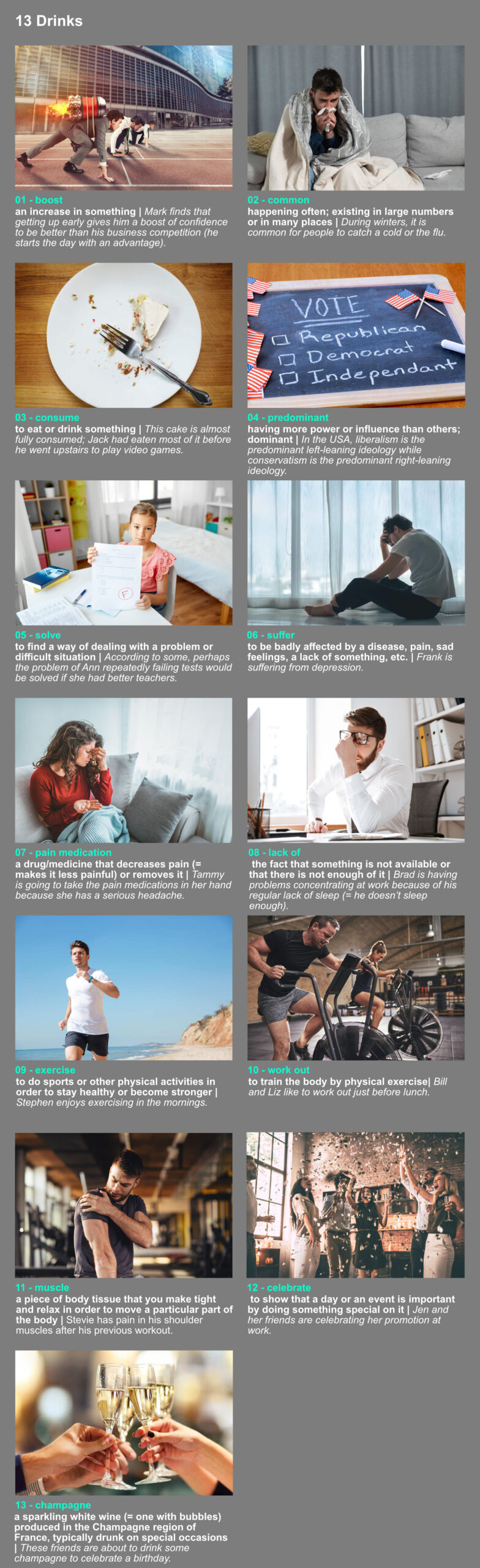
13 Drinks (steps 1, 2 and 4)
- 01 What is your favourite drink?
My favourite drink is – right now – coffee as it helps to get me up in the morning sometimes and gives me an extra boost of energy when I need it.
boost1: an increase in something | Mark finds that getting up early gives him a boost of confidence to be better than his business competition (he starts the day with an advantage).
Is it common for people to drink tea and coffee in your country?
It is very common in my country for people to drink tea and coffee. Although, I will say while both are consumed, coffee is by far predominant.
common2: happening often; existing in large numbers or in many places | During winters, it is common for people to catch a cold or the flu.
consume3: to eat or drink something | This cake is almost fully consumed; Jack had eaten most of it before he went upstairs to play video games.
by far: by a great amount | Max is the fastest runner in the class by far. (= He’s much, much faster than the others.)
predominant4: having more power or influence than others; dominant | In the USA, liberalism is the predominant left-leaning ideology while conservatism is the predominant right-leaning ideology.
- 02 Did you prefer different drinks as a child?
As a child, I did indeed prefer tea. I still like tea, and I still use it whenever I need it, but I drink coffee more often now, so I have to say that coffee is my favourite. But I still drink tea when I’m sick or when I’m cold and just need something to warm me up, then I drink tea.
indeed: used to say that something is really/absolutely true or right. | Did Steve fall down the stairs today? Indeed he did. (= Yes! Absolutely!)
whenever: at any time that; on any occasion that | Mary asked her parents for help with her homework whenever she needed it.
- 03 Do you think it’s important to drink lots of water?
I do indeed think it is important to drink lots of water. In fact, if you don’t drink enough water, many, many bad things will happen, which would otherwise be solved by drinking enough water. For example, if you suffer from frequent headaches, drinking more water is just as good or, in some cases, even more effective than some pain medications, as the reason why you’re having the headache is because of the lack of water.
Otherwise: used to state (= tell) what would happen if things were different or if something didn’t happen; or else| Lock the car doors before you leave, otherwise someone might open it.
solve5: to find a way of dealing with a problem or difficult situation | According to some, perhaps the problem of Ann repeatedly failing tests would be solved if she had better teachers.
suffer6: to be badly affected by a disease, pain, sad feelings, a lack of something, etc. | Frank is suffering from depression.
frequent: happening or doing something often | Jack is a frequent visitor to his neighbour; they both enjoy playing board games like Monopoly.
pain medication7: a drug/medicine that decreases pain (= makes it less painful) or removes it | Tammy is going to take the pain medications in her hand because she has a serious headache.
lack of8: the fact that something is not available or that there is not enough of it | Brad is having problems concentrating at work because of his regular lack of sleep (= he doesn’t sleep enough).
Also, if you exercise, you work out or you want to build your muscles, you need to remember to drink lots of water. The thing about water is we are made out of 80% water, and when we don’t have enough of it, things go wrong, but it’s beyond just being made up of water. Also, a lot of the chemical processes in the body rely on water. As such, water is extremely important.
exercise9: to do sports or other physical activities in order to stay healthy or become stronger | Stephen enjoys exercising in the mornings.
work out10: to train the body by physical exercise| Bill and Liz like to work out just before lunch.
muscle11: a piece of body tissue that you make tight and relax in order to move a particular part of the body | Stevie has pain in his shoulder muscles after his previous workout.
beyond: more than something | Maggie’s career success was far beyond anything her friends or family could have predicted.
process: a series of steps in order to make something or make something happen, or a series of changes that happen naturally | Slowing down and having grey hair are natural ageing processes.
rely on: to need or depend on somebody/something | Since he sold his car, John has relied on public transport to get to work.
as such: because of this | There weren’t any vegetarian dishes that tickled our fancy (= that made us interested) in the restaurant. As such, we left and cooked our own dinner at home.
- 04 What is the traditional drink in your country for celebrating?
The old traditional drink in my country for celebrating would be champagne, but I don’t know anyone that actually drinks champagne. It’s almost a cliche that you drink champagne when you celebrate here, but I don’t know anyone that actually does it. Here they mainly drink beer or some sort of hard liquor to celebrate.
celebrate12: to show that a day or an event is important by doing something special on it | Jen and her friends are celebrating her promotion at work.
champagne13: a sparkling white wine (= one with bubbles) produced in the Champagne region of France, typically drunk on special occasions | These friends are about to drink some champagne to celebrate a birthday.
cliché: often said, used, or done, and therefore not original and not interesting | A lot of movies use clichéd slow-motion action scenes.
liquor: strong alcoholic drink; spirit | Although she likes the way it looks, Sally especially hates the scent of liquor.
What is your favourite drink?
My favourite drink is – right now – coffee as it helps to get me up in the morning sometimes and gives me an extra boost of energy when I need it.
Did you prefer different drinks as a child?
As a child, I did indeed prefer tea. I still like tea, and I still use it whenever I need it, but I drink coffee more often now, so I have to say that coffee is my favourite. But I still drink tea when I’m sick or when I’m cold and just need something to warm me up, then I drink tea.
Do you think it’s important to drink lots of water?
I do indeed think it is important to drink lots of water. In fact, if you don’t drink enough water, many, many bad things will happen, which would otherwise be solved by drinking enough water. For example, if you suffer from frequent headaches, drinking more water is just as good or, in some cases, even more effective than some pain medications, as the reason why you’re having the headache is because of the lack of water.
Also, if you exercise, you work out or you want to build your muscles, you need to remember to drink lots of water. The thing about water is we are made out of 80% water, and when we don’t have enough of it, things go wrong, but it’s beyond just being made up of water. Also, a lot of the chemical processes in the body rely on water. As such, water is extremely important.
What is the traditional drink in your country for celebrating?
The old traditional drink in my country for celebrating would be champagne, but I don’t know anyone that actually drinks champagne. It’s almost a cliche that you drink champagne when you celebrate here, but I don’t know anyone that actually does it. Here they mainly drink beer or some sort of hard liquor to celebrate.
14 Evenings (steps 1, 2 and 4)
- 01 What do you often do in the evenings?
I usually spend time with my family in the evenings. We do a lot of things: sometimes we watch television, sometimes we listen to polkas … many things.
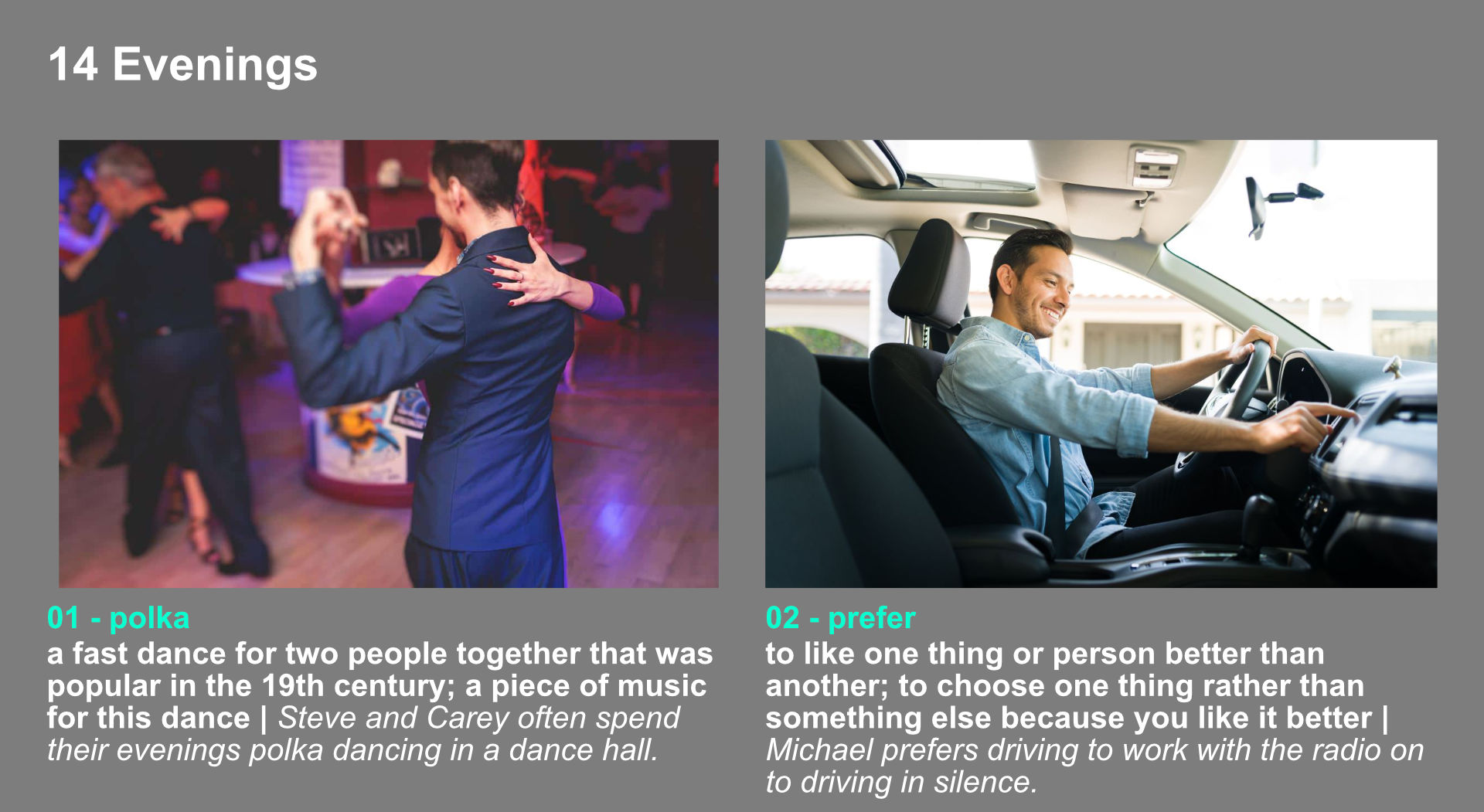
polka1: a fast dance for two people together that was popular in the 19th century; a piece of music for this dance | Steve and Carey often spend their evenings polka dancing in a dance hall.
- 02 Do you do the same thing every evening?
Yes, I do the same thing almost every single evening.
- 03 Do you prefer to spend you evenings with family or friends?
I prefer to spend my evenings with both, but if one had to win out, it would be my family. I prefer to spend time in the evenings with my family.
prefer2: to like one thing or person better than another; to choose one thing rather than something else because you like it better | Michael prefers driving to work with the radio on to driving in silence.
- 04 Do you ever work or study in the evenings?
I sometimes work or study in the evenings, but I rarely do that. I much prefer spending time with my family then.
- 05 What is a popular activity for young people in your country in the evenings?
Very unfortunately, I don’t know many young people in my country, and I have no idea what they do in the evenings, so I don’t really know how to answer this question.
unfortunately: used to say when a situation or fact makes you sad or disappointed, or gets you into a difficult position | Unfortunately, Alfie dropped the ice-cream right after leaving the shop, so he had no chance to even taste it.
- 06 Do you do the same thing in the evenings as you did when you were a child?
Yes, I do roughly the exact same thing in my evenings as I did when I was a child.
roughly: approximately but not exactly | It took Kerry roughly five years to write and publish her new novel.
What do you often do in the evenings?
I usually spend time with my family in the evenings. We do a lot of things: sometimes we watch television, sometimes we listen to polkas … many things.
Do you do the same thing every evening?
Yes, I do the same thing almost every single evening.
Do you prefer to spend you evenings with family or friends?
I prefer to spend my evenings with both, but if one had to win out, it would be my family. I prefer to spend time in the evenings with my family.
Do you ever work or study in the evenings?
I sometimes work or study in the evenings, but I rarely do that. I much prefer spending time with my family then.
What is a popular activity for young people in your country in the evenings?
Very unfortunately, I don’t know many young people in my country, and I have no idea what they do in the evenings, so I don’t really know how to answer this question.
Do you do the same thing in the evenings as you did when you were a child?
Yes, I do roughly the exact same thing in my evenings as I did when I was a child.
15 Family and Friends (steps 1, 2 and 4)
- 01 Do you spend much time with your family?
I spend a lot of time with my family, most of my time, in fact. Neither my family nor I tend to go out, and since we live in the same house, this means we spend a lot of time together.
neither… nor: used to show that a negative statement is true of two things | Neither the mobile phone, nor its charger works; they both have been damaged by water.
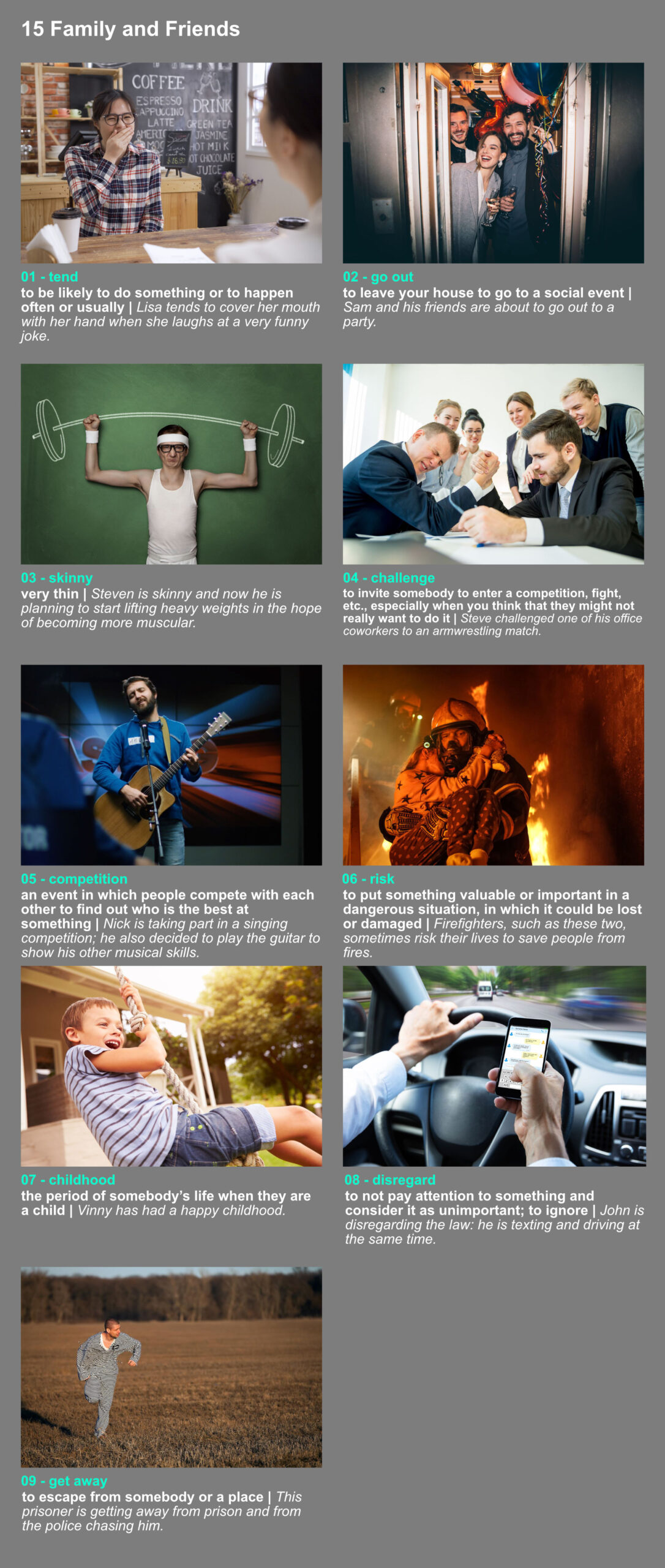
tend1: to be likely to do something or to happen often or usually | Lisa tends to cover her mouth with her hand when she laughs at a very funny joke.
go out2: to leave your house to go to a social event | Sam and his friends are about to go out to a party.
- 02 Who are you closest to in your family?
I suspect I’m probably closer to my mother and my family, but we’re all very close.
suspect: to have an idea that something is probably true or likely to happen, but without having definite proof | I suspect (= I have a feeling) that it will be very hot during the time of the festival next summer.
- 03 Do you prefer spending time with your family or friends?
Well see, I can’t really answer this question because I would say that I prefer spending time with my friends, but in reality, this is because I spend so much time with my family already that I would prefer to spend any other time that I can with my friends, so really I enjoy spending time with both.
- 04 Who is your best friend?
My best friend is a skinny Hungarian man who I’ve never met and who lives on the other side of the world. We frequently challenge each other to competitions that usually risk both of our health.
skinny3: very thin | Steven is skinny and now he is planning to start lifting heavy weights in the hope of becoming more muscular.
challenge4: to invite somebody to enter a competition, fight, etc., especially when you think that they might not really want to do it | Steve challenged one of his office coworkers to an armwrestling match.
competition5: an event in which people compete with each other to find out who is the best at something | Nick is taking part in a singing competition; he also decided to play the guitar to show his other musical skills.
risk6: to put something valuable or important in a dangerous situation, in which it could be lost or damaged | Firefighters, such as these two, sometimes risk their lives to save people from fires.
- 05 Are you still friends with people from your childhood?
I am not still friends with anyone from my childhood. I live in a different country from them and haven’t spoken with them in years. I have no contact with any of my childhood friends.
childhood7: the period of somebody’s life when they are a child | Vinny has had a happy childhood.
- 06 Is family important in your country?
Unfortunately, almost everyone in my country has completely disregarded family. Most people hate their families and try to get away as fast as they can, which is very sad.
disregard8: to not pay attention to something and consider it as unimportant; to ignore | John is disregarding the law: he is texting and driving at the same time.
get away9: to escape from somebody or a place | This prisoner is getting away from prison and from the police chasing him.
Do you spend much time with your family?
I spend a lot of time with my family, most of my time, in fact. Neither my family nor I tend to go out, and since we live in the same house, this means we spend a lot of time together.
Who are you closest to in your family?
I suspect I’m probably closer to my mother and my family, but we’re all very close.
Do you prefer spending time with your family or friends?
Well see, I can’t really answer this question because I would say that I prefer spending time with my friends, but in reality, this is because I spend so much time with my family already that I would prefer to spend any other time that I can with my friends, so really I enjoy spending time with both.
Who is your best friend?
My best friend is a skinny Hungarian man who I’ve never met and who lives on the other side of the world. We frequently challenge each other to competitions that usually risk both of our health.
Are you still friends with people from your childhood?
I am not still friends with anyone from my childhood. I live in a different country from them and haven’t spoken with them in years. I have no contact with any of my childhood friends.
Is family important in your country?
Unfortunately, almost everyone in my country has completely disregarded family. Most people hate their families and try to get away as fast as they can, which is very sad.
16 Flowers (steps 1, 2 and 4)
- 01 Do you like flowers?
Yes, I like flowers, though I don’t think about it too much.
- 02 What is your favourite flower?
My favourite flower is the jasmine flower. I know it from China, but I think it grows elsewhere as well.
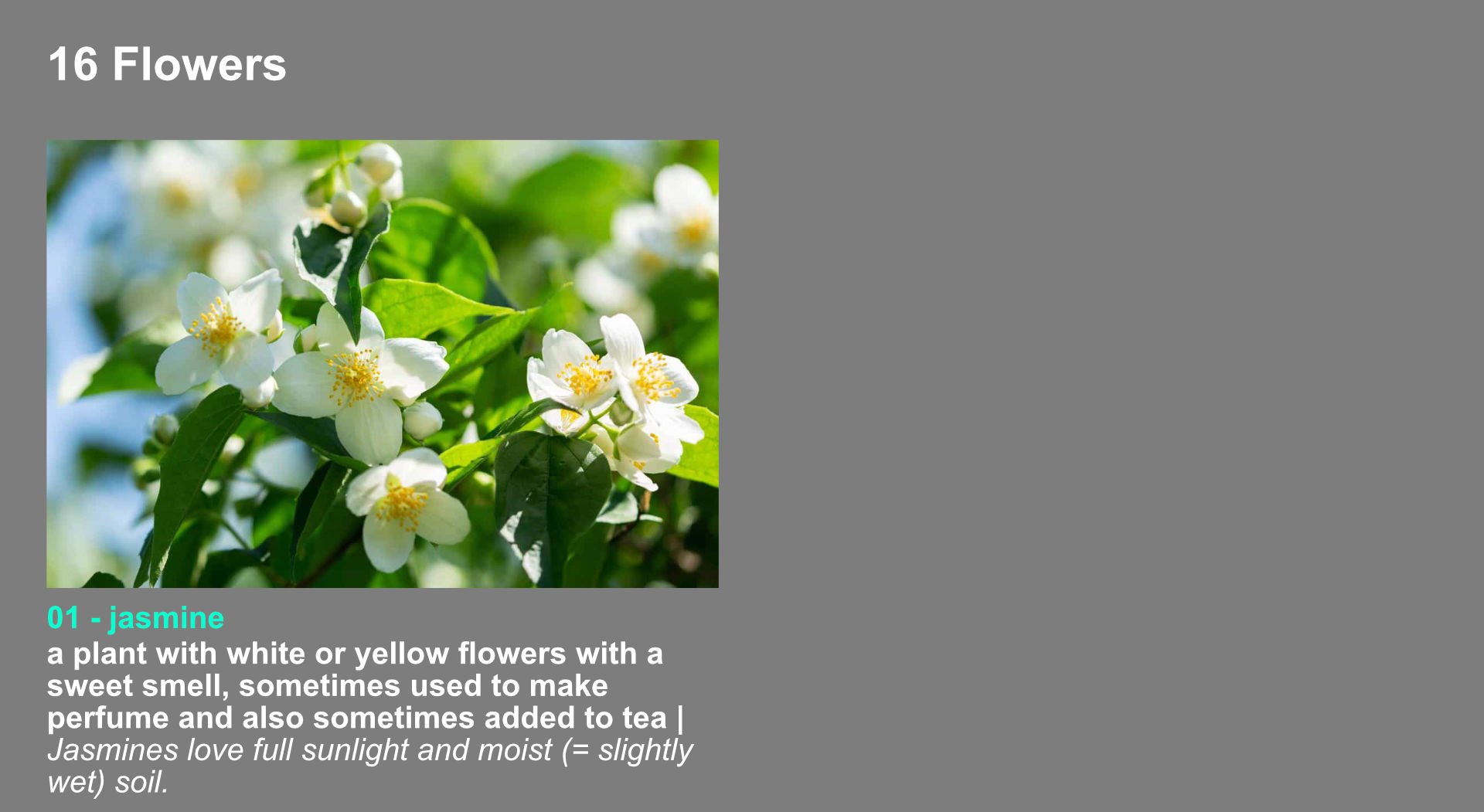
jasmine1: a plant with white or yellow flowers with a sweet smell, sometimes used to make perfume and also sometimes added to tea | Jasmines love full sunlight and moist (= slightly wet) soil.
elsewhere: in, at or to another place or other places | Matt is not here. If you want to find him, you must look elsewhere.
as well: in addition to somebody/something; too; also | I thought we would be going to the cinema alone, but I have just found out that Clara would be coming as well.
- 03 When was the last time you gave someone flowers?
The last time I gave someone flowers was when I was in high school, and I haven’t had much occasion to give anyone flowers since.
occasion: a suitable time for something | Music concerts are an occasion to sing along to our favourite songs.
- 04 Do any flowers have a special meaning in your country?
Yes, most flowers have a special meaning in my country, but most people in my country have forgotten that.
- 05 Why do you think women like flowers more than men?
I don’t really know, but I suspect maybe it’s because they have more time to think about such things; I don’t know.
Do you like flowers?
Yes, I like flowers, though I don’t think about it too much.
What is your favourite flower?
My favourite flower is the jasmine flower. I know it from China, but I think it grows elsewhere as well.
When was the last time you gave someone flowers?
The last time I gave someone flowers was when I was in high school, and I haven’t had much occasion to give anyone flowers since.
Do any flowers have a special meaning in your country?
Yes, most flowers have a special meaning in my country, but most people in my country have forgotten that.
Why do you think women like flowers more than men?
I don’t really know, but I suspect maybe it’s because they have more time to think about such things; I don’t know.
17 Food (steps 1, 2 and 4)
- 01 What’s your favorite food?
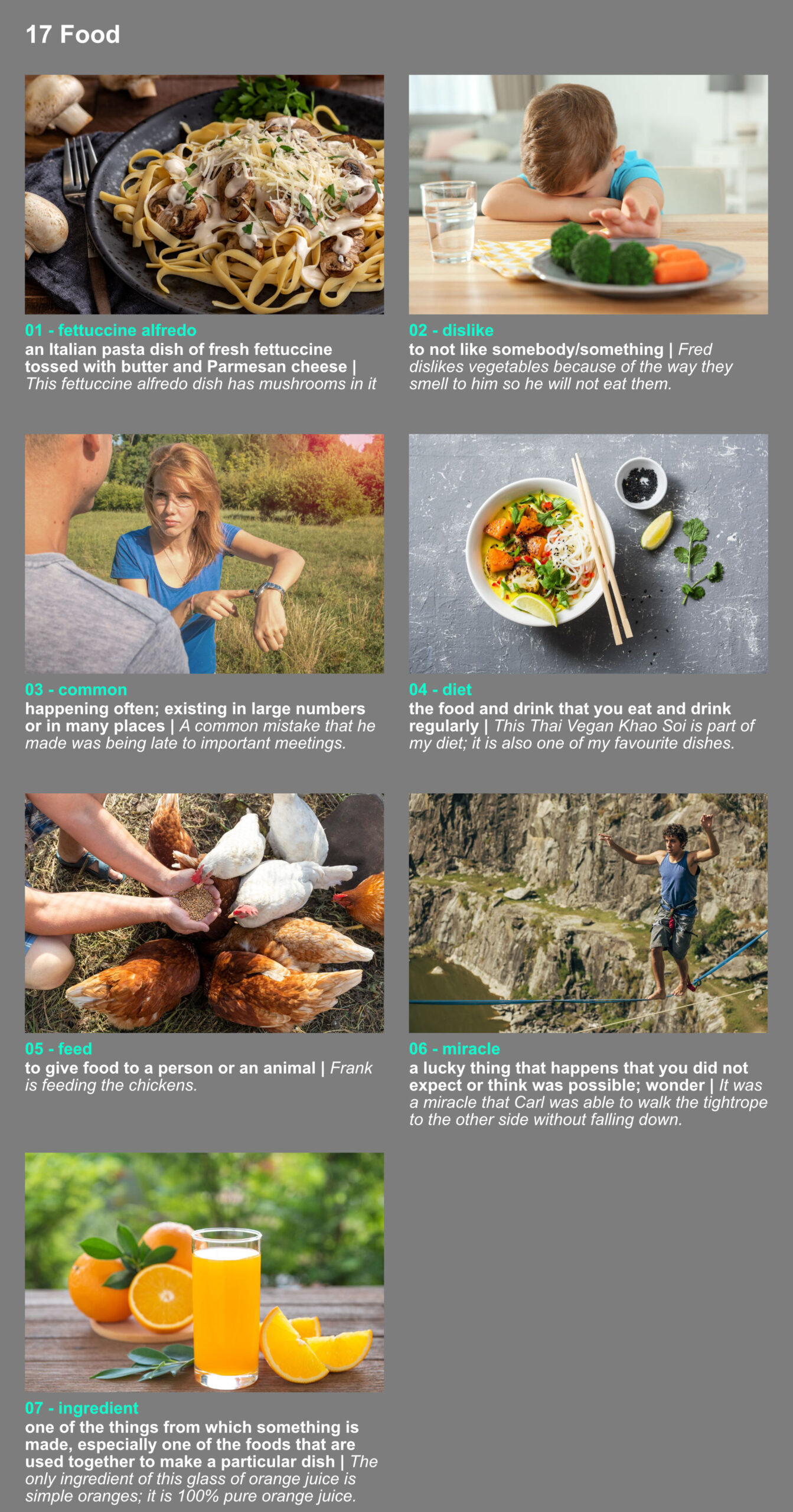
My favorite food is fettuccine alfredo. I like it quite a lot, and I have eaten it in almost every restaurant in Maine.
fettuccine alfredo1: an Italian pasta dish of fresh fettuccine tossed with butter and Parmesan cheese | This fettuccine alfredo features a generous quantity of mushrooms.
- 02 Have you always liked the same food?
Yes, I have always liked fettuccine alfredo. I don’t suspect that’ll ever stop, either.
- 03 Is there any food you dislike?
I dislike mushrooms, and I dislike any food that won’t actually fill me. I like a lot of food.
dislike2: to not like somebody/something | Fred dislikes vegetables because of the way they smell to him, so he doesn’t eat them.
mushroom: a fungus with a round flat head and short stem | Harry went to the forest to pick some mushrooms; Being a mushroom expert, he knows which ones are edible (= can be eaten).
- 04 What is a common meal in your country?
Probably the most common meal in my country is pizza. I don’t know why, but we all eat pizza very regularly. It’s slightly strange to me, but that is the most common meal we have here.
common3: happening often; existing in large numbers or in many places | A common mistake that he made was being late to important meetings.
regularly: with equal or similar amounts of space or time between one and the next | The workers meet regularly to discuss their progress on the project.
slightly: a little | Mark is slightly scared of bugs such as ants but he does not have a phobia.
- 05 Do you have a healthy diet?
Yes, I have a very healthy diet. Meat and pasta, and potatoes are very good. They keep me fed.
diet4: the food and drink that you eat and drink regularly | This Thai Vegan Khao Soi is part of my diet; it is also one of my favourite dishes.
feed5: to give food to a person or an animal | Frank is feeding the chickens.
(well) fed: having plenty of good food to eat regularly | Even though I am quite well fed, I cannot easily gain weight (= put on kilos).
- 06 What do you think of fast food?
I think fast food is a modern miracle, but I think that many companies that sell it have been using poor ingredients, and many people get sick because of it.
miracle7: a lucky thing that happens that you did not expect or think was possible; wonder | It was a miracle that Carl was able to successfully walk the tightrope to the other side.
ingredient8: one of the things from which something is made, especially one of the foods that are used together to make a particular dish | This squeezed orange juice contains no additional ingredients.
What’s your favorite food?
My favorite food is fettuccine alfredo. I like it quite a lot, and I have eaten it in almost every restaurant in Maine.
Have you always liked the same food?
Yes, I have always liked fettuccine alfredo. I don’t suspect that’ll ever stop, either.
Is there any food you dislike?
I dislike mushrooms, and I dislike any food that won’t actually fill me. I like a lot of food.
What is a common meal in your country?
Probably the most common meal in my country is pizza. I don’t know why, but we all eat pizza very regularly. It’s slightly strange to me, but that is the most common meal we have here.
Do you have a healthy diet?
Yes, I have a very healthy diet. Meat and pasta, and potatoes are very good. They keep me fed.
What do you think of fast food?
I think fast food is a modern miracle, but I think that many companies that sell it have been using poor ingredients, and many people get sick because of it.
18 Going Out (steps 1, 2 and 4)
- 01 Do you often go out in the evenings?
No, on account of how far I am from town, I don’t go out very often in the evenings.
on account of: because of somebody/something | We were kicked out of the cinema on account of talking too loudly and disturbing others watching the movie.
- 02 What do you like to do when you go out?
I usually like to go to my friend’s house when I go out.
- 03 Do you prefer going out on your own or with your friends?
I usually prefer going out with friends, but I don’t have many friends, so that’s rare.
rare: not done, seen, happening, etc. very often | It is very rare for us to see the stars at night on account of the cloudy skies above our city.
- 04 How often do you go out in a week?
I go out maybe once every 2 weeks.
- 05 Where do most young people like to go out in our country?
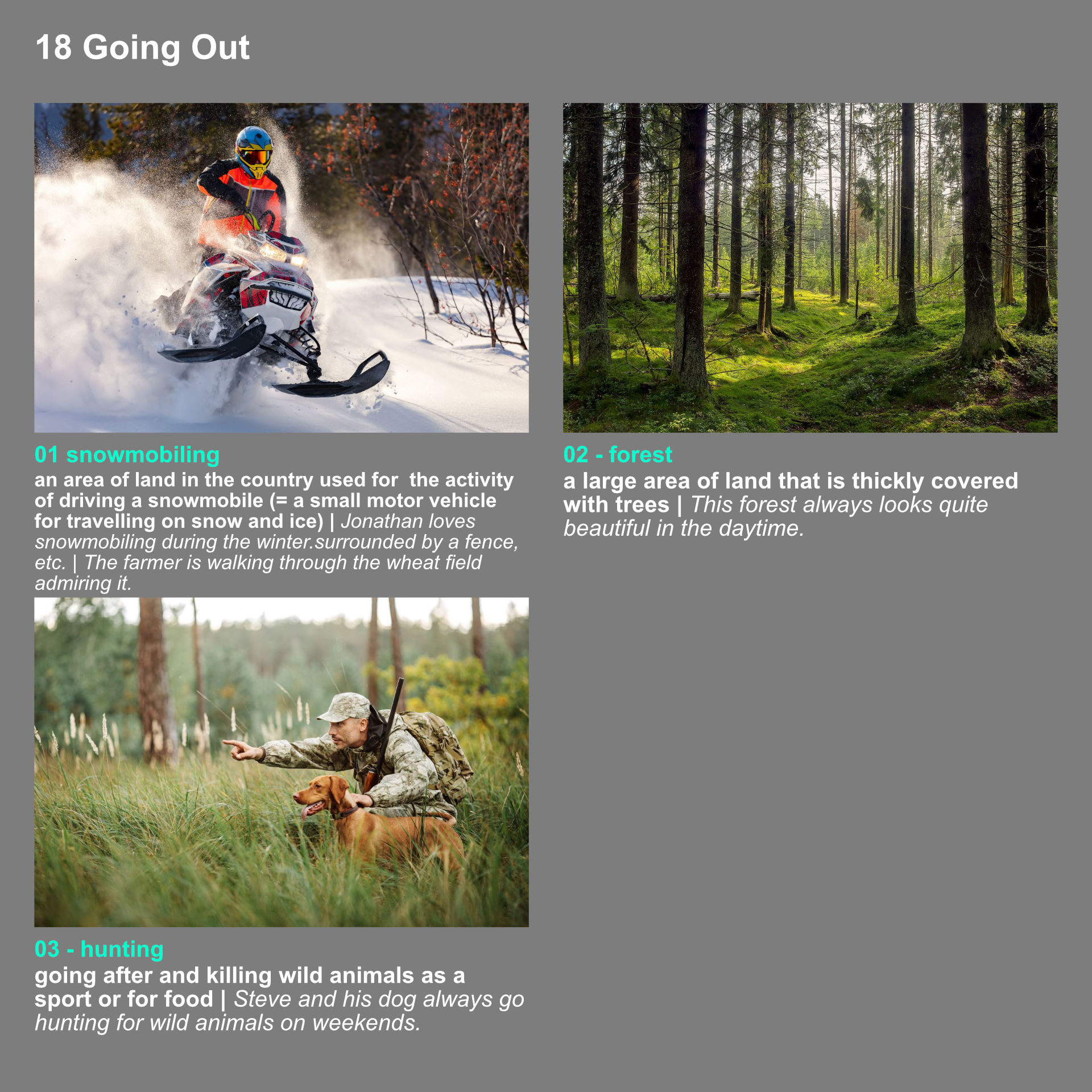
In the winter, most people in my country like to go out snowmobiling. They drive around in the forest on snowmobiles. In the summer, they like to go out hunting together.
snowmobiling1: the activity of driving a snowmobile (= a small motor vehicle for travelling on snow and ice) | Jonathan loves snowmobiling during the winter.
forest2: a large area of land that is thickly covered with trees | This forest always looks quite beautiful in the daytime.
hunting3: going after and killing wild animals as a sport or for food | Steve and his dog always go hunting for wild animals at weekends.
Do you often go out in the evenings?
No, on account of how far I am from town, I don’t go out very often in the evenings.
What do you like to do when you go out?
I usually like to go to my friend’s house when I go out.
Do you prefer going out on your own or with your friends?
I usually prefer going out with friends, but I don’t have many friends, so that’s rare.
How often do you go out in a week?
I go out maybe once every 2 weeks.
Where do most young people like to go out in our country?
In the winter, most people in my country like to go out snowmobiling. They drive around in the forest on snowmobiles. In the summer, they like to go out hunting together.
19 Happiness (steps 1, 2 and 4)
- 01 Are you a happy person?
I am indeed a happy person. I would certainly consider myself that.
indeed: used to say that something is really/absolutely true or right. | Did Danny fall down the stairs last week?” “Indeed, he did.” (= Yes, absolutely.)
consider: to think of somebody/something in a particular way | Jack considers the other driver responsible for the car accident. (= He thinks that the it was the other driver’s fault.)
- 02 What usually makes you happy, and what makes you unhappy?
A lot of things make me happy, and a lot of things make me unhappy. Some things that make me happy, though this is by no means a comprehensive list: physical labour. I like working. I like working hard. It gives me a sense of accomplishment.
by no means: not at all | She was a great teacher but was by no means qualified to be giving lessons.
comprehensive: including all the items, details, facts, information, etc. that is important; complete | Francis kept a comprehensive list of all the costumers who have bought from him.
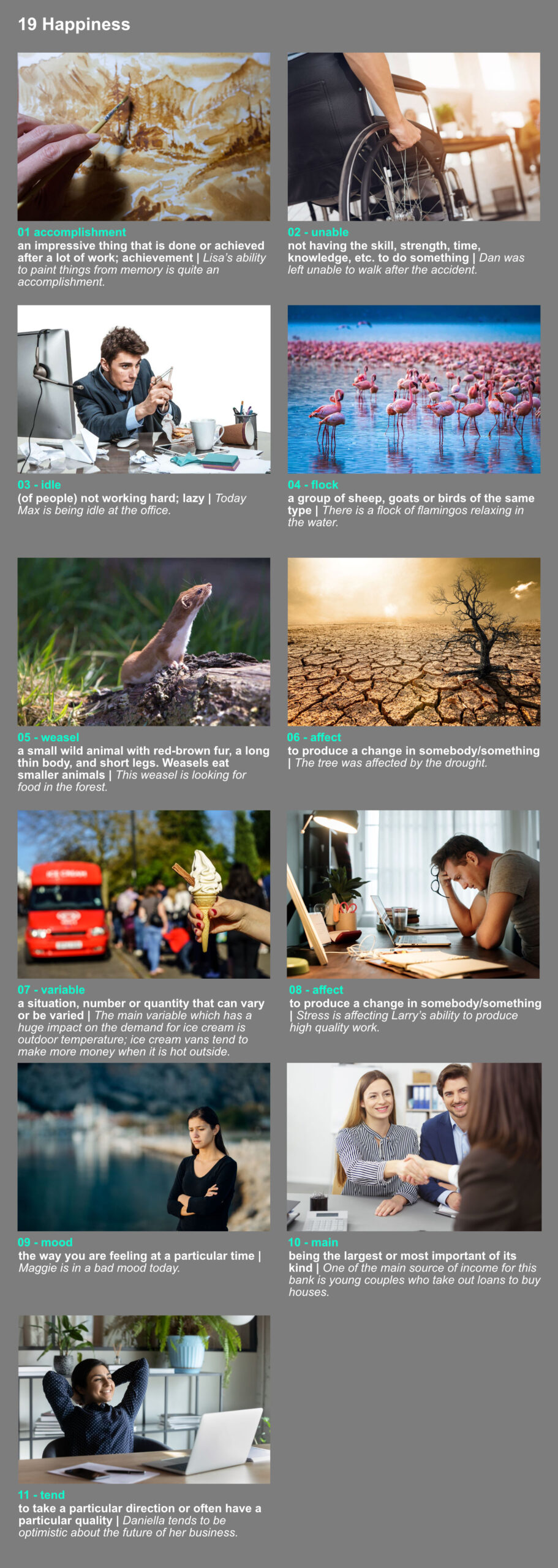
accomplishment1: an impressive thing that is done or achieved after a lot of work; achievement | Lisa’s ability to paint things from memory is quite an accomplishment.
Speaking of other things that make me happy: a sense of accomplishment. I like knowing I got something done. I also feel very happy when I have a good time with my friends and family.
I generally feel unhappy when I’m unable to work, when I don’t have anything to do, when I’ve been idle, or when I’ve lost something like saying an entire flock of chickens to a weasel or things like that.
sense: a general feeling or understanding | The ticking sound of the clock gave Steven a sense of urgency: he didn’t have much time left to complete his exam paper.
unable2: not having the skill, strength, time, knowledge, etc. to do something | Dan was left unable to walk after the accident.
idle3: (of people) not working hard; lazy | Today Max is being idle at the office.
entire: including everything, everyone or every part; the whole; | Max spent the entire day being idle in the office.
flock4: a group of sheep, goats or birds of the same type | A flock of flamingos are relaxing in the water.
weasel5: a small wild animal with red-brown fur, a long thin body, and short legs. Weasels eat smaller animals | This weasel is looking for food in the forest.
- 03 Does the weather affect how you feel?
The weather does indeed affect how I feel quite a lot. In fact, I have found one main variable of the weather … (that) affects how I feel quite a lot, and that is air pressure. Depending on how the air pressure is, it completely changes my mood. The air pressure I enjoy the most is right as a storm is moving in, right as the weather front is above my house, and the two pressures are fighting it out; that’s what I like the most.
indeed: used to say that something is really/absolutely true or right. | “Is spaghetti your favourite food?” “Spaghetti is indeed one of my favourite dishes.”
affect6: to produce a change in somebody/something | The tree was affected by the drought (= a very long and dry period of time). It simply dried out and died.
variable7: a situation, number or quantity that can change or be different | The main variable on the demand for ice cream is outdoor temperature: ice cream vans tend to make more money when it is hot outside.
affect8: to produce a change in somebody/something | Stress is affecting Larry’s ability to produce high quality work.
air pressure: the air around you has weight, and it presses against everything it touches | Air pressure is different at the top of a mountain compared to the base, where the elevation (= height over sea level) is lower.
depend on sth: be affected by something | Whether or not I am going out tonight depends on the weather. If it’s dry, I will go, but if it rains, I’ll stay at home
mood9: the way you are feeling at a particular time | Maggie is in a bad mood today.
right as: exactly when; at exactly that moment; just as | Right as Johnny’s car left his garage, heavy rain started to pour down.
- 04 What makes you smile?
Many things make me smile. Two main ones are being outside in nature and enjoying it, and seeing other people smile.
main10: being the largest or most important of its kind | One of the main sources of income for this bank is young couples who take out loans to buy houses.
- 05 Do you think people in your country are generally happy?
People in my country are very, very much not happy people. They tend to be extremely unhappy.
tend11: to often have a particular quality; to be usually like that | Daniella tends to be optimistic about the future of her business.
Are you a happy person?
I am indeed a happy person. I would certainly consider myself that.
What usually makes you happy, and what makes you unhappy?
A lot of things make me happy, and a lot of things make me unhappy. Some things that make me happy, though this is by no means a comprehensive list: physical labour. I like working. I like working hard. It gives me a sense of accomplishment.
Speaking of other things that make me happy: a sense of accomplishment. I like knowing I got something done. I also feel very happy when I have a good time with my friends and family.
I generally feel unhappy when I’m unable to work, when I don’t have anything to do, when I’ve been idle, or when I’ve lost something like saying an entire flock of chickens to a weasel or things like that.
Does the weather affect how you feel?
The weather does indeed affect how I feel quite a lot. In fact, I have found one main variable of the weather … (that) affects how I feel quite a lot, and that is air pressure. Depending on how the air pressure is, it completely changes my mood. The air pressure I enjoy the most is right as a storm is moving in, right as the weather front is above my house, and the two pressures are fighting it out; that’s what I like the most.
What makes you smile?
Many things make me smile. Two main ones are being outside in nature and enjoying it, and seeing other people smile.
Do you think people in your country are generally happy?
People in my country are very, very much not happy people. They tend to be extremely unhappy.
20 Hobbies (steps 1, 2 and 4)
- 01 Do you have a hobby?
I would consider my hobby to be sabre fencing, although I don’t often have a partner to do it with.
consider: to think of somebody/something in a particular way | I consider Frank to be a bad person.
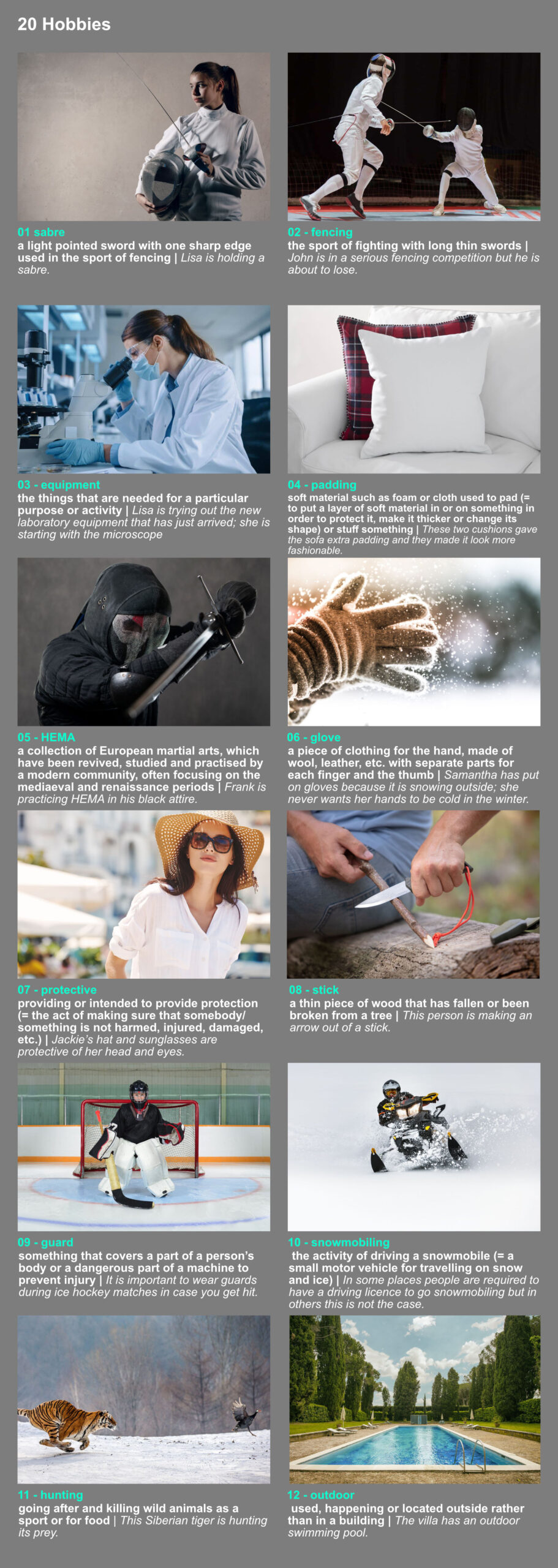
sabre1: a light, pointed sword with one sharp edge used in the sport of fencing | Lisa is holding a sabre.
fencing2: the sport of fighting with long thin swords | John is in a serious fencing competition, but he is about to lose.
- 02 What equipment do you need for it?
It can be done with very little equipment or a lot of equipment. Some people, when they sabre fence, they want a full suit of padding, they want a HEMA mask, they want gloves, they want a jacket. When I, and whomever I had as a fencing partner, which was usually my nephew (who) would do it, we did not use any protective equipment; we just used sticks. I would make guards for them out of metal, but other than that, no equipment was needed.
equipment3: the things that are needed for a particular purpose or activity | Lisa is trying out the new laboratory equipment that has just arrived; she is starting with the microscope.
padding4: soft material such as foam or cloth used to pad (= to put a layer of soft material in or on something in order to protect it, make it thicker or change its shape) or stuff something | These two cushions gave the sofa extra padding, and they made it look more fashionable.
HEMA5: “Historical European Martial Arts.” Fighting and swordplay from the mediaeval (= Middle Age) and renaissance periods, which have been studied and practised by a modern community | Frank is practicing HEMA in his black attire (= fine, formal clothes).
glove6: a piece of clothing for the hand, made of wool, leather, etc. with separate parts for each finger and the thumb | Samantha has put on gloves because it is snowing outside; she never wants her hands to be cold in the winter.
whomever: whoever; anyone | I gave you the sandwich, so it’s yours; if you don’t want it, give it to whomever you want.
protective7: something is there to keep someone/something safe or making sure that somebody/something is not harmed, injured, damaged, etc.) | Jackie’s skin is very sensitive to sunlight, so she’s wearing some protective accessories, like a hat and sunglasses.
stick8: a thin piece of wood that has fallen or been broken from a tree | This person is making an arrow out of a stick.
would: used for talking about things that often happened in the past; used to | When I was away, my neighbours would feed my cat until I came back.
guard9: something that covers a part of a person’s body or a dangerous part of a machine to prevent (= stop from happening) injury | It is important to wear guards during ice hockey matches in case you get hit.
other than that: with the exception of something; except for something | I almost broke my leg when I was young, but other than that I have had no major (= big) injuries.
- 03 Do you think hobbies should be shared with other people?
That would largely depend upon the hobby. My hobby: it’s very hard to do without other people. It can be done, but it’s hard. Some hobbies: it’s very hard to do them with other people.
depend on sth: be affected by something | Whether or not I am going out tonight depends on the weather. If it’s dry, I will go, but if it rains, I’ll stay at home
largely: mainly; mostly| The number of available hospital beds largely depends on how many people are seriously injured and sent to that particular hospital.
- 04 Did you have a hobby as a child?
If it counts, my hobby as a child would be reading. I read quite a lot.
count: to be important | I’ve had several bicycles. Seven, to be more precise, if my first toddler bike doesn’t count.
- 05 What hobbies are popular in your country?
In my country, snowmobiling is a very popular hobby among a lot of people, as is hunting, fishing … I know a man, who thinks of very little other than fishing, in fact. Most people’s hobbies are generally outdoor things.
snowmobiling10: the activity of driving a snowmobile | In some places, people are required to have (= they have to have) a driving licence to go snowmobiling,while in others this is not the case.
hunting11: going after and killing wild animals as a sport or for food | This Siberian tiger is hunting its prey.
think of something: to have an image or idea of something/somebody in your mind | During the movie, Jack wasn’t thinking of anything in particular; he just focused on the film.
outdoor12: used, happening or located outside rather than in a building | The villa has an outdoor swimming pool.
- 06 Why do you think people have hobbies?
I think one has to have something to do in one’s off-time.
one: any person, but not a particular person | One should look after one’s own health.
off-time: time when one is not working | Jack often writes novels in his off-time.
Do you have a hobby?
I would consider my hobby to be sabre fencing, although I don’t often have a partner to do it with.
What equipment do you need for it?
It can be done with very little equipment or a lot of equipment. Some people, when they sabre fence, they want a full suit of padding, they want a HEMA mask, they want gloves, they want a jacket. When I, and whomever I had as a fencing partner, which was usually my nephew (who) would do it, we did not use any protective equipment; we just used sticks. I would make guards for them out of metal, but other than that, no equipment was needed.
Do you think hobbies should be shared with other people?
That would largely depend upon the hobby. My hobby: it’s very hard to do without other people. It can be done, but it’s hard. Some hobbies: it’s very hard to do them with other people.
Did you have a hobby as a child?
If it counts, my hobby as a child would be reading. I read quite a lot.
What hobbies are popular in your country?
In my country, snowmobiling is a very popular hobby among a lot of people, as is hunting, fishing … I know a man, who thinks of very little other than fishing, in fact. Most people’s hobbies are generally outdoor things.
Why do you think people have hobbies?
I think one has to have something to do in one’s off-time.
21 Internet (steps 1, 2 and 4)
- 01 How often do you go online?
I go online almost every day, but I also go on long trips into the woods in which I have no internet and don’t intend to.
intend: to have a plan, result or purpose in your mind when you do something; want | The lion intended to eat the giraffe but failed to do so.
- 02 What do you use the internet for?
I use the Internet to communicate with my friends and to work. Also, I use it to study things.
- 03 How do you get online?
I get online by using a web browser.
web browser: a computer program that lets you look at or read documents on the World Wide Web e.g. Google Chrome | Tim closed his web browser and shut down his computer before he went to school.
- 04 Do you have your own computer?
I didn’t use to have my own computer, but I do now.
- 05 What is your favourite website?
My favourite website is YouTube because, with only a few clicks, I can learn about almost anything I want to learn.
- 06 Do you think children should be allowed unsupervised access to the internet?
Children should definitely not be allowed unsupervised access to the Internet; there’s too many bad things on there for them. I grew up without the Internet, and I was much better for it.
definitely: a way of saying that something is totally true and that there is no doubt about it | I definitely finished my biology homework before I started playing on my computer.
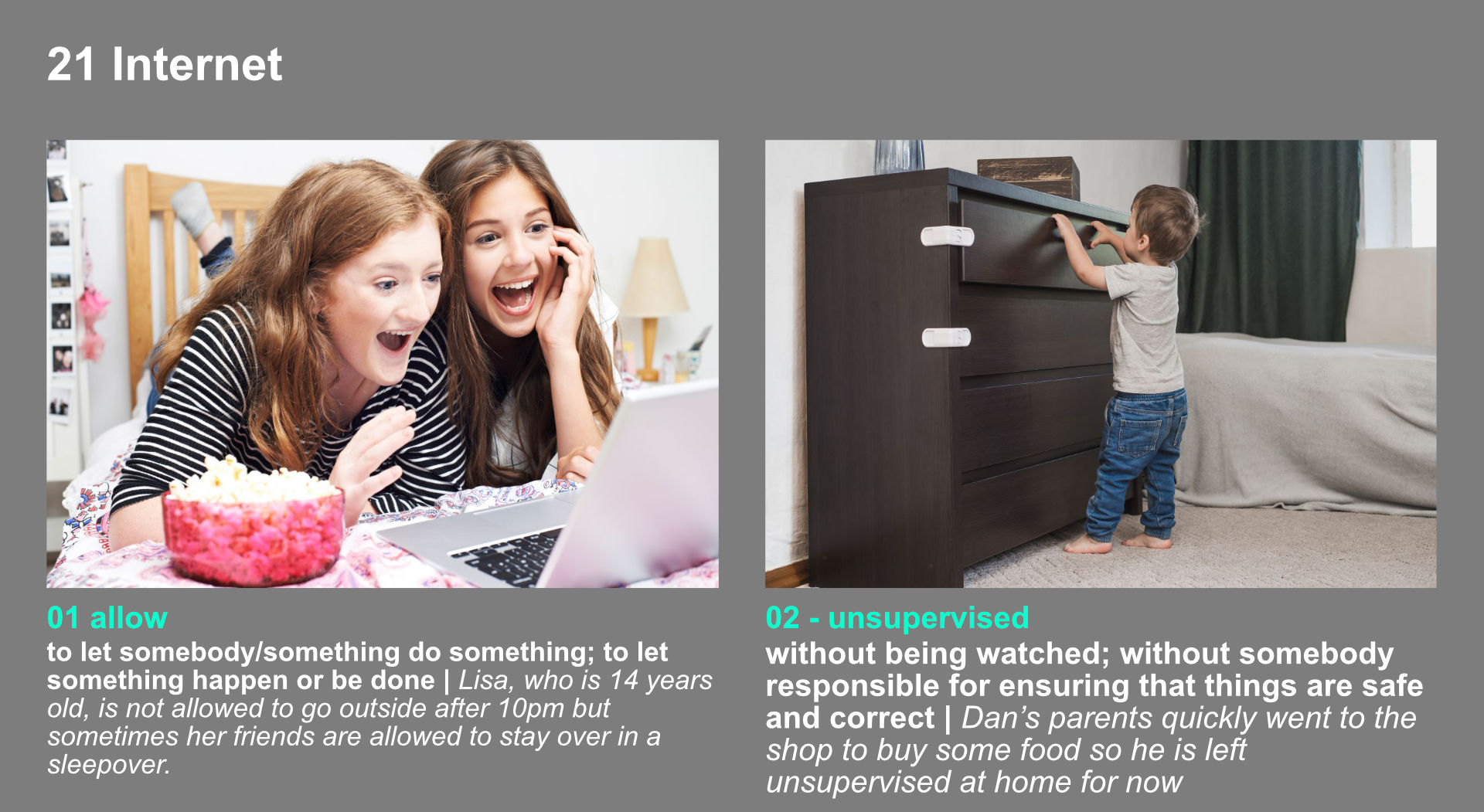
allow1: to let somebody/something do something; to let something happen or be done | Lisa, who is 14 years old, is not allowed to go outside after 10 p.m., but sometimes her friends are allowed to stay over in a sleepover (= a party for children or young people when a group of them spend the night at one house).
unsupervised2: without being watched to be safe or to behave (= act) correctly | Dan’s parents quickly went to the shop to buy some food, so now he is left at home unsupervised.
access: the opportunity or right to use something or to see somebody/something | The news reporters were denied (= weren’t given) access to the prime minister.
How often do you go online?
I go online almost every day, but I also go on long trips into the woods in which I have no internet and don’t intend to.
What do you use the internet for?
I use the Internet to communicate with my friends and to work. Also, I use it to study things.
How do you get online?
I get online by using a web browser.
Do you have your own computer?
I didn’t use to have my own computer, but I do now.
What is your favourite website?
My favourite website is YouTube because, with only a few clicks, I can learn about almost anything I want to learn.
Do you think children should be allowed unsupervised access to the internet?
Children should definitely not be allowed unsupervised access to the Internet; there’s too many bad things on there for them. I grew up without the Internet, and I was much better for it.
22 Languages (steps 1, 2 and 4)
- 01 How many foreign languages do you speak?
Well, that depends on how you reckon it. My native tongue is English. My parents spoke it, and that is my native tongue; however, I was born and raised in China, so I also learned Chinese at a young age, so it all depends on whether Chinese counts as a foreign language or whether it is just my second language.
depend on sth: be affected by something | We might go to the beach today; it mainly depends on the weather
reckon: think about something and decide what you believe or feel about it | The fund raiser (= the special event or activity for collecting money) for the charity is reckoned to be a success. (= People think it was successful.)
native tongue: the first language that you learn | Fracois’ native tongue is French, but he lives in Sweden.
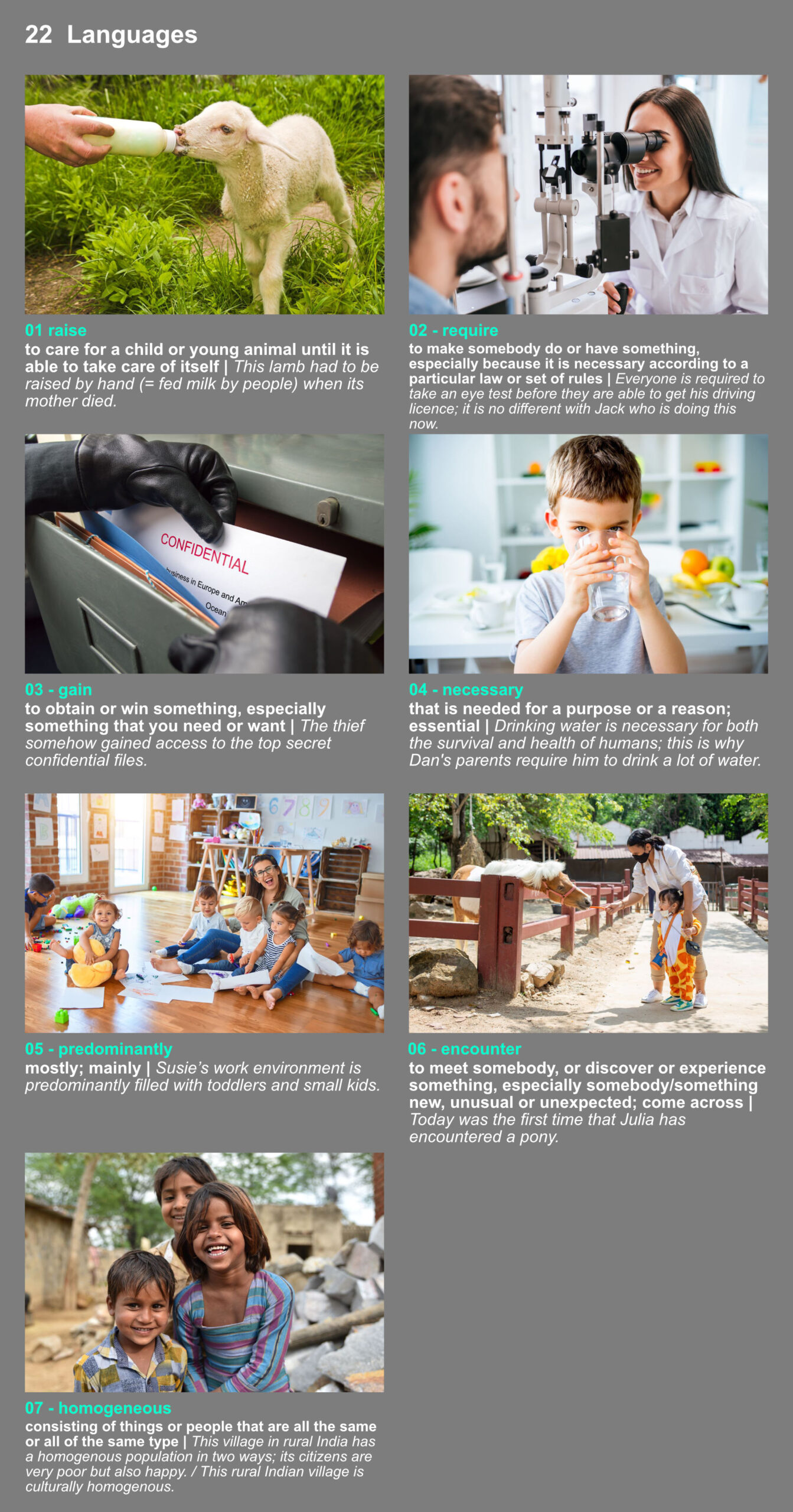
raise1: to care for a child or young animal until it is able to take care of itself | This lamb had to be raised by hand (= fed milk by people) because its mother had died.
foreign: in or from a country that is not your own | I had to go to my bank and get some foreign currency (= another country’s money) because I was travelling overseas.
- 02 When did you start learning your first foreign language?
I speak some Chinese, mainly market Chinese. I also speak some Spanish. At one time, I was fairly fluent in Spanish, but I’ve not had the chance to speak it in some time, so I’ve lost it. I’ve also studied some Irish Gaelic.
mainly: more than anything else; primarily; mostly | I eat mainly rice, pasta and pizza as part of my diet.
at one time: in the past | At one time, I really enjoyed games like rock, paper, scissors; but now I mainly play computer games.
fairly: to some extent but not very; quite | The air-conditioned office felt fairly comfortable.
fluent: able to speak, read or write a language, especially a foreign language | Sam is fairly fluent in Swedish and totally fluent in German; she learned Swedish in school, but he is a German native.
in some time: for a certain period of time | “Oh, it’s a turkey! I haven’t had that in some time; I’m happy to have some again now.”
- 03 How many foreign languages do children in your country learn at school?
In my country, we were required to learn at least one foreign language. In my case, this was Spanish. However, the year I came to school we lost our French teacher and gained a Spanish teacher, so everyone who was older than me had studied French, but everyone from me down studied Spanish.
require2: to make somebody do or have something, especially because it is necessary according to a particular law or set of rules | Jack, just like everyone else, is required to take an eye test before he can get his driving licence.
at least: not less than; minimum | “You must be at least 18 years old to drink alcohol here.”
gain3: to obtain (= to get/have) or win something, especially something that you need or want | The thief somehow gained access to some confidential files (= secret files).
- 04 Do you think it’s important to learn a foreign language?
I think that it depends on where you are. In my country, a foreign language is useful but by no means necessary. You can go from where I am now for hundreds of miles in any direction, and you will not hit a place which speaks a foreign language predominantly. If you go to the north, you can find places that speak mainly French, but most people there will speak English.
by no means: not at all | I have by no means finished all my homework yet.
necessary4: that is needed for a purpose or a reason; essential | Drinking water is necessary for both the survival and health of humans; this is why Dan’s parents require him to drink a lot of water.
hit a place: reach or arrive at a location of a certain feature/quality | Go left of the corner store, and you will hit a place full of large trees.
predominantly5: mostly; mainly | Susie’s work environment is predominantly filled with toddlers and small kids.
However, in some places, it is much more important to learn a foreign language. For example, in many countries in Europe, you only need to go a very short distance to encounter entirely different languages. The languages in Europe are far less homogeneous than where I am currently and where I was born and raised, China. In both of those places, except for local dialects, you could mainly just understand the main language – here English, there Chinese – and you would be fine.
encounter6: to meet somebody, or discover or experience something, especially somebody/something new, unusual or unexpected; to come across | Today was the first time that Julia has encountered a pony.
entirely: in every way possible; completely | The food in Taiwan was entirely new to me; I could not believe the things available to eat there.
homogeneous7: consisting of things or people that are all the same or all of the same type | This rural Indian village is culturally homogenous.
currently: at the present time | Currently, Steven is a Biology teacher in a high school.
dialect: the form of a language that is spoken in one area with grammar, words and pronunciation that may be different from other forms of the same language | In the UK, Scottish and Yorkshire dialects are quite different.
How many foreign languages do you speak?
Well, that depends on how you reckon it. My native tongue is English. My parents spoke it, and that is my native tongue; however, I was born and raised in China, so I also learned Chinese at a young age, so it all depends on whether Chinese counts as a foreign language or whether it is just my second language.
When did you start learning your first foreign language?
I speak some Chinese, mainly market Chinese. I also speak some Spanish. At one time, I was fairly fluent in Spanish, but I’ve not had the chance to speak it in some time, so I’ve lost it. I’ve also studied some Irish Gaelic.
How many foreign languages do children in your country learn at school?
In my country, we were required to learn at least one foreign language. In my case, this was Spanish. However, the year I came to school we lost our French teacher and gained a Spanish teacher, so everyone who was older than me had studied French, but everyone from me down studied Spanish.
Do you think it’s important to learn a foreign language?
I think that it depends on where you are. In my country, a foreign language is useful but by no means necessary. You can go from where I am now for hundreds of miles in any direction, and you will not hit a place which speaks a foreign language predominantly. If you go to the north, you can find places that speak mainly French, but most people there will speak English.
However, in some places, it is much more important to learn a foreign language. For example, in many countries in Europe, you only need to go a very short distance to encounter entirely different languages. The languages in Europe are far less homogeneous than where I am currently and where I was born and raised, China. In both of those places, except for local dialects, you could mainly just understand the main language – here English, there Chinese – and you would be fine.
23 Leisure Time (steps 1, 2 and 4)
- 01 What is your favourite leisure activity?
My favorite leisure activity is fencing. I like to fence with whoever will fence with me.
leisure: time when you are not working or studying; free time | These days we have more money and more leisure to enjoy it.
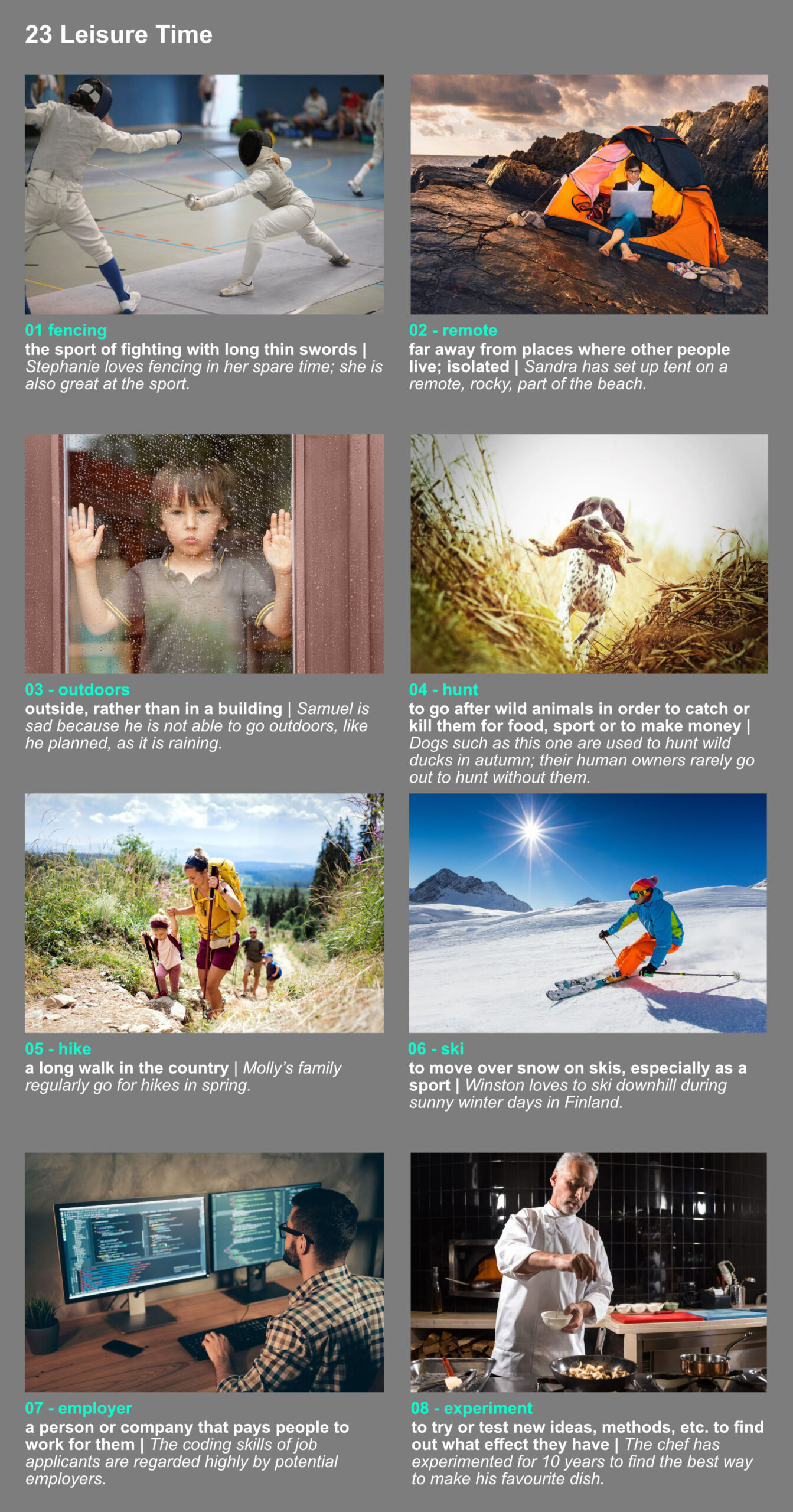
fencing1: the sport of fighting with long thin swords | Stephanie loves fencing in her spare time; she is also great at the sport.
- 02 What did you enjoy doing in your free time as a child?
When I was a child, I enjoyed running, climbing and jumping off of large objects.
- 03 Do you prefer to spend your free time with other people or alone?
I prefer to spend my free time with other people, but I live in a pretty remote place, so I usually spend it alone.
prefer: to like one thing or person better than another; to choose one thing because you like it better | I prefer walking in the forest for fresh air in the morning to running on the running tracks.
pretty: to some extent; fairly; quite | The process of cooking this dish is pretty hard to explain to someone who has never cooked anything in their life.
remote2: far away from places where other people live; isolated | Sandra has set up a tent on a remote, rocky, part of the beach.
- 04 What is a common leisure activity in your country?
In my country most people spend most of their time outdoors. In the summer, that means they like to hunt or hike. In the winter, it means they like to ski or snowmobile.
outdoors3: outside, rather than in a building | Samuel is sad because he is unable to go outdoors as he planned due to the rain
hunt4: to go after wild animals in order to catch or kill them for food, sport or to make money | Hounds, which are hunting dogs, are used to hunt wild ducks because of their outstanding sense of smell.
hike5: a long walk in the country | Molly’s family regularly go on hikes in spring.
ski6: to move over snow on skis, especially as a sport | Winston loves to ski downhill during sunny winter days in Finland.
- 05 Do most people in your country get two days off a week?
Most people in my country get two days off a week. However, some employers and some schools are experimenting with other systems such as a three-day weekend or every other day, and many systems are being tried out right now.
off: away from work or duty | Greg has been working non stop for 12 hours now, so he really needs some time off.
however: used to introduce a statement that contrasts with something that has just been said; but | I went to school today confident about the multiple choice test I was about to take; however, it was much harder than I thought it would be.
employer7: a person or company that pays people to work for them | The coding skills of job applicants are regarded highly (= thought about very positively) by potential employers.
experiment8: to try or test new ideas, methods, etc. to find out what effect they have | The chef has been experimenting for 10 years to find the best way to make his favourite dish.
such as: for example | There are many exciting colours of paint available to paint your room with, such as purple, green and yellow.
every other day: every two days, every second day | I have piano lessons every other day.
- 06 Do you think leisure time is important?
Yes, I think leisure time is important. I think that without some time off of work or school, people would probably go crazy.
go crazy: to become annoyed or angry | The constant noise from the construction work going on next door drove Michael crazy (= made him very angry).
What is your favourite leisure activity?
My favorite leisure activity is fencing. I like to fence with whoever will fence with me.
What did you enjoy doing in your free time as a child?
When I was a child, I enjoyed running, climbing and jumping off of large objects.
Do you prefer to spend your free time with other people or alone?
I prefer to spend my free time with other people, but I live in a pretty remote place, so I usually spend it alone.
What is a common leisure activity in your country?
In my country most people spend most of their time outdoors. In the summer, that means they like to hunt or hike. In the winter, it means they like to ski or snowmobile.
Do most people in your country get two days off a week?
Most people in my country get two days off a week. However, some employers and some schools are experimenting with other systems such as a three-day weekend or every other day, and many systems are being tried out right now.
Do you think leisure time is important?
Yes, I think leisure time is important. I think that without some time off of work or school, people would probably go crazy.
24 Music (steps 1, 2 and 4)
- 01 Do you like music?
Yes, I very much like music. I listen to music whenever I get the chance.
whenever: at any time that; on any occasion that | You can come to our gas station whenever you want; we are open 24/7 (= all day everyday).
get the chance: to have an opportunity or the time to do something | Sarah drinks orange juice wherever she gets the chance to do so; orange juice is her favourite drink.
- 02 What’s your favourite type of music?
My favourite type of music would either be Finnish polkas or Irish rebel music.
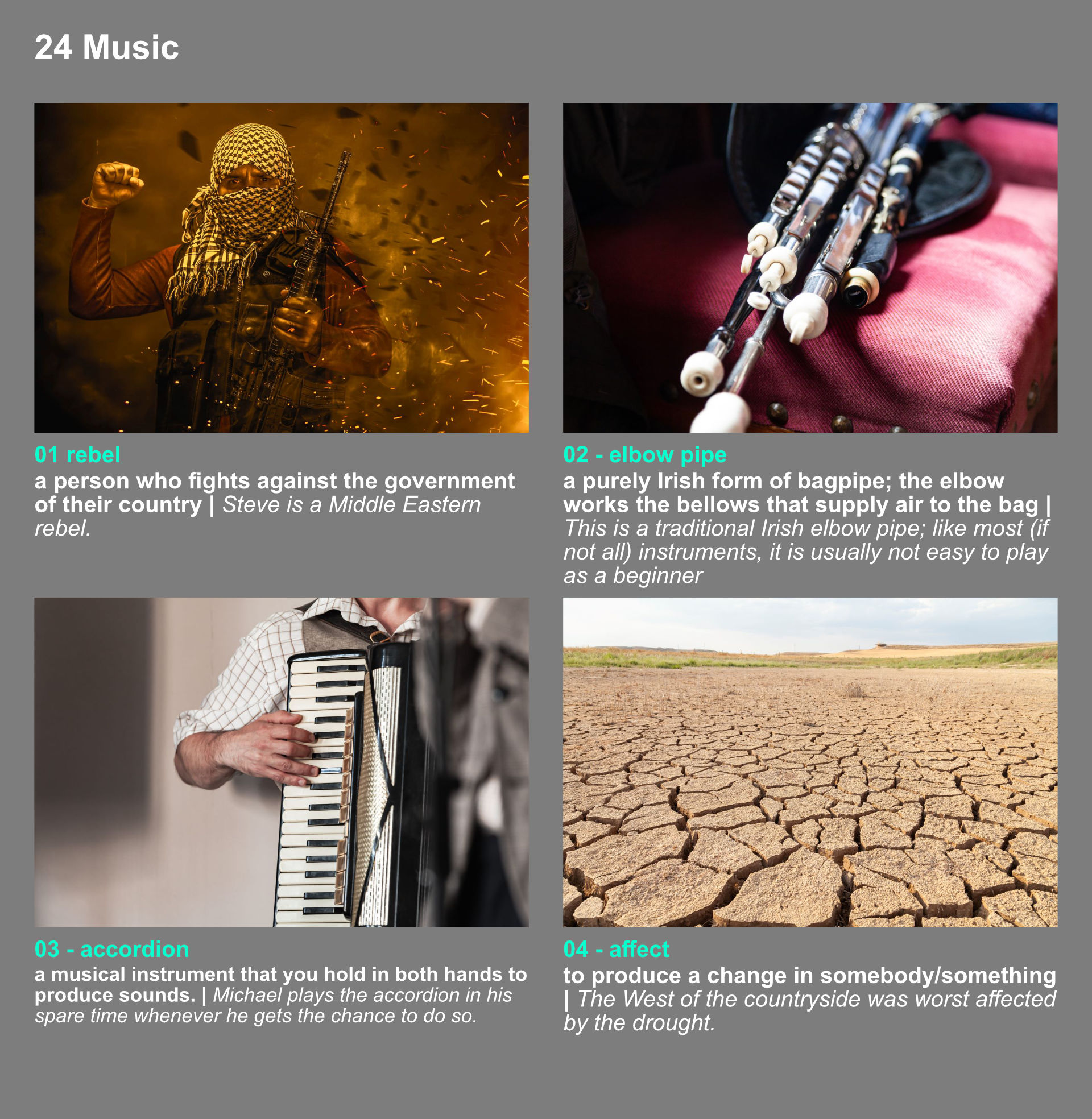
rebel1: a person who fights against the government of their country | Steve is a Middle Eastern rebel.
- 03 Can you sing?
I can indeed sing. In fact, some people have expressed that I can sing quite well.
express: to show or make known a feeling, an opinion, etc. by words, looks or actions | Many of the business’ clients expressed their desire to buy the new product when an article was published in a business magazine.
- 04 Did you learn music at school?
Yes, I learned music at school. I specifically studied guitar. My music teacher was quite good.
specifically: used when you want to add more detailed and exact information | The TV show, or more specifically the actors, received awards for their work.
- 05 If you could learn a musical instrument, what would it be?
If I could learn a musical instrument, I would prefer it to be either the elbow pipes or the Russian accordion.
elbow pipe2: a purely Irish form of bagpipe; the elbow works the bellows that supply air to the bag | This is a traditional Irish elbow pipe; like most instruments, it is usually not easy to play for a beginner.
accordion3: a musical instrument that you hold in both hands to produce sounds. You press the two ends together and pull them apart and press buttons and/or keys to produce the different notes | Michael plays the accordion in his spare time whenever he gets the chance to do so.
- 06 Do you think music is important?
I think music is very important. It can affect people like nothing else can.
affect4: to produce a change in somebody/something | The western part of the countryside was worst affected by the drought (= a very dry and prolonged period of time).
Do you like music?
Yes, I very much like music. I listen to music whenever I get the chance.
What’s your favourite type of music?
My favourite type of music would either be Finnish polkas or Irish rebel music.
Can you sing?
I can indeed sing. In fact, some people have expressed that I can sing quite well.
Did you learn music at school?
Yes, I learned music at school. I specifically studied guitar. My music teacher was quite good.
If you could learn a musical instrument, what would it be?
If I could learn a musical instrument, I would prefer it to be either the elbow pipes or the Russian accordion.
Do you think music is important?
I think music is very important. It can affect people like nothing else can.