
Modul 6: Oral Exams B2/C1: Part 2 Set 1. Topics 1-8
Keegan (Maine, USA) 8db hétköznapi, mégis komplex témában mondja el gondolatait. Ezek a témák a nyelvvizsgák tipikus “nagy témái”. Az IELTS nyelvvizsgán 5 percen át kell tudnod beszélni a témáról. Keegan ezt helyenként átlépi, de mivel a tartalom nyelvtanulói szempontból is értékes, nem beszélve az amerikai kultúrával, élettel kapcsolatos sok-sok érdekes információval, így a tananyagban az 5 percet liberálisan kezeltük.
Fontos, hogy a kézikönyvekben leírtak szerint dolgozz az anyagon. A videók össz hossza kb. 30 perc.
1 Art (steps 1, 2 and 4)
Describe a piece of art you like. You should say:
what the work of art is;
when you first saw it;
what you know about it;
explain why you like it.
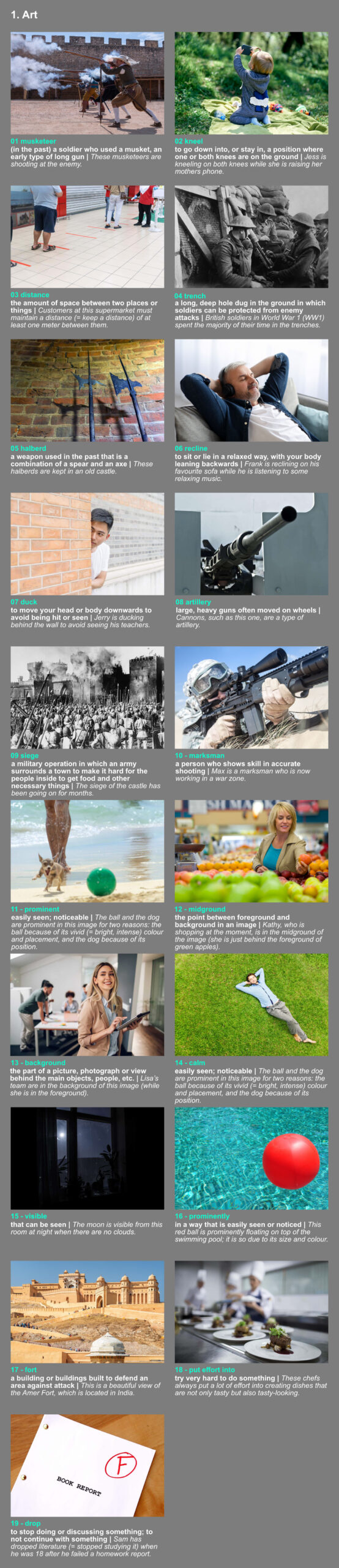
01
It is a drawing of 2 men. One of them is a musketeer. He is kneeling and looking into the distance over a trench. The other holds a halberd and is reclining against the wooden wall of the trench. He’s holding his helmet on as though he’s ducking from artillery fire or some such thing.
musketeer1: (in the past) a soldier who used a musket, an early type of long gun | These musketeers are shooting at the enemy.
kneel2: to go down into, or stay in, a position where one or both knees are on the ground | Jess is kneeling on both knees while she is raising her mothers phone.
distance3: the amount of space between two places or things | Customers at this supermarket must maintain a distance (= keep a distance) of at least one meter between them.
trench4: a long, deep hole dug in the ground in which soldiers can be protected from enemy attacks | British soldiers in World War 1 (WW1) spent the majority of their time in the trenches.
halberd5: a weapon used in the past that is a combination of a spear and an axe | These halberds are kept in an old castle.
recline6: to sit or lie in a relaxed way, with your body leaning backwards | Frank is reclining on his favourite sofa while he is listening to some relaxing music.
as though: in a way that suggests something; as if | I got home early and heard music playing loudly; it sounded as though there was a party going on in the house.
duck7: to move your head or body downwards to avoid being hit or seen | Jerry is ducking behind the wall to avoid seeing his teachers.
artillery8: large, heavy guns often moved on wheels | Cannons, such as this one, are a type of artillery.
02
The drawing appears to be of a scene set in the mid-1600s. Specifically of a certain siege during the 30 years’ war in Holland. The men appear to be Dutch. As for what I know about it from an artistic perspective: it’s a realistic drawing but it could be much better. In fact, the lighting is terrible; however, the lines are accurate, and it is a good depiction of the subject matter.
set: to place the action of a play, novel or film in a particular place, time, etc. | The novel was set in 19th century England.
siege9: a military operation in which an army surrounds a town to make it hard for the people inside to get food and other necessary things | The siege of the castle has been going on for months.
appear: to give the impression of being or doing something; seem | We have asked some experts, and according to them, it appears (= it seems like) that there will be no tax increases in the country.
accurate: correct and true in every detail | It is essential that we have accurate measurements for the wedding dress.
depiction: the act of showing somebody/something in a particular way in words or pictures, especially in a work of art | The depiction of the life of the Queen was very accurate in the movie; it almost appeared like a historical biography documentary.
the subject matter: the ideas or information contained in a book, speech, painting, etc. | The director is looking for the subject matter for her new movie; she wants it to be either a sports or a sci-fi movie.
03
In the foreground of it, you have the 2 men. You have the musketeer in the orange jacket, who appears to be a marksman. He’s very prominent. The other man is in the background … or midground. In the background, you have a you have a large calm of smoke rising in the distance from what, it is unknown, it is not visible, and very prominently in the background is a brick fort.
marksman10: a person who shows skill in accurate shooting | Max is a marksman who is now working in a war zone.
prominent11: easily seen; noticeable | The ball and the dog are prominent in this image for two reasons: the ball because of its vivid (= bright, intense) colour and placement, and the dog because of its position.
midground12: the point between foreground and background in an image | Kathy, who is shopping at the moment, is in the midground of the image (she is just behind the foreground of green apples).
background13: the part of a picture, photograph or view behind the main objects, people, etc. | Lisa’s team are in the background of this image (while she is in the foreground).
calm14: a quiet and peaceful time or situation | Danny is relaxing in the calm afternoon on his backyard lawn (= area of grass).
visible15: that can be seen | The moon is visible from this room at night when there are no clouds.
prominently16: in a way that is easily seen or noticed | This red ball is prominently floating on top of the swimming pool; it is so due to its size and colour.
fort17: a building or buildings built to defend an area against attack | This is a beautiful view of the Amer Fort, which is located in India.
04
So, why do I like the drawing? Well, firstly, it’s realistic. The lines are good, the perspective is good, the figure of everything is accurate. As far as that goes, the lighting could be better, but as far as that goes, it is very accurate and very good.
as far as it goes: good or true only to a limited extent; just fine but not very good | My new laptop is all right as far as it goes, but it won’t work well with high-level games.
05
Secondly, I like the subject matter. I’m interested in history, and I’m interested in 30 years’ war and the 1600s, in general. I find that history interesting, and so I like it from that perspective, and I know what it’s a drawing of and I like it like that.
06
The third reason I like it is because I drew it. I put a lot of effort into the drawing of it. It took me 3 hours … 4 hours (!) … it took me 4 hours to drop, and I can appreciate it because of the effort I put into it. I suppose I first saw it at 1:30 in the morning on New Year’s Day. I have been drawing since 9:00, 4 hours before. I would say the night before (New Year’s Day), but in fact it was still night time when it was finished.
effort: the physical or mental energy that you need to do something; something that takes a lot of energy | They never put enough effort into their homework; that is their problem.
put effort into18: try very hard to do something | These chefs always put a lot of effort into creating dishes that are not only tasty but also tasty-looking.
drop19: to stop doing or discussing something; to not continue with something | Sam has dropped literature (= stopped studying it) when he was 18 after he failed a homework report.
suppose: to think or believe that something is true or possible (based on the knowledge that you have) | I have read the full report, so I suppose oil prices will go up.
Describe a piece of art you like. You should say:
what the work of art is;
when you first saw it;
what you know about it;
explain why you like it.
It is a drawing of 2 men. One of them is a musketeer. He is kneeling and looking into the distance over a trench. The other holds a halberd and is reclining against the wooden wall of the trench. He’s holding his helmet on as though he’s ducking from artillery fire or some such thing.
The drawing appears to be of a scene set in the mid-1600s. Specifically of a certain siege during the 30 years’ war in Holland. The men appear to be Dutch. As for what I know about it from an artistic perspective: it’s a realistic drawing but it could be much better. In fact, the lighting is terrible; however, the lines are accurate, and it is a good depiction of the subject matter.
In the foreground of it, you have the 2 men. You have the musketeer in the orange jacket, who appears to be a marksman. He’s very prominent. The other man is in the background … or midground. In the background, you have a you have a large calm of smoke rising in the distance from what, it is unknown, it is not visible, and very prominently in the background is a brick fort.
So, why do I like the drawing? Well, firstly, it’s realistic. The lines are good, the perspective is good, the figure of everything is accurate. As far as that goes, the lighting could be better, but as far as that goes, it is very accurate and very good.
Secondly, I like the subject matter. I’m interested in history, and I’m interested in 30 years’ war and the 1600s, in general. I find that history interesting, and so I like it from that perspective, and I know what it’s a drawing of and I like it like that.
The third reason I like it is because I drew it. I put a lot of effort into the drawing of it. It took me 3 hours … 4 hours (!) … it took me 4 hours to drop, and I can appreciate it because of the effort I put into it. I suppose I first saw it at 1:30 in the morning on New Year’s Day. I have been drawing since 9:00, 4 hours before. I would say the night before (New Year’s Day), but in fact it was still night time when it was finished.
2 Book (steps 1, 2 and 4)
Describe a book you have recently read. You should say:
what kind of book it is;
what is it about;
what sort of people would enjoy it;
and explain why you liked it.
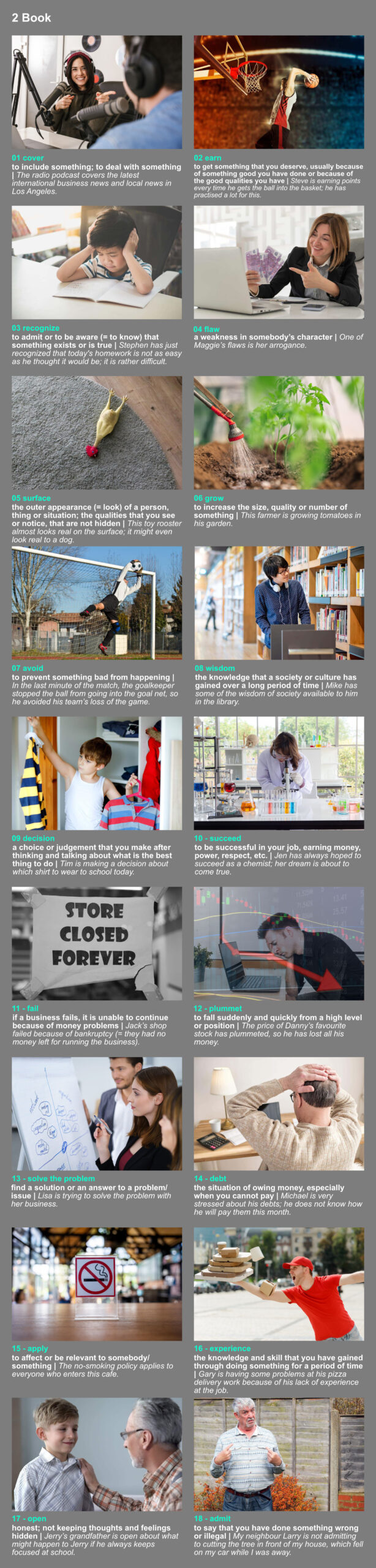
01
A book I’ve read recently is called “The Knack” written by a man named Norm Brodsky. It’s an informational book about how to do better in business, but it covers so much more than just that. It doesn’t just tell you how to build a better business – although it does in fact do that and quite well, too – however, it also tells you how to earn loyalty from people and how to recognise flaws in yourself and correct them.
cover1: to include something; to deal with something | The radio podcast covers the latest international business news and local news in Los Angeles.
earn2: to get something that you deserve, usually because of something good you have done or because of the good qualities you have | Steve is earning points every time he gets the ball into the basket; he has practised a lot for this.
loyalty: the quality of being constant in your support of somebody/something (= always being there for someone or something and sticking with them no matter what) | Hannah values the loyalty of her partner.
recognise3: to admit or to be aware (= to know) that something exists or is true | Stephen has just recognized that today’s homework is not as easy as he thought it would be; it is rather difficult.
flaw4: a weakness in somebody’s character | One of Maggie’s flaws is her arrogance.
02
Now what sort of people would enjoy this book? Well on the surface, business people would: anyone who wants to start a business, wants to run a business, who wants to grow a business, who wants to avoid trouble in business (they) should read this book. They are the people who it is intended for. However, I would say that this book is not just good for those people, but rather it is a good book for everyone to read.
surface5: the outer appearance (= look) of a person, thing or situation; the qualities that you see or notice, that are not hidden | This toy rooster almost looks real on the surface; it might even look real to a dog.
grow6: to increase the size, quality or number of something | This farmer is growing tomatoes in his garden.
avoid7: to prevent something bad from happening | In the last minute of the match, the goalkeeper stopped the ball from going into the goal net, so he avoided his team’s loss of the game.
intended: planned or designed for somebody/something | Some music is intended to help babies fall asleep; it usually does this well.
rather: used to introduce an idea that is different or opposite to the idea that you have stated (= said) previously | Evelyn’s favourite animals are not hamsters, like everyone thinks; rather, she likes dogs the most.
03
The book is essentially the collected wisdom of a lifetime of both good and bad decisions by the author Norm Brodski. He started building businesses in the 1980s, made very successful businesses and had them succeed to the highest level of success, and fail just as quickly. In this book, he tells you what you should do to make your business succeed and how to avoid plummeting back down to the bottom because of making simple mistakes as so many do. It tells stories of many different times in norm Brodsky’s life such as starting his first business, failing in his first business, along with many different situations which can cause trouble for business people, and he tells how to solve the problems that come up.
essentially: when you think about what is really important or basic about someone or something; basically | There are essentially only two possible solutions to the problem; we either get more information or we make a decision now.
wisdom8: the knowledge that a society or culture has gained over a long period of time | Mike has some of the wisdom of society available to him in the library.
collected wisdom: wisdom brought together in one place | The internet and libraries together have most of the collected wisdom of humanity.
decision9: a choice or judgement that you make after thinking and talking about what is the best thing to do | Tim is making a decision about which shirt to wear to school today.
succeed10: to be successful in your job, earning money, power, respect, etc. | Jen has always hoped to succeed as a chemist; her dream is about to come true.
fail11: if a business fails, it is unable to continue because of money problems | Jack’s shop failed because of bankruptcy (= they had no money left for running the business).
plummet12: to fall suddenly and quickly from a high level or position | The price of Danny’s favourite stock has plummeted, so he has lost all his money.
many: many people; lots of people | Many of the cinema’s customers had bought popcorn prior to (=before) going to watch the movie.
along with: in company with (= together with) or at the same time as | Maggie was chosen, along with a few other gymnasts to represent the USA in the Olympics.
solve the problem13: find a solution or an answer to a problem/issue | Lisa is trying to solve the problem with her business.
04
So why did I like it? Well, I think by now you probably already have a fairly good idea of why I like it. It teaches you how to start a business – and I like that, I want to be able to start a business someday -, it teaches you how to hire the right kind of people, how to know who is going to be the right kind of people and how to make people into the right kind of people for your work.
fairly: to some extent but not very; quite | The answers to some physics questions are fairly obvious (= quite clear and easy) to the students.
hire: to give somebody a job | Maggie is looking to hire some new sales people in her business.
05
It teaches you how to manage money, which is useful whether or not you’re starting a business. Anyone needs to know how to manage money. It’s very important to know how to manage money, how to make sure you aren’t going into debt, how to know if you’re actually going to be making any money and how to solve simple problems that are taking money away from you that you might otherwise have. It teaches you how to build a good company culture and that section can be applied to any sort of group of people, whether it’s a company, or a family, or any other group of people. It’s very useful information for everyone.
manage : to use money, time, information, etc. in a sensible (= intelligent, clever) way | Larry is looking for mobile applications that would help him to manage his time better.
debt14: the situation of owing money, especially when you cannot pay | Michael is very stressed about his debts; he does not know how he will pay them this month.
otherwise: used to state (= tell) what would happen if things were different or if something didn’t happen; or else | Don’t forget to close the door at night; otherwise, the dog will run out into the streets.
company culture: the way how people act and work together at a company | Members of Generation Z (those who were born between 1996 and 2010) consider a positive company culture very important and prioritize it highly.
apply15: to affect or be relevant to somebody/something | The no-smoking policy applies to everyone who enters this cafe.
06
Norm Brodsky is a man who has had a lot of experience. He has a very direct style of writing, which I think a lot of people like, I certainly do. He says things in very direct ways; he’s also very open about where he has made mistakes. He doesn’t try to hide that he’s made many mistakes in his life. He admits it, and he uses those mistakes to be able to do better the next time. And not only so that he can do better the next time, but he’s written it down in the book so that we can do better next time as well and learn from his mistakes, so we don’t have to make them ourselves.
experience16: the knowledge and skill that you have gained through doing something for a period of time | Gary is having some problems at his pizza delivery work because of his lack of experience at the job.
open17: honest; not keeping thoughts and feelings hidden | Jerry’s grandfather is open about what might happen to Jerry if he always keeps focused at school.
admit18: to say that you have done something wrong or illegal | My neighbour Larry is not admitting to cutting the tree in front of my house, which fell on my car while I was away.
Describe a book you have recently read. You should say:
what kind of book it is;
what is it about;
what sort of people would enjoy it;
and explain why you liked it.
A book I’ve read recently is called “The Knack” written by a man named Norm Brodsky. It’s an informational book about how to do better in business, but it covers so much more than just that. It doesn’t just tell you how to build a better business – although it does in fact do that and quite well, too – however, it also tells you how to earn loyalty from people and how to recognise flaws in yourself and correct them.
Now what sort of people would enjoy this book? Well on the surface, business people would: anyone who wants to start a business, wants to run a business, who wants to grow a business, who wants to avoid trouble in business (they) should read this book. They are the people who it is intended for. However, I would say that this book is not just good for those people, but rather it is a good book for everyone to read.
The book is essentially the collected wisdom of a lifetime of both good and bad decisions by the author Norm Brodski. He started building businesses in the 1980s, made very successful businesses and had them succeed to the highest level of success, and fail just as quickly. In this book, he tells you what you should do to make your business succeed and how to avoid plummeting back down to the bottom because of making simple mistakes as so many do. It tells stories of many different times in norm Brodsky’s life such as starting his first business, failing in his first business, along with many different situations which can cause trouble for business people, and he tells how to solve the problems that come up.
So why did I like it? Well, I think by now you probably already have a fairly good idea of why I like it. It teaches you how to start a business – and I like that, I want to be able to start a business someday -, it teaches you how to hire the right kind of people, how to know who is going to be the right kind of people and how to make people into the right kind of people for your work.
It teaches you how to manage money, which is useful whether or not you’re starting a business. Anyone needs to know how to manage money. It’s very important to know how to manage money, how to make sure you aren’t going into debt, how to know if you’re actually going to be making any money and how to solve simple problems that are taking money away from you that you might otherwise have. It teaches you how to build a good company culture and that section can be applied to any sort of group of people, whether it’s a company, or a family, or any other group of people. It’s very useful information for everyone.
Norm Brodsky is a man who has had a lot of experience. He has a very direct style of writing, which I think a lot of people like, I certainly do. He says things in very direct ways; he’s also very open about where he has made mistakes. He doesn’t try to hide that he’s made many mistakes in his life. He admits it, and he uses those mistakes to be able to do better the next time. And not only so that he can do better the next time, but he’s written it down in the book so that we can do better next time as well and learn from his mistakes, so we don’t have to make them ourselves.
3 Communication (steps 1, 2 and 4)
Describe a piece of advice you have recently received. You should say:
when this happened;
who gave you the advice;
what the advice was;
and explain how you felt about the advice.
01
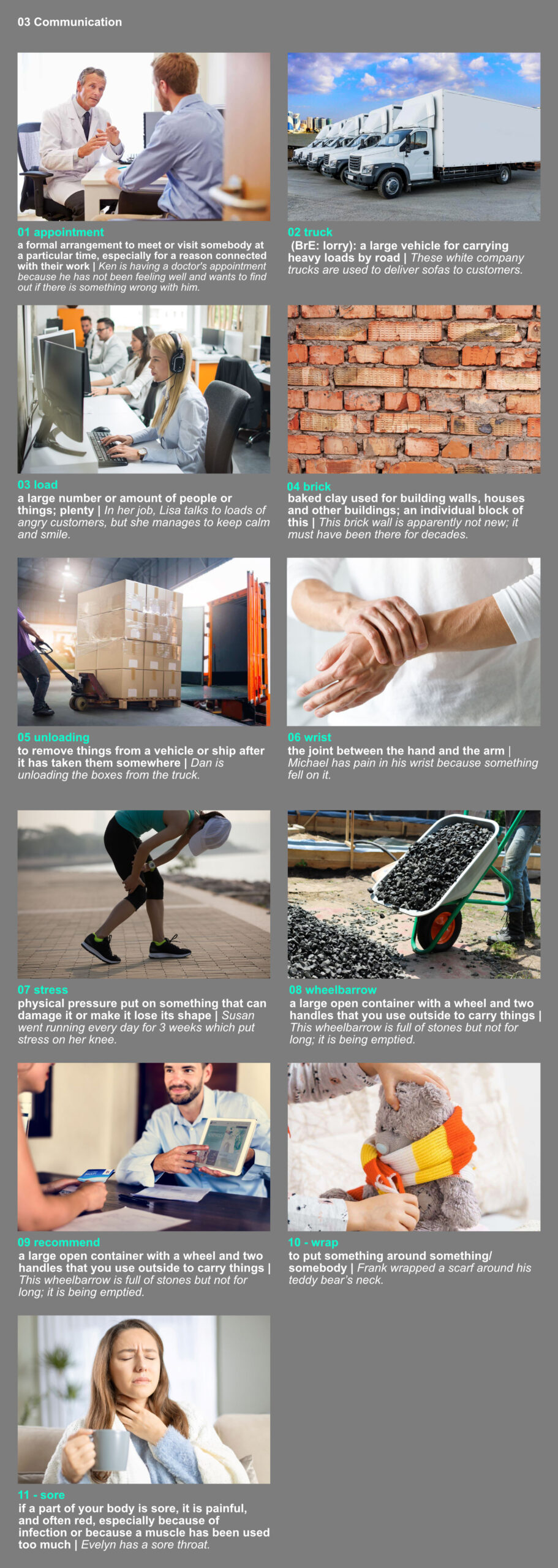
Around 45 minutes ago, I was given a very good piece of advice by my mother. My father had realized too late that he had an appointment to get the truck fixed tomorrow in the morning. This would not have been a problem except that we had a full load of bricks in the back of the truck and it was at night, and the appointment was in the morning. So, I decided that I would rather than getting up early in the morning and having to do it then, I would get straight to work on it in the middle of the night.
advice: an opinion or a suggestion about what somebody should do in a particular situation | Meg broke her leg and was told by a medical professional to not walk on it for a few weeks; she followed the doctor’s advice.
appointment1: a formal arrangement to meet or visit somebody at a particular time, especially for a reason connected with their work | Ken is having a doctor’s appointment because he has not been feeling well and wants to find out if there is something wrong with him.
truck2 (BrE: lorry): a large vehicle for carrying heavy loads by road | These white company trucks are used to deliver sofas to customers.
except that: used to give a reason why something is not possible or true | I wanted to go to the rock concert in my local arena except that I was very tired.
load3: a large number or amount of people or things; plenty | In her job, Lisa talks to loads of angry customers, but she manages to keep calm and smile.
brick4: baked clay used for building walls, houses and other buildings; an individual block of this | This brick wall is apparently not new; it must have been there for decades.
rather than: instead of somebody/something | I would rather drink water than pay to buy a drink here.
straight: by a direct route (without going anywhere else); immediately | After you are finished with your work, come straight to my office, I have to talk to you.
02
So, I went out there and was unloading bricks. This wouldn’t have been a problem except that a while back I had broken both of my wrists. They’re fine, but they are terribly weak and any sort of stress on them can make me not able to use them for up to a week. And so I went out there, and I unloaded maybe 2 wheelbarrows full of bricks before my left wrist completely went out. Unusuable. A little bit later, I received some advice from my mother. When I told her of what had happened she recommended that I wrap my wrist before doing any sort of stressful thing on my wrist. This was very good advice, and I liked it quite a lot, although I would have liked it much much more if it had been given to me about an hour before as then I would not have a very sore wrist.
unloading5: to remove things from a vehicle or ship after it has taken them somewhere | Dan is unloading the boxes from the truck.
a while back: some time in the past; some time ago | A while back, I went to the theatre to see one of my relatives act in a play.
wrist6: the joint between the hand and the arm | Michael has pain in his wrist because something fell on it.
stress7: physical pressure put on something that can damage it or make it lose its shape | Susan went running every day for 3 weeks which put stress on her knee.
up to: used to say that something is less than or equal to but not more than a stated value, number, or level; maximum | Up to 2 teenagers (maximum two) were allowed to go into the shop at the time so that the security guard could watch them.
wheelbarrow8: a large open container with a wheel and two handles that you use outside to carry things | This wheelbarrow is full of stones but not for long; it is being emptied.
recommend9: to tell somebody that something is good or useful, or that somebody would be suitable for a particular job, etc. | Harry is recommending a holiday hotel to Suzy, who is going on holiday this summer.
wrap10: to put something around something/somebody | Frank wrapped a scarf around his teddy bear’s neck.
sore11: if a part of your body is sore, it is painful, and often red, especially because of infection or because a muscle has been used too much | Evelyn has a sore throat.
- Describe a piece of advice you have recently received. You should say:
when this happened;
who gave you the advice;
what the advice was;
and explain how you felt about the advice.
Around 45 minutes ago, I was given a very good piece of advice by my mother. My father had realized too late that he had an appointment to get the truck fixed tomorrow in the morning. This would not have been a problem except that we had a full load of bricks in the back of the truck and it was at night, and the appointment was in the morning. So, I decided that I would rather than getting up early in the morning and having to do it then, I would get straight to work on it in the middle of the night.
So, I went out there and was unloading bricks. This wouldn’t have been a problem except that a while back I had broken both of my wrists. They’re fine, but they are terribly weak and any sort of stress on them can make me not able to use them for up to a week. And so I went out there, and I unloaded maybe 2 wheelbarrows full of bricks before my left wrist completely went out. Unusuable. A little bit later, I received some advice from my mother. When I told her of what had happened she recommended that I wrap my wrist before doing any sort of stressful thing on my wrist. This was very good advice, and I liked it quite a lot, although I would have liked it much much more if it had been given to me about an hour before as then I would not have a very sore wrist.
4 Daily routine (steps 1, 2 and 4)
Describe a time of day you like. You should say:
what time of day it is;
what you do at that time;
who you are usually with;
and explain why you like it.
01
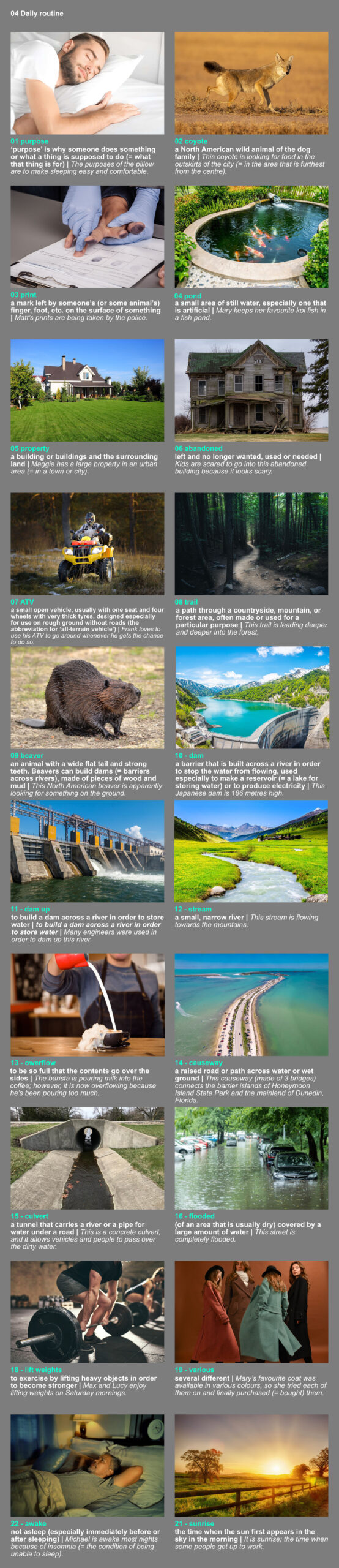
A time of day that I like is 4:35 in the morning. I like this time of day because that’s when I get up. At this time I get up, do some exercises, make breakfast and sometimes coffee, and I go on a walk. I don’t always do this, but I do this every few days. I like walking early in the morning because I get to have some fresh air and walk around. I don’t really get to see anything because it’s very dark out at that time, but it also serves some other purposes. For example, I go out to make sure there aren’t any coyotes or anything like that around.
purpose1: ‘purpose’ is why someone does something or what a thing is supposed to do (= what that thing is for) | The purposes of the pillow are to make sleeping easy and comfortable.
serve a purpose: to have a use | The bookmark in Stacy’s book serves an important purpose: it is to help Stacy know where she stopped reading.
coyote2: a North American wild animal of the dog family | This coyote is looking for food in the outskirts of the city (= in the area that is furthest from the centre).
02
The chances of my seeing them are very low, but I can maybe see prints and know if they’ve been in the area. Our chickens are fairly well protected now, but before this was more important because we would let them out. I also go out to check the far side of the pond on our property. This is because there are abandoned ATV trails on it which sometimes people drive on, and sometimes they do things they should not be doing when they are out there. And I check to make sure that this has not been happening. I also check the status of the pond.
print3: a mark left by someone’s (or some animal’s) finger, foot, etc. on the surface of something | Matt’s prints are being taken by the police.
would: used to; shows an action that often happened in the past | I would take an hour to get ready for work when I was your age, but now it takes me only 10 minutes.
pond4: a small area of still water, especially one that is artificial | Mary keeps her favourite koi fish in a fish pond.
property5: a building or buildings and the surrounding land | Maggie has a large property in an urban area (= in a town or city).
abandoned6: left and no longer wanted, used or needed | Kids are scared to go into this abandoned building because it looks scary.
ATV7: a small open vehicle, usually with one seat and four wheels with very thick tyres, designed especially for use on rough ground without roads (the abbreviation for ‘all-terrain vehicle’) | Frank loves to use his ATV to go around whenever he gets the chance to do so.
trail8: a path through a countryside, mountain, or forest area, often made or used for a particular purpose | This trail is leading deeper and deeper into the forest.
03
The pond is not supposed to be there. It was formed when beavers dammed up a small stream that ran through our property, and after they damped it up it overflowed and created a large pond which blocked off part of our property. We built a causeway across the pond with a culvert through it. Every once in a while, it’s good to go out there, check the water levels, make sure that the causeway is not flooded and to see what the beavers have been doing out there: to see if they’ve been cutting down too many trees, to see if they have damned up a culvert and just to see what sort of trouble they’re getting into, so I can hopefully stop it before it gets too bad.
beaver9: an animal with a wide flat tail and strong teeth. Beavers can build dams (= barriers across rivers), made of pieces of wood and mud | This North American beaver is apparently looking for something on the ground.
dam10: a barrier that is built across a river in order to stop the water from flowing, used especially to make a reservoir (= a lake for storing water) or to produce electricity | This Japanese dam is 186 metres high.
dam up11: to build a dam across a river in order to store water | Many engineers were used in order to dam up this river.
stream12: a small, narrow river | This stream is flowing towards the mountains.
overflow13: to be so full that the contents go over the sides | The barista is pouring milk into the coffee; however, it is now overflowing because he’s been pouring too much.
causeway14: a raised road or path across water or wet ground | This causeway (made of 3 bridges) connects the barrier islands of Honeymoon Island State Park and the mainland of Dunedin, Florida.
culvert15: a tunnel that carries a river or a pipe for water under a road | This is a concrete culvert, and it allows vehicles and people to pass over the dirty water.
flooded16: (of an area that is usually dry) covered by a large amount of water | This street is completely flooded.
04
I also often exercise at this time of day. Sometimes I will run on the trails in the back of our property, sometimes I’ll lift weights. I do various things, and after that I usually take a shower.
lift weights17: to exercise by lifting heavy objects in order to become stronger | Max and Lucy enjoy lifting weights on Saturday mornings.
various18: several different | Mary’s favourite coat was available in various colours, so she tried each of them on and finally purchased (= bought) them.
05
Who am I usually with? Absolutely no one. There is usually no one else awake at this time, although sometimes my father is awake. Sometimes I am with the chickens, though. I go out, and I open them up so they can go out in their yard, and I turn on their light and say hello to them.
awake19: not asleep (especially immediately before or after sleeping) | Michael is awake most nights because of insomnia (= the condition of being unable to sleep).
06
Why do I like this time of day? Well, I like it for a lot of reasons. I like this time of day because I like waking up before the sun. I don’t like to sleep in past sunrise, although I do it quite often, and so I like to get up before sunrise. It’s also quite a peaceful time as not much else is happening, so it’s very quiet. If I get up at this time, I can get a lot of things done if I’m doing anything. Right now it’s winter, so I don’t have that many projects, but if I get up at this time in the summer, I can do a lot of things very early on, and there’s not many distractions about it this time. These are some of the reasons why I like this time of day.
past: later than something | It is half past two at the moment.
sunrise20: the time when the sun first appears in the sky in the morning | It is sunrise; the time when some people get up to work.
peaceful: quiet and calm; not worried or upset in any way | I heard that many people find it peaceful in the countryside.
distraction: a thing that takes your attention away from what you are doing or thinking about | Turn off your phone when you go to the cinema to watch a movie because it will be a distraction to others if it goes off (= if it starts ringing or vibrating loudly).
- Describe a time of day you like. You should say:
what time of day it is;
what you do at that time;
who you are usually with;
and explain why you like it.
A time of day that I like is 4:35 in the morning. I like this time of day because that’s when I get up. At this time I get up, do some exercises, make breakfast and sometimes coffee, and I go on a walk. I don’t always do this, but I do this every few days. I like walking early in the morning because I get to have some fresh air and walk around. I don’t really get to see anything because it’s very dark out at that time, but it also serves some other purposes. For example, I go out to make sure there aren’t any coyotes or anything like that around.
The chances of my seeing them are very low, but I can maybe see prints and know if they’ve been in the area. Our chickens are fairly well protected now, but before this was more important because we would let them out. I also go out to check the far side of the pond on our property. This is because there are abandoned ATV trails on it which sometimes people drive on, and sometimes they do things they should not be doing when they are out there. And I check to make sure that this has not been happening. I also check the status of the pond.
The pond is not supposed to be there. It was formed when beavers dammed up a small stream that ran through our property, and after they damped it up it overflowed and created a large pond which blocked off part of our property. We built a causeway across the pond with a culvert through it. Every once in a while, it’s good to go out there, check the water levels, make sure that the causeway is not flooded and to see what the beavers have been doing out there: to see if they’ve been cutting down too many trees, to see if they have damned up a culvert and just to see what sort of trouble they’re getting into, so I can hopefully stop it before it gets too bad.
I also often exercise at this time of day. Sometimes I will run on the trails in the back of our property, sometimes I’ll lift weights. I do various things, and after that I usually take a shower.
Who am I usually with? Absolutely no one. There is usually no one else awake at this time, although sometimes my father is awake. Sometimes I am with the chickens, though. I go out, and I open them up so they can go out in their yard, and I turn on their light and say hello to them.
Why do I like this time of day? Well, I like it for a lot of reasons. I like this time of day because I like waking up before the sun. I don’t like to sleep in past sunrise, although I do it quite often, and so I like to get up before sunrise. It’s also quite a peaceful time as not much else is happening, so it’s very quiet. If I get up at this time, I can get a lot of things done if I’m doing anything. Right now it’s winter, so I don’t have that many projects, but if I get up at this time in the summer, I can do a lot of things very early on, and there’s not many distractions about it this time. These are some of the reasons why I like this time of day.
5 Exercise (steps 1, 2 and 4)
Describe an exercise you know. You should say:
what it is;
how it is done;
when you first tried it;
what kind of people it is suitable for;
and explain why you think it is a good exercise.
01
An exercise that I know is the ‘Evil Russian Push-up’ program’; technically, ‘Evil Russian Hit the Deck’ program. This program was created by a man named Pavel Tsatsouline whose nickname was the ‘Evil Russian’. What this program entails is large numbers of push-ups following a set pattern. The program lasts for only 2 weeks and is advertised to put 2 extra inches on your chest and reportedly bulk up your biceps.
evil1: (of people) enjoying harming others; morally bad and cruel | This man is giving an evil smile.
entail: to involve something that cannot be avoided | The job of a bartender entails a lot of talking to people and taking criticism.
push-up2: an exercise in which you lie on your stomach and raise your body off the ground by pressing down on your hands until your arms are straight | Carl enjoys doing push-ups in his spare time.
pattern3: the regular way in which something happens or is done | Lucy’s sleep pattern is not normal due to her coffee consumption (= coffee drinking) and nighttime phone use.
last: to continue for a period of time, or to continue to exist | A regular football match lasts for ninety minutes; this is divided into two 45-minute parts.
advertise4: to tell the public about a product or a service in order to encourage people to buy or to use it | This newspaper is advertising certain jobs and services to its readers.
chest5: the top part of the front of the body, between the neck and the stomach | Steven has his hands on his chest.
reportedly: according to what some people say | There were, reportedly, some problems with the microphone at the karaoke bar.
bulk up6: to add weight and size to your body, especially by gaining more muscle | Michael has bulked up over the last year.
02
To start with, on the first day of the program, you take a test. You do as many push-ups as you possibly can until you are physically unable to continue. That will give you your first 100%. When you then do is you take this 100% and every single day you will do a certain percentage of that at various intervals. For example, some days it might be 50% of that 100% that you did every half an hour, some days it might be 25% every 15 minutes, some days it might be 75% every hour. The percentage of your maximum that you do every day and the interval between them changes every day. You do this for the rest of the 1st week. Then on the first day of the second week, you take another 100% test to see how many you can do now. (It) usually improves quite a bit by this point.
at (…) intervals7: with (… time) between | Mike is doing exercise at 1-minute intervals by alternating between sprinting and jogging.
various8: several different | Steve ran into various problems on his way to work; this includes him forgetting his phone at home and his car breaking down in the middle of the road.
improve9: to become better than before; to make something/somebody better than before | Frank has improved his ability to speak Chinese to the point where he can now ask for directions when he visits China.
03
You then take that that’s renewed 100%, and every day of the next week you do a certain percentage of that number every interval, and the intervals are half an hour, 20 minutes, 45 minutes, an hour, an hour and a half. Depending on what day it is, it changes. The end of the test is that on the 1st day of the 3rd week, you take a 3rd 100% test to see how many you can do now, and that’s the end of the program.
renew10: happening again with increased interest or strength | After a lunch break, Suzy’s enthusiasm about the interior (= the inside part) design project she is working on was renewed.
depending on: according to | The main language that people speak often changes according to which country you are in; for example, they speak mainly English in the UK but Romanian in Romania.
04
By this point, you should already have measurable improvement. I first tried this exercise several years ago, and I did the regular 2 weeks and called it there, and I found it to be quite excellent, but I didn’t stop there. After I did that, I persuaded my best friend Dominik to try it as well, and I didn’t stop there either. Shortly after he completed the program as well, I then challenged him to a competition. What the competition was is that we would both do the program, not for 2 weeks not for 3 weeks, We would do it until we were physically incapacitated and incapable of continuing. We continued for at least a month. I don’t remember exactly how long it was, but it was more than a month, most likely around 2 months. In the end, I lost the competition and my bet by breaking both of my wrists after a 100% test.
by/at this point: used to mark a point in time in a sentence or story about the past | I went to the shop which was at the other end of the town; then I had to go to my cousin’s. By this point, I was very tired but I had to keep going to collect the kids from school.
measurable11: able to be measured, or large enough to be noticed | There is a measurable progress in the weight loss of Stacy after her new exercise and diet.
improvement12: the act of making something better; the process of something becoming better | There was an improvement in the business sales revenue (= income) in the company.
call it (a day) 13: to conclude that no more work can be done due to fatigue (= feeling extremely tired), shortage of material to work with, etc. | Mark called it a day when he realised that he running late for dinner with his wife.
challenge14: to try and win something from someone or try to do something better than them | Lisa is a politician who is challenging the current president’s presidency.
competition15: aa special event where people show what they are really good at and see who is the best | Dan and Steve are having a hand wrestling competition with each other.
incapacitate16: to make somebody/something unable to live or work normally | Lisa was incapacitated from her work as a sprinter for a few years when she broke her legs.
incapable17: not able to do something | Babies are incapable of feeding themselves.
bet18: to risk money on something that may happen in the future | Steve is using a mobile application to bet on the success of his favourite football team.
wrist19: the joint between the hand and the arm | Larry has an expensive watch on his wrist.
05
Despite the injuries, I consider it to be an excellent exercise and in fact I have adapted it in several other ways. For example, you can use this system with other exercises that aren’t push-ups. In fact, I’ve found it to be directly compatible. You can do it with sit-ups, you can do it with squats, you can do with many types of exercises. It is suitable for anyone who is intending to bulk up their upper body and get better at doing push-ups. Because it works on percentages, that is to say, instead of having a set number every day, it gives you your number as a percentage of your total possible number, it is suitable for anyone of any strength level. If you can do multiple push-ups, you can take a percentage of those push-ups, and you can do this program.
despite: used to show that something happened or is true although it might have been stopped it by something else | Carl’s hands were shaking despite his effort to stop this with his other hand. (= Carl tried to stop his hand’s shaking with his other hand, but it was still shaking.)
injury20: harm done to a person’s or an animal’s body, for example in an accident | Bill has a shoulder injury from hitting the tennis ball too hard, with bad technique, repeatedly.
adapt: to change something in order to make it suitable for a new use or situation; modify | We need to adapt artificial intelligence (AI) to meet the needs of the future generations.
compatible: (of ideas, methods or things) able to exist or be used together without causing problems | Is economic growth compatible with environmental sustainability?
sit-up21: an exercise for making your stomach muscles strong, in which you lie on your back on the floor and raise the top part of your body to a sitting position | Frank is doing sit-ups at home to become fitter.
squat22: an exercise in which you stand on the ground with your feet apart and raise and lower your bottom by bending and straightening your legs | These people are doing squats to make their leg muscles stronger.
percentage: the number, amount or rate of something, expressed as if it is part of a total that is 100; the meaning of the “%” sign | A very low percentage of his body is made of fat because he is a professional athlete.
that is to say: in other words | Jen only works on weekdays, that is to say, she does not work on weekends.
instead of: in the place of somebody/something | I only managed to eat a chocolate bar for breakfast instead of my usual egg sandwich and coffee.
suitable23: right or appropriate for a particular purpose or occasion | Lisa found a suitable place for the picnic under the shade of a tree.
multiple: many in number; involving many different people or things | There are multiple people in my living room at the moment; they are all watching TV.
06
I think it is a good exercise because of my personal experience with the exercise. I have found it to be very effective at increasing bulk and increasing endurance as far as as push-ups go, and other things if you use it for other things as well.
effective24: producing the result that is wanted or intended; producing a successful result | The smart phone can be an effective tool in helping to communicate with people far away.
endurance25: the ability to continue doing something painful or difficult for a long period of time without giving up | This marathon runner has remarkable endurance to have gotten this far.
as well: in addition to somebody/something; too | The supermarket is open on weekdays and weekends as well.

Describe an exercise you know. You should say:
what it is;
how it is done;
when you first tried it;
what kind of people it is suitable for;
and explain why you think it is a good exercise.
An exercise that I know is the ‘Evil Russian Push-up’ program’; technically, ‘Evil Russian Hit the Deck’ program. This program was created by a man named Pavel Tsatsouline whose nickname was the ‘Evil Russian’. What this program entails is large numbers of push-ups following a set pattern. The program lasts for only 2 weeks and is advertised to put 2 extra inches on your chest and reportedly bulk up your biceps.
To start with, on the first day of the program, you take a test. You do as many push-ups as you possibly can until you are physically unable to continue. That will give you your first 100%. When you then do is you take this 100% and every single day you will do a certain percentage of that at various intervals. For example, some days it might be 50% of that 100% that you did every half an hour, some days it might be 25% every 15 minutes, some days it might be 75% every hour. The percentage of your maximum that you do every day and the interval between them changes every day. You do this for the rest of the 1st week. Then on the first day of the second week, you take another 100% test to see how many you can do now. (It) usually improves quite a bit by this point.
You then take that that’s renewed 100%, and every day of the next week you do a certain percentage of that number every interval, and the intervals are half an hour, 20 minutes, 45 minutes, an hour, an hour and a half. Depending on what day it is, it changes. The end of the test is that on the 1st day of the 3rd week, you take a 3rd 100% test to see how many you can do now, and that’s the end of the program.
By this point, you should already have measurable improvement. I first tried this exercise several years ago, and I did the regular 2 weeks and called it there, and I found it to be quite excellent, but I didn’t stop there. After I did that, I persuaded my best friend Dominik to try it as well, and I didn’t stop there either. Shortly after he completed the program as well, I then challenged him to a competition. What the competition was is that we would both do the program, not for 2 weeks not for 3 weeks, We would do it until we were physically incapacitated and incapable of continuing. We continued for at least a month. I don’t remember exactly how long it was, but it was more than a month, most likely around 2 months. In the end, I lost the competition and my bet by breaking both of my wrists after a 100% test.
Despite the injuries, I consider it to be an excellent exercise and in fact I have adapted it in several other ways. For example, you can use this system with other exercises that aren’t push-ups. In fact, I’ve found it to be directly compatible. You can do it with sit-ups, you can do it with squats, you can do with many types of exercises. It is suitable for anyone who is intending to bulk up their upper body and get better at doing push-ups. Because it works on percentages, that is to say, instead of having a set number every day, it gives you your number as a percentage of your total possible number, it is suitable for anyone of any strength level. If you can do multiple push-ups, you can take a percentage of those push-ups, and you can do this program.
I think it is a good exercise because of my personal experience with the exercise. I have found it to be very effective at increasing bulk and increasing endurance as far as as push-ups go, and other things if you use it for other things as well.
6 Family (steps 1, 2 and 4)
Describe a member of your family you get on well with. You should say:
who it is;
what relationship you have with that person;
what that person is like;
what you do together;
and explain why you get on so well:
01
A member of my family that I get on well with is my sister-in-law. Because I moved to America, I didn’t see her for 8 years. Until recently, she lived in China with my brother, her husband. As such, I didn’t see her for 8 years after I moved to America, but recently she’s moved here with my brother.
get on well: to establish (= to start having) a friendly relationship | Jill gets on well with the fellow students at her school; she chats to them frequently in break times.
sister-in-law: the sister of your husband or wife; your brother’s or sister’s wife; the wife of your husband’s or wife’s brother or sister | Frank’s sister-in-law always enjoys long walks in the park in spring afternoons.
move1: to go to a different place to live or work | The family that has been living in this house is moving to another town; their belongings are being taken there by a moving company.
as such: because of this | The park was largely empty on Saturday afternoon. As such, we were able to play ball games peacefully.
02
My sister-in-law is a very cheerful person. She teaches English to people from very young ages all the way up to older ages, and she does it quite well and she loves what she does. She is also a master of making jiaozis. She would probably tell you that she’s only the student of the jiaozi master, who is her mother. However, I can tell you, having eaten her jiaozis very recently, she is good at making jiaozis.
cheerful2: happy, and showing it by the way that you behave | Lisa is cheerful today because she has just got some good news from her family members in the morning.
jiaozi3: a type of Chinese dumpling | The food on this plate is called jiaozi; it is very tasty.
03
A jiaozi is … in English I believe they call it a dumpling, but that’s sort of a different thing than it. It’s like ravioli. It’s a piece of dough flattened out into a circle with a filling put inside, and it is then folded in half and steamed. And the best jiaozis are after they are steamed they’re *fried. That is the best way to eat jiaozis in my opinion, and she makes them.
dumpling4: a small ball of dough (= a mixture of flour, fat and water) that is cooked and served with meat dishes or in soup | This plate has dumplings on it which are filled with cabbage.
ravioli5: pasta in the shape of small squares filled with meat, cheese, etc., usually served with a sauce | This ravioli with tomato sauce is an excellent dish to have for lunch or dinner.
dough6: flour mixed with water and often yeast, fat, or sugar, so that it is ready for baking | This bread dough, which was left on the table for proofing (= to become larger and lighter), is ready to be baked. What makes it grow? Yeast does.
flatten7: to become flat or flatter; to make something flat or flatter | Some trees in the city, including this one, were flattened (= knocked down) by the thunderstorm yesterday evening.
filling8: food put inside a sandwich, cake, pie, etc. | There is a Swiss roll with whipped cream filling on this table.
fold9: to bend something, especially paper or cloth, so that one part lies on top of another part | Maggie is folding her jumper on the table so she can put it away neatly (= nicely and in an organised way) into a drawer.
steam10: to place food over boiling water so that it cooks in the steam | This mango fish is being steamed with lemongrass and herbs in a steaming pot.
fry11: to cook something in hot fat or oil; to be cooked in hot fat or oil | This chicken is being fried so that a restaurant can serve it to its customers.
04
Recently she made jiaozis for us, which I was very happy about. No one else in my family knows how to do it. She made the jiaozis, and she showed us how to make them. I don’t know if she knew she was showing us how to make them, but we were all standing around her watching eagerly to learn how to make good jiaozis. We watched as she made the flour, kneaded it, rolled it into cylinders and cut them into circles … slices. She then took each of these slices, put them down and turned them while rolling them with a rolling pin to make a circle about that size. She then put the ground beef mixed with garlic and onions and spices, and she put it into the jiaozis, folded them in half and squeezed them together; then lay them in neat lines on the pan.
eagerly12: in a way that shows great interest and excitement about something that is going to happen or about something that you want to do | Lucy is eagerly waiting to see what is inside the carrier bag.
flour13: a fine white or brown powder typically made from wheat and used in cooking for making bread, cakes, etc. | This is a bag of flour next to some wheat on a table.
knead14: to press and stretch dough, wet clay, etc. with your hands to make it ready to use | Carla has been kneading the dough to make pizza for 3 minutes.
roll15: to make something/yourself into the shape of a ball or tube | I’ve started rolling the dough into smaller balls for the Christmas meal.
cylinder16: a figure with round ends and long straight side | These two things have the shape of a cylinder.
each: used to refer to every one of two or more people or things, when you are thinking about them separately | Each cake in the bakery was specially made by a master chef.
rolling pin17: a wooden or glass kitchen utensil (= a tool) in the shape of a tube, used for rolling pastry flat | This rolling pin is being used by Stella to roll dough.
ground18: (of food) cut or crushed into very small pieces or powder | There is ground coffee in that bag and also in the wooden spoon on the table.
garlic19: a vegetable of the onion family with a very strong taste and smell, used in cooking to add taste to food | These cloves of garlic look healthy and fresh.
spice20: a type of powder or seed that comes from plants and are used in cooking. Spices have a strong taste and smell | Various spices and herbs are beautifully arranged in this photo.
squeeze21: to press something, especially with your fingers | Steve often feels like squeezing the stress ball at the office due to the tremendous workload (= he has too much work to do).
lay22: to put somebody/something in a particular position, especially when it is done gently or carefully | Maggie laid a red rose on the grave of her family member.
neat23: tidy and in order; carefully done or arranged | The bed sheets in Frank’s bedroom are folded in a neat way.
pan: a container, usually made of metal, with a handle or handles, used for cooking food in | Stella likes to cook her food in a stainless steel pan.
05
Later she found that she had made enough for 2 meals, so she made the second batch of jiaozis the next day. The second batch of jiaozis she made, she didn’t just steam them she also fried them. Fried jiaozis are much better. You fry them in oil just that they have a nice crispy exterior. Then, after she had made the jiaozi, we ate the jiaozi together. We ate them Chinese style in which you just have a dish of food and everyone takes what they want from it with their chopsticks and eats it. We also made a dipping sauce which is made by combining sesame oil, soy sauce and rice vinegar.
06
We get on very well because she likes making jiaozis and I like eating jiaozis.
batch24: an amount of food, medicine, etc. produced at one time | Kathy made a fresh batch of pastries.
crispy25: (of food) pleasantly hard and dry | This fried chicken is crispy and fresh.
exterior26: on or from the outside | The exterior of this building looks beautiful, but it is a mess on the inside.
dish27: food prepared in a particular way as part of a meal | This waiter is serving the main dish to the customer.
chopstick28: either of a pair of thin sticks that are used for eating with, especially in East Asian countries | Maxine is eating grilled pork with chopsticks.
dipping sauce29: a common condiment (= a substance such as salt, mustard, or pickle that is used to add flavour to food) for many types of food | There are a variety of dipping sauces on the table.
sesame30: a tropical plant grown for its seeds and their oil, which are used in cooking | These sesame seeds may be a good source of fibre.
vinegar31: a liquid with a bitter taste made from wine or malt, used to add taste to food or to preserve it (= keep it fresh) | White vinegar can be used to add an extra flavour to some foods.

Describe a member of your family you get on well with. You should say:
who it is;
what relationship you have with that person;
what that person is like;
what you do together;
and explain why you get on so well:
A member of my family that I get on well with is my sister-in-law. Because I moved to America, I didn’t see her for 8 years. Until recently, she lived in China with my brother, her husband. As such, I didn’t see her for 8 years after I moved to America, but recently she’s moved here with my brother.
My sister-in-law is a very cheerful person. She teaches English to people from very young ages all the way up to older ages, and she does it quite well and she loves what she does. She is also a master of making jiaozis. She would probably tell you that she’s only the student of the jiaozi master, who is her mother. However, I can tell you, having eaten her jiaozis very recently, she is good at making jiaozis.
A jiaozi is … in English I believe they call it a dumpling, but that’s sort of a different thing than it. It’s like ravioli. It’s a piece of dough flattened out into a circle with a filling put inside, and it is then folded in half and steamed. And the best jiaozis are after they are steamed they’re *fried. That is the best way to eat jiaozis in my opinion, and she makes them.
Recently she made jiaozis for us, which I was very happy about. No one else in my family knows how to do it. She made the jiaozis, and she showed us how to make them. I don’t know if she knew she was showing us how to make them, but we were all standing around her watching eagerly to learn how to make good jiaozis. We watched as she made the flour, kneaded it, rolled it into cylinders and cut them into circles … slices. She then took each of these slices, put them down and turned them while rolling them with a rolling pin to make a circle about that size. She then put the ground beef mixed with garlic and onions and spices, and she put it into the jiaozis, folded them in half and squeezed them together; then lay them in neat lines on the pan.
Later she found that she had made enough for 2 meals, so she made the second batch of jiaozis the next day. The second batch of jiaozis she made, she didn’t just steam them she also fried them. Fried jiaozis are much better. You fry them in oil just that they have a nice crispy exterior. Then, after she had made the jiaozi, we ate the jiaozi together. We ate them Chinese style in which you just have a dish of food and everyone takes what they want from it with their chopsticks and eats it. We also made a dipping sauce which is made by combining sesame oil, soy sauce and rice vinegar.
We get on very well because she likes making jiaozis and I like eating jiaozis.
7 Gift (steps 1, 2 and 4)
Describe a gift you recently gave to someone. You should say:
who you gave it to;
what kind of person he/she is;
what the gift was;
what occasion the gift was for;
and explain why you chose the gift.
01
Well, I haven’t given any gifts to anyone recently, but I am currently working on making gifts for my 2 sisters.
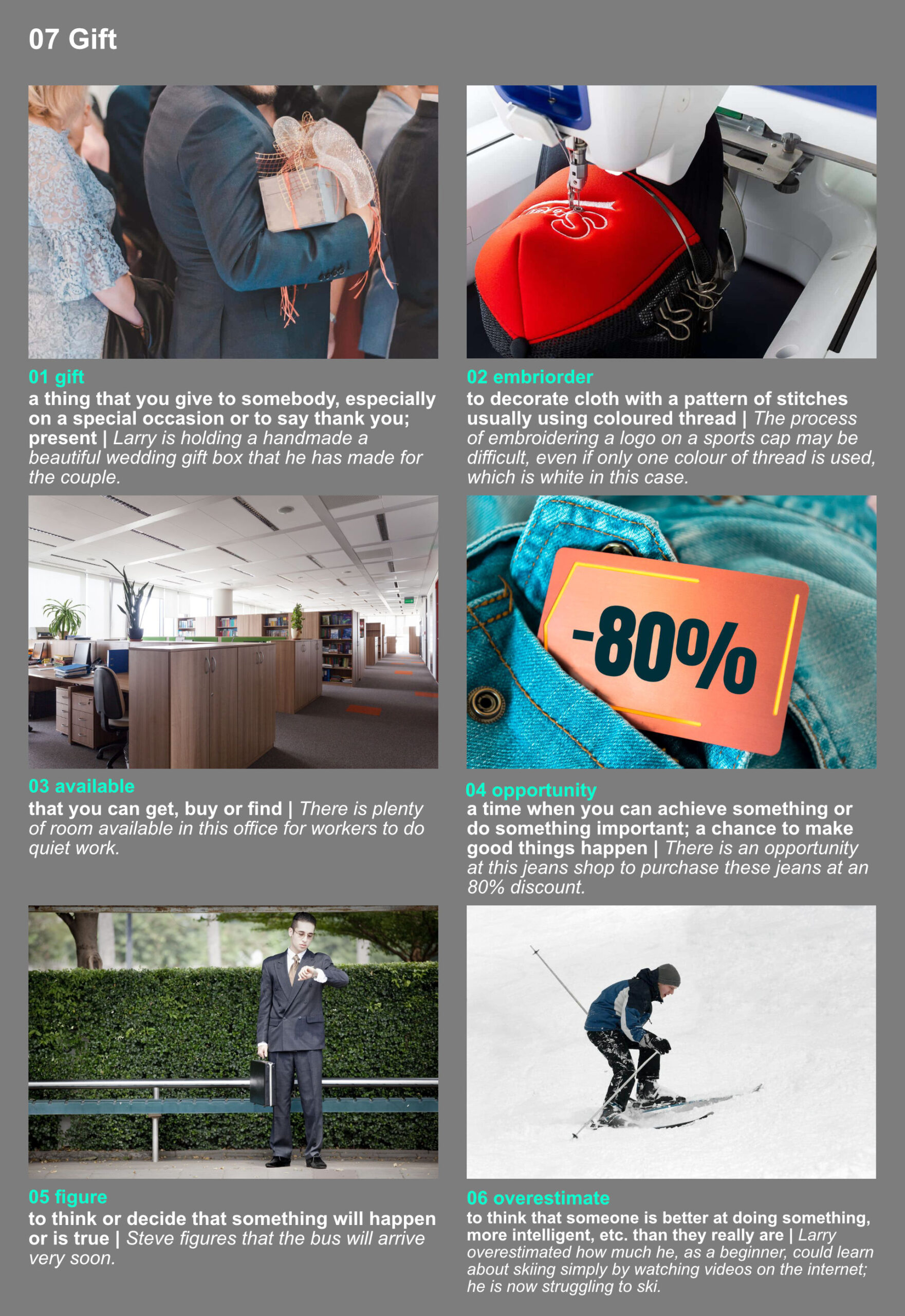
gift1: a thing that you give to somebody, especially on a special occasion or to say thank you; present | Larry is holding a handmade a beautiful wedding gift box that he has made for the couple.
currently: at the present time | There are currently 19 students in my chemistry class; this number is the lowest out of all of the classes at my school.
02
I am going to embroider a pair of skirts with little, um … I draw things – birds and stuff -,and I’m thinking I can embroider them onto the skirts. Unfortunately, I’ve never embroidered before in my life, and it was a lot. I thought it was a lot easier than it actually is. As such, I have not given it to them yet, and I hope they don’t hear this because they may be in the vicinity.
embroider2: to decorate cloth with a pattern of stitches usually using coloured thread | The process of embroidering a logo on a sports cap may be difficult, even if only one colour of thread is used, which is white in this case.
and stuff: used to refer to more things of a similar kind to those you have mentioned, when you do not say exactly what they are | Frank keeps his favourite videos, DVDs and stuff in his room on his table.
vicinity: the area around a particular place | There are no corner shops in our house’s vicinity.
03
I was originally going to give them to them for Christmas, but then I discovered that I cannot embroider. As such, I’m going to wait until the next available opportunity after I figure out how to embroider which will probably be Chinese New Year.
available3: that you can get, buy or find | There is plenty of room available in this office for workers to do quiet work.
opportunity4: a time when you can achieve something or do something important; a chance to make good things happen | There is an opportunity at this jeans shop to purchase these jeans at an 80% discount.
Chinese New Year: the beginning of the year according to the Chinese calendar, when there are celebrations for several days | I happened to be in Asia during the Chinese New Year. Where I was staying, it was celebrated with fireworks.
04
Why did I choose that gift? That was for 2 reasons: the first reason is because I knew they would probably like it. Both of them like skirts, and both of them like embroidered things and birds and pictures and stuff like that. So, I figured they’d like’em.
reason: the cause why something happens or why you do something | Brenda had a few reasons as to why she was late to the meeting; they included traffic, an incompetent taxi driver who got lost and bad weather.
figure5: to think or decide that something will happen or is true | Steve figures that the bus will arrive very soon.
05
The second reason is because I thought it would be a lot easier than it actually was. I overestimated my skills and what went into embroidering. I do still think I can do it, but I do not think it will be as easy as I thought it was.
overestimate6: to think that someone is better at doing something, more intelligent, etc. than they really are | Larry overestimated how much he, as a beginner, could learn about skiing simply by watching videos on the internet; he is now struggling to ski.
Describe a gift you recently gave to someone. You should say:
who you gave it to;
what kind of person he/she is;
what the gift was;
what occasion the gift was for;
and explain why you chose the gift.
Well, I haven’t given any gifts to anyone recently, but I am currently working on making gifts for my 2 sisters.
I am going to embroider a pair of skirts with little, um … I draw things – birds and stuff -,and I’m thinking I can embroider them onto the skirts. Unfortunately, I’ve never embroidered before in my life, and it was a lot. I thought it was a lot easier than it actually is. As such, I have not given it to them yet, and I hope they don’t hear this because they may be in the vicinity.
I was originally going to give them to them for Christmas, but then I discovered that I cannot embroider. As such, I’m going to wait until the next available opportunity after I figure out how to embroider which will probably be Chinese New Year.
Why did I choose that gift? That was for 2 reasons: the first reason is because I knew they would probably like it. Both of them like skirts, and both of them like embroidered things and birds and pictures and stuff like that. So, I figured they’d like’em.
The second reason is because I thought it would be a lot easier than it actually was. I overestimated my skills and what went into embroidering. I do still think I can do it, but I do not think it will be as easy as I thought it was.
8 Hobby (steps 1, 2 and 4)
Describe an interesting hobby. You should say:
What it is;
What kind of people do it;
How it is done;
And explain why you think it is interesting.
01
Historical European martial arts is a collection of many European fighting systems as they survive through things like manuals and textbooks and as passed down by very rare lineages of masters and students.
survive1: to continue to live or exist | Max survived in the jungle for three weeks by drinking rain water from a leaf and by eating coconuts.
manual2: a book that tells you how to do or operate something, especially one that comes with a machine, etc. when you buy it | Hans is skimming through (= reading through fast) the manual of his new deep fryer to figure out how to use it.
textbook3: a book that teaches a particular subject and that is used especially in schools and colleges | Tara forgot her textbooks on the kitchen table because she was a desperate hurry to get to school in time.
pass down: to give or teach something to your children or people younger than you | The older sister passed down her jumpers to her younger sibling.
lineage: the series of families that somebody comes from originally | Dan was an Englishman with royal lineage.
02
It comprises many different types of systems from many different time periods. Among them are, for example, rapier fencing, saber fencing, longsword fencing, halberd fighting, pike fighting, dagger and things like that; even, wrestling and boxing. All sorts of different systems.
comprise: to have somebody/something as parts or members; consists of | It was a set of books comprising the first three books in the Harry Potter series.
rapier fencing4: the first truly “civilian” system of fencing, maximized for single combat and meant to be used without either any secondary arms or protective armour | Sarah is practicing rapier fencing in the vicinity of a historical castle.
saber5 (BrE: sabre): a light sword with a thin blade used in the sport of fencing | These fencers are crossing their sabres.
longsword6: a European sword with a long, straight double-edged blade | This knight is sitting on a rock in the forest with a longsword in his hand.
halberd7: a weapon used in the past that is a combination of a spear and an axe | This is a beautifully crafted halberd.
pike8: a weapon with a sharp blade (= metal cutting edge) on a long wooden handle, used in the past by soldiers on foot | These pikes are properly sharpened.
dagger9: a short pointed knife that is used as a weapon | Daggers are commonly used props in theatre plays, especially in tragedies.
wrestling10: a sport in which two people fight by holding each other and trying to throw or force their opponent to the ground | Max and Steve are wrestling in the gym.
03
It’s done by a lot of different kinds of people: it’s done by history enthusiasts, people who like history and are interested in it, and it’s done by people who are in it for the physicality for sports (the sport versions ) or for exercise (getting strong), all different things like that.
enthusiast: a person who is very interested in something and spends a lot of time doing it | There were a bunch of football enthusiasts in the bar watching the match on TV.
physicality: the quality of being physical rather than emotional or spiritual | Wrestlers usually has a strong physicality.
04
There are different forms of it. For example, you could join a HEMA club. A HEMA club (HEMA is Historical European Martial Arts) is a club of people who get together, usually they have a master or someone who is more experienced in it, who can who can teach people who don’t know that much, and they get together, and they study from the manuscripts from what surviving ones we have – usually if there’s a manuscript, it’s a more recent form. They usually put on a lot of protective gear, and they actually spar with each other. That’s the more academic version.
get together11: to meet with somebody socially or in order to discuss something | The top management of the company got together to discuss the future of the company.
manuscript12: a very old book or document that was written by hand before printing was invented | These are some old manuscripts spread out messily on the table.
protective gear13: protective clothing, helmets (to cover the head), goggles (to cover the eyes), or other garments (to cover the body) or equipment designed to protect the wearer’s body from injury or infection | This professional chemical worker is wearing protective gear.
spar14: to make the movements used in boxing, either in training or to test the speed of your opponent’s reaction | These two boxers are sparring with their protective gear on.
academic: involving a lot of reading and studying rather than practical or technical skills | Maxine has academic qualifications in chemistry but has little experience with doing experiments (= tests).
05
There’s also the SCA. The SCA is the Society for Creative Anachronism. They do arts and sciences and things like that. They’ve got different things other than just HEMA. The SCA is a big group with a lot of people in it, so they’re more common if you want to get into it.
anachronism: a person, a custom or an idea that seems old-fashioned and does not belong to the present | The British monarchy seems like an anachronism to some today.
art15: the use of the imagination to express ideas or feelings, particularly in painting, drawing or sculpture | Louisa loves to create art in her spare time and does so every time she has the opportunity o do so.
science16: knowledge about the structure and behaviour of the natural and physical world, based on facts that you can prove | Steven is a biologist who tries to advance modern science through creating biological experiments (= tests) with newly discovered plants.
common : happening often; existing in large numbers or in many places | It is common for drivers to have car insurance and quite uncommon for drivers not to have it.
06
They do cut-and-thrust fencing, which is more modern stuff, and they also do another form of HEMA in which they put on heavy armor, usually historical armor not modern fencing gear. They put on heavy armor, and they have events where they spar with each other, (usually) often in groups even, sometimes with thousands of people on each side, and they use wooden weapons and shields and all sorts of stuff.
thrust17: to push something/somebody suddenly or violently in a particular direction; to move quickly and suddenly in a particular direction | Lisa is thrusting the toy sword towards her imaginary enemy.
armor18 ( BrE: armour): special metal clothing that soldiers wore in the past to protect their bodies while fighting; special clothing that soldiers or police officers wear to protect their bodies | This knight has his armour on him and his sword in his hand; he is ready for the battle.
event: a planned public or social occasion | The annual fund raising party will be held in my mansion (= large, impressive house) this year.
even: used to emphasize something unexpected or surprising | Mark did not even open the door when they knocked on it.
weapon19: an object such as a knife, gun, bomb, etc. that is used for fighting or attacking somebody | There is a collection of weapons on the wall.
shield20: a large piece of metal or leather carried by soldiers in the past to protect the body when fighting | These soldiers are hiding behind their shields because they are expecting their enemy’s attack.
07
That is a particularly good form of HEMA to get into if you want to get strong because the armor weighs a lot. It weighs a lot, so if you can wear it and fight in it, you’re going to get very strong and good at doing things outside of it.
particularly: especially; more than usual or more than others | I enjoyed the concert; I particularly liked the way the guitarist played his solo.
weigh21: to have a particular weight | Susan weighs 47.7 kilograms.
08
Of course, you can also get into it by yourself, though that’s harder because once you get to a certain level in it, you need to practise with someone else, but you can still learn a great deal by studying it directly from manuscripts and textbooks, from whenever these martial arts were from, and you can also combine that with either watching videos of people do it or watching them actually do it, and that can give you a very good idea of how to do these things.
once: as soon as | Once I got to school, I stopped running.
level: a standard or quality | Stella consistently performed in competitions at the highest level; she was a professional.
a certain level: a particular standard or quality | Once you manage to perform at a certain level, you receive a black belt in the martial art.
practise22: doing an activity or training regularly so that you can improve your skill; the time you spend doing this | Lisa regularly practises playing the guitar with his father, even though he is far away.
a great deal: much; a lot | Lisa went to the shopping centre and spent a great deal of her pocket money.
whenever: every time when | Whenever we get the chance, my wife and I go to the cinema to watch a film, just the two of us, no kids.
actually: in fact or really | I am not sure what actually happened to the rock band members after they stopped playing together.
09
Some people get into it to compete as there are sports versions of a lot of these. One famous one is called buhurt. In buhurt, you put on heavy, heavy armor, and you use steel weapons, and it’s a sport in which 2 teams of people basically just whack each other with steel weapons until all of one side is on the ground.
compete23: to take part in a contest or game | 105 runners competed against each other in the marathon.
buhurt24: a modern-day full-contact combat sport which involves fighters using blunt steel weapons and armour characteristic of medieval times | These people are competing in a buhurt to prove that they are the best at it.
steel25: a strong, hard metal that is made of a mixture of iron and carbon | These are steel coils.
whack26: to hit somebody/something very hard | Steve is whacking the toys in the machine.
10
Injury is not inherent in the sport. Usually, you just get tired and fall down, but if you aren’t careful, you could get hurt, but there’s heavy protection so that’s uncommon.
injury27: harm done to a person’s or an animal’s body, for example in an accident | Phil has suffered a head injury, so he is now at the doctor’s.
inherent: existing as a natural or basic part of something | There is an inherent weakness in the design of a smart watch, so it can crack relatively easily.
uncommon: not existing in large numbers or in many places; rare | It is uncommon to see someone having a tiger as a pet.
11
There’s also Olympic fencing which is only inspired by actual historical fencing, but it’s close enough that it counts, and there are even competitions – International ones, too – for things like knife fighting and sabre fencing and things like that.
inspired: resulting from inspiration (= from someone or something that gives you ideas for doing something) | Frank has some inspired ideas about how to live life.
knife fighting28: a combat with knives | These people are practising knife fighting.
12
I think it’s interesting for a number of reasons. One reason is it’s a slice of history you can experience, often quite painfully, if you are doing it too rough, and I think that’s quite interesting. It’s also very good exercise. It’s very physical stuff, and if you do it the way that I do it, which is generally, I don’t have a lot of protection. (In) most versions of HEMA, you wear gloves, you wear helmets, you wear big suits; you are armoured to protect yourself. I don’t have any of that; instead, we basically just try to hit each other more softly. If you’re doing it like I do it, you get to tolerate pain quite well.
experience: things that happen to you or affects you in a special way. Experience is also what you feel or learn from things that occur in your life. | Jim Lovell had the opportunity to experience what it is like to take steps on the moon.
painfully29: in a way that causes you physical or emotional pain | Frank fell down and hit his knee painfully against the playground floor.
rough: not gentle or careful; violent | Maggie complained that the police officer was too rough when he grabbed her arm to take her to the police station.
instead: in the place of somebody/something | Danny could not attend the football match so Larry had to be the goalkeeper instead.
tolerate30: to accept somebody/something that is annoying, unpleasant, etc. without complaining | Kathy is tolerating the loud noise coming from the construction machines, but she needs to put a pillow over her ears to be able to rest.
13
Also, many versions of it, such as SCA and buhurt, they’re very good weight training. If you want to be able to run faster and longer, if you want endurance, those can help you with it. You have to have a very strong heart and strong lungs to be able to do that. I remember I used to be in the SCA, and when I was, it was hot and tiring. Fifteen minutes in one of those suits felt like 2 hours. Very good stuff if you want to build endurance. In addition, because when you do it, you often join a club, you can meet a lot of interesting people that way and make new friends and things like that.
weight training31: the activity of lifting weights as a form of exercise | Bill enjoys weight training early in the morning.
endurance32: the ability to continue doing something painful or difficult for a long period of time without giving up | These marathon runners need to have a lot of physical endurance to successfully finish the race.
lung33: either of the two organs in the chest that you use for breathing | Max has pain in his lungs.
in addition: used when you want to mention another person or thing after something else | Frank fell down in the park and, in addition, he had broken his phone that day.

Describe an interesting hobby. You should say:
What it is
What kind of people do it
How it is done
And explain why you think it is interesting
Historical European martial arts is a collection of many European fighting systems as they survive through things like manuals and textbooks and as passed down by very rare lineages of masters and students.
It comprises many different types of systems from many different time periods. Among them are, for example, rapier fencing, saber fencing, longsword fencing, halberd fighting, pike fighting, dagger and things like that; even, wrestling and boxing. All sorts of different systems.
It’s done by a lot of different kinds of people: it’s done by history enthusiasts, people who like history and are interested in it, and it’s done by people who are in it for the physicality for sports (the sport versions ) or for exercise (getting strong), all different things like that.
There are different forms of it. For example, you could join a HEMA club. A HEMA club (HEMA is Historical European Martial Arts) is a club of people who get together, usually they have a master or someone who is more experienced in it, who can who can teach people who don’t know that much, and they get together, and they study from the manuscripts from what surviving ones we have – usually if there’s a manuscript, it’s a more recent form. They usually put on a lot of protective gear, and they actually spar with each other. That’s the more academic version.
There’s also the SCA. The SCA is the Society for Creative Anachronism. They do arts and sciences and things like that. They’ve got different things other than just HEMA. The SCA is a big group with a lot of people in it, so they’re more common if you want to get into it.
They do cut-and-thrust fencing, which is more modern stuff, and they also do another form of HEMA in which they put on heavy armor, usually historical armor not modern fencing gear. They put on heavy armor, and they have events where they spar with each other, (usually) often in groups even, sometimes with thousands of people on each side, and they use wooden weapons and shields and all sorts of stuff.
That is a particularly good form of HEMA to get into if you want to get strong because the armor weighs a lot. It weighs a lot, so if you can wear it and fight in it, you’re going to get very strong and good at doing things outside of it.
Of course, you can also get into it by yourself, though that’s harder because once you get to a certain level in it, you need to practise with someone else, but you can still learn a great deal by studying it directly from manuscripts and textbooks, from whenever these martial arts were from, and you can also combine that with either watching videos of people do it or watching them actually do it, and that can give you a very good idea of how to do these things.
Some people get into it to compete as there are sports versions of a lot of these. One famous one is called buhurt. In buhurt, you put on heavy, heavy armor, and you use steel weapons, and it’s a sport in which 2 teams of people basically just whack each other with steel weapons until all of one side is on the ground.
Injury is not inherent in the sport. Usually, you just get tired and fall down, but if you aren’t careful, you could get hurt, but there’s heavy protection so that’s uncommon.
There’s also Olympic fencing which is only inspired by actual historical fencing, but it’s close enough that it counts, and there are even competitions – International ones, too – for things like knife fighting and sabre fencing and things like that.
I think it’s interesting for a number of reasons. One reason is it’s a slice of history you can experience, often quite painfully, if you are doing it too rough, and I think that’s quite interesting. It’s also very good exercise. It’s very physical stuff, and if you do it the way that I do it, which is generally, I don’t have a lot of protection. (In) most versions of HEMA, you wear gloves, you wear helmets, you wear big suits; you are armoured to protect yourself. I don’t have any of that; instead, we basically just try to hit each other more softly. If you’re doing it like I do it, you get to tolerate pain quite well.
Also, many versions of it, such as SCA and buhurt, they’re very good weight training. If you want to be able to run faster and longer, if you want endurance, those can help you with it. You have to have a very strong heart and strong lungs to be able to do that. I remember I used to be in the SCA, and when I was, it was hot and tiring. Fifteen minutes in one of those suits felt like 2 hours. Very good stuff if you want to build endurance. In addition, because when you do it, you often join a club, you can meet a lot of interesting people that way and make new friends and things like that.