
Modul 6: Oral Exams B2/C1: Part 2 Set 2. Topics 9-14
Keegan (Maine, USA) 6db hétköznapi, mégis komplex témában mondja el gondolatait. Ezek a témák a nyelvvizsgák tipikus “nagy témái”. Az IELTS nyelvvizsgán 5 percen át kell tudnod beszélni a témáról. Keegan ezt helyenként átlépi, de mivel a tartalom nyelvtanulói szempontból is értékes, nem beszélve az amerikai kultúrával, élettel kapcsolatos sok-sok érdekes információval, így a tananyagban az 5 percet liberálisan kezeltük.
Fontos, hogy a kézikönyvekben leírtak szerint dolgozz az anyagon. A videók össz hossza kb. 28 perc.
9 Internet (steps 1, 2 and 4)
Describe a useful website. You should say:
what it is;
how often you visit it;
what kind of site it is;
what kind of information it offers;
and explain why you think it is useful.
01
A website that I have found to be useful is YouTube. YouTube is, in fact, one of the most common websites and one of the most popular websites on the Internet. YouTube is a video hosting website that allows almost any user with an account to post videos – as many videos as they like – up to a certain size limit without verification, and it allows all other users to view any content on it without an account.
common: happening often; existing in large numbers or in many places | Noah is a very common name in Britain.
allow: to let somebody/something do something; to let something happen or be done | Any random civilian is not just allowed to enter the White House in Washington; they may need an invitation or some special reason to be there.
verification: the act of showing or checking that something is true or accurate | The verification of facts which are to be printed out in newspapers is very important to some big newspapers.
content1: the information or other material contained on a website or other digital media | Freddy often reads the content posted on this blog because he is interested in the topics written about there.
account2: an arrangement that somebody has with a company that allows them to use the internet, send and receive messages by email, social media, etc. | Lisa sometimes forgets to log out of her email account when she goes on her lunch break from work.
02
Why do I think that YouTube is useful? Well, I can find any information that I want to get my hands on on YouTube, almost any information. Some things are probably not there, but almost anything I want to know how to do, I can go on YouTube and make a quick search and find dozens of videos telling me how to do it.
search3: an act or the activity of looking for information on a computer or on the internet | David is conducting a search for affordable (= cheap) great literature books on the internet.
dozen: a group of twelve of the same thing | I went to the supermarket to get a dozen fresh eggs.
03
Just today, I wanted to know how to make a shortbow. Now I could have searched for information on any kind of bow, but I was looking for a shortbow in specific and how to make it have the correct poundage. So, I went on YouTube, and I found a video. The video showed how to make a shortbow; it showed the benefits of different types of arrows and how to make them. I immediately had the information I was looking for, and if I wanted to, there were dozens of other videos showing different details. And all of this is completely free to me. I don’t have to pay a penny to get this. As such, I visit it quite often.
shortbow4: a small bow that has a strong tension (= pulling force), and is usually about a metre tall | Ted is using a shortbow to shoot at the target.
poundage: weight | Dan carried extra poundage on his back due to an additional bag he had to carry.
benefit: a helpful and useful effect that something has or that something gives you | Jen was able to gain from the benefits of modern medicine.
detail5: a piece of information about something | The job application form required a lot of details about the applicant, such as their full name, age, email address etc.
04
Usually, before I start a project, if I don’t know specifically what I’m going to do, I will look on YouTube for information on how to do it. For example, before I built my cabin, I watched videos on how to build all different types of cabins. I took in the information, and I made my cabin. If I want information on any sort of thing like that, I can find it, and it’s all free.
cabin6: a small house or shelter, usually made of wood | This cabin was built away from the urban areas = away from the city or town) so its owner can relax alone.
free: costing nothing | You don’t have to pay for admission to this new parking lot; it is free.
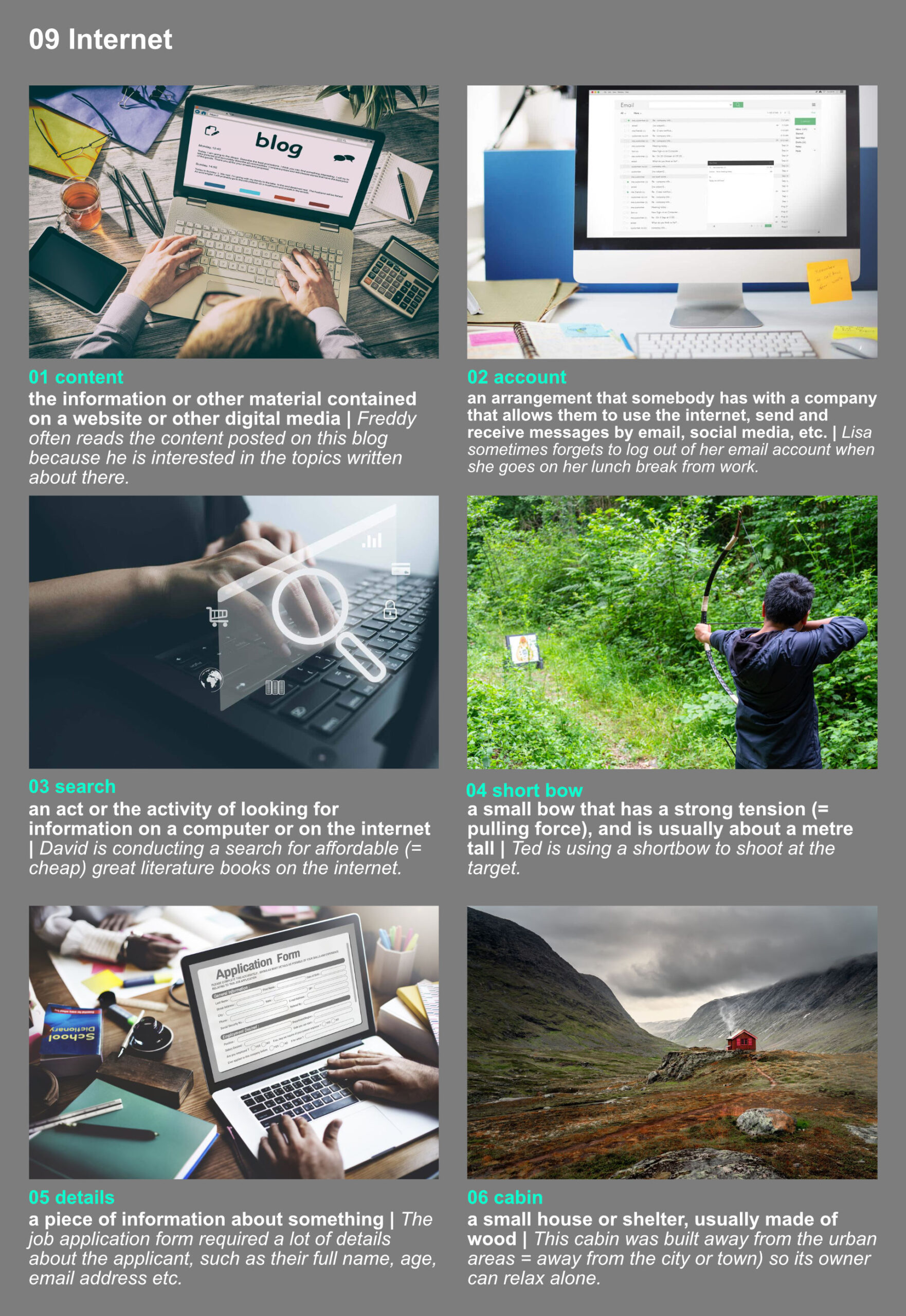
Describe a useful website. You should say:
what it is;
how often you visit it;
what kind of site it is;
what kind of information it offers;
and explain why you think it is useful.
A website that I have found to be useful is YouTube. YouTube is, in fact, one of the most common websites and one of the most popular websites on the Internet. YouTube is a video hosting website that allows almost any user with an account to post videos – as many videos as they like – up to a certain size limit without verification, and it allows all other users to view any content on it without an account.
Why do I think that YouTube is useful? Well, I can find any information that I want to get my hands on on YouTube, almost any information. Some things are probably not there, but almost anything I want to know how to do, I can go on YouTube and make a quick search and find dozens of videos telling me how to do it.
Just today, I wanted to know how to make a shortbow. Now I could have searched for information on any kind of bow, but I was looking for a shortbow in specific and how to make it have the correct poundage. So, I went on YouTube, and I found a video. The video showed how to make a shortbow; it showed the benefits of different types of arrows and how to make them. I immediately had the information I was looking for, and if I wanted to, there were dozens of other videos showing different details. And all of this is completely free to me. I don’t have to pay a penny to get this. As such, I visit it quite often.
Usually, before I start a project, if I don’t know specifically what I’m going to do, I will look on YouTube for information on how to do it. For example, before I built my cabin, I watched videos on how to build all different types of cabins. I took in the information, and I made my cabin. If I want information on any sort of thing like that, I can find it, and it’s all free.
10 Journey (steps 1, 2 and 4)
Describe a journey that didn’t go as planned. You should say:
where you were going;
how you were travelling;
who you were with;
what went wrong;
and explain what you would do differently.
01
I’ve gone to an event called Bike Maine several times. Bike Maine is an event in which people pay a bunch of money to a company who runs a bike tour, and the people bike from town to town around Maine. And the company sets up tents and carries their baggage from place to place, and gives them meals as they go. I volunteered at this event on the tent and porter crew.
event1: a planned public or social occasion | Stella and her friends from work are running in a special fundraiser event to help those that are in need in their local area.
bunch2: a large amount of something; a large number of things or people | Michael has a bunch of things to do today, so he has put reminders of them even in his car.
a bunch of money: a lot of money | Yesterday Maggie made a bunch of money through an important business deal with a large corporation, so she can surely afford her dream vacation this year.
bike tour3: travelling via roads to or around a destination | These men often go bike touring not only to become better cyclists but also to become fitter.
tent4: a shelter made of a large sheet of canvas, nylon, etc. that is supported by poles and ropes fixed to the ground, and is used especially for camping | These people have set up their tent and are now gathered around the fire.
baggage5: bags, cases, etc. that contain somebody’s clothes and things when they are travelling | The baggage handler is transporting the baggage to the Swedish airline company’s aeroplane.
volunteer6: to offer to do something without being forced to do it or without getting paid for it | These people are all volunteering at this charity shop; they are packing food that they will give out to those who need it.
porter7: a person whose job is carrying people’s bags and other loads, especially at a train station, an airport or in a hotel | Frank works as a hotel porter at a five-star hotel in the USA.
crew8: a group of people with special skills working together | The film crew are shooting part of an episode of a sitcom on a beach today.
02
Now, our job was exactly what it sounded like. Our job was to set up all of the tents and to take them down, and after we had set them up, we would move the people’s baggage into them. The first time I volunteered at the event, it was being held way up north on the border with Canada. In addition, it was being held in mid-fall. Now, fall gets cold enough in some places down where I was, but this was up north on the border – it was actually on the Saint John River on the border between Maine and Canada -and it was getting pretty cold.
set up9: to prepare something for use, especially by putting the different parts of it together | Steve is setting up his new drumset for the first time; he is excited because it is nearly finished, and he is very eager to play.
way up: a long distance up | The supermarket is way up this road; just follow it for about 10 km.
border10: the line that divides two countries or areas; the land near this line | This border crossing is on the border between Bosnia-Herzegovina and Croatia.
in addition: used when you want to mention another person or thing after something else | In addition, there is one more statistic that we should look at to understand this modern phenomenon.
mid-fall11: in the middle of the season of the year between summer and winter, when leaves change colour and the weather becomes colder; the middle of autumn | It is mid-fall, and Terence and Velma are taking a walk in the forest.
pretty: fairly; very | The English Literature exam was pretty hard this year but I guess I did alright.
03
Now, I’d missed the first time I had a chance to go to this event. So I wasn’t about to miss the 2nd time. The 2nd time I got on to it, but unfortunately, the very day I was set to go, I began getting sick. Now, every time I’ve been to Bike Maine, everyone has gotten sick, but that time it was my fault. The next time it wasn’t my fault, but that time it was.
miss: to fail to be or go somewhere | Hayley never missed a single movie of her favourite franchise, Star Wars. She went to the cinema and watched each of them on the very day they were released.
about to12: to be going to do something very soon | This train is about to leave, so Suzy needs to get on it quickly if she wants to arrive at work on time.
the very day: on that particular day (= not another day) | The very day I thought about actually going out to the shop to buy a new pack of batteries for my TV remote, I found some in a drawer, so I saved a trip to the supermarket (= I didn’t have to go).
sick13: physically or mentally ill; not well or healthy | Frank is feeling sick today, but he is hoping that he will be well before the end of the week.
fault14: the responsibility for something wrong that has happened or been done | Karen accidentally dropped her teacup on her way to the kettle, but people say it wasn’t her fault because Steve scared her.
04
Now, if I got to do this a 3rd time, I would definitely do one thing differently. I would bring a lot less stuff. Both times I carried everything I could possibly need on the trip and then proceeded to not need any of it.
proceed: to do something next, after having done something else first; go on | On the day of her presentation, Jen wrote down all the key points on a piece of paper in advance and then proceeded to speak about each one of them in great detail.
05
If I did it again, I would bring only clothes and plenty of clothes for both warm and cold as both are possible; and since raining happens quite a lot, it’s always good to have spare dry clothing that you can switch into, but other than that I would not bring much at all. It’s hard enough trying to lug everyone else’s belongings around without having to lug your own with you.
spare: kept in case you need to replace the one you usually use; extra | Ken always keeps a spare key to his car nearby so that if he loses one key, he can still use his car with the other one.
switch15: to change or make something change from one thing to another | Steve received his first phone, the one on the far left, when he turned 17 years old. Over the years, he frequently switched to better ones but also kept the previous ones. Now, he has a collection of old phones.
but other than that: but except that | For Maggie, train seats are sometimes not very comfortable, but other than that, she finds it useful to travel with trains.
(not) at all: in any way; to any degree; absolutely not | Jess went to the party but, unfortunately, she did not enjoy herself there at all.
lug16: to carry or drag (= pull) something heavy with a lot of effort | Sarah had to lug her heavy suitcase up the stairs because there was no ramp to pull it up on.
belongings17: the things that you own which can be moved, for example, not land or buildings; possessions | Eve is looking for some of her belongings (her phone and wallet) in her bag, but they seem to be missing; she may have forgotten to pack them, or they are lost.
06
On the first day, we had to set up the tents for everyone. My crew, which was myself and one other guy, were in a race with our friends, and we won. My team set up the most tents out of everyone, and discounting our rival team, we set up more tents than everyone else in the entire crew. Now normally, after the first day, they split us into 2 groups. One of us goes ahead and puts up the tents, the other stays behind and takes down the tents and moves the baggage into the tents put up by the first team, but that first day we were all doing it, and my team was the fastest.
race18: a competition between people, animals, vehicles, etc. to see which one is the faster or fastest | Harry appears to be winning the horse race as he has a lead of more than a horse length.
discount: to think or say that something is not important or not true; dismiss | The corrupt police officers discounted the overwhelming evidence proving the innocence of Frank.
entire: including everything, everyone or every part; whole| Lea spent the entire day watching TV shows on her computer.
split19: to divide, or to make something divide, into two or more parts | The axe split the wood into two parts.
go ahead: to start to do something | To help her busy wife, Dan often goes ahead and cooks vegetables to give to their children.
stay behind: to not leave a place when other people leave | Lucy and her family often stay behind in the cinema after a movie to watch the after-credits scenes and listen to the after-credits song.
07
Now you got cold. In fact, you got so cold at night, and we were sleeping in just very thin tents that the condensation would form (on the outside) on the inside of the tents, and it would freeze, and if there was any water on you at all, it would freeze. You would wake up covered in ice and have to knock the ice off yourself. That is how cold it was there. It hadn’t snowed yet, though, and it was warmer in the day. So it was already, by itself, a fairly difficult event, and we were going to be moving from town to town all around the Caribou-Presque Isle area, around the Saint John River, which is the border with Canada.
thin20: having a smaller distance between opposite sides or surfaces than other similar objects or than normal; not thick | Maxine is cutting this onion into very thin pieces.
condensation21: drops of water that form on a cold surface when warm water vapour becomes cool | The window has frosted due to the extreme temperature outside, causing condensation to form on the glass.
freeze22: to become hard, and often turn to ice, as a result of extreme cold; to make something do this | The lake froze last night.
covered: having a layer or amount of something on it | Fred’s fingers were covered in ketchup. (= There was ketchup on his fingers.)
knock (something) off23: to hit or brush something away from something/someone | Sam and his son are knocking snow off the car.
08
Now I mentioned that I was sick. I was only just starting to get sick as I went into it, but in these conditions, “a little sick” turns into “very sick” very quickly. And in fact, it had not taken more than a couple of days before all of us, almost every single member of our crew was sick, and given the conditions being sick was both hard to cure and quite dangerous. I was never one to let getting sick stop me from doing anything, though, and so I continued on just as strongly as before, although by now, my throat was very … speaking was hard. Eventually, I don’t remember how she heard, but my mother got word that I was sick and decided that she would drive several hours up north to get to me. I think she was thinking she would bring me back.
mention: to write or speak about something/somebody, especially without giving much information | Earlier this week, the teacher mentioned several times that there might be a short multiple-choice exam about the topic soon. Still, the students have forgotten all about it.
condition: the circumstances or situation in which people live, work or do things | The living conditions in the poor village were dire (= very bad).
couple: a small number of people or things | Steven reads a couple of pages from his favourite book every night before he goes to sleep.
given the conditions: based on what’s happening or how things are | Given the conditions on Earth, falling from a high enough point is probably deadly.
cure24: to make a person or an animal healthy again after an illness | In some cases, pills do not cure the illness itself but may help a patient deal with it.
throat25: a passage in the neck through which food and air pass on their way into the body; the front part of the neck | Jack’s throat is in pain because he’s caught a cold.
eventually: at the end of a period of time or a series of events | Francine will eventually sell her shoes online to make some extra money.
get word: to receive or be given a message or communication (from someone or something) | The prime minister of the UK got word about a person who is very good at impersonating (pretending to be) him to entertain people.
09
The leader of our crew was a former artillery officer who was very skilled at managing groups of people. She determined that we were all going to get well, and she was going to make that (be) the case no matter what. Now, fortunately, one of the nights, the place where we were staying happened to have an aircraft hangar that was empty enough for us to use. As such, it was a building with a roof, it had a solid floor, and it kept heat. That was great.
leader26: a person in control of a group, country, or situation | This person appears to be the leader of the Netherlands.
former: that used to have a particular position or status in the past; previous | Mike Tyson is a former professional boxer.
artillery27: large, heavy guns which are often moved on wheels | This is an artillery piece put on display (= that people can see) in Florida.
manage: to control or be in charge of a business, a team, an organisation, land, etc. | It takes a lot of money to successfully manage a world-class football club, like Arsenal or Manchester United.
determined: wanting to do something very much and not giving up, even if it’s hard or others say to do so | Stella is determined to succeed in her new career; she wants to be a professional photographer.
happen: to take place, especially without being planned | Minor car accidents like parking lot accidents happen all the time. These cause cosmetic damage like scratches or dents.
hangar28: a large building in which aircraft are kept | This aerospace hangar is so huge that it could store more than one aeroplane.
10
Now we were no longer sleeping in leaky, frozen tents, but we had a proper building to sleep in. We even had showers. They had a shower truck. A truck with showers in it so you could take showers. And our leader decided she was going to make us well no matter what. She bought large amounts of medicine, and she made us all take the medicine. Most of us were sick. There may have been a few who weren’t entirely sick yet and a few who were getting better, but by golly, she made us well. If, by morning, a single one of us were still sick, I would have been very surprised. She gave us every medicine, every vitamin known to man and made us all get very good sleep, and that was that. Most of us got better, including myself.
leaky29: having holes that allow liquid or gas to escape | Maxine has a leaky roof, so she is calling a plumber to fix it as soon as possible.
shower30: to wash using a shower | Stan is taking a shower so that he can go to work feeling clean and good about himself.
truck31 (BrE: lorry): a large vehicle for carrying heavy loads by road | This white truck is en route (= on its way) to France, delivering sofas to a business.
medicine32: a substance that you take in order to cure an illness, especially a liquid that you drink or swallow | Kate is pouring some liquid cough medicine into a spoon so she can give it to her ill daughter.
by golly: used to show surprise | After I nearly accidentally broke the plates in Sarah’s house, I thought she would never talk to me again, but by golly, she did talk to me this morning!
a single one of us: any one of us | Not a single one of us woke up in time to catch the early bus to school.
that is that: used to say that there is nothing more you can do or say about a particular matter | I really like strawberries and that is that.
including myself: me too | Every passenger on the bus, including myself, looked concerned when the bus driver picked up his ringing phone while driving.
11
So the next day, we were moving on, and I was in high spirits, and our next spot was down by the Saint John River. The Saint John River, as I mentioned, is the border between Maine and Canada. It was a warm sunny day, which was nice for how the weather normally was at that time of year, and we set up our tents, and we would be staying at that location for 2 days. This gave us time to settle in.
in high spirits33: extremely happy and enjoying the situation | Dan was in high spirits his team won the Rugby World Cup.
spot34: a particular area or place | Lily found a quiet spot in the park where she can read her favourite novel in peace.
settle in35: to start to feel comfortable in a new home, job, etc. | It has only been one week since Michael started, but he is already settling into his new school.
12
Now, something interesting happened. Because we were all on the St. John River, despite the temperature of the weather at that time of year, we all determined we were going to go swimming in the Saint John River. Because we’ve got a river, it’s a warm day, why should we not go all bathe in the river. So, we all bathed in the river.
on: at or near a place | There was a little village on the coast of North England.
despite: used to show that something happened or is true although it might have been stopped it by something else | Mary was very good at poker, despite the fact that she hated card games in general. (= She hated card games, but even so, she was very good at poker.)
bathe: to go swimming in the sea, a river, etc. for pleasure | When the class finally saw the ocean, they all wanted to bathe in the water to relax after their long journey.
13
Now don’t think most of us had brought any sort of swimming clothes. I think we all bought towels of some sort because a towel is a good thing to have in this sort of situation. A number of things happened there; for example, one of my friends blew his nose on poison ivy, which was very interesting, and we all got a good laugh out of that except for him. But we all went down into the Saint John River, and we bathed.
of some sort: (also: a/some sort of …) used for describing something in a not very exact way | “What was that noise?” “It was an insect of some sort.”
sort of: a group or type of people or things that are similar in a particular way; kind of | What sort of person is Linda?” “She is the sort of person to share her last piece of apple pie if someone else is there with her.”
blow your nose36: to force air from your lungs and through your nose to clear it | Larry needs to blow his nose quite often these days, due to his allergy.
poison ivy37: a North American climbing plant that causes painful spots on the skin when you touch it | In some places in North America, there are warning signs put up to help tourists and hikers avoid poison ivy.
14
Unfortunately, when I came back out, I could not, in fact, find my trousers. I do not know what happened to my trousers, but they were gone. I don’t know why I didn’t have a second pair of trousers, but maybe they were wet or maybe it was that I only had one pair of trousers, and they didn’t go missing, but they were wet, but regardless, I ended up without a pair of trousers. I had a pair of shorts, but it was rather cold, so instead, I had a tartan; my towel was in a tartan pattern.
gone: if something is gone, there is none of it left | Frank checked his wallet, and most of his money was gone; he had become so focused on the items he was buying that he stopped counting the money he was spending.
regardless: paying no attention, even if the situation is bad or there are difficulties | It started to rain heavily, but the marathon runners continued the race regardless.
tartan38: cloth, especially made of wool, that has a tartan pattern | Maggie often has her favourite tartan scarf on during cold days in autumn.
tartan pattern39: a pattern (= design) of squares and lines of different colours and widths that cross each other at an angle of 90° | The tartan pattern is prominent in the outfit of this Scottish sword dancer; both his kilt (= tartan skirt) and socks have this same pattern.
15
So, I wrapped it around my waist and tied it on with a belt and wore it like it was a kilt. And it worked! People thought I was wearing a kilt, which was very interesting. Incidentally, I found someone else’s trousers, and they fit me perfectly, so I took them. I didn’t find out until very, very recently they were my friend’s trousers. He had left the day before.
wrap40: to put something around something/somebody | Stella has a clean white towel wrapped around her head while she is drying her head after a long bath.
tie: to attach, hold or fasten two or more things together using string, rope, etc. | Larry had his hands tied behind his back because he was dangerous.
belt41: a long narrow piece of leather, cloth, etc. that you wear around the middle part of your body | Leather belts, such as this one, are often worn by people as part of their work uniform.
kilt42: a skirt made of tartan cloth that reaches to the knees | Kilts are sometimes worn as casual clothing by some men, such as this Scottish bagpiper, because they enjoy both wearing it and sharing their heritage (i.e. their traditions/culture).
incidentally: in a way that was not planned but that is connected with something else | Last night, as Jack went out to his car to check the lighting, he incidentally discovered that a thief had been trying to break into it.
belong43 (to): to be owned by somebody/something | Both the Teddy bear and the book belong to Harold; he received both of them as birthday presents from his parents last month.
fit44: to be the right shape and size for somebody/something | This last piece should fit exactly into the jigsaw puzzle.
until very, very recently: up to a very short time ago | I had never won at Monopoly against my siblings (= brothers/sisters) until very, very recently; I had always lost in that game until yesterday afternoon.
16
There’s a sad story about why he left, but I’m not going to go into that, and he forgot his trousers, and I have them to this day, and in fact, I am currently wearing them. These are the trousers that I found that day.
go into something: to discuss, examine, describe, or explain something in a detailed or careful way | The first part of the movie goes into the hero’s life story before he enters the forest where the adventure begins.
to this day: even now, when a lot of time has passed | To this day, I do not understand how Janet managed to climb that mountain alone.
currently: at the present time | Currently, it is not raining outside; in fact, it has just stopped raining as I got home from work soaking wet, but I won’t go into that.
17
I didn’t find them yet, though, and as I mentioned, my mother was coming. So, it’s around lunchtime. We’re all going in to get food, and I am currently wearing a towel wrapped around my waist like a kilt. I have shorts on underneath, but yeah, and then my mother arrives. So, she was anxious to see whether I was well, and I was indeed well, and she was surprised to see me attired so.
mention: to write or speak about something/somebody, especially without giving much information | Francesca has mentioned that she will go to her friend’s on Saturday, but she did not say the specific time, so her mum was surprised when her daughter tried to leave at 11pm.
waist45: the area around the middle of the body between the ribs and the hips, often narrower than the areas above and below | The groom has put his arms around the bride’s waist.
underneath46: under or below something else, especially when it is hidden or covered by the thing on top | Steve is wearing a yellow jumper underneath his grey coat he believes these colours complement each other well (= go well with each other).
anxious47: feeling worried or nervous | Maddy is anxious about the future because one of her friends is seriously ill.
indeed: used to say that something is really/absolutely true or right. | “Did you say that Jerry had already finished his homework assignment for chemistry?” “Indeed, I did.”
attired48: dressed in a particular way | Frank was fashionably attired in a tuxedo for the wedding which he is about to attend.
But it all ended up well. She didn’t take me back, although she had rented a hotel room a little bit outside of town. So I got to spend the night in a nice warm bed with blankets in a hotel room, and that was the best thing ever in my mind. I was very happy about that.
end up well: to achieve some good situation after other activities | When we saw that Billy is going up to the stage to play the clarinet, we were worried, but all ended up well as he played a great solo that the audience greatly enjoyed.
in my mind: used to show you are giving your opinion about something | In my mind, Billy’s musical performance wasn’t the best one of the night; Fred played much better.
18
Some interesting things happened, like the fire alarm went off in the middle of the night, and we had to call the owner of the hotel who lived down the road to come and deal with it. All of the fire alarms went off. But there was no fire, and there was no way to turn them off. But apart from that, I got a good night’s sleep. It’s better than I’d gotten the whole week, and I went back out and continued on Bike Maine.
go off: if a warning device goes off, it starts to ring loudly or make a loud noise | My alarm clock went off at 7.30 in the morning.
deal with49: to take appropriate action in a particular situation; handle | Hank is able to deal with most customers as he has been working at this call centre for years and is now very good at his job.
apart from that: except for something| I have my wallet, but apart from that, my pockets are empty.

Describe a journey that didn’t go as planned. You should say:
where you were going;
how you were travelling;
who you were with;
what went wrong;
and explain what you would do differently.
I’ve gone to an event called Bike Maine several times. Bike Maine is an event in which people pay a bunch of money to a company who runs a bike tour, and the people bike from town to town around Maine. And the company sets up tents and carries their baggage from place to place, and gives them meals as they go. I volunteered at this event on the tent and porter crew.
Now, our job was exactly what it sounded like. Our job was to set up all of the tents and to take them down, and after we had set them up, we would move the people’s baggage into them. The first time I volunteered at the event, it was being held way up north on the border with Canada. In addition, it was being held in mid-fall. Now, fall gets cold enough in some places down where I was, but this was up north on the border – it was actually on the Saint John River on the border between Maine and Canada -and it was getting pretty cold.
Now, I’d missed the first time I had a chance to go to this event. So I wasn’t about to miss the 2nd time. The 2nd time I got on to it, but unfortunately, the very day I was set to go, I began getting sick. Now, every time I’ve been to Bike Maine, everyone has gotten sick, but that time it was my fault. The next time it wasn’t my fault, but that time it was.
Now, if I got to do this a 3rd time, I would definitely do one thing differently. I would bring a lot less stuff. Both times I carried everything I could possibly need on the trip and then proceeded to not need any of it.
If I did it again, I would bring only clothes and plenty of clothes for both warm and cold as both are possible; and since raining happens quite a lot, it’s always good to have spare dry clothing that you can switch into, but other than that I would not bring much at all. It’s hard enough trying to lug everyone else’s belongings around without having to lug your own with you.
On the first day, we had to set up the tents for everyone. My crew, which was myself and one other guy, were in a race with our friends, and we won. My team set up the most tents out of everyone, and discounting our rival team, we set up more tents than everyone else in the entire crew. Now normally, after the first day, they split us into 2 groups. One of us goes ahead and puts up the tents, the other stays behind and takes down the tents and moves the baggage into the tents put up by the first team, but that first day we were all doing it, and my team was the fastest.
Now you got cold. In fact, you got so cold at night, and we were sleeping in just very thin tents that the condensation would form (on the outside) on the inside of the tents, and it would freeze, and if there was any water on you at all, it would freeze. You would wake up covered in ice and have to knock the ice off yourself. That is how cold it was there. It hadn’t snowed yet, though, and it was warmer in the day. So it was already, by itself, a fairly difficult event, and we were going to be moving from town to town all around the Caribou-Presque Isle area, around the Saint John River, which is the border with Canada.
Now I mentioned that I was sick. I was only just starting to get sick as I went into it, but in these conditions, “a little sick” turns into “very sick” very quickly. And in fact, it had not taken more than a couple of days before all of us, almost every single member of our crew was sick, and given the conditions being sick was both hard to cure and quite dangerous. I was never one to let getting sick stop me from doing anything, though, and so I continued on just as strongly as before, although by now, my throat was very … speaking was hard. Eventually, I don’t remember how she heard, but my mother got word that I was sick and decided that she would drive several hours up north to get to me. I think she was thinking she would bring me back.
The leader of our crew was a former artillery officer who was very skilled at managing groups of people. She determined that we were all going to get well, and she was going to make that (be) the case no matter what. Now, fortunately, one of the nights, the place where we were staying happened to have an aircraft hangar that was empty enough for us to use. As such, it was a building with a roof, it had a solid floor, and it kept heat. That was great.
Now we were no longer sleeping in leaky, frozen tents, but we had a proper building to sleep in. We even had showers. They had a shower truck. A truck with showers in it so you could take showers. And our leader decided she was going to make us well no matter what. She bought large amounts of medicine, and she made us all take the medicine. Most of us were sick. There may have been a few who weren’t entirely sick yet and a few who were getting better, but by golly, she made us well. If, by morning, a single one of us were still sick, I would have been very surprised. She gave us every medicine, every vitamin known to man and made us all get very good sleep, and that was that. Most of us got better, including myself.
So the next day, we were moving on, and I was in high spirits, and our next spot was down by the Saint John River. The Saint John River, as I mentioned, is the border between Maine and Canada. It was a warm sunny day, which was nice for how the weather normally was at that time of year, and we set up our tents, and we would be staying at that location for 2 days. This gave us time to settle in.
Now, something interesting happened. Because we were all on the St. John River, despite the temperature of the weather at that time of year, we all determined we were going to go swimming in the Saint John River. Because we’ve got a river, it’s a warm day, why should we not go all bathe in the river. So, we all bathed in the river.
Now don’t think most of us had brought any sort of swimming clothes. I think we all bought towels of some sort because a towel is a good thing to have in this sort of situation. A number of things happened there; for example, one of my friends blew his nose on poison ivy, which was very interesting, and we all got a good laugh out of that except for him. But we all went down into the Saint John River, and we bathed.
Unfortunately, when I came back out, I could not, in fact, find my trousers. I do not know what happened to my trousers, but they were gone. I don’t know why I didn’t have a second pair of trousers, but maybe they were wet or maybe it was that I only had one pair of trousers, and they didn’t go missing, but they were wet, but regardless, I ended up without a pair of trousers. I had a pair of shorts, but it was rather cold, so instead, I had a tartan; my towel was in a tartan pattern.
So, I wrapped it around my waist and tied it on with a belt and wore it like it was a kilt. And it worked! People thought I was wearing a kilt, which was very interesting. Incidentally, I found someone else’s trousers, and they fit me perfectly, so I took them. I didn’t find out until very, very recently they were my friend’s trousers. He had left the day before.
There’s a sad story about why he left, but I’m not going to go into that, and he forgot his trousers, and I have them to this day, and in fact, I am currently wearing them. These are the trousers that I found that day.
I didn’t find them yet, though, and as I mentioned, my mother was coming. So, it’s around lunchtime. We’re all going in to get food, and I am currently wearing a towel wrapped around my waist like a kilt. I have shorts on underneath, but yeah, and then my mother arrives. So, she was anxious to see whether I was well, and I was indeed well, and she was surprised to see me attired so.
Some interesting things happened, like the fire alarm went off in the middle of the night, and we had to call the owner of the hotel who lived down the road to come and deal with it. All of the fire alarms went off. But there was no fire, and there was no way to turn them off. But apart from that, I got a good night’s sleep. It’s better than I’d gotten the whole week, and I went back out and continued on Bike Maine.
11 Kindness (steps 1, 2 and 4)
Describe a person you know who is kind. You should say:
Who it is;
How you know this person;
What sort of person he/she is;
And explain why you think they are kind.
01
I know a kind man by the name of Jordan. He’s the son of a friend of my family, and I first met him when he came to visit my family when I was a small child, and he was younger than I am now. He is and was a man, very knowledgeable about history and a lot of things. He was and is a fencer and a quite good one at that. Though I’m sure he’d be the first to tell you that he is not the best. He is far better than I am, though.
knowledgeable1 (about something): knowing a lot | Peter is very knowledgeable about physics; he’s spent most of his life studying and teaching it.
fencer2: a person who takes part in the sport of fencing (the sport of fighting with long thin swords) | Mike is a young fencer who is taking a break from his class for the sake of this photograph.
02
Now, when he visited us, he was not there to visit me, and in fact, he had much better and much more enjoyable – I’m sure – things to do than to chat with a little kid like me.
enjoyable3: making you feel happy | Dan finds going to the movies enjoyable; he loves watching a new movie while munching on a big bucket of popcorn almost every week..
03
And in fact, my family didn’t even know how much happened, but when he came to visit, he took the time to talk with me. He told me about history, he read to me, and he was only there for a short time, so it wasn’t that much. I was never into history that much before he came, but he got me into history. And as it turns out, I’m a fencer now too.
take the time: to use as much time as needed without hurrying | Frank always takes the time to clean up after himself when he has finished eating breakfast.
(be) into sth: to be interested in something in an active way | My cousin, David, is into snowboarding early in the morning because there are no people around him.
as it turns out: as was shown or proved by later events | While we were picnicking in the park, Sammy predicted that the weather was going to turn bad. As it turns out, she was right; it started raining heavily only 15 minutes after she had said it, and it continued for many hours.
04
He is and always has been a very wise, knowledgeable and eloquent man. He’s always been popular and has never had any shortage of friends, I’m sure.
wise4: able to make sensible decisions and give good advice because of the experience and knowledge that you have | Steven is the typical wise old man that one hears about in stories.
eloquent: able to use language and express your opinions well, especially when you are speaking in public | Mary gave an eloquent speech at her company last week; it was so good that some of her colleagues were shocked.
shortage of sth5: a situation in which there is not enough of something | There is a shortage of food in Douglas’ local supermarket, so he and his wife are worried they might have to find another supermarket to buy bread from.
05
Now, why I think he was kind is that when he came to our home, there were far more interesting things he could have been doing than spending his time reading history to a little kid and explaining things to him and talking with him. There are far more interesting things I’m sure that he could have done than doing that, but he did choose to do that, and in fact, because of that, I am the man I am today. Because he started me on that. I then started reading history myself, I started studying it, and I became very well-versed and knowledgeable in a lot of subjects around that and interested in it, and he was the one that awoke that interest in me.
well-versed: having a lot of knowledge about something, or skill at something | Matt is well-versed in marketing and sales.
subject: an area of knowledge studied in a school, college, etc. | Music is Elena’s favourite subject at school because, compared to her classmates, she is well-versed in playing piano.
awake6 (something): if an emotion awakes or something awakes an emotion, you start to feel that emotion | Timothy thought that his fear of flying on aeroplanes is gone; however, he found out that simply seeing a plane on the runway was enough to awake his fear again.
06
Now, it would have been entirely possible and understandable, I’d say even, if he had simply ignored my existence. I was a small fellow at that time, and he could quite easily have done it and not read to me and not spent time with me. I don’t know what I would be like today, but I certainly would not be the person I am today if he had not done that.
entirely: in every way possible; completely | Who gets to go to the finals of the singing competition should depend entirely on how well they perform their song.
ignore7: to pay no attention to something | When Stan could no longer ignore the pain in his foot, he went to his doctor who treated it properly.
fellow: a man or boy | The poor fellow lost his school bag at the train station because he put it down and forgot it on a bench.
07
Now since then, I’ve met him again very fairly recently; it was actually last year. I am obviously much older than I was when I first met him, and thus we were able to discuss history and other things as we do, and we were even able to fence together, which was quite enjoyable. I think both of us enjoyed that quite a lot.
obviously8: used to say that a particular situation or fact is easy to see or understand | Stan and Claire are still angry at each other. Obviously, there is some misunderstanding between them.
and thus: so; and because of this | Frank slept well the day before his big presentation in front of his company colleagues, and thus he was able to remember all the details of his presentation.
08
Now, I’m certainly not much to him, I don’t think. He’s got plenty of friends, and, well, we get along together quite well. I’m certain that I do not occupy much of his thoughts, nor should I. Nor would I expect to. But because of what he did, he awakened the interests that I have now and made me the way I am now, and so I have been affected greatly by what he did many years ago. And I’ve always been very grateful for that, and as such, I have always tried to whenever I meet a child now and get the chance, you know – obviously, I don’t just grab people off of the street and start explaining history to them, but whenever I get the chance to talk with a child I try to do the same thing he did for me.
not much to someone: to not mean a lot to someone | Frank is not much to Claire. (= Claire doesn’t consider Frank important.)
get along together9: to have a friendly relationship with somebody | Sam and Fred get along together; they even go on long biking trips together.
certain: strongly believing something; having no doubts | Maggie is certain that it is going to rain today because she can see dark clouds gathering above her house.
occupy much of someone’s thoughts10: if something occupies your mind, thoughts, or attention, or if it occupies you, you think about it a lot | Jacob occupies much of Susie’s thoughts when she is alone because she misses him.
affected: changed or influenced by something | Harry, who is 60 now, was not affected by the changes in local laws because the new laws only affect people under 25.
grateful11: feeling or showing thankful because somebody has done something kind for you or has done as you asked | Sarah is grateful to her husband, who has given her beautiful bouquet of tulips for their anniversary.
grab12: to take or hold somebody/something with your hand suddenly or roughly | Vivien angrily grabbed the phone in Jack’s hand.
09
I try to talk with them, to explain things to them, to discuss stuff with them, to spend time with them in the hopes that I can help them as greatly as I was helped by him many years ago. And so, I’m sure he had no intention of this: he is not all-seeing; he did not foresee that this would happen, but by that act of kindness, he started what I hope will be a great chain going off into the future of kindness. I’m very grateful for that.
discuss13: to write or talk about something in detail, showing the different ideas and opinions about it | Lisa and Mike like to discuss the current trends in the business in the morning.
in the hopes: with the hope that something will happen or could happen | The detective returned to the crime scene in the hopes of finding critical evidence that had been overlooked (= that had not been taken seriously).
intention: what you intend or plan to do; your aim or goal | Frank had no intention of taking a crowded bus to work every morning, so he bought an electric scooter.
all-seeing14: seeing everything | In the building he guards, Mark operates an all-seeing camera system.
foresee15: to think something is going to happen in the future; to know about something before it happens; predict | It was sunny in the morning; however, Hank luckily foresaw that it might actually rain later on, so he took an umbrella with himself on his way to work just in case.
act of kindness16: an act of contribution (= giving), help, kindness or share with someone if you know they need it | In an act of kindness, Lisa has decided to give some of her old toys to a children’s hospital.
chain17: A) a series of connected metal rings, used for pulling or fastening things; a length of chain used for a particular purpose | This thick chain can be used for multiple purposes.
- B) a series of connected things/events or people |Frank started a chain of events which led to the fall of his local government.
chain of kindness: a series of acts of kindness that are connected | Max started a chain of kindness by helping someone at his school with their homework; the person they helped then decided to help someone later.
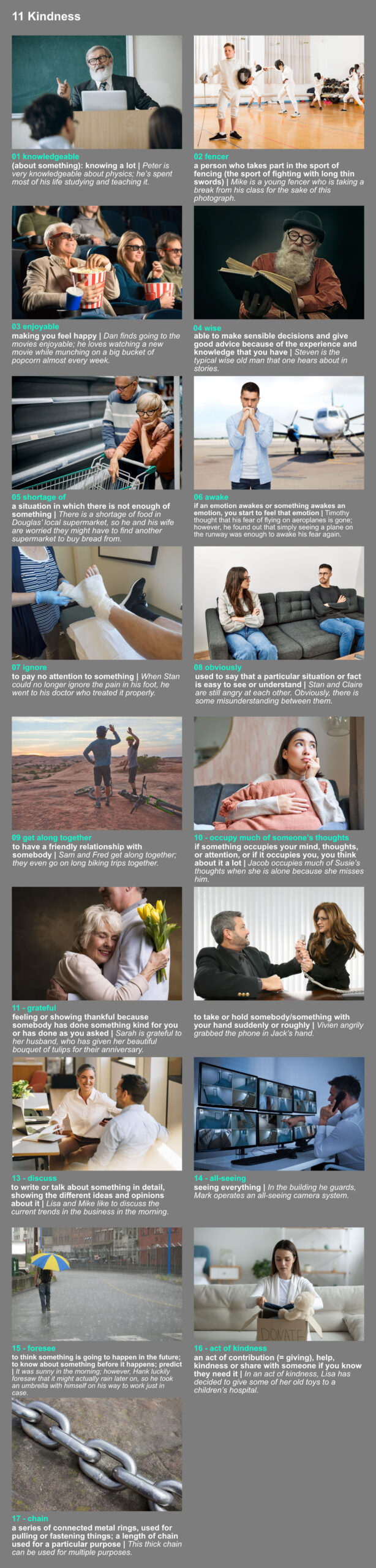
Describe a person you know who is kind. You should say:
Who it is
How you know this person
What sort of person he/she is
And explain why you think they are kind.
I know a kind man by the name of Jordan. He’s the son of a friend of my family, and I first met him when he came to visit my family when I was a small child, and he was younger than I am now. He is and was a man, very knowledgeable about history and a lot of things. He was and is a fencer and a quite good one at that. Though I’m sure he’d be the first to tell you that he is not the best. He is far better than I am, though.
Now, when he visited us, he was not there to visit me, and in fact, he had much better and much more enjoyable – I’m sure – things to do than to chat with a little kid like me.
And in fact, my family didn’t even know how much happened, but when he came to visit, he took the time to talk with me. He told me about history, he read to me, and he was only there for a short time, so it wasn’t that much. I was never into history that much before he came, but he got me into history. And as it turns out, I’m a fencer now too.
He is and always has been a very wise, knowledgeable and eloquent man. He’s always been popular and has never had any shortage of friends, I’m sure.
Now, why I think he was kind is that when he came to our home, there were far more interesting things he could have been doing than spending his time reading history to a little kid and explaining things to him and talking with him. There are far more interesting things I’m sure that he could have done than doing that, but he did choose to do that, and in fact, because of that, I am the man I am today. Because he started me on that. I then started reading history myself, I started studying it, and I became very well-versed and knowledgeable in a lot of subjects around that and interested in it, and he was the one that awoke that interest in me.
Now, it would have been entirely possible and understandable, I’d say even, if he had simply ignored my existence. I was a small fellow at that time, and he could quite easily have done it and not read to me and not spent time with me. I don’t know what I would be like today, but I certainly would not be the person I am today if he had not done that.
Now since then, I’ve met him again very fairly recently; it was actually last year. I am obviously much older than I was when I first met him, and thus we were able to discuss history and other things as we do, and we were even able to fence together, which was quite enjoyable. I think both of us enjoyed that quite a lot.
Now, I’m certainly not much to him, I don’t think. He’s got plenty of friends, and, well, we get along together quite well. I’m certain that I do not occupy much of his thoughts, nor should I. Nor would I expect to. But because of what he did, he awakened the interests that I have now and made me the way I am now, and so I have been affected greatly by what he did many years ago. And I’ve always been very grateful for that, and as such, I have always tried to whenever I meet a child now and get the chance, you know – obviously, I don’t just grab people off of the street and start explaining history to them, but whenever I get the chance to talk with a child I try to do the same thing he did for me.
I try to talk with them, to explain things to them, to discuss stuff with them, to spend time with them in the hopes that I can help them as greatly as I was helped by him many years ago. And so, I’m sure he had no intention of this: he is not all-seeing; he did not foresee that this would happen, but by that act of kindness, he started what I hope will be a great chain going off into the future of kindness. I’m very grateful for that.
12 Language (steps 1, 2 and 4)
Describe a language you have learned. You should say:
What it is;
When you started learning;
How you learned it;
What was difficult about it;
And why you decided to learn that language.
01
A language I learned that isn’t my native tongue, English, is Irish Gaelic. It’s a language from Ireland spoken by the Gaels there. It’s a sister language to the Gaelic spoken by the Gaels in Scotland just across the Irish sea. It’s a Goidelic language from the Q-Celtic group. So, there are two branches of the Celtic language family. One branch is the Q-Celtic and the other branch is the P-celtic.
branch1: A) a part of a tree that grows out from the main stem and on which leaves, flowers and fruit grow | There is a small bird on the branch of this tree resting.
- B) a division of an area of knowledge or a group of languages |Astrophysics is a branch of physics.
02
The Q-celtic is the older, original branch. It has a lot of hard “K” sounds in it. However, unfortunately, the members of the other language group, the Wlesh and Bretons, were unable to pronounce the hard “K” sound. So, instead, they changed the sound to a “pa” or “ba”, and thus the two languages diverged. So, one interesting thing about this language is that it has never head a writing system until it was put into English – the Latin – alphabet.
member2: a person, animal, or thing that is part of a group | Members of the US Army undergo intense training, including both physical and mental challenges.
pronounce: to make the sound of a word or letter in a particular way | Maggie likes to pronounce every word she says very clearly because that is the way she was taught to speak.
thus: as a result of something just mentioned; therefore | Freddy likes playing the guitar very much, and thus he often pays close attention to songs’ guitar solos in case he can learn something new and exciting.
diverge3: to follow a different direction, or to be or become different | Although Sam was taught the same material in his class as the others, his answers to the questions greatly diverged from the others when he sat his physics finals exams.
03
Previously, they did some writing by whacking marks into the sides of the rocks. However, that was obviously inefficient for most things and only served for things like gravestones or markers of sorts. It was not very common.
previously: at a time before the time that you are talking about | Today Janet woke up late, but previously, she had always woken up in time to get to school.
whack4: to give someone or something a hard, noisy hit | John is whacking the piggy bank so that he can take the coins out of it.
obviously: used to say that a particular situation or fact is easy to see or understand | Stella is obviously happy to see Janet again because she is her childhood friend.
inefficient5: not doing a job well and not making the best use of time, money, energy, etc.; not effective | Pulling out ten rusty nails from this wood by hand one by one is inefficient; it may be better to use a tool.
gravestone6: a stone that is put on a grave, showing the name, etc. of the person buried there | Family members of the deceased person have placed fresh red roses in front of the gravestone.
common: happening often; existing in large numbers or in many places | Finding parking places on busy streets of Central London is a common problem.
04
As such, it’s a very verbal language, which can be a hard thing to understand if you are learning it from a book. There are many things about the language that make it different from languages that developed alongside a writing system.
verbal: spoken, not written | In Steve’s English Literature class, students always get verbal feedback from their teacher on how good their homework is.
develop7: to gradually grow or become bigger, more advanced, stronger, etc.; to make something do this | Henry focuses on helping Frank develop his guitar playing skills as much as possible because Frank is one of his favourite students.
alongside: next to, or together with | A loud motorcycle stopped alongside Mike’s car at a red light on the road, distracting him from his own thoughts.
05
I learned it through a variety of methods. I originally learned it because I studied a course from a website called Duolingo, which offers language courses. However, I also picked it up from music and other things like that, and I also read dictionaries to learn more. Doulingo was good for establishing the framework as it gave me sentences of various types, which let me learn how to use the words, but the dictionary is more useful for learning specific words that I want to use as many of the words that I use are not in the Duolingo course.
a variety of8: many different | There are a variety of guitars available in this music shop; this makes Sam happy because he has a lot to choose from.
offer: to make something available for sale or use | Big supermarkets such as Tesco offer a variety of food products.
establish: to start or create an organization, a system, etc. that is meant to last for a long time | The law established an entirely new requirement for companies to provide more information about their earnings.
framework: the structure of a particular system | Frank thinks that it is important for each country to have a legal framework which protects all of its citizens.
06
Well, one quirk of the Irish language is that it must keep on flowing which confuses new speakers. The reason why it confuses them is because some of the methods which it uses to accomplish this are very hard to write down. For example, some words upon being inserted into a sentence change their spelling slightly. This is done to make them flow together more easily.
quirk9: an unusual habit or part of someone’s personality, or something that is strange and unexpected | By some strange quirk, the two trains met exactly at the entrance of the tunnel; one was going into it, while the other was just coming out.
flow10: (of people or things) to move or pass continuously from one place or person to another, especially in large numbers or amounts | The invention of the computer, the mobile phone and the internet have each led to a huge increase in the flow of information between people.
confuse11: to cause someone to feel uncertain or unclear, or to make something difficult to understand | At first, the very formal legal letter confused Mark due to its use of jargon (= special, difficult-to-understand words).
accomplish12: to succeed in doing or completing something; achieve | Sam just accomplished the first part of his business strategy: he wanted to get a new supplier for his business.
upon: when, after | Upon completing the business speech explaining her new product idea, Lisa’s colleagues clapped because the idea was so great!
insert13: to put something inside something else | Frank is inserting the key of this antique furniture into it to access some important documents stored inside it.
spelling14: the way that a particular word is written | There are some spelling mistakes in Maxine’s homework; for example, she spelt the word leave as “live”.
07
If there’d be a hard juncture between the words, then the spelling is changed just slightly. Now, when actually inserted into a sentence, for example, “good morning”, that would be /… /, but because /… / there’s a hard juncture between the words, so in order for them to flow more easily it becomes /… /, and these interesting aspects of its spelling are very difficult for newcomers to the language. However, they make sense if you remember that it’s a spoken language originally. Back in the old days before they had a writing system, they didn’t need to write down a spelling change; they simply changed the pronunciation, and doing so is entirely natural: it feels right.
juncture15: a particular point or stage in an activity or a series of events | Mike was on his way to the kitchen for a coffee, but at this juncture, he was very likely to fall because he lost his balance.
slightly: a little | Although both of my nieces are about 140 cm tall, Marlene is slightly taller than Maggie.
in order to: with the purpose or intention of doing or achieving something | In order to arrive on time to her biology exam this morning, Lisa is taking the earliest bus available.
spelling16: the act of forming words correctly from individual letters; the ability to do this | Maggie is doing her report outlining both the differences and similarities between American and British English; she will cover pronunciation as well as spelling in her report.
newcomers: a person who has only recently arrived in a place or started an activity | Frank is a newcomer to the Star Wars movie series; he has just started watching them one by one this weekend.
make sense: to have a meaning that you can easily understand | A few of the sentences that Jack speaks do not always make sense.
back in the old days: a time long ago | Back in the old days, people did not have electricity and its benefits as we do today.
pronunciation17: the sound of a word or letter made in a particular way | Maxine is practicing the correct pronunciation of words with her speech therapist.
08
So why did I decide to learn it? Well, there were a number of reasons for that. One is that most of my father’s family are originally Irish. As such, I wanted to learn their language. In addition, my family likes to learn a lot of different languages, and some of them were already studying it. So, I figured I should as well. In the end, I got further than any of the rest of my family. Also, I like to sing. I like to sing a lot and I sing old Irish music. As such, if I’m going to listen to a song in Gaelic, it only makes sense that I should learn the language.
a number of: several of a particular type of thing | Mark has failed his Geography class for a number of reasons; they include illness and laziness.
in addition: used when you want to mention another person or thing after something else | Mark was absent from work last week because he was ill. In addition, he fell down the stairs in his house.
figure: to think or decide that something will happen or is true | Larry figured that since he was going to be 30 minutes late to school it would be a good idea to finish his unfinished homework before showing up to class.
as well: in addition to somebody/something; too | I eat quite a lot of fruit daily and take some vitamine as well.
further: at or to a greater distance | Nancy was too tired to go any further in the Marathon, so she figured she would stop and try competing in the next year’s one.
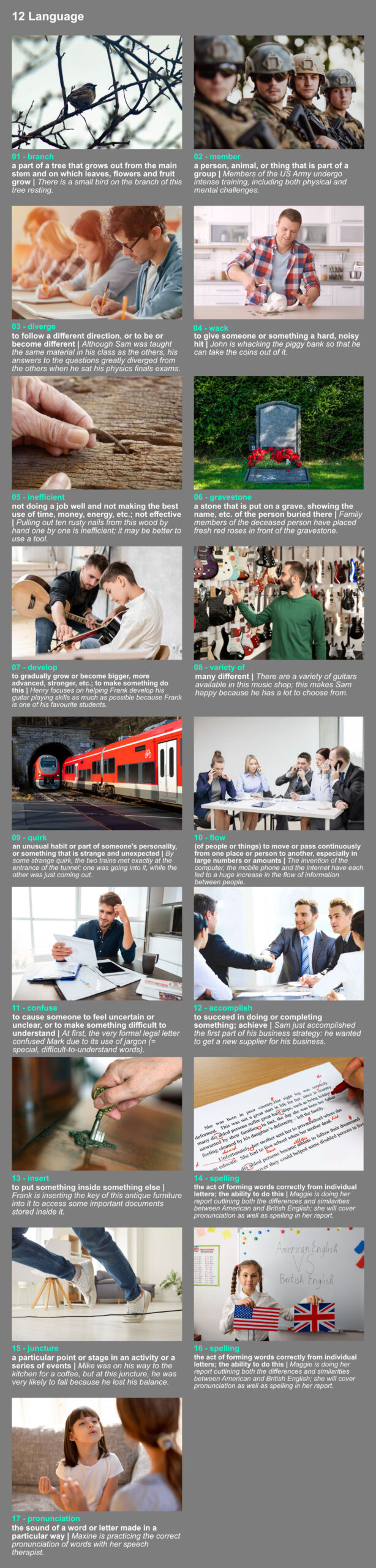
Describe a language you have learned. You should say:
What it is
When you started learning
How you learned it
What was difficult about it
And why you decided to learn that language
A language I learned that isn’t my native tongue, English, is Irish Gaelic. It’s a language from Ireland spoken by the Gaels there. It’s a sister language to the Gaelic spoken by the Gaels in Scotland just across the Irish sea. It’s a Goidelic language from the Q-Celtic group. So, there are two branches of the Celtic language family. One branch is the Q-Celtic and the other branch is the P-celtic.
The Q-celtic is the older, original branch. It has a lot of hard “K” sounds in it. However, unfortunately, the members of the other language group, the Wlesh and Bretons, were unable to pronounce the hard “K” sound. So, instead, they changed the sound to a “pa” or “ba”, and thus the two languages diverged. So, one interesting thing about this language is that it has never head a writing system until it was put into English – the Latin – alphabet.
Previously, they did some writing by whacking marks into the sides of the rocks. However, that was obviously inefficient for most things and only served for things like gravestones or markers of sorts. It was not very common.
As such, it’s a very verbal language, which can be a hard thing to understand if you are learning it from a book. There are many things about the language that make it different from languages that developed alongside a writing system.
I learned it through a variety of methods. I originally learned it because I studied a course from a website called Duolingo, which offers language courses. However, I also picked it up from music and other things like that, and I also read dictionaries to learn more. Doulingo was good for establishing the framework as it gave me sentences of various types, which let me learn how to use the words, but the dictionary is more useful for learning specific words that I want to use as many of the words that I use are not in the Duolingo course.
Well, one quirk of the Irish language is that it must keep on flowing which confuses new speakers. The reason why it confuses them is because some of the methods which it uses to accomplish this are very hard to write down. For example, some words upon being inserted into a sentence change their spelling slightly. This is done to make them flow together more easily.
If there’d be a hard juncture between the words, then the spelling is changed just slightly. Now, when actually inserted into a sentence, for example, “good morning”, that would be /… /, but because /… / there’s a hard juncture between the words, so in order for them to flow more easily it becomes /… /, and these interesting aspects of its spelling are very difficult for newcomers to the language. However, they make sense if you remember that it’s a spoken language originally. Back in the old days before they had a writing system, they didn’t need to write down a spelling change; they simply changed the pronunciation, and doing so is entirely natural: it feels right.
So why did I decide to learn it? Well, there were a number of reasons for that. One is that most of my father’s family are originally Irish. As such, I wanted to learn their language. In addition, my family likes to learn a lot of different languages, and some of them were already studying it. So, I figured I should as well. In the end, I got further than any of the rest of my family. Also, I like to sing. I like to sing a lot and I sing old Irish music. As such, if I’m going to listen to a song in Gaelic, it only makes sense that I should learn the language.
13 Music (steps 1, 2 and 4)
Describe a song you like. You should say:
What kind of song it is;
What the song is about;
When you first heard it;
And explain why you like it.
01
The song’s name is Marcshlua Uí Néill or O’Neill’s Cavalry March. It’s an instrumental song from Ireland, a march specifically. It’s an old tune from maybe the 18th century / mid-1700s, but it was rediscovered and reintroduced to the public by a man named Sean o’Riada. He released it in his album Ó Riada sa Gaiety. It has since been recorded by quite a few people, not just him, but I personally like his version best.
instrumental1: involving only musical instruments, and no singing | These high school students are playing the instrumental version of a popular folk song.
march2: a piece of music written for marching to (march = to walk with stiff regular steps like a soldier) | The trumpet player is playing a march.
specifically: used when you want to add more detailed and exact information | Pillows are used to comfort their owners, more specifically to help people sleep.
tune: a series of musical notes that are sung or played in a particular order to form a piece of music; a melody | Stella loves to play popular tunes on her electric guitar in front of her friends.
rediscover: to find again something that had been forgotten or lost | The old scientific paper was rediscovered 100 years after its owner had died.
reintroduce: to put something into use, operation, or a place after it has not been used or in a place for some time | The city has reintroduced cash fines for those throwing litter (= trash/rubbish) in public places to encourage people to throw their rubbish into bins.
the public3: ordinary people in society in general | Clara loves to go to this park because it has a free book collection available to the public (= to people; to everyone).
release4: to make a film, recording or other product available to the public | The new Marvel movie was released in 3D yesterday at cinemas in the US.
quite a few: a fairly large number | The cinema was full of kids to watch the release of the new action movie, but surprisingly, there were quite a few scary moments in the film.
02
It’s a song of the Uí Néill family, a powerful family in medieval Ireland in the Northwest of Ireland, which was always powerful, but they gained great prominence at one point in history, following which they were destroyed.
medieval5: connected with the Middle Ages (about AD 1000 to AD 1450) | These medieval knights are ready to protect their fortress.
gain6: to obtain (= to get) or win something, especially something that you need or want | The thief somehow gained access to the business documents.
prominence7: the state of being important, well known or easy to notice | Frank has achieved extraordinary prominence in the film industry; his recent film even earned him an award.
destroy7: to damage something, especially in a violent way, so that it can no longer be used or no longer exists | Stan is destroying the old paper copies of his earnings using a shredder.
03
This is one reason why another name for this song is O’Neill’s Retreat. I don’t remember when I first heard this song, but it was a few years back. I like it because it has a very powerful driving beat. It was a very great performance by Sean. I particularly like the Uilleann pipes and the bodhrán, drum and pipes. I think he did a great job with them.
retreat9: a movement away from a place or an enemy because of danger or defeat | Frank is retreating with Joe by dragging him, as Joe is injured.
beat: the main rhythm, or a unit of rhythm, in a piece of music, a poem, etc. | You could almost hear the beat of his heart because he was very nervous.
driving beat: a technique of performing music where the tempo is pressed forward while intensifying the energy | “The song has a steady driving beat and electronic music accompanying it (= going with it).”
performance: the way a person performs (= plays) in a play, concert, etc. | Danny’s acting performance was the most convincing one out of all the people in his class.
particularly: especially; more than usual or more than others | Frank particularly enjoys watching action movies in the cinema with his friends.
Uilleann pipes10: the characteristic national bagpipe of Ireland | These are Uilleann pipes.
bodhrán11: a shallow Irish drum that you hold on its side in your hand and play with a short wooden stick | The bodhrán is an intriguing (= unusual and interesting) instrument.
04
The song never fails to get my blood pumping and my feet tapping, and for that, I like it.
fail: to not be successful in achieving something | When Jan was 6 years old, he tried to climb a tall tree but ultimately failed (= but failed in the end).
pump: to move quickly up and down or in and out | Jerry and the rest of the boys are sprinting to the ice cream van, their legs pumping.
tap12: if you tap your fingers, feet, etc. or they tap, you hit them gently against a table, the floor, etc., for example to the rhythm of music | Bored to tears (= extremely bored to the point that you almost want to cry), Lisa is tapping her fingers on the table.
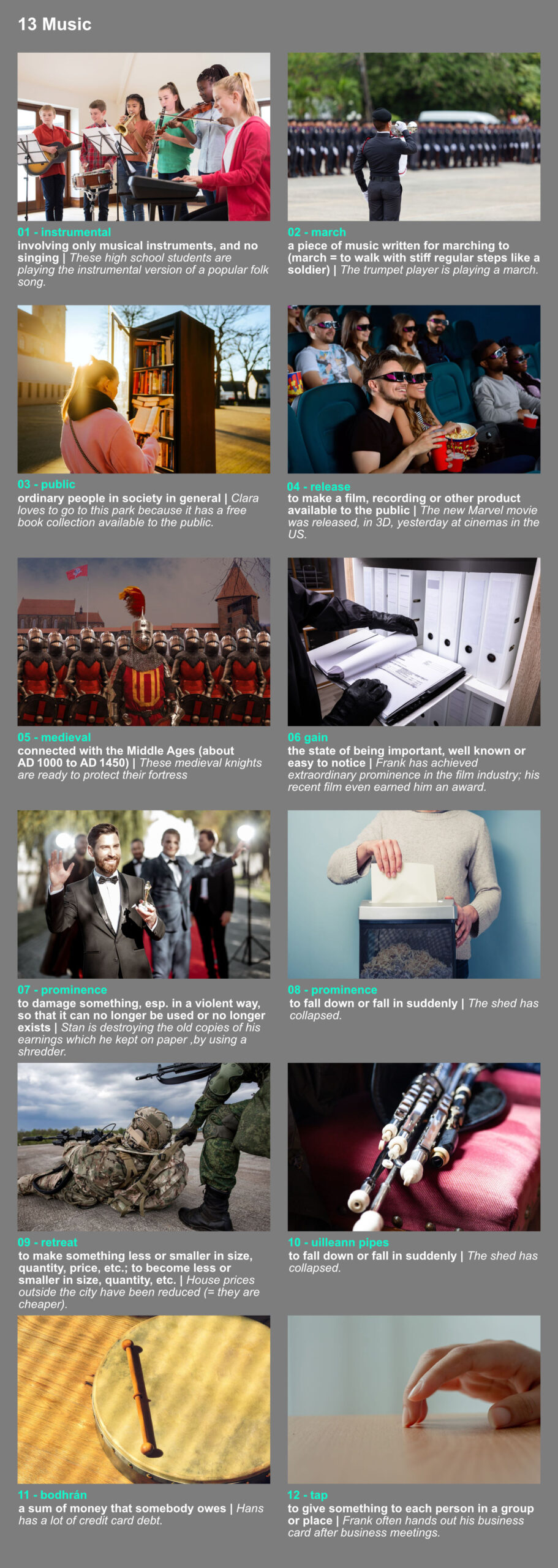
Describe a song you like. You should say:
What kind of song it is
What the song is about
When you first heard it
And explain why you like it
The song’s name is Marcshlua Uí Néill or O’Neill’s Cavalry March. It’s an instrumental song from Ireland, a march specifically. It’s an old tune from maybe the 18th century / mid-1700s, but it was rediscovered and reintroduced to the public by a man named Sean o’Riada. He released it in his album Ó Riada sa Gaiety. It has since been recorded by quite a few people, not just him, but I personally like his version best.
It’s a song of the Uí Néill family, a powerful family in medieval Ireland in the Northwest of Ireland, which was always powerful, but they gained great prominence at one point in history, following which they were destroyed.
This is one reason why another name for this song is O’Neill’s Retreat. I don’t remember when I first heard this song, but it was a few years back. I like it because it has a very powerful driving beat. It was a very great performance by Sean. I particularly like the Uilleann pipes and the bodhrán, drum and pipes. I think he did a great job with them.
The song never fails to get my blood pumping and my feet tapping, and for that, I like it.
14 News (steps 1, 2 and 4)
Describe some good news you recently received. You should say:
What the news was;
How you received the news;
Who gave it to you;
And explain why this was good news.
01
Some good news I recently received was that my aunt Margaret out in Kentucky was no longer dying of cancer. In fact, she had beaten cancer. I received this news when my family mentioned it in passing, and it is a very very good thing that she is healed. Not only because, you know, I would prefer if my aunt did not die but for a lot of reasons.
dying1: very ill and likely to die soon | Mikey is dying because of a serious accident he was involved in.
cancer2: a serious disease in which growths of cells form in the body (these are called tumours) and kill normal body cells | Bella has cancer, but her health is showing signs of improvement.
beat3: to beat something that is going to happen is to take action that will prevent it from having an effect on you | Sarah got up very early to get to work, so she managed to beat the traffic that usually makes her late; today her car is the only one on the road.
mention: to write or speak about something/somebody, especially without giving much information | The radio mentioned that some of the routes to the West of the city are blocked because there are road constructions taking place.
in passing4: done or said when your main focus is something different; causally | Sally mentioned the fact that she is learning a new instrument in passing while she was washing the dishes with Jack; she didn’t explain either why or anything else about it.
heal5: to become healthy again; to make something healthy again | Danny has fully healed from his sickness, but the doctors are keeping him in for an extra day to be sure.
02
For one thing, one of my aunts had already died of cancer a little while before then, and It greatly shook that branch of my family. And in addition to that, my aunt Margaret was pretty much the one holding that branch of the family together in the first place, and now she got sick herself, and she was very sick. The doctors pulled many, many tumours out of her, and she seems to have survived and be well now, as well now, which is very good.
shake6: to shock or upset somebody very much | Fran is shaken up about the sudden illness of his best friend; he’s desperate (= he feels liker there’s no hope) as he does not know what to do.
branch of one’s family: a specific line or group of individuals within a family tree | Obesity (= being overweight) is a challenge within the branch of my father’s family.
in addition to that: used when you want to mention another person or thing after something else | Danny decided to go to the supermarket by bus. In addition to that, he also wants to come back with a taxi to make the transportation easier.
hold together7: to keep (a group or organisation) complete or in its original state or condition | Matt is doing everything he can to hold together his marriage; he does this partly by remembering his anniversary each year.
in the first place: in or at the beginning (of a series of events) | Harry was given some extra time to finish his physics exam, but he should not have been late in the first place.
get sick8: become ill | Steve’s son got sick because he ate food that had fallen on the floor, so he got an infection after eating it.
tumour9: a mass of cells growing in or on a part of the body where they should not, usually causing medical problems | White blood cells are attacking this tumour (in this case cancer cells).
survive10: to continue to live or exist despite a dangerous event or time | Susie survived a car accident while she was in one of the cars that crashed.
03
In addition, a number of other members of my family in that branch are sick with various things themselves, and she was normally the one who would take care of people, but she was sick herself.
04
Her being healed is a great encouragement to the rest of them. In addition, she had a bunch of children, most of whom had just had children themselves, and so for their mother to die like that would be very bad. As such, I was very glad to receive this news. I had been greatly worried about her, and my family has been *praying for her for a long time.
encouragement11: the act of giving someone support, confidence, or a positive push to motivate and inspire them to do something | Doctor Smith is giving encouragement to Steve about the surgery; she is telling him that he will be fine.
pray12: to speak to God, especially to give thanks or ask for help | Francine and her friends are praying.
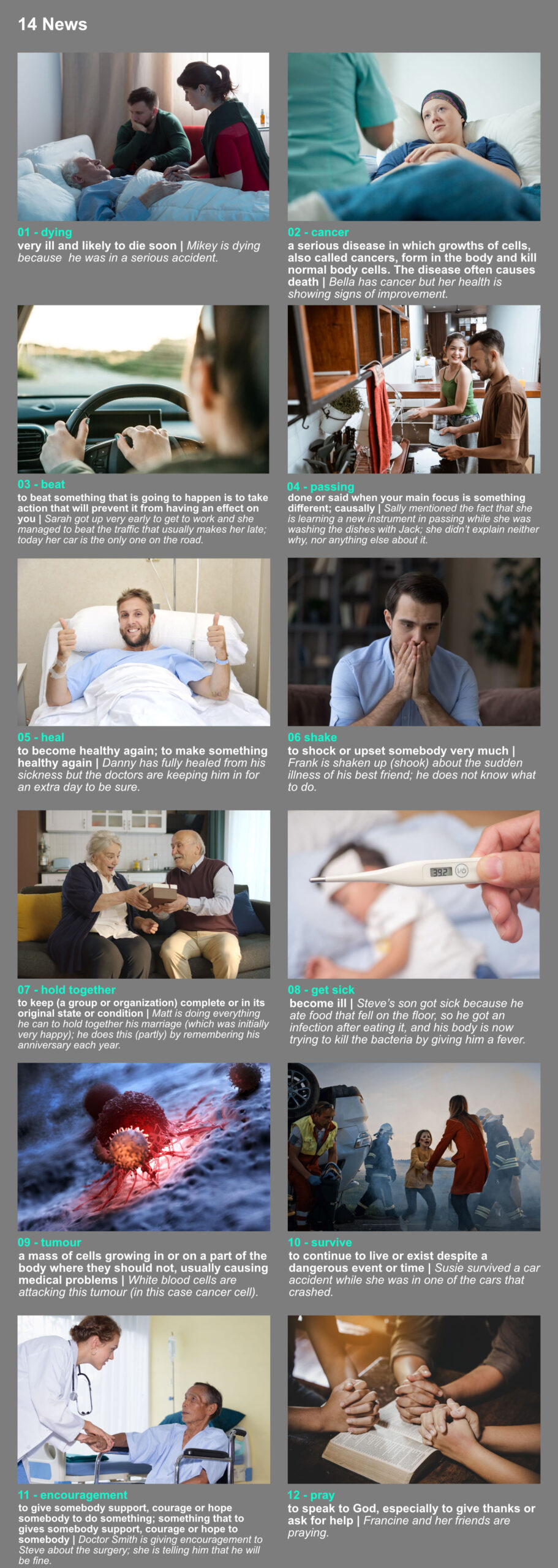
Describe some good news you recently received. You should say:
What the news was
How you received the news
Who gave it to you
And explain why this was good news
Some good news I recently received was that my aunt Margaret out in Kentucky was no longer dying of cancer. In fact, she had beaten cancer. I received this news when my family mentioned it in passing, and it is a very very good thing that she is healed. Not only because, you know, I would prefer if my aunt did not die but for a lot of reasons.
For one thing, one of my aunts had already died of cancer a little while before then, and It greatly shook that branch of my family. And in addition to that, my aunt Margaret was pretty much the one holding that branch of the family together in the first place, and now she got sick herself, and she was very sick. The doctors pulled many, many tumours out of her, and she seems to have survived and be well now, as well now, which is very good.
In addition, a number of other members of my family in that branch are sick with various things themselves, and she was normally the one who would take care of people, but she was sick herself.
Her being healed is a great encouragement to the rest of them. In addition, she had a bunch of children, most of whom had just had children themselves, and so for their mother to die like that would be very bad. As such, I was very glad to receive this news. I had been greatly worried about her, and my family has been *praying for her for a long time.