
Modul 6: Oral Exams B2/C1: Part 2 Set 4. Topics 20-24
Keegan (Maine, USA) 6db hétköznapi, mégis komplex témában mondja el gondolatait. Ezek a témák a nyelvvizsgák tipikus “nagy témái”. Az IELTS nyelvvizsgán 5 percen át kell tudnod beszélni a témáról. Keegan ezt helyenként átlépi, de mivel a tartalom nyelvtanulói szempontból is értékes, nem beszélve az amerikai kultúrával, élettel kapcsolatos sok-sok érdekes információval, így a tananyagban az 5 percet liberálisan kezeltük.
Fontos, hogy a kézikönyvekben leírtak szerint dolgozz az anyagon. A videók össz hossza kb. 28 perc.
20 Unexpected (steps 1, 2 and 4)
Describe an unexpected event. You should say:
what it was;
when it happened;
who was there;
why it was unexpected;
and explain why you enjoyed it.
01
My family lives on a farm. We keep chickens on the farm and we sometimes have them enclosed with a fence and sometimes we let them roam free. We’ve done it differently at different times.
keep1: to own and care for animals | Stan’s family successfully run a farm where they keep sheep as well as some cows.
enclosed2: surrounded by walls, objects, or structures | Sam hates it when he has to enter enclosed spaces, so when he got into the lift this morning, he began to feel unwell.
fence3: a structure made of wood or wire supported with posts that is put between two areas of land as a boundary, or around a garden, field, etc. to keep animals in, or to keep people and animals out | Kyle is building a wooden fence to protect his property.
roam: to walk or travel around an area without any definite aim or direction | Matt decided to escape (= run away from) the noisy city and roam the countryside this weekend upon hearing that the weather would be fine.
02
Right now they are in a fenced-in area which even has a roof such that they can’t get out and nothing else can get in. At some points though, we’ve simply opened up the coop and just let them roam free. They’re smart enough that they’ll stay in the area. They know who feeds them, they know their area, they won’t try to run away, but it does mean that they are rather vulnerable to wild animals coming in and killing them, and you have to remember to shut them up in the night, and they will go home themselves. You don’t have to drive them in yourself. As soon as it starts getting dark, they all go into the coop, climb up on the little sticks that they sit on, and they’ll climb up on them to shut the door, turn the lights off and you’re fine.
coop4: a cage where small animals are kept, especially chickens | This wooden coop was made to look like a house.
smart: intelligent | Managers welcome smart ideas from employees during business meetings.
feed5: to give food to a person or an animal | Kathy is very careful of feeding her dog only high-quality dry dog food.
vulnerable: weak and easily hurt physically or emotionally | Frank became vulnerable to online scams because he has only recently just got a computer with an internet connection for the first time in his life.
wild animal6: animals that have not been domesticated (= made to live around people) or tamed (= made to be friendly with people) and are usually living in a natural environment | Lions are wild, unpredictable animals (= you cannot tell what it will do next), so you have to be very careful when they are around.
stick7: a thin piece of wood that has fallen or been broken from a tree | My dog has been playing with and chewing on a wooden stick.
to (do sth): in order to; so that | I am learning how to paint in watercolour to illustrate my own book.
03
However, it is not at all uncommon for wild animals and less wild animals to come in and attack the chickens. Foxes will do it; weasels are particularly malevolent. They don’t even eat the chickens; they just kill them for killing them. And as such it is my job to make sure that the chickens stay alive. Right now, because we have so fully fenced them, we don’t need to worry about that as much, but before, it was much more important.
uncommon: not existing in large numbers or in many places; rare | It is uncommon for us to actually see the full moon in the sky because it is often cloudy where we live, so the clouds cover and hide the full moon.
not at all uncommon: absolutely not unusual; often happens| It is not at all uncommon for people to be scared of giant spiders.
04
Now, our neighbour has a dog. It’s this little brown and white thing that she keeps chained up outside her house, and quite frequently it escapes, and it’s just chained up there, so it’s entirely understandable that it would want to. And, every once in a while, it escapes and it goes on a merry run around our property. One time it escaped and ran off into the woods, and many people had to go and chase it, and sometimes it runs there; sometimes it runs here. It usually goes to our place because our property is interesting to it. It’ll often go up to our rabbit who is happy for the company. It can’t get to the rabbit because the rabbit’s in a cage.
chain up: tie up with chains | Prisoners were chained up in often dark and humid cells to prevent escapes until the reforms in Western prison systems during the 19th century.
escape: to get away from a place where you have been kept as a prisoner or not allowed to leave | So far, no prisoner has escaped from Fuchu prison in Japan.
entirely: in every way possible; completely | Steve is not entirely sure about how to go about buying a car without it being too expensive.
understandable: (of behaviour, feelings, reactions, etc.) seeming normal and reasonable in a particular situation; natural | It was not completely understandable how John made such a careless mistake in the coffee shop today. Namely, he poured cold water instead of warm milk into the customer’s coffee.
every once in a while: occasionally | Every once in a while, Jennie comes up with a new business idea that can increase her profits.
go on a merry run: to go on a joyful run | This afternoon, Frank is going on a merry run in the park to try out his new running shoes.
property: a building or buildings and the surrounding land | Frank currently owns property in Florida, but he is planning on buying many more across the United States.
chase: to run, drive, etc. after somebody/ something in order to catch them or it | The deer was being chased by a hungry grizzly bear across the forest.
rabbit: a small animal with soft fur, long ears and a short tail | Francine has a pet rabbit called Spock; she loves it so much that she takes it with her whenever she is able to.
company: the fact of being with somebody else and not alone | Lisa has spent a lot of time in the company of her friends; she likes their company (= enjoys being around them).
cage: a structure made of metal bars or wire in which animals or birds are kept | Sally and her husband have just bought a farm in Scotland, but they still need to buy new cages for the animals they want to keep.
05
One time, however, it led to a great disaster. The dog was chained to the house … not chained, not even chained, it was attached to the house by a steel cable. It broke the steel cable when our chickens were out. It broke the steel cable and immediately ran at our chickens. I can’t remember how many chickens we had at that time; it was probably around 10. Though afterwards, it was not 10 anymore.
lead to: if an action or event leads to something, it causes that thing to happen or exist | According to the governor, hiring and training more competent police officers will lead to a decrease in crime in London.
disaster8: an event that results in great harm, damage, death, or serious difficulty | The wildfire in Australia is a seasonal natural disaster that has to be stopped by firefighters.
attach: to fasten or join one thing to another | I have attached my photograph to my CV as you requested (= asked).
cable9: a thick rope of wire used for construction, mooring ships, and towing vehicles | These two steel cables are fastened (= joined) together so that the total length of the cable can be longer.
afterwards: at a later time; after an event that has already been mentioned | Stella decided to go to the beach first and eat an ice cream afterwards.
06
We still had our rooster then, whose job is to sound the alarm when the chickens are being attacked, and he’s supposed to fight, but this rooster was rather cowardly. He would not fight anything. Well, he’d fight us, but he wouldn’t fight anything attempting to kill the chickens; he’d just run. He would sound the alarm, though, so the chickens would know to hide.
rooster10: an adult male chicken | This rooster greets the morning sun from the top of the fence with a loud – but not very pretty – crow every single day.
sound the alarm11: to cause a noise to be made or say or shout a message to warn people about something | Steve is sounding the fire alarm in the supermarket due to the fire in the warehouse behind the shop.
supposed (to do sth): to be expected or required to do/be something according to a rule, a custom, an arrangement, etc. | Frank was supposed to look after his little brother while his parents were away, but instead he was just watching TV.
cowardly12: (of a person) not at all brave and too eager to avoid danger, difficulty, or pain | Lex’s dog is always timid (= shy) and cowardly even when meeting strangers for the first time. So much for the protection of the house.
attempt13: to make an effort or try to do something, especially something difficult | Mark is attempting to jump over a gap with his skateboard. He’s in mid-air and seems to succeed.
hide14: to go somewhere where you hope you will not be seen or found | Frank is hiding in the bushes because he’s eavesdropping on his neighbours (= trying to hear what they’re talking about).
07
The dog got loose and was just running here and there and everywhere after whatever chickens he could see. I heard that something was off, and I immediately went outside. I do this all the time. It’s my job, too: I listen to hear if anything’s going wrong, and if I hear anything going wrong, then it’s my job to respond. Normally I would’ve brought a spear or some sort of a large stick, but in this case, I did not.
get loose15: to be released from confinement (= being locked up in prison or jail) or to escape | Larry is attempting to get loose using a key he has made inside his cell.
off: something is not right, or not the way it should be | Something about the business deal felt off as the counterparty (partner) seemed too eager to sell their fridges at a price deep under the expected cost.
respond: to do something as a reaction to something that somebody has said or done | Harriet responded well to the criticism of her artwork given by her mentor; she thought about it and used it to improve her work.
spear16: a weapon with a long wooden handle and a sharp metal point used for fighting, hunting and fishing in the past | A spear is a popular movie prop (= an object used by actors in films), featured not only in historical dramas but also in fantasy movies.
08
I ran out, and I saw the dog running circles around the barn chasing chickens here and there, and I chased it through the woods; it ran, jumped the wall, ran off to … there’s a campground on that side of our house, (and) it ran through there. Its owner was behind it, trying to catch it, and she couldn’t catch it. She’s an old lady; she couldn’t run. I can run. She was calling it, trying to get it to come, but it was not going to come. So I went after it. I saw that it had killed our head hen.
campground17 (BrE: campsite): a place where people on holiday can put up their tents, park their caravan, etc., often with toilets, water, etc. | These cabins were built on the campground (= campsite) in California.
call18: to ask somebody to come by shouting or speaking loudly | Maxine is calling her children for dinner.
hen19: a female chicken, often kept for its eggs or meat | This hen is hatching its eggs by sitting on them and keeping them warm.
09
The social structure of the chickens is such that they’ve got a rooster or several roosters sometimes, and then there’s the hens, and there’s one hen who’s in charge of the hens, and the dog got her, which was very unfortunate. She was a good hen. He killed her and just kept on running, and I ran after him, but at some point, he wheeled around and came back. And I ran after him, and he was chasing the rooster in circles around the barn, and he got the rooster. He bit the rooster’s tail off; fortunately, the rooster survived.
social structure: the set of interconnected social institutions, groups, and relationships that together form a society. | The family unit is an essential part of social structure in many societies. Unfortunately, it is losing its importance in Western societies.
unfortunate: if you say that a situation is unfortunate, you wish that it had not happened or that it had been different | It is unfortunate that John and many of his other colleagues were fired today from work.
wheel around: to turn around quickly | Frank wheeled around to see where the loud noise was coming from and discovered two delivery people blaming each other for dropping a box.
bite20: to use your teeth to cut into or through something | Matt took a bite into an apple even though he is not an apple fan, to say the least.
tail21: the part that sticks out at the back of the body of a bird, an animal or a fish, which the animal can move from side to side or up and down | The lion cub playfully grabbed the lioness’s tail with its teeth.
survive22: to continue to live or exist despite a dangerous event or time | Max survived the factory fire thanks to the firefighter who saved him.
10
He was very, very, very frightened and missing a tail, but he survived, and I managed, in that moment as he was on the rooster, to grab this dog, and the dog didn’t look like anything; it just sort of looked fat and useless like a normal house dog. It was not. I don’t know how it got that way, but this dog was just solid muscle. Every cubic inch of it was muscle, and it was rather hard to control, but now I had it, and I was not letting it get away. I was very close. I usually run out there with something, as I mentioned – a stick or a spear or something. I was very close: if I had had a spear … it was on top of my chicken. I knew it had killed a bunch more …, and I probably would have done something to it, but fortunately for it, I didn’t.
missing: that cannot be found, or that is not in its usual place; that has been removed, lost or destroyed | Janet’s phone charger has been missing; she thinks she may have left it in her gym bag.
grab23: to take or hold somebody/something with your hand suddenly or roughly | Lisa was very hungry, so when the waitress finally put her sandwiches down, she instantly grabbed one.
useless24: not very good at something; not able to do things well |This waiter is practically useless at his job as he much too often brings the wrong orders to customers, which results in complaints that harm the restaurant’s reputation.
solid: hard or firm, keeping a clear shape | My uncle’s house on the beach is made out of solid bricks so that it can withstand (= stand strong against) high winds during the winter.
muscle25: one of many tissues in the body that can tighten and relax to produce movement | Bill is flexing the muscles in his right arm to see how strong he looks.
cubic inch26: a unit of the volume of a cube with each of its three dimensions (length, width, and height) being one inch long (where 1 inch = 2.54cm) | Every cubic inch of this plush teddy bear is filled with soft polyester fiberfill, which makes it very soft.
11
I managed to grab it, and it was maybe 90 pounds of pure muscle, [and] it was trying to get away and try to get the rooster. The rooster got away, though. And I sort of steered back over (to) where my neighbour was, and she managed to get it and get a leash on it and took it home.
steer27: to take someone or something or make someone or something go in the direction in which you want him, her or it | The traffic police sometimes steer drivers to alternate roads due to an accident or construction work ahead.
leash28: a long piece of leather, chain or rope used for holding and controlling a dog | Leading three dogs on separate leashes at the same time can be challenging. Not with these three English Bulldogs, though.
12
At the end, our chickens had scattered. A few of them were still around, a few of them had died, and a few of them had gone missing but later came back. They’d been hiding in the woods somewhere. But that was definitely unexpected.
scatter29: spread far apart over a wide area or over a long period of time | The children’s toys are scattered around the room: they are all over the place.

Describe an unexpected event. You should say:
what it was;
when it happened;
who was there;
why it was unexpected;
and explain why you enjoyed it.
My family lives on a farm. We keep chickens on the farm and we sometimes have them enclosed with a fence and sometimes we let them roam free. We’ve done it differently at different times.
Right now they are in a fenced-in area which even has a roof such that they can’t get out and nothing else can get in. At some points though, we’ve simply opened up the coop and just let them roam free. They’re smart enough that they’ll stay in the area. They know who feeds them, they know their area, they won’t try to run away, but it does mean that they are rather vulnerable to wild animals coming in and killing them, and you have to remember to shut them up in the night, and they will go home themselves. You don’t have to drive them in yourself. As soon as it starts getting dark, they all go into the coop, climb up on the little sticks that they sit on, and they’ll climb up on them to shut the door, turn the lights off and you’re fine.
However, it is not at all uncommon for wild animals and less wild animals to come in and attack the chickens. Foxes will do it; weasels are particularly malevolent. They don’t even eat the chickens; they just kill them for killing them. And as such it is my job to make sure that the chickens stay alive. Right now, because we have so fully fenced them, we don’t need to worry about that as much, but before, it was much more important.
Now, our neighbour has a dog. It’s this little brown and white thing that she keeps chained up outside her house, and quite frequently it escapes, and it’s just chained up there, so it’s entirely understandable that it would want to. And, every once in a while, it escapes and it goes on a merry run around our property. One time it escaped and ran off into the woods, and many people had to go and chase it, and sometimes it runs there; sometimes it runs here. It usually goes to our place because our property is interesting to it. It’ll often go up to our rabbit who is happy for the company. It can’t get to the rabbit because the rabbit’s in a cage.
One time, however, it led to a great disaster. The dog was chained to the house … not chained, not even chained, it was attached to the house by a steel cable. It broke the steel cable when our chickens were out. It broke the steel cable and immediately ran at our chickens. I can’t remember how many chickens we had at that time; it was probably around 10. Though afterwards, it was not 10 anymore.
We still had our rooster then, whose job is to sound the alarm when the chickens are being attacked, and he’s supposed to fight, but this rooster was rather cowardly. He would not fight anything. Well, he’d fight us, but he wouldn’t fight anything attempting to kill the chickens; he’d just run. He would sound the alarm, though, so the chickens would know to hide.
The dog got loose and was just running here and there and everywhere after whatever chickens he could see. I heard that something was off, and I immediately went outside. I do this all the time. It’s my job, too: I listen to hear if anything’s going wrong, and if I hear anything going wrong, then it’s my job to respond. Normally I would’ve brought a spear or some sort of a large stick, but in this case, I did not.
I ran out, and I saw the dog running circles around the barn chasing chickens here and there, and I chased it through the woods; it ran, jumped the wall, ran off to … there’s a campground on that side of our house, (and) it ran through there. Its owner was behind it, trying to catch it, and she couldn’t catch it. She’s an old lady; she couldn’t run. I can run. She was calling it, trying to get it to come, but it was not going to come. So I went after it. I saw that it had killed our head hen.
The social structure of the chickens is such that they’ve got a rooster or several roosters sometimes, and then there’s the hens, and there’s one hen who’s in charge of the hens, and the dog got her, which was very unfortunate. She was a good hen. He killed her and just kept on running, and I ran after him, but at some point, he wheeled around and came back. And I ran after him, and he was chasing the rooster in circles around the barn, and he got the rooster. He bit the rooster’s tail off; fortunately, the rooster survived.
He was very, very, very frightened and missing a tail, but he survived, and I managed, in that moment as he was on the rooster, to grab this dog, and the dog didn’t look like anything; it just sort of looked fat and useless like a normal house dog. It was not. I don’t know how it got that way, but this dog was just solid muscle. Every cubic inch of it was muscle, and it was rather hard to control, but now I had it, and I was not letting it get away. I was very close. I usually run out there with something, as I mentioned – a stick or a spear or something. I was very close: if I had had a spear … it was on top of my chicken. I knew it had killed a bunch more …, and I probably would have done something to it, but fortunately for it, I didn’t.
I managed to grab it, and it was maybe 90 pounds of pure muscle, [and] it was trying to get away and try to get the rooster. The rooster got away, though. And I sort of steered back over (to) where my neighbour was, and she managed to get it and get a leash on it and took it home.
At the end, our chickens had scattered. A few of them were still around, a few of them had died, and a few of them had gone missing but later came back. They’d been hiding in the woods somewhere. But that was definitely unexpected.
21 Vocation (steps 1, 2 and 4)
Describe a vocation you think is useful to society. You should say:
what it is;
what it involves;
what kind of people usually do this work;
and explain why you think it’s useful to society.
01
A vocation that I think is useful to society is framing. What is framing? Framing is putting the bones of the house together. When you see a wall like this, (it’s) in some countries, it’s usually made of bricks and stuff like that; in my country, it’s generally made of a wooden frame with insulation inserted in and covered in drywall, we call it, or sheetrock. It’s chalk held together by layers of paper.
useful: that can help you to do or achieve what you want | Cars are very useful inventions because people can travel longer distances more easily and faster than if they walk.
society: people in general, living together in communities | Every member of society should have access to basic healthcare.
framing1: the fitting together of pieces to give a structure, support and shape | Dan is framing the roof of his house.
bone2: any of the hard pieces that form the skeleton (= frame) of a human or animal body | These are some of the bones from the skeleton of a dinosaur found by an archaeologist in a desert.
brick3: baked clay used for building walls, houses and other buildings; an individual block of this | The construction worker is building a house wall by laying bricks on top of each other.
wooden frame3: a structure that holds the parts of an object in position and gives them support that is made of wood | This wooden frame was built next to a brick house so that it can be an extension (= a new room added to a house) of the house and make the overall house bigger.
insulation5: the act of protecting something with a material that prevents heat, sound, electricity, etc. from passing through; the materials used for this | This worker is putting insulation on the attic floor; he is using mineral wool to stop heat from passing through it.
insert6: to put something into something else or between two things | Mary is inserting her credit card into the machine to withdraw some cash.
drywall7 (BrE: plasterboard): a building material made of two sheets of thick paper with plaster set between them, used for inside walls and ceilings | The workers are putting up drywall.
sheetrock8: a building material made of sheets of cardboard with plaster between them, used for inside walls and ceilings; drywall | There is new sheetrock (= drywall/ plasterboard) on the ceiling in the reconstructed room.
chalk: a type of soft white stone | Before whiteboards became common in classrooms, teachers used chalk to write on blackboards.
layer: a quantity or sheet of something that lies over a surface or between surfaces | In cool autumn evenings, I usually wear three layers of clothing: a T-shirt, a jumper and a jacket.
02
But, what a framer does is: a framer constructs the wood frame of the house. In some places and some styles of building, the frame is made of big, big timbers like this or even bigger, and they make the frame out of that, and that’s what holds the house together. As much as I prefer that type of framing, here it is more common to use thinner timbers, usually 2×4 or 2×6. That’s 2 inches (= 5cm) thick. Very thin things, but they put a lot of them together to make a very durable and cheap-to-make structure. They do this because it’s easier to make more good beams of a smaller size than it is to make bigger ones. You can get more of them out of a tree.
construct9: to build or make something such as a road, building or machine | With the help of these giant cranes, this block of flats will be built in months.
timber10: a long heavy piece of wood used in building a house or ship | These timbers will be used to build a house frame.
durable11: likely to last for a long time without breaking or getting weaker | These coins are durable; some of them have been in use for decades (= for tens of years).
beam12: a long, thick piece of wood, metal, or concrete, especially used to support weight in a building or other structure | These metal beams have been placed on a wooden pallet for storage and easy transportation.
03
In addition, the shapes of things you can make are more diverse. Because you’re putting many little things together, you can make more shapes out of them, and a framer is the one who does all of this work. Framers gotta do a lot of stuff.
shape13: the form of the outer edges or surfaces of something; an example of something that has a particular form | This plate, which has the shape of a heart, feels a bit cliché.
diverse14: very different from each other and of various kinds | This is a diverse group of people.
gotta: the written form of the word ‘got to’, meaning: ‘(have) got to’ or ‘(have) got a’, which is not considered to be correct | I gotta go to the shop to buy some new shoes for myself as the old ones are a bit too small for me, so they squeeze my toes.
04
A framer is the one who actually does all of this work. Now, on the one hand, they do the physical work of actually putting everything together. They carry the beams in, they cut them to size, they nail them or screw them together in whatever pattern the blueprint requires.
on the one hand: the first thing to consider is this | On the one hand, there are far too many restaurants that sell fast food in the city …
nail15: to fasten something to something with a nail or nails | A blank sign has been nailed onto this cabin door so that a note can be left for the owner.
screw16: to fasten one thing to another or make something tight with a screw or screws | A brand new screw is being screwed into the wood.
pattern17: a regular arrangement of lines, shapes, colours, etc., for example, as a design on material, carpets, etc. | This square pattern looks cool on the wall.
blueprint18: a photographic print of a plan for a building or a machine, with white lines on a blue background | An architect has left his blueprint in progress (= in the making) on the table.
require19: to make somebody do or have something, especially because it is necessary according to a particular law or set of rules | The Passport control usually requires those who want to use its airline’s services to show their passports in order to be allowed to travel from the airport.
05
On the other hand, they’re also required for a lot of the technical work. Now, sometimes in some projects, it’s actually common to even have a framer make the plan of the building too. Now, on bigger projects, they don’t do this, but if you’re building a shed, often the framer will be the one who is designing the building in the first place, but there’s a lot of other detailed work that goes into it even if you already have a blueprint that the framer did not make.
on the other hand: …a second and different thing to consider is this | On the other hand, there are a lot of customer choices for food in the city, which people are free to eat if they want to.
common: happening often; existing in large numbers or in many places | It is very common for new untrained puppies to do their business (= “go to the toilet”) wherever they please, especially on carpets.
shed20: a small, simple building, usually built of wood or metal, used for keeping things in | This new shed was just built a few days ago in the backyard of Ann’s house.
in the first place: first, before anyone else | During the board meeting (= the meeting of managers and executives), Sam highlighted, in the first place, some key strategic moves that could be executed relatively easily.
06
For example, you have a big trailer-load of wood. A framer has to take the stuff; he has to read the blueprint, see what they need and cut everything exactly to size. It has to be very exact … (but) often less exact than with other materials; wood is somewhat more forgiving but still exact, nonetheless. They have to get the angles right, they have to get the lengths right; everything has to fit together, and if you make even small mistakes, they either compound or they can seem small but actually be very, very, very bad. Even an inch of error is massive.
trailer-load21: as much as a trailer can hold | This is a trailer-load of stuff being moved.
exact: correct in every detail | Thanks to high-tech optical instruments and drones, soldiers can easily learn the exact coordinates of enemy tanks on the battlefield.
forgiving22: (of a thing) easy or safe to deal with | The tricycle is forgiving for people who want to learn how to ride a bike.
nonetheless: despite what has just been said or done | Kenny was afraid to watch the horror movie in the cinema; nonetheless (= however), he still watched it to impress his classmates.
angle: the space between two lines or surfaces that join, measured in degrees | The angle of each corner of a football field is 90° (= ninety degrees).
length24: the size or measurement of something from one end to the other | Jess is measuring the length of the wall in her living room because she wants to redecorate it with wallpaper.
compound: to make a problem or difficult situation worse | Steven got a fright falling in the kitchen; his fright of fall was compounded by severe pain, as the kitchen floor was made of very hard ceramic.
inch: (in Britain and North America) a unit for measuring length or height, equal to 2.54 centimetres | Sammy is only two inches taller than her younger sister; her sister has been growing quickly, so she might be the same height as her in less than a year.
error25: a mistake, especially one that causes problems or affects the result of something | The teacher marked the errors in the student’s maths homework with a red pen; all the mistakes together lead the student to get an “F-” grade for it.
07
What kind of people usually do this work? Well, unfortunately, the framer population is thinning. There are still many of them because someone is making the houses, but they seem fewer than before – certainly, experienced ones – as framing does not seem like a popular profession anymore, so a lot of framers will still be the older, more experienced ones.
thin: when a crowd or a group thins (out), it becomes fewer in number, and when you thin (out) a group of plants or other things, you remove some to make them fewer | The number of miners is thinning.
experienced: having knowledge or skill in a particular job or activity | Martha is an experienced chef; she has over 20 years of experience in the kitchen.
profession: any type of work that needs special training or a particular skill, often one that is respected because it involves a high level of education | Kathy has left her profession as a lawyer to start a new business as a hairdresser.
anymore: if you do not do something or something does not happen anymore, you have stopped doing it, or it does not now happen | Daniel does not eat fish anymore; he stopped liking it a few months ago.
08
Why do I think it is useful to society? Well, it is probably immediately apparent. If it weren’t for framers, things in this country would not get built. Almost every building in my country has had at least one framer work on it. If there were no more framers, nothing would get built. There are some buildings that are put together by welders and bricklayers, but those are rare. Most things here are built out of wood, and if it’s built out of wood, it has a frame. If it had a frame, a framer built it.
immediately: without delay; at once | When Dennis realised his phone was missing, he immediately turned around and went back to his workplace, thinking he had left it there.
apparent: easy to see or understand; obvious | It is apparent that there are more people who want to be millionaires than there are actual people who are millionaires.
if it weren’t for: when you say if it weren’t for or (also if it hadn’t been for) something, you mean if it were not true or had not happened, the situation would be different | If it weren’t for the bad weather, we would have gone to the park for a picnic.
welder26: a person whose job is welding metal (= joining pieces of metal together by heating their edges and pressing them together) | Frank and Tony are welders who have just started doing today’s work in the factory.
bricklayer27: a person whose job is to build walls, etc., with bricks | Mark works part-time as a bricklayer to support himself financially.
rare28: not done, seen, happening, etc. very often | White tigers are rare; their colour is caused by a lack of a pigment called pheomelanin.

Describe a vocation you think is useful to society. You should say:
what it is;
what it involves;
what kind of people usually do this work;
and explain why you think it’s useful to society.
A vocation that I think is useful to society is framing. What is framing? Framing is putting the bones of the house together. When you see a wall like this, (it’s) in some countries, it’s usually made of bricks and stuff like that; in my country, it’s generally made of a wooden frame with insulation inserted in and covered in drywall, we call it, or sheetrock. It’s chalk held together by layers of paper.
But, what a framer does is: a framer constructs the wood frame of the house. In some places and some styles of building, the frame is made of big, big timbers like this or even bigger, and they make the frame out of that, and that’s what holds the house together. As much as I prefer that type of framing, here it is more common to use thinner timbers, usually 2×4 or 2×6. That’s 2 inches (= 5cm) thick. Very thin things, but they put a lot of them together to make a very durable and cheap-to-make structure. They do this because it’s easier to make more good beams of a smaller size than it is to make bigger ones. You can get more of them out of a tree.
In addition, the shapes of things you can make are more diverse. Because you’re putting many little things together, you can make more shapes out of them, and a framer is the one who does all of this work. Framers gotta do a lot of stuff.
A framer is the one who actually does all of this work. Now, on the one hand, they do the physical work of actually putting everything together. They carry the beams in, they cut them to size, they nail them or screw them together in whatever pattern the blueprint requires.
On the other hand, they’re also required for a lot of the technical work. Now, sometimes in some projects, it’s actually common to even have a framer make the plan of the building too. Now, on bigger projects, they don’t do this, but if you’re building a shed, often the framer will be the one who is designing the building in the first place, but there’s a lot of other detailed work that goes into it even if you already have a blueprint that the framer did not make.
For example, you have a big trailer-load of wood. A framer has to take the stuff; he has to read the blueprint, see what they need and cut everything exactly to size. It has to be very exact … (but) often less exact than with other materials; wood is somewhat more forgiving but still exact, nonetheless. They have to get the angles right, they have to get the lengths right; everything has to fit together, and if you make even small mistakes, they either compound or they can seem small but actually be very, very, very bad. Even an inch of error is massive.
What kind of people usually do this work? Well, unfortunately, the framer population is thinning. There are still many of them because someone is making the houses, but they seem fewer than before – certainly, experienced ones – as framing does not seem like a popular profession anymore, so a lot of framers will still be the older, more experienced ones.
Why do I think it is useful to society? Well, it is probably immediately apparent. If it weren’t for framers, things in this country would not get built. Almost every building in my country has had at least one framer work on it. If there were no more framers, nothing would get built. There are some buildings that are put together by welders and bricklayers, but those are rare. Most things here are built out of wood, and if it’s built out of wood, it has a frame. If it had a frame, a framer built it.
22 Water (steps 1, 2 and 4)
Describe a place near water. You should say:
where it is;
how you get there;
how often you go there;
what you can do there;
and explain why you like it.
01
Hawaii is an island in the middle of the Pacific Ocean. It’s also a state in America. The United States of America, specifically. You can get there by (a) boat or by (a) plane, although planes are far more common these days. When I was young, I would go to Hawaii or, more accurately, the island of O’ahu, next to the island of Hawaii, every year or so. I did this because my mother’s family was from there, and we would visit them. My grandfather moved to Hawaii in the 1950s, and his family has been living there ever since. My mother was from there, though she moved away at a young age, and my uncle has actually married in and is related to half of the island, and by extension, so am I.
island1: a piece of land that is completely surrounded by water | I’m pretty sure most people would wish to visit this beautiful small desert island at least once.
specifically: used when you want to add more detailed and exact information | There are a few pencils on the table; more specifically, there are three of them.
common: happening often; existing in large numbers or in many places | Pigeons are common in Venice, especially in tourist spots, because people constantly feed them.
would: used to | I would go for long walks in the forest in autumn afternoons when I lived in the village.
accurately: in a way that is correct and true in every detail | The weather presenter did not predict the weather accurately.
related: in the same family; connected with somebody or something in some way | When people find out that they are somehow related to ancient (= old, historic), noble families, they feel very proud.
related to: connected with something/somebody in some way | Much of the crime in this area is related to drug abuse (= the use of drugs in a wrong way).
by extension: taking the argument or situation one stage further | The baker is to blame for selling out-of-date (old and spoiled) bread to the bakery’s customers for a whole month, and, by extension, the owner of the bakery is also to blame for this mistake.
02
As I mentioned, I went there around (every) once a year when I was young, but I haven’t gone there in a while. Unfortunately, my grandfather has died, and we haven’t had many reasons to go back there since then.
as I mentioned: like I have already said | As I mentioned, our company sells high definition (HD) televisions of various brands.
in a while: for some time | I have not gone to the local supermarket in a while; I have been ordering food online.
03
There are many things you can do on the island of O’ahu; the most famous thing to do, of course, is to go to the beaches. The beaches are very famous. When I was young, they were a lot better, but now the quality has deteriorated. Too many people came, and the landscape has changed.
deteriorate2: to become worse | The way Frank felt deteriorated immediately after he used the nasal spray.
landscape3: everything you can see when you look across a large area of land, especially in the country | The landscape is completely covered in snow in this Colorado mountain.
04
There is, in fact, more to Hawaii than just the beaches, though. Because it’s a volcanic island, there are very tall, steep mountains, and it rains a lot, so there are waterfalls coming down the mountains, which is quite beautiful to watch, and rainbows are very
common to see there, and there are a lot of animals there that you can’t find in other places.
volcanic4: caused or produced by a volcano (= a mountain with a large opening at the top through which gases and lava (= hot liquid rock) are forced out into the air, or have been in the past) | There is a volcanic eruption happening on this island at the moment.
steep5: (of a slope, hill, etc.) rising or falling quickly, not gradually | This is a steep climb to the top of the hill.
waterfall6: a place where a stream or river falls from a high place, for example, over a cliff or rock | This waterfall is beautiful but also dangerous.
rainbow7: a curved band of different colours that appears in the sky when the sun shines through rain | A vibrant rainbow arches beautifully over the countryside.
common8: happening often; existing in large numbers or in many places | It is common for Suzie to get the flu in winter; the flu itself is a common type of illness in her area this time of year.
05
More inland on the island, you can find thick rainforests. They even have wild pigs in them. Wild pigs, wild chickens, no snakes. There are no snakes on the island of Hawaii, and the government is very determined to keep it that way.
inland: in or towards the middle of a country; away from the coast | I live a few kilometres inland so I have to travel a couple of hours after I have disembarked the boat (= get off the boat).
thick9: having a large number of people or a large amount of something in one place | The high street was thick with shoppers who were going to buy goods at lower holiday prices.
rainforest10: a thick forest in tropical parts of the world that have a lot of rain | This is a tropical rainforest which has not seen a lot of humans inside it.
wild pig11: (also: wild boar) pigs that live independently of people, in natural conditions and with natural characteristics | A male wild boar is standing still, attentively observing (= carefully watching) the open land in front of him for any signs of danger.
determined12: having made a definite decision to do something and not letting anyone prevent you (= stop you) | Danny is determined to keep lifting weights until he gets much stronger; even when he is very tired, he does not stop.
06
Every once in a while, someone sneaks a snake into Hawaii and lets it loose, and you will hear about it. It’s scary when that happens. The pigs were not originally from Hawaii; they were introduced by some settlers who visited the island. Chickens were introduced as well, and quite devastatingly: rats.
sneak13: to go somewhere secretly, or to take someone or something somewhere secretly | This thief is trying to sneak into a house, unaware (= not knowing) that the CCTV camera is capturing (= recording) his every move.
loose14: free to move around without control; not tied up or shut in somewhere | The dog is running loose because the leash has slipped out of Billy’s hand.
introduce: to bring a plant, an animal or a disease to a place for the first time | Cholera was introduced to the Native Americans by Europeans in the 1830s.
settler15: a person who goes to live in a new country or region | This image shows a family of settlers in Nebraska in 1886.
devastatingly: in a way that causes a lot of damage and destruction | The Roman Empire was devastatingly successful at winning wars.
Rats are unwanted stowaways on ships, and when a ship comes into the harbour, the rats come with it and infect wherever they come to. But, fortunately, there was another solution to the rat problem. Another invasive species was introduced.
rat16: a small animal with a long tail, that looks like a large mouse, usually considered a pest (= an animal which is disliked because it destroys food or spreads disease) | This brown rat is ready to slip through the door and into the barn.
stowaways: a person who hides on a ship, aircraft, or other vehicle | One of the reasons why countries, such as the United States of America, have strict border protections is that they want to prevent stowaways from getting illegally into their country.
harbour17: an area of water on the coast, protected from the open sea by strong walls, where ships can shelter | This harbour is filled with various sailing boats, though there are some empty slots (= free spaces).
infect18: to make a disease or an illness spread to a person, an animal or a plant | Some germs spread through physical contact, potentially infecting a person who touches something or someone.
invasive species19: an organism that causes ecological or economic harm in a new environment where it is not native | Red Fire Ants are an invasive species. In the United States, without intervention, they damage agriculture.
07
The mongoose was introduced to Hawaii. A mongoose is a thin rodent that is a bit like a weasel, but it has a very interesting personality. They have been known to be pets. They are not necessarily hostile to humans, although sometimes they get rabies and go insane. But, they kill rats, and they kill snakes, and they do that very, very effectively. So, they have killed off a lot of the rats, and there were never snakes in Hawaii, and hopefully, there never will be.
mongoose20: a small tropical animal with fur, that kills snakes, rats, etc. | This mongoose is on the lookout for prey (= an animal to eat).
rodent21: any small animal that belongs to a group of animals with strong, sharp front teeth. Mice, rats and squirrels are all rodents | A squirrel is a type of rodent.
weasel22: a small wild animal with red-brown fur, a long, thin body, and short legs. Weasels eat smaller animals. | This weasel is searching the forest for food.
pet: an animal that is kept in the home as a companion (= friend/partner) and treated kindly | Dogs and cats are the most common types of pets.
hostile: aggressive or unfriendly and ready to argue or fight | The crowd was hostile towards the band at the concert when they realised that the band was only going to play three songs and then go home.
rabies: a disease of dogs and other animals that causes madness and death; animals with the disease can pass it to humans by biting them | The dog on our street has rabies, so we had to stay indoors to prevent being bit until it got caught.
go insane: become mad/crazy | Steve does not want to go to a dangerous warzone as a soldier because he is afraid that he might become insane by seeing a lot of death.
08
But, what you can see: mongeese (= mongooses) around. If you go to parks and just around you, you can see mongeese. And, another thing they have there is … they have … there is a park called “Ho’omaluhia”, and it’s a nature preserve, basically. It’s a state park that is preserved for plants. You can go in there, and you can camp; you can even eat the fruit, though I am not sure how… I mean, everyone I knew did it; I don’t know, maybe the park officials were not too happy about that, but you can do it. There’s a lot of fruit trees, a lot of beautiful nature; it’s a rainforest, it’s a beautiful place to go to.
nature preserve: (BrE: nature reserve) an area where animals and plants are protected and that has few buildings or homes | Jack works at a nature reserve in Poland, and his job is to do research on some of the animals there.
preserve23: to keep somebody/something alive or safe from harm or danger | Some parks preserve leopards such as this one so they will not go extinct (= not die out).
park official24: a person immediately in charge of any park area | This park official is looking after a park in Africa; he is making sure that there is no trouble ahead of him (= in front of him).
09
I skimmed over the beaches earlier because anyone who’s heard of Hawaii has probably heard of the beaches, and they’re very famous. Some places are so popular that they are not good anymore. So, if you want to go to the really good spots, there are certain good spots where people haven’t gone as much. Now, by saying this, I run the risk of many people will then go to these spots, but I run that risk.
skim: to read something quickly in order to find a particular point or the main points | I quickly skimmed through the map to find the closest petrol station.
probably: used to say that something is likely to happen or to be true | It’s rather early, but my aunt is probably already at the coffee shop ordering her regular caffè latte.
spot25: a particular area or place | This dog has found a comfortable, quiet spot in the house to sleep in.
run the risk: to be or put yourself in a situation in which something bad could happen to you | By climbing Mount Everest, mountaineers run the risk of dying on the mountain due to the extreme and unpredictable (= difficult to say what will happen) weather conditions.
10
Most people go to a place called Kailua. Kailua is a nice place in Hawaii. When I was young, it was a great beach: beautiful water, beautiful beach, everything clean; now, there is trash everywhere.
But if you know where to go, there is a place called Waimanalo. Waimanalo beach is a good beach. Now, one thing you’ve got to worry about Waimanalo: it is a very steep slope, and it narrows down, but (there are) BIG waves. Very big waves! The last time I was there, I watched as my cousin and her toddler almost got swept off to the sea. We were all playing in that. If you wanna go surfing, go to Waimanalo. They’ve got the big waves there.
steep26: (of a slope, hill, etc.) rising or falling quickly, not gradually | This snowy mountain is very steep for climbers.
slope27: a surface or piece of land that is higher at one end than the other | This grassy public park has a slight slope; if you want to leave it towards the left, then you have to climb a small hill.
narrow down28: make/become less wide | The hourglass narrows (down) in the middle to slow down and control the downward flow of sand.
toddler29: a child who has only recently learnt to walk | My toddler niece loves walking and playing in the meadow (= big, open, grassy area) on sunny afternoons.
get swept30: to get carried somewhere; be taken somewhere by the elements | These dandelion seeds are getting swept by the wind.
11
If you want to get the big waves, you go to Waimanalo, and it’s a great place if you like struggling to not be swept off into the Ocean, which I personally find very amusing, but others might not. But, if you go there, you will probably be alone. There aren’t that many people that go there, so if you want a nice beach to go to in Hawaii, go to Waimanalo.
struggle: to fight against somebody/something in order to prevent a bad situation or result | Stella had been struggling against an unknown illness for three years before she got better.
amusing: funny and giving pleasure | I found the story of the New Star Wars movie amusing; it entertained me a lot.
12
Why do I like Hawaii and O’ahu, specifically? Well, I would never want to live there. It is far too expensive to actually live there, but I do like it because the people are very, very nice people. If you are nice to them, they’ll usually be nice back to you. It’s all very easygoing, very calm, very slow; you don’t have to worry about the big hurry and everything. So, the people are very nice. The beaches are nice, also. The animals, the plants – they’re nice. There is less variety of animals, though, because it’s an island, but the plants are very nice. Mainly the reason why I like it is because my mother’s family is from there, so I like it because of good memories with them.
easygoing31: relaxed and happy to accept things without worrying or getting angry | Lisa is an easygoing professional painter; she can smile even when she makes a mistake, as she has now.
calm32: not excited, nervous or upset | Maggie feels calm as she closes her eyes in the morning sun, breathing in some fresh air before her day starts.
variety33: a type of a thing, for example, a plant or language, that is different from the others in the same general group | There is a variety of cheeses available in my uncle’s kitchen, ranging from Italian to French (= including everything between Italian and French) homemade ones.

Describe a place near water. You should say:
where it is;
how you get there;
how often you go there;
what you can do there;
and explain why you like it.
Hawaii is an island in the middle of the Pacific Ocean. It’s also a state in America. The United States of America, specifically. You can get there by (a) boat or by (a) plane, although planes are far more common these days. When I was young, I would go to Hawaii or, more accurately, the island of O’ahu, next to the island of Hawaii, every year or so. I did this because my mother’s family was from there, and we would visit them. My grandfather moved to Hawaii in the 1950s, and his family has been living there ever since. My mother was from there, though she moved away at a young age, and my uncle has actually married in and is related to half of the island, and by extension, so am I.
As I mentioned, I went there around (every) once a year when I was young, but I haven’t gone there in a while. Unfortunately, my grandfather has died, and we haven’t had many reasons to go back there since then.
There are many things you can do on the island of O’ahu; the most famous thing to do, of course, is to go to the beaches. The beaches are very famous. When I was young, they were a lot better, but now the quality has deteriorated. Too many people came, and the landscape has changed.
There is, in fact, more to Hawaii than just the beaches, though. Because it’s a volcanic island, there are very tall, steep mountains, and it rains a lot, so there are waterfalls coming down the mountains, which is quite beautiful to watch, and rainbows are very.
More inland on the island, you can find thick rainforests. They even have wild pigs in them. Wild pigs, wild chickens, no snakes. There are no snakes on the island of Hawaii, and the government is very determined to keep it that way.
Every once in a while, someone sneaks a snake into Hawaii and lets it loose, and you will hear about it. It’s scary when that happens. The pigs were not originally from Hawaii; they were introduced by some settlers who visited the island. Chickens were introduced as well, and quite devastatingly: rats.
The mongoose was introduced to Hawaii. A mongoose is a thin rodent that is a bit like a weasel, but it has a very interesting personality. They have been known to be pets. They are not necessarily hostile to humans, although sometimes they get rabies and go insane. But, they kill rats, and they kill snakes, and they do that very, very effectively. So, they have killed off a lot of the rats, and there were never snakes in Hawaii, and hopefully, there never will be.
But, what you can see: mongeese (= mongooses) around. If you go to parks and just around you, you can see mongeese. And, another thing they have there is … they have … there is a park called “Ho’omaluhia”, and it’s a nature preserve, basically. It’s a state park that is preserved for plants. You can go in there, and you can camp; you can even eat the fruit, though I am not sure how… I mean, everyone I knew did it; I don’t know, maybe the park officials were not too happy about that, but you can do it. There’s a lot of fruit trees, a lot of beautiful nature; it’s a rainforest, it’s a beautiful place to go to.
I skimmed over the beaches earlier because anyone who’s heard of Hawaii has probably heard of the beaches, and they’re very famous. Some places are so popular that they are not good anymore. So, if you want to go to the really good spots, there are certain good spots where people haven’t gone as much. Now, by saying this, I run the risk of many people will then go to these spots, but I run that risk.
Most people go to a place called Kailua. Kailua is a nice place in Hawaii. When I was young, it was a great beach: beautiful water, beautiful beach, everything clean; now, there is trash everywhere.
But if you know where to go, there is a place called Waimanalo. Waimanalo beach is a good beach. Now, one thing you’ve got to worry about Waimanalo: it is a very steep slope, and it narrows down, but (there are) BIG waves. Very big waves! The last time I was there, I watched as my cousin and her toddler almost got swept off to the sea. We were all playing in that. If you wanna go surfing, go to Waimanalo. They’ve got the big waves there.
If you want to get the big waves, you go to Waimanalo, and it’s a great place if you like struggling to not be swept off into the Ocean, which I personally find very amusing, but others might not. But, if you go there, you will probably be alone. There aren’t that many people that go there, so if you want a nice beach to go to in Hawaii, go to Waimanalo.
Why do I like Hawaii and O’ahu, specifically? Well, I would never want to live there. It is far too expensive to actually live there, but I do like it because the people are very, very nice people. If you are nice to them, they’ll usually be nice back to you. It’s all very easygoing, very calm, very slow; you don’t have to worry about the big hurry and everything. So, the people are very nice. The beaches are nice, also. The animals, the plants – they’re nice. There is less variety of animals, though, because it’s an island, but the plants are very nice. Mainly the reason why I like it is because my mother’s family is from there, so I like it because of good memories with them.
23 Your Favourite (steps 1, 2 and 4)
Describe your favourite shop. You should say:
where it is;
how often you go there;
what it sells;
and explain why you think it is a good shop.
01
My favourite shop is a hardware store called Lowe’s. It’s 2 hours’ walk away in the nearest town, but 2 hours’ walk is much shorter when you have a car. I go to Lowe’s around once a month, though a lot more often in summer or fall because of the abundance of projects at that time of year.
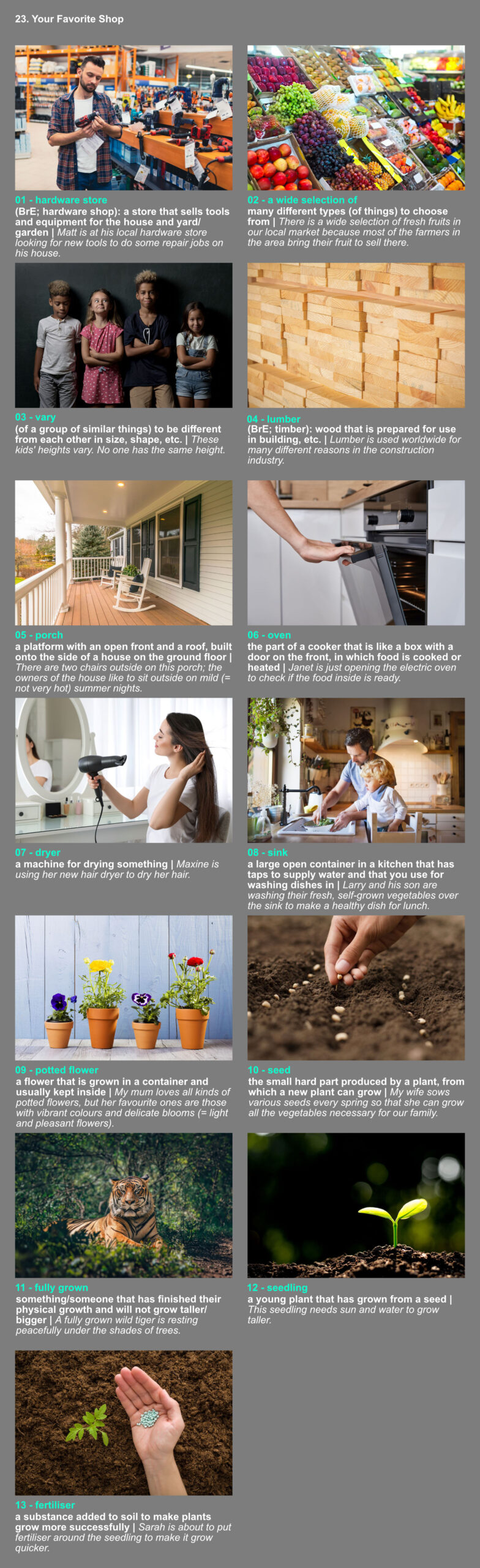
hardware store1 (BrE; hardware shop): a store that sells tools and equipment for the house and yard/garden | Matt is at his local hardware store looking for new tools to do some repair jobs on his house.
around: approximately | A retro car costs around £600,000 in the car dealership because it is a collector’s item.
though: used to add a fact or an opinion that makes the previous statement less strong or less important | I hate eating tomatoes in any form, though I often eat ketchup.
abundance: a large quantity that is more than enough | The countryside has an abundance of green plants, such as grass, flowers and trees.
02
I go to Lowe’s when something goes wrong. If something breaks, if I need a part, if I need a tool, I go to Lowe’s. If I’m going to start a new project, I also go to Lowe’s because I can get pretty much whatever I need at Lowe’s, and that includes materials for most projects.
So what does Lowe’s sell? Perhaps a better question would be, what doesn’t it sell? What it does sell is a lot of things. At Lowe’s, you can get tools, pretty much any sort of tool you’ll need. It’s got a wide selection of tools as well. You can get cheaper tools or more expensive tools, varying qualities of tools and most kinds of tools that you want. You can also buy lumber at Lowe’s. If you’re going to build a house or a porch or pretty much anything out of wood, you can get wood fairly cheaply at Lowe’s, though lumber prices have been absolutely crazy lately.
a wide selection (of)2: many different types (of things) to choose from | There is a wide selection of fresh fruits in our local market because most of the farmers in the area bring their fruit to sell there.
vary3: (of a group of similar things) to be different from each other in size, shape, etc. | These kids’ heights vary. No one has the same height.
quality: the standard of something when it is compared to other things like it; how good or bad something is | My new phone is made of the highest quality materials, which makes it very expensive.
lumber4 (BrE; timber): wood that is prepared for use in building, etc. | Lumber is used worldwide for many different reasons in the construction industry.
porch5: a platform with an open front and a roof, built onto the side of a house on the ground floor | There are two chairs outside on this porch; the owners of the house like to sit outside on mild (= not very hot) summer nights.
lately: recently; in the recent past | I have been feeling terrific (= very good) lately; maybe it is because the sun is out more.
03
It doesn’t just sell tools and wood, though. Oh no. It also sells a lot of different appliances like ovens and toilets and washing machines, dryers, all sorts of things like that … sinks. If you’re building a house, you can get almost everything you need at Lowe’s. It sells paint and things like that, curtains and, as I said, pretty much anything you would need if you’re building a house. It also sells plants of many different kinds, whether they be small potted flower plants or seeds for farming.
appliance: a machine that is designed to do a particular thing in the home, such as preparing food, heating or cleaning | Being extremely cautious (= careful to avoid danger), I never leave my house without checking that all of my appliances are turned off.
oven6: the part of a cooker that is like a box with a door on the front, in which food is cooked or heated | Janet is just opening the electric oven to check if the food inside is ready.
dryer7: a machine for drying something | Maxine is using her new hair dryer to dry her hair.
sink8: a large open container in a kitchen that has taps to supply water and that you use for washing dishes in | Larry and his son are washing their fresh, self-grown vegetables over the sink to make a healthy dish for lunch.
pot: a container of various kinds, made for a particular purpose | There is no more coffee in the coffee pot because all of it was used up.
potted flower9: a flower that is grown in a container and usually kept inside | My mum loves all kinds of potted flowers, but her favourite ones are those with vibrant colours and delicate blooms (= light and pleasant flowers).
seed10: the small hard part produced by a plant, from which a new plant can grow | My wife sows various seeds every spring so that she can grow all the vegetables necessary for our family.
04
It even sells trees, not fully grown trees, but halfway grown trees such that you can simply plant them wherever you need them, but you don’t have to wait as long as if they were only a small seedling. You can also buy a lot of other farming supplies like fertiliser and things like that there. It sells a lot of different things.
fully grown11: something/someone that has finished their physical growth and will not grow taller/bigger | A fully grown wild tiger is resting peacefully under the shades of trees.
seedling12: a young plant that has grown from a seed | This seedling needs sun and water to grow taller.
supplies: the things such as food, medicines, fuel, etc., that are needed by a group of people, for example, an army or expedition | My local charity is sending medical supplies to countries that are hit by earthquakes.
fertiliser13: a substance added to soil to make plants grow more successfully | Sarah is about to put fertiliser around the seedling to make it grow quicker.
05
So, why do I think it’s a good shop? That’s very easy to explain. Simply put, it has what I need.
If I need something when I’m working, I can get it for a good price at Lowe’s. Almost anything I need, I can get there, and I can get it in varying varying levels of quality. It’s also not too far away; it’s only 10 miles away, and it has anything I could need there for working.
simply put: to say something in clearer, more direct, or more easily understandable terms | Simply put, a lot of customers no longer needed cassettes when there were CDs, MP3 players and later smartphones, so most companies stopped producing them.
Describe your favourite shop. You should say:
where it is;
how often you go there;
what it sells;
and explain why you think it is a good shop.
My favourite shop is a hardware store called Lowe’s. It’s 2 hours’ walk away in the nearest town, but 2 hours’ walk is much shorter when you have a car. I go to Lowe’s around once a month, though a lot more often in summer or fall because of the abundance of projects at that time of year.
I go to Lowe’s when something goes wrong. If something breaks, if I need a part, if I need a tool, I go to Lowe’s. If I’m going to start a new project, I also go to Lowe’s because I can get pretty much whatever I need at Lowe’s, and that includes materials for most projects.
So what does Lowe’s sell? Perhaps a better question would be, what doesn’t it sell? What it does sell is a lot of things. At Lowe’s, you can get tools, pretty much any sort of tool you’ll need. It’s got a wide selection of tools as well. You can get cheaper tools or more expensive tools, varying qualities of tools and most kinds of tools that you want. You can also buy lumber at Lowe’s. If you’re going to build a house or a porch or pretty much anything out of wood, you can get wood fairly cheaply at Lowe’s, though lumber prices have been absolutely crazy lately.
It doesn’t just sell tools and wood, though. Oh no. It also sells a lot of different appliances like ovens and toilets and washing machines, dryers, all sorts of things like that … sinks. If you’re building a house, you can get almost everything you need at Lowe’s. It sells paint and things like that, curtains and, as I said, pretty much anything you would need if you’re building a house. It also sells plants of many different kinds, whether they be small potted flower plants or seeds for farming.
It even sells trees, not fully grown trees, but halfway grown trees such that you can simply plant them wherever you need them, but you don’t have to wait as long as if they were only a small seedling. You can also buy a lot of other farming supplies like fertiliser and things like that there. It sells a lot of different things.
So, why do I think it’s a good shop? That’s very easy to explain. Simply put, it has what I need.
If I need something when I’m working, I can get it for a good price at Lowe’s. Almost anything I need, I can get there, and I can get it in varying varying levels of quality. It’s also not too far away; it’s only 10 miles away, and it has anything I could need there for working.
24 Zoo (steps 1, 2 and 4)
Describe a place with animals. You should say:
where it is;
how you heard of it;
what animals can be seen;
and explain why it might be an interesting place to visit.
01
A place that you might not expect to have animals is the city where I grew up, Beijing. Now while there are ordinarily not many animals in a big city and certainly not one such as Beijing, there were surprisingly a large number of animals there. In my complex where I lived, there were not many wild animals, though there were a few. One example that comes to mind is the hedgehogs that were occasionally sighted there. I never saw one alive; my mother and sister did.
expect1: to think or believe that something will happen or that somebody will do something | Mark’s parents were pleasantly surprised when their son cleaned up after them, something they hadn’t expected.
Beijing2: the capital city of China, situated in the northern part of the country | Some of the buildings in Beijing are very modern looking; the architecture looks almost futuristic.
ordinarily: used to say what typically happens in a particular situation, especially because something different is happening this time | Ordinarily, I would not have used public transport to get to work, but this time I had no other choice but to take the train there.
complex3: a group of buildings of a similar type together in one place | This is a luxurious apartment complex in Korea; numerous people live here.
wild animal4: any animal living in a natural, undomesticated state (= not used to living with or working for humans) | This wild Canadian puma is climbing up a tree to hunt.
one example that comes to mind: to think of (or give) an example; to have thought of an example | Some artists of the past were highly skilled; one example that comes to mind is Leonardo da Vinci, who painted the Mona Lisa.
hedgehog5: a small brown animal with stiff parts like needles (called spines) covering its back | This hedgehog is looking for food on an autumn morning.
sight6: to suddenly see something or someone, especially something/someone you have been looking for | On the second day of the Safari, Sally has finally sighted a giraffe.
02
I saw a dead hedgehog, but I do know that they were alive and that they roamed my complex. A hedgehog – if you don’t know – is a small porcupine-like mammal. It’s less spiky than a porcupine and smaller, and somehow these things managed to survive there.
dead: no longer alive | The doctors try very hard to save all the injured or ill people in the hospital, but sadly some people still end up dead there.
roam7: to walk or travel around an area without any definite aim or direction | This group of chickens are allowed to roam the land freely.
porcupine8: an animal covered with long, stiff parts like needles (called quills), which it can raise to protect itself when it is attacked | This is a Malayan porcupine roaming this grassy area.
mammal: any animal that gives birth to live young, not eggs, and feeds its young on milk; cows, humans and whales are all mammals | All mammals are warm-blooded (= they have warm blood).
spiky9: having sharp points | This cactus is very spiky, so it can cause injury when touched carelessly.
manage10: to succeed in doing something, especially something difficult | “Suzie, how did you manage to open that jar of pickled eggplants?“
survive11: to continue to live or exist | Thanks to his practical skills, Mark is surviving in the forest despite being very far away from civilization.
03
Now that I remember it, there was actually a large variety of animals in the complex in which I lived. Not only did we have the indigenous porcupines, there was also a pet monkey which was owned by some people who lived down the road from us.
indigenous: (of plants and animals) having originally developed in a particular place, rather than having been brought there from somewhere else | There are indigenous ducks in Hawaii, which are often found in pairs rather than large groups.
04
They would take it out occasionally on a leash, and it would climb in trees, and I assume that they would pull it out of the tree eventually by the leash. In addition, there were very few pigeons, but they did have pigeons. Far more common than pigeons were magpies and sparrows, which flew naturally over the area. My mother, in fact, would feed them from her window.
leash12: a piece of rope, chain, etc., tied to an animal, especially to a dog at its collar when taking it for a walk | Ready to go for a walk, this dog is holding its leather leash in its mouth, eagerly waiting for its owner to get ready too.
assume: to think or accept that something is true but without having proof of it | Lily assumed that she was allowed to take her dog to the beach, but eventually, she found a sign which prohibited dogs from entering the area.
eventually: in the end; finally | When I was young, I thought that all birds were able to fly. Eventually, I found out that some couldn’t. They are called flightless birds.
in addition: and; also | Frank is a full-time student; in addition, he works in a fast food restaurant in his spare time.
pigeon13: a fat grey and white bird with short legs; pigeons are common in cities | These pigeons are walking around the pavement picking the food that has been given to them by people.
magpie14: a black and white bird with a long tail and a noisy call | There is a popular belief that magpies like to steal small bright objects.
sparrow15: a small brown and grey bird, common in many parts of the world | This sparrow is sitting on the branch of a tree.
feed16: to give food to a person or an animal | Mary is feeding vegetables to her child because he considers (= thinks) it is important for a child to have a balanced diet.
05
In addition, one person who lived down the road from us had an aviary, a big cage full of all types of birds. He had mallard ducks in it, and he had all sorts of birds. I don’t think he had a parrot, but he had many different kinds of birds from all over, which he kept in there.
aviary17: a large cage or building for keeping birds in, for example, in a zoo | This aviary exclusively houses parrots, though there are many different kinds in there.
cage18: a structure made of metal bars or wire in which animals or birds are kept | Some people do not like it when animals such as lions are kept in a cage.
mallard duck19: a common and widely distributed wild duck of the northern hemisphere, the males of which have a green head and white-ringed neck | These mallard ducks are flying away from the noise that a hunter has made.
parrot20: a tropical bird with a curved beak. There are several types of parrots, most of which have bright feathers. | This parrot is enjoying its life in a tropical forest in Panama.
06
There was also the bane of my existence when I was a child, which was three little pomeranian dogs owned by a woman who lived nearby us, and these three little dogs would quite frequently break loose. They’re only very small dogs, and they would chase me around. She didn’t put them on leashes, and they would run after me.
bane: something that causes trouble and makes people unhappy | The neighbours’ kids are the bane of my life.
the bane of my existence: the biggest trouble or the thing that makes me the most unhappy in my life | The London public transport is the bane of my existence.
pomeranian dog21: a breed of dog of the Spitz type that is named for the Pomerania region in north-west Poland and north-east Germany in Central Europe | This pomeranian dog is out for a walk without a leash.
break loose22: to suddenly become loose; to suddenly stop being attached to something | Jonny’s dog broke loose from his control, too excited to run into the park.
chase23: to run, drive, etc. after somebody/something in order to catch them or it | Stella is chasing Maggie in the park because they are playing “Tag”, a popular game in which a person has to touch other players. The tagged player becomes the tagger and has to touch or tag someone else.
07
However, there was much more common wildlife to be found in that complex. Specifically, cats. Now, it’s hard to say whether these cats were tame or wild. They were fed, in fact, by most households within the complex, but they went where they pleased and belonged to almost no one. There was one particularly snobbish group of cats which tended to frequent the yard of one person there. The person fed them, and they had beds and things in her yard, and she had little a yappy dog to scare off anyone who tried to bother the cats. The cats were by no means entirely tame, though as they tended to go where they pleased. On several occasions, though, I managed to catch the cats.
tame24: (of animals, birds, etc.) not afraid of people, and used to living with them | According to its owner, his small lion is tame because it has not attacked anyone.
household: all the people living together in a house or flat | Since there are many people living in my household, we need to have at least five bedrooms.
please: often used after as or what, where, etc. to mean ‘to want’, ‘to choose’ or ‘to like’ to do something | You may stay here as long as you please because we are happy to have you here.
belong25: to be owned by somebody/something | This little green toy car belongs to Carl; it is his favourite toy to play with.
snobbish: thinking that having a high social class is very important; feeling that you are better than other people | My brother is rather snobbish about wine because he has learned some about it in the past few months.
frequent: to visit a particular place often | My local library is frequented by students and elderly people; other types of people are rarely seen there.
yappy dog26: a dog often making short, high sounds | This little yappy dog causes a lot of confusion in people when they first meet it.
scare off27: to make somebody go away by frightening them | The bigger bear scared off the other bear by starting to chase it.
bother28: to annoy, worry or upset somebody; to cause somebody trouble or pain | Mosquitoes keep bothering Sam while he is trying to sleep.
by no means: not at all | Even though Helen hasn’t won in any significant competitions, she is by no means bad at playing ping pong.
tend: to be likely to do something or to happen in a particular way because this is what often or usually happens | Early in the morning, especially after a cup of coffee, I tend to concentrate better.
on several occasions: used when referring to multiple times something happened | On my way to work, I have been stuck in traffic on several occasions during the week as a result of unexpected roadworks.
08
One time, my sister brought home three little *kittens and wanted to keep them. Unfortunately, we didn’t end up keeping them, though later on, we caught another small kitten, and we did actually keep him, and he lived a long time, maybe ten years, before he finally *went missing. We brought him here when we moved. I caught other kittens, though. I caught one small kitten that my mother didn’t like the look of, an orange one that she thought looked a little sickly, and I gave it to a friend of mine, who presumably still has it. Later on, I found one of its siblings as well.
kitten29: a young cat | This kitten likes to walk and sleep on the carpet because it is very soft.
end up: to find yourself in a place or situation at the end of a process or period of time | In school, I ended up doing all the work for the physics group assignment because my group mates did not want to do anything.
go missing30: to become lost or absent, often under suspicious circumstances; disappear | The Smiths’ family dog went missing a few days ago; they are putting up flyers to get help from anyone who has seen it or found it.
sickly: not looking healthy and strong | Even three weeks after experiencing food poisoning, Mike and Stella still look sickly.
presumably: used to say that you think that something is probably true | Presumably, Luke still plays football every Saturday in the park with his friends as he has in the last ten years.
sibling: a brother or sister | I have siblings who also enjoyed playing video games when we were children.
09
That place is an interesting place to visit for many reasons, but purely by the animals alone, it might be an interesting place. Just walking around the area and viewing the native wildlife – some of it not so wild – is quite an interesting thing to do, although the complex also had several quite nice parks, which one could go to, and was overall a nice place even without the wildlife.
purely: only; completely | I ran into my old teacher in Paris by the Eiffel Tower, purely by chance.
overall: including all the things or people that are involved in a particular situation; general | I watched the new Marvel adventure movie, and overall, it was a quite pleasant experience, considering aspects like the plot, cinematography, and acting.

Describe a place with animals. You should say:
where it is;
how you heard of it;
what animals can be seen;
and explain why it might be an interesting place to visit.
A place that you might not expect to have animals is the city where I grew up, Beijing. Now while there are ordinarily not many animals in a big city and certainly not one such as Beijing, there were surprisingly a large number of animals there. In my complex where I lived, there were not many wild animals, though there were a few. One example that comes to mind is the hedgehogs that were occasionally sighted there. I never saw one alive; my mother and sister did.
I saw a dead hedgehog, but I do know that they were alive and that they roamed my complex. A hedgehog – if you don’t know – is a small porcupine-like mammal. It’s less spiky than a porcupine and smaller, and somehow these things managed to survive there.
Now that I remember it, there was actually a large variety of animals in the complex in which I lived. Not only did we have the indigenous porcupines, there was also a pet monkey which was owned by some people who lived down the road from us.
They would take it out occasionally on a leash, and it would climb in trees, and I assume that they would pull it out of the tree eventually by the leash. In addition, there were very few pigeons, but they did have pigeons. Far more common than pigeons were magpies and sparrows, which flew naturally over the area. My mother, in fact, would feed them from her window.
In addition, one person who lived down the road from us had an aviary, a big cage full of all types of birds. He had mallard ducks in it, and he had all sorts of birds. I don’t think he had a parrot, but he had many different kinds of birds from all over, which he kept in there.
There was also the bane of my existence when I was a child, which was three little pomeranian dogs owned by a woman who lived nearby us, and these three little dogs would quite frequently break loose. They’re only very small dogs, and they would chase me around. She didn’t put them on leashes, and they would run after me.
However, there was much more common wildlife to be found in that complex. Specifically, cats. Now, it’s hard to say whether these cats were tame or wild. They were fed, in fact, by most households within the complex, but they went where they pleased and belonged to almost no one. There was one particularly snobbish group of cats which tended to frequent the yard of one person there. The person fed them, and they had beds and things in her yard, and she had little a yappy dog to scare off anyone who tried to bother the cats. The cats were by no means entirely tame, though as they tended to go where they pleased. On several occasions, though, I managed to catch the cats.
One time, my sister brought home three little *kittens and wanted to keep them. Unfortunately, we didn’t end up keeping them, though later on, we caught another small kitten, and we did actually keep him, and he lived a long time, maybe ten years, before he finally *went missing. We brought him here when we moved. I caught other kittens, though. I caught one small kitten that my mother didn’t like the look of, an orange one that she thought looked a little sickly, and I gave it to a friend of mine, who presumably still has it. Later on, I found one of its siblings as well.
That place is an interesting place to visit for many reasons, but purely by the animals alone, it might be an interesting place. Just walking around the area and viewing the native wildlife – some of it not so wild – is quite an interesting thing to do, although the complex also had several quite nice parks, which one could go to, and was overall a nice place even without the wildlife.