
Modul 6: PragerU Videos Set 1. Videos 1-14
Ez a videóválogatás 14db izgalmas, gondolatébresztő témát jár körül 5 perces prezentációkban. A gyakorlat végeztével közel 600 szóval növeled szókincsedet. Fontos, hogy a kézikönyvekben leírtak szerint dolgozz az anyagon.
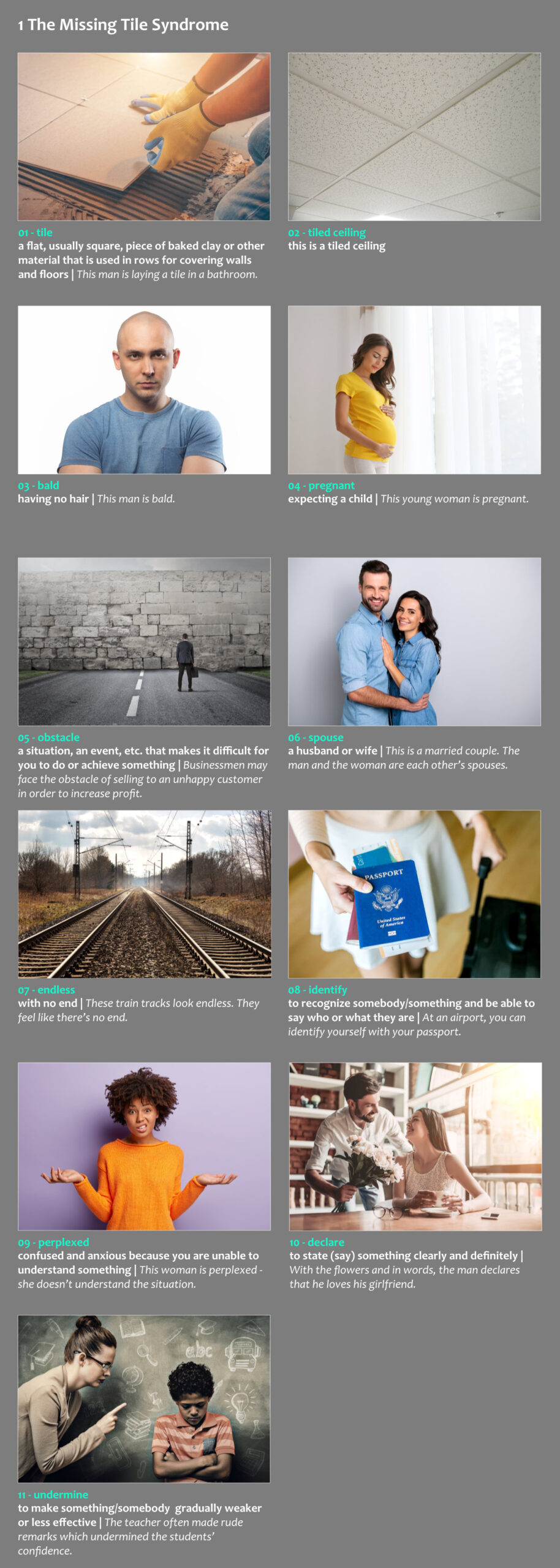
01 The missing tile syndrome (steps 1, 3 and 5)
I would like you to imagine sitting in a room, looking up at a tiled ceiling. And you notice that one tile is missing – just one. What would you concentrate your vision on? What would you look at the most? The answer of course, is the missing tile.
Now, that’s fine for ceilings, in fact it’s actually good because we can replace a ceiling’s missing tile and once again have a perfect ceiling. Ceilings, after all, can be perfect. But this doesn’t apply to life. Most of what is missing in our lives, or what we think is missing, cannot be replaced. Unlike a ceiling, life can never be made perfect. For that reason, concentrating on the missing tiles in your life is a big problem.
Let me give you the example that taught me this great lesson about what I call The Missing Tile Syndrome.
A bald man once said to me, “You know, Dennis, whenever I walk into a room with people, all I see is hair. When I heard this I immediately realized in this regard this man sees the world completely differently from how I do. Because I have all my hair, when I walk into a room I don’t even notice hair. It’s not a missing tile for me. But for this person, hair is what he sees. This applies, in some way, to everyone.
When a woman who thinks she has imperfect legs walks into a room, all she sees are perfect legs. Or take the example of the woman who once said to me, “Wherever I go, all I see are pregnant women.” Now how could that be? The vast majority of women, even those young enough to be pregnant, are not pregnant at any given time. But that was all she saw because she wanted to get pregnant and wasn’t able to. Her missing tile was not having a child. That’s the way human nature is: we focus on what’s missing in our lives.
The Missing Tile Syndrome is a very big obstacle to happiness. So big, in fact, that it makes happiness almost impossible. There will always be something missing in your life. When you see other people’s kids, you’ll think you see tiles that are missing in your own children. “Gee, why can’t my kids study as hard, or be as polite, or be as bright, or be as good looking, or be as athletic.” The same holds true regarding our spouses, our work, our looks. The list is endless.
I’ll give one more example; when I was a single and looking to find the “right woman”, I wanted to first identify the most important trait to look for in my future wife. So after almost every date I would call my best friend, Joseph, and announce, “Joseph, tonight I identified the most important trait in a woman.” And he would always say, “Okay, Dennis, what is it?” and then patiently listen. One night I would tell him that it was intelligence; another night that it was looks; another night, personality; and yet on another night, kindness. One night, as usual, I called him up after an evening out and said, “Joseph, I finally figured out what the most important trait in a woman is.” But this time he didn’t say, “Okay, Dennis, what is it?” Instead he said, “Don’t tell me, I’ll tell you!” Perplexed I asked, “How do you know? You don’t even know the woman I went out with.” “It doesn’t matter,” he said, “Whatever trait tonight’s woman was missing, that’s the one you decided is the most important trait in a woman.” I could say nothing. He was right. Whatever that night’s date was missing was what I would declare the most important trait in a woman.
I hadn’t yet come up with the term Missing Tile Syndrome, but that is exactly what I was suffering from. That’s the way we play tricks on ourselves and undermine our happiness; by concentrating on the missing tiles every one of us has. So we really have a simple choice: do we focus on the rest of the ceiling, on all the tiles we do have, or do we focus on the ones we’re missing, To a large extent, the answer to that question will determine how happy you will be.
I’m Dennis Prager.
I would like you to imagine sitting in a room, looking up at a tiled ceiling. And you notice that one tile is missing – just one. What would you concentrate your vision on? What would you look at the most? The answer of course, is the missing tile.
tile1: a flat, usually square, piece of baked clay or other material that is used in rows for covering walls and floors | This man is laying a tile in a bathroom.
tiled ceiling2: This is a tiled ceiling.
Now, that’s fine for ceilings, in fact it’s actually good because we can replace a ceiling’s missing tile and once again have a perfect ceiling. Ceilings, after all, can be perfect. But this doesn’t apply to life. Most of what is missing in our lives, or what we think is missing, cannot be replaced. Unlike a ceiling, life can never be made perfect. For that reason, concentrating on the missing tiles in your life is a big problem.
(not) apply to: something (not) working in a particular situation | The shop closes at 9 pm. Everyone has to leave; this rule doesn’t apply to employees – they have to stay in longer.
replace: to change something that is old, damaged, etc. for a similar thing that is newer or better | The battery was flat (it didn’t work), so I had to replace it.
unlike: in contrast with; different from | Unlike his father, Johnny loves fishing. (Johnny’s father doesn’t like fishing; Johnny, however, loves it.)
Let me give you the example that taught me this great lesson about what I call The Missing Tile Syndrome.
A bald man once said to me, “You know, Dennis, whenever I walk into a room with people, all I see is hair. When I heard this, I immediately realized in this regard this man sees the world completely differently from how I do. Because I have all my hair, when I walk into a room I don’t even notice hair. It’s not a missing tile for me. But for this person, hair is what he sees. This applies, in some way, to everyone.
bald3: having no hair | This man is bald.
in this regard: in this case (in this situation) | Tammy made many spelling mistakes in her essay; in this regard (i.e. in spelling) she failed.
notice: see/realise something | My daughter noticed the red book on the bookshelf.
When a woman who thinks she has imperfect legs walks into a room, all she sees are perfect legs. Or take the example of the woman who once said to me, “Wherever I go, all I see are pregnant women.” Now how could that be? The vast majority of women, even those young enough to be pregnant, are not pregnant at any given time. But that was all she saw because she wanted to get pregnant and wasn’t able to. Her missing tile was not having a child. That’s the way human nature is: we focus on what’s missing in our lives.
pregnant4 : expecting a child | This young woman is pregnant.
the vast majority: almost all (over 80%) | The vast majority of households in America have electricity.
at any given time: at any particular/specific time | The supermarket in our street is open 24/7, so I can go shopping at any given time.
The Missing Tile Syndrome is a very big obstacle to happiness. So big, in fact, that it makes happiness almost impossible. There will always be something missing in your life. When you see other people’s kids, you’ll think you see tiles that are missing in your own children. “Gee, why can’t my kids study as hard, or be as polite, or be as bright, or be as good looking, or be as athletic.” The same holds true regarding our spouses, our work, our looks. The list is endless.
obstacle5 : a situation, an event, etc. that makes it difficult for you to do or achieve something. | Businessmen may face the obstacle of selling to an unhappy customer in order to increase profit.
spouse6: a husband or wife; | This is a married couple. The man and the woman are each other’s spouses.
endless7: with no end | These train tracks look endless. They feel like there’s no end.
I’ll give one more example; when I was a single and looking to find the “right woman”, I wanted to first identify the most important trait to look for in my future wife. So after almost every date I would call my best friend, Joseph, and announce, “Joseph, tonight I identified the most important trait in a woman.” And he would always say, “Okay, Dennis, what is it?” and then patiently listen. One night I would tell him that it was intelligence; another night that it was looks; another night, personality; and yet on another night, kindness. One night, as usual, I called him up after an evening out and said, “Joseph, I finally figured out what the most important trait in a woman is.” But this time he didn’t say, “Okay, Dennis, what is it?” Instead he said, “Don’t tell me, I’ll tell you!” Perplexed, I asked, “How do you know? You don’t even know the woman I went out with.” “It doesn’t matter,” he said, “Whatever trait tonight’s woman was missing, that’s the one you decided is the most important trait in a woman.” I could say nothing. He was right. Whatever that night’s date was missing was what I would declare the most important trait in a woman.
identify8: to recognize somebody/something and be able to say who or what they are | At an airport, you can identify yourself with your passport.
trait: a particular quality in your personality. | One of my dad’s major character traits was his openness.
perplexed9: confused and anxious because you are unable to understand something | This woman is perplexed – she doesn’t understand the situation.
declare10: to state (say) something clearly and definitely | With the flowers and in words, the man declares that he loves his girlfriend.
I hadn’t yet come up with the term Missing Tile Syndrome, but that is exactly what I was suffering from. That’s the way we play tricks on ourselves and undermine our happiness; by concentrating on the missing tiles every one of us has. So we really have a simple choice: do we focus on the rest of the ceiling, on all the tiles we do have, or do we focus on the ones we’re missing. To a large extent, the answer to that question will determine how happy you will be.
undermine11: to make something/somebody gradually weaker or less effective. | The teacher often made rude remarks which undermined the students’ confidence.
to a large extent: mostly true. | What this documentary portrays is accurate, to a large extent.
I’m Dennis Prager.
02 What Matters Most in Life (steps 1, 3 and 5)
I’m going to talk to you about the most important thing you will ever have. Now try to guess what that might be.
For example, is it money? Well it’s certainly better to have money than not to, but it’s definitely not the most important thing you can have — just ask all the rich people who are very unhappy — or, even better, read about most of the people who have won tens of millions of dollars in a lottery. Most of these people actually became less happy, not more.
So alright, then, what about love — is that the most important thing you could ever have? Well, love sure is important. I can’t imagine living without it. I sure treasure the love of my friends and the love of my family, but if you don’t have the thing I’m about to tell you, you won’t receive much love at all.
So, let’s try a third answer: happiness. Well, that, too, is very, very important. Who wants to be unhappy? But again, without the thing I will tell you about, there would be little happiness in the world.
So, here goes — the most important thing you will ever have is — drumroll please — good values. Yes, good values. Now I know that may sound boring and I realize that it’s possible that you may have never really thought about values or even know what I’m talking about.
So, let me explain. A value is something you think is more important than anything else — more important than money, more important even than love, and even more important than happiness. And above all, values are what you consider to be more important than your feelings.
This is very hard for a lot of people to believe because we live in a time when people think that how they feel about something is more important than anything else, but that isn’t so.
Here’s a simple example of the conflict between a feeling and a value. Just about everyone feels like eating junk food, but there’s a big problem here. If you eat whatever you feel like eating you will end up obese and unhealthy. So then, what is it that stops people from eating all the food they feel like eating? The answer is a value — that’s right, a value. And what is that value? Not getting obese and staying healthy.
There is, in other words, a necessary battle that goes on inside of most people: the battle between what they feel–in this case the desire to eat junk food — and a value that they hold — in this case staying healthy and looking good. Now as important as a healthy body is, this conflict between what we feel like doing and values, is even more important when it comes to doing what is right, when it comes to how we treat other people, not just ourselves.
Here’s one that will make you think. Imagine you’re walking on a beach with the dog you love, when all of a sudden you look out at the water and you see your dog drowning. And imagine, too, that at the same time about 100 feet from your dog, a person you don’t know — a stranger — is also drowning. Now, which would you try to save first?
Just about anyone who loves their pet would feel like saving their pet first. But what if you value human life even more than an animal’s life — and you probably do. After all, you probably eat animals, but you wouldn’t eat a human being. Then your value — the unique preciousness of human life — is in conflict with your feelings for your dog.
Here’s another example. Imagine you are about to take an important test at school. If you cheat on that test, you may be able to avoid failing and maybe even get into a great school. But what if you have a value — what we call a moral value — that cheating is wrong? You sure feel like cheating, but if you have moral values, you know it’s wrong to. Again, that battle between your feelings and a value.
Almost everything that is wrong with the world comes from people either not having higher moral values, or not living by them, because they feel they want to do something else.
People who murder feel like murdering, and they do what they feel rather than live by the value of preserving human life. People who steal feel that they want the thing that they steal, so they take what they feel like having rather than live by the value of not stealing.
The list is pretty much endless, and that’s why good values are the most important thing any of us can ever have. Without them, the world would be a very terrible place.
And finally, know this: the best people you know–meaning the nicest, kindest, and most honest–are people who battle their feelings every day of their lives. So should you.
I’m Dennis Prager.
I’m going to talk to you about the most important thing you will ever have. Now try to guess what that might be.
For example, is it money? Well, it’s certainly better to have money than not to, but it’s definitely not the most important thing you can have — just ask all the rich people who are very unhappy — or, even better, read about most of the people who have won tens of millions of dollars in a lottery. Most of these people actually became less happy, not more.
So alright, then, what about love — is that the most important thing you could ever have? Well, love sure is important. I can’t imagine living without it. I sure treasure the love of my friends and the love of my family, but if you don’t have the thing I’m about to tell you, you won’t receive much love at all.
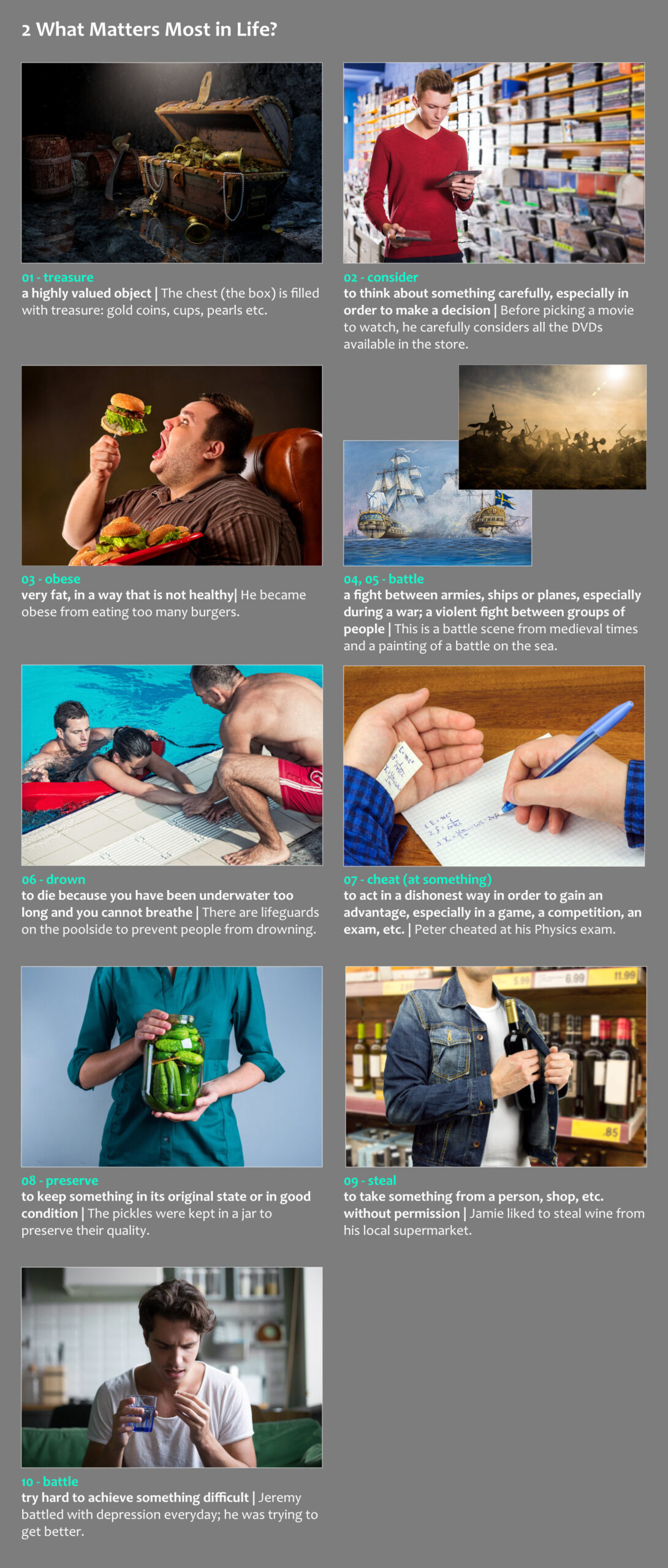
treasure1: a highly valued object | The chest (the box) is filled with treasure: gold coins, cups, pearls etc..
treasure (verb): to have or keep something that you love and that is extremely valuable to you | I treasure my new laptop.
So, let’s try a third answer: happiness. Well, that, too, is very, very important. Who wants to be unhappy? But again, without the thing I will tell you about, there would be little happiness in the world.
So, here goes — the most important thing you will ever have is — drumroll please — good values. Yes, good values. Now I know that may sound boring and I realize that it’s possible that you may have never really thought about values or even know what I’m talking about.
So, let me explain. A value is something you think is more important than anything else — more important than money, more important even than love, and even more important than happiness. And above all, values are what you consider to be more important than your feelings.
value: if something has value, it is useful or important | Honesty is one of my brother’s main values.
above all: most important of all; especially | Above all, in order to get a good grade, Jonah needed to study hard for his exams.
consider2: to think about something carefully, especially in order to make a decision | Before picking a movie to watch, he carefully considers all the DVDs available in the store.
This is very hard for a lot of people to believe because we live in a time when people think that how they feel about something is more important than anything else, but that isn’t so.
Here’s a simple example of the conflict between a feeling and a value. Just about everyone feels like eating junk food, but there’s a big problem here. If you eat whatever you feel like eating, you will end up obese and unhealthy. So then, what is it that stops people from eating all the food they feel like eating? The answer is a value — that’s right, a value. And what is that value? Not getting obese and staying healthy.
obese3: very fat, in a way that is not healthy | He became obese from eating too many burgers.
There is, in other words, a necessary battle that goes on inside of most people: the battle between what they feel–in this case the desire to eat junk food — and a value that they hold — in this case staying healthy and looking good. Now as important as a healthy body is, this conflict between what we feel like doing and values, is even more important when it comes to doing what is right when it comes to how we treat other people, not just ourselves.
battle4-5: 1. a fight between armies, ships or planes, especially during a war; a violent fight between groups of people | This is a battle scene from medieval times. And a painting of a battle on the sea.
2. an effort in which someone tries to solve a difficult situation | She finally lost her long battle against cancer.
desire: a strong wish to have or do something | He had a burning desire to get more and more money.
when it comes to: when it is a question of something | When it comes to deciding which movie to watch, I pick the movie with the best Hollywood actors in it.
Here’s one that will make you think. Imagine you’re walking on a beach with the dog you love, when all of a sudden you look out at the water and you see your dog drowning. And imagine, too, that at the same time about 100 feet from your dog, a person you don’t know — a stranger — is also drowning. Now, which would you try to save first?
drown6: to die because you have been underwater too long and you cannot breathe | There are lifeguards on the poolside to prevent people from drowning.
Just about anyone who loves their pet would feel like saving their pet first. But what if you value human life even more than an animal’s life — and you probably do. After all, you probably eat animals, but you wouldn’t eat a human being. Then your value — the unique preciousness of human life — is in conflict with your feelings for your dog.
precious: valuable or important and not to be wasted. | In desert zone nations – e.g. in the Sahel zone – water is precious.
preciousness: being precious | My sister always knew about the preciousness of family.
Here’s another example. Imagine you are about to take an important test at school. If you cheat on that test, you may be able to avoid failing and maybe even get into a great school. But what if you have a value — what we call a moral value — that cheating is wrong? You sure feel like cheating, but if you have moral values, you know it’s wrong too. Again, that battle between your feelings and a value.
cheat7 (at something): to act in a dishonest way in order to gain an advantage, especially in a game, a competition, an exam, etc. | Peter cheated at his Physics exam.
avoid: to prevent something bad from happening | Britain tried to avoid war with Germany in the 1940s.
Almost everything that is wrong with the world comes from people either not having higher moral values, or not living by them, because they feel they want to do something else.
People who murder feel like murdering, and they do what they feel rather than live by the value of preserving human life. People who steal feel that they want the thing that they steal, so they take what they feel like having rather than live by the value of not stealing.
preserve8: to keep something in its original state or in good condition | The pickles were kept in a jar to preserve their quality.
steal9: to take something from a person, shop, etc. without permission | Jamie liked to steal wine from his local supermarket.
The list is pretty much endless, and that’s why good values are the most important thing any of us can ever have. Without them, the world would be a very terrible place.
And finally, know this: the best people you know–meaning the nicest, kindest, and most honest–are people who battle their feelings every day of their lives. So should you.
battle10: try hard to achieve something difficult | Jeremy battled with depression every day; he was trying to get better.
I’m Dennis Prager.
03 The Truth About Canadian Healthcare (steps 1, 3 and 5)
Why can’t America’s healthcare system be more like Canada’s?
Here’s what most people who ask that question think they know about Canadian-style healthcare:
- Everybody gets covered.
- It’s free.
- It’s great.
Number one is true. Everybody is covered.
Number two is false. Nothing is free. Canadians pay for their insurance through their taxes. And, as you might expect, the tax rates in Canada are very high.
And number three is… well, let’s just say it’s questionable. Let’s find out how questionable. But before we do, let me tell you a bit about me.
I was born and raised in Montreal, Canada. That makes me French Canadian. I’m so French Canadian, my name—Alan—is spelled A-L-A-I-N. I have also lived and worked in the United States. I have experienced both Canadian health care and American health care. Here are some of my experiences with the Canadian system, the one so many Americans aspire to. I believe they are typical. So do the Canadians I know.
Experience #1:
In September 2000, my wife was seven months pregnant with our youngest daughter. One day, my wife started having severe lower back pain. She suspected kidney stones—she had them in the past. But she was very pregnant, so we needed to check it out. Kidney stones are bad, but something going wrong with the pregnancy would be a lot worse.
We went to the emergency room of our local hospital in Montreal. This was Thursday. She was admitted to the hospital and given morphine for her pain. She couldn’t get an ultrasound the next day because the machine for this procedure was fully booked.
She didn’t get the ultrasound during the weekend, either, because ultrasound operators don’t work on weekends. Finally, on Monday afternoon, she got the test—after I begged her doctor to do something so we could find out if indeed my wife had a kidney stone or something had gone wrong with the pregnancy. Thank God, it was the former and not the latter.
In the United States, a pregnant woman doesn’t wait a day to get an ultrasound if the baby’s health is in question. And ultrasound technicians are available on the weekend.
Experience #2:
One of my friends struggled with back issues for years. Eventually, he needed surgery. Like all people with non-life-threatening conditions in Canada, he was placed on a waiting list. The pain got so bad, after a few months he went to see the specialist and pleaded for an operation. The specialist asked, “Are you suicidal?” My friend responded, “No, I’m not suicidal—I need a back operation!” The specialist concluded, “If you are not suicidal, it means you can handle the pain.” Had my friend waited, his surgery would have been covered. Instead, he went to Florida and paid $20,000 out of his own pocket to have the surgery immediately.
In the United States, if you’re in terrible pain, you can get a back surgery within days.
Experience #3
Several years ago, I was diagnosed with polyps on my colon. Since I have a family history of colon cancer, I was advised to get a colonoscopy every year. I went to see my specialist in May to set up my next procedure. After a brief consult, he told me to book the colonoscopy with his secretary on my way out. She told me that the doctor could perform the procedure in November. Being used to long waiting times, I felt that was rather short, so I said, “Great, that works for me.” She replied, “Not this November. Next November.”
In the United States, you can get a colonoscopy in a few days, and certainly within a few weeks.
Experience #4
Just recently, a friend had a biopsy for prostate cancer. He had to wait three months to get the results. Sadly, the test came back positive. The earliest he could have surgery was three months after receiving the diagnosis. Needless to say, cancer doesn’t care about waiting lists. It grows and it spreads, sometimes beyond the point when treatment can be effective. I pray that my friend gets treated in time.
In the United States, you don’t have to wait three months to get the results of a biopsy. Or wait three months after that to get surgery if you need it.
But here’s the good news: Canadian hospice care is first-rate—caring and compassionate. Once you’re terminal, they take very good care of you.
That’s the Canadian system for you. And that’s what you aspire to?
I can tell you who will be really bummed out if you adopt it.
Canadians.
When we’re in trouble, we know where to go: the USA.
Don’t go the Canadian route, America. Make your healthcare system better, not worse. As our great Canadian singer-songwriter, Joni Mitchell, says in one of her most famous songs, “You don’t know what you’ve got ‘til it’s gone.”
I’m Alain Lambert for Prager University.
Why can’t America’s healthcare system be more like Canada’s?
Here’s what most people who ask that question think they know about Canadian-style healthcare:
- Everybody gets covered.
- It’s free.
- It’s great.
Number one is true. Everybody is covered.
cover: to provide compensation in case of disaster or damage | My car is covered by my insurance company against any damage. E.g. if someone breaks the window of my car, it will be paid for by insurance.
Number two is false. Nothing is free. Canadians pay for their insurance through their taxes. And, as you might expect, the tax rates in Canada are very high.
insurance: an arrangement with a company in which you pay them regular amounts of money, and they agree to pay the costs, for example, if you die or are ill, or if you lose or damage something | I have to pay for my home insurance every month.
tax: money that you have to pay to the government so that it can pay for public services | I forgot to pay my taxes.
tax rates: the % of taxes | The tax rate on tobacco products has increased.
And number three is… well, let’s just say it’s questionable. Let’s find out how questionable. But before we do, let me tell you a bit about me.
questionable: If something is questionable, you have a feeling that it may not be accurate or correct. | The conclusion that my friend came to is questionable.
I was born and raised in Montreal, Canada. That makes me French Canadian. I’m so French Canadian, my name—Alan—is spelled A-L-A-I-N. I have also lived and worked in the United States. I have experienced both Canadian health care and American health care. Here are some of my experiences with the Canadian system, the one so many Americans aspire to. I believe they are typical. So do the Canadians I know.
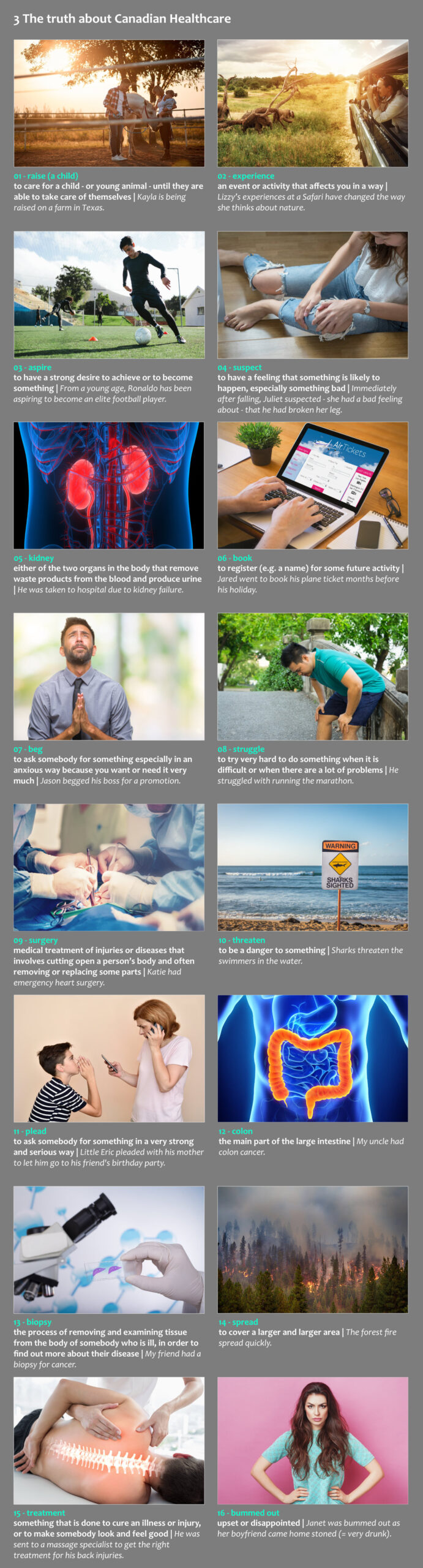
raise (a child)1: to care for a child – or young animal – until they are able to take care of themselves | Kayla is being raised on a farm in Texas.
experience2: an event or activity that affects you in a way | Lizzy’s experiences at a Safari have changed the way she thinks about nature.
aspire3: to have a strong desire to achieve or to become something | From a young age, Ronaldo has been aspiring to become an elite football player.
Experience #1:
In September 2000, my wife was seven months pregnant with our youngest daughter. One day, my wife started having severe lower back pain. She suspected kidney stones—she had them in the past. But she was very pregnant, so we needed to check it out. Kidney stones are bad, but something going wrong with the pregnancy would be a lot worse.
severe: extremely bad or serious | Chris fell down the stars and severely injured his left leg.
suspect4: to have a feeling that something is likely to happen, especially something bad | Immediately after falling, Juliet suspected – she had a bad feeling about – that he had broken her leg.
kidney5: either of the two organs in the body that remove waste products from the blood and produce urine | He was taken to hospital due to kidney failure.
We went to the emergency room of our local hospital in Montreal. This was Thursday. She was admitted to the hospital and given morphine for her pain. She couldn’t get an ultrasound the next day because the machine for this procedure was fully booked.
admit: to take somebody to a hospital | Jackie was admitted to a hospital after she had a car accident.
book6: to register (e.g. a name) for some future activity | Jared went to book his plane ticket months before his holiday.
She didn’t get the ultrasound during the weekend, either, because ultrasound operators don’t work on weekends. Finally, on Monday afternoon, she got the test—after I begged her doctor to do something so we could find out if indeed my wife had a kidney stone or something had gone wrong with the pregnancy. Thank God, it was the former and not the latter.
beg7: to ask somebody for something especially in an anxious way because you want or need it very much | Jason begged his boss for a promotion.
indeed: without any question; truly, undeniably | Mona had to check if indeed she had failed her exam, as she suspected.
the former: the first of two things or people mentioned | Out of the colours orange and blue, I prefer the former.
the latter: the second of two things or people mentioned | At the restaurant I had to choose between apple juice or orange juice; I chose the latter.
In the United States, a pregnant woman doesn’t wait a day to get an ultrasound if the baby’s health is in question. And ultrasound technicians are available on the weekend.
in question: uncertain | Since he became ill, his health is in question. available: If something is available, you can get, buy or find it. | A range of fast food options are available in my city.
Experience #2:
One of my friends struggled with back issues for years. Eventually, he needed surgery. Like all people with non-life-threatening conditions in Canada, he was placed on a waiting list. The pain got so bad, after a few months he went to see the specialist and pleaded for an operation. The specialist asked, “Are you suicidal?” My friend responded, “No, I’m not suicidal—I need a back operation!” The specialist concluded, “If you are not suicidal, it means you can handle the pain.” Had my friend waited, his surgery would have been covered. Instead, he went to Florida and paid $20,000 out of his own pocket to have the surgery immediately.
struggle8: to try very hard to do something when it is difficult or when there are a lot of problems | He struggled with running the marathon.
issue: a problem or worry that somebody has with something | He had issues about his low pay for years; he wanted to get paid more.
surgery9: medical treatment of injuries or diseases that involves cutting open a person’s body and often removing or replacing some parts | Katie had emergency heart surgery.
threaten10: to be a danger to something | Sharks threaten the swimmers in the water.
condition: the state of somebody’s health or how fit they are | His medical condition was getting worse by the day.
plead11: to ask somebody for something in a very strong and serious way | Little Eric pleaded with his mother to let him go to his friend’s birthday party.
suicidal: People who are suicidal feel that they want to kill themselves. | After his wife left him, he was feeling suicidal.
handle the pain: to deal with the pain | She handled the pain of giving birth to a child very well.
In the United States, if you’re in terrible pain, you can get a back surgery within days.
Experience #3
Several years ago, I was diagnosed with polyps on my colon. Since I have a family history of colon cancer, I was advised to get a colonoscopy every year. I went to see my specialist in May to set up my next procedure. After a brief consult, he told me to book the colonoscopy with his secretary on my way out. She told me that the doctor could perform the procedure in November. Being used to long waiting times, I felt that was rather short, so I said, “Great, that works for me.” She replied, “Not this November. Next November.”
colon12: the main part of the large intestine | My uncle had colon cancer.
In the United States, you can get a colonoscopy in a few days, and certainly within a few weeks.
Experience #4
Just recently, a friend had a biopsy for prostate cancer. He had to wait three months to get the results. Sadly, the test came back positive. The earliest he could have surgery was three months after receiving the diagnosis. Needless to say, cancer doesn’t care about waiting lists. It grows and it spreads, sometimes beyond the point when treatment can be effective. I pray that my friend gets treated in time.
biopsy13: the process of removing and examining tissue from the body of somebody who is ill, in order to find out more about their disease | My friend had a biopsy for cancer.
Needless to say: used to emphasize that the information you are giving is obvious/clear | Needless to say, the earth is round.
spread14: to cover a larger and larger area | The forest fire spread quickly.
beyond: more than something | The pain was beyond what he could take.
beyond the point when: after the point when | Studying beyond the point when you are exhausted is not good for learning.
treatment15: something that is done to cure an illness or injury, or to make somebody look and feel good | He was sent to a massage specialist to get the right treatment for his back injuries.
In the United States, you don’t have to wait three months to get the results of a biopsy. Or wait three months after that to get surgery if you need it.
But here’s the good news: Canadian hospice care is first-rate—caring and compassionate. Once you’re terminal, they take very good care of you.
hospice care: care in a hospital for people who are dying | When grandma was too old, she was placed under hospice care.
caring: kind and helpful | Jane’s mother is caring.
compassionate: feeling or showing sympathy for people or animals who are suffering | The animal doctor was very compassionate towards my ill puppy.
terminal: Something that leads to death (incurable), or a person that is dying. | The hospital provided beds for the terminal patients.
That’s the Canadian system for you. And that’s what you aspire to? I can tell you who will be really bummed out if you adopt it. Canadians. When we’re in trouble, we know where to go: the USA.
bummed out16: upset or disappointed | Janet was bummed out as her boyfriend came home stoned (= very drunk).
Don’t go the Canadian route, America. Make your healthcare system better, not worse. As our great Canadian singer-songwriter, Joni Mitchell, says in one of her most famous songs, “You don’t know what you’ve got ‘til it’s gone.”
I’m Alain Lambert for Prager University.
04 What Is A Quarter Life Crisis (steps 1, 3 and 5)
Graduates: Even though it’s a long way off, you’ve probably heard about something called “the mid-life crisis” – men buy Italian sports cars; women go on yoga retreats to Bali.
But I’ll bet you’ve never heard of a crisis you may be facing in a few short years. I call it “the quarter life crisis.”
I know a little something about it, because I went through it. Oh, boy – did I go through it!
When I was 24, a lot was going my way – at least, on the surface. I had great friends. I had a great job on Capitol Hill. I even had a great apartment. So, why didn’t I feel great about my life? I was working as a press secretary for a congressman. I should have been happy about that. But instead, I just felt…trapped – anxious and uncertain about my future. Where was I going? What was my next move?
On the personal side, things weren’t much better. I hadn’t had a boyfriend in years, and there were no prospects on the horizon. Marriage seemed like an impossible dream. I loved my friends, but I still felt lonely.
Right before my twenty-fifth birthday, I took a personal inventory (I love lists). It felt like
I was falling short… almost everywhere. I missed my college days, which seemed, in retrospect, so carefree. The future just looked boring and hard.
That is what you call a quarter-life crisis. And I’d like to help you avoid it.
To that end, I bring you three pieces of advice.
One: Get out of town.
Feeling trapped? One of the best ways to set yourself free is to move – literally. After years of structure – high school, college, right into a career – I longed to be free. I wanted to be able to leave town at a moment’s notice. So I stopped accumulating stuff. I only had one cup, one glass, one plate, one bowl, and one set of silverware. It was one of the best things I did for myself. It allowed me to be nimble in my life and my career. Assuming for a moment you’re not married (if you are, congratulations!), you’re pretty much accountable to no one. That will change. Take advantage of your mobility while you have it. Go where the opportunities are. But more than that, just go! That might mean going somewhere for a better job, or it might mean traveling whenever you get the chance. It’s a big country and a big world. There’s no reason to be stuck in one place, especially if that one place isn’t working for you.
Two: You’re not going to become a ballerina at 25.
You’re still young, but you’re not as young as you used to be. You don’t have unlimited potential anymore. The last time you had unlimited potential, you were nine. At this point, you’re pretty well formed – what you’re good at, what you’re really bad at, what you like and don’t like. I’m not saying you can’t change, that you can’t grow. Of course you can – and must; but you are who you are, and you need to figure out who that is. To put it another way, what is it that you want out of your life? You need to make a realistic assessment of your strengths and weaknesses. Again, lists. This will help you take the next step in the process: setting a goal. Okay, ballerina – not practical. What is? Be honest. Figure it out. Write it down. Then, as one of my mentors told me before my first White House press conference, “Put your big girl panties on, and deal with it.”
Which leads to my final piece of advice: Meet the universe halfway.
No one is going to hand you the life you want. You’re going to have to go out and get it. But there’s a twist. You don’t really know where your life is going to take you. You almost certainly won’t end up where you plan to be. But that’s okay, because when you set goals and work toward them, positive things happen. You gain skills. And those skills will create opportunities that never would’ve existed if you weren’t working toward something. Life will happen along the way; things will change in ways you can’t possibly predict, but nothing happens if you’re sitting on a couch waiting for your life to begin.
I have a lot of other advice that will help you – like, don’t skip the dentist. But when it comes to surviving the quarter life crisis, I think this will help.
Now, if anyone has any advice for my upcoming midlife crisis, let me know.
I’m Dana Perino for Prager University.
Graduates: Even though it’s a long way off, you’ve probably heard about something called “the mid-life crisis” – men buy Italian sports cars; women go on yoga retreats to Bali.
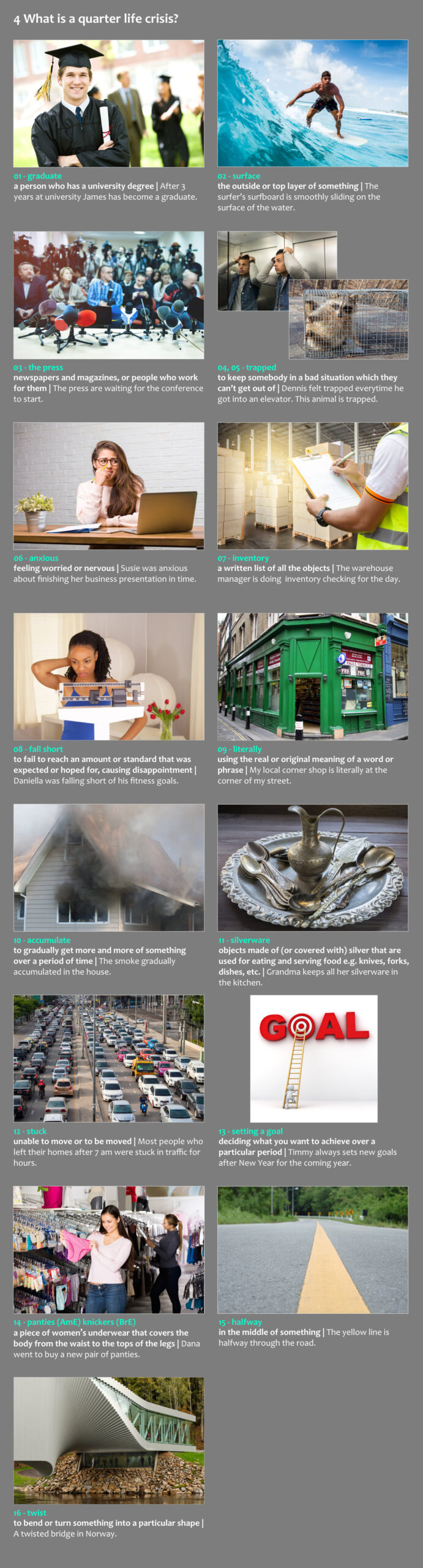
graduate1: a person who has a university degree | After 3 years at university James has become a graduate.
a long way off: happened a long time ago
But I’ll bet you’ve never heard of a crisis you may be facing in a few short years. I call it “the quarter life crisis.”
I bet: used to say that you are almost certain that something is true or that something will happen | I bet all my local shops are closed after 10pm.
I know a little something about it, because I went through it. Oh, boy – did I go through it!
When I was 24, a lot was going my way – at least, on the surface. I had great friends. I had a great job on Capitol Hill. I even had a great apartment. So, why didn’t I feel great about my life? I was working as a press secretary for a congressman. I should have been happy about that. But instead, I just felt…trapped – anxious and uncertain about my future. Where was I going? What was my next move?
surface2: the outside or top layer of something | The surfer’s surfboard is smoothly sliding on the surface of the water.
the press3: newspapers and magazines, or people who work for them | The press are waiting for the conference to start.
trapped4-5: to keep somebody in a bad situation which they can’t get out of | Dennis felt trapped everytime he got into an elevator. This animal is trapped.
anxious6: feeling worried or nervous | Susie was anxious about finishing her business presentation in time.
On the personal side, things weren’t much better. I hadn’t had a boyfriend in years, and there were no prospects on the horizon. Marriage seemed like an impossible dream. I loved my friends, but I still felt lonely.
prospects: the possibility that something good might happen in the future | Jimmy had no job prospects after leaving university.
Right before my twenty-fifth birthday, I took a personal inventory (I love lists). It felt like I was falling short… almost everywhere. I missed my college days, which seemed, in retrospect, so carefree. The future just looked boring and hard.
inventory7: a written list of all the objects | The warehouse manager is doing inventory checking for the day.
fall short8: to fail to reach an amount or standard that was expected or hoped for, causing disappointment | Daniella was falling short of his fitness goals.
in retrospect: thinking about a past event or situation, often with a different opinion of it | In retrospect, my decision to take a holiday at that time was a bad idea.
That is what you call a quarter-life crisis. And I’d like to help you avoid it. To that end, I bring you three pieces of advice.
to that end: for that reason | As a child, I wanted to be an astronaut. To that end, I studied hard in school.
advice: an opinion or a suggestion about what somebody should do in a particular situation | My advice to him was to leave as quickly as possible.
One: Get out of town.
Feeling trapped? One of the best ways to set yourself free is to move – literally. After years of structure – high school, college, right into a career – I longed to be free. I wanted to be able to leave town at a moment’s notice. So I stopped accumulating stuff. I only had one cup, one glass, one plate, one bowl, and one set of silverware. It was one of the best things I did for myself. It allowed me to be nimble in my life and my career. Assuming for a moment you’re not married (if you are, congratulations!), you’re pretty much accountable to no one. That will change. Take advantage of your mobility while you have it. Go where the opportunities are. But more than that, just go! That might mean going somewhere for a better job, or it might mean traveling whenever you get the chance. It’s a big country and a big world. There’s no reason to be stuck in one place, especially if that one place isn’t working for you.
literally9: using the real or original meaning of a word or phrase | My local corner shop is literally at the corner of my street.
long: to want something very much | She longed to see him again.
at a moment’s notice: not long in advance; immediately | He was ready to leave school at a moment’s notice.
accumulate10: to gradually get more and more of something over a period of time | The smoke gradually accumulated in the house.
silverware11: objects made of (or covered with) silver that are used for eating and serving food e.g. knives, forks, dishes, etc. | Grandma keeps all her silverware in the kitchen.
nimble: able to move quickly and easily | The boxer was very nimble on his feet.
assuming (something) : supposing; let’s think/imagine that something is true | Assuming he aces the interview, he will get the job.
accountable: responsible for your decisions or actions and expected to explain them when you are asked | Jeremy was accountable for the project to his boss.
take advantage: to make use of something well; to make use of an opportunity | He took advantage of the free meals provided by his school.
opportunity: a good chance to do or achieve something | There are many job opportunities in the city.
stuck12: unable to move or to be moved | Most people who left their homes after 7 am were stuck in traffic for hours.
Two: You’re not going to become a ballerina at 25.
You’re still young, but you’re not as young as you used to be. You don’t have unlimited potential anymore. The last time you had unlimited potential, you were nine. At this point, you’re pretty well formed – what you’re good at, what you’re really bad at, what you like and don’t like. I’m not saying you can’t change, that you can’t grow. Of course you can – and must; but you are who you are, and you need to figure out who that is. To put it another way, what is it that you want out of your life? You need to make a realistic assessment of your strengths and weaknesses. Again, lists. This will help you take the next step in the process: setting a goal. Okay, ballerina – not practical. What is? Be honest. Figure it out. Write it down. Then, as one of my mentors told me before my first White House press conference, “Put your big girl panties on, and deal with it.”
well formed: completely and properly formed/shaped | His personality was well formed by the age of 25.
to put it another way: used when you are going to explain something in a different way in order to make it easier to understand | Janet’s brain is still not fully developed; to put it another way, she is still very young and impulsive.
assessment: an opinion or a judgement about somebody/something that has been thought about very carefully | He made an assessment about humans’ contribution to global warming.
strengths and weaknesses: a person’s positive and negative characteristics | Football coaches look at individual players’ strengths and weaknesses to decide what position individuals should play in.
setting a goal13: deciding what you want to achieve over a particular period | Timmy always sets new goals after New Year for the coming year.
panties14 (AmE): a piece of womenʼs underwear that covers the body from the waist to the tops of the legs (BrE: knickers)| Dana went to buy new pair of panties.
Which leads to my final piece of advice: Meet the universe halfway.
No one is going to hand you the life you want. You’re going to have to go out and get it. But there’s a twist. You don’t really know where your life is going to take you. You almost certainly won’t end up where you plan to be. But that’s okay, because when you set goals and work toward them, positive things happen. You gain skills. And those skills will create opportunities that never would’ve existed if you weren’t working toward something. Life will happen along the way; things will change in ways you can’t possibly predict, but nothing happens if you’re sitting on a couch waiting for your life to begin.
halfway15: in the middle of something | The yellow line is halfway through the road.
twist16: to bend or turn something into a particular shape | A twisted bridge in Norway.
gain: to obtain or win something, especially something that you need or want | He gained his IT knowledge from YouTube tutorials.
predict: to say that something will happen in the future | My aunt keeps trying to predict the lottery numbers.
I have a lot of other advice that will help you – like, don’t skip the dentist. But when it comes to surviving the quarter life crisis, I think this will help.
skip: to not do something that you usually do or should do | Marry often skips eating breakfast before going to work.
Now, if anyone has any advice for my upcoming midlife crisis, let me know.
I’m Dana Perino for Prager University.
05 Why You Love Capitalism (steps 1, 3 and 5)
You love capitalism. Really – you do.
And you can’t stand big government. Really – you can’t.
Don’t believe me? Then I’ll just have to prove it to you.
Do you use an iPhone? Android? Macbook? PC? Read on a Kindle? Watch TV and movies on Netflix? Videos on YouTube? Shop on Amazon? Listen to Spotify? Search on Google? Send money on Venmo? Grab a ride with Uber? Drive with Waze? Book a room with Airbnb?
Are you on Facebook? Or Instagram? Or Snapchat?
You probably use many, if not all, of these things, and, if you’re like me, you love them. In today’s world, they’re practically necessities.
Where do you think they came from?
From entrepreneurs with great ideas and the freedom to test them in the marketplace. That is what is known as . . . capitalism.
Now consider some other things you probably use:
Have you been to the DMV? Gone through airport security? Mailed a package at the Post Office? Called the IRS customer service line? Or called any government office, for that matter?
What’s different?
Why is going to the Apple Store so fun, but going to the DMV so painful? Because one has nothing to do with the government, and one is the government. One needs to satisfy its customers to survive and grow. One doesn’t.
The purpose of government is not to create products. And we don’t expect it to. But if you thought about it for a few moments, you’d realize you don’t want the government involved in just about anything private business can do. That’s because profit-motivated individuals have to work to please their customers. You. Government agencies don’t have to please anyone.
Call that IRS service line, if you doubt me.
Can you imagine if Steve Jobs had to seek government approval for every new design of the iPhone? We’d have been lucky to get to iPhone 3G.
Look at Uber. Just a few years ago, summoning a private driver in a few minutes who would take you where you wanted to go was truly a service available only to the wealthiest people. But now, thanks to capitalism, private rides are an affordable option for ordinary people all over the world. Until Uber came around, if it started to rain in, say, Manhattan and you wanted a grab a cab, good luck. Too many rain-drenched people and too few cabs. Uber had a better idea. Rain falls. Demand for rides spikes. Raise prices to incentivize more Uber drivers to hit the road. Ride-in-the-rain problem solved.
Airbnb is another example. Only a few years ago, if you were going on vacation with your friends or family, hotels were just about your only option. But hotels are expensive, and often don’t provide all that much in terms of space, amenities, or interesting neighborhoods. If you wanted to, say, find out if individual homeowners were making their homes or apartments available for a few nights, you’d have to scour internet postings.
But then Airbnb came along, giving anyone with a computer or smartphone access to over 2 million homes in 190 countries. You can find places with hot tubs and pools; or, if you’re on a tighter budget, you can rent a room, or even just a couch.
Government never could have done this. What motivation would it have? How would it even know we wanted services like Uber or Airbnb? We didn’t know it, until risk-taking entrepreneurs made it possible. Thanks to capitalism. And no thanks to government which, more often than not, just gets in the way.
Why?
Because the government’s knee-jerk reaction is to regulate and control everything it can regulate and control. Otherwise, what would be the purpose of many government agencies and all those bureaucrats?
Cities across the world are putting up barriers to slow down or shut down services like Uber and Airbnb. Rulemaking may be the only area where the government shows creativity. Economic growth has the best chance of happening in the absence of that rulemaking.
As economist Adam Thierer explains, the internet, to use just one important example, was able to develop in a regulatory climate that embraced what he calls “permissionless innovation.” This approach to regulating allows entrepreneurs to meet their customers’ needs without first seeking government approval.
In sum, almost everything you enjoy using is a product of capitalism; almost everything you can’t stand is a product of big government. So, do you love capitalism? Of course you do. You practice it every day. It’s time to preach it.
I’m Jared Meyer of the Manhattan Institute for Prager University.
You love capitalism. Really – you do.
And you can’t stand big government. Really – you can’t.
Don’t believe me? Then I’ll just have to prove it to you.
can’t stand1: used for saying that a person dislikes someone or something very much | Jim couldn’t stand the smell of the baby’s diaper.
Do you use an iPhone? Android? Macbook? PC? Read on a Kindle? Watch TV and movies on Netflix? Videos on YouTube? Shop on Amazon? Listen to Spotify? Search on Google? Send money on Venmo? Grab a ride with Uber? Drive with Waze? Book a room with Airbnb?
Are you on Facebook? Or Instagram? Or Snapchat?
You probably use many, if not all, of these things, and, if you’re like me, you love them. In today’s world, they’re practically necessities.
necessity: a thing that you must have and cannot manage without | Having a good internet connection is a necessity in the West.
Where do you think they came from?
From entrepreneurs with great ideas and the freedom to test them in the marketplace. That is what is known as capitalism.
entrepreneur: a person who makes money by starting or running a business/businesses | Janet quit her 9 to 5 job to become an entrepreneur.
Now consider some other things you probably use:
Have you been to the DMV? Gone through airport security? Mailed a package at the Post Office? Called the IRS customer service line? Or called any government office, for that matter?
DMV: Department of Motor Vehicles | In the US, car owners have to register their cars at the DMV.
IRS: Internal Revenue Service (tax service in the USA) | The IRS began to investigate him for tax fraud.
for that matter: used to add a comment on something that you have just said | Janey has never broken her leg … or her arm, for that matter.
What’s different?
Why is going to the Apple Store so fun, but going to the DMV so painful? Because one has nothing to do with the government, and one is the government. One needs to satisfy its customers to survive and grow. One doesn’t.
satisfy2: to provide what is wanted, needed or asked for | There was not enough food to satisfy the bear’s hunger, and it remained hungry.
The purpose of the government is not to create products. And we don’t expect it to. But if you thought about it for a few moments, you’d realize you don’t want the government involved in just about anything private business can do. That’s because profit-motivated individuals have to work to please their customers. You. Government agencies don’t have to please anyone.
involve: to make somebody take part in something | Jeremy wanted to involve as many people as he could in his new science project.
Call that IRS service line, if you doubt me.
Can you imagine if Steve Jobs had to seek government approval for every new design of the iPhone? We’d have been lucky to get to iPhone 3G.
approve: to say that something is good enough to be used or is correct | The university approved John’s application.
approval: Danny’s application for a bank loan is waiting for the bank manager’s approval.
Look at Uber. Just a few years ago, summoning a private driver in a few minutes who would take you where you wanted to go was truly a service available only to the wealthiest people. But now, thanks to capitalism, private rides are an affordable option for ordinary people all over the world. Until Uber came around, if it started to rain in, say, Manhattan and you wanted to grab a cab, good luck. Too many rain-drenched people and too few cabs. Uber had a better idea. Rain falls. Demand for rides spikes. Raise prices to incentivize more Uber drivers to hit the road. Ride-in-the-rain problem solved.
summon3: to order somebody to come to you | The Korean ruler summoned his servant.
wealthy4: having a lot of money, possessions, etc. | James is a wealthy banker.
affordable: cheap enough for people to pay for it or buy it | The shop at the corner sells affordable clothing.
rain-drenched5: really wet by rain | Mike is totally rain-drenched.
demand: customer’s desire or need for goods or services that they want to buy or use | The demand for ice cream goes up in summertime.
spike6: a sudden large increase in something | There was a spike in oil prices after an OPEC deal.
incentivize7: to encourage somebody to behave in a particular way by offering them a reward | Parents sometimes incentivize their children to do some housework by offering them payment.
Airbnb is another example. Only a few years ago, if you were going on vacation with your friends or family, hotels were just about your only option. But hotels are expensive, and often don’t provide all that much in terms of space, amenities, or interesting neighborhoods. If you wanted to, say, find out if individual homeowners were making their homes or apartments available for a few nights, you’d have to scour internet postings.
in terms of: regarding; with regard to | In terms of living a long life, eating healthily is important.
amenities8: a feature or service that makes a place pleasant, comfortable or easy to live in | My local hotel has essential amenities like towels and shampoo.
scour9: to search a place or thing carefully and completely in order to find somebody/something | Grandpa was scouring the forest for mushrooms.
But then Airbnb came along, giving anyone with a computer or smartphone access to over 2 million homes in 190 countries. You can find places with hot tubs and pools; or, if you’re on a tighter budget, you can rent a room, or even just a couch.
budget: your money and a plan of how to spend it over a period of time | John carefully planned his budget for the next year.
tight budget: having little money to spend | Jane has a tight budget because rent has become much more expensive in her city recently.
couch10: a long comfortable seat for two or more people to sit on | The dog was lying on the couch.
Government never could have done this. What motivation would it have? How would it even know we wanted services like Uber or Airbnb? We didn’t know it, until risk-taking entrepreneurs made it possible. Thanks to capitalism. And no thanks to government which, more often than not, just gets in the way.
risk: the possibility of something bad happening at some time in the future; a situation that could be dangerous or have a bad result | There was a fire risk in the factory.
take a risk: to do something even though you know that something bad could happen as a result | Mark loves to take a risk by always spending his monthly salary on lottery tickets.
more often than not: usually; in a way that is typical of somebody/ something | More often than not, Mark wins the chess game against his elder brother.
Why?
Because the government’s knee-jerk reaction is to regulate and control everything it can regulate and control. Otherwise, what would be the purpose of many government agencies and all those bureaucrats?
knee-jerk reaction: reaction without any serious thought | His knee-jerk reaction to watching a scary movie was hiding behind a pillow.
regulate: to control something by rules | All banks in the UK are regulated by the Bank of England.
otherwise: in a different way; differently | Mona surely loves playing music; otherwise, why would she spend hours upon hours playing it?
Cities across the world are putting up barriers to slow down or shut down services like Uber and Airbnb. Rulemaking may be the only area where the government shows creativity. Economic growth has the best chance of happening in the absence of that rulemaking.
barrier11: a problem, rule or situation that prevents somebody from doing something, or that makes something impossible | There was a barrier at the entrance to the parking lot.
absence12: a lack of something | The teacher noticed the absence of half of the class.
As economist Adam Thierer explains, the internet, to use just one important example, was able to develop in a regulatory climate that embraced what he calls “permissionless innovation.” This approach to regulating allows entrepreneurs to meet their customers’ needs without first seeking government approval.
climate: a general attitude or feeling; an atmosphere or a situation that exists in a particular place | The economic climate changed after the discovery of oil in the country.
embraced13: to accept an idea, a proposal, a set of beliefs, etc., especially when it is done with enthusiasm | The child is embracing her mother. / Russia has embraced capitalism.
approach: a way of dealing with somebody/something; a way of doing or thinking about something such as a problem or a task | There are a few approaches to escaping poverty.
seek approval: to ask for official agreement or permission | John had to seek the approval of the bank manager for his mortgage application.
In sum, almost everything you enjoy using is a product of capitalism; almost everything you can’t stand is a product of big government. So, do you love capitalism? Of course you do. You practice it every day. It’s time to preach it.
in sum: it is used when you present your conclusion as a summary of all the facts previously mentioned | In sum, in order to learn a new skill, you need determination, motivation, practice and patience.
preach14: to tell people about a particular religion, way of life, system, etc. in order to make them accept it | He went to preach about the benefits of capitalism to anyone who would listen.
I’m Jared Meyer of the Manhattan Institute for Prager University.
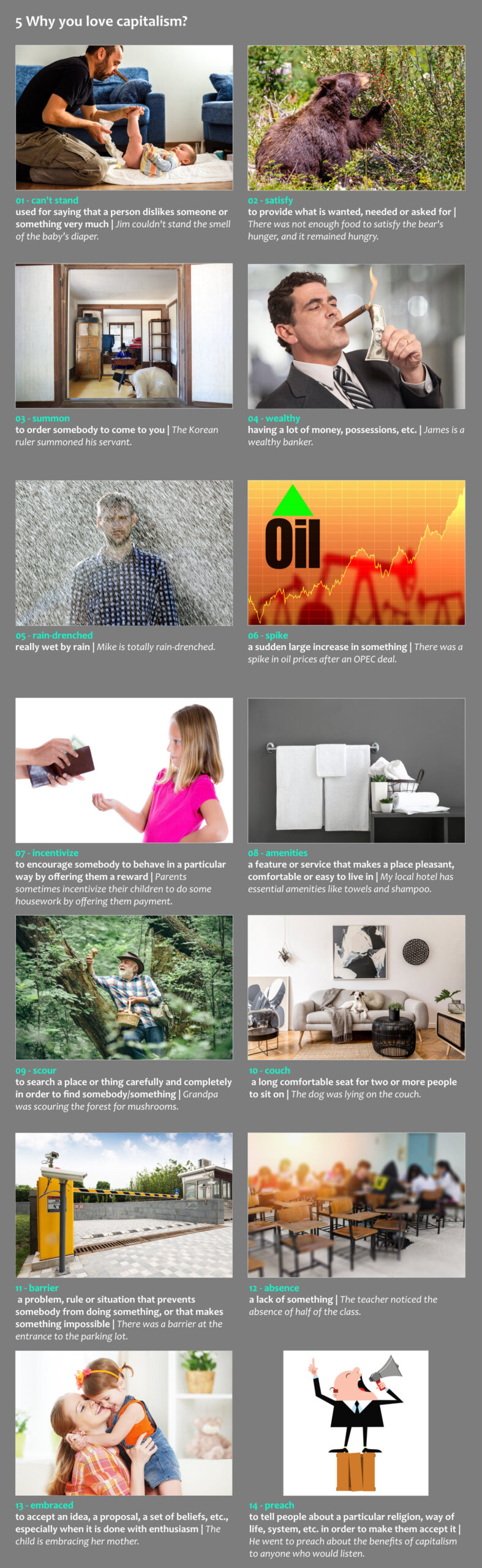
06 Love Needs Laughs (steps 1, 3 and 5)
I grew up in the former Soviet Union. My parents and I lived in a communal apartment with nine other families. When my parents wanted to be romantic they would send me to look out the window.
One day my dad said, “So what did you see out the window?”I said, “Our neighbors being romantic.”He said, “How could you tell?”I said, “Because their son is looking at me.”
My parents laughed. At that moment, I felt that I was in the presence of love. As a child, I made the discovery that laughter must be the way people communicate to one another that they’re happy.
Did you know that there has been actual research into the relationship between laughter and happy marriages? For over four decades, Dr. John Gottman, Professor of Psychology at the University of Washington, has studied thousands of couples in both successful relationships and not-so-successful ones. “Couples who laugh together,” he concludes, “last together.”
Here’s how it works: we make each other happy first and then laughter reassures us that we are on the right track. The fading away of laughter may be the best way to tell if your relationship has gone off course.
So here is what I want you to start doing: listen for laughter in your relationship.
And not just any laughter – listen for moments when you share laughter together. If that isn’t happening just about every day, it is time to do something about it.
Let me give you an example from my own life. One night, I was putting my son Alexander to bed. He was cranky and crying. My wife said to me, “I’ll show you how to put the baby to sleep.” She took Alexander from me and put him in the bassinet and put the bassinet on top of the dryer. Two minutes later he was sound asleep. I said “Oh great. All other kids are going to go to daycare center. I’ll have to drop him off at the laundromat. Oh, that bundle? Yeah, that one is mine.”
My wife did not laugh. As a comedian, I should have caught that. In my show, if a joke doesn’t get a laugh, I analyze what went wrong. Perhaps change the set-up, or a punch line to get the laughter back. I use laughter as a gauge of the happiness of my audience. At that time, I did not understand that it could be applied to my personal life as well. If I had understood that laughter was a gauge of happiness, I might have saved my marriage.
As I started to research the science of happiness, I learned that when there is a genuine connection between people, laughter is the first thing that happens as a confirmation of a happy relationship.
The intimacy comes next and then people get married and live together.
When things are not working, laughter is the first thing to go.
Second thing to go is intimacy.
Third thing is your house.
Of course, marriages and relationships break up for all sorts of reasons. But, I can say with confidence, if you’re not laughing, there is trouble ahead.
So, how do you get the laughter back if you’ve lost it? Every relationship is different, of course, but there is one constant: To laugh together, you need to be together. And that literally means time together.
You need to start by making a decision that time together is important and it’s not negotiable. Set a date night, take a dance lesson, a cooking class. Doesn’t matter what you do. You just have to do it.
According to the U.S. Bureau of Labor Statistics, American couples sleep an average 7.2 hours a day, work 8.5 hours a day, and watch television 2.4 hours a day. Then they wanted to know how much time are we intimate with one another. They combined hugging, kissing, cuddling and lovemaking. It was one minute a day.
So if you’re doing it for 20 minutes, you’re using somebody else’s minutes…And they don’t roll over.
I believe that if you understand the connection between happiness and laughter, you’ll be way ahead of those statistics. You will have better or even best chance to have a long, lasting happy relationship.
Just like the gas gauge in your car let’s you know how much gas you have in your tank, laughter can let you know how much happiness you have in your relationship.
The goal is to live happily ever laughter. And maybe make love more than one minute a day.
I’m Yakov Smirnoff for Prager University.
I grew up in the former Soviet Union. My parents and I lived in a communal apartment with nine other families. When my parents wanted to be romantic they would send me to look out the window.
communal1: shared by, or for the use of, a number of people, especially people who live together | Jane and the people in his apartment had a communal garden, which everyone would use from time to time.
One day my dad said, “So what did you see out the window?” I said, “Our neighbors being romantic.” He said, “How could you tell?” I said, “Because their son is looking at me.”
My parents laughed. At that moment, I felt that I was in the presence of love. As a child, I made the discovery that laughter must be the way people communicate to one another that they’re happy.
in the presence of somebody/something2: with somebody/something in the same place | The minister is signing a document in the presence of the Queen of France.
laughter3: the act or sound of laughing | The air was filled with the two friends’ laughter.
Did you know that there has been actual research into the relationship between laughter and happy marriages? For over four decades, Dr. John Gottman, Professor of Psychology at the University of Washington, has studied thousands of couples in both successful relationships and not-so-successful ones. “Couples who laugh together,” he concludes, “last together.”
research4: a careful study of a subject, especially in order to discover new facts or information about it | Scientists are doing research on the growth of cancer cells.
last: to continue to happen or exist | My laptop’s battery lasts around 3 hours; after this time I have to recharge it.
Here’s how it works: we make each other happy first and then laughter reassures us that we are on the right track. The fading away of laughter may be the best way to tell if your relationship has gone off course.
So here is what I want you to start doing: listen for laughter in your relationship.
reassure: to say or do something that makes somebody less frightened or worried | The government reassured businesses that they will not raise taxes in the coming year.
fade away5: to gradually become less strong or clear and then disappear | John bought an old car with a faded away red colour.
(go) off course6: a ship, plane, etc. moving in the wrong direction | In the snowy weather, the car went off course, into a ditch.
And not just any laughter – listen for moments when you share laughter together. If that isn’t happening just about every day, it is time to do something about it.
share7: to divide something between two or more people | Mikhael shared his sandwich with his girlfriend.
Let me give you an example from my own life. One night, I was putting my son Alexander to bed. He was cranky and crying. My wife said to me, “I’ll show you how to put the baby to sleep.” She took Alexander from me and put him in the bassinet and put the bassinet on top of the dryer. Two minutes later he was sound asleep. I said “Oh great. All other kids are going to go to daycare center. I’ll have to drop him off at the laundromat. Oh, that bundle? Yeah, that one is mine.”
cranky8: easily annoyed | Little Chris got cranky because he did not sleep enough last night.
bassinet9: a small bed for a baby, that looks like a basket; a Moses basket | The baby was sleeping in the blue bassinet.
laundromat10: a place where you can wash and dry your clothes in machines that you pay to use | The laundromat is open now.
My wife did not laugh. As a comedian, I should have caught that. In my show, if a joke doesn’t get a laugh, I analyze what went wrong. Perhaps change the set-up, or a punchline to get the laughter back. I use laughter as a gauge of the happiness of my audience. At that time, I did not understand that it could be applied to my personal life as well. If I had understood that laughter was a gauge of happiness, I might have saved my marriage.
punchline: the last few words of a joke that make it funny | Jimmy forgot the punchline of his joke.
gauge11: an instrument for measuring the amount or level of something | The fuel gauge of my car indicated that I was running out of petrol.
As I started to research the science of happiness, I learned that when there is a genuine connection between people, laughter is the first thing that happens as a confirmation of a happy relationship.
The intimacy comes next and then people get married and live together.
genuine12: real; exactly what it appears to be | Whilst in the museum, we went to see the genuine Mona Lisa.
intimacy13: the state of having a close personal relationship with somebody | The friends had formed a close intimacy with each other.
When things are not working, laughter is the first thing to go.
Second thing to go is intimacy.
Third thing is your house.
Of course, marriages and relationships break up for all sorts of reasons. But, I can say with confidence, if you’re not laughing, there is trouble ahead.
So, how do you get the laughter back if you’ve lost it? Every relationship is different, of course, but there is one constant: To laugh together, you need to be together. And that literally means time together.
literally14: for real, rather than in an abstract or poetic meaning | Janet literally fell down laughing.
You need to start by making a decision that time together is important and it’s not negotiable. Set a date night, take a dance lesson, a cooking class. Doesn’t matter what you do. You just have to do it.
negotiable: if something is negotiable, you can discuss it or change it before you make a final agreement or decision | The price of the laptop was non negotiable (= there was no way to change it).
According to the U.S. Bureau of Labor Statistics, American couples sleep an average 7.2 hours a day, work 8.5 hours a day, and watch television 2.4 hours a day. Then they wanted to know: how much time are we intimate with one another? They combined hugging, kissing, cuddling and lovemaking. It was one minute a day.
cuddle15: to hold somebody/something close in your arms to show love | The baby girl was cuddling her teddy bear.
So if you’re doing it for 20 minutes, you’re using somebody else’s minutes … And they don’t roll over.
roll over16: to move something valuable such as an amount of money or stock etc. from one place to another | There hasn’t been a winning lottery ticket for months, so the rolled-over value of the jackpot is now over £14M.
I believe that if you understand the connection between happiness and laughter, you’ll be way ahead of those statistics. You will have better or even best chance to have a long, lasting happy relationship.
Just like the gas gauge in your car let’s you know how much gas you have in your tank, laughter can let you know how much happiness you have in your relationship.
The goal is to live happily ever laughter. And maybe make love more than one minute a day.
I’m Yakov Smirnoff for Prager University.
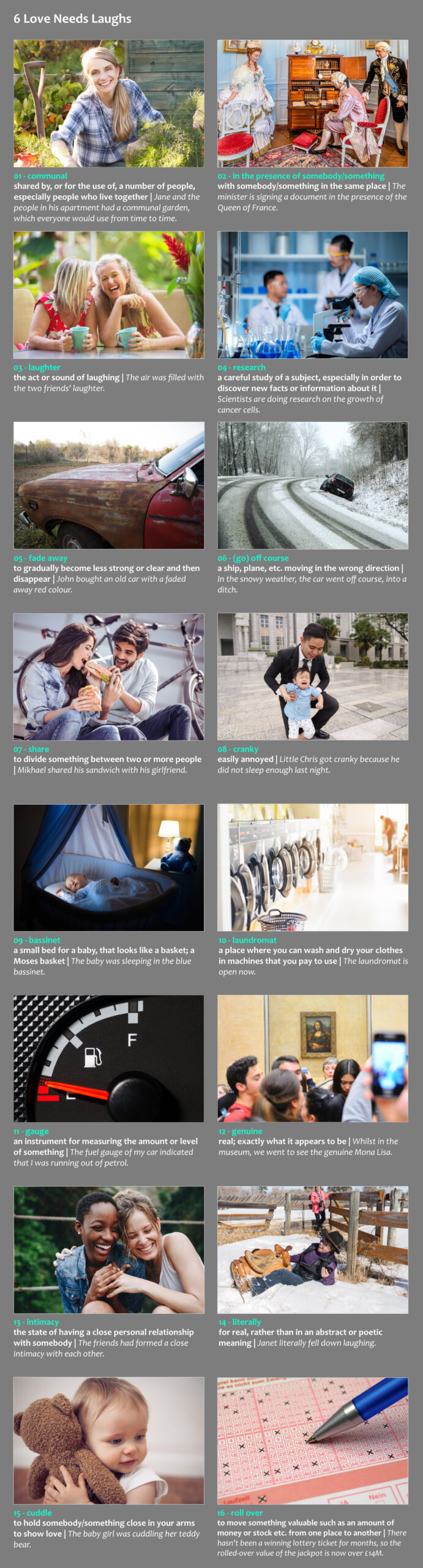
07 A Secret To Success (steps 1, 3 and 5)
Countless books, seminars, and gurus promise to teach you the “secrets” to success. Well, here’s my secret: There are no secrets to success.
Actually, it’s pretty simple. Want to excel in whatever you do? Get to work. Keep working. And don’t stop until the job is done. That’s called “work ethic.”
I’m the sideline reporter for NBC’s Sunday Night Football. I won’t lie – it’s a dream job. But it isn’t a dream-come-true. There’s no fantasy involved. Just a lifetime of hard work.
I had my first real job at 13. I was a papergirl. I delivered newspapers to people’s homes and sold subscriptions door-to-door. That job taught me persistence. I learned that to succeed, especially in sales, you have to knock on a lot of doors.
In high school, I worked at Baskin Robbins. The manager didn’t appreciate it when I gave out overly-generous portions to customers. That taught me accountability. Until you run the show, you answer to the person who does.
A few years later, I worked as a telemarketer for an insurance company. A lot of people look down on telemarketers. I don’t. If you think a legitimate job is beneath you, you don’t deserve that job – or any other. Like all telemarketers, I was rejected far more often than not. Usually, I didn’t get past the first sentence. But sometimes I did – enough to make some good money. The path to success is paved with failure.
As a waitress in college, I learned that you need to smile and treat customers well, even when you’re having a bad day. Leave your mood at the door, or expect to be shown the door.
After I graduated, I had seven jobs – count ‘em, seven! One of those was a public relations assistant in Los Angeles. It was fun, but it involved ridiculously long hours. That was okay, though. I got used to it. And when long hours were called for later, I was ready.
I went from PR to producing a morning radio show. The host had talent. We put out a good product. But it wasn’t enough – because timing and luck are also important, and you can’t control those. You can only control what you do. You just have to keep working. What choice do you have?
The radio show gave me the idea that I could be a host – the talent. I put together a demo and sent it out to every station I could find an address for. I finally caught the eye of a sports show in Charlotte, North Carolina. I decided that I would never think of myself as a “female sports reporter,” but just as a sports reporter. My ambition is to be the best sports journalist, period. What does being a woman have to do with it?
As the newbie, I was at the station all day, and took every assignment that I could, especially the ones no one else wanted. After five months, TV stations noticed I was scooping their stories and started calling. One of those was CBS Sports. I took that job.
It was a huge jump, and it put me under a microscope. I wasn’t used to that. I made a lot of mistakes – some honest ones, and some really dumb ones. All of them were public. My bosses didn’t hold back their displeasure, and neither did the viewers. This pushed me to screw-up less and taught me how to deal with criticism. Mistakes are life’s way of highlighting what you need to improve. So I kept making mistakes, and I kept improving.
After 5 years, I was offered a job at ESPN. After 10 years there, I joined NBC, where I am now.
After all of that – a lifetime of work – I think I’ve learned what it takes to succeed.
Whether it’s your first job or your dream job, the formula is always the same: Get to work. Keep working. And don’t stop until the job is done.
That’s the secret – that’s not a secret – to success.
I’m Michele Tafoya for Prager University.
Countless books, seminars, and gurus promise to teach you the “secrets” to success. Well, here’s my secret: There are no secrets to success.
countless: very many; too many to be counted or mentioned | I warned my sister not to go too close to the lake countless times.
Actually, it’s pretty simple. Want to excel in whatever you do? Get to work. Keep working. And don’t stop until the job is done. That’s called “work ethic.”
excel1: to be very good at doing something | He excelled at creating new songs on the guitar.
I’m the sideline reporter for NBC’s Sunday Night Football. I won’t lie – it’s a dream job. But it isn’t a dream-come-true. There’s no fantasy involved. Just a lifetime of hard work.
sideline2: an activity that you do as well as your main job in order to earn extra money | Within a couple of years, Harry’s hobby of winemaking has become a very profitable sideline.
involved3: taking part in something; being part of something or connected with something | Dozens of vehicles were involved in the crash.
I had my first real job at 13. I was a papergirl. I delivered newspapers to people’s homes and sold subscriptions door-to-door. That job taught me persistence. I learned that to succeed, especially in sales, you have to knock on a lot of doors.
subscription: an amount of money that you pay regularly to receive a service, be a member of a club or receive regular copies of a newspaper or magazine | I have annual subscriptions to Netflix and Amazon Prime.
persistence: the fact of continuing to try to do something even if there are difficulties | My brother’s persistence finally paid off when he got a high paying job.
In high school, I worked at Baskin Robbins. The manager didn’t appreciate it when I gave out overly-generous portions to customers. That taught me accountability. Until you run the show, you answer to the person who does.
appreciate: to be grateful for something that somebody has done; to welcome something | I appreciate when my kids clean up their rooms.
generous4: more than is necessary; large | There is a generous amount of parking space for cars.
overly-generous5: giving too much of something | Santa is overly-generous with the presents this year.
portion6: an amount of food that is large enough for one person | I had one portion of lasagna to eat.
accountability: the fact of being responsible for your decisions or actions and expected to explain them when you are asked | Waiters are accountable for how they treat the guests.
A few years later, I worked as a telemarketer for an insurance company. A lot of people look down on telemarketers. I don’t. If you think a legitimate job is beneath you, you don’t deserve that job – or any other. Like all telemarketers, I was rejected far more often than not. Usually, I didn’t get past the first sentence. But sometimes I did – enough to make some good money. The path to success is paved with failure.
telemarketer7: a person selling things and taking orders for sales by phone | Jonah worked as a telemarketer for a large mobile phone company.
legitimate: allowed and acceptable according to the law; legal | My uncle is running a strictly legitimate business by selling antique postcards from all over the world.
deserve8: to do something or show qualities for which a particular reaction, reward or punishment is appropriate | The comedian deserves applause for his witty performance. | The boy deserved the punishment for his bad behaviour.
reject9: to refuse to accept or consider something | Janey rejected the roses.
more often than not: usually; in a way that is typical of somebody/ something | More often than not, I get up early in the morning.
the path to success10: the road to achieving something that you want | The path to success in business is through climbing the corporate ladder (i.e. promotions).
pave (the way): to create a situation in which somebody will be able to do something, or something can happen | Martin’s idea of building electric cars paved the way for massive changes in the car industry.
failure: lack of success in doing or achieving something | Thomas’ failures in building a successful business by himself meant he eventually needed to get a job.
As a waitress in college, I learned that you need to smile and treat customers well, even when you’re having a bad day. Leave your mood at the door, or expect to be shown the door.
treat (well): to behave – act – nicely towards someone | As the company leader, Lisa always treated her employees well: she was always kind to them and never yelled at them.
mood11: the way you are feeling at a particular time | Peter was in a bad mood all day.
show the door: to ask somebody to leave, because they are no longer welcome | James was shown the door by the manager.
After I graduated, I had seven jobs – count ‘em, seven! One of those was a public relations assistant in Los Angeles. It was fun, but it involved ridiculously long hours. That was okay, though. I got used to it. And when long hours were called for later, I was ready.
graduate12: to get a degree, especially your first degree, from a university or college | Jenna has just graduated.
count’em: count them (1,2,3,4,5 …)
public relations (PR): the business of giving the public information about a particular organization or person in order to create a good impression | Jonathan works in public relations.
ridiculously13: to a silly or unreasonable degree | The orange juice was ridiculously expensive in the café.
call for: to need something | Extreme situations call for extreme responses.
I went from PR to producing a morning radio show. The host had talent. We put out a good product. But it wasn’t enough – because timing and luck are also important, and you can’t control those. You can only control what you do. You just have to keep working. What choice do you have?
host14: a person who introduces a television or radio show and talks to guests | Janet, the host, read the viewers’ messages.
The radio show gave me the idea that I could be a host – the talent. I put together a demo and sent it out to every station I could find an address for. I finally caught the eye of a sports show in Charlotte, North Carolina. I decided that I would never think of myself as a “female sports reporter,” but just as a sports reporter. My ambition is to be the best sports journalist, period. What does being a woman have to do with it?
period: When you add ‘period’ to the end of a statement, you indicate that no further discussion is possible or desirable. | New York is in America, period.
As the newbie, I was at the station all day, and took every assignment that I could, especially the ones no one else wanted. After five months, TV stations noticed I was scooping their stories and started calling. One of those was CBS Sports. I took that job.
newbie: a person who is new to a particular environment or activity and has little experience | Jon is a newbie at playing baseball.
assignment: a task or piece of work that somebody is given to do, usually as part of their job or studies | Correy had to write an essay assignment on World War 2 as a part of his History university degree.
scoop: to publish a story before all the other newspapers, television companies, etc. | The local newspaper scooped the national papers covering the prime minister’s visit to the newly opened school.
It was a huge jump, and it put me under a microscope. I wasn’t used to that. I made a lot of mistakes – some honest ones, and some really dumb ones. All of them were public. My bosses didn’t hold back their displeasure, and neither did the viewers. This pushed me to screw up less and taught me how to deal with criticism. Mistakes are life’s way of highlighting what you need to improve. So I kept making mistakes, and I kept improving.
dumb: stupid | People make dumb mistakes when they are young.
displeasure15: the feeling of being upset and annoyed | Evelyn experienced displeasure throughout the business meeting.
screw up16: to deal with a situation very badly | The factory worker got told off because he screwed up.
deal with: to take appropriate action in a particular situation | Breathing techniques help you to deal with stress.
highlight: to emphasize something, especially so that people give it more attention | Celebrities’ successes and failures are always highlighted by newspapers.
After 5 years, I was offered a job at ESPN. After 10 years there, I joined NBC, where I am now.
After all of that – a lifetime of work – I think I’ve learned what it takes to succeed.
Whether it’s your first job or your dream job, the formula is always the same: Get to work. Keep working. And don’t stop until the job is done.
That’s the secret – that’s not a secret – to success.
I’m Michele Tafoya for Prager University.
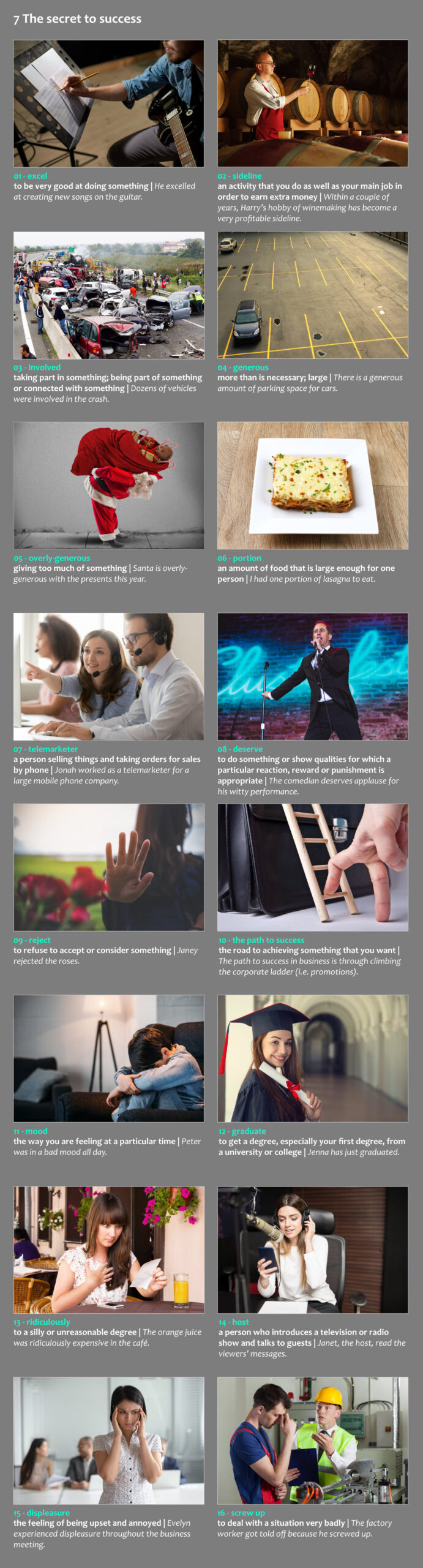
08 What Is Fair (steps 1, 3 and 5)
Life isn’t fair.
And you know what? It can’t be.
Here’s the problem: The word “fair” doesn’t mean “justice” or “equity” or, indeed, anything very specific. Instead, it’s become a sort of all-purpose statement of moral superiority—superiority tinged, paradoxically, with victimhood.
Now, fairness does have an exact meaning in certain contexts. For example, if we’re playing a game, fairness means that the rules should be applied impartially. When we are kids and our parents and teachers set the rules, the word still has that essential meaning: it’s a young person’s way of demanding what we might call “equality before the law.” But as we get older, the word becomes more of a whine. In the mouth of a teenager—trust me on this—“it’s not fair” means, more often than not, “You won’t let me do something I want!”
In recent years, though, something odd has happened. Adults have started using the word in much the same way that teenagers do. More than in any previous generation, people today retain their teenage sense of self-centeredness. They use “it’s not fair” as a catch-all complaint, as an assertion of wounded entitlement.
Look at a Google graph of the use of the word “fairness.” From around 1965 it looks like the proverbial hockey stick—flat and then it suddenly shoots up.
We’ve developed a “fairness” obsession.
But what do we mean when we use that word? Do we mean “justice”? Do we mean “equality”? Do we mean “need”? Or do we mean something else?
Suppose you and Jane buy a cake together. You pay $6, and Jane pays $4. What would be the “fair” way to split it up? You could do it on the basis of proportionality—in other words, you get 60 percent of the cake and Jane gets 40 percent. Or you could do it on the basis of strict egalitarianism—half each, regardless of who paid what. Or you could do it on the basis of wealth. Jane has much less money than you for non-essentials like cake, so maybe she should get the larger share.
A case can be made for each approach. But the beauty of the word “fair” is that it doesn’t require you to come down clearly in favor of any of them. It gives you the cover of ambiguity.
So, for example, when a politician says, “We want the rich to pay their fair share,” he doesn’t usually mean that he wants the rich to pay taxes at the same rate as everyone else. He means that he wants them to pay extra. The word “fair” lets him present higher rates of taxation as a form of justice. But only if we don’t think about it too hard.
That’s the beauty of it. “Fair” doesn’t ultimately mean “proportionate” or “impartial” or “equal.” You can use it to mean almost any positive thing you like.
“I want fairness” generally means “Look at me—I’m a nice person.” Demanding fairness lets you tell the world how decent you are without your actually having to contribute a penny. It’s a kind of vanity: “Mirror, Mirror, on the wall, who’s the fairest of them all?”
Let’s get real. The only just way to distribute the cake is to see how much people are prepared to pay for their slice.
Sure, that could leave a banker with a bigger slice than a baker. Sure, we might not like that distribution. We might feel that the baker is doing something more valuable than the banker. He is making delicious pastries, while the money man doesn’t seem to be making anything—except money for himself.
But how can we judge someone else’s economic worth? You might want bakers to be paid more than bankers. I might want teachers to be paid more than movie stars. Since we all have our own preferences, the only way to measure the economic value of a service is to see how much others are prepared to pay for it.
That’s what the market does: it aggregates our preferences. It doesn’t ask us, in the abstract, what we think someone else deserves. It tests, in reality, how many hours of our own labor we are prepared to put in in exchange for a product or a service.
Under every other economic system, our relations are mediated by accidents of birth and social caste; financial rewards are determined by favoritism. The free market alone gives everyone the same rights. My money is as good as yours.
You can’t get fairer than that.
I’m Daniel Hannan, president of the Initiative for Free Trade and author of Inventing Freedom, for Prager University.
Life isn’t fair.
And you know what? It can’t be.
Here’s the problem: The word “fair” doesn’t mean “justice” or “equity” or, indeed, anything very specific. Instead, it’s become a sort of all-purpose statement of moral superiority—superiority tinged, paradoxically, with victimhood.
justice1: the fair treatment of people | Lady Justice (from the Latin Iustitia) is an allegorical personification of justice. Her attributes are a blindfold, a balance, and a sword.
equal2: having the same rights or being treated the same as other people, without differences such as race, religion or sex being considered | Everyone who came to the meeting was considered equal .
equity3: a situation in which everyone is treated equally | There is more equity in society than ever before.
superior4: showing by your behaviour that you think you are better than others | People sometimes try to look superior to others.
superiority: the state or quality of being better, more powerful, greater, etc. than others | The British settlers had technological superiority over the Native Americans.
tinge5: to add a small amount of a particular emotion or quality to something | During his session with the counselor, sadness tinged Tom’s voice.
victim6: a person or thing that is badly affected by a situation, a decision, etc. | Johnny was a victim of violence.
victimhood: the state of being a victim | After being attacked, Johnny was left with a sense of victimhood.
Now, fairness does have an exact meaning in certain contexts. For example, if we’re playing a game, fairness means that the rules should be applied impartially. When we are kids and our parents and teachers set the rules, the word still has that essential meaning: it’s a young person’s way of demanding what we might call “equality before the law.” But as we get older, the word becomes more of a whine. In the mouth of a teenager—trust me on this—“it’s not fair” means, more often than not, “You won’t let me do something I want!”
certain: that one, not another | I need certain size shoes. (= I need that size, not another one.)
impartial: not supporting one person or group more than another | Referees in football should be impartial.
demand7: to make a very strong request for something | Jack demanded the rent fee immediately .
whine8: to make a long, high, unpleasant sound because you are in pain or unhappy | The puppy whined for her mother. https://freesound.org/search/?q=whining+dog .
In recent years, though, something odd has happened. Adults have started using the word in much the same way that teenagers do. More than in any previous generation, people today retain their teenage sense of self-centeredness. They use “it’s not fair” as a catch-all complaint, as an assertion of wounded entitlement.
odd: strange or unusual | The scientists who came into town were odd.
retain: to keep something; to continue to have something | James retained his positivity during his old age.
self-centeredness9: the fact of thinking only about yourself and not about the needs or feelings of other people | Jenifer’s self-centeredness was shown during her training sessions in the gym: she kept taking selfies .
complaint10: a reason for not being satisfied; a statement that somebody makes saying that they are not satisfied | Susie made a complaint over the phone about her airline ticket.
a catch-all complaint: a very general complaint | A catch-all complaint for customers was the price of meals in 5-star hotels.
assertion: the act of stating, using or claiming something strongly | The king’s assertion that he was divine was met with disbelief.
wounded11: hurt | The cat’s paw was wounded.
entitlement: the feeling of having a right to the good things in life without necessarily having to work for them | Jane constantly complains about the entitlement of young people in the West.
Look at a Google graph of the use of the word “fairness.” From around 1965 it looks like the proverbial hockey stick—flat and then it suddenly shoots up.
proverb: a well-known phrase or sentence that gives advice or says something that is generally true | Mona liked to memorise proverbs in her spare time.
proverbial: well known and talked about by a lot of people; famous | Hungarian people’s hospitality is proverbial.
obsessed12: to completely fill your mind so that you cannot think of anything else, in a way that is not normal | Michael’s grandad was obsessed with acoustic guitars and ukuleles. His workshop was filled with them.
obsession: the state in which a person’s mind is completely filled with thoughts of one particular thing or person in a way that is not normal | Jane was worried about her husband’s obsession with guitars.
But what do we mean when we use that word? Do we mean “justice”? Do we mean “equality”? Do we mean “need”? Or do we mean something else?
Suppose, you and Jane buy a cake together. You pay $6, and Jane pays $4. What would be the “fair” way to split it up? You could do it on the basis of proportionality—in other words, you get 60 percent of the cake and Jane gets 40 percent. Or you could do it on the basis of strict egalitarianism—half each, regardless of who paid what. Or you could do it on the basis of wealth. Jane has much less money than you for non-essentials like cake, so maybe she should get the larger share.
suppose: to imagine what would happen if something were true | “Suppose that all flights are cancelled, where can we stay then?” asked Janet.
proportion13: a part or share of a whole | Everyone got the same proportion of the iced coffee with ice cream.
proportionality: based on the correct relationship in size, degree, importance, etc. between one thing and another | The food has to be divided based on proportionality.
egalitarianism: the belief that everyone is equal and should have the same rights and opportunities | My father always followed the rules of egalitarianism: I and my brother shared everything in 50-50%.
wealth14: the state of being rich | Dorothy’s wealth was evident in her owning a private jet.
share15: one part of something that is divided between two or more people | Pocket money was given out in a way that some children received a larger share than others.
A case can be made for each approach. But the beauty of the word “fair” is that it doesn’t require you to come down clearly in favor of any of them. It gives you the cover of ambiguity.
approach: a way of dealing with somebody/something; a way of doing or thinking about something such as a problem or a task | People take different approaches to decide what is important in life.
ambiguity: the state of having more than one possible meaning | Humour depends on ambiguity.
So, for example, when a politician says, “We want the rich to pay their fair share,” he doesn’t usually mean that he wants the rich to pay taxes at the same rate as everyone else. He means that he wants them to pay extra. The word “fair” lets him present higher rates of taxation as a form of justice. But only if we don’t think about it too hard.
That’s the beauty of it. “Fair” doesn’t ultimately mean “proportionate” or “impartial” or “equal.” You can use it to mean almost any positive thing you like.
ultimately: in the end; finally | Ultimately, a bad diet may lead to illness.
“I want fairness” generally means “Look at me—I’m a nice person.” Demanding fairness lets you tell the world how decent you are without your actually having to contribute a penny. It’s a kind of vanity: “Mirror, Mirror, on the wall, who’s the fairest of them all?”
contribute16: to give something, especially money or goods, to help achieve or provide something | Jayne contributed to her family’s savings as much as she could.
vain17: too proud of your own appearance, abilities or achievements | David is vain.
vanity: the fact of being too proud of your own appearance, abilities or achievements | David’s vanity was one of his major personality flaws.
Let’s get real. The only just way to distribute the cake is to see how much people are prepared to pay for their slice.
distribute18: to give things to a large number of people; to share something between a number of people | Teresa works at a food bank; her job is to distribute food to refugee children.
Sure, that could leave a banker with a bigger slice than a baker. Sure, we might not like that distribution. We might feel that the baker is doing something more valuable than the banker. He is making delicious pastries, while the money man doesn’t seem to be making anything—except money for himself.
pastries19: a mixture of flour, fat and water or milk that is rolled out flat to be a base or cover for a pie, etc. | There were french pastries on the table.
But how can we judge someone else’s economic worth? You might want bakers to be paid more than bankers. I might want teachers to be paid more than movie stars. Since we all have our own preferences, the only way to measure the economic value of a service is to see how much others are prepared to pay for it.
measure20: to find the size, quantity, etc. of something in standard units | The joiner is measuring the table.
That’s what the market does: it aggregates our preferences. It doesn’t ask us, in the abstract, what we think someone else deserves. It tests, in reality, how many hours of our own labor we are prepared to put in in exchange for a product or a service.
aggregate21: a total number or amount made up of smaller amounts that are collected together | The mining truck aggregated all the rocks in one place.
labor: work, especially physical work | The price of a table includes labor and materials.
in exchange for something22: the act of giving something to someone and them giving you something else | In exchange for seeds, they received a bottle of water.
Under every other economic system, our relations are mediated by accidents of birth and social caste; financial rewards are determined by favoritism. The free market alone gives everyone the same rights. My money is as good as yours.
mediate: to influence something and/or make it possible to happen | Educational success is mediated by economic factors.
caste: any of the four main divisions of Hindu society, originally those made according to functions in society | Indian society is divided into castes.
reward23: a thing that you are given because you have done something good, worked hard, etc. | Dennis was rewarded by a promotion for his work.
financial rewards: rewards connected with money and finance | He received financial rewards based on his performance in the company.
favoritism: the act of unfairly treating one person better than others because you like them better | Parents sometimes show favoritism towards one of their children.
You can’t get fairer than that.
I’m Daniel Hannan, president of the Initiative for Free Trade and author of Inventing Freedom, for Prager University.

09 All I Want to Do Is Make Cookies (steps 1, 3 and 5)
I own a small business with seven employees. We make cookies—but not just any cookies. We make sugar-free cookies that diabetics can eat. Actually, they’re so tasty, anyone can enjoy them. That was the inspiration that motivated me to start this business.
You see, I am a diabetic myself. I have been one my whole life.
If you think running a cookie company is fun and games, think again. I work a hundred hours a week—which isn’t unusual for small business owners. I make a nice living, but I’m not in it for the money. I love what I do.
I’d better. My margins are very tight—around 1%. That means I have to sell a million dollars’ worth of cookies to make $10,000. Every penny counts—literally. That’s why I get so frustrated with government regulations.
Now, let me be clear: some regulations are necessary—especially, for obvious reasons, in the food industry. But “necessary” and “excessive” are two entirely different things. Excessive, UN-necessary regulations soak up valuable hours of my time and my money for no good purpose.
That 100 hours I work per week? I estimate 36 of them are spent on compliance issues alone. This keeps me away from activities that would help me grow my business—like sales and product development.
And that keeps me away from hiring more people.
My employees are like family to me. It’s that way with most small businesses. But it’s a struggle every single day.
I could be more productive and feel a lot less anxiety if I didn’t have to fight my own government; or, should I say, governments—federal, state and local. I get the roads and the bridges and the national defense, but I don’t get why they have to be involved in every tiny aspect of my business, sometimes competing with each other as to who can make my life more difficult.
For example, as a bakery, I’m under the jurisdiction of the Food and Drug Administration (FDA), the Department of Agriculture, and the Occupational Safety and Health Administration (OSHA). I also have to deal with the state health agency.
They all have different rules. If these rules contradict one another, it’s not their problem; it’s mine.
A few years ago, the FDA inspector showed up for one of his random inspections. He noticed the door to the area in which we bake our cookies swung out as you walked in. He told me that was a code violation. The doors have to swing in. I had 30 days to fix it or I’d be fined thousands of dollars.
I should note we have an air curtain between both rooms so no food particles can get in or out of the baking area. I pointed this out. The inspector was unmoved.
A few months later, the inspector from the Ag Department shows up for one of his random inspections. He notices that the door swings in. Yes, I tell him. It does. It’s an FDA regulation.
No, he tells me, it has to swing out. Fix it within 30 days, he says, or you’ll be fined
I started keeping two sets of doors: one that swings in for the FDA, and one that swings out for the Ag Department.
Here’s another example:
The FDA requires bakeries to send a sample of every product batch to a 3rd-party lab for testing. We make 36 batches a day. That means we have to send 36 bags of cookies every day to that lab. This costs me tens of thousands of dollars every year. And remember, in order to make 10,000 dollars, I have to sell a million dollars in cookies.
We’ve never had a bad test. Hardly surprising. Making cookies isn’t that complex. The ingredients are well-known and safe.
I’m all for testing, but how about one bag out of every ten batches? That alone might double my profit margin to 2%!
One more example:
The government demands that the type on my packaging be a certain size. Fine. I hired a company that does this sort of work to do the printing. The inspector gets out his magnifying glass and decides the font is off by 1/100th of an inch. All the packaging has to be trashed and a whole new set ordered. That cost me $15,000. Or 1.5 million dollars in cookies to make that money back.
Another time, we didn’t include the word “coconut” in the allergy section of the package. We didn’t think it was necessary, as these were coconut cookies. All that packaging had to be redone, too. That cost me $68,000. Or 6.8 million dollars’ worth of cookies to make that money back.
I could go on. So could anyone who owns a small business, but you get the idea.
Small businesses are responsible for 60 million jobs. We could be responsible for a lot more—if the politicians who pass these laws and the bureaucrats who enforce them would back off.
Common sense regulation—I’m all for it.
Excessive, unnecessary, wasteful regulation? I need to get back to work.
I’m Joseph Semprevivo, president of Joseph’s Lite Cookies, for Prager University.
I own a small business with seven employees. We make cookies—but not just any cookies. We make sugar-free cookies that diabetics can eat. Actually, they’re so tasty, anyone can enjoy them. That was the inspiration that motivated me to start this business.
diabetic: a person having a medical condition in which the body cannot produce enough insulin to control the amount of sugar in the blood | Diabetics have to carefully monitor what they eat.
You see, I am a diabetic myself. I have been one my whole life.
If you think running a cookie company is fun and games, think again. I work a hundred hours a week—which isn’t unusual for small business owners. I make a nice living, but I’m not in it for the money. I love what I do.
I’d better. My margins are very tight—around 1%. That means I have to sell a million dollars’ worth of cookies to make $10,000. Every penny counts—literally. That’s why I get so frustrated with government regulations.
profit margin: the difference between the cost of buying or producing something and the price that it is sold for | The bank’s profit margins started to shrink in 2008.
regulation: an official rule made by a government or some other authority (eg. the police, the local government, child service etc.) | There were new bank regulations after the Financial Crisis.
Now, let me be clear: some regulations are necessary—especially, for obvious reasons, in the food industry. But “necessary” and “excessive” are two entirely different things. Excessive, UN-necessary regulations soak up valuable hours of my time and my money for no good purpose.
excessive: greater than what seems reasonable or appropriate | Excessive drinking can lead to stomach disorders.
soak up1: A) to take in and hold liquid | The sponge was soaking up the water in the sink.
B) to use a large amount of (money, supplies, etc.) | The house expenses soaked up all our saved money.
purpose2: the thing that something is supposed to achieve | The purpose of social benefit (= money to help people) is to help those who live in very poor conditions.
That 100 hours I work per week? I estimate 36 of them are spent on compliance issues alone. This keeps me away from activities that would help me grow my business—like sales and product development.
compliance: the practice of obeying rules or requests made by people in authority | Business must ensure that their practice is in compliance with the law.
And that keeps me away from hiring more people.
My employees are like family to me. It’s that way with most small businesses. But it’s a struggle every single day.
struggle3: to try very hard to do something when it is difficult or when there are a lot of problems | Janet struggled to pull the rock up the hill.
I could be more productive and feel a lot less anxiety if I didn’t have to fight my own government; or, should I say, governments—federal, state and local. I get the roads and the bridges and the national defense, but I don’t get why they have to be involved in every tiny aspect of my business, sometimes competing with each other as to who can make my life more difficult.
anxiety4: the state of feeling nervous or worried that something bad is going to happen | Maria felt constant anxiety about her future.
federal: having a system of government in which the individual states of a country have control over their own affairs – problems and situations – , but are controlled by a central government for national decisions, etc. | The federal government of the USA has two bodies: the Senate and the Congress.
compete5: to try to be more successful or better than somebody else who is trying to do the same as you | The two racehorses competed against each other, in order to win the race.
For example, as a bakery, I’m under the jurisdiction of the Food and Drug Administration (FDA), the Department of Agriculture, and the Occupational Safety and Health Administration (OSHA). I also have to deal with the state health agency.
jurisdiction: the authority (the power) that an official organization has to make legal decisions about somebody/something | Banks in the United Kingdom are under the jurisdiction of the Bank of England.
Food and Drug Administration: The Food and Drug Administration (FDA or USFDA) is a federal agency of the United States Department of Health and Human Services | The FDA is responsible for protecting and promoting public health through the control and supervision of food safety , tobacco products, dietary supplements etc.
deal with6: to take appropriate action in a particular situation | The receptionist has to deal with new customers.
They all have different rules. If these rules contradict one another, it’s not their problem; it’s mine.
contradict: (statements or pieces of evidence) to be so different from each other that one of them must be wrong | The eye witness accounts of the bank robbery contradicted each other: one said that the robber had a gun, while the other that he didn’t.
A few years ago, the FDA inspector showed up for one of his random inspections. He noticed the door to the area in which we bake our cookies swung out as you walked in. He told me that was a code violation. The doors have to swing in. I had 30 days to fix it or I’d be fined thousands of dollars.
random: done, chosen, etc. without somebody deciding in advance what is going to happen, or without any regular pattern | There were random police inspections to see if teens had knives.
swing7: to move backwards or forwards or from side to side while hanging from a fixed point | The door in the hospital swung open.
code violation8: an act of breaking (not obeying) a code (set of rules) that applies to a particular area of activity, sport, etc. | The red card in football shows there has been severe code violation.
fine9: a sum of money that must be paid as punishment for breaking a law or rule | Stanley was mad because he had to pay a fine for a parking violation.
I should note we have an air curtain between both rooms so no food particles can get in or out of the baking area. I pointed this out. The inspector was unmoved.
particle10: a very small piece of something | There was an explosion of thousands of white powder particles.
point out: to mention something in order to give somebody information about it or make them notice it | Janet pointed out that the funds of the University are not unlimited.
moved11: to cause somebody to have strong feelings, especially of sympathy or of being sad | Olivia was moved to tears.
unmoved12 : not feeling sympathy or not feeling sad, especially in a situation where it would be normal to do so | The business woman’s face was unmoved throughout the day despite having to fire many of her workers.
A few months later, the inspector from the Ag Department shows up for one of his random inspections. He notices that the door swings in. Yes, I tell him. It does. It’s an FDA regulation.
No, he tells me, it has to swing out. Fix it within 30 days, he says, or you’ll be fined.
I started keeping two sets of doors: one that swings in for the FDA, and one that swings out for the Ag Department.
Here’s another example:
The FDA requires bakeries to send a sample of every product batch to a 3rd-party lab for testing. We make 36 batches a day. That means we have to send 36 bags of cookies every day to that lab. This costs me tens of thousands of dollars every year. And remember, in order to make 10,000 dollars, I have to sell a million dollars in cookies.
product batch13: a manufacturing process in which items or products are produced in batches (groups/big numbers) | Different product batches of sunflower oil were lined up in the grocery store.
lab14: a room or building used for scientific research, experiments, testing, etc. | Healthcare professionals are working long hours in the lab.
We’ve never had a bad test. Hardly surprising. Making cookies isn’t that complex. The ingredients are well-known and safe.
ingredient: one of the things from which something is made, especially a dish | To make an excellent soup, you always need fresh ingredients.
hardly surprising: not very surprising | It’s hardly surprising that top universities only take in a few students per class each year.
I’m all for testing, but how about one bag out of every ten batches? That alone might double my profit margin to 2%!
One more example:
The government demands that the type on my packaging be a certain size. Fine. I hired a company that does this sort of work to do the printing. The inspector gets out his magnifying glass and decides the font is off by 1/100th of an inch. All the packaging has to be trashed and a whole new set ordered. That cost me $15,000. Or 1.5 million dollars in cookies to make that money back.
demand15: a very strong request for something; something that somebody needs | Students demanded a $15 per hour minimum wage.
type16 (letter fonts): letters that are printed | There was a new Halloween type that Microsoft Powerpoint users were allowed to use.
magnifying glass17: a lens (a curved piece of glass), usually with a handle, that you look through and that makes things look bigger | Joel studied the business report with his magnifying glass.
trash18: to throw away something that you do not want | Jonah trashed an empty water bottle.
Another time, we didn’t include the word “coconut” in the allergy section of the package. We didn’t think it was necessary, as these were coconut cookies. All that packaging had to be redone, too. That cost me $68,000. Or 6.8 million dollars’ worth of cookies to make that money back.
redo: to do something again or in a different way | A whole day’s work had to be redone.
I could go on. So could anyone who owns a small business, but you get the idea.
Small businesses are responsible for 60 million jobs. We could be responsible for a lot more—if the politicians who pass these laws and the bureaucrats who enforce them would back off.
enforce19: to make sure that people obey a particular law or rule | Police enforced the law by arresting a man who robbed a bank.
back off20 : to stop threatening, criticizing or annoying somebody | The thief backed off when he saw the dog.
Common sense regulation—I’m all for it.
Excessive, unnecessary, wasteful regulation? I need to get back to work.
common sense: the ability to think about things in a practical way and make sensible decisions | Some people value common sense over pure logic.
waste21: A) garbage; trash | A lot of our waste goes into the ocean.
- B) a situation in which it is not worth spending time, money, etc. on something | Playing video games day and night is a waste of time – unless you’re making money doing it.
wasteful: using more of something than is necessary | This system is wasteful: it takes our money and time.
I’m Joseph Semprevivo, president of Joseph’s Lite Cookies, for Prager University.

10 Discipline = Freedom (steps 1, 3 and 5)
There are no shortcuts.
There are no hacks.
If you want to take the easy road, I promise you: it’s longer and more painful than the hard road.
I know. I’ve lived it. I’ve ventured down the easy road at times in my life and it never led to anywhere good. The positive things in my life always came when I faced the biggest challenges.
I joined the Navy. I took the hard road in the Navy and made it into the SEAL Teams. There, I had the honor of leading men in combat. I learned some lessons along the way, lessons that have been tested on the battlefield and, when implemented, lead to success in any arena.
One of the best things I’ve learned is that anyone has what it takes to travel the hard road – to walk The Path that leads to success. That includes you. It won’t be easy. It will demand everything you’ve got to give. But you can do it, and I want to give you three key principles I’ve learned that will help you to get it done.
Principle number one: Discipline. Equals. Freedom.
That’s not a contradiction – it’s an equation. Discipline might appear to be the opposite of freedom. But, in fact, discipline is the path to freedom.
Discipline is the driver of daily execution. Discipline defeats the infinite excuses that hold you back.
Some people think motivation is what will compel them to get things done. But motivation is just an emotion – a feeling, and like all feelings, it’s fickle: it comes and goes. You can’t count on motivation to be there when you need to get through truly challenging times.
But you can count on discipline. Discipline is something you dictate.
Motivation won’t make you exercise every day; discipline will. Motivation won’t stay up late and finish a project for you; discipline will. Motivation isn’t going to get you out of bed in the morning; discipline will. Make discipline part of your daily life and your daily life will get better.
Principle Number Two: Stay. Humble.
In life, you are going to have to do things that you don’t want to do. Maybe things that you don’t think you should have to do – things that offend your precious ego.
When I got done with Basic SEAL Training and reported on board SEAL Team One, you know what I was assigned to do? I was assigned to clean toilets. That’s right – despite having just graduated some of the most difficult military training in the world, despite being assigned to an “elite” commando unit – my first mission at the actual SEAL Team was to clean toilets. Not exactly a glorious job.
But you know what? I did it. I did it to the best of my ability and took pride in doing it well. And that attitude got noticed: if I cared that much about how clean the toilets were, people knew I would do a good job with even more important assignments. After a short period of time, I got those more important assignments. But it was humility that opened the door for me.
Now, being humble does not mean that you shouldn’t be confident. You certainly have to believe that you are a capable person. But don’t let confidence turn into arrogance. So keep your ego in check and stay humble.
The third and final principle: Take. Ownership. Of. Everything.
I call this “Extreme Ownership.”
In the military, the best leaders and the best troops were the ones that took ownership of everything in their world – not just the things they were responsible for, but for every challenge and obstacle that impacted their mission.
When something went wrong: They cast no blame, they made no excuses. They took ownership of the problem and fixed it.
You can implement this attitude as well – not only in your job, but in your life. Let other people blame their parents, their boss, or the system. Let weaker people complain that the world isn’t fair. You are the leader of your life: take ownership of everything in it.
So: be disciplined in all that you do. Don’t subject yourself to the whims of motivation. Stay humble and be willing to do what needs to be done.
And: take extreme ownership of your life and everything in it.
Then: choose the hard path – the path of responsibility, hard work, and sacrifice. The Path of discipline, humility, and ownership that ultimately leads to freedom.
If you follow these principles, then nothing in the world will stop you.
I’m Jocko Willink, host of the Jocko Podcast and author of Extreme Ownership, for Prager University.
There are no shortcuts.
There are no hacks.
shortcut1: A) a quicker or shorter way of getting to a place | As we were biking on the road, we saw that there was a shortcut across the forest.
- B) a way of doing something that is quicker than the usual way | Instead of reading all the pages of the Lord of the Rings trilogy over the summer, the students took the shortcut of watching the movies.
hack2: a strategy or technique that you use in order to manage an activity in a more efficient way | Susie showed her daughter some cooking hacks in the kitchen.
If you want to take the easy road, I promise you: it’s longer and more painful than the hard road.
I know. I’ve lived it. I’ve ventured down the easy road at times in my life and it never led to anywhere good. The positive things in my life always came when I faced the biggest challenges.
venture: to go somewhere even though you know that it might be dangerous or unpleasant | Johnny never ventured abroad – he stayed in his home country his entire life.
I joined the Navy. I took the hard road in the Navy and made it into the SEAL Teams. There, I had the honor of leading men in combat. I learned some lessons along the way, lessons that have been tested on the battlefield and, when implemented, lead to success in any arena.
honor3: to be given the opportunity to do something that makes you feel proud and happy | The cameraman had the honor of filming Queen Elizabeth II from close up.
implement: to start using a plan or system | The changes to the tax system will be implemented next year.
One of the best things I’ve learned is that anyone has what it takes to travel the hard road – to walk The Path that leads to success. That includes you. It won’t be easy. It will demand everything you’ve got to give. But you can do it, and I want to give you three key principles I’ve learned that will help you to get it done.
path4: A) a route or track between one place and another | There was a wooden path leading to the sea.
- B) a plan of action or a way of achieving something | There is no easy path to success.
Principle number one: Discipline. Equals. Freedom.
That’s not a contradiction – it’s an equation. Discipline might appear to be the opposite of freedom. But, in fact, discipline is the path to freedom.
discipline5: the ability to control your behaviour or the way you live, work, etc. | Sam has got no discipline in terms of getting up in the morning.
contradiction6: a lack of agreement (a disagreement) between facts, opinions, actions, etc. | There was a contradiction between what the signs said.
equation7: a statement showing that two amounts or values are equal | Students at university may have to learn many scientific equations and their graph forms.
Discipline is the driver of daily execution. Discipline defeats the infinite excuses that hold you back.
execution: the act of doing a piece of work, performing a duty, or putting a plan into action | Jeffrey‘s new year’s resolution of going to the gym was a good idea, but he failed in the execution of his plan.
defeat8: A) to win against somebody in a war, competition, sports game, etc. | The fighter in the red baseball cap defeated the other fighter.
- B) to stop something from being successful | NATO is committed to defeating global terrorism.
infinite9: without limits; without end | Mark stood on the hill looking up at the infinite number of stars.
excuse10: a reason, either true or invented, that you give to explain or defend your behaviour | Mandy was not interested in the excuses of her husband, who failed to take out the trash again.
Some people think motivation is what will compel them to get things done. But motivation is just an emotion – a feeling, and like all feelings, it’s fickle: it comes and goes. You can’t count on motivation to be there when you need to get through truly challenging times.
compel11: to force somebody to do something; to make something necessary | The book was so interesting that Jane felt compelled to finish it.
fickle: changing often and suddenly | The weather in New York is fickle.
But you can count on discipline. Discipline is something you dictate.
Motivation won’t make you exercise every day; discipline will. Motivation won’t stay up late and finish a project for you; discipline will. Motivation isn’t going to get you out of bed in the morning; discipline will. Make discipline part of your daily life and your daily life will get better.
Principle Number Two: Stay. Humble.
humble12: not proud or not believing that you are important | When John came face to face with the mountain he became humble.
In life, you are going to have to do things that you don’t want to do. Maybe things that you don’t think you should have to do – things that offend your precious ego.
offend13: to make somebody feel upset | After friends insulted him, Jamie felt offended.
precious14: loved or valued very much | The polar bear was precious to little Emma.
When I got done with Basic SEAL Training and reported on board SEAL Team One, you know what I was assigned to do? I was assigned to clean toilets. That’s right – despite having just graduated some of the most difficult military training in the world, despite being assigned to an “elite” commando unit – my first mission at the actual SEAL Team was to clean toilets. Not exactly a glorious job.
assigned: to give somebody some work or responsibility | The teacher assigned a different task to each of the children .
graduate15: to get a degree, especially your first degree, from a university or college | Beth graduated as a navy sailor.
glorious: deserving great admiration, praise and honour | Napoleon was a glorious military leader.
But you know what? I did it. I did it to the best of my ability and took pride in doing it well. And that attitude got noticed: if I cared that much about how clean the toilets were, people knew I would do a good job with even more important assignments. After a short period of time, I got those more important assignments. But it was humility that opened the door for me.
take pride16 in sth: to be proud of something | The construction worker took pride in his work.
attitude: the way that you think and feel about somebody/something; the way that you behave towards somebody/something that shows how you think and feel | Many workers have a humble attitude towards their work.
humility17: the quality of not thinking that you are better than other people; the quality of being humble | Mr Smith was well known for his kindness and humility.
Now, being humble does not mean that you shouldn’t be confident. You certainly have to believe that you are a capable person. But don’t let confidence turn into arrogance. So keep your ego in check and stay humble.
confident18: feeling sure about your own ability to do things and be successful | James lives in the city, and he is most confident there.
capable: able to do things well | Employees who prove themselves to be capable will usually get promoted quite rapidly.
keep sth in check: to keep (something) under control | The government tries to keep inflation in check.
The third and final principle: Take. Ownership. Of. Everything.
I call this “Extreme Ownership.”
ownership: the fact of owning something | The ownership of the land is currently being disputed (discussed/argued about).
In the military, the best leaders and the best troops were the ones that took ownership of everything in their world – not just the things they were responsible for, but for every challenge and obstacle that impacted their mission.
obstacle19: a situation, an event, etc. that makes it difficult for you to do or achieve something. | People had to climb over the obstacle placed in their way .
impact: the powerful effect that something has on somebody/ something | The cost of flour has an impact on the price of bread.
When something went wrong: They cast no blame, they made no excuses. They took ownership of the problem and fixed it.
blame20: to think or say that somebody/something is responsible for something bad | Jonathan blamed his wife for his bad mood.
cast blame: accuse | The poor cast blame on the rich for their lack of wealth.
make excuses21: To explain (a fault or offense) in the hope of being forgiven or understood; try to justify | The business man held up his arms as he made excuses about his behaviour.
You can implement this attitude as well – not only in your job, but in your life. Let other people blame their parents, their boss, or the system. Let weaker people complain that the world isn’t fair. You are the leader of your life: take ownership of everything in it.
So: be disciplined in all that you do. Don’t subject yourself to the whims of motivation. Stay humble and be willing to do what needs to be done.
And: take extreme ownership of your life and everything in it.
subject: to bring a country or group of people under your control, especially by using force | The Roman Empire subjected most of Europe to its rule.
whim22: a sudden wish to do or have something, especially when it is something unusual or unnecessary | The friends went on a shopping spree and bought all kinds of clothes and stuff on a whim.
Then: choose the hard path – the path of responsibility, hard work, and sacrifice. The Path of discipline, humility, and ownership that ultimately leads to freedom.
sacrifice: the fact of giving up something important or valuable to you in order to get or do something that seems more important; something that you give up in this way | Jonathan made a heavy sacrifice by giving up much of his savings in order to buy a house.
If you follow these principles, then nothing in the world will stop you.
I’m Jocko Willink, host of the Jocko Podcast and author of Extreme Ownership, for Prager University.

11 What It Takes to Become a Millionaire (steps 1, 3 and 5)
“He’s a millionaire.”
Even today that phrase has a magical ring to it.
And what image do you see? Probably a guy in a $1000 suit pulling up in his luxury car to his ten-bedroom mansion. He doesn’t have a care in the world. Why should he? He’s got all the money in the world.
Who knows how he got it. Maybe his parents left it to him or he got lucky in the stock market or acquired it in some dishonest way.
What does it matter? It’s out of your reach, right?
I don’t blame you if you think this way. I thought that way once myself. It’s how Hollywood and the popular media like to portray the wealthy… “the one-percent.”
But it couldn’t be further from the truth.
How can I say that?
Because my research team and I surveyed and interviewed over 10,000 millionaires. We learned a lot about them. What we found out surprised me, and, I suspect, will surprise you, too.
But before I explode some millionaire myths, let me first define what I mean by a “millionaire.”
It means someone who has $1 million dollars in net assets; that is, the total of their assets, bank accounts and investments minus any debts totals $1 million or more.
According to a recent report, there are almost 11 million millionaires in the United States today – more than ever. But here’s the kicker: that same report shows the number of people living paycheck to paycheck is on the rise, with one in three – unable – to cover a $2000 emergency with cash.
The key difference between the so-called haves and have nots? Well that’s what really blew us away. Before I give you that answer, I need to deal with some myths about the millionaires we talked to.
Myth #1 – Wealthy people inherited all their money.
The truth is, 79% of millionaires received zero inheritance. That’s right, zip from mom and dad. They earned it on their own.
Myth #2 – Wealthy people are lucky.
This is one that I believed for a long time. But in reality, 76% of millionaires say that nothing extraordinary happened to enhance their wealth. No lottery wins. No stock market killing. Discipline and hard work were the key factors. As for luck, the luckiest thing in most of their lives was being born in, or becoming a citizen of, the United States.
Myth #3 – Wealthy people have prestigious private-school educations.
Wrong again. 62% of millionaires went to public state schools. You don’t have to go to an Ivy League School to do well.
Myth #4 – Wealthy People Have High Paying Jobs.
Not true at all! One-third of millionaires never had a six-figure household income in a single working year. Really. I’m not making it up.
So, what makes these millionaires so extraordinary?
You ready for the shocking answer?
Here it is:
Nothing. Nothing at all.
Remember I said that there was one key thing that separated the haves from the have-nots? It’s the attitude millionaires have – toward – money. They have learned to control it and not let it control them.
So, if you want to achieve financial security, you need to change your mindset. The sooner the better. You have to start with the belief that it’s possible for you to become a millionaire. I can give you 10,000 examples of people like you who have done it.
Next you have to take responsibility for where you are financially – right now. – And wherever you are, however you got there, you’ve got to own it. My friend Dave Ramsey says, “If you’re the problem, it also means you’re the solution.” And that’s actually good news. It means your financial destiny is in your own hands.
Once you’ve accepted where you are, you have to create a plan and set goals. You need to pay off debt and build up savings. Methodically. 92% of millionaires set long-term goals for their money.
There are no shortcuts. Reaching millionaire status won’t just happen accidentally. It takes what I call “intense intentionality.”
And, of course, hard work.
But I believe just about anyone who’s willing to work hard and be disciplined about spending and saving can become a millionaire in America today.
If you had talked to all the ordinary Americans, like I have, who have “made it”, you’d believe it too.
The opportunity is there.
Take it.
This is America – where there’s always room for one more millionaire.
I’m Chris Hogan, author of Everyday Millionaires, for Prager University.
“He’s a millionaire.”
Even today that phrase has a magical ring to it.
Have a (familiar) ring to it: to seem or sound like something you have heard or seen before | I didn’t know who was speaking, but his voice had a familiar ring.
And what image do you see? Probably a guy in a $1000 suit pulling up in his luxury car to his ten-bedroom mansion. He doesn’t have a care in the world. Why should he? He’s got all the money in the world.
pull up1: to stop | Jason pulled up in his car to his garage.
mansion2: a large, impressive house | This is a mansion.
Who knows how he got it. Maybe his parents left it to him or he got lucky in the stock market or acquired it in some dishonest way.
stock market3: the business of buying and selling shares in companies and the place where this happens; a stock exchange | Mike is buying stocks on the stock market.
acquire: to obtain (have/get) something by buying or being given it | The museum acquired many Picasso paintings.
What does it matter? It’s out of your reach, right?
I don’t blame you if you think this way. I thought that way once myself. It’s how Hollywood and the popular media like to portray the wealthy… “the one-percent.”
But it couldn’t be further from the truth.
reach4: the distance over which you can stretch your arms to touch something | The cookie jar was just within Danny’s reach.
out of reach: beyond the capacity of someone to attain something / = to get it through a lot of effort | Janet thought that university was out of her reach.
blame5: to think or say that somebody/something is responsible for something bad | In therapy, the couple blamed each other for their marriage problems.
portray: to describe or show somebody/something in a particular way | Hollywood likes to portray rock stars in movies as glamorous.
How can I say that?
Because my research team and I surveyed and interviewed over 10,000 millionaires. We learned a lot about them. What we found out surprised me, and, I suspect, will surprise you, too.
research6: a careful study of a subject, especially in order to discover new facts or information about it | The marketing team concluded their market research in the office.
suspect: to think or believe that something is probably true or likely to happen, but without having definite proof | I suspect that many people get injured every day by falling down stairs.
But before I explode some millionaire myths, let me first define what I mean by a “millionaire.”
It means someone who has $1 million dollars in net assets; that is, the total of their assets, bank accounts and investments minus any debts totals $1 million or more.
asset: a thing of value, especially property, that a person or company owns, which can be used or sold to pay debts | Johnny’s only asset was his property.
debt: a sum of money that somebody owes (= money they have to pay back) | Johnny has massive amounts of debt from borrowing money to buy expensive retro cars.
According to a recent report, there are almost 11 million millionaires in the United States today – more than ever. But here’s the kicker: that same report shows the number of people living paycheck to paycheck is on the rise, with one in three unable to cover a $2000 emergency with cash.
the kicker: a surprising end to a series of events | Most people will never win the lottery, but here’s the kicker: those who win the lottery tend to become bankrupt.
live paycheck to paycheck7: to spend all of the money before receiving the next paycheck | Because of her expensive bills, Julie lived paycheck to paycheck.
on the rise8: increasing | House prices are on the rise again.
The key difference between the so-called haves and have nots? Well that’s what really blew us away. Before I give you that answer, I need to deal with some myths about the millionaires we talked to.
blow away: to impress somebody a lot | The patience of the grandmother towards her grandchildren blew us away.
Myth #1 – Wealthy people inherited all their money.
The truth is, 79% of millionaires received zero inheritance. That’s right, zip from mom and dad. They earned it on their own.
inherit: to receive money, property, etc. from somebody when they die | When his parents die, the prince will inherit the royal fortune.
zip: nothing | Nathan said zip all evening.
earn: to get money for work that you do | Jason earned enough to buy a new car.
Myth #2 – Wealthy people are lucky.
This is one that I believed for a long time. But in reality, 76% of millionaires say that nothing extraordinary happened to enhance their wealth. No lottery wins. No stock market killing. Discipline and hard work were the key factors. As for luck, the luckiest thing in most of their lives was being born in, or becoming a citizen of, the United States.
enhance9 something: to increase or further improve the good quality, value or status of somebody/something | The Christmas decorations enhanced the Holiday Season.
make a killing10: to make a lot of money quickly | Bernie made a killing by running his Ponzi scheme.
Myth #3 – Wealthy people have prestigious private-school educations.
Wrong again. 62% of millionaires went to public state schools. You don’t have to go to an Ivy League School to do well.
prestigious: respected and admired as very important or of very high quality | Jonah’s parents wanted him to go to a prestigious university.
Myth #4 – Wealthy People Have High Paying Jobs.
Not true at all! One-third of millionaires never had a six-figure household income in a single working year. Really. I’m not making it up.
make up: to invent a story, etc., especially in order to trick or entertain somebody | Liars sometimes make up outrageous stories-
So, what makes these millionaires so extraordinary?
You ready for the shocking answer?
Here it is:
Nothing. Nothing at all.
Remember I said that there was one key thing that separated the haves from the have-nots? It’s the attitude millionaires have toward money. They have learned to control it and not let it control them.
attitude: the way that you think and feel about somebody/something; the way that you behave towards somebody/something that shows how you think and feel | Some factory workers have a humble attitude towards their work.
So, if you want to achieve financial security, you need to change your mindset. The sooner the better. You have to start with the belief that it’s possible for you to become a millionaire. I can give you 10,000 examples of people like you who have done it.
achieve11: to succeed in reaching a particular goal, status or standard, especially by making an effort for a long time | He achieved climbing the mountain in less than two days.
mindset: a set of attitudes or fixed ideas that somebody has and that are often difficult to change | Jane had a pessimistic mindset.
Next you have to take responsibility for where you are financially right now. And wherever you are, however you got there, you’ve got to own it. My friend Dave Ramsey says, “If you’re the problem, it also means you’re the solution.” And that’s actually good news. It means your financial destiny is in your own hands.
Once you’ve accepted where you are, you have to create a plan and set goals. You need to pay off debt and build up savings. Methodically. 92% of millionaires set long-term goals for their money.
accept: to continue (even in a difficult situation) without complaining, because you realize that you cannot change it | Workers have to accept the risks as part of the job.
set goals12: to say what you or someone else will or must try to achieve | Successful businesses set specific goals.
pay off debt: to finish paying money owed for something | After 15 years, Janet managed to pay off her mortgage debt (= debt for her house).
savings: money that you have saved, especially in a bank, etc. | Fred put all his savings into buying stocks on the stock market.
methodically: in a careful and logical way | Every time Justin goes abroad, he plans his travel routes methodically.
long-term: over a long period of time | Successful businesses have long-term goals.
There are no shortcuts. Reaching millionaire status won’t just happen accidentally. It takes what I call “intense intentionality.”
accidentally: by chance; in a way that was not planned | Most car crashes happen accidentally.
intention: what you intend or plan to do; your aim | Jeremy’s intention is to pay off all his debts.
intentionality: someone’s intention to do sth | In student-centered learning processes, student intentionality dictates what is learned.
And, of course, hard work.
But I believe just about anyone who’s willing to work hard and be disciplined about spending and saving can become a millionaire in America today.
willing: not objecting to doing something; having no reason for not doing something; being ready to do something | Dana is willing to spend time studying for her exam.
If you had talked to all the ordinary Americans, like I have, who have “made it”, you’d believe it too.
The opportunity is there.
opportunity: a time when a particular situation makes it possible to do or achieve something | The opportunity to win the lottery is there for everyone who buys a ticket.
Take it.
This is America – where there’s always room for one more millionaire.
I’m Chris Hogan, author of Everyday Millionaires, for Prager University.

12 Is There An Afterlife (steps 1, 3 and 5)
Is there an afterlife—life after this life ends? There probably isn’t a human being who hasn’t asked this question at one time or another.
And here’s the answer: If there is a God, there is an afterlife. It’s that simple.
And here’s why:
First, this life is filled with an immeasurable amount of injustice and suffering. The only way there can be some ultimate justice for victims of evil is if there is an afterlife. And the only way comfort is available to those who suffer unjustly – from painful disease and premature death to the death of a child – is if there is an afterlife.
But such an afterlife exists only if there is a good and just God. A good and just God provides a way to compensate for all the unjust suffering in this world.
Second, since God is not physical, the physical world is not the only reality. There is also a non-physical reality. And we humans have a part of us which, being non-physical, survives the death of our body. We call it the “soul.” But if there is no God, this physical life is all there is. So, no God, no soul; no soul, no afterlife.
Now, of course, those who doubt God’s existence have every reason to doubt an afterlife. But if you believe in a good God, then you have to believe there’s an afterlife. If you say you believe in God but not in an afterlife, the god you believe in is not only not good, that god is cruel. That god made a world filled with unjust suffering and just left it at that.
Now, some people who don’t believe in an afterlife offer their own version of immortality. I once attended a funeral where the man officiating said, “While there is no afterlife, we do live on—through our good works and in the memories of loved ones.”
That’s what a lot of people who reject an afterlife want to believe.
But the idea that human beings “live on” through their good works or through the memories of loved ones—which generally means a person’s children or grandchildren—is simply meaningless.
If people live on “through their good works,” then children who die don’t “live on.” The number of “good works” most children are even capable of is minuscule. As for babies who die, well, babies can’t engage in good works at all so, I guess, they just don’t “live on.”
Anyway, the truth is that bad works usually live on longer than nearly any good works. In fact, if works make us immortal, Hitler, with all the evil he did, is far more immortal than the kindest people on earth.
As for “living on in the memories of our children,” what do we say to those who have no children? “Sorry, you don’t live on”?
Moreover, living on in anyone’s memory—as beautiful as that is—is not the same as immortality or an afterlife. As Woody Allen put it, “I don’t want to achieve immortality through my work. I want to achieve it through not dying.”
If there’s no afterlife, we don’t live on. Period. Let’s be honest enough to acknowledge that. If there’s no afterlife, none of us will ever again be with those we most love and who love us. If there’s no afterlife, neither anyone murdered nor any murderer will ever receive ultimate justice. If there’s no afterlife, this life—for the vast majority of people who ever lived and for those alive now—is a meaningless crapshoot.
Finally, people always ask me, “So, what happens in the afterlife?” To which I can only respond: I don’t know.
But I do know this: My belief in God and the afterlife keeps me sane. The thought that this life is all there is means that torturers get away with the horrors they have engaged in; it means that this life is random and pointless; and it means that I will never again see anyone I love. This would drive me mad. In fact, I don’t see how it wouldn’t drive anyone mad who cares about suffering and who loves anyone.
So, is there an afterlife? If there is a God, of course there is.
I’m Dennis Prager.
Is there an afterlife—life after this life ends? There probably isn’t a human being who hasn’t asked this question at one time or another.
And here’s the answer: If there is a God, there is an afterlife. It’s that simple.
And here’s why:
First, this life is filled with an immeasurable amount of injustice and suffering. The only way there can be some ultimate justice for victims of evil is if there is an afterlife. And the only way comfort is available to those who suffer unjustly – from painful disease and premature death to the death of a child – is if there is an afterlife.
immeasurable: too large, great, etc. to be measured | Newton’s contribution to science was of immeasurable importance.
ultimate: happening at the end of a long process; final | The ultimate responsibility for Kathy’s actions lies with her.
injustice: the fact of a situation being unfair and of people not being treated equally | Native Americans faced much injustice in the past.
suffering1: physical or mental pain | Janet is suffering from abdominal pain.
justice: the fair treatment of people | Julie wants social justice for everyone.
victim2: a person or thing that is badly affected by a situation, a decision, etc. | Avril was a victim of a car accident.
evil3: having a harmful effect on people; morally bad | Johnny is evil.
comfort4: a person or thing that helps you when you are suffering, worried or unhappy | The massage therapist is trying to bring comfort to Jerry, who has back pain.
unjustly: in a way that is not deserved or fair; unfairly | Toby was unjustly kicked out of his high school.
premature: happening before the normal or expected time | There are many premature child births in the USA.
But such an afterlife exists only if there is a good and just God. A good and just God provides a way to compensate for all the unjust suffering in this world.
just5: morally fair and reasonable | The distribution of the cheesecake is just: it is sliced into equal parts, each slice going to a different person.
unjust6: not deserved or fair | The distribution of the strawberry cheesecake is unjust: it is sliced into unequal parts.
compensate7-8: to provide something good to balance or reduce the bad effects of damage, loss, etc. | Jonah got injured whilst working in a factory, so he complained, and as it was not his fault, he got compensation from the factory.
Second, since God is not physical, the physical world is not the only reality. There is also a non-physical reality. And we humans have a part of us which, being non-physical, survives the death of our body. We call it the “soul.” But if there is no God, this physical life is all there is. So, no God, no soul; no soul, no afterlife.
survive9: to continue to live or exist | Susie built a wooden shelter to survive in the forest.
Now, of course, those who doubt God’s existence have every reason to doubt an afterlife. But if you believe in a good God, then you have to believe there’s an afterlife. If you say you believe in God but not in an afterlife, the god you believe in is not only not good, that god is cruel. That god made a world filled with unjust suffering and just left it at that.
doubt: to feel uncertain about something; to feel that something is not true, will probably not happen, etc. | Tony doubted that England would win the World Cup .
cruel10: having a desire to cause physical or mental pain and make somebody suffer | The children are being cruel to Susie.
Now, some people who don’t believe in an afterlife offer their own version of immortality. I once attended a funeral where the man officiating said, “While there is no afterlife, we do live on—through our good works and in the memories of loved ones.”
immortality: the state of living or lasting forever | Jonah believes in the immortality of the soul.
attend: to be present at an event | Mike found it fun to attend weddings.
officiate11: to do the official duties at a public or religious ceremony | The priest is officiating at the wedding.
That’s what a lot of people who reject an afterlife want to believe.
reject12: to refuse to accept or consider something | An employee wrote down new business ideas; however, the manager has rejected them.
But the idea that human beings “live on” through their good works or through the memories of loved ones—which generally means a person’s children or grandchildren—is simply meaningless.
meaningless: without representing or expressing anything; pointless | There are many newspapers that are full of meaningless information.
If people live on “through their good works,” then children who die don’t “live on.” The number of “good works” most children are even capable of is minuscule. As for babies who die, well, babies can’t engage in good works at all, so I guess, they just don’t “live on.”
capable13: having the ability or qualities necessary for doing something | Julie is a very capable businesswoman.
minuscule14: extremely small | Dave was riding a minuscule motorbike.
engage15: to cause someone to become interested or involved in an activity | Jared engages in tennis.
Anyway, the truth is that bad works usually live on longer than nearly any good works. In fact, if works make us immortal, Hitler, with all the evil he did, is far more immortal than the kindest people on earth.
As for “living on in the memories of our children,” what do we say to those who have no children? “Sorry, you don’t live on”?
Moreover, living on in anyone’s memory—as beautiful as that is—is not the same as immortality or an afterlife. As Woody Allen put it, “I don’t want to achieve immortality through my work. I want to achieve it through not dying.”
moreover: used to introduce some new information that adds to or supports what you have said previously; and | Jonah likes to watch tennis matches, moreover, he likes to play tennis.
If there’s no afterlife, we don’t live on. Period. Let’s be honest enough to acknowledge that. If there’s no afterlife, none of us will ever again be with those we most love and who love us. If there’s no afterlife, neither anyone murdered nor any murderer will ever receive ultimate justice. If there’s no afterlife, this life—for the vast majority of people who ever lived and for those alive now—is a meaningless crapshoot.
acknowledge: to accept that something is true | Many historians acknowledge that German tanks were superior to American ones, in WW2.
the vast majority: almost all | The vast majority of elephants live in Africa.
crapshoot16-17: A) game of craps | We are playing crapshoot.
- B) a situation whose success or result is based on luck | Skiing down a dangerous mountain slope is a crapshoot.
Finally, people always ask me, “So, what happens in the afterlife?” To which I can only respond: I don’t know.
But I do know this: My belief in God and the afterlife keeps me sane. The thought that this life is all there is means that torturers get away with the horrors they have engaged in; it means that this life is random and pointless; and it means that I will never again see anyone I love. This would drive me mad. In fact, I don’t see how it wouldn’t drive anyone mad who cares about suffering and who loves anyone.
sane: having a normal healthy mind; not mentally ill | Not all the soldiers remained sane after fighting in a war.
insane: seriously mentally ill and unable to live in normal society | The prisoners were slowly going insane.
torturer: a person who causes somebody severe physical or mental pain in order to punish them or make them give information | The torturer tried to get the information out of his victim when Batman appeared to rescue him.
random: happening without any regular pattern | The police randomly stopped young people, to see if they had knives.
pointless: having no purpose; not worth doing | Playing tennis without a ball is pointless.
So, is there an afterlife? If there is a God, of course there is.
I’m Dennis Prager.
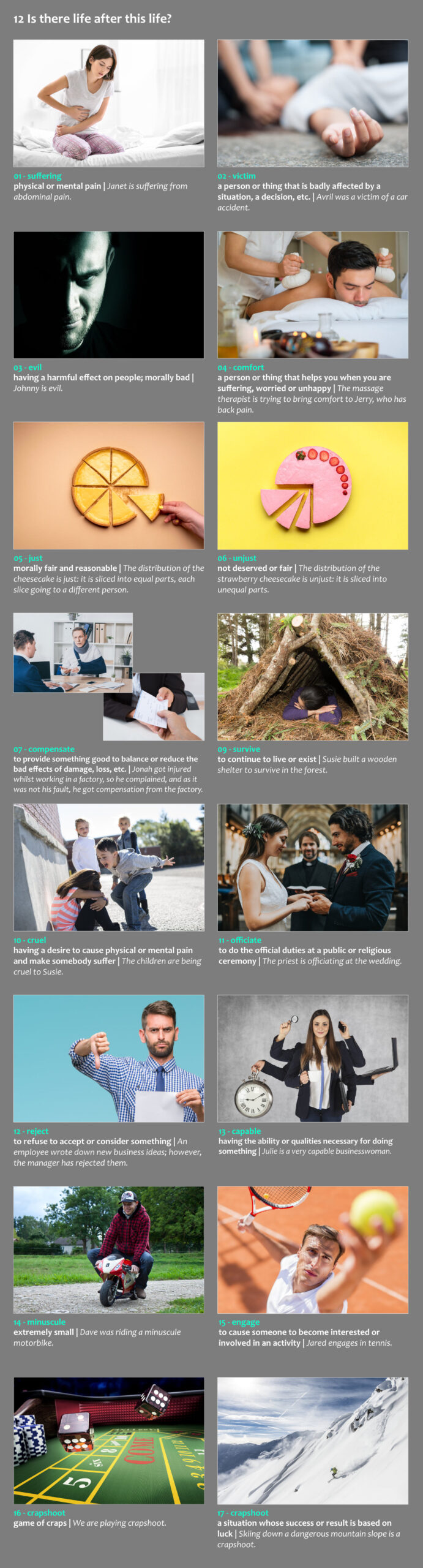
13 Fix yourself (steps 1, 3 and 5)
Blaming others for your problems is a complete waste of time. When you do that, you don’t learn anything.
You can’t grow, and you can’t mature. Thus, you can’t make your life better.
In my three decades as a professor and clinical psychologist, I have learned that there are two fundamental attitudes toward life and its sorrows. Those with the first attitude blame the world. Those with the second ask what they could do differently.
Imagine a couple on the brink of divorce. They’re hurt and angry. The unhappy, bitter husband recalls the terrible things his wife has done, and the reasons he can no longer live with her.
The harried and disillusioned wife, in turn, can describe all the ways her husband let her down. Each has a long list of necessary changes—for the other person.
Their prospects for reconciliation are grim. Why? Because other people aren’t the problem. You’re the problem. You can’t change other people, but you can change yourself. But it’s difficult. It takes courage to change, and it takes discipline. It’s much easier—and much more gratifying to your basest desires—to blame someone else for your misery.
Consider the youthful activist, making a “statement” against the “corrupt” capitalist system by smashing in the storefront of a local business. What has he done, other than to bring harm to people who have nothing to do with his real problems?
The guilt, doubt and shame he will inevitably feel in consequence will have to be suppressed so his beliefs can remain unchanged. And that suppression will do nothing but foster his anger and alienation.
In the play “The Cocktail Party” by American-English poet T.S. Eliot, one of the characters is having a very hard time of it. She speaks of her profound unhappiness to her psychiatrist. She tells him that she hopes her suffering is all her own fault.
Taken aback, the psychiatrist asks why. Because, she tells him, if it’s her fault, she can do something about it. If it’s in the nature of the world, however, she’s doomed. She can’t change everything else. But she could change herself.
Now, there are people who seem to be consigned to a terrible fate. But most of us aren’t. Most of us have a chance to make our lives better.
But how?
Start small. Ask yourself a few questions: Have you taken full advantage of the opportunities offered to you? Are you working to your fullest capacity at school or at work? Have you, in other words, set your own house in order?
If the answer is no, try this: stop doing what you know to be wrong. Stop today.
Don’t waste time asking how you know that what you’re doing is wrong.
Inopportune questioning can confuse without enlightening, and deflect you from action. You can know something is right or wrong without knowing why.
Start paying attention: Do you procrastinate, show up late, spend money you don’t have, and drink more than you should?
It’s not a matter of accepting some externally imposed morality. It’s a dialogue with your own conscience. What are you doing that’s wrong, from your own perspective? What could you put right—right now?
Get to work on time. Stop interrupting people. Make peace with your siblings and your parents. Diligently utilize everything you already have at hand. If you do those things, your life will improve. You’ll become more peaceful, productive and desirable.
After some days, or weeks, or months of attentive effort, your mind will clear. Your life will become less tragic, and you will become more confident. You’ll start seeing right from wrong more clearly. The path in front of you will shine more brightly. You’ll stop getting in your own way. Instead of bringing trouble to yourself, your family, and your society, you’ll be a positive and reliable force.
Your life will still be difficult. You’ll still suffer. That’s the price of being alive. But maybe you’ll become strong enough to accept that burden, and in that fashion even come to act nobly, and with purpose.
The proper way to fix the world isn’t to fix the world. There’s no reason to assume that you’re even up to such a task. But you can fix yourself. You’ll do no one any harm by doing so.
And in that manner, at least, you will make the world a better place.
I’m Jordan Peterson, Professor of Psychology at the University of Toronto, for Prager University.
Blaming others for your problems is a complete waste of time. When you do that, you don’t learn anything.
You can’t grow, and you can’t mature. Thus, you can’t make your life better.
blame1: to think or say that somebody/something is responsible for something bad | James is blaming his coworker for a big mistake in their project.
a waste of time2: a bad use of time | Gossiping at work is a waste of time.
mature: to develop emotionally and start to behave like a sensible adult; when boys turn into adults, they mature | Young adults mature after they start to work.
thus: as a result of something just mentioned | He is the eldest son of the king, and thus he’s going to sit on the throne after his father dies.
In my three decades as a professor and clinical psychologist, I have learned that there are two fundamental attitudes toward life and its sorrows. Those with the first attitude blame the world. Those with the second ask what they could do differently.
decade: a period of ten years, especially a continuous period, such as 1910–1919 or 2000–2009 | Johnny has been teaching for two decades (20 years).
fundamental: being the most basic or most important thing on which other things depend | One of the fundamental laws of Physics are Newton’s laws.
attitude: the way that you think and feel about somebody/something; the way that you behave towards somebody/something that shows how you think and feel | Many workers have a humble attitude towards their work.
sorrow3: a feeling of being very sad because something very bad has happened | Marie’s husband has died so she is now in a state of sorrow.
Imagine a couple on the brink of divorce. They’re hurt and angry. The unhappy, bitter husband recalls the terrible things his wife has done, and the reasons he can no longer live with her.
The harried and disillusioned wife, in turn, can describe all the ways her husband let her down. Each has a long list of necessary changes—for the other person.
on the brink: a critical point of a situation beyond which success or catastrophe occurs (happens) | After the assasination of a leader, the two counties were on the brink of war.
bitter4: feeling angry and unhappy because you feel that you have been treated unfairly | Damien was bitter after he had lost his job.
recall5: to remember something | Looking at the memorial, war veterans can recall how many people died in war.
harry6: to annoy or upset somebody by continuously asking them questions or for something | Jenna was harried by her husband.
disillusioned7: disappointed because the person you admired or the idea you believed to be good and true now seems without value | Because her family did not show up for Christmas, Evelyn became disillusioned with Christmas.
let down8: to fail to help or support somebody as they had hoped or expected | Janet has let her mum down by not helping her out with the shopping.
Their prospects for reconciliation are grim. Why? Because other people aren’t the problem. You’re the problem. You can’t change other people, but you can change yourself. But it’s difficult. It takes courage to change, and it takes discipline. It’s much easier—and much more gratifying to your basest desires—to blame someone else for your misery.
prospect: the possibility that something will happen | The prospects for aliens making contact with earth are slim.
reconciliation: an end to a disagreement or conflict with somebody and the start of a good relationship again | There was a reconciliation between the ex husband and his ex wife.
grim: unpleasant and depressing | Things are looking grim for the financial industry.
courage9: the ability to do something dangerous, or to face pain or opposition, without showing fear | John showed courage as he dived off the cliff.
gratifying10: giving pleasure and making you feel satisfied | James feels that being a father is gratifying.
desire11:a strong wish to have or do something | Danny had the desire to eat the burger quickly.
misery12: great physical or mental pain | Her husband has died, so Janet is in a state of misery.
Consider the youthful activist, making a “statement” against the “corrupt” capitalist system by smashing in the storefront of a local business. What has he done, other than to bring harm to people who have nothing to do with his real problems?
smash13: to break something, or to be broken, violently and noisily into many pieces | Sam smashed his keyboard because he lost at a video game.
storefront14: the outside of a shop that faces the street | The storefront was smashed by rioters.
other than: except | I don’t know any English people other than you.
The guilt, doubt and shame he will inevitably feel in consequence will have to be suppressed so his beliefs can remain unchanged. And that suppression will do nothing but foster his anger and alienation.
guilt15: the unhappy feelings caused by knowing or thinking that you have done something wrong | Clara felt guilt after stealing from work.
doubt16: a feeling of being uncertain about something or not believing something | Jenna was in doubt about the trustworthiness of her business partner.
shame17: the feelings of being sad, embarrassed or guilty that you have when you know that something you have done is wrong or stupid | Lisa was full of shame after she’d talked badly about her boyfriend, so she went to hide her face under her blanket.
inevitably: certain to happen | Lightning inevitably creates the sound of thunder.
suppress18 to prevent yourself from having or expressing a feeling or an emotion | Jodie tries to suppress her smile.
foster: to encourage something to develop | The government adopted policies that foster competition.
alienation19: the feeling that you do not belong in a particular group | The young couple were angry at each other so they each suffered from a sense of alienation.
In the play “The Cocktail Party” by American-English poet T.S. Eliot, one of the characters is having a very hard time of it. She speaks of her profound unhappiness to her psychiatrist. She tells him that she hopes her suffering is all her own fault.
profound: very great; felt or experienced very strongly | Veteran soldiers feel a profound sadness when they remember their fellow fallen soldiers.
fault20: the responsibility for something wrong that has happened or been done | It is Jodie`s fault that the plant fell on the carpet.
Taken aback, the psychiatrist asks why. Because, she tells him, if it’s her fault, she can do something about it. If it’s in the nature of the world, however, she’s doomed. She can’t change everything else. But she could change herself.
taken aback21: to be shocked or surprised | Kenny and his friends were taken aback by the movie, in the cinema.
doomed22: certain to fail, suffer, die, etc.| There is a nuclear explosion in the city so its citizens are doomed.
Now, there are people who seem to be consigned to a terrible fate. But most of us aren’t. Most of us have a chance to make our lives better.
consigned: to put somebody/something in an unpleasant situation | The technological revolution cosigned workers in small textile companies, in America, to be jobless.
fate: the power that is believed to control everything that happens and that cannot be stopped or changed | Jenny believed that fate was kind to her when she acted like a good person.
But how?
Start small. Ask yourself a few questions: Have you taken full advantage of the opportunities offered to you? Are you working to your fullest capacity at school or at work? Have you, in other words, set your own house in order?
If the answer is no, try this: stop doing what you know to be wrong. Stop today.
Don’t waste time asking how you know that what you’re doing is wrong.
take advantage of sth: to make use of something well; to make use of an opportunity | The refugees took advantage of the meals provided for them.
opportunity23: a time when a particular situation makes it possible to do or achieve something | The two companies took the opportunity to work together and cut their costs.
set your own house in order24: to organize your own business or improve your own behaviour before you try to criticize somebody else | Danny is taking a long look in the mirror, setting his own house in order in his mind.
Inopportune questioning can confuse without enlightening, and deflect you from action. You can know something is right or wrong without knowing why.
inopportune: happening at a bad time | The famine hit the country at an inopportune time as it was winter.
confuse25: to make somebody unable to think clearly or understand something | Lisa is confused by the spreadsheet on her laptop.
enlighten26: to give somebody information so that they understand something better | Johnny is being enlightened about geography by using his father’s private library.
deflect27: A. to change direction or make something change direction, especially after hitting something | The football player is using his head to deflect the ball (change the ball’s direction).
- to prevent somebody from doing something that they are determined to do | The government will not be deflected from its commitments.
Start paying attention: Do you procrastinate, show up late, spend money you don’t have, and drink more than you should?
procrastinate28: to delay doing something that you should do, usually because you do not want to do it | Lisa is procrastinating instead of doing her homework.
It’s not a matter of accepting some externally imposed morality. It’s a dialogue with your own conscience. What are you doing that’s wrong, from your own perspective? What could you put right—right now?
impose: to force someone to accept or put up with | People hate it when other people impose their beliefs on them.
externally imposed: imposed from the outside | Some companies hate externally imposed regulations on their business.
conscience29 : the part of your mind that tells you whether your actions are right or wrong | Jason cannot sleep because his conscience is guilty.
Get to work on time. Stop interrupting people. Make peace with your siblings and your parents. Diligently utilize everything you already have at hand. If you do those things, your life will improve. You’ll become more peaceful, productive and desirable.
interrupt30: to say or do something that makes somebody stop what they are saying or doing | The office worker interrupted the meeting by walking in late.
diligently31: in a way that shows care and effort in your work or duties | The waiter diligently washed all the plates.
utilize: to use something, especially for a practical purpose | The Romans were the first to utilize concrete as a building material.
have at hand: be near in time or position | Help is at hand (=easily available) for refugees.
desirable: having pleasing qualities or properties | John’s personality made him desirable for women.
After some days, or weeks, or months of attentive effort, your mind will clear. Your life will become less tragic, and you will become more confident. You’ll start seeing right from wrong more clearly. The path in front of you will shine more brightly. You’ll stop getting in your own way. Instead of bringing trouble to yourself, your family, and your society, you’ll be a positive and reliable force.
attentive32: listening or watching carefully and with interest | All the students are attentive during their lesson.
effort33: the physical or mental energy that you need to do something; something that takes a lot of energy | It takes a lot of effort for Mike to balance the bike.
confident34: feeling sure about your own ability to do things and be successful | Lucy is a confident public speaker.
path35: A) a route or track between one place and another | The path leads to the top of the hill.
- B) a plan of action or a way of achieving something | There is no easy path to success.
reliable36: that can be trusted to do something well | Mercedes is a reliable car brand.
Your life will still be difficult. You’ll still suffer. That’s the price of being alive. But maybe you’ll become strong enough to accept that burden, and in that fashion even come to act nobly, and with purpose.
burden37: a duty, responsibility, etc. that causes worry, difficulty or hard work | Gary has the burden of doing all the office work for the company.
in that fashion: in that particular way | Jared talked sweetly to his girlfriend, and in that fashion he wrote her a love letter.
nobly: in a way that shows fine personal qualities that people admire, such as courage, honesty and care for others | Mother Teresa interacted nobly with the poor.
purpose38: a person’s goal; something that you want to achieve | Liam’s purpose is buying a venue for his company in the city and making it successful.
The proper way to fix the world isn’t to fix the world. There’s no reason to assume that you’re even up to such a task. But you can fix yourself. You’ll do no one any harm by doing so.
assume: to think or accept that something is true but without having proof of it | A lot of kids assume that they can play professional football when they get older even when they do not have exceptional skills.
up to sth: able or willing to do something | When people get ill they are generally not up to doing any physical exercise.
And in that manner, at least, you will make the world a better place.
in that manner: that way; using that method | The water pipe in the bathroom got clogged – the water couldn’t run through it -, so I used a hammer to unclog it by hitting the pipe several times. In that manner, I managed to “fix” the water system.
I’m Jordan Peterson, Professor of Psychology at the University of Toronto, for Prager University.
14 Sticks and Stones (steps 1, 3 and 5)
I’m always telling my daughters stories from when I was a kid. By comparison, the world of my youth was rougher and meaner than the world that kids grow up in today.
So, here’s my question: Did this rougher and meaner world better prepare me to be a well-adjusted, happy adult? I say yes.
When I was a kid, you could say we were less sensitive about a lot of things. I mean, just look at the commercials we watched. We had The Frito Bandito, the cartoon spokesman for Fritos. He was a three and a half foot tall Mexican thief! Can you imagine pitching that at an ad agency today?
“OK…The Frito Bandito? Alright Phil, you don’t work here anymore. Yeah, you gotta go clear out your desk right now.”
Some were violent. Hawaiian Punch? Every commercial was the same. A cartoon Hawaiian character walks up to an unsuspecting cartoon tourist and says, “Hey — how about a nice Hawaiian Punch?!” “Sure!” says the tourist, which gets him punched directly in the face. We all thought that was hilarious.
Kids had to be tougher then, too. An occasional playground fight was expected. And as for teasing? My mom had a remedy for that. “Sticks and stones may break my bones but names will never hurt me.”
She used to say that all the time, one of the seemingly endless adages she had at her disposal to deal with any of life’s problems. But I think long and hard about the practical applications that statement had on my life.
“That’s true,” I thought, “if someone punches you in the chest it hurts no matter what, but with words, it all depends on how you think about it.” You could actually choose whether or not to be hurt! You can’t choose whether or not a punch hurts. But you can choose whether or not words hurt. That was huge.
Even though it had been repeated ad nauseam for generations, “Sticks and Stones” really was a powerful bit of philosophy to a kid. That’s one of the great things about being a parent — you can spout clichés til the cows come home and yet, to your child, it’s all new. You come off as one of the great thinkers in Western Culture.
But does anyone really say “Sticks and Stones” anymore? I doubt there is a grammar school teacher today who is even allowed to utter that phrase. They’re much more likely to warn against the ever present danger of “hate speech” or “triggers” or hurting people’s feelings. This is done in the name of teaching children to respect each other. It begins innocently enough by trying to eradicate teasing, but it continues into middle and high school, where there’s no greater sin than offending someone’s personal or cultural sensitivity.
We’ve seen what used to be called “Great Books” banned because of fear of offending. That would not have even occurred to us years ago! Of course, how could the physical abuse in The Great Gatsby harm us in high school when we spent our childhood watching Jerry the mouse staple gun Tom the Cat’s tongue to the wall? How could reading an honest depiction of racial attitudes in The Adventures of Huckleberry Finn harm us when we sang “Ai yi yi yi!” along with the Frito Bandito, or “Fat kids, skinny kids, kids who climb on rocks; Tough kids! Sissy kids! — they said Sissy kids — Even kids with Chicken Pox!” We sang that along with the Armour hot dog kids on our TV sets?
People look back and some feel ashamed that teasing was expected in childhood, and stereotypes were commonplace in our culture, but was growing up in that environment worse than the hyper-sensitive culture we live in now?
I look at the rough and tumble of childhood, and the process of learning to deal with bullying and being insulted, as a process of inoculation. After each instance of being offended, and then repeating my mother’s “sticks and stones” philosophy, it was like a vaccine that built up my immune system. Eventually you’re resistant. And often you weren’t even aware it was happening!
I can’t imagine my college-aged self, living in fear of “microagressions.” Yet, today there are full-time campus administrators whose job involves scrubbing the campus curriculum and social life of anything that might offend anyone. And these are college students — ostensible adults, headed into the job market… I don’t want to offend anyone with a microaggression if they’re holding a scalpel!
I try to laugh it off. I don’t want my outrage to match theirs. The best thing I can do is tell my stories to my kids, and remind them that “Sticks and stones may break their bones, but names will never hurt them.” They think I wrote it.
I’m Tom Shillue for Prager University.
I’m always telling my daughters stories from when I was a kid. By comparison, the world of my youth was rougher and meaner than the world that kids grow up in today.
rough: A)1 having large and dangerous waves; wild and with storms | It is stormy today, so the sea is rough.
B)2 not gentle or careful; violent | A nurse was fired for being rough with the patients.
mean3: unkind or not caring | James is mean to his sister.
So, here’s my question: Did this rougher and meaner world better prepare me to be a well adjusted, happy adult? I say yes.
prepare4: to make or get something or someone ready for something that will happen in the future | The chef is preparing dinner for his customer.
well adjusted: able to deal with people, problems and life in general in a normal, sensible way | Schools aim to produce well adjusted members of society.
When I was a kid, you could say we were less sensitive about a lot of things. I mean, just look at the commercials we watched. We had The Frito Bandito, the cartoon spokesman for Fritos. He was a three and a half foot tall Mexican thief! Can you imagine pitching that at an ad agency today?
sensitive5: easily offended or upset | Lisa is very sensitive, so she doesn’t like criticism.
commercial6: an advertisement on television, on the radio or on a website | Jane always watches muffin commercials on TV.
pitch: a speech or act that attempts to persuade someone to buy or do something | Good salesmen usually have a practiced pitch ready when they meet their potential customers.
“OK…The Frito Bandito? Alright Phil, you don’t work here anymore. Yeah, you gotta go clear out your desk right now.”
you gotta go: you have to go | When you are in a restaurant, and the manager asks you to leave, then you gotta go.
Some were violent. Hawaiian Punch? Every commercial was the same. A cartoon Hawaiian character walks up to an unsuspecting cartoon tourist and says, “Hey — how about a nice Hawaiian Punch?!” “Sure!” says the tourist, which gets him punched directly in the face. We all thought that was hilarious.
violent7: involving or caused by physical force that is intended to hurt or kill somebody | The drunk man was ready to get violent with his victim.
suspect: to feel that something is not completely right, legal or honest | I suspected her motives in her offering to help.
unsuspecting8: not suspecting that anything is wrong or dangerous | The thief is stealing the unsuspecting woman`s mobile phone.
punch9: to hit somebody/something hard with your fist (= closed hand) | The robber is getting ready to punch his victim.
hilarious10: extremely funny | The coworkers are all laughing at the hilarious joke one of them has told.
Kids had to be tougher then, too. An occasional playground fight was expected. And as for teasing? My mom had a remedy for that. “Sticks and stones may break my bones but names will never hurt me.”
tough11: strong; not easily broken or defeated | This mountain climber is tough.
occasional: happening or done sometimes but not often | Many adults enjoy the occasional glass of wine.
tease12: to laugh at somebody and make jokes about them, either in a friendly way or in order to annoy them or make them embarrassed | Daisy is teasing her daughter by not giving her credit card to her.
remedy13: a way of dealing with or improving an unpleasant or difficult situation | Sally`s remedy for her illness is drinking herbal tea.
stick14: a thin piece of wood or other material | Mike is hitting the pinata with a stick.
She used to say that all the time, one of the seemingly endless adages she had at her disposal to deal with any of life’s problems. But I think long and hard about the practical applications that statement had on my life.
adage: a well-known phrase expressing a general truth about people or the world | According to the old adage, a picture is worth a thousand words.
at her disposal: available to be used by her | Jane would take me if she could, but she doesn’t have a car at her disposal this week.
deal with15 (a problem): to take action to do something, especially to solve a problem | A couple are unhappy about their mortgage contract ,so the banker is dealing with the problem.
practical application: use in real situations and events, rather than just ideas and theories | The practical application of learning about radio waves is the creation of a radar.
“That’s true,” I thought, “if someone punches you in the chest it hurts no matter what, but with words, it all depends on how you think about it.” You could actually choose whether or not to be hurt! You can’t choose whether or not a punch hurts. But you can choose whether or not words hurt. That was huge.
chest16: the top part of the front of the body, between the neck and the stomach | Ellie put her hands on her chest.
no matter what: used to say that something is always true, whatever the situation is | Some people believe that no matter what, the better chess player wins.
huge: extremely large in size or amount; great in degree | After the hacking incident, huge amounts of data was lost.
Even though it had been repeated ad nauseam for generations, “Sticks and Stones” really was a powerful bit of philosophy to a kid. That’s one of the great things about being a parent — you can spout clichés til the cows come home and yet, to your child, it’s all new. You come off as one of the great thinkers in Western Culture.
ad nauseam: if a person says or does something ad nauseam, they say or do it again and again so that it becomes boring or annoying | Some comedians repeat the same joke ad nauseum.
spout17: A) to send out something, especially a liquid, in a stream with great force; to come out of something in this way | The fountain constantly spouts water through pipes.
- B) to speak a lot about something; to repeat something in a boring or annoying way | Johnny could spout poetry for hours.
til: until | Just wait til you see it; it’s great.
come off as sth: to have the intended effect or result; successfully seem like sth | Johnny always answers the questions asked by his teachers, so he always comes off as intelligent.
But does anyone really say “Sticks and Stones” anymore? I doubt there is a grammar school teacher today who is even allowed to utter that phrase. They’re much more likely to warn against the ever present danger of “hate speech” or “triggers” or hurting people’s feelings. This is done in the name of teaching children to respect each other. It begins innocently enough by trying to eradicate teasing, but it continues into middle and high school, where there’s no greater sin than offending someone’s personal or cultural sensitivity.
doubt18: a feeling of being uncertain about something or not believing something | Lisa doubted that Tom was telling the truth.
utter19: to make a sound with your voice; to say something | James is not uttering a word (= he’s not saying anything).
ever present: used to describe something that is always there | For some people there is an ever present feeling of fear whenever they enter a hospital.
trigger20 A) to cause something to happen, especially something bad | Cold air and pollen trigger asthma.
- B) something that causes someone to feel upset and frightened because they are made to remember something bad that has happened in the past | Some war veterans can be triggered by loud noises; they are reminded of the sound of gunfire in war.
respect: a strong feeling of approval of somebody/something because of their good qualities or achievements | Most civilians have respect for the military forces which defeated Hitler in World War 2.
innocent21: not guilty of a crime, etc.; not having done something wrong | Jonah told the judge that he is innocent.
eradicate22: to destroy or get rid of something completely | The digger and bulldozer are eradicating the forest.
offend23: to make somebody feel upset because of something you say or do that is rude or embarrassing | Janet`s husband offended her, so she doesn’t want to talk to him.
sensitivity: an ability to understand what other people need, and be helpful and kind to them | The police showed sensitivity in their handling of the case.
We’ve seen what used to be called “Great Books” banned because of fear of offending. That would not have even occurred to us years ago! Of course, how could the physical abuse in The Great Gatsby harm us in high school when we spent our childhood watching Jerry the mouse staple gun Tom the Cat’s tongue to the wall? How could reading an honest depiction of racial attitudes in The Adventures of Huckleberry Finn harm us when we sang “Ai yi yi yi!” along with the Frito Bandito, or “Fat kids, skinny kids, kids who climb on rocks; Tough kids! Sissy kids! — they said Sissy kids — Even kids with Chicken Pox!” We sang that along with the Armour hot dog kids on our TV sets?
ban24: to order somebody not to do something, go somewhere, etc., especially officially | Fishing and swimming are banned in the river.
occur: to happen | A major event occurred in the US on September 11th 2001.
physical abuse25: intended to cause feelings of physical pain, injury, or other physical suffering or bodily harm | The boy is experiencing physical abuse from his father.
staple gun26: a device for fixing paper to walls, etc. using staples | Johnny is using a staple gun to fix some plastic film to the wall.
depiction27 : the act of showing what somebody/something is like in words or pictures, especially in a work of art | Here is a depiction of a business team.
racial28: connected with a person’s race | There are no racial stereotypes between the friends.
attitude: the way that you behave towards somebody/something that shows how you think and feel | Many workers have a humble attitude towards their work.
People look back and some feel ashamed that teasing was expected in childhood, and stereotypes were commonplace in our culture, but was growing up in that environment worse than the hyper-sensitive culture we live in now?
ashamed29: feeling shame or feeling embarrassed about somebody/something or because of something you have done | Brian is ashamed about what he said yesterday.
commonplace: done very often, or existing in many places, and therefore not unusual | Having computers is now commonplace in schools.
I look at the rough and tumble of childhood, and the process of learning to deal with bullying and being insulted, as a process of inoculation. After each instance of being offended, and then repeating my mother’s “sticks and stones” philosophy, it was like a vaccine that built up my immune system. Eventually you’re resistant. And often you weren’t even aware it was happening!
tumble30: a sudden fall | There has been a tumble down the stairs here.
rough and tumble: a situation in which people compete with each other and are aggressive in order to get what they want | Most people hate the rough and tumble of politics.
bully31: the use of strength or power to frighten or hurt weaker people | Joe’s schoolmates are bullying him.
insult32: to say or do something that offends somebody | Mary always insults her co-workers with the “L” gesture, meaning loser.
inoculation33: an act of protecting a person or an animal from catching a particular disease by injecting them with a mild form of the disease | Mathews’ visit to the hospital included his inoculation from the smallpox disease.
instance: a particular example or case of something | The report highlights a number of instances of injustice (= unfair practices).
resistant34: not damaged by the thing mentioned | The phone is water resistant.
I can’t imagine my college-aged self, living in fear of “microaggressions.” Yet, today there are full-time campus administrators whose job involves scrubbing the campus curriculum and social life of anything that might offend anyone. And these are college students — ostensible adults, headed into the job market… I don’t want to offend anyone with a microaggression if they’re holding a scalpel!
microaggression35: a small act or remark that makes someone feel insulted or treated badly because of their race, sex, etc. | Janet’s facial expression is interpreted by her colleague as a microaggression as everytime the colleague talks to her, Janet makes the same expression.
scrub36 A) to clean something by rubbing it hard, especially with a brush and usually with soap and water | Mike is scrubbing the dishes.
- B) eliminate or cancel | The flights were scrubbed because of bad weather.
ostensible37: seeming or stated to be real or true, when this is perhaps not the case | Jason is not attending school today; the ostensible reason for his absence from school is illness.
scalpel38: a small sharp knife used by doctors in medical operations | The surgeon is holding a scalpel in his hands.
I try to laugh it off. I don’t want my outrage to match theirs. The best thing I can do is tell my stories to my kids, and remind them that “Sticks and stones may break their bones, but names will never hurt them.” They think I wrote it.
outrage39 : a strong feeling of shock and anger | The poor customer service sparks outrage in Danny.
match40: to make something the same as something else | The kids are wearing matching hats.
I’m Tom Shillue for Prager University.
