
Modul 6: PragerU Videos Set 2. Videos 15-28
Ez a videóválogatás 14db izgalmas, gondolatébresztő témát jár körül 5 perces prezentációkban. A gyakorlat végeztével közel 600 szóval növeled szókincsedet. Fontos, hogy a kézikönyvekben leírtak szerint dolgozz az anyagon.
15 Don’t Make Things Worse (steps 1, 3 and 5)
I never graduated college.
I never even went to college.
I went to the University of Digging Ditches on Construction Sites – go Fighting Shovels!
So, why should you listen to me?
Hmmm, let’s see… Well, I run a business that I built myself. So, let me give you a couple of tips.
I hire and fire people like you all the time. And I’ve seen a pattern with your generation—something I call “The Language of Losers.” Let me give you some examples:
“I did my best.” My assistant told me this once after screwing up royally. And I said, “Matt, if you did your best and you screwed up royally, then I need to fire you right now. The answer is either, ‘I didn’t do my best, I’ll do better next time’ or, ‘I’m drunk right now and need to sit down.’ So the phrase I’ve drilled into my employees is, ‘Don’t do your best; do my best.’”
Another example: I had a young employee once say to me, “I’m sorry. I screwed up. Next time, I’ll triple check.” And I said, “Did you single check? Did you double check? How did you get to triple check?” I know how he got to triple check. Single check is a screw up. Double check is…ehhhh…a flub. And triple check is, “Hey, what do you want from me?” So, he hopped right to triple-check after not single- or double-checking.
And the worst one—the one that’s driving me nuts, the one that’s destroying our society, the one that got hold of the piece of thread of the sweater of society and is just unraveling it: “I feel.” “I feel threatened.” “I feel I’m being treated unfairly.” “I feel you’re a bully.” You’re 23. You live at home. Your bed is shaped like a race car and it’s covered with stuffies and your huggie-bookie. Nobody cares how you feel.
So, no excuses. Please. If you do the job you’re hired to do and you do it well, your employer will never stop thanking you and lavishing you with ponies, and frankincense, and myrrh.
Now, you do your job well and you’re not rewarded? Someone else will find you and reward you. Believe me, that’s how the universe works.
But, let’s face it—the chances of any of you working for me are slim to none. The chances some of you may go out there and set some policy are pretty good. And most of you are going to vote on that policy. So, let me ask you a favor: please, stay away from my freedom.
If you want to know about the loss of freedom, look no further than the beach. I grew up in Southern California. I used to go to the beach all the time. There was one sign, and that sign read, “No lighting vans on fire and throwing the homeless into it.” Now you go to the beach and the sign looks like a menu from Fuddruckers. It never ends! No football. No fires. No smoking. No alcohol. And now, no frisbee. No digging. No sandcastle. No dogs.
The beach is a metaphor for this country. It’s freedom. It means freedom. Everyone who came to this country landed on the beach. They didn’t land in Nebraska. They pulled up to the beach, they cracked a beer, they lit a cigarette, and they threw a frisbee.
And now, you can’t do jack squat on the beach. Look no further than the beach sign from the fifties and the beach sign from 2018. All it gets is longer. And, do the politicians ever show up with their eraser and go, “Hmm…let’s remove a few of these Orwellian ideas that we put on this bonderized steel in front of the beach”? No! More things to assure we have a horrible time at the beach, don’t enjoy ourselves and, more importantly, could get a ticket—just because we’re there, trying to drink a cold one, make a sandcastle, and throw the dog the tennis ball.
Don’t be one of those people who adds to the sign on the beach. You be with me: sittin’ on a folding chair with a cigar between my lips and a beer between my legs.
So, you’re graduating and you’re all idealistic. You want to make the world a better place. Here’s my request: Don’t make it worse.
I’m Adam Carolla for Prager University.
I never graduated college.
I never even went to college.
I went to the University of Digging Ditches on Construction Sites – go Fighting Shovels!
graduate1: to get a degree, especially your first degree, from a university or college | Jenna and Michael have just graduated, and they are hugging to congratulate each other.
dig2: to make a hole in the ground or to move soil from one place to another using your hands, a tool or a machine | The dogs are digging a hole in the sand.
ditch3-4: a long channel dug at the side of a field or road, to hold or take away water | The ditch between the road and the field is filled with rain water. The workers are digging a ditch.
shovel5-6: a tool like a spade with a long handle and a broad metal part with curved edges, used for moving earth, snow, sand, etc. | This is a shovel. Mike’s favourite tool is his grandad’s old shovel.
So, why should you listen to me?
Hmmm, let’s see… Well, I run a business that I built myself. So, let me give you a couple of tips.
I hire and fire people like you all the time. And I’ve seen a pattern with your generation—something I call “The Language of Losers.” Let me give you some examples:
hire: to give somebody a job | Companies hire experienced workers.
fire7: to force somebody to leave their job | John packed his office belongings after he had been fired.
“I did my best.” My assistant told me this once after screwing up royally. And I said, “Matt, if you did your best and you screwed up royally, then I need to fire you right now. The answer is either, ‘I didn’t do my best, I’ll do better next time’ or, ‘I’m drunk right now and need to sit down.’ So the phrase I’ve drilled into my employees is, ‘Don’t do your best; do my best.’”
screw up8: to deal with a situation very badly | Look! The hotel receptionist is shouting at the customer! Man! She’s screwing up.
royal9: connected with or belonging to the king or queen of a country | There is no one sitting on the royal throne.
royally: to a great degree | Johnny royally disappointed his employers: he did not do his job well.
drunk10: having drunk so much alcohol that it is impossible to think or speak clearly | Sally drank too much champagne, so now she is drunk.
drill (something) into someone: to make someone learn or understand something by telling them about it many times | If you do something you should never do it half-heartedly. My parents drilled that into me when I was young.
Another example: I had a young employee once say to me, “I’m sorry. I screwed up. Next time, I’ll triple check.” And I said, “Did you single check? Did you double check? How did you get to triple check?” I know how he got to triple check. Single check is a screw-up. Double check is…ehhhh…a flub. And triple check is, “Hey, what do you want from me?” So, he hopped right to triple-check after not single- or double-checking.
check: to examine something to see if it is correct, safe or acceptable | In school, my teachers used to check my homework.
flub: a mistake; an act of doing something badly | In the concert, Johnny made a mistake on the violin. It was a flub that everyone in the audience heard.
And the worst one—the one that’s driving me nuts, the one that’s destroying our society, the one that got hold of the piece of thread of the sweater of society and is just unravelling it: “I feel.” “I feel threatened.” “I feel I’m being treated unfairly.” “I feel you’re a bully.” You’re 23. You live at home. Your bed is shaped like a race car and it’s covered with stuffies and your huggie-bookie. Nobody cares how you feel.
drive me nuts: annoy me greatly | The noises little pigs make always drive me nuts.
destroy11: to damage something so badly that it no longer exists, works, etc. | The dog has destroyed the Teddy Bear.
get hold of: to find someone or obtain (=have) something | Larry finally got hold of Chris in the late afternoon.
thread12: a thin string of cotton, wool, silk, etc. used for sewing or making cloth | There are many different colour sewing threads here.
unravel13: if you unravel threads that are twisted, woven or knitted, or if they unravel, they become separated | The blue knitted wool cloth is unravelling.
sweater14: a piece of clothing for the upper part of the body, made of wool or cotton, with long sleeves| The sweater is yellow.
threatened: If you feel threatened, you feel as if someone is trying to harm you | When walking home late at night, some people feel threatened when they see other people in the dark, so they do not feel safe.
treat: to behave in a particular way towards somebody/something | Some managers treat their employees badly.
bully: a person who uses their strength or power to frighten or hurt weaker people | In every school there is a bully.
stuffies15: plush toys or stuffed animals | The stuffies are on the bed.
huggie-bookie16: a child’s comfort blanket | Children are often attached to their blankets. This little girl is hugging her huggie-bookie.
So, no excuses. Please. If you do the job you’re hired to do and you do it well, your employer will never stop thanking you and lavishing you with ponies, and frankincense, and myrrh.
excuse: a reason that you give to explain or defend your behaviour | Courts of justice usually do not listen to the excuses of war criminals.
lavishing: spending, giving, or using more than is necessary or reasonable; more than enough | Parents of newborn babies usually love to lavish their baby with hugs and kisses.
pony17: a type of small horse | The pony is eating grass.
frankincense18: a substance that is burnt to give a pleasant smell, especially during religious ceremonies | The frankincense is burning on hot coal.
myrrh19: a sticky substance with a sweet smell that comes from trees and is used to make perfume | In the biblical story, the wise men brought gold, frankincense and myrrh to the baby Jesus.
Now, you do your job well and you’re not rewarded? Someone else will find you and reward you. Believe me, that’s how the universe works.
reward: to give something to somebody because they have done something good, worked hard, etc. | My grandpa rewarded me and my brother handsomely (= with a lot of money, biscuits, chocolate etc.) whenever we helped him.
But, let’s face it—the chances of any of you working for me are slim to none. The chances some of you may go out there and set some policy are pretty good. And most of you are going to vote on that policy. So, let me ask you a favor: please, stay away from my freedom.
slim to none: almost none | “What are their chances of winning?” “Slim to none.”
policy: a plan of action agreed or chosen by a political party, a business, etc. | The new government would bring about a radical shift (= change) in policy if it came to power.
set policy: to decide on policy | The new prime minister set some new government policies.
favor (BrE favour): a thing that you do to help somebody | I will ask Janet to take care of the kids. She owes me a favor.
If you want to know about the loss of freedom, look no further than the beach. I grew up in Southern California. I used to go to the beach all the time. There was one sign, and that sign read, “No lighting vans on fire and throwing the homeless into it.” Now you go to the beach and the sign looks like a menu from Fuddruckers. It never ends! No football. No fires. No smoking. No alcohol. And now, no frisbee. No digging. No sandcastle. No dogs.
van20: a covered vehicle with no side windows in its back half, usually smaller than a lorry, used for carrying goods or people | The van is speeding towards the sunset.
homeless21: having no home, and therefore typically living on the streets | The homeless man is sitting on the side of the street begging for money that people can put in his cup.
The beach is a metaphor for this country. It’s freedom. It means freedom. Everyone who came to this country landed on the beach. They didn’t land in Nebraska. They pulled up to the beach, they cracked a beer, they lit a cigarette, and they threw a frisbee.
crack (open) a bottle: to open a bottle and drink | Some people like to crack beer bottles open by using only their hands.
And now, you can’t do jack squat on the beach. Look no further than the beach sign from the fifties and the beach sign from 2018. All it gets is longer. And, do the politicians ever show up with their eraser and go, “Hmm…let’s remove a few of these Orwellian ideas that we put on this bonderized steel in front of the beach”? No! More things to assure we have a horrible time at the beach, don’t enjoy ourselves and, more importantly, could get a ticket—just because we’re there, trying to drink a cold one, make a sandcastle, and throw the dog the tennis ball.
jack squat: nothing; zero | I came out of that deal with jack squat.
can’t do jack squat: can do nothing; can’t do anything | My parents are taking away my hamster, and I can’t do jack squat about it.
look no further than: used to say that something is exactly what somebody needs, and so they do not need to consider any other options | To find a good deal on a new iPhone, you need look no further than your local electronics shop; you don’t need to go out of town to get a good deal.
eraser22 (BrE rubber): a small piece of rubber or a similar substance, used for removing pencil marks from paper | When you make a mistake in your exercise book, you can fix it by using an eraser.
bonderized steel: galvanised steel | It’s best if bonderized steel is painted immediately.
assure: to make something certain to happen; guarantee | Harriet Quimby was the first woman pilot that flew across the English Channel. This assured her a place in the history books.
ticket23: an official notice that orders you to pay a fine because you have done something illegal | I got a parking ticket for parking somewhere where I was not allowed to.
Don’t be one of those people who adds to the sign on the beach. You be with me: sittin’ on a folding chair with a cigar between my lips and a beer between my legs.
folding chair24: a chair that can be folded flat for storage | Taking some folding chairs to the beach is very practical.
So, you’re graduating and you’re all idealistic. You want to make the world a better place. Here’s my request: Don’t make it worse.
request: the action of asking for something formally and politely; a thing that you formally ask for | I went to the shop assistant, and made a request for more information about a laptop.
I’m Adam Carolla for Prager University.

16 Government Can’t Fix Healthcare (steps 1, 3 and 5)
Why is the government so bad at healthcare? They’ve been at it for seventy-five years and still can’t get it right. It’s expensive. Access is spotty. It’s mired in bureaucracy. And it’s fraught with waste.
Obamacare was supposed to fix all this, but instead, like every other government healthcare program before it, it just made things worse.
Why?
Because the government is a third-party payer.
Let me explain.
Suppose you are going to buy something for yourself. You have two priorities: price and quality. You want the highest quality for the lowest possible price.
Say you’re buying a television. You have many options: the size of the screen, the quality of the image, the price. Only you know which one best suits your needs and your budget. And a lot of companies are competing for your business. You do your research; you make your choice.
This is called a first-party purchase – the person paying is the person using.
Now, let’s suppose that either the price or quality is not controlled by you; in this case, you are buying something for someone else. You care about the price because you are paying for it, but you are a little more flexible on the quality. A good example would be a wedding gift – say, a coffee maker.
You might think, by the time it breaks they’ll forget who gave it to them anyway…the cheaper one will be fine.
All of us have bought things for others we never would have bought for ourselves. We care about the price because we’re paying for it, but not so much about the quality because we’re not going to use it.
Or, suppose that we’re going to use something, but we’re not going to pay for it. Then we’re concerned about the quality because we’re consuming it, but the cost is not as important because we’re not paying for it. Any father who ever got roped into paying for an open bar at a wedding understands this program. Nobody ever orders the cheap stuff when it’s free.
These are called second-party purchases. The person paying is not the person using.
And now, for the coup de grace: when it is not your money paying for something, AND you don’t use it. Then you’re not concerned about either the price or the quality.
Suppose the boss gives you $150 to buy a door prize for the office party. In a store window, you see a six-foot tall stuffed frog marked $149.00 You think, Oh, that’s perfect – let’s buy it. The raffle winner is awarded the six-foot frog. Everyone laughs at the gag.
Now, this is called a third-party purchase – a purchase that is made with money that is not yours (therefore you don’t care about the cost) to buy something you’re not going to consume (therefore you don’t care about the quality).
Here’s the point: By definition, all government purchases are third-party purchases. The government spends other people’s money on things it won’t consume. It doesn’t care about the price or the quality. Thus, there will always be waste in government spending.
That is why, to paraphrase Abraham Lincoln, government should do only those things that a man can’t do better for himself.
If 300 million Americans were free to buy health insurance for themselves, just as they buy their own life and home and car insurance, then that little gecko on television would offer us health insurance with a little more coverage for a little less cost.
And he wouldn’t be the only one. Insurance companies and hospitals would be working night and day to get our business. Quality would go up, and prices would go down. It’s already happened with laser eye surgery. It used to cost $2,200 per eye. Now it can cost as low as $500 per eye. That’s the way free enterprise competition works…every time.
But when the government gets involved, costs go up, waste and fraud go up, essential medical services are denied or unavailable. These are the hallmarks of government healthcare bureaucracies around the globe.
The sooner we make health insurance a first-party purchase again, the sooner Americans will get the health care they want…finally.
I’m Bob McEwen for Prager University.
Why is the government so bad at healthcare? They’ve been at it for seventy-five years and still can’t get it right. It’s expensive. Access is spotty. It’s mired in bureaucracy. And it’s fraught with waste.
healthcare1: the service of providing medical care | This team of professionals provide healthcare to patients.
access2: to be able to have or use something, especially something that you have a right to | Mark tried to access the internet on his laptop. His access was denied because he did not get the correct wifi password.
spotty: not complete; good in some parts, but not in others | Access to clean water in some small villages is spotty.
mired (in something): in a difficult or unpleasant situation that you cannot escape from | Johnny was mired in a bad relationship; he felt like he was trapped.
fraught3 (with): filled with something unpleasant | The landfill is fraught with trash.
waste4: A) garbage; trash | The beach is filled with waste; there are plastic bottles scattered everywhere.
- B) a situation in which it is not worth spending time, money, etc. on something | Playing video games day and night is a waste of time – unless you’re making money doing it.
Obamacare was supposed to fix all this, but instead, like every other government healthcare program before it, it just made things worse.
Why?
Because the government is a third-party payer.
Let me explain.
Suppose you are going to buy something for yourself. You have two priorities: price and quality. You want the highest quality for the lowest possible price.
suppose: to imagine what would happen if something were true | “Suppose that all flights are cancelled, where can we stay then?” asked Janet.
priority5: something that you think is more important than other things and should be dealt with first | Washing the car is a priority on Jane`s to do list.
Say you’re buying a television. You have many options: the size of the screen, the quality of the image, the price. Only you know which one best suits your needs and your budget. And a lot of companies are competing for your business. You do your research; you make your choice.
suit6: to be convenient or useful for somebody | A variety of dishes were available to suit all tastes.
budget7: the money that is available to a person or an organization and a plan of how it will be spent over a period of time | Mark always writes his monthly budget in his notebook.
compete8: to try to be more successful or better than somebody else who is trying to do the same as you | The Formula 1 cars compete for the golden trophy.
research9: to study something carefully and try to discover new facts about it | Hayley is researching hotel prices to find the best priced hotel for her holiday.
This is called a first-party purchase – the person paying is the person using.
purchase10: the act of buying; the things you have bought | Maddy is using her card to purchase groceries. She looks quite happy with the purchase.
Now, let’s suppose that either the price or quality is not controlled by you; in this case, you are buying something for someone else. You care about the price because you are paying for it, but you are a little more flexible on the quality. A good example would be a wedding gift – say, a coffee maker.
flexible11: A) able to bend easily without breaking | This pencil is flexible.
- B) able to change or be changed easily according to the situation | Our plans need to be flexible enough to cater for everyone’s needs.
You might think, by the time it breaks they’ll forget who gave it to them anyway…the cheaper one will be fine.
All of us have bought things for others we never would have bought for ourselves. We care about the price because we’re paying for it, but not so much about the quality because we’re not going to use it.
Or, suppose that we’re going to use something, but we’re not going to pay for it. Then we’re concerned about the quality because we’re consuming it, but the cost is not as important because we’re not paying for it. Any father who ever got roped into paying for an open bar at a wedding understands this program. Nobody ever orders the cheap stuff when it’s free.
concerned12: worried about something/somebody | Carla is concerned about the text she received from her grandma.
consume13: to use something, especially fuel, energy or time | Video games consume most of Billy’s time.
get roped into: to persuade somebody to join in an activity or to help to do something, even when they do not want to | Ben hates to watch his friend, Tony, get roped into making coffee for the whole team.
These are called second-party purchases. The person paying is not the person using.
And now, for the coup de grace: when it is not your money paying for something, AND you don’t use it. Then you’re not concerned about either the price or the quality.
coup de grace: an action or event that finally ends something that has been getting weaker or worse | My horrible exam results in biology was the coup de grace to my career as a biologist.
Suppose the boss gives you $150 to buy a door prize for the office party. In a store window, you see a six-foot tall stuffed frog marked $149.00 You think, Oh, that’s perfect – let’s buy it. The raffle winner is awarded the six-foot frog. Everyone laughs at the gag.
door prize14: a prize awarded to the person holding a winning ticket sold or given at the beginning of a party or other event | The door prize to the party was cash as the organiser was too lazy to buy anything.
raffle15: a way of making money for a particular project or organization. People buy tickets with numbers on them and some of these numbers are later chosen to win prizes | Tommy is reaching into a bowl of raffle tickets to find the winner of the office raffle.
gag16: a trick you play on somebody; a joke on somebody | Check out this gag: the businessman is going to shake hands with a hand buzzer in his hand. (Touching a hand buzzer makes you feel like you have an electric shock – but in reality you don’t.).
Now, this is called a third-party purchase – a purchase that is made with money that is not yours (therefore you don’t care about the cost) to buy something you’re not going to consume (therefore you don’t care about the quality).
Here’s the point: By definition, all government purchases are third-party purchases. The government spends other people’s money on things it won’t consume. It doesn’t care about the price or the quality. Thus, there will always be waste in government spending.
That is why, to paraphrase Abraham Lincoln, government should do only those things that a man can’t do better for himself.
paraphrase: to express what somebody has said or written using different words, especially in order to make it easier to understand | The journalist gave us a quick paraphrase of what had been said by the prime minister.
If 300 million Americans were free to buy health insurance for themselves, just as they buy their own life and home and car insurance, then that little gecko on television would offer us health insurance with a little more coverage for a little less cost.
insurance17: an arrangement with a company in which you pay them regular amounts of money, and they agree to pay the costs, for example, if you die or are ill, or if you lose or damage something | Marie has just agreed the terms of her life insurance: she has signed all the documents and is shaking hands with the agent.
gecko18: a small lizard that lives in warm countries; Note: GEICO is an insurance company in the US. Its character is a gecko. | This is a real gecko.
And he wouldn’t be the only one. Insurance companies and hospitals would be working night and day to get our business. Quality would go up, and prices would go down. It’s already happened with laser eye surgery. It used to cost $2,200 per eye. Now it can cost as low as $500 per eye. That’s the way free enterprise competition works…every time.
surgery19: medical treatment of injuries or diseases that involves cutting open a person’s body and often removing or replacing some parts | The doctors are performing surgery on their patient.
enterprise20: a private company or business | Jenny owns a small startup company; her enterprise was started by grants (= money from the government to help starting companies) which were given out to encourage small businesses in the region.
But when the government gets involved, costs go up, waste and fraud go up, essential medical services are denied or unavailable. These are the hallmarks of government healthcare bureaucracies around the globe.
get involved: taking part in something; being part of something or connected with something | Johnny’s brother didn’t want to get involved with the Mafia.
fraud21: the crime of cheating somebody in order to get money or goods illegally | The businessman committed fraud.
deny: to refuse to allow somebody to have something that they want or ask for | The government denied access to the information that journalists asked for.
hallmark: a feature or quality that is typical of somebody/something | Simplicity is one of the hallmarks of the phone’s design.
The sooner we make health insurance a first-party purchase again, the sooner Americans will get the health care they want…finally.
I’m Bob McEwen for Prager University.

17 Mother Knows Best Why I Fight For School Choice (steps 1, 3 and 5)
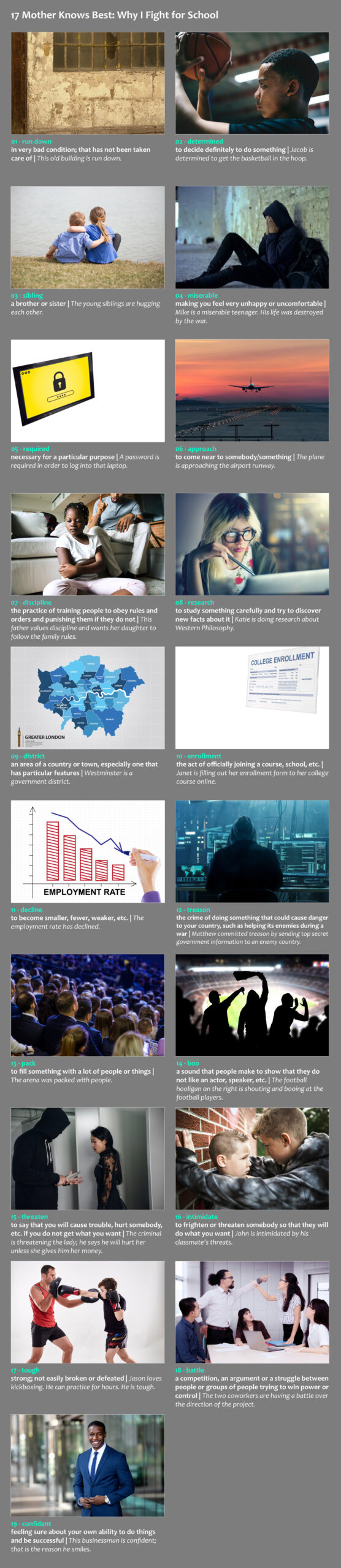
In the town where I grew up in El Salvador, we had one school. It was old and run down. There weren’t enough teachers. There weren’t enough textbooks. But my mother was a determined woman, and she had a plan—an amazing plan. I and my siblings would not get our education in El Salvador. We would get it in America.
So we left our home, our family—everything and everyone we had ever known. I guess you could say it was an extreme example of school choice.
It was a miserable bus ride to California—long and hot. But we made it.
That was the easy part.
My mother barely spoke English. I spoke none. When I complained to her that it was too hard to learn in American schools, I didn’t get much sympathy. We had reached the promised land—the promise of a good education, of unlimited opportunity. English—good English—was required. So I learned it. My mom made sure of that.
With that kind of background, you can imagine that I put a premium on the education of my own children. So when my son approached first grade, I took a hard look at the government school in our neighborhood.
I didn’t like what I saw. Academic standards were low. Discipline was lax. I saw no good future there for my son. But I didn’t have the money for private school.
I did some research. I found that my district offered something they call “a fundamental school”—kind of like a charter school—where they stress reading, writing, and math. The test results at this school were higher than at the government school. This was exactly what I wanted for my son.
I wasn’t the only one. Many other parents had come to the same conclusion. But there weren’t enough slots at the school to meet the demand. The only way to get in was through a lottery.
My son’s education was going to be determined by a lottery? I was frustrated and angry. But I had no alternative—no choice.
He didn’t get in the first year. But he did in the second year. We got lucky.
This didn’t make me any less angry, though. I decided to do something with my anger. I decided I would run for school board and push for every parent to have a choice of schools for their children. It shouldn’t be a matter of luck.
I had no experience running for local office. I certainly wasn’t a politician. I was just a mom with an issue. I guess that was enough because I won.
But like my long bus ride from El Salvador years ago, that proved to be the easy part. The government school system was in worse shape than I thought. Enrollment was declining, but costs were going up. We had more teachers making more money teaching fewer kids—with no test improvement to show for it.
“Why don’t we try school choice?” I suggested at a board meeting. Introduce competition—because competition almost always makes things better. This sounded like common sense to me. To the teachers’ union, it was treason.
First came the nasty emails. Then the ugly tweets. When I wouldn’t shut up, the union packed board meetings with their activists. They booed me. Called me names you wouldn’t believe. I was even physically threatened—all because I had made the case for school choice.
When they couldn’t intimidate me, they tried to get me thrown off the school board. When I decided to run for a second term, the union leaders declared war. They spent almost $250,000 against me in 2016—a quarter of a million dollars! For a seat on a local school board!
But I won. Again. This time, with more votes than any other candidate.
And the reason is clear to me: Parents want good schools for their children. They want choice. And this got me thinking…teachers have a union. Why not parents? So I started the Parent Union to give parents more of a voice. And now chapters are all over the state and in some of Southern California’s toughest neighborhoods.
It’s a battle. But I’m confident we’ll win. There are few forces stronger than a parent determined to get a good education for their child.
I’m Cecilia Iglesias, president of the Parent Union, for Prager University.
In the town where I grew up in El Salvador, we had one school. It was old and run down. There weren’t enough teachers. There weren’t enough textbooks. But my mother was a determined woman, and she had a plan—an amazing plan. I and my siblings would not get our education in El Salvador. We would get it in America.
run down1: in very bad condition; that has not been taken care of | This old building is run down.
determined2: to decide definitely to do something | Jacob is determined to get the basketball in the hoop.
sibling3: a brother or sister | The young siblings are hugging each other.
So we left our home, our family—everything and everyone we had ever known. I guess you could say it was an extreme example of school choice.
It was a miserable bus ride to California—long and hot. But we made it.
miserable4: making you feel very unhappy or uncomfortable | Mike is a miserable teenager. His life was destroyed by the war.
That was the easy part.
My mother barely spoke English. I spoke none. When I complained to her that it was too hard to learn in American schools, I didn’t get much sympathy. We had reached the promised land—the promise of a good education, of unlimited opportunity. English—good English—was required. So I learned it. My mom made sure of that.
barely: in a way that is just possible but only with difficulty; (= not very well/much, just a little) | Some 5-year-olds can barely read or write.
required5: necessary for a particular purpose | A password is required in order to log into that laptop.
With that kind of background, you can imagine that I put a premium on the education of my own children. So when my son approached first grade, I took a hard look at the government school in our neighborhood.
approach6: to come near to somebody/something | The plane is approaching the airport runway.
I didn’t like what I saw. Academic standards were low. Discipline was lax. I saw no good future there for my son. But I didn’t have the money for private school.
discipline7: the practice of training people to obey rules and orders and punishing them if they do not | This father values discipline and wants her daughter to follow the family rules.
lax: not putting enough care, attention or energy into something and so not doing it well enough | Security in some art museums is lax: they do not have enough security guards.
I did some research. I found that my district offered something they call “a fundamental school”—kind of like a charter school—where they stress reading, writing, and math. The test results at this school were higher than at the government school. This was exactly what I wanted for my son.
research8: to study something carefully and try to discover new facts about it | Katie is doing research about Western Philosophy.
district9: an area of a country or town, especially one that has particular features | Westminster is a government district.
charter school (in the US): a school that has been established by teachers, parents or community groups, but receives public funds, and places special emphasis on a particular subject or teaching method | Both of Beth’s children attend a performing arts charter school.
stress: to emphasize a fact, an idea, etc. | Mothers stress the importance of a good education.
I wasn’t the only one. Many other parents had come to the same conclusion. But there weren’t enough slots at the school to meet the demand. The only way to get in was through a lottery.
slot: a position, a time or an opportunity for somebody/something, for example in a list, a programme of events or a series of broadcasts | I wanted to go to a private school, however, there weren’t enough slots; all the places for my course were already filled up by other students.
demand: customers’ desire or need for goods or services that they want to buy or use | The demand for gloves goes up in winter.
My son’s education was going to be determined by a lottery? I was frustrated and angry. But I had no alternative—no choice.
He didn’t get in the first year. But he did in the second year. We got lucky.
This didn’t make me any less angry, though. I decided to do something with my anger. I decided I would run for school board and push for every parent to have a choice of schools for their children. It shouldn’t be a matter of luck.
I had no experience running for local office. I certainly wasn’t a politician. I was just a mom with an issue. I guess that was enough because I won.
experience: the knowledge and skill that you have gained through doing something for a period of time | My lack of practical experience was a disadvantage in applying for the job.
issue: a problem or worry that somebody has with something | When you are extremely rich, money is not an issue.
But like my long bus ride from El Salvador years ago, that proved to be the easy part. The government school system was in worse shape than I thought. Enrollment was declining, but costs were going up. We had more teachers making more money teaching fewer kids—with no test improvement to show for it.
prove: if something proves to be dangerous, expensive, etc., you discover that it is dangerous, etc. over a period of time | Climbing the mountain proved to be difficult for some of the climbers.
enrollment10: the act of officially joining a course, school, etc. | Janet is filling out her enrollment form to her college course online.
decline11: to become smaller, fewer, weaker, etc. | The employment rate has declined.
“Why don’t we try school choice?” I suggested at a board meeting. Introduce competition—because competition almost always makes things better. This sounded like common sense to me. To the teachers’ union, it was treason.
introduce: to make something available for use, discussion, etc. for the first time | The new government is going to introduce changes to the school system.
treason12: the crime of doing something that could cause danger to your country, such as helping its enemies during a war | Matthew committed treason by sending top secret government information to an enemy country.
First came the nasty emails. Then the ugly tweets. When I wouldn’t shut up, the union packed board meetings with their activists. They booed me. Called me names you wouldn’t believe. I was even physically threatened—all because I had made the case for school choice.
nasty: unkind; unpleasant | Bullies use nasty statements to hurt their victims.
pack13: to fill something with a lot of people or things | The arena was packed with people.
boo14: a sound that people make to show that they do not like an actor, speaker, etc. | The football hooligan on the right is shouting and booing at the football players.
threaten15: to say that you will cause trouble, hurt somebody, etc. if you do not get what you want | The criminal is threatening the lady; he says he will hurt her unless she gives him her money.
make the case for (sth): to state the reasons why something should be done or should be the case. | Jane’s coworker, Mary, hates Jane. She has made the case for Jane to be fired.
When they couldn’t intimidate me, they tried to get me thrown off the school board. When I decided to run for a second term, the union leaders declared war. They spent almost $250,000 against me in 2016—a quarter of a million dollars! For a seat on a local school board!
intimidate16: to frighten or threaten somebody so that they will do what you want | John is intimidated by his classmate’s threats.
declare war: to officially decide to fight or go to war | England declared war on Germany.
But I won. Again. This time, with more votes than any other candidate.
And the reason is clear to me: parents want good schools for their children. They want choice. And this got me thinking … teachers have a union. Why not parents? So I started the Parent Union to give parents more of a voice. And now chapters are all over the state and in some of Southern California’s toughest neighborhoods.
chapter: a local branch of a society, club, etc. | Rotary is an international service organisation. My nephew goes to the local chapter of the Rotary club.
tough17: strong; not easily broken or defeated | Jason loves kickboxing. He can practice for hours. He is tough.
It’s a battle. But I’m confident we’ll win. There are few forces stronger than a parent determined to get a good education for their child.
battle18: a competition, an argument or a struggle between people or groups of people trying to win power or control | The two coworkers are having a battle over the direction of the project.
confident19: feeling sure about your own ability to do things and be successful | This businessman is confident; that is the reason he smiles.
I’m Cecilia Iglesias, president of the Parent Union, for Prager University.
18 Minimum Wage Cost Me My Job (steps 1, 3 and 5)
Like the fair-minded Progressive that I was, I thought a $15 minimum wage was an absolute good.
Then, I had a head-on collision with reality.
It’s a funny thing about reality. It just is. You can’t wish it away.
So, here is my cautionary tale.
For over three decades I had a good job working as a server. I have worked in some amazing, award-winning restaurants in Seattle.
I enjoyed the work. Met wonderful people. And I was making really good money.
I wasn’t making much, per hour—that’s true—but in my business, the magic is in tips. On a typical night, I would make on average $25 to $50 an hour.
Believe me, I earned it. I took pride in my work. I wanted every dining experience to be a memorable one for my guests.
I also loved my job for THIS reason: I had flexibility. I could plan my work schedule. That was very important to me because I had a growing son. It was a good life.
Then, in 2015, the Seattle City Council raised the minimum wage from $9.47 to $15 an hour—a 58 percent hike!
Great for the working stiff, right?
Well, hang on, because here comes Mr. Reality.
The business owner, the person who signs the checks, has to find a way to pay for this massive new expense. For Walmart or Microsoft or a large restaurant chain, this might not be a problem. For a local restaurant owner, it’s a nightmare.
Contrary to popular opinion, most restaurants don’t have big profit margins. In fact, most are razor thin.
Seattle restaurant owners, faced with this shock to their bottom line, raised prices, reworked their menus and created new compensation models.
Some did away with tips altogether, substituting a flat service charge as a way of navigating the climbing wage. That change in the tipping model caused a dent in my pocketbook. The rise in the wage did not cover the loss of the tips.
And, of course, they cut back on employee hours and support staff, too.
But for many establishments, none of these cost-saving measures worked. Restaurants, some that had been in business for decades, many family-owned, closed — including the ones I worked for.
Good servers don’t grow on trees. I was able to score an interview at another amazing restaurant.
Then, before I could even confirm the interview, that one closed, too. Same reason. The $15 minimum wage cut their profits down to nothing.
So, let me add this up for you.
I make a lot less money now than I did before Seattle decided to do what was supposedly in my best interest.
I used to be able to pay my bills as they came due.
Now it’s a juggling act.
I used to have enough money to support my son’s extra-curricular activities.
Now I often just say no.
Before the minimum wage increase, I had one job and worked four days a week.
After the wage hike, I had two jobs and worked six.
With my skills and a tipping culture, I used to average 18 to 20 percent or more on any check. Now, instead of tips, I get a flat 14 percent, part of the 20 percent service charge the restaurant owner tacks on the bill. I still pride myself in providing good service, but the incentive to go the extra mile is gone. There is no way to maximize my income.
And what’s Seattle’s answer to my problem? To raise the minimum wage again!
The progressive idea is that you should be able to make a “fair wage”. But if you have no job or are working more for less, how is that fair?
How is it fair to my friend, who worked his way up from busboy to sommelier (the fancy name for the person who manages a restaurant’s wine list)? He lost his job when his restaurant closed due to the minimum wage increase. Or, my former boss, who went from a cook to an owner, and couldn’t survive the double blow of the minimum wage law and the coronavirus?
And it’s not just a “Seattle problem.”
In New York City, raising the minimum wage to $15 an hour pushed the restaurant industry into a recession. To stay afloat, seventy-five percent of owners reduced employee hours, and forty-seven percent eliminated jobs. San Francisco is in the same boat.
Mandating minimum wage laws might be a winner for progressive politicians and ivory tower economists, but it’s a loser for those of us who have to live with the consequences.
Unless fair-minded people speak out, those consequences only figure to get worse as more states, and maybe even the federal government, succumb to the false promise of raising the minimum wage.
I’m Simone Barron, with The Full Service Workers Alliance, for Prager University.
Like the fair-minded Progressive that I was, I thought a $15 minimum wage was an absolute good.
Then, I had a head-on collision with reality.
It’s a funny thing about reality. It just is. You can’t wish it away.
So, here is my cautionary tale.
fair-minded (of people): looking at and judging things in a fair and open way | A fair-minded employer will not try to stop you from joining a union.
collision1: A) an accident in which two vehicles or people crash into each other | There was a collision between two cars.
- B) a strong disagreement between two people or between ideas, opinions, etc. that are opposed to each other; the meeting of two things that are very different | According to Marx, there is a collision of interests between the workers and the employees.
cautionary: giving advice or a warning | Jenna gave a cautionary tale about buying phones.
For over three decades I had a good job working as a server. I have worked in some amazing, award-winning restaurants in Seattle.
I enjoyed the work. Met wonderful people. And I was making really good money.
I wasn’t making much, per hour—that’s true—but in my business, the magic is in tips. On a typical night, I would make on average $25 to $50 an hour.
tip2: a small amount of extra money that you give to somebody, for example somebody who serves you in a restaurant | This waiter received a generous tip.
Believe me, I earned it. I took pride in my work. I wanted every dining experience to be a memorable one for my guests.
earn3: to get something that you deserve, usually because of something good you have done or because of the good qualities you have | Johnny has been working hard non-stop for years. He finally went on a well earned family vacation.
take pride4 (in sth): to feel very pleased about something | Mia takes pride in her home garden.
dining5: the activity of eating a meal | The two friends are dining at a restaurant.
I also loved my job for THIS reason: I had flexibility. I could plan my work schedule. That was very important to me because I had a growing son. It was a good life.
flexibility: being able to change or be changed easily according to the situation | There was flexibility in the working hours at the restaurant.
Then, in 2015, the Seattle City Council raised the minimum wage from $9.47 to $15 an hour—a 58 percent hike!
hike6: a large or sudden increase in prices, costs, etc. | There was a hike in the price of coffee beans.
Great for the working stiff, right?
Well, hang on, because here comes Mr. Reality.
working stiff: someone who does an ordinary job that is often not very well paid | Government executives are earning around two times more than the working stiffs.
hang on: used to ask somebody to wait for a short time or to stop what they are doing | “Hang on, don’t buy it yet. There may be sales on Black Friday.”
The business owner, the person who signs the checks, has to find a way to pay for this massive new expense. For Walmart or Microsoft or a large restaurant chain, this might not be a problem. For a local restaurant owner, it’s a nightmare.
expense7: the money that you spend on something | Mark is surprised at his medical health expense.
Contrary to popular opinion, most restaurants don’t have big profit margins. In fact, most are razor thin.
contrary to: showing or proving the opposite | Contrary to what movies show, romantic relationships don’t always end well.
profit margin: the difference between the cost of buying or producing something and the price that it is sold for | The profit margin of the business has increased from 18.5% to 20%.
razor8: an instrument that is used for removing hair by shaving | This razor is wet.
razor thin: very thin | The administration’s economic program was approved by a razor-thin margin in the Senate.
Seattle restaurant owners, faced with this shock to their bottom line, raised prices, reworked their menus and created new compensation models.
bottom line: the amount of money that is a profit or a loss after everything has been calculated | The bottom line for 2019 was a profit of £80 million.
Some did away with tips altogether, substituting a flat service charge as a way of navigating the climbing wage. That change in the tipping model caused a dent in my pocketbook. The rise in the wage did not cover the loss of the tips.
do away (with sth): to stop doing or having something; to make something end | Martin Luther King had the desire (= really wanted/wished) to do away with racism.
substitute: to use somebody/something instead of somebody/something else | Many people like substituting ketchup for mayonnaise.
flat (especially of an amount of money): not changing or varying: | We charge a flat rate of $25 per hour.
dent9: A) a hollow place in a hard surface, usually caused by something hitting it | There is a big dent on the car’s door.
- B) make/cause a dent (in sth): to reduce an amount of something, esp. money or work | Buying a new car made a big dent in our savings.
pocketbook10 A) a small book for writing in | This pocketbook still has empty pages left.
- B) used to refer to the financial situation of a person or country | The increase in taxes will hit customers’ pocketbooks.
cover: to be or provide enough money for something | $50 should cover your expenses.
loss11: the state (= the situation) of no longer having something or as much of something | The businessman is disappointed at the loss of his company’s profit.
And, of course, they cut back on employee hours and support staff, too.
cut back12 (on sth): to reduce something | Mark’s company is trying to cut back on production costs so the company is firing Mark.
But for many establishments, none of these cost-saving measures worked. Restaurants, some that had been in business for decades, many family-owned, closed — including the ones I worked for.
establishment13: an organization, a large institution or a hotel | Even though it looks modern, this establishment is one of the oldest ones in Moscow.
measure: an official action that is done in order to achieve a particular aim | The government took measures to reduce crime in the capital.
Good servers don’t grow on trees. I was able to score an interview at another amazing restaurant.
score14 A) to win points, goals, etc. in a game or competition | Somebody scored a goal in a game of football.
- B) to get something | I managed to score tickets to the World Cup final.
Then, before I could even confirm the interview, that one closed, too. Same reason. The $15 minimum wage cut their profits down to nothing.
So, let me add this up for you.
I make a lot less money now than I did before Seattle decided to do what was supposedly in my best interest.
I used to be able to pay my bills as they came due.
Now it’s a juggling act.
I used to have enough money to support my son’s extra-curricular activities.
supposedly: used to show that you do not believe that something you have been told is true | Johnny is supposedly the best football player in the league.
due15: A) expected | The bus is due; it should arrive now.
- B) when a sum of money is due, it must be paid immediately | Payment is due on the 1st December.
juggle16: A) to throw a set of three or more objects such as balls into the air and catch and throw them again quickly, one at a time, so as to keep at least one in the air at all times | Sarah is juggling with balls.
- B) to try to deal with two or more important jobs or activities at the same time | Some women have to juggle their career with being a mother.
extra-curricular17: not part of the usual course of work or studies at a school or college | Mark is involved in many extra-curricular activities. One of them is going to a local chess club.
Now I often just say no.
Before the minimum wage increase, I had one job and worked four days a week.
After the wage hike, I had two jobs and worked six.
With my skills and a tipping culture, I used to average 18 to 20 percent or more on any check. Now, instead of tips, I get a flat 14 percent, part of the 20 percent service charge the restaurant owner tacks on the bill. I still pride myself in providing good service, but the incentive to go the extra mile is gone. There is no way to maximize my income.
tack18: to add something to something, especially in a careless way | The bill was tacked on to the bills booklet.
incentive19: something that encourages you to do something | The owner of the house put cheese inside a mousetrap as an incentive for a mouse to go into the mousetrap.
And what’s Seattle’s answer to my problem? To raise the minimum wage again!
The progressive idea is that you should be able to make a “fair wage”. But if you have no job or are working more for less, how is that fair?
How is it fair to my friend, who worked his way up from busboy to sommelier (the fancy name for the person who manages a restaurant’s wine list)? He lost his job when his restaurant closed due to the minimum wage increase. Or, my former boss, who went from a cook to an owner, and couldn’t survive the double blow of the minimum wage law and the coronavirus?
busboy20: a person who works in a restaurant removing dirty dishes and bringing clean ones | This busboy is taking the dirty dishes.
double blow21: a situation in which two negative things happen at the same time or in rapid succession (= one after the other) | Jesse recently lost her job and also got infected by the coronavirus; that is a double blow.
And it’s not just a “Seattle problem.”
In New York City, raising the minimum wage to $15 an hour pushed the restaurant industry into a recession. To stay afloat, seventy-five percent of owners reduced employee hours, and forty-seven percent eliminated jobs. San Francisco is in the same boat.
recession: a situation where there is less trade and more unemployment | The economy fell into recession.
stay afloat22: A) floating on water | James is staying afloat because he has his life saving vest on.
- B) having enough money to pay what you owe | The business had enough customers to stay afloat.
eliminate: to remove or get rid of something | A healthy lifestyle may not be enough to eliminate the risk of heart attacks.
Mandating minimum wage laws might be a winner for progressive politicians and ivory tower economists, but it’s a loser for those of us who have to live with the consequences.
mandate: to give official permission for something to happen | Going to war against Germany was mandated by the British Parliament in 1939.
ivory23: a hard white substance like bone that forms the tusks (= long teeth) of elephants and some other animals | This is a pile of old white ivory tusks.
ivory tower: to live or be in an ivory tower is not to know about the ordinary (= not special, boring) and unpleasant things that happen in normal life | Academics sitting in ivory towers do not understand what is important to ordinary people.
Unless fair-minded people speak out, those consequences only figure to get worse as more states, and maybe even the federal government, succumb to the false promise of raising the minimum wage.
succumb: to give up, and accept something that you first opposed | Billy succumbed to the temptation of eating a large chocolate cake during his diet.
I’m Simone Barron, with The Full Service Workers Alliance, for Prager University.

19 Does College = Success (steps 1, 3 and 5)
Maybe the dumbest thing you can do is to go to the place that’s supposed to make you smart. That would be…college.
Now, perhaps I’m biased. I don’t have a college degree—although I employ a lot of people who do, and from some of the most prestigious universities in the country.
I made a conscious choice. I had clear career ambitions and I didn’t see how a college degree was going to get me there. In retrospect, I’m confident I made the right decision.
I’m the co-founder and co-CEO of a company called The Daily Wire. We publish news and commentary from a conservative point of view. We have well over 100 employees and an audience which numbers in the millions every single day.
Now, I don’t have a problem if you go to college. It’s a free country. Do what you want. But the idea that somehow college is the great pathway to success and fulfillment—that I don’t buy.
The left takes a different view. They are obsessed with higher education. To them, it’s a human right. And they want it to be free—which just means paid for by people like me—for anyone who’s eighteen and can breathe.
That makes perfect sense from their point of view. One, the idea is a big winner among young people, a critical voting bloc. Who doesn’t want something for nothing—especially something that costs more than a Ferrari?
And two, colleges exist to do one thing: create conformity of thought. And since college professors and administrators overwhelmingly lean left, it’s a pretty good bet most of their students will as well.
But I’m being unfair, you say.
After all, we live in a knowledge-based world. And America isn’t making the grade. Don’t you know we rank 13th in the world in reading, 18th in science literacy, and a pitiful 37th in math? To which I say, “so what?”
It wasn’t Singapore that split the atom, or Estonia that mapped the human genome. America is #1 in Nobel Prizes awarded, #1 in scientific citations issued, #1 in popular entertainment, and #1 in technological advancement.
In short, America creates almost everything. Even what other countries manufacture was probably invented by an American. Which is why we’re also the #1 economy in the world—by far.
And who made this possible?
Well, here are the names of just a few of the individuals who pretty much invented the modern world: Bill Gates, Mark Zuckerberg, Steve Jobs, Michael Dell, and Larry Ellison.
None of them has a college degree.
Many of the CEOs who run the companies they created do have college degrees. But the founders do not. What they do have are things colleges can’t teach you: curiosity, ambition, and a willingness to fail. Those qualities almost guarantee success. A college diploma doesn’t.
Want to build an airplane? Engineers educated in aerodynamics are handy to have on your team. Want to invent the airplane? Well, you’re better off finding a couple of restless bicycle repairmen. That’s what the Wright brothers were.
It’s not that colleges aren’t teaching; it’s that too often they’re teaching the wrong things. Or they’re teaching right things the wrong way.
Tech-entrepreneur David Gelernter says, “The thing I don’t look for in a developer is a degree in computer science…” Quite a statement from a man who teaches computer science at Yale.
Tech billionaire and co-founder of PayPal, Peter Thiel, actually pays people not to go college.
Thiel and Gelernter understand that colleges are factories, and like all factories, they want to produce a consistent product. That means producing people who all think alike.
But innovation and entrepreneurship require people who think differently. Innovators innovate. Colleges teach those innovations after the fact. If professors could have taught engineers how to build the airplane in 1903, professors would have built the airplane before 1903. They would have invented the personal computer, Microsoft, and social media, too.
And it’s not only big tech where this applies; 56% of all small business owners in the United States don’t have a four-year degree. That’s right, the majority of small business owners—who employ more than half of American workers—either never went to, or never finished, college.
What all of this says to me is that, while college is useful for some people, it’s by no means necessary for all. And it’s hardly essential for economic success—not for the individual, and not for the nation. No one is being deprived of the opportunity to succeed simply because they can’t afford a university’s steep price tag.
In fact, if you go to college, there’s a good chance you’ll be taught how not to succeed. If I were you, I’d think long and hard before paying for that.
I’m Jeremy Boreing for Prager University.
Maybe the dumbest thing you can do is to go to the place that’s supposed to make you smart. That would be…college.
dumb: stupid | Larry always says the dumbest things in his business presentations.
supposed: believed by many people to be true, but not proven and often doubted by the person who is speaking or writing | The supposed benefits of this diet are far outweighed by its costs.
Now, perhaps I’m biased. I don’t have a college degree—although I employ a lot of people who do, and from some of the most prestigious universities in the country.
biased: tending to show favour towards or against one group of people or one opinion for personal reasons; making unfair judgements | The Newspaper is biased towards the Democratic Party.
prestigious: respected and admired as very important or of very high quality | Daniel has received many prestigious awards in the field of biology, including The Nobel Prize in Chemistry.
I made a conscious choice. I had clear career ambitions and I didn’t see how a college degree was going to get me there. In retrospect, I’m confident I made the right decision.
conscious choice: a choice made after much thought | Jeremy made a conscious choice to adopt a puppy.
in retrospect: thinking now about something in the past | In retrospect, I made a mistake buying the TV. I should have waited until Black Friday when it was less expensive.
I’m the co-founder and co-CEO of a company called The Daily Wire. We publish news and commentary from a conservative point of view. We have well over 100 employees and an audience which numbers in the millions every single day.
commentary: a spoken description of an event that is given while it is happening, especially on the radio or television | Mike is watching a sports commentary on the TV.
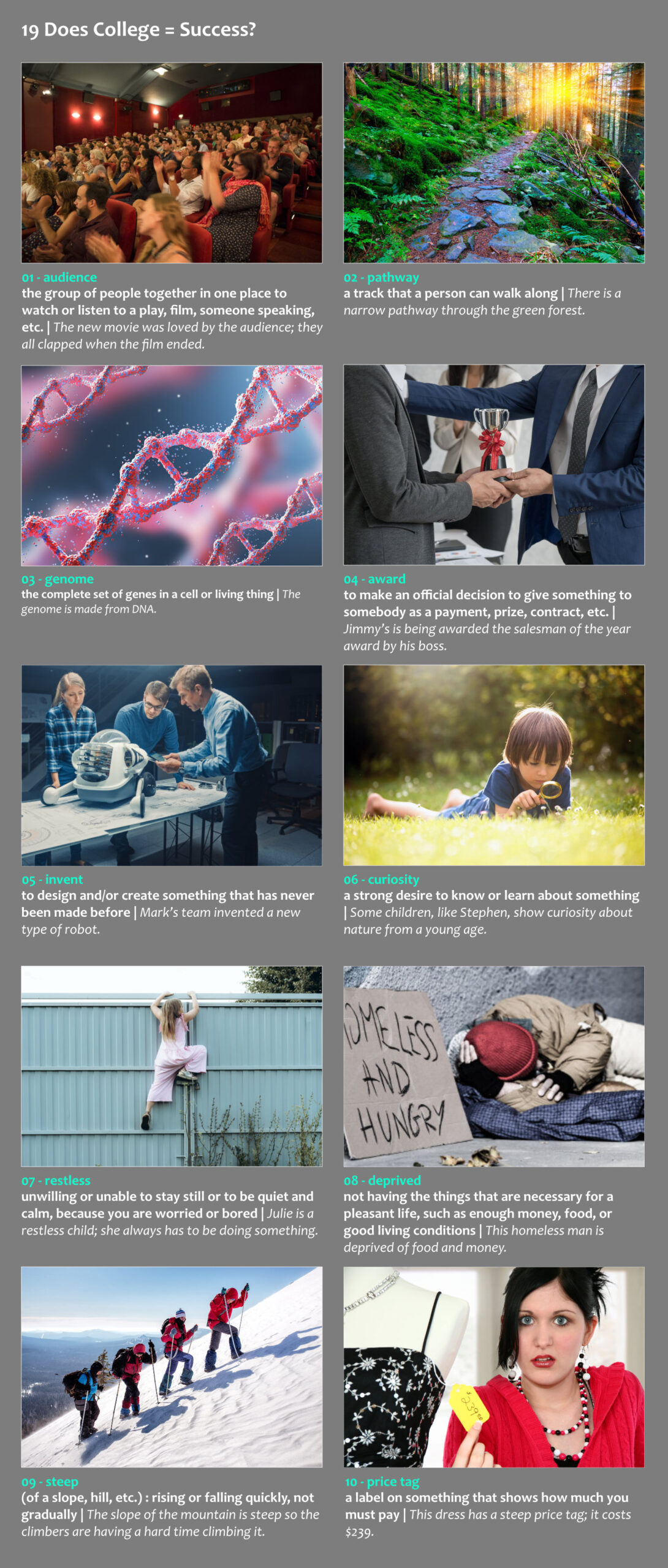
audience1: the group of people together in one place to watch or listen to a play, film, someone speaking, etc | The new movie was loved by the audience; they all clapped when the film ended.
Now, I don’t have a problem if you go to college. It’s a free country. Do what you want. But the idea that somehow college is the great pathway to success and fulfillment—that I don’t buy.
pathway2: a track that a person can walk along | There is a narrow pathway through the green forest.
fulfillment: the act of doing or achieving what was hoped for or expected | The fulfillment of his dream is important to Fred; he wants to become an engineer.
The left takes a different view. They are obsessed with higher education. To them, it’s a human right. And they want it to be free—which just means paid for by people like me—for anyone who’s eighteen and can breathe.
obsessed: not able to stop thinking about something; too interested in or worried about something | Gordon is obsessed with money.
That makes perfect sense from their point of view. One, the idea is a big winner among young people, a critical voting bloc. Who doesn’t want something for nothing—especially something that costs more than a Ferrari?
bloc: a group of countries or people that have similar political interests | Old people are an important voting bloc in Japan.
And two, colleges exist to do one thing: create conformity of thought. And since college professors and administrators overwhelmingly lean left, it’s a pretty good bet most of their students will as well.
conformity: behaviour or actions that follow the accepted rules of society | Some find it odd that there is much conformity in many young children.
But I’m being unfair, you say.
After all, we live in a knowledge-based world. And America isn’t making the grade. Don’t you know we rank 13th in the world in reading, 18th in science literacy, and a pitiful 37th in math? To which I say, “so what?”
literacy: the ability to read and write | The United Nations aims to have all youths and most adults achieve literacy by 2030.
It wasn’t Singapore that split the atom, or Estonia that mapped the human genome. America is #1 in Nobel Prizes awarded, #1 in scientific citations issued, #1 in popular entertainment, and #1 in technological advancement.
genome3: the complete set of genes in a cell or living thing | The genome is made from DNA.
award4: to make an official decision to give something to somebody as a payment, prize, contract, etc. | Jimmy’s is being awarded the salesman of the year award by his boss.
citation: words or lines taken from a book or a speech | Some new business books are full of citations from ancient books.
advancement: the process of helping something/somebody to make progress or succeed; the progress that is made | The Ancient Greeks made advancements in the sciences.
In short, America creates almost everything. Even what other countries manufacture was probably invented by an American. Which is why we’re also the #1 economy in the world—by far.
invent5: to design and/or create something that has never been made before | Mark’s team invented a new type of robot.
And who made this possible?
Well, here are the names of just a few of the individuals who pretty much invented the modern world: Bill Gates, Mark Zuckerberg, Steve Jobs, Michael Dell, and Larry Ellison.
None of them has a college degree.
Many of the CEOs who run the companies they created do have college degrees. But the founders do not. What they do have are things colleges can’t teach you: curiosity, ambition, and a willingness to fail. Those qualities almost guarantee success. A college diploma doesn’t.
curiosity6: a strong desire to know or learn about something | Some children, like Stephen, show curiosity about nature from a young age.
willingness: the quality of being happy to do something if it is needed | Johnny had the willingness to learn from his mistakes.
Want to build an airplane? Engineers educated in aerodynamics are handy to have on your team. Want to invent the airplane? Well, you’re better off finding a couple of restless bicycle repairmen. That’s what the Wright brothers were.
handy: useful or convenient | A hammer is a handy tool to have in your house.
better off (doing sth): used to say that somebody is happier or more satisfied because they are in a particular position or doing a particular thing | Jonah, a single parent, is better off paying a nanny to look after his children while he is on a business trip.
restless7 : unwilling or unable to stay still or to be quiet and calm, because you are worried or bored | Julie is a restless child; she always has to be doing something.
It’s not that colleges aren’t teaching; it’s that too often they’re teaching the wrong things. Or they’re teaching right things the wrong way.
Tech-entrepreneur David Gelernter says, “The thing I don’t look for in a developer is a degree in computer science…” Quite a statement from a man who teaches computer science at Yale.
entrepreneur: a person who makes money by starting or running businesses | Lisa is a hard working entrepreneur working in the computer software industry.
Tech billionaire and co-founder of PayPal, Peter Thiel, actually pays people not to go college.
Thiel and Gelernter understand that colleges are factories, and like all factories, they want to produce a consistent product. That means producing people who all think alike.
consistent: always behaving in the same way, or having the same opinions, standards, etc | Ellie’s views have been consistent over the years.
alike: similar to each other | Tony’s and James’ shoes are alike.
But innovation and entrepreneurship require people who think differently. Innovators innovate. Colleges teach those innovations after the fact. If professors could have taught engineers how to build the airplane in 1903, professors would have built the airplane before 1903. They would have invented the personal computer, Microsoft, and social media, too.
And it’s not only big tech where this applies; 56% of all small business owners in the United States don’t have a four-year degree. That’s right, the majority of small business owners—who employ more than half of American workers—either never went to, or never finished, college.
majority: the largest part of a group of people or things | Johnny thinks that the majority of people shop in large supermarkets instead of small shops.
What all of this says to me is that, while college is useful for some people, it’s by no means necessary for all. And it’s hardly essential for economic success—not for the individual, and not for the nation. No one is being deprived of the opportunity to succeed simply because they can’t afford a university’s steep price tag.
by no means: not at all | Winning a round of chess by no means guarantees winning the entire tournament.
hardly: almost no; almost not; almost none | Although money is important, having millions of dollars is hardly necessary to start a business.
essential: necessary or needed | If we wish to remain competitive in the market, it is essential that we keep our product’s quality very high.
deprived8: not having the things that are necessary for a pleasant life, such as enough money, food, or good living conditions | This homeless man is deprived of food and money.
steep9 (of a slope, hill, etc.) : rising or falling quickly, not gradually | The slope of the mountain is steep so the climbers are having a hard time climbing it.
price tag10: a label on something that shows how much you must pay | This dress has a steep price tag; it costs $239.
In fact, if you go to college, there’s a good chance you’ll be taught how not to succeed. If I were you, I’d think long and hard before paying for that.
I’m Jeremy Boreing for Prager University.
20 It’s Time to Grow Up (steps 1, 3 and 5)
We all know it takes a long time to grow up—not only biologically, but psychologically. There’s a saying among psychiatrists that it takes 50 years to overcome the first 20.
Here’s the good news: unlike other species, we are not restrained by our instincts alone. We are able to learn from our parents, our experiences and our culture.
Here’s the bad news: Nobody matures without effort. It doesn’t happen naturally. It takes a lot of hard work.
But what does it mean to be “mature?” Good question. So, let’s answer it.
I have identified five characteristics of maturity. If you work to possess them all, you will have a happier, deeper, and more productive life.
One: Taking Control
Of course, you had no choice what era you were born in, or where you were born, or who your parents are. But with each year of childhood you attain more and more capacity to chart your own course. Yes, society and fate play a role, but cultivating your ability and willingness to make your own decisions, expands your ability to influence how your life unfolds. The only way to achieve maturity is to take charge of your life. Nothing empowers you as much as exercising that control. Refusing to act, waiting to be rescued and seeing yourself as a victim are sure signs of immaturity.
Two: Taking Responsibility.
I mean this in two ways.
The first way is simply to acknowledge that you’re responsible for what you do. If you make a mistake, acknowledge it. Don’t alibi and don’t blame others. This is an easy thing to say, but we all know it’s very hard to do. A mature person does it. A mature person takes responsibility.
Second, is the willingness to take on obligations and fulfill them. For example, I got married and took on obligations to my wife and children. I have ethical obligations to my patients and my profession, even on days that I might not feel like it. A mature person doesn’t see obligations as burdens but as something he willingly accepts and sees through to fulfillment.
Three: Containing Emotions.
I would never suggest that you should ignore your emotions, but you have to learn to contain them. Immature people lash out at their boss or their coworker if something doesn’t go their way, or argue with their spouse when they come home, or turn to alcohol or drugs because of a rough day.
I often tell my patients that maturity can be measured by how much anxiety they can tolerate without acting out inappropriately against themselves or others. Mature people express their emotions in the right place, at the right time, in the right way. We are emotional beings, but we should never let go of the steering wheel; that is, we need to learn how and when to contain our emotions.
Four: Having Perspective.
An immature teenager will regard a pimple as a catastrophic eruption of Mt. Vesuvius, or will regard rejection by a girlfriend or boyfriend as the end of the world. Maturity comes from putting disappointments into perspective.
The reason we forgive a teenager’s overreaction is because we understand it’s probably the first time it’s happened. But life’s disappointments don’t stop when you turn 21. Far from it. Disappointments of every variety, great and small, happen throughout life. The mature person learns from them and gets stronger each time he recovers. This kind of mature thinking is best expressed in the famous advice given to King Solomon: This too shall pass.
Perspective also means that when we are upset with someone dear to us, we have to put that negative experience in the context of the entire relationship. Immature people demonize a friend or a relative they are upset with, and forget or ignore all the love and good experiences they once had. Mature people see the whole picture—not only the good, and not only the bad.
Five: Achieving Deep Understanding.
This takes the concept of empathy to a higher level. Beyond tuning in to another’s feelings, this is about comprehending the ways in which another’s ideas and behaviors make sense to them. You don’t have to agree with that person, but you need to be able to get inside their thinking. You need to understand why they believe what they believe.
A good way to do this is to repeat what a person has said back to them. “Is this what you meant?” If they say “yes it is,” then you know, and they know, that you’ve reached a deeper understanding. This kind of understanding, by the way, is indispensable to achieving true intimacy. It explains why the mature person is able to have more intimate relationships than the immature person ever will.
Taking control. Taking responsibility. Containing your emotions. Having perspective. Achieving deep understanding—these are five characteristics of maturity.
Together they can lead you to a deeper and happier life.
I’m Dr. Stephen Marmer, Psychiatrist, UCLA School of Medicine, for Prager University.
We all know it takes a long time to grow up—not only biologically, but psychologically. There’s a saying among psychiatrists that it takes 50 years to overcome the first 20.
Here’s the good news: unlike other species, we are not restrained by our instincts alone. We are able to learn from our parents, our experiences and our culture.
species: a set of animals, plants, etc. in which the members have similar characteristics to each other and can breed with each other | There are rare bird species on the island.
restrain1: to control the actions or behavior of someone by force, esp. in order to stop that person from doing something | The prisoner is restrained (his hands are tied together) to stop him from fighting with the guards.
instincts: a natural quality that makes people and animals behave in a particular way using abilities that they were born with | When Johnny noticed a snake in the grass his first instinct was to stop moving.
Here’s the bad news: nobody matures without effort. It doesn’t happen naturally. It takes a lot of hard work.
mature: to become fully grown or developed | Some people mature quicker than others.
But what does it mean to be “mature?” Good question. So, let’s answer it.
I have identified five characteristics of maturity. If you work to possess them all, you will have a happier, deeper, and more productive life.
possess: to have or own something | Johnny wants to possess his dream car.
One: Taking Control
Of course, you had no choice what era you were born in, or where you were born, or who your parents are. But with each year of childhood you attain more and more capacity to chart your own course. Yes, society and fate play a role, but cultivating your ability and willingness to make your own decisions, expands your ability to influence how your life unfolds. The only way to achieve maturity is to take charge of your life. Nothing empowers you as much as exercising that control. Refusing to act, waiting to be rescued and seeing yourself as a victim are sure signs of immaturity.
era: a period of time, usually in history, that is different from other periods because of particular characteristics or events | Kelly was born in the post World War 2 era.
attain: to reach or succeed in getting something | Nancy attained the highest score possible in her biology exam.
chart your course: to choose and plan to reach a goal | Everyone should chart their own course.
fate: the power that is believed to control everything that happens and that cannot be stopped or changed | Johnny believed that fate allowed him to meet Julie.
cultivate2: to develop and improve something | This musical teacher cultivates young talents.
expand: to become or make something greater in size, number or importance | In less than a year, Messi expanded his ability to do some very sophisticated football tricks (= he was able to do more and better tricks).
influence: to cause someone to change a behaviour, belief, or opinion | Marry is able to influence her friends’ opinion about the president.
unfold: (of a situation or story) to develop or become clear | The election unfolded just as Johnny wished it would.
take charge of: to take responsibility for controlling or caring for something | Lewis’ parents asked him to take charge of their house while they were gone on holiday.
empower: to give somebody more control over their own life or the situation they are in | The movement aimed to empower women.
exercise3: to use your power, rights or personal qualities in order to achieve something | Jonah is being interrogated at the police station with his lawyer. He is exercising his right to remain silent.
victim4: a person who has suffered the effects of violence or illness or bad luck, etc. | Sally is a victim of bullying.
Two: Taking Responsibility.
I mean this in two ways.
The first way is simply to acknowledge that you’re responsible for what you do. If you make a mistake, acknowledge it. Don’t alibi and don’t blame others. This is an easy thing to say, but we all know it’s very hard to do. A mature person does it. A mature person takes responsibility.
acknowledge: to accept that something is true | Johnny acknowledged that he currently cannot play poker well.
Second, is the willingness to take on obligations and fulfill them. For example, I got married and took on obligations to my wife and children. I have ethical obligations to my patients and my profession, even on days that I might not feel like it. A mature person doesn’t see obligations as burdens but as something he willingly accepts and sees through to fulfillment.
obligation: something that you must do | Lisa cannot do housework because she doesn’t have time; she has too many obligations already.
fulfil: to do or have what is required or necessary | Mary wanted to fulfil her promise to her child; she had promised him a toy car for Christmass.
feel like: to want to have or do something | Danny is sick of the office; he feels like going for a walk.
burden5: a duty, responsibility, etc. that causes worry, difficulty or hard work | Julie has the burden of managing the office.
Three: Containing Emotions.
contain (an emotion): to control or hide a strong emotion | Peter couldn’t contain his anger any longer.
I would never suggest that you should ignore your emotions, but you have to learn to contain them. Immature people lash out at their boss or their coworker if something doesn’t go their way, or argue with their spouse when they come home, or turn to alcohol or drugs because of a rough day.
lash out6: to criticize somebody in an angry way | Bill lashed out at his co-worker for making a mistake in their presentation.
go somebody’s way: (of events) to go well for somebody | The chess tournament is not going your way; you are losing too many games.
spouse7: a person’s husband or wife | Matt is dancing with his spouse.
rough: difficult and unpleasant | Billy is having a rough day, so leave him alone!
I often tell my patients that maturity can be measured by how much anxiety they can tolerate without acting out inappropriately against themselves or others. Mature people express their emotions in the right place, at the right time, in the right way. We are emotional beings, but we should never let go of the steering wheel; that is, we need to learn how and when to contain our emotions.
anxiety8: an uncomfortable feeling of nervousness or worry about something that is happening or might happen in the future | Daniel has so much anxiety that he often stays awake at night instead of sleeping.
inappropriately: in a way that is not suitable or appropriate in a particular situation | Larry was dressed inappropriately for his job interview as he was wearing a baseball cap.
steering wheel9: the wheel that the driver turns to control the direction that a vehicle goes in | Both of Ross’ hands are on the steering wheel.
let go of the steering wheel: to release control of something | Sometimes it may be good to relax and let go of the steering wheel of life.
Four: Having Perspective.
An immature teenager will regard a pimple as a catastrophic eruption of Mt. Vesuvius, or will regard rejection by a girlfriend or boyfriend as the end of the world. Maturity comes from putting disappointments into perspective.
regard: to consider or have an opinion about something or someone | People regard Reggie as a liar.
pimple10: a small raised red spot on the skin | Mary has some pimples on her face.
eruption11: an occasion when a volcano suddenly throws out burning rocks, smoke, etc. | People are afraid to live at the bottom of volcanoes because of a possible eruption.
rejection12: the act of not giving someone the love and attention they want and expect | Matt wasn’t ready for the rejection of his proposal.
The reason we forgive a teenager’s overreaction is because we understand it’s probably the first time it’s happened. But life’s disappointments don’t stop when you turn 21. Far from it. Disappointments of every variety, great and small, happen throughout life. The mature person learns from them and gets stronger each time he recovers. This kind of mature thinking is best expressed in the famous advice given to King Solomon: This too shall pass.
forgive: to stop feeling angry with somebody who has done something to harm, annoy or upset you; to stop feeling angry with yourself | Julie forgave her friend after thinking long and hard about the situation.
variety: many different types of things or people | There are a variety of meals to choose from in the restaurant.
recover13: to return to a normal state after an unpleasant or unusual experience or a period of difficulty | Yesterday Jill had food poisoning. She is feeling fine now; in fact, she has fully recovered after spending a night in the hospital.
pass: (a state or feeling) disappear | You have the normal flu; don’t worry it will pass in a few days.
Perspective also means that when we are upset with someone dear to us, we have to put that negative experience in the context of the entire relationship. Immature people demonize a friend or a relative they are upset with, and forget or ignore all the love and good experiences they once had. Mature people see the whole picture—not only the good, and not only the bad.
ignore14: to pay no attention to something or somebody | Dave is ignoring Emily; he is only paying attention to his phone.
Five: Achieving Deep Understanding.
This takes the concept of empathy to a higher level. Beyond tuning in to another’s feelings, this is about comprehending the ways in which another’s ideas and behaviors make sense to them. You don’t have to agree with that person, but you need to be able to get inside their thinking. You need to understand why they believe what they believe.
empathy: the ability to share someone else’s feelings or experiences by imagining what it would be like to be in that person’s situation | Mother Teresa had empathy which is why she helped a lot of people.
tune in: to get a good understanding of what is happening in a situation or what other people are thinking | Bill is a great sales person because he is always tuning in to his customers needs.
comprehend: to understand something fully | Evelyn is quick to comprehend new ideas.
A good way to do this is to repeat what a person has said back to them. “Is this what you meant?” If they say “yes it is,” then you know, and they know, that you’ve reached a deeper understanding. This kind of understanding, by the way, is indispensable to achieving true intimacy. It explains why the mature person is able to have more intimate relationships than the immature person ever will.
indispensable: something or someone that is indispensable is so good or important that you could not manage without it, him or her: | Michael Jordan was an indispensable part of his basketball team.
Taking control. Taking responsibility. Containing your emotions. Having perspective. Achieving deep understanding—these are five characteristics of maturity.
Together they can lead you to a deeper and happier life.
I’m Dr. Stephen Marmer, Psychiatrist, UCLA School of Medicine, for Prager University.
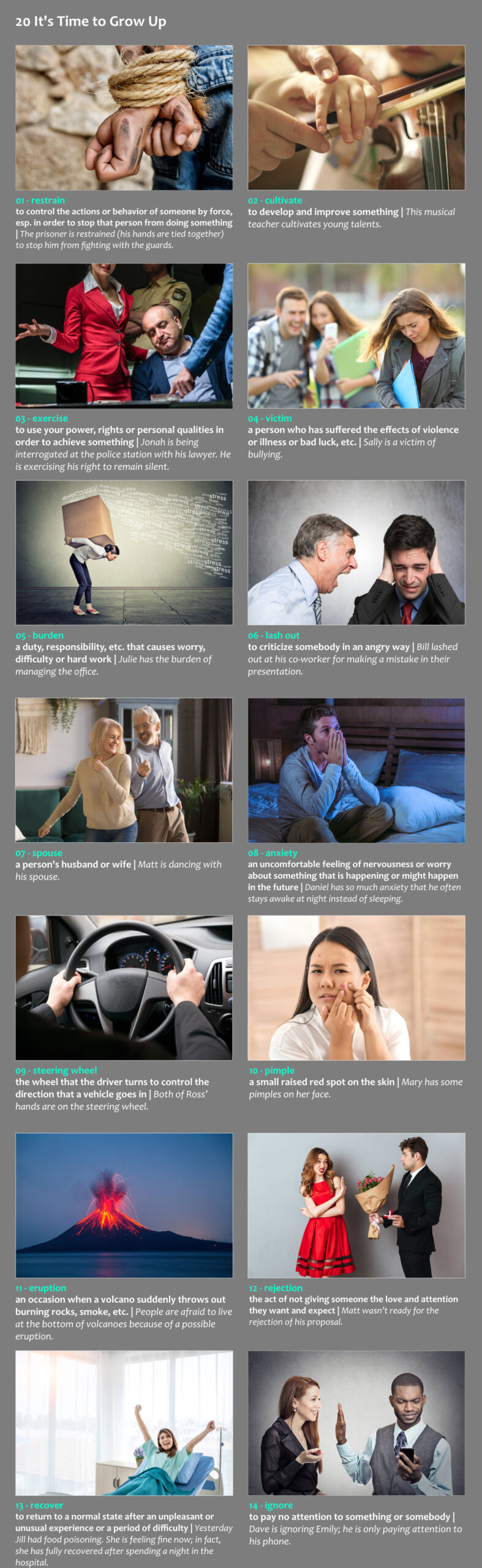
21 Walt Disney American Dreamer (steps 1, 3 and 5)
I want to tell you about an American Original, a man who saw into the future and made it a reality.
He isn’t the only one to do this. There were American Originals before him—Benjamin Franklin, the Wright Brothers, John D. Rockefeller—and there are American Originals in our time, like Steve Jobs, Bill Gates, Elon Musk.
But in the middle of the twentieth century, there was no better example than Walt Disney.
Fifty years after his death, his name still stands atop a global empire.
Raised on a small family farm in Missouri, Walt Disney arrived in Hollywood in 1923 with little more than a suitcase and a pencil. But he had something else. An idea—an idea to explore humanity’s foibles through cartoon animals. Now, I know it sounds obvious now, but only because we live in the world that he helped create.
At first, Disney, like most entrepreneurs, did everything himself—he wrote, produced, directed, and animated. And animation is a painstakingly, time-intensive task. In the early days, it would take hundreds, if not thousands, of separate drawings to create a moving cartoon. But hard work was never really a problem for Walt Disney. Living on baked beans, and renting a one-room office for $5 a month, he believed he was on to something—and nobody could convince him otherwise.
And Disney would need every bit of that conviction. Now, though the barriers to entry in Hollywood in the 1920s were low, the competition was cut-throat. But a charming rodent and the coming of sound allowed him to break through.
Steamboat Willie, in 1928, starring an early version of a whistling Mickey Mouse, confirmed Disney’s belief that there was an audience—a very large audience—for what he wanted to produce.
By 1933, Mickey was the biggest star in the world. And in that year alone, a cartoon mouse received 800,000 pieces of fan mail. Within a decade, Disney had transformed his one-person operation into a major studio employing a thousand animators.
But Disney was a restless personality; he was easily dissatisfied with his own success. And he wanted to make a full-length animated feature. It couldn’t be good. It had to be great. It couldn’t be in black and white. It had to be in color. And it couldn’t just be in color. It had to be art in motion.
It would be very expensive – far beyond what he had ever spent on a single project. But money didn’t really interest him. It was only a means to an end. That end? Snow White and the Seven Dwarfs.
Three years in the making, it was finally released in 1937. And it was an instant and phenomenal success—worth every dime spent, every heartache he had endured.
Disney followed it with one artistic triumph after another: Pinocchio, Fantasia, Dumbo, Bambi.
But by the late forties, Disney’s creative restlessness kicked in again. This time he had a new vision. He wanted to create a new kind of entertainment experience. Not 2D, but a 3D world. He called it a “theme park.” And, typically for Walt, it would be very, very expensive.
Where was he going to get the money? Disney had a plan. He would trade his known quantity—his ability to engage an audience, for an unknown quantity—this crazy theme park idea. He approached the three television networks, NBC, CBS and ABC, with this proposal: He’d create a live-action TV show and in exchange they would give him the money to build this theme park.
Well, CBS turned him down—it was too risky. And NBC couldn’t make up their own mind. But ABC, the youngest and the least successful of the three networks, desperately needed a hit. They said, “Yes, please.”
So, with ABC’s money, Disney built his park. Disneyland soon became another iconic Disney creation, the fantasy destination of every child on earth. And that’s as true today as it was when it opened in 1955.
Men like Disney are rare, but far less so in America.
Why?
Well, because traditionally, Americans, unlike other people in other countries, don’t rely on the government to get things done. And, ideally, the government stays out of their way. Americans instead rely on their own ingenuity. In America, the only limit to your ambition is your own imagination. And if we want more American originals like Walt Disney, let’s hope we keep it that way.
I’m Glenn Beck for Prager University.
I want to tell you about an American Original, a man who saw into the future and made it a reality.
He isn’t the only one to do this. There were American Originals before him—Benjamin Franklin, the Wright Brothers, John D. Rockefeller—and there are American Originals in our time, like Steve Jobs, Bill Gates, Elon Musk.
But in the middle of the twentieth century, there was no better example than Walt Disney.
Fifty years after his death, his name still stands atop a global empire.
atop: on top of; at the top of | Sarah put a flag atop Mt Everest after she climbed it with her team.
empire: a very large and important business or organization | Mark built a business empire.
Raised on a small family farm in Missouri, Walt Disney arrived in Hollywood in 1923 with little more than a suitcase and a pencil. But he had something else. An idea—an idea to explore humanity’s foibles through cartoon animals. Now, I know it sounds obvious now, but only because we live in the world that he helped create.
foibles: a silly habit, or a strange or weak aspect of a person’s character that is not considered serious by other people | Unlike others, Mary could never get used to her friends’ foibles.
At first, Disney, like most entrepreneurs, did everything himself—he wrote, produced, directed, and animated. And animation is a painstakingly time-intensive task. In the early days, it would take hundreds, if not thousands, of separate drawings to create a moving cartoon. But hard work was never really a problem for Walt Disney. Living on baked beans, and renting a one-room office for $5 a month, he believed he was on to something—and nobody could convince him otherwise.
entrepreneur1: a person who makes money by starting or running businesses | Fred, who is an entrepreneur who owns his own coffee shop, welcomes his guests with a bright smile.
painstakingly: in a way that takes a lot of care, effort and attention to detail | Julie painstakingly explained how to solve the math homework to her classmate.
convince: to make somebody believe that something is true | Billy convinced his friend that the earth is flat and not round.
And Disney would need every bit of that conviction. Now, though the barriers to entry in Hollywood in the 1920s were low, the competition was cut-throat. But a charming rodent and the coming of sound allowed him to break through.
barrier2: something that exists between one thing or person and another and keeps them separate | Not all cars can enter the parking lot because of the barrier.
barrier to entry: something, such as official rules or high costs, that makes it difficult for a person or company to get into a particular type of business | The barriers to entry in the airline industry have skyrocketed over the last decade: startup costs are extremely high, and getting the required permissions is a painfully difficult procedure.
cut-throat: competing in a strong and unfair way | According to Michael Ovitz, there is cut-throat competition in the entertainment industry.
rodent3: any small animal that belongs to a group of animals with strong sharp front teeth. Mice, rats and squirrels are all rodents | There are two rodents on the bookshelf chewing on books.
Steamboat Willie, in 1928, starring an early version of a whistling Mickey Mouse, confirmed Disney’s belief that there was an audience—a very large audience—for what he wanted to produce.
star: if a film, play, etc. stars someone, or if someone stars in a film, play, etc., they are the main actor in it | Keanu Reeves starred in The Matrix.
By 1933, Mickey was the biggest star in the world. And in that year alone, a cartoon mouse received 800,000 pieces of fan mail. Within a decade, Disney had transformed his one-person operation into a major studio employing a thousand animators.
decade: a period of ten years, especially a continuous period, such as 1911–1920 or 2003–2012 | It took Johnny a decade to master the guitar.
But Disney was a restless personality; he was easily dissatisfied with his own success. And he wanted to make a full-length animated feature. It couldn’t be good. It had to be great. It couldn’t be in black and white. It had to be in color. And it couldn’t just be in color. It had to be art in motion.
restless: unable to stay still or be happy where you are, because you are bored or need a change | Joseph is always restless: he can’t stay in one place for long, so he’s always on the move.
feature: a film that is usually 90 or more minutes long | Fred’s first feature was released in 2010.
It would be very expensive – far beyond what he had ever spent on a single project. But money didn’t really interest him. It was only a means to an end. That end? Snow White and the Seven Dwarfs.
a means to an end: something that you do because it will help you to achieve something else | Martin does not especially like to give interviews about his business product, but he views them as a means to an end which is more publicity and higher profits.
Three years in the making, it was finally released in 1937. And it was an instant and phenomenal success—worth every dime spent, every heartache he had endured.
heartache: a feeling of being very sad or worried | Everyone goes through heartache at one point in their lives.
endure: to suffer something difficult, unpleasant, or painful | Danny endured an operation on his right arm.
Disney followed it with one artistic triumph after another: Pinocchio, Fantasia, Dumbo, Bambi.
But by the late forties, Disney’s creative restlessness kicked in again. This time he had a new vision. He wanted to create a new kind of entertainment experience. Not 2D, but a 3D world. He called it a “theme park.” And, typically for Walt, it would be very, very expensive.
kick in: to begin to take effect | The painkillers that Logan took kicked in after an hour.
Where was he going to get the money? Disney had a plan. He would trade his known quantity—his ability to engage an audience, for an unknown quantity—this crazy theme park idea. He approached the three television networks, NBC, CBS and ABC, with this proposal: he’d create a live-action TV show and in exchange they would give him the money to build this theme park.
Well, CBS turned him down—it was too risky. And NBC couldn’t make up their own mind. But ABC, the youngest and the least successful of the three networks, desperately needed a hit. They said, “Yes, please.”
hit: a thing or person that is very popular or successful | The Star Wars movies are a hit.
So, with ABC’s money, Disney built his park. Disneyland soon became another iconic Disney creation, the fantasy destination of every child on earth. And that’s as true today as it was when it opened in 1955.
Men like Disney are rare, but far less so in America.
Why?
Well, because traditionally, Americans, unlike other people in other countries, don’t rely on the government to get things done. And, ideally, the government stays out of their way. Americans instead rely on their own ingenuity. In America, the only limit to your ambition is your own imagination. And if we want more American originals like Walt Disney, let’s hope we keep it that way.
rely on: to need or depend on somebody/something | Babies rely on their parents for protection.
ingenuity: someone’s ability to think of clever new ways of doing something | Thanks to Steve Jobs’ ingenuity, the iPhone was a huge commercial success.
I’m Glenn Beck for Prager University.
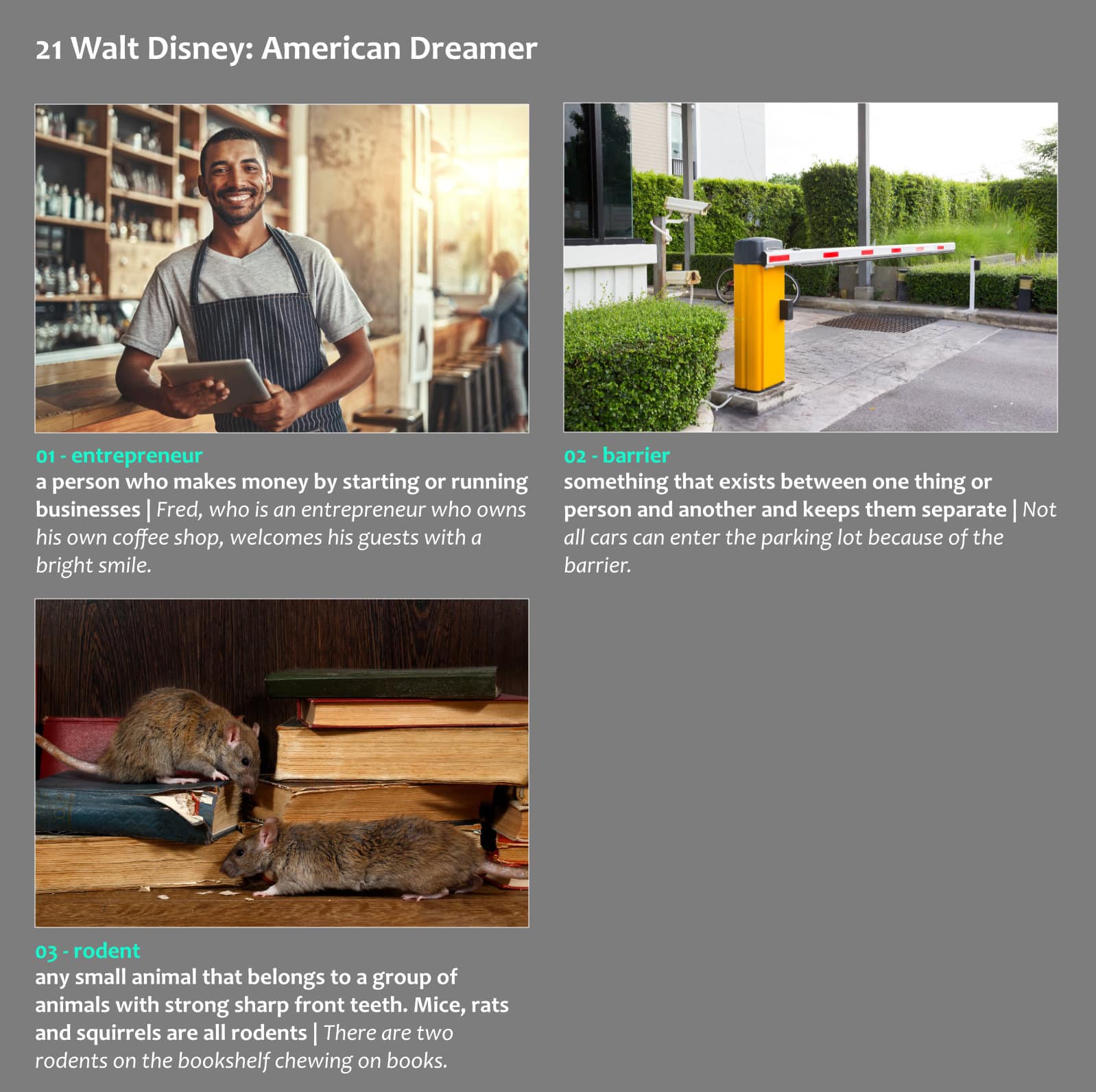
22 Are People Born Good (steps 1, 3 and 5)
There are two important — indeed, fundamental — questions you have to answer in life:
The first is: Is there is a God — specifically a moral and judging Creator. The second is: Are people basically good?
Your answer to the second question will shape just about all of your moral, social, and political views — even more than whether you believe in God. That’s why a believer and an atheist who have the same views about human nature almost always have the same social and political views.
Let me give you some examples:
You’ve probably heard the phrase “Poverty causes crime.” If you believe that people are basically good, you are likely to believe that poverty or bigotry or some other outside force causes people to commit violent crime. That’s the only way you can make sense of the fact that some people commit crimes despite their basically good nature — something drove them to it. But if you don’t believe people are basically good, you are far more likely to blame the criminals themselves, not outside forces, for their actions.
One more example: in a society where it is believed that people are basically good, parents and society don’t devote great efforts toward making good people. After all, if we are born good, why do you have to teach goodness? On the other hand, those who don’t believe we are born all that good understand that parents and society have to undertake major efforts to make children into good adults.
Ok, then, are people basically good? As I will show, given humanity’s history, the answer should be obvious. Of course, human nature isn’t basically good.
Now, this doesn’t mean that people are basically bad. We are born with real potential to do good. But we are not basically good.
Take babies. Babies are lovable and innocent, but they are not good: They are entirely self-centered — as they have to be in order to survive. “I want mommy; I want milk; I want to be held; I want to be comforted, and if you do not do all these things immediately, I will ruin your life!” That’s not goodness; that’s narcissism.
We are born narcissists, preoccupied with “number one:” ourselves. And if you’ve ever worked with kids, you know how cruel, how bullying, they can be.
And don’t parents have to tell their child tens of thousands times “Say thank you”? Now, why is that? If we are naturally good, wouldn’t feeling and expressing gratitude come naturally?
And then there is the historical record. Evils — huge evils affecting much of the human race — have been the norm.
Here goes, just a few examples:
The Ottoman Turks targeted millions of Armenian Christians for death during World War I.
The German Nazi regime murdered six million Jews — two out of every three European Jews, including more than a million children and babies.
The Soviet Communist regime slaughtered about five million Ukrainians and about 25 million other innocents.
The Chinese Communists killed about 70 million Chinese and enslaved the rest of the Chinese people.
The North Korean Communist regime has built what one can only call the world’s largest concentration camp — most of North Korea.
In post-colonial Congo in the decade between 1998 and 2008, over 5 million people were murdered, and tens, if not hundreds, of thousands of women, were raped.
Of course before that, about ten million Africans were kidnapped and made slaves in the European slave trade. And another 10 to 18 million Africans were enslaved by Arab slave traders.
And, let me ask you this, if people are basically good, why does every civilization have so many laws to control human behavior?
Knowing all this, those who believe that people are basically good have simply made a decision to believe that and ignore all the evidence.
Why do people commit evil? Because it’s easy to. Because it’s tempting to. And, yes, because it often accords with human nature.
That is why figuring out how to make good people is the single most important project in all of human life. But first, you have to believe it’s necessary.
I’m Dennis Prager.
There are two important — indeed, fundamental — questions you have to answer in life:
The first is: Is there a God — specifically a moral and judging Creator? The second is: Are people basically good?
indeed: used to add emphasising information to a statement (= and also/and surely/and really/and truly) | John was a quick runner in the race; indeed, he was so quick that he won the race.
judge1: to have or give an opinion, or to decide about something or someone, especially after thinking carefully | The judge is judging a criminal as guilty.
Your answer to the second question will shape just about all of your moral, social, and political views — even more than whether you believe in God. That’s why a believer and an atheist who have the same views about human nature almost always have the same social and political views.
shape2 A: to make something into a particular form | Jerry is shaping clay.
B: to have an important influence on the way that somebody/something develops | Lily’s parents largely shaped her future.
social: relating to society and living together in an organized way | Some social differences are present in every society.
Let me give you some examples:
You’ve probably heard the phrase “Poverty causes crime.” If you believe that people are basically good, you are likely to believe that poverty or bigotry or some other outside force causes people to commit violent crime. That’s the only way you can make sense of the fact that some people commit crimes despite their basically good nature — something drove them to it. But if you don’t believe people are basically good, you are far more likely to blame the criminals themselves, not outside forces, for their actions.
poverty3: the state of being poor | Although Danny lives in poverty, he still studies hard.
bigotry: the fact of having and expressing strong, unreasonable beliefs and disliking other people who have different beliefs or a different way of life | Mark was the victim of racial bigotry.
commit a crime: to do something illegal | The mafia are known to commit crimes.
violent4: involving or caused by physical force that is intended to hurt or kill somebody | The Great White Shark is one of the most violent animals alive; here it is making a violent attack on a bird.
far: very much; to a great degree | Peter has far more interesting ideas than his friends.
One more example: in a society where it is believed that people are basically good, parents and society don’t devote great efforts toward making good people. After all, if we are born good, why do you have to teach goodness? On the other hand, those who don’t believe we are born all that good understand that parents and society have to undertake major efforts to make children into good adults.
devote (something to something/someone): to give time or effort completely to something you believe in or to a person | Mary devotes herself to raising her kids.
effort5: an attempt (= a try) to do something especially when it is difficult to do | Joe is making efforts to lift the weight in the gym.
undertake: to make yourself responsible for something and start doing it | The builders undertook a major construction project; they will begin building the house very soon.
Ok, then, are people basically good? As I will show, given humanity’s history, the answer should be obvious. Of course, human nature isn’t basically good.
Now, this doesn’t mean that people are basically bad. We are born with real potential to do good. But we are not basically good.
Take babies. Babies are lovable and innocent, but they are not good: they are entirely self-centered — as they have to be in order to survive. “I want mommy; I want milk; I want to be held; I want to be comforted, and if you do not do all these things immediately, I will ruin your life!” That’s not goodness; that’s narcissism.
innocent: having no knowledge of the unpleasant and evil things in life | Danny was too young and innocent to know about the mafia.
comfort: to make somebody who is worried or unhappy feel better by being kind and showing sympathy to them | Maggie always comforts Lisa when she is sad.
ruin6: to spoil or destroy something completely | War ruined the entire city.
narcissism: too much interest in and admiration for yourself | Gary’s narcissism was his main weakness.
We are born narcissists, preoccupied with “number one:” ourselves. And if you’ve ever worked with kids, you know how cruel, how bullying, they can be.
preoccupied: thinking and/or worrying continuously about something so that you do not pay attention to other things | Leslie was preoccupied with her health problems.
bullying7: the behaviour of a person who hurts or frightens someone smaller or less powerful, often forcing that person to do something they do not want to do | Bullying occurs in many schools.
And don’t parents have to tell their child tens of thousands of times “Say thank you”? Now, why is that? If we are naturally good, wouldn’t feeling and expressing gratitude come naturally?
express: to show or make known a feeling, an opinion, etc. by words, looks or actions | Johnny always expressed his opinions about the food to the waiter, whenever he went to a new restaurant.
gratitude: a strong feeling of appreciation to someone or something for what the person has done to help you | Mr Klein received gifts from a lot of his students in gratitude for his teaching style.
And then there is the historical record. Evils — huge evils affecting much of the human race — have been the norm.
the norm: a situation or a pattern of behaviour that is usual or expected | We have seen cheating on exams become the norm in schools.
Here goes, just a few examples:
The Ottoman Turks targeted millions of Armenian Christians for death during World War I.
target8: to aim an attack or a criticism at somebody/something | Foxes are targeted for hunting in Northern Ireland.
The German Nazi regime murdered six million Jews — two out of every three European Jews, including more than a million children and babies.
The Soviet Communist regime slaughtered about five million Ukrainians and about 25 million other innocents.
slaughter: to kill a large number of people or animals violently | In most countries it is illegal for hunters to slaughter animals in the wild.
The Chinese Communists killed about 70 million Chinese and enslaved the rest of the Chinese people.
The North Korean Communist regime has built what one can only call the world’s largest concentration camp — most of North Korea.
one: someone or anyone; a person | One does not simply walk into a warzone without armour.
In post-colonial Congo in the decade between 1998 and 2008, over 5 million people were murdered, and tens, if not hundreds, of thousands of women, were raped.
rape: to force somebody to have sex with them when they do not want to by threatening them or using violence | Mary was scared that she would be raped, so she was careful with where she went at night.
Of course before that, about ten million Africans were kidnapped and made slaves in the European slave trade. And another 10 to 18 million Africans were enslaved by Arab slave traders.
kidnap9: to take a person away illegally by force, usually in order to demand money in exchange for releasing them | Lucy has been kidnapped.
enslave10: to make somebody be owned by another person and force them to work for them | These statues show people who were enslaved.
And, let me ask you this, if people are basically good, why does every civilization have so many laws to control human behavior?
behavior: a particular way of acting | Mark was behaving very rudely towards customers.
Knowing all this, those who believe that people are basically good have simply made a decision to believe that and ignore all the evidence.
ignore: to pay no attention to something | Evelyn ignored her doctor’s advice.
evidence: reasons or things that show that something is true or is not true | There is much evidence about the harmful effects of cigarettes.
Why do people commit evil? Because it’s easy to. Because it’s tempting to. And, yes, because it often accords with human nature.
tempting11: something that is tempting is attractive, and makes people want to have it, do it, etc. | Lucy is deciding whether to eat an orange or a chocolate muffin; the chocolate muffin is more tempting to her.
accord (with): to agree with or match something | Fred’s prediction about the results of the election accords with the newest facts. (He correctly predicted what will happen in the election.)
That is why figuring out how to make good people is the single most important project in all of human life. But first, you have to believe it’s necessary.
I’m Dennis Prager.
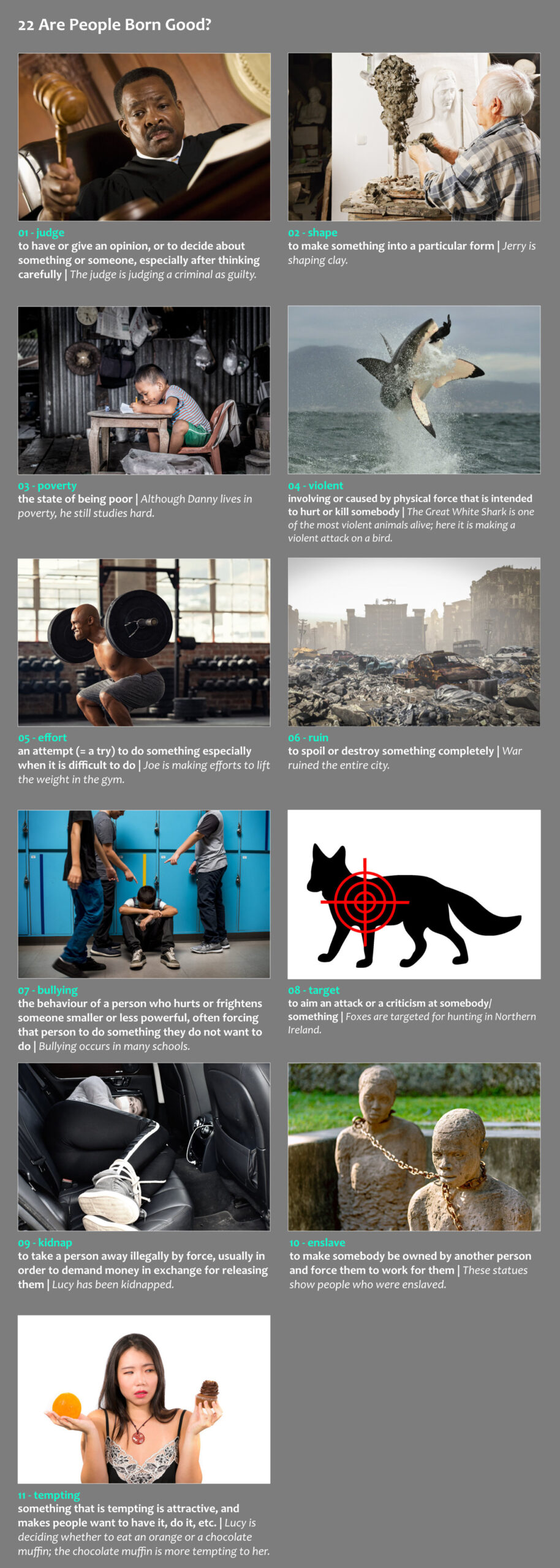
23 What Did Your Parents Most Want You to Be (steps 1, 3 and 5)
A lot of the things that are wrong with the world we can’t fix by ourselves. As much as we’d like to see peace brought to troubled areas, corrupt governments reformed, cancers cured, there’s a limited amount that any of us as individuals can do about such things.
However, there is one thing that nearly all of us can do that will immediately and exponentially increase goodness and happiness on earth.
Parents — and all other adults — should reserve their highest praise of children for when their children do kind acts. This is not the case at present. As a rule, children receive their highest compliments for one of four things:
— their intellectual and academic achievements “my son, Sean is brilliant! His teacher says he is the best student she has had in years.”
— their athletic abilities,
— their artistic attainments,
— and, in the case of girls, their looks.
Children who receive their parents’ and other adults’ compliments in these areas are delighted; everyone loves compliments. But what about the child who doesn’t excel at academics, who isn’t a gifted athlete or dancer? Or the girl who is not particularly pretty?
About what will their parents praise them? The most flattering remark such a child is likely to hear their parents tell others will be something like, “But he or she is a really good kid.” From which it can generally be inferred that being a good kid is not a big deal — that, from the parent’s perspective, the child is probably not very good at anything worth talking about.
Some parents to whom I’ve made this proposal have told me it’s unnecessary; they’re certain that they’ve successfully communicated to their children that being a good person is what really matters most to them.
By in large, these parents are deluding themselves and there is a way for parents to find out if this is so.
For many years, Dennis Prager has suggested that parents ask their children: What do you think that I, your mother, or I, your father, want you to be: Successful, smart, good, or happy?
Many parents who have conducted this experiment have been quite surprised to learn that their children did not think that being good was what mattered most to their parents. Try it yourself. Ask your child of any age that question: What do you think I most want you to be?
I want to make clear that I am not suggesting that parents stop complimenting their children for their accomplishments in other areas. All children want to know that their parents have respect for their accomplishments. And girls, even more than boys, also need to feel that they’re physically attractive.
But — and this is an important but — what I am suggesting is this: the traits that we most often emphasize and praise are all important only if being a good person is placed at the top of the list.
But then you might say, “don’t these traits have a value in and of themselves independent of goodness?” The answer is no. They don’t. Germany did not start World War II and carry out the Holocaust because it lacked intelligence or cultured people, but because it lacked enough good people.
Now, what do I mean when I speak about young people being good? Let me cite a few examples:
— speaking out against and confronting a school bully;
— Befriending a new kid at school who isn’t popular;
— Finding a wallet or cell phone and making every effort to locate the owner, instead of keeping it;
— Offering one’s seat on a bus to an older person;
— Treating one’s siblings decently;
— Not cheating on tests;
And much more.
Note, however, that I didn’t list among my examples going on a 10K walk for a good cause like cancer research. That is, of course, a very worthwhile thing for a young person to do, but it’s not really what I’m talking about. I’m talking about individual one-to-one acts of goodness and integrity.
Why will parents’ reserving their highest praise for their child’s goodness and integrity have so powerful an impact?
Because children will then ultimately identify feeling good about themselves with being a good person, and they will most like themselves when they act nobly. Or to put in another way, their self-esteem will come more from their goodness than from anything else.
What a world that would be! And the best news about this proposal is that you can start doing it immediately. And I don’t mean tomorrow. I mean now.
I’m Joseph Telushkin, for Prager University.
A lot of the things that are wrong with the world we can’t fix by ourselves. As much as we’d like to see peace brought to troubled areas, corrupt governments reformed, cancers cured, there’s a limited amount that any of us as individuals can do about such things.
cure1-2: to make a person or an animal healthy again after an illness | The doctors cured Maggie; the virus has been killed.
However, there is one thing that nearly all of us can do that will immediately and exponentially increase goodness and happiness on earth.
exponentially3: in a way that becomes quicker and quicker as something becomes larger | In MLM businesses, the number of customers (or members) increases exponentially.
Parents — and all other adults — should reserve their highest praise of children for when their children do kind acts. This is not the case at present. As a rule, children receive their highest compliments for one of four things:
reserve: to keep something for somebody/something, so that it cannot be used by any other person or for any other reason | Johnny reserved his thoughts to himself (=he didn’t tell anyone about them).
praise4: to express admiration or approval of the achievements or characteristics of a person | Susan is praising her daughter for getting the correct answer in her homework; she is high fiving her as a reward.
compliment5: a comment that expresses praise or approval of somebody | Sarah was given compliments all day by her co-workers after she successfully finished a project.
— their intellectual and academic achievements “my son, Sean is brilliant! His teacher says he is the best student she has had in years.”
— their athletic abilities,
— their artistic attainments,
— and, in the case of girls, their looks.
achievement: something that a person, company, etc. has done or finished successfully | One of Edward’s biggest achievements has been climbing Mt Everest at a very young age.
attainment: something that you achieved | Johnny had exceptional academic attainments.
Children who receive their parents’ and other adults’ compliments in these areas are delighted; everyone loves compliments. But what about the child who doesn’t excel at academics, who isn’t a gifted athlete or dancer? Or the girl who is not particularly pretty?
delighted6: very pleased | Sophie, who has just finished shopping, is delighted with her new clothes.
excel: to be very good at doing something | Timmy excelled at geography.
About what will their parents praise them? The most flattering remark such a child is likely to hear their parents tell others will be something like, “But he or she is a really good kid.” From which it can generally be inferred that being a good kid is not a big deal — that, from the parent’s perspective, the child is probably not very good at anything worth talking about.
flattering7: saying nice things about somebody/something | Mark is saying flattering remarks to his boss while he is holding her hand.
infer: to reach an opinion from available information or facts | Evelyn inferred from the look on her friend’s face that her friend was in a bad mood.
worth: important or useful enough to have or do | There is nothing worth reading about in this newspaper (= the news isn’t important, interesting or useful).
Some parents to whom I’ve made this proposal have told me it’s unnecessary; they’re certain that they’ve successfully communicated to their children that being a good person is what really matters most to them.
proposal8: a formal suggestion or plan; the act of making a suggestion | Greg is presenting a proposal about the possible future strategy of the business.
By and large, these parents are deluding themselves and there is a way for parents to find out if this is so.
by and large: generally, but not completely, true | By and large, Emma enjoyed the roller coaster in Disneyland.
deluding: to make somebody believe something that is not true | Johnny is deluding himself if he thinks that the exam will be over in just a few minutes.
For many years, Dennis Prager has suggested that parents ask their children: What do you think that I, your mother, or I, your father, want you to be: Successful, smart, good, or happy?
Many parents who have conducted this experiment have been quite surprised to learn that their children did not think that being good was what mattered most to their parents. Try it yourself. Ask your child of any age that question: What do you think I most want you to be?
conduct9: to organize and perform a particular activity | Jim is conducting the orchestra.
experiment10: a new activity, idea or method that you try out to see what happens or what effect it has | Tracy and Brian did an experiment in the laboratory; unfortunately, it went wrong.
I want to make clear that I am not suggesting that parents stop complimenting their children for their accomplishments in other areas. All children want to know that their parents have respect for their accomplishments. And girls, even more than boys, also need to feel that they’re physically attractive.
suggest: to put forward an idea or a plan for other people to think about | Eva suggested that her family go to a fancy restaurant instead of eating at home.
accomplishment11: something that is successful, or that is achieved after a lot of work or effort | Dave’s biggest accomplishment this year has been climbing Mt Everest.
respect: to have a very good opinion of somebody/something; to admire somebody/something | Physicists respect most of Einstein’s ideas.
attractive12: very pleasing in appearance or sound | The Smith family found this house attractive.
But — and this is an important but — what I am suggesting is this: the traits that we most often emphasize and praise are all important only if being a good person is placed at the top of the list.
trait13: a particular quality in your personality | One of Lisa’s best traits is her optimism.
emphasize14: to show that something is very important or worth giving attention to | The word “identification” is emphasized in this document.
But then you might say, “don’t these traits have a value in and of themselves independent of goodness?” The answer is no. They don’t. Germany did not start World War II and carry out the Holocaust because it lacked intelligence or cultured people, but because it lacked enough good people.
lack15: to have none or not enough of something | Mike lacked sleep at night, so he fell asleep at his workplace.
Now, what do I mean when I speak about young people being good? Let me cite a few examples:
cite: to mention something as a reason or an example, or in order to support what you are saying | James cited health problems as a reason for his bad performance in school.
— speaking out against and confronting a school bully;
— Befriending a new kid at school who isn’t popular;
— Finding a wallet or cell phone and making every effort to locate the owner, instead of keeping it;
— Offering one’s seat on a bus to an older person;
— Treating one’s siblings decently;
— Not cheating on tests;
And much more.
speak out16: to state your opinions publicly, especially in opposition to something and in a way that takes courage | Jesse and her friends are speaking out on some issues.
befriend17: to be friendly to someone | Eric and Stephanie are befriending a dog.
decently: honestly and fairly; in a way that involves treating people with respect | Kyle always treated others decently.
Note, however, that I didn’t list among my examples going on a 10K walk for a good cause like cancer research. That is, of course, a very worthwhile thing for a young person to do, but it’s not really what I’m talking about. I’m talking about individual one-to-one acts of goodness and integrity.
cause: a socially valuable principle (= a moral rule or strong belief) that is strongly supported by some people | William gave money monthly to a good cause.
integrity: the quality of being honest and having strong moral principles | Fred was a man of integrity.
Why will parents’ reserving their highest praise for their child’s goodness and integrity have so powerful an impact?
impact18: the powerful effect that something has on somebody/something | The impact of Jason pushing the first domino is the falling of all the dominoes in the line.
Because children will then ultimately identify feeling good about themselves with being a good person, and they will most like themselves when they act nobly. Or to put in another way, their self-esteem will come more from their goodness than from anything else.
ultimately: finally, after a series of things have happened | Sarah’s grade for geography will ultimately depend on how she does on today’s final exams.
nobly: in a way that shows fine personal qualities that people admire, such as courage, honesty and care for others | Michael dealt with the homeless man nobly: he gave him £10 without thinking much.
self-esteem19: belief and confidence in your own ability and value | Susie has high self esteem.
What a world that would be! And the best news about this proposal is that you can start doing it immediately. And I don’t mean tomorrow. I mean now.
I’m Joseph Telushkin, for Prager University.
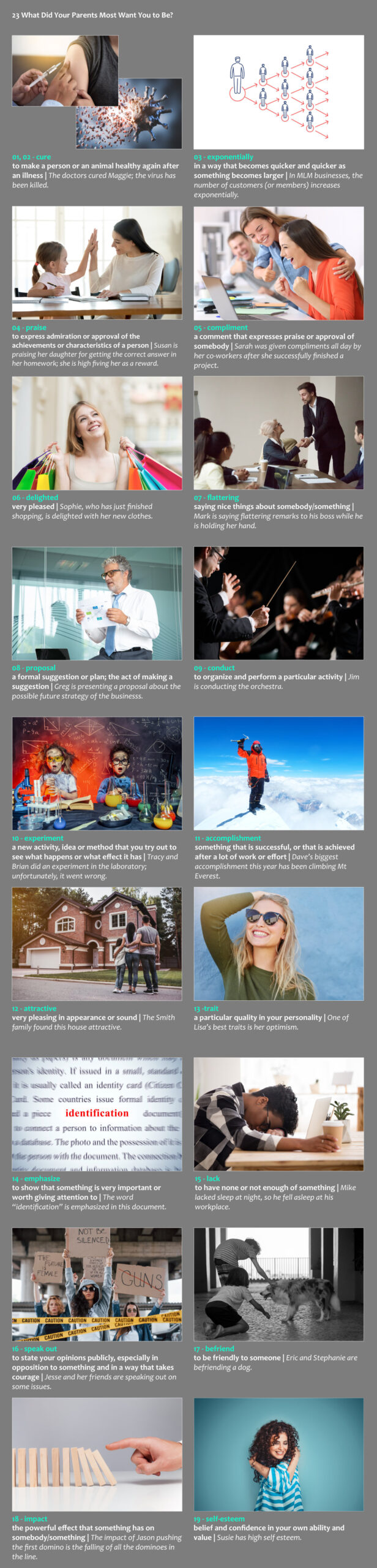
24 Is your child getting enough Vitamin N (steps 1, 3 and 5)
I want to tell you about an essential vitamin you’ve probably never heard of. If you’re a parent, or plan to be one, it might be more important to your child’s growth than all other vitamins combined. And only you, a parent, can provide it.
I call it Vitamin N. The word “No.”
More and more children, I find, are suffering from Vitamin N deficiency. And they, their parents, and our entire culture are paying the price.
Let me illustrate my point with a story that’s quite typical. A father, I’ll call him Bill, gave his son, age five, pretty much everything the little boy asked for. Like most parents, Bill wanted more than anything for his son to be happy. But he wasn’t. Instead he was petulant, moody, and often sullen. He was also having problems getting along with other children. In addition, he was very demanding and rarely if ever expressed any appreciation, let alone gratitude, for all the things Bill and his wife were giving him. Was his son depressed, Bill wanted to know? Did he need therapy? His son, I told him, was suffering the predictable ill effects of being over-indulged. What he needed was a healthy and steady dose of Vitamin N.
Over-indulgence–a deficiency of Vitamin N—leads to its own form of addiction. When the point of diminishing returns is passed (and it’s passed fairly early on), the receiving of things begins to generate nothing but want for more things. One terrible effect of this is that our children are becoming accustomed to a material standard that’s out of kilter with what they can ever hope to achieve as adults. Consider also that many, if not most, children attain this level of affluence not by working, sacrificing, or doing their best, but by whining, demanding, and manipulating. So in the process of inflating their material expectations, we also teach children that something can be had for next to nothing. Not only is that a falsehood, it’s also one of the most dangerous, destructive attitudes a person can acquire.
This may go a long way toward explaining why the mental health of children in the 1950s – when kids got a lot less — was significantly better than the mental health of today’s kids. Since the ‘50s, and especially in the last few decades, as indulgence has become the parenting norm, the rates of child and teen depression have skyrocketed.
Children who grow up believing in the something-for-nothing fairy tale are likely to become emotionally stunted, self-centered adults. Then, when they themselves become parents, they’re likely to overdose their children with material things – the piles of toys, plushies, and gadgets one finds scattered around most households. In that way, over indulgence—a deficiency of Vitamin N—becomes an inherited disease, an addiction passed from one generation to the next.
This also explains why children who get too much of what they want rarely take proper care of anything they have. Why should they? After all, experience tells them that more is always on the way.
Children deserve better. They deserve to have parents attend to their needs for protection, affection, and direction. Beyond that: They deserve to hear their parents say “no” far more often than yes when it comes to their whimsical desires. They deserve to learn the value of constructive, creative effort as opposed to the value of effort expended whining, lying on the floor kicking and screaming, or playing one parent against the other. They deserve to learn that work is the only truly fulfilling way of getting anything of value in life, and that the harder they work, the more ultimately fulfilling the outcome.
In the process of trying to protect children from frustration, parents have turned reality upside down. A child raised in this topsy-turvy fashion may not have the skills needed to stand on his or her own two feet when the time comes to do so.
Here’s a simple rule: Turn your children’s world right-side up by giving them all of what they truly need, but no more than 25 percent of what they simply want. I call this the “Principle of Benign Deprivation.”
When all is said and done, the most character-building two-letter word in the English language is no. Vitamin N.
Dispense it frequently. You’ll be happier in the long run, and so will your child.
I’m John Rosemond, author and family psychologist, for Prager University.
I want to tell you about an essential vitamin you’ve probably never heard of. If you’re a parent, or plan to be one, it might be more important to your child’s growth than all other vitamins combined. And only you, a parent, can provide it.
I call it Vitamin N. The word “No.”
More and more children, I find, are suffering from Vitamin N deficiency. And they, their parents, and our entire culture are paying the price.
deficiency1: the state of not having, or not having enough of, something that is essential | Rachel has vitamin D deficiency, so she is going on holiday to a sunny beach to get more of it.
entire2: whole or complete, with nothing missing | The entire class raised their hands to answer the teacher’s question.
Let me illustrate my point with a story that’s quite typical. A father, I’ll call him Bill, gave his son, age five, pretty much everything the little boy asked for. Like most parents, Bill wanted more than anything for his son to be happy. But he wasn’t. Instead, he was petulant, moody, and often sullen. He was also having problems getting along with other children. In addition, he was very demanding and rarely if ever expressed any appreciation, let alone gratitude, for all the things Bill and his wife were giving him. Was his son depressed, Bill wanted to know? Did he need therapy? His son, I told him, was suffering the predictable ill effects of being overindulged. What he needed was a healthy and steady dose of Vitamin N.
petulant3: behaving in an angry way, especially because you cannot do or have what you want | Rose behaved like a petulant child because she did not get sweets on the way to the farm.
sullen4: angry and unwilling to smile or be pleasant to people | Maggie gave her parents a sullen look at Christmas.
demanding5: expecting a lot of work or attention from others; not easily satisfied | Joe is the most demanding customer that the hotel staff have ever seen. He comes down to reception every 5 minutes to complain and wants immediate attention.
appreciation: showing that you are grateful (= thankful) for something that a person has done | Danny has landed (=successfully got) a new big client for his firm, so his boss and coworkers are showing their appreciation to him.
gratitude6: wanting to express your thanks | Zack is feeling gratitude towards the doctor who cured him of his illness.
overindulged7: to give somebody more than is good for them | Joe is being overindulged by his parents.
steady8: happening in a smooth, gradual, and regular way, not suddenly or unexpectedly | In the children’s story, the turtle walks at a slow, steady pace.
Overindulgence–a deficiency of Vitamin N—leads to its own form of addiction. When the point of diminishing returns is passed (and it’s passed fairly early on), the receiving of things begins to generate nothing but want for more things. One terrible effect of this is that our children are becoming accustomed to a material standard that’s out of kilter with what they can ever hope to achieve as adults. Consider also that many, if not most, children attain this level of affluence not by working, sacrificing, or doing their best, but by whining, demanding, and manipulating. So in the process of inflating their material expectations, we also teach children that something can be had for next to nothing. Not only is that a falsehood, it’s also one of the most dangerous, destructive attitudes a person can acquire.
diminish: to become smaller, weaker, etc.; to make something become smaller, weaker, etc. | The celebrity’s fame has steadily diminished over the years.
diminishing returns: The law of diminishing returns refers to a situation in which a smaller result is achieved for an increasing amount of effort | A good night’s sleep is important; however, sleeping more than what is optimal has diminishing returns: the extra hours don’t benefit you much.
out of kilter: not agreeing with or the same as something else | Joe’s opinions about how the country should be run are out of kilter with most of those in his country.
affluence: the state of having a lot of money or owning many things | According to Julie, the 2000s were an age of affluence in America.
sacrifice: to give up something that is important or valuable to you in order to get or do something that seems more important for yourself or for another person | Larry sacrificed his savings to buy a new sports car.
whine9: to complain in an annoying, crying voice | Lucy cannot find her car keys, so she is whining as she is running very late to work.
inflate10: to make something larger or more important | Steve is inflating a balloon.
falsehood: something that is not true; a lie | The book was full of falsehoods.
acquire11: to obtain (= to get) something by buying or having it given | Mark is acquiring jewelry for his wife.
This may go a long way toward explaining why the mental health of children in the 1950s – when kids got a lot less — was significantly better than the mental health of today’s kids. Since the ‘50s, and especially in the last few decades, as indulgence has become the parenting norm, the rates of child and teen depression have skyrocketed.
significantly: in a way that is large or important; very much | The number of people who know how to read has significantly increased since the 1950s.
skyrocket12: (esp. of amounts) to rise extremely quickly | Prices have recently skyrocketed.
Children who grow up believing in the something-for-nothing fairy tale are likely to become emotionally stunted, self-centered adults. Then, when they themselves become parents, they’re likely to overdose their children with material things – the piles of toys, plushies, and gadgets one finds scattered around most households. In that way, over indulgence—a deficiency of Vitamin N—becomes an inherited disease, an addiction passed from one generation to the next.
fairy tale13: a story about magic or fairies, usually for children | Fairy tales often involve dragons, a castle , a hero and a witch.
stunted: prevented from growing or developing to the usual size | There were children with stunted emotional growth in the building.
pile14: a number of things that have been placed on top of each other | There is a red robot standing on top of a pile of toys.
gadget15: a small device or machine with a particular purpose | These are some modern gadgets that people use; they include a smartphone, an ipod and a camera.
scattered around16: spread far apart over a wide area or over a long period of time | Clothes, books and other things are scattered around this room.
inherit: to have qualities, physical features, etc. that are similar to those of your parents, grandparents, etc. | Harry inherited his mother’s eyes (= they have similar eyes).
This also explains why children who get too much of what they want rarely take proper care of anything they have. Why should they? After all, experience tells them that more is always on the way.
Children deserve better. They deserve to have parents attend to their needs for protection, affection, and direction. Beyond that: They deserve to hear their parents say “no” far more often than yes when it comes to their whimsical desires. They deserve to learn the value of constructive, creative effort as opposed to the value of effort expended whining, lying on the floor kicking and screaming, or playing one parent against the other. They deserve to learn that work is the only truly fulfilling way of getting anything of value in life, and that the harder they work, the more ultimately fulfilling the outcome.
affection: the feeling of liking or loving somebody/something very much and caring about them | Danny regularly showed his wife affection.
whimsical: unusual and not serious in a way that is either funny or annoying | Noah has a whimsical sense of humour.
effort: physical or mental activity needed to achieve something | Lola put a lot of effort into making herself look good.
as opposed to: used to make a contrast between two things; rather than | As opposed to going on holiday in July as usual, Sally went on holiday in January this year.
expended: to use or spend a lot of time, money, energy, etc. | Calvin expended all his efforts into passing his chemistry class.
“effort-expended whining”: when a child puts a lot of effort and energy into his/her crying in order to try to prove how upset they are.
fulfilling: making you feel happy and satisfied | The employees at the company found their work fulfilling.
In the process of trying to protect children from frustration, parents have turned reality upside down. A child raised in this topsy-turvy fashion may not have the skills needed to stand on his or her own two feet when the time comes to do so.
topsy-turvy: in a state in which nothing is certain and everything is very confused | Everything’s topsy-turvy in my life at the moment.
fashion: way (= how something is being done) | Jonah worked on his project in a topsy-turvy fashion.
Here’s a simple rule: Turn your children’s world right-side up by giving them all of what they truly need, but no more than 25 percent of what they simply want. I call this the “Principle of Benign Deprivation.”
right-side up: with the top part turned to the top; in the correct, normal position | My buttered toast fell on the floor; however; it landed the right side up.
benign: pleasant and kind | Solomon, who was a benign king, cared for his people.
deprivation: an absence or too little of something important | In some countries, there are usually periods of food shortages and other deprivation during wars.
When all is said and done, the most character-building two-letter word in the English language is no. Vitamin N.
Dispense it frequently. You’ll be happier in the long run, and so will your child.
I’m John Rosemond, author and family psychologist, for Prager University.
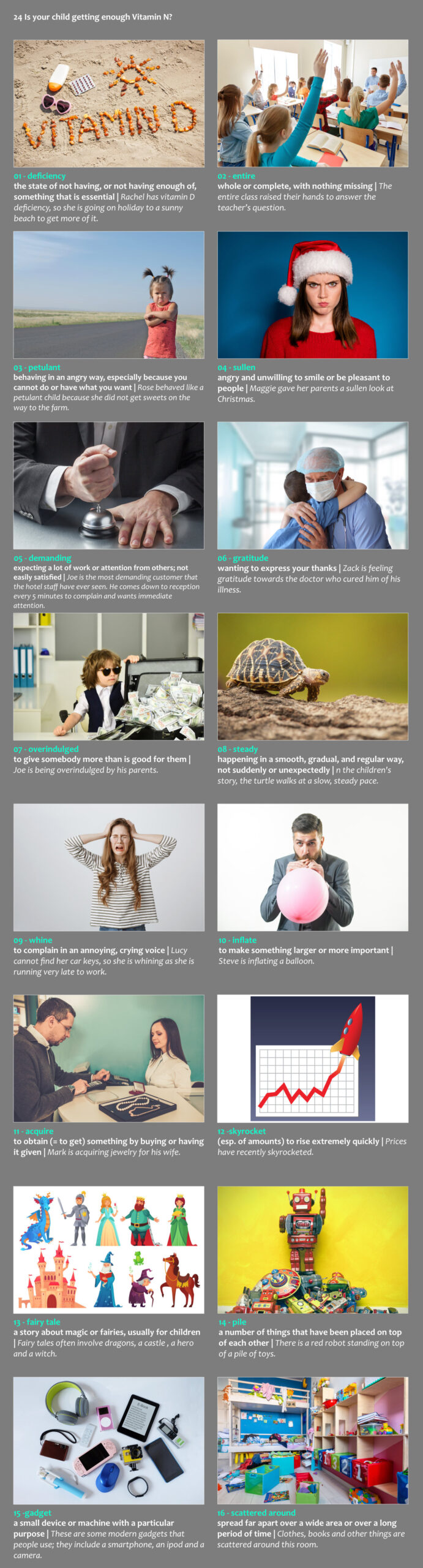
25 Graduation 2020 The Covid Class (steps 1, 3 and 5)
We are living in a unique time. You are therefore a unique graduating class. You may well be known forever as “the Covid Class.”
For the first time in history, billions of people, including healthy people and people living in free societies, have been confined to their homes. So let me offer you three lessons about life based on what you’ve experienced.
Number one: Life is hard. It’s unfair. It’s unpredictable.
Until now, most young people, at least in the West, did not appreciate how true this is. You’ve been living in a time and place in which so many of life’s hardships have been overcome. You’ve probably lived a healthier, safer, and freer existence than almost any young people who ever lived before you.
And if that is true, you would only know about how hard life is if you’ve read about the sufferings of others, such as the awful suffering people endured during World Wars I and II, not to mention the starvation and disease of the medieval and ancient worlds.
Because of the hardships caused by the coronavirus—including the shattering of millions of people’s livelihoods and dreams throughout the world—you’ve come to sense how hard life is. And that understanding equips you to deal much better with life’s challenges—which are inevitable.
Number two: Always be grateful.
Gratitude is probably the most important trait you can have—because it is the source of both happiness and goodness. In other words, you cannot be either a happy person or a good person unless you are a grateful person.
Unfortunately, most people don’t learn how important gratitude is until it’s too late. I’ll bet this makes a lot more sense to you now, thanks to the coronavirus pandemic. How often have you thought of the good old days when you could go to a restaurant with friends, or to a sporting event or concert, or visit a relative you love? But were you grateful for those things when you were able to do them? Probably not.
So now, make this promise to yourself: I will not wait until I lose the good things in my life to be grateful for having them. Or, to put it another way, adopt an attitude that has guided me all of my life: If nothing’s horrific, life is terrific.
Most people wait for something wonderful to happen to be happy. My view has always been that instead of waiting for something great to happen to be happy, I will be happy until something awful happens.
Number three: Freedom is fragile. Very fragile.
The ease with which most Americans acquiesced to the removal of many of their most basic rights—even if you agree with that removal—should take your breath away. At the very least, it should make you realize how easily any government can take away people’s most elementary freedoms. This happened around the world, but I single out America because no country has been so free for so long. America, more than any country, has symbolized liberty. That’s why France gave America—and no other country—the Statue of Liberty.
Yet people living in states with fewer deaths from the coronavirus than from car accidents acquiesced to living under house arrest except to get food or medicine, being barred from walking outside with more than one other person, and being barred from walking their dog without wearing a face mask. Remarkably, they acquiesced to all this as they watched their life savings, their family business, or their job disappear.
Now, again, you may agree that this should have been done even in states with almost no deaths due to the coronavirus. I don’t. But that’s not the issue here. The issue is how easily modern governments can become police states. In sophisticated New York City, the mayor appealed to people to send the police photos of fellow citizens gathering in groups of more than two or not wearing a face mask outside.
You may think all this was reasonable. But what is to stop governments from doing such things when you don’t think it’s reasonable?
If there are any silver linings to the coronavirus shutdown of the world’s economic and social life, one would be the opportunity to learn life-enriching lessons. So I offered you three:
Life is hard. Always be grateful. And freedom is fragile.
I’m Dennis Prager.
We are living in a unique time. You are therefore a unique graduating class. You may well be known forever as “the Covid Class.”
For the first time in history, billions of people, including healthy people and people living in free societies, have been confined to their homes. So let me offer you three lessons about life based on what you’ve experienced.
confine1: to keep somebody/something inside the limits of a particular activity, subject, area, etc. | Lisa is confined to the cave.
Number one: Life is hard. It’s unfair. It’s unpredictable.
Until now, most young people, at least in the West, did not appreciate how true this is. You’ve been living in a time and place in which so many of life’s hardships have been overcome. You’ve probably lived a healthier, safer, and freer existence than almost any young people who ever lived before you.
And if that is true, you would only know about how hard life is if you’ve read about the sufferings of others, such as the awful suffering people endured during World Wars I and II, not to mention the starvation and disease of the medieval and ancient worlds.
endure: to experience and bear (= accept and deal with) something difficult, painful, or unpleasant| The prisoner of war endured torture without giving away where his team mates were.
starvation2: the state in which somebody suffers or dies because they have no food | Margaret had to endure starvation because she had no money to buy food.
medieval3: related to the Middle Ages (= the period in European history from about AD 600 to AD 1500) | Peasants, who worked on farms and lived in villages, were the poorest class in the medieval ages.
Because of the hardships caused by the coronavirus—including the shattering of millions of people’s livelihoods and dreams throughout the world—you’ve come to sense how hard life is. And that understanding equips you to deal much better with life’s challenges—which are inevitable.
shatter4: to destroy something completely, especially somebody’s feelings, hopes or beliefs; to be destroyed in this way | Howard’s dreams of winning the race were shattered as he could not finish the race.
livelihood: the money a person needs to pay for food, a place to live, etc. and the way of earning this money | The significant fall in costumer’s income threatens the livelihood of restaurant owners.
equip5: to prepare somebody for an activity or task, especially by teaching them what they need to know | Medical school is there to equip future doctors and nurses with the skills necessary to work in a hospital.
inevitable: certain to happen and unable to be avoided or prevented | War between the two countries is inevitable as one of them is already getting ready to attack.
Number two: Always be grateful.
Gratitude is probably the most important trait you can have—because it is the source of both happiness and goodness. In other words, you cannot be either a happy person or a good person unless you are a grateful person.
gratitude6: wanting to express your thanks | Selena’s gratitude to her mother is shown to her on every mother’s day.
unless: except if | Unless Danny falls asleep in the next 15 minutes, then he will not get any sleep tonight because he has to wake up and get to work in 15 mins.
Unfortunately, most people don’t learn how important gratitude is until it’s too late. I’ll bet this makes a lot more sense to you now, thanks to the coronavirus pandemic. How often have you thought of the good old days when you could go to a restaurant with friends, or to a sporting event or concert, or visit a relative you love? But were you grateful for those things when you were able to do them? Probably not.
pandemic7: a dangerous disease that infects many people at one time | Some people remain positive during the Covid pandemic.
So now, make this promise to yourself: I will not wait until I lose the good things in my life to be grateful for having them. Or, to put it another way, adopt an attitude that has guided me all of my life: If nothing’s horrific, life is terrific.
attitude8: the way that you think and feel about somebody/something; the way that you behave towards somebody/something that shows how you think and feel | Having a positive attitude may help you to live a happy life.
terrific: excellent; wonderful | Fred had a terrific time at the beach.
Most people wait for something wonderful to happen to be happy. My view has always been that instead of waiting for something great to happen to be happy, I will be happy until something awful happens.
Number three: Freedom is fragile. Very fragile.
fragile9: A) easily damaged, broken, or harmed | Eggs are fragile.
- B) weak and uncertain; easy to destroy or harm | Jenna dealt with Johnny’s fragile ego.
The ease with which most Americans acquiesced to the removal of many of their most basic rights—even if you agree with that removal—should take your breath away. At the very least, it should make you realize how easily any government can take away people’s most elementary freedoms. This happened around the world, but I single out America because no country has been so free for so long. America, more than any country, has symbolized liberty. That’s why France gave America—and no other country—the Statue of Liberty.
ease: the state of experiencing no difficulty, effort, pain, etc | Mike won the 100m race with ease (= easily; without much difficulty).
acquiesce (in/to something): to accept something without arguing, even if you do not really agree with it | Although he was uneasy with Julie’s plan to sell the car, his husband acquiesced.
at the very least: used to say that someone should do something small, even if they do nothing else | At the very least, send him a birthday card for his birthday.
single out: to choose somebody/something from a group for special attention | Mark was singled out in his class for his excellent presentation.
Yet people living in states with fewer deaths from the coronavirus than from car accidents acquiesced to living under house arrest except to get food or medicine, being barred from walking outside with more than one other person, and being barred from walking their dog without wearing a face mask. Remarkably, they acquiesced to all this as they watched their life savings, their family business, or their job disappear.
yet: despite what has just been said; however | Mark is the best chess player in the world, yet he was beaten by an amateur.
bar10: to ban or prevent somebody from doing something | Smoking is barred inside the pub.
Now, again, you may agree that this should have been done even in states with almost no deaths due to the coronavirus. I don’t. But that’s not the issue here. The issue is how easily modern governments can become police states. In sophisticated New York City, the mayor appealed to people to send the police photos of fellow citizens gathering in groups of more than two or not wearing a face mask outside.
appeal11: to make a serious or formal request, especially to the public, for money, information, or help etc | The National Health Service is appealing to those living in the UK with coronavirus to self isolate and get tested.
You may think all this was reasonable. But what is to stop governments from doing such things when you don’t think it’s reasonable?
If there are any silver linings to the coronavirus shutdown of the world’s economic and social life, one would be the opportunity to learn life-enriching lessons. So I offered you three:
silver lining: an advantage that comes from a difficult or unpleasant situation | Joe breaking his leg had a silver lining as he managed to spend some extra time with his family.
Life is hard. Always be grateful. And freedom is fragile.
I’m Dennis Prager.
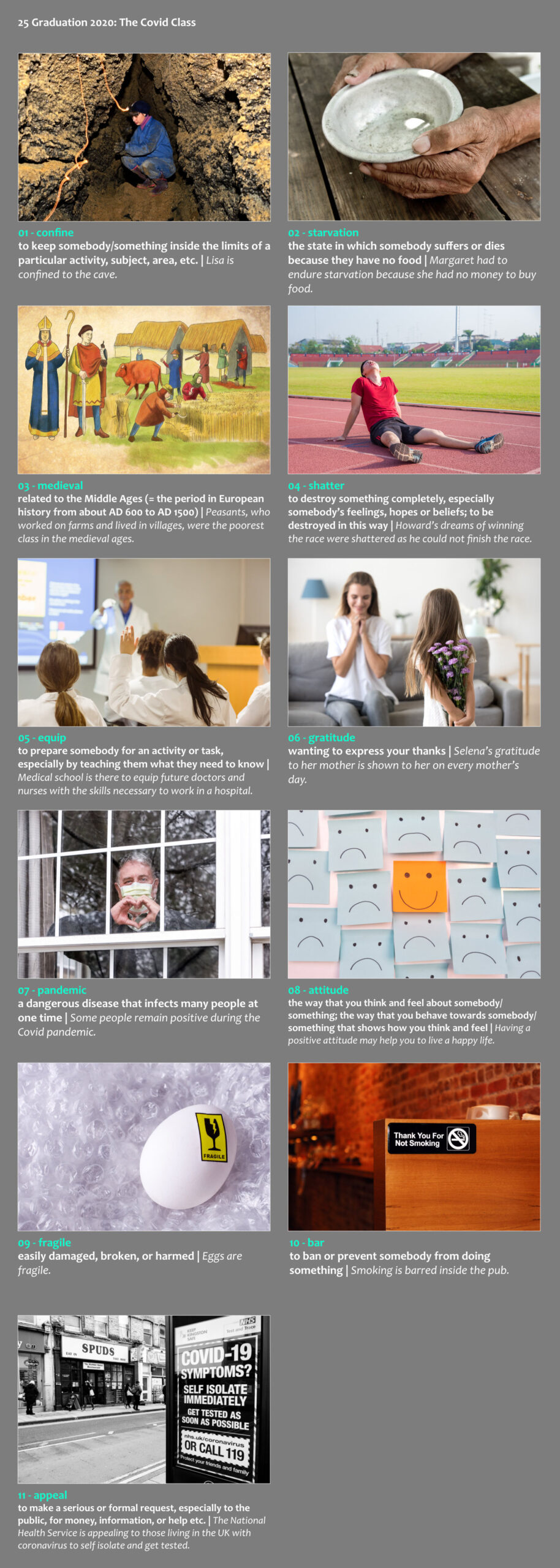
26 The sexiest man alive (steps 1, 3 and 5)
Ward Cleaver, the iconic father of the 1950s TV Show, “Leave It to Beaver,” is… a stud. I’m quite serious. And, no, this isn’t about nostalgia for America in the 1950s. This is about a man of his time, yet timeless. But to appreciate him, we first have to get past the noise.
A loud corner of American culture has been rebelling against the image of the 1950s since, oh…the 1950s. Most of that scorn has been directed at the Ozzie-and-Harriet image of American suburban bliss, specifically “dad.” Well, enough already. Can we at least entertain the idea that in the rejection of that stereotypical 1950s suburban dad image, we threw some metaphorical babies out with the bathwater? That if today’s men modeled Ward Cleaver, America and the world would be better places? Sure, compared with current pop icons, he comes across as boring and buttoned-down. But it’s a very incomplete picture.
Of Ward Cleaver we can also say this: He’s a man who takes care of business. He doesn’t make excuses. He doesn’t whine. He doesn’t brood in defeat. He knows that his hard work and persistence will eventually win the day, if not this day. And there’s a lot he’s simply outgrown. He never had any interest in perpetuating his own adolescence. He’s a grown-up who accepts marriage and fatherhood as the life of an adult.
Now, we can quibble about his methods, but we can’t dispute that he loves his wife and kids, that they know he loves them, and that he tries to do what’s best for them—usually pretty successfully. What is not in dispute is that he’s the man of the house, that he wears that title with pride, and everyone, including his wife, likes that fact.
Ward wasn’t alone. There were lots of other iconic dads of that era: Ozzie Nelson of “The Adventures of Ozzie and Harriet;” Jim Anderson from “Father Knows Best;” one could argue George Bailey in the 1946 film, “It’s a Wonderful Life.” They were grown-ups who had already been through a Great Depression and, in many cases, were veterans of World War II or, later, the Korean War.
Their archetype outlasted the 1950s—Steve Douglas of “My Three Sons,” Mike Brady of “The Brady Bunch,” Howard Cunningham in “Happy Days,” and Cliff Huxtable in “The Cosby Show” (we’re talking TV characters here) shared similar traits. Like all human beings who have ever lived and whoever will live, these men had flaws. But in the end, they were solid and dependable. If you had to summarize them in one word, that word would be “responsible.”
Maybe they seem like such throwbacks now because so much of our culture has thoroughly embraced irresponsibility. But if you ask women what they really want in a man— or at least all those women who have grown out of their adolescent fascination with bad boys – they may not say Ward Cleaver, but they’ll describe most, if not all, of his traits: Reliable; trustworthy; smart; confident, but not smug. Funny and capable of laughing at himself. A man who’s successful at work, but not a workaholic. A man who likes children, but is not a child himself. Perhaps most importantly, devoted to his family. It’s an indisputably masculine figure. And make no mistake, that’s what most women want and what all children need.
Now, I’m not saying that the Ward Cleavers of the world are off-limits to criticism or even mockery; I’m just pointing out that there was a time not that long ago when men were expected to work hard, be good husbands, neighbors and friends; to raise children and to act as role models for the next generation. Sure, laugh at them, but remember they are what our world is built on.
And here is where Ward Cleaver fits in today, where he’s never gone out of style – not really: Getting married, being a father, working your way to owning a home. These are probably the best things that will ever happen to most of us. Our culture snickers at Ward Cleaver types, but it is propagating a falsehood when it paints them as stifled, miserable, hollowed-out men yearning for their carefree bachelor days and regretting their commitments. What leaves a man depressed and hollow inside is not attachments, but the lack of them.
Consider this: If all the slackers in the world disappeared tomorrow, the video game industry would collapse, but if all the Ward Cleavers of the world disappeared tomorrow, civilization would collapse.
I’m Jim Geraghty of The National Review for Prager University.
Ward Cleaver, the iconic father of the 1950s TV Show, “Leave It to Beaver,” is… a stud. I’m quite serious. And, no, this isn’t about nostalgia for America in the 1950s. This is about a man of his time, yet timeless. But to appreciate him, we first have to get past the noise.
stud1: a man who is considered to be attractive and skilled sexually | They think Mark is a stud.
appreciate2: to recognize the good qualities of somebody/something | Fred’s talents are appreciated by the team.
A loud corner of American culture has been rebelling against the image of the 1950s since, oh…the 1950s. Most of that scorn has been directed at the Ozzie-and-Harriet image of American suburban bliss, specifically “dad.” Well, enough already. Can we at least entertain the idea that in the rejection of that stereotypical 1950s suburban dad image, we threw some metaphorical babies out with the bathwater? That if today’s men modeled Ward Cleaver, America and the world would be better places? Sure, compared with current pop icons, he comes across as boring and buttoned-down. But it’s a very incomplete picture.
rebel3 (against something/somebody): to fight against or refuse to obey an authority, for example a government, a system, your parents, etc. | Lisa rebelled against her mum because she was too strict.
scorn4: a very strong feeling of no respect for someone or something that you think is stupid or has no value | Danny has scorn for the ideas of his enemies.
bliss5: extreme happiness | Jenny is in a state of bliss because it’s the weekend.
entertain: to consider or allow yourself to think about an idea, a hope, a feeling, etc. | Sally entertained the hope that the war will end early, and she will see her husband again.
current: of the present time | Jared never watched the news, so he failed to keep up with current events.
buttoned-down: formal and old-fashioned or boring | Some people considered Jerry to be a buttoned-down accountant.
Of Ward Cleaver we can also say this: He’s a man who takes care of business. He doesn’t make excuses. He doesn’t whine. He doesn’t brood in defeat. He knows that his hard work and persistence will eventually win the day, if not this day. And there’s a lot he’s simply outgrown. He never had any interest in perpetuating his own adolescence. He’s a grown-up who accepts marriage and fatherhood as the life of an adult.
make excuses6: to give false reasons why you cannot do something | Mary is making excuses about why she did not clean her room; she is saying that she didn’t know where the vacuum cleaner was, so she couldn’t vacuum (clean) the floor.
whine7: to complain in an annoying, crying voice | Zack is whining because he has lost his watch.
brood8: to think for a long time about things that make you sad, worried, or angry | Xavier is brooding in front of his wife.
defeat9: failure to win or to be successful | Harry (on the left side) is suffering defeat in arm wrestling against his friend.
persistence10: the fact of continuing to try to do something despite difficulties | This plant’s persistence was a key factor in growing through the asphalt road.
outgrow: to lose interest in an idea or activity as you get older | Nathan has outgrown his interest in toy trains.
perpetuate11: to make something continue for a long time | When pushed, pendulums perpetuate their motions for quite some time. / High traffic perpetuates noise in cities.
adolescence12: the time in a person’s life when he or she develops from a child into an adult; puberty | This group of friends enjoyed most of their adolescence in school, at home and at a park.
Now, we can quibble about his methods, but we can’t dispute that he loves his wife and kids, that they know he loves them, and that he tries to do what’s best for them—usually pretty successfully. What is not in dispute is that he’s the man of the house, that he wears that title with pride, and everyone, including his wife, likes that fact.
quibble13: to argue or complain about a small matter or an unimportant detail | Grandpa and his friend often quibble about gardening practices.
dispute: to argue or disagree strongly with somebody about something | The United Nations looks at the area as a disputed territory (= there’s no agreement about the area).
in dispute: not yet agreed on or accepted by everyone | The side effects of the new drug are still in dispute.
Ward wasn’t alone. There were lots of other iconic dads of that era: Ozzie Nelson of “The Adventures of Ozzie and Harriet;” Jim Anderson from “Father Knows Best;” one could argue George Bailey in the 1946 film, “It’s a Wonderful Life.” They were grown-ups who had already been through a Great Depression and, in many cases, were veterans of World War II or, later, the Korean War.
Their archetype outlasted the 1950s—Steve Douglas of “My Three Sons,” Mike Brady of “The Brady Bunch,” Howard Cunningham in “Happy Days,” and Cliff Huxtable in “The Cosby Show” (we’re talking TV characters here) shared similar traits. Like all human beings who have ever lived and whoever will live, these men had flaws. But in the end, they were solid and dependable. If you had to summarize them in one word, that word would be “responsible.”
archetype14: the most typical or perfect example of a particular kind of person or thing | This man is the archetype of a successful businessman.
traits15: a particular quality in your personality | One of John’s major traits is his pessimism.
flaw16: a weakness in somebody’s character | Lucy’s main character flaw is her excessive vanity. She spends hours in front of a mirror.
solid17: strong | Solid armours, such as this one, were important to have during war periods in medieval times.
dependable18: that can be relied on to do what you want or need | Jerry is a dependable father; he does everything for his family’s well-being.
Maybe they seem like such throwbacks now because so much of our culture has thoroughly embraced irresponsibility. But if you ask women what they really want in a man— or at least all those women who have grown out of their adolescent fascination with bad boys – they may not say Ward Cleaver, but they’ll describe most, if not all, of his traits: Reliable; trustworthy; smart; confident, but not smug. Funny and capable of laughing at himself. A man who’s successful at work, but not a workaholic. A man who likes children, but is not a child himself. Perhaps most importantly, devoted to his family. It’s an indisputably masculine figure. And make no mistake, that’s what most women want and what all children need.
throwback19: a person or thing that is similar to somebody/something that existed in the past | Micheal and James are unhappy that the only movies they have in the house are on throwback 90s VHS tapes.
embrace20: to accept something with great interest or enthusiasm | The business employees embraced the new company strategy.
fascination21: the state of being very attracted to and interested in somebody/something | The fascination that Emily has for cartoons can be seen on her face here.
devoted22: extremely loving and loyal | Dogs are devoted animals.
indisputably: in a way that cannot be disagreed with or denied | As of 2020, Jeff Bezos, the owner of Amazon, is indisputably the richest person alive.
Now, I’m not saying that the Ward Cleavers of the world are off-limits to criticism or even mockery; I’m just pointing out that there was a time not that long ago when men were expected to work hard, be good husbands, neighbors and friends; to raise children and to act as role models for the next generation. Sure, laugh at them, but remember they are what our world is built on.
off-limits23: A) (of a place) where people are not allowed to go | The area behind the fence is off-limits.
- B) not allowed to be discussed | The topic of turning back the ship is off-limits.
mockery24: unkind, critical remarks or actions | Although mockery is not allowed in this office, Jenna always does it behind Jack’s back.
And here is where Ward Cleaver fits in today, where he’s never gone out of style – not really: Getting married, being a father, working your way to owning a home. These are probably the best things that will ever happen to most of us. Our culture snickers at Ward Cleaver types, but it is propagating a falsehood when it paints them as stifled, miserable, hollowed-out men yearning for their carefree bachelor days and regretting their commitments. What leaves a man depressed and hollow inside is not attachments, but the lack of them.
snicker25: to laugh in a quiet unpleasant way, especially at something rude or at somebody’s problems or mistakes | Marlene and her friend, Danielle, are snickering at someone.
propagate26: to spread opinions, lies, or beliefs among a lot of people | Steve is propagating lies at his workplace; this time he is talking to Joe, but he already talked to the others in his department.
stifle27-28: to prevent something from happening, being expressed, or continuing | Michael is always stifled: he never expresses himself or his emotions. / Although he tried, Jason couldn’t stifle his yawn in his chemistry lesson.
miserable29: very unhappy | Rebecca is miserable after her break-up.
hollow out30: to make an empty space inside something | The tree trunk is hollowed out.
yearn31: have a strong and emotional desire; want something very much | Dave is yearning to see his partner again.
attachment: a feeling of love or strong connection to someone or something | Jane formed an attachment to her cat.
Consider this: If all the slackers in the world disappeared tomorrow, the video game industry would collapse, but if all the Ward Cleavers of the world disappeared tomorrow, civilization would collapse.
slacker32: a person who is lazy and avoids work | Dave is a slacker.
I’m Jim Geraghty of The National Review for Prager University.

27 How to get kids to listen (steps 1, 3 and 5)
When was the last time you heard a child referred to as obedient? It’s probably been a while. That’s too bad, because the best research tells us that obedient children are happy children. And, from my experience as a family psychologist, the parents of obedient children are happy parents.
Since all parents want their children to be happy, the question becomes: How does one get a child to obey? Is there some trick to it?
Well, there are certainly are a lot of parents who think so. They believe that proper discipline is a matter of using the right methods, techniques, and strategies – what I call “consequence delivery systems.” Parents have been using these behavior modification-based methods since they became popular in the 1960s – seemingly to no avail. Would anyone argue that today’s kids are more obedient than kids were several generations ago? I don’t think so. The reason these methods and techniques don’t work is that proper discipline is not a matter of proper methods. It’s a matter of a proper attitude on the part of the parent.
Let me illustrate the point. Let’s say that for a week I observe the classroom of a grade school teacher who has the reputation of being the best disciplinarian in her district. She consistently has fewer behavior problems than any of her colleagues. What is she doing? She’s making her expectations perfectly clear. Which means, first, she communicates in simple, declarative sentences. She doesn’t use fifty words when she could use ten. The more words you use to communicate your expectations, the less confident you sound.
Second, she prefaces her instructions to her students with authoritative phrases like, “I want you to…” and “It’s time for you to…” She says, “It’s time for you to take out your math books and turn to page 25,” as opposed to, “Let’s take out our math books and turn to page 25, okay?”
Third, this teacher does not explain the motives behind her instructions to her students. Why? Because she knows that explanations invite arguments.
Whenever parents tell me they’re dealing with an argumentative child I know that these well-intentioned people are explaining themselves. They tell their child why they want him to pick up his toys, for example. And he argues, because you can always pick apart an explanation. If you don’t explain yourself when you give an instruction to a child, then the child, being a child, is almost surely going to ask for one. He’s going to ask, “why?” or “why not?” At which point – get ready for a big surprise – your answer should be: “Because I said so.”
These very useful four words – and no, they will not cause psychological damage to your kids; quite the contrary — are a simple, but powerful, affirmation of the legitimacy of your authority. Say it calmly. Don’t scream it. Nothing good is ever accomplished by a person who screams.
Last, but certainly not least, when giving instructions to a child, do not – let me repeat: do not – bend down to the child’s level. Getting a child to do what he or she is told is a matter of looking and acting and talking like you have complete confidence in your authority. Bending down to a child’s level does not look authoritative. It looks, in fact, like you’re one movement away from being down on your knees in front of a king.
I know – you’ve read somewhere that you should get down to a child’s level when you talk to him. Well, all I can tell you is that there’s a lot of really bad parenting advice out there. And that’s but one example. Speak to children from an upright position. That causes them to look up to you. And that is a good thing – for them and for you both.
I’m John Rosemond, author and family psychologist, for Prager University.
When was the last time you heard a child referred to as obedient? It’s probably been a while. That’s too bad, because the best research tells us that obedient children are happy children. And, from my experience as a family psychologist, the parents of obedient children are happy parents.
refer: to talk or write about someone or something | Every time she talks about him, Matt’s mother refers to Matthew as Mattie.
obedient1: doing, or willing to do, what you have been told to do by someone in authority | This dog is obedient: its owner has told it to go and fetch the frisbee (= get it and bring it back). Now the dog is obediently running to fetch it.
research2: a careful study of a subject, especially in order to discover new facts or information about it | Lisa is doing research about plants in her biology lab.
Since all parents want their children to be happy, the question becomes: How does one get a child to obey? Is there some trick to it?
Well, there certainly are a lot of parents who think so. They believe that proper discipline is a matter of using the right methods, techniques, and strategies – what I call “consequence delivery systems.” Parents have been using these behavior modification-based methods since they became popular in the 1960s – seemingly to no avail. Would anyone argue that today’s kids are more obedient than kids were several generations ago? I don’t think so. The reason these methods and techniques don’t work is that proper discipline is not a matter of proper methods. It’s a matter of a proper attitude on the part of the parent.
discipline3: training that produces obedience or self-control, often in the form of rules and punishments if these are broken | Discipline is important in this family.
consequence4: a result of something that has happened, especially an unpleasant result | The consequence of Jane eating too much calories and drinking too much alcohol is that she has gained weight.
to no avail: without any success or any effect | The students asked the teachers for extra exam preparation help, but to no avail (= the teachers didn’t give the extra help).
attitude5: the way that you think and feel about somebody/something; the way that you behave towards somebody/something that shows how you think and feel | Having an overly confident attitude towards life may sometimes be a bad thing.
Let me illustrate the point. Let’s say that for a week I observe the classroom of a grade school teacher who has the reputation of being the best disciplinarian in her district. She consistently has fewer behavior problems than any of her colleagues. What is she doing? She’s making her expectations perfectly clear. Which means, first, she communicates in simple, declarative sentences. She doesn’t use fifty words when she could use ten. The more words you use to communicate your expectations, the less confident you sound.
observe6: to watch carefully the way something happens or the way someone does something, especially in order to learn more about it | Thomas and his daughter are observing the sky in order to study the clouds and stars.
reputation7: the opinion that people have about what somebody/something is like, based on what has happened in the past | The hotel has a reputation of giving 5-star customer service experience, so customers regularly rate it with 5 stars.
district8: an area of a country or town, especially one that has particular features | Wall Street is in the Financial district of New York City.
expectations9: the feeling or belief that something will or should happen | Mark has low expectations that he will get the job as his skill set does not perfectly match the job description, but he relies a little bit on luck too.
declarative: (of a sentence) in the form of a simple statement (= one subject + one action) | Dog trainers may use declarative statements, such as “sit” or “lie down”, to teach dogs tricks.
confident10: feeling sure about your own ability to do things and be successful | Danny is confident in his ability to succeed in his career.
Second, she prefaces her instructions to her students with authoritative phrases like, “I want you to…” and “It’s time for you to…” She says, “It’s time for you to take out your math books and turn to page 25,” as opposed to, “Let’s take out our math books and turn to page 25, okay?”
preface11: if you preface your words or actions with something else, you say or do this other thing first | Peter prefaced his speech by thanking his sales colleagues for their outstanding performance the previous month.
as opposed to: used to make a contrast between two things; rather than | Mary likes it when the weather is sunny, as opposed to rainy.
Third, this teacher does not explain the motives behind her instructions to her students. Why? Because she knows that explanations invite arguments.
argument12: a conversation or discussion in which two or more people disagree, often angrily | This couple are having a heated argument.
invite13 : to make something, especially something bad or unpleasant, likely to happen; ask for | Mike is inviting trouble by pushing James; James might fight back.
Whenever parents tell me they’re dealing with an argumentative child I know that these well-intentioned people are explaining themselves. They tell their child why they want him to pick up his toys, for example. And he argues, because you can always pick apart an explanation. If you don’t explain yourself when you give an instruction to a child, then the child, being a child, is almost surely going to ask for one. He’s going to ask, “why?” or “why not?” At which point – get ready for a big surprise – your answer should be: “Because I said so.”
argumentative14: a person who is argumentative likes arguing or often starts arguing | Susan is argumentative; she likes to start arguments for no reason.
well-intentioned15: intending (= wanting) to be helpful or useful but not always succeeding very well | Fred’s father gave him well-intentioned advice which Fred didn’t find very helpful.
pick apart16: to say all of the things that are bad or wrong about (someone or something); to criticize (a person or thing) in a very detailed and usually unkind way | Michael picked apart Sandra’s work this morning.
These very useful four words – and no, they will not cause psychological damage to your kids; quite the contrary — are a simple, but powerful, affirmation of the legitimacy of your authority. Say it calmly. Don’t scream it. Nothing good is ever accomplished by a person who screams.
contrary: different from something; against something | Contrary to popular belief, fortune cookies are not Chinese.
affirmation: a definite or public statement that something is true or that you support something strongly; confirmation | The exam results of the class are an affirmation that the new teaching methods work.
legitimacy: the quality of being based on a fair or acceptable reason | The legitimacy of the king’s argument for higher taxes was questioned; people believed that he just wanted more wealth (= more money).
authority17: the power to give orders to people | The CEO of a company (= the top manager) has authority over the company’s employees.
accomplish18: able to do or finish something successfully | Sarah has accomplished getting through the selection process for her dream job; she now has it.
Last, but certainly not least, when giving instructions to a child, do not – let me repeat: do not – bend down to the child’s level. Getting a child to do what he or she is told is a matter of looking and acting and talking like you have complete confidence in your authority. Bending down to a child’s level does not look authoritative. It looks, in fact, like you’re one movement away from being down on your knees in front of a king.
I know – you’ve read somewhere that you should get down to a child’s level when you talk to him. Well, all I can tell you is that there’s a lot of really bad parenting advice out there. And that’s but one example. Speak to children from an upright position. That causes them to look up to you. And that is a good thing – for them and for you both.
I’m John Rosemond, author and family psychologist, for Prager University.
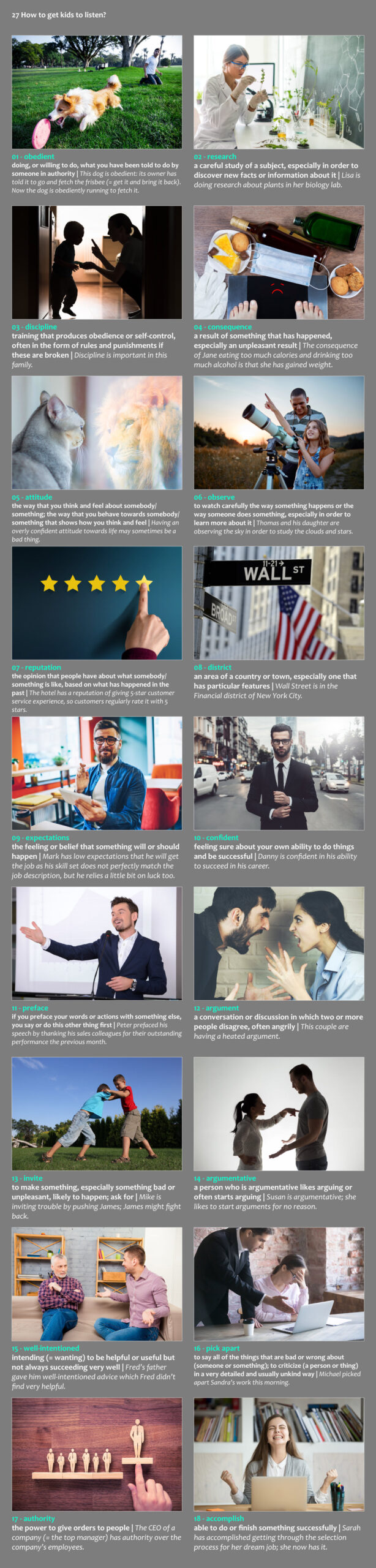
28 Don’t follow your passion (steps 1, 3 and 5)
There are only two things I can tell you today that come with absolutely no agenda. The first is “Congratulations.” The second is “Good luck.” Everything else is what I like to call, “The Dirty Truth,” which is just another way of saying, “It’s my opinion.”
And in my opinion, you have all been given some terrible advice, and that advice, is this:
Follow your passion.
Every time I watch the Oscars, I cringe when some famous movie star—trophy in hand—starts to deconstruct the secret of their success. It’s always the same thing: “Don’t let anyone tell you that you don’t have what it takes, kid!”; and the ever popular, “Never give up on your dreams!”
Look, I understand the importance of persistence, and the value of encouragement, but who tells a stranger to never give up on their dreams, without even knowing what it is they’re dreaming? How can Lady Gaga possibly know where your passion will lead you?
Have these people never seen American Idol?
Year after year, thousands of aspiring American Idols show up with great expectations, only to learn that they don’t possess the skills they thought they did.
What’s really amazing though, is not their lack of talent—the world is full of people who can’t sing. It’s their genuine shock at being rejected—the incredible realization that their passion and their ability had nothing to do with each other.
Look, if we’re talking about your hobby, by all means let your passion lead you.
But when it comes to making a living, it’s easy to forget the dirty truth: just because you’re passionate about something doesn’t mean you won’t suck at it.
And just because you’ve earned a degree in your chosen field, doesn’t mean you’re gonna find your “dream job.”
Dream Jobs are usually just that—dreams.
But their imaginary existence just might keep you from exploring careers that offer a legitimate chance to perform meaningful work and develop a genuine passion for the job you already have. Because here’s another Dirty Truth: your happiness on the job has very little to do with the work itself.
On Dirty Jobs, I remember a very successful septic tank cleaner, a multi-millionaire, who told me the secret to his success:
“I looked around to see where everyone else was headed,” he said, “And then I went the opposite way. Then I got good at my work. Then I began to prosper. And then one day, I realized I was passionate about other people’s crap.”
I’ve heard that same basic story from welders, plumbers, carpenters, electricians, HVAC professionals, hundreds of other skilled tradesmen who followed opportunity—not passion—and prospered as a result.
Consider the reality of the current job market.
Right now, millions of people with degrees and diplomas are out there competing for a relatively narrow set of opportunities that polite society calls “good careers.” Meanwhile, employers are struggling to fill nearly 5.8 million jobs that nobody’s trained to do. This is the skills gap, it’s real, and its cause is actually very simple: when people follow their passion, they miss out on all kinds of opportunities they didn’t even know existed.
When I was 16, I wanted to follow in my grandfather’s footsteps. He was a skilled tradesman who could build a house without a blueprint. That was my passion, and I followed it for years. I took all the shop classes at school, I did all I could to absorb the knowledge and skill that came so easily to my granddad.
Unfortunately, the handy gene is recessive. It skipped right over me, and I struggled mightily to overcome my deficiencies. But I couldn’t. I was one of those contestants on American Idol, who believed his passion was enough to ensure his success.
One day, I brought home a sconce I had made in wood-shop that looked like a paramecium. After a heavy sigh, my granddad gave me the best advice I’ve ever received. He told me, “Mike, you can still be a tradesman, but only if you get yourself a different kind of toolbox.”
At the time, this felt contrary to everything I believed about the importance of “passion” and persistence and “staying the course.” But of course, he was right. Because “staying the course” only makes sense if you’re headed in a sensible direction.
And while passion is way too important to be without, it is way too fickle to follow around.
Which brings us to the final Dirty Truth. “Never follow your passion, but always bring it with you.”
Congratulations, again – and good luck.
I’m Mike Rowe from mikeroweWORKS, for Prager University.
There are only two things I can tell you today that come with absolutely no agenda. The first is “Congratulations.” The second is “Good luck.” Everything else is what I like to call, “The Dirty Truth,” which is just another way of saying, “It’s my opinion.”
And in my opinion, you have all been given some terrible advice, and that advice, is this:
Follow your passion.
passion1: a very strong feeling of liking something; a hobby, an activity, etc. that you like very much | Playing the guitar is Joe’s passion.
Every time I watch the Oscars, I cringe when some famous movie star—trophy in hand—starts to deconstruct the secret of their success. It’s always the same thing: “Don’t let anyone tell you that you don’t have what it takes, kid!”; and the ever popular, “Never give up on your dreams!”
cringe2: to feel embarrassed and ashamed about something | Susie is cringing because she realized what she’d just done; she’d said her thoughts out loud when there were people in the same room.
Look, I understand the importance of persistence, and the value of encouragement, but who tells a stranger to never give up on their dreams, without even knowing what it is they’re dreaming? How can Lady Gaga possibly know where your passion will lead you?
persistence3: the fact of continuing to try to do something despite difficulties | The salmon’s persistence to swim upstream in a river is remarkable.
encouragement4: words or behaviour that give someone confidence to do something | The crowd is giving encouragement to Tommy to help him finish the race.
Have these people never seen American Idol?
Year after year, thousands of aspiring American Idols show up with great expectations, only to learn that they don’t possess the skills they thought they did.
possess: to have or own something, or to have a particular quality | Johnny does not possess the cooking skills he thinks he does: his cooking is worse than he thinks.
What’s really amazing though, is not their lack of talent—the world is full of people who can’t sing. It’s their genuine shock at being rejected—the incredible realization that their passion and their ability had nothing to do with each other.
lack5: the state of not having something or not having enough of something | Joe’s lack of money is a problem to him.
genuine6: real; exactly what it appears to be; not artificial | These are genuine leather gloves; they are not fake.
Look, if we’re talking about your hobby, by all means let your passion lead you.
by all means: used to give permission | “May I borrow this DVD from you?” “By all means” (= yes). / If you have the money, then by all means go buy a new TV.
But when it comes to making a living, it’s easy to forget the dirty truth: just because you’re passionate about something doesn’t mean you won’t suck at it.
passionate7: having or showing strong feelings of enthusiasm for something or belief in something | James is passionate about playing the piano.
suck8: to be bad or worthless | Billy sucks at skateboarding (= he is bad at it).
And just because you’ve earned a degree in your chosen field, doesn’t mean you’re gonna find your “dream job.”
earn9: to get something that you deserve, usually because of something good you have done or because of the good qualities you have | These students have earned their university degree.
Dream Jobs are usually just that—dreams.
But their imaginary existence just might keep you from exploring careers that offer a legitimate chance to perform meaningful work and develop a genuine passion for the job you already have. Because here’s another Dirty Truth: your happiness on the job has very little to do with the work itself.
existence10: the state or fact of being real or living or of being present | Dinosaurs, such as the T-rex, are no longer in existence (= they are no longer present and living on Earth).
legitimate: reasonable, sensible, or valid | Young Billy kept asking legitimate questions in his Physics class.
perform11: to do something, such as a piece of work, task or duty | This maid is performing her duties in the hotel.
meaningful: useful, serious, or important | Joseph does meaningful work which allows him to be happy.
On Dirty Jobs, I remember a very successful septic tank cleaner, a multi-millionaire, who told me the secret to his success:
septic tank12: a large container, usually underground, that holds human waste from toilets until the action of bacteria makes it liquid enough to go into the ground | This underground septic tank is being emptied.
“I looked around to see where everyone else was headed,” he said, “And then I went the opposite way. Then I got good at my work. Then I began to prosper. And then one day, I realized I was passionate about other people’s crap.”
head13: to move in a particular direction | The group of friends are heading to the ocean.
prosper14: (of a person or a business) to be or become successful, especially financially | Mobile phone companies are prospering.
crap15: solid waste | There is dog crap on the street.
I’ve heard that same basic story from welders, plumbers, carpenters, electricians, HVAC professionals, hundreds of other skilled tradesmen who followed opportunity—not passion—and prospered as a result.
welder16: a person whose job is welding (= joining pieces of metal together by heating their edges and pressing them together) | This welder is welding car parts.
HVAC: heating, ventilation and air conditioning (used to refer to a system that can heat or cool a building or allow fresh air to move around) | HVAC technicians are sometimes called to fix HVAC systems.
tradesman17: someone who works in a trade that needs skill at using their hands, usually in the building industry | These tradesmen are all going to be working on the same building.
Consider the reality of the current job market.
Right now, millions of people with degrees and diplomas are out there competing for a relatively narrow set of opportunities that polite society calls “good careers.” Meanwhile, employers are struggling to fill nearly 5.8 million jobs that nobody’s trained to do. This is the skills gap, it’s real, and its cause is actually very simple: when people follow their passion, they miss out on all kinds of opportunities they didn’t even know existed.
compete18: to do an activity with others and try to do better than they do | The swimmers are competing for the gold medal in the Olympics.
struggle19: to try very hard to do something when it is difficult or when there are a lot of problems | Matt is struggling to write a book.
gap20: a difference between two things | The income gap between the rich and poor is rising.
When I was 16, I wanted to follow in my grandfather’s footsteps. He was a skilled tradesman who could build a house without a blueprint. That was my passion, and I followed it for years. I took all the shop classes at school, I did all I could to absorb the knowledge and skill that came so easily to my granddad.
blueprint21: a photographic print of a plan for a building or a machine, with white lines on a blue background | This is a blueprint for a jet engine.
absorb22: to take something in, especially gradually | The water is running in the sink, and the sponge is absorbing some of it.
Unfortunately, the handy gene is recessive. It skipped right over me, and I struggled mightily to overcome my deficiencies. But I couldn’t. I was one of those contestants on American Idol, who believed his passion was enough to ensure his success.
recessive: (of genes and the physical qualities they control) only appearing in a child if both parents supply the controlling gene | Left-handedness may be the result of a recessive gene.
mightily: with great effort | John struggled mightily to climb Mt Everest.
deficiency23: the lack of something that is needed in order to meet a particular standard or level of quality, or the thing that is lacking | Lisa has a deficiency of Vitamin A, so she is now eating foods with ingredients that have this vitamin in them.
contestant24: a person or animal who takes part in a contest or competition | This dog race has more than 8 contestants.
One day, I brought home a sconce I had made in wood-shop that looked like a paramecium. After a heavy sigh, my granddad gave me the best advice I’ve ever received. He told me, “Mike, you can still be a tradesman, but only if you get yourself a different kind of toolbox.”
sconce25: an object that is attached to a wall, used for holding a candle or an electric light | The sconce is attached to the wall.
paramecium26: a type of protozoan (= an organism with only one cell) that lives in water and swims by moving structures similar to hairs that are attached to its body | This is a picture of a paramecium seen through a microscope.
sigh27: to take and then let out a long deep breath that can be heard, to show that you are disappointed, sad, tired, etc. | Reggie is sighing because he forgot his mobile phone at work.
toolbox28: a container in which you keep and carry small tools | My uncle keeps his tools in a wooden toolbox.
At the time, this felt contrary to everything I believed about the importance of “passion” and persistence and “staying the course.” But of course, he was right. Because “staying the course” only makes sense if you’re headed in a sensible direction.
course29: a direction or route followed by a ship or an aircraft | The airplane trail shows that this aeroplane pilot has not been changing course recently (= it has been going straight).
sensible: having or using good judgment; reasonable | Luke did the sensible thing, and paid off the parking ticket.
And while passion is way too important to be without, it is way too fickle to follow around.
fickle: changing often and suddenly | The weather in London is fickle.
Which brings us to the final Dirty Truth. “Never follow your passion, but always bring it with you.”
Congratulations, again – and good luck.
I’m Mike Rowe from mikeroweWORKS, for Prager University.
