Modul 6: PragerU Videos Set 3. Videos 29-42
Ez a videóválogatás 14db izgalmas, gondolatébresztő témát jár körül 5 perces prezentációkban. A gyakorlat végeztével közel 600 szóval növeled szókincsedet. Fontos, hogy a kézikönyvekben leírtak szerint dolgozz az anyagon.
29 Anger Management (steps 1, 3 and 5)
Do you wish you had better control over your temper? Do the people around you, your spouse, your friends, your boyfriend or girlfriend, your children, wish you had better control over your temper?
Unfair or excessive anger is a major cause of marital strife, of tensions between parents and children, and of tensions in work places. Sometimes anger is responsible for more than just tension. “Road rage,” for example, is implicated in hundreds of deaths and thousands of accidents each year.
Of course, anger is not always wrong. Sometimes it’s absolutely necessary. There is evil in the world and sometimes in our own lives. If that didn’t make us angry, neither nations nor individuals would ever oppose it. Think about it for a moment: Would you want to live in a world where no one except victims felt anger toward terrorists, rapists and murderers?
But that’s not the sort of anger I am talking about now. I’m talking about day-to-day anger and the role an angry disposition plays in poisoning our daily lives and the lives of those around us. People with quick tempers sometimes say that they can’t control their anger. But that’s not true. People can’t always control how they feel, but they can almost always control how they act.
Let me offer an example: Imagine you’re walking down the street when suddenly you’re confronted by a person with a weapon demanding your money. Clearly, you’re furious. But do you shout at the person? Do you curse him? Very unlikely. You speak in as calm a voice as you can, probably even in a respectful manner — if you speak at all! We all know why we would act in such a calm way — in order to save our life. Obviously, then, we can control our tempers when we really want to.
Now there are whole courses on “anger management” and they undoubtedly have many ideas and suggestions. But I would like to offer one rule that will enable you to control your anger and almost guarantee that you will never say something that will lead to an irrevocable break or a permanent hurt in your relationship with another person: No matter how angry you get, restrict the expression of your anger to the incident that provoked it.
This means when someone has done something wrong and has hurt you, express anger for what they did – but only concerning that incident . Don’t use words like “always,” or “never.” “You’re always inconsiderate,” “You never think before you act.” What’s the other person supposed to say? “You’re right. I am always inconsiderate.” In addition to making the other person defensive — who wouldn’t become defensive when accused of always being anything bad — your statement is untrue. No one is always inconsiderate. No one never thinks before he or she acts.
That someone has done something wrong to you doesn’t give you the right to lie to or about them.
Also, expressing thoughts like this is destructive in another way. One of the sad and unfair consequences of anger is that people think that what you say when you’re angry is what you really think. Now, it might be. But usually it isn’t what you really think. It’s what you are thinking at that moment. Who hasn’t had some really angry and unfair thoughts about their spouse, their child, or about a good friend? No one.
But most of the time we make sure not to express these angry thoughts. Because the moment we express them, it becomes hard, if not impossible, for the other person to ever forget what you’ve said.
A medieval philosopher offered wise guidance: “I can take back words I didn’t say, but I can’t take back words I did say.” How hard is it to practice this rule? For some, it might be pretty hard. For others less so. But everyone can do it. You have to stay focused, and you have to exercise self-control. If you have issues with your temper, this might well be a life-transforming suggestion, so let me repeat it one final time.
No matter how angry you get, restrict the expression of your anger to the incident that provoked it.
I’m Joseph Telushkin for Prager University.
Do you wish you had better control over your temper? Do the people around you, your spouse, your friends, your boyfriend or girlfriend, your children, wish you had better control over your temper?
temper1: the tendency to become angry very quickly | Dan, who is an actor, sometimes cannot control his temper.
spouse2: a husband or wife | Mark is sitting on the couch with his spouse.
Unfair or excessive anger is a major cause of marital strife, of tensions between parents and children, and of tensions in work places. Sometimes anger is responsible for more than just tension. “Road rage,” for example, is implicated in hundreds of deaths and thousands of accidents each year.
excessive: too much | Excessive eating may be bad for you.
marital: connected with marriage or with the relationship between a married couple | John and Chloe are experiencing marital problems.
strife3: violent or angry disagreement | There is a strife between John and Matt in the office; their co-worker has to keep them apart.
tension4 (between A and B): a situation in which the fact that there are different needs or interests causes difficulties | There is a tension between Jack and his son, Larry, because Larry never listens to his father.
road rage5: a situation in which a driver becomes extremely angry or violent with the driver of another car because of the way they are driving | A road rage incident is about to happen between these two drivers.
implicate: to show that someone is involved in a crime or partly responsible for something bad that has happened | A gang was implicated in the bank robbery.
Of course, anger is not always wrong. Sometimes it’s absolutely necessary. There is evil in the world and sometimes in our own lives. If that didn’t make us angry, neither nations nor individuals would ever oppose it. Think about it for a moment: Would you want to live in a world where no one except victims felt anger toward terrorists, rapists and murderers?
oppose6: to disagree strongly with somebody’s plan, policy, etc. and try to change it or prevent it from succeeding | Karl opposes the new company dress policy; he opposes the plan which requires all male workers to wear ties in all office hours.
rapist: a person who forces somebody to have sex when they do not want to (= rapes them) | The rapist has struck again.
murderer: a person who has killed somebody deliberately and illegally | Fred is a convicted murderer.
But that’s not the sort of anger I am talking about now. I’m talking about day-to-day anger and the role an angry disposition plays in poisoning our daily lives and the lives of those around us. People with quick tempers sometimes say that they can’t control their anger. But that’s not true. People can’t always control how they feel, but they can almost always control how they act.
disposition: the natural qualities of a person’s character | Marcus has a cheerful disposition.
poison7: to cause serious harm to something | This rat has been poisoned by a toxic bait.
Let me offer an example: Imagine you’re walking down the street when suddenly you’re confronted by a person with a weapon demanding your money. Clearly, you’re furious. But do you shout at the person? Do you curse him? Very unlikely. You speak in as calm a voice as you can, probably even in a respectful manner — if you speak at all! We all know why we would act in such a calm way — in order to save our life. Obviously, then, we can control our tempers when we really want to.
demand8: to make a very strong request for something | This armed robber is demanding his victim’s money.
curse9: a rude or offensive word or phrase that some people use when they are very angry | Greg is cursing his son for taking his wallet without his permission.
respectful10: showing admiration for someone or something | Anne, who lives in Thailand, is always respectful towards her mother before going to school.
Now there are whole courses on “anger management” and they undoubtedly have many ideas and suggestions. But I would like to offer one rule that will enable you to control your anger and almost guarantee that you will never say something that will lead to an irrevocable break or a permanent hurt in your relationship with another person: No matter how angry you get, restrict the expression of your anger to the incident that provoked it.
undoubtedly: used to emphasize that something exists or is definitely true | Michael Jordan is undoubtedly one of the best basketball players to ever play the game.
irrevocable: impossible to change | When the Titanic was sinking, some passengers made the irrevocable decision of jumping from the ship in order to survive, before it sank in the ocean.
permanent: lasting for a long time or for all time in the future; existing all the time | Lisa was unable to find a permanent job.
restrict11: to limit the movements or actions of someone, or to limit something and reduce its size or prevent it from increasing | Using only scooters to deliver food to customers restricts the area where food can be delivered to.
incident: something that happens, especially something unusual or unpleasant | Ryan’s bad behaviour was an isolated incident; it only happened once and is not connected with how he behaves in general.
This means when someone has done something wrong and has hurt you, express anger for what they did – but only concerning that incident . Don’t use words like “always,” or “never.” “You’re always inconsiderate,” “You never think before you act.” What’s the other person supposed to say? “You’re right. I am always inconsiderate.” In addition to making the other person defensive — who wouldn’t become defensive when accused of always being anything bad — your statement is untrue. No one is always inconsiderate. No one never thinks before he or she acts.
concerning: about | Emily just received a letter in her mail concerning her electricity bill payments.
inconsiderate: not giving enough thought to other people’s feelings or needs | Jeff is sometimes inconsiderate.
supposed (to do/be something): to be expected or required to do/be something according to a rule, a custom, an arrangement, etc. | If a robber comes into my house what am I supposed to do (= what should I do)?
accuse12: to say that somebody has done something wrong or is guilty of something | Ray is being accused of stealing from the company by some of his co-workers.
That someone has done something wrong to you doesn’t give you the right to lie to or about them.
Also, expressing thoughts like this is destructive in another way. One of the sad and unfair consequences of anger is that people think that what you say when you’re angry is what you really think. Now, it might be. But usually it isn’t what you really think. It’s what you are thinking at that moment. Who hasn’t had some really angry and unfair thoughts about their spouse, their child, or about a good friend? No one.
destructive13: negative or not helpful | Sam’s comments concerning Paul’s work are destructive; they are damaging Paul’s morale.
But most of the time we make sure not to express these angry thoughts. Because the moment we express them, it becomes hard, if not impossible, for the other person to ever forget what you’ve said.
A medieval philosopher offered wise guidance: “I can take back words I didn’t say, but I can’t take back words I did say.” How hard is it to practice this rule? For some, it might be pretty hard. For others less so. But everyone can do it. You have to stay focused, and you have to exercise self-control. If you have issues with your temper, this might well be a life-transforming suggestion, so let me repeat it one final time.
medieval14: connected with the Middle Ages (about AD 1000 to AD 1450) | This is a medieval feast.
guidance15: help or advice that is given to somebody, especially by somebody older or with more experience | Susan is giving guidance to Claire concerning her career.
No matter how angry you get, restrict the expression of your anger to the incident that provoked it.
I’m Joseph Telushkin for Prager University.
30 Is Honesty always the best policy (steps 1, 3 and 5)
Pretty much everybody regards the Golden Rule — “Do unto others as you would have others do unto you” — as the best guide to moral behavior. But did you ever consider this rule in terms of speech, in how you talk about others?
We all acknowledge that it’s wrong to spread untruths about people, but many of us seem to feel that it’s okay to say anything about another as long as it’s true. But the fact that something is true doesn’t mean that it is necessarily anybody else’s concern. Do you want every aspect of your life made known to others — even if true?
How important is it to guard our tongues?
A lifetime of experience suggests to me that unfair speech is a major, not a minor, issue. I often ask listeners at workshops I conduct on the ethics of speech: ‘How many of you can think of at least one embarrassing personal incident, that were it to become widely known, would negatively impact your life?”
Almost all the hands go up, except for those who have led very boring lives, have poor memories, or are lying. What is perverse about human nature is that while we don’t want others to know about such events in our lives, almost all of us are just aching to learn and speak about such events in the lives of others.
Let’s analyze this further. Why exactly don’t we want people to know about a highly embarrassing episode? After all, for most of us, the deep secret that we’re concealing doesn’t involve a criminal act. But we all know that if people learn about this one thing, it can easily become their primary association with us and with our name.
Why is this so?
Because, what is most interesting about people is what’s not so nice about them. This is pretty much true of just about everyone. As Isaac Bashevis Singer, the Nobel Prize winning writer, used to say, “Even good people don’t like to read novels about good people.”
If you’re thinking that what I have said so far does not apply to you, that you rarely speak about others, when you do your comments are always fair, then let me pose a question and a challenge. Can you go for twenty-four hours without saying anything unkind about anyone?
Invariably, when I make this challenge people laugh nervously. I can read their minds: “One day without any negative comments about anybody? My boss? My co-workers?” They’re not sure they can do it.
“Then you have a serious problem,” I tell them. “Because if I were to ask you whether you can go for twenty-four hours without drinking alcohol and you said that you couldn’t, that means that you’re an alcoholic. And if you can’t go for twenty-hours without speaking unkindly about another that means that you’ve lost control over your mouth.”
Regaining such control will require considerable discipline. But such self-control will also bring great comfort, admiration and trust from all those in your life. Anyway, every perceptive person knows that if you badmouth others to them, you will surely badmouth them to others!
One final thought: Before you relate something negative about another, and even if you feel quite sure that what you are saying is factually accurate, ask yourself three questions:
Does the person to whom I am speaking really need this information? Is what I am saying fair? Why am I saying it?
I’m Joseph Telushkin for Prager University.
Pretty much everybody regards the Golden Rule — “Do unto others as you would have others do unto you” — as the best guide to moral behavior. But did you ever consider this rule in terms of speech, in how you talk about others?
regard: to think about somebody/something in a particular way | John regards himself as a great painter.
We all acknowledge that it’s wrong to spread untruths about people, but many of us seem to feel that it’s okay to say anything about another as long as it’s true. But the fact that something is true doesn’t mean that it is necessarily anybody else’s concern. Do you want every aspect of your life made known to others — even if true?
acknowledge: to accept, admit, or recognize something, or the truth or existence of something | Evelyn acknowledged that she had made a mistake regarding the Christmas dinner as she had forgotten to invite people.
untruth: a statement that is not true | Lizzy was spreading untruths in the office.
concern: something that you have the right to know about | It is not your concern where I went to school (= it is none of your business).
How important is it to guard our tongues?
guard your tongue1: to speak carefully, watch what you say | Lucy almost talked rudely about a coworker but she remembered to guard her tongue.
A lifetime of experience suggests to me that unfair speech is a major, not a minor, issue. I often ask listeners at workshops I conduct on the ethics of speech: ‘How many of you can think of at least one embarrassing personal incident, that were it to become widely known, would negatively impact your life?”
issue: a problem or worry that somebody has with something | Money is not an issue for Bill Gates.
conduct2: to organize and direct a particular activity | Marie is conducting a business workshop.
Almost all the hands go up, except for those who have led very boring lives, have poor memories, or are lying. What is perverse about human nature is that while we don’t want others to know about such events in our lives, almost all of us are just aching to learn and speak about such events in the lives of others.
perverse: showing a deliberate and determined desire to behave in a way that most people think is wrong, unacceptable or unreasonable | Johny finds a perverse pleasure in making very bad decisions.
ache (for something): to want something very much | Billy was on a strict diet and aching for a cake.
Let’s analyze this further. Why exactly don’t we want people to know about a highly embarrassing episode? After all, for most of us, the deep secret that we’re concealing doesn’t involve a criminal act. But we all know that if people learn about this one thing, it can easily become their primary association with us and with our name.
conceal3: to hide somebody/something | The FBI agent is concealing a gun behind his back.
Why is this so?
Because, what is most interesting about people is what’s not so nice about them. This is pretty much true of just about everyone. As Isaac Bashevis Singer, the Nobel Prize winning writer, used to say, “Even good people don’t like to read novels about good people.”
If you’re thinking that what I have said so far does not apply to you, that you rarely speak about others, when you do your comments are always fair, then let me pose a question and a challenge. Can you go for twenty-four hours without saying anything unkind about anyone?
pose: to create a threat, problem, etc. that has to be dealt with | The policeman posed a series of questions (= asked several questions) to understand what had happened at the crime scene.
Invariably, when I make this challenge people laugh nervously. I can read their minds: “One day without any negative comments about anybody? My boss? My co-workers?” They’re not sure they can do it.
invariably: always | The bus Harry takes to work is invariably late.
“Then you have a serious problem,” I tell them. “Because if I were to ask you whether you can go for twenty-four hours without drinking alcohol and you said that you couldn’t, that means that you’re an alcoholic. And if you can’t go for twenty-hours without speaking unkindly about another that means that you’ve lost control over your mouth.”
Regaining such control will require considerable discipline. But such self-control will also bring great comfort, admiration and trust from all those in your life. Anyway, every perceptive person knows that if you badmouth others to them, you will surely badmouth them to others!
considerable: great in amount, size, importance, etc | It takes Susie considerable effort to stay away from her favorite ice cream.
discipline4: to control the way you behave and make yourself do things that you believe you should do | It takes discipline for Marie to keep working on her project while her kids are running around her, trying to distract her.
perceptive5: having or showing the ability to see or understand things quickly, especially things that are not obvious | John is very perceptive of new technology.
badmouth6 somebody: to say unpleasant things about somebody | Chris is badmouthing someone.
One final thought: Before you relate something negative about another, and even if you feel quite sure that what you are saying is factually accurate, ask yourself three questions:
accurate7: correct, exact, and without any mistakes | This Seiko watch is accurate.
Does the person to whom I am speaking really need this information? Is what I am saying fair? Why am I saying it?
I’m Joseph Telushkin for Prager University.
31 Who does a 15 dollar minimum wage help (steps 1, 3 and 5)
Progressive politicians love to talk about raising the minimum wage.
It makes them sound caring, compassionate, concerned. They’re on the side of the worker, standing against the greedy employer.
The current call is for a national $15-an-hour minimum wage – more than double the current federal rate of $7.25.
A number of cities and states are already there – including New York, California, Washington D.C. and Seattle. Others are considering it.
The left casts the minimum wage debate as a war between employee and employer. But most business owners pay their workers as much as they can. Finding and keeping good people is the hardest part of any employer’s job.
I know. For 17 years, I ran CKE restaurants, the parent company for Carl’s Jr. and Hardees. Our company and franchised restaurants employed over 75,000 people, but, as with most retail businesses, our profit margins were razor thin.
Based on my experience, if we adopt a national minimum wage of $15, here’s what will happen:
- A lot of people will lose their jobs or have their hours reduced. According to a 2014 Congressional Budget Office study, just a $10 minimum wage would cost half a million jobs as businesses terminate employees. Obviously, far more jobs would be lost at $15 an hour. To survive, employers would have to reduce hours even for workers who manage to keep their jobs. That’s a pay cut.
- Businesses will close, and the jobs they created will disappear. A recent report from researchers at the Harvard Business School found that each $1 increase in the minimum wage results in a 4-10% increase in the likelihood of restaurants closing. An over $7 an hour increase, to $15, would be devastating not only for restaurants, but for small businesses and their employees.
- Young people will lose that entry-level job opportunity. My first job was scooping ice cream at a Baskin-Robbins in Cleveland, Ohio in the 1960s. I was paid just $1 an hour. But it taught me valuable lessons – like the importance of showing up on time, teamwork, and presenting a happy demeanor to customers. No one can get that better job until they have their first job.
- The cost of all workers will have to go up. If you hire a dishwasher at $15 an hour, your cooks will be unhappy with their wages. You’re going to have to pay everybody more, which increases labor costs across the board. That’s more pressure on profits. Too much pressure and you’re out of business.
- Fewer people will open businesses. $15 an hour is a very steep hill to climb. Would-be entrepreneurs will do the math on labor costs and realize it’s just not worth the risk. This is a real cost to the economy that we can’t measure. A company that never exists never employs anyone.
- Prices for everything will go up as businesses pass higher labor costs along to consumers. One of two things will happen: Either consumers won’t pay the higher prices and businesses will lay off workers or close, or consumers will pay higher prices and have less money to spend elsewhere. Either way, the higher minimum wage will represent a drag on the overall economy.
Now, this may sound like doom and gloom. But it’s already a reality for many business owners and workers in the cities and states that are raising the minimum wage.
In San Francisco, AQ, a 2012 James Beard Award finalist for the best new restaurant in America, saw rising labor costs drive its profit margins down from 8.5% in 2012 to 1.5% by 2015. So, it shut the doors.
Jeremy Merrin’s chain of Cuban restaurants in New York closed two locations because of minimum wage increases and has raised prices at the restaurants he’s still operating. The minimum wage, he said, “is going up too fast… We can’t catch our breath.”
Kevin McNamee is a chiropractor in California. “I’ll be moving my two companies out of Los Angeles,” he wrote in a letter to the New York Times. “When the city compels me to pay employees $15 an hour, it comes out my pocket. Last year, my employees made more than I did.”
These stories are already all too common. Expect them to become more so as cities and states pile on the $15 minimum wage bandwagon.
So…if a $15 minimum wage doesn’t help workers, and doesn’t help employers, who exactly does it help? Well, maybe just the progressive politicians who manage to mislead voters into believing that it’s the right thing to do. Sounding caring, compassionate and concerned is all well and good. But having a job is better.
I’m Andy Puzder for Prager University.
Progressive politicians love to talk about raising the minimum wage.
progressive politician: politician who has modern ideas about how things should be done, rather than traditional ones | Progressive politicians are in support of social reform.
It makes them sound caring, compassionate, concerned. They’re on the side of the worker, standing against the greedy employer.
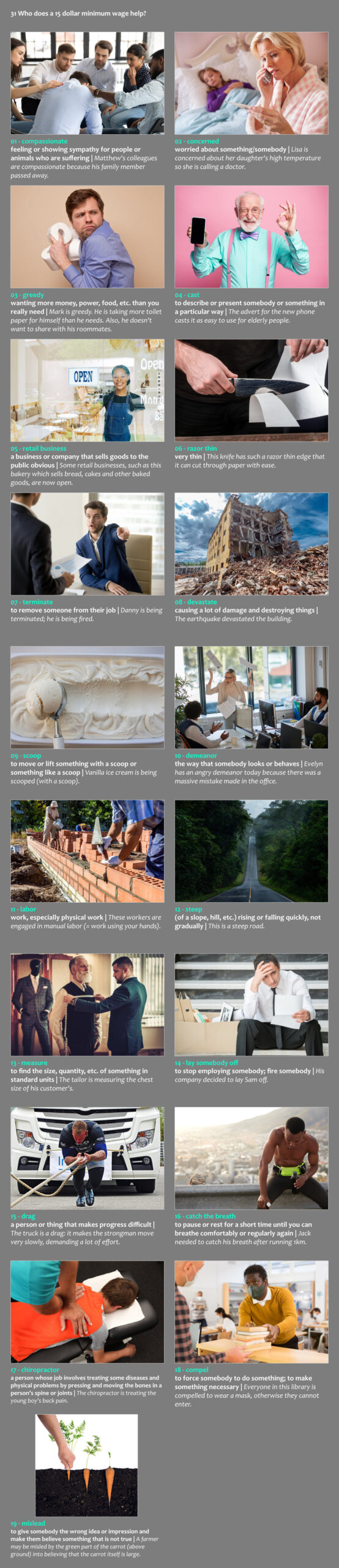
compassionate1: feeling or showing sympathy for people or animals who are suffering | Matthew’s colleagues are compassionate because his family member passed away.
concerned2: worried about something/somebody | Lisa is concerned about her daughter’s high temperature so she is calling a doctor.
greedy3: wanting more money, power, food, etc. than you really need | Mark is greedy. He is taking more toilet paper for himself than he needs. Also, he doesn’t want to share with his roommates.
The current call is for a national $15-an-hour minimum wage – more than double the current federal rate of $7.25.
current: happening now; of the present time | The current situation in the world with vaccines for the virus is better than last year.
A number of cities and states are already there – including New York, California, Washington D.C. and Seattle. Others are considering it.
consider: to think about something carefully, especially in order to make a decision | Johnny is considering ordering pizza instead of eating a home cooked meal tonight.
The left casts the minimum wage debate as a war between employee and employer. But most business owners pay their workers as much as they can. Finding and keeping good people is the hardest part of any employer’s job.
cast4: to describe or present somebody or something in a particular way | The advert for the new phone casts it as easy to use for elderly people.
I know. For 17 years, I ran CKE restaurants, the parent company for Carl’s Jr. and Hardees. Our company and franchised restaurants employed over 75,000 people, but, as with most retail businesses, our profit margins were razor thin.
retail business5: a business or company that sells goods to the public | Some retail businesses, such as this bakery which sells bread, cakes and other baked goods, are now open.
profit margin: the difference between the cost of buying or producing something and the price that it is sold for | The profit margin of the business has increased from 18.5% to 20%.
razor thin6: very thin | This knife has such a razor thin edge that it can cut through paper with ease.
Based on my experience, if we adopt a national minimum wage of $15, here’s what will happen:
- A lot of people will lose their jobs or have their hours reduced. According to a 2014 Congressional Budget Office study, just a $10 minimum wage would cost half a million jobs as businesses terminate employees. Obviously, far more jobs would be lost at $15 an hour. To survive, employers would have to reduce hours even for workers who manage to keep their jobs. That’s a pay cut.
reduce: to make something less or smaller in size, quantity, price, etc.; to become less or smaller in size, quantity, etc. | Some shops that sell electronics reduce their prices by almost 50% on Black Friday.
terminate7: to remove someone from their job | Danny is being terminated; he is being fired.
pay cut: the act of reducing a salary | Jenna had a pay cut after the 2008 Financial Crisis.
- Businesses will close, and the jobs they created will disappear. A recent report from researchers at the Harvard Business School found that each $1 increase in the minimum wage results in a 4-10% increase in the likelihood of restaurants closing. An over $7 an hour increase, to $15, would be devastating not only for restaurants, but for small businesses and their employees.
devastate8: causing a lot of damage and destroying things | The earthquake devastated the building.
- Young people will lose that entry-level job opportunity. My first job was scooping ice cream at a Baskin-Robbins in Cleveland, Ohio in the 1960s. I was paid just $1 an hour. But it taught me valuable lessons – like the importance of showing up on time, teamwork, and presenting a happy demeanor to customers. No one can get that better job until they have their first job.
scoop9: to move or lift something with a scoop or something like a scoop | Vanilla ice cream is being scooped (with a scoop).
demeanor10: the way that somebody looks or behaves | Evelyn has an angry demeanor today because there was a massive mistake made in the office.
- The cost of all workers will have to go up. If you hire a dishwasher at $15 an hour, your cooks will be unhappy with their wages. You’re going to have to pay everybody more, which increases labor costs across the board. That’s more pressure on profits. Too much pressure and you’re out of business.
labor11: work, especially physical work | These workers are engaged in manual labor (= work using your hands).
across the board: involving everyone or everything in a company, an industry, etc. | Home health care services have seen an increase in wage growth across the board in 2020.
- Fewer people will open businesses. $15 an hour is a very steep hill to climb. Would-be entrepreneurs will do the math on labor costs and realize it’s just not worth the risk. This is a real cost to the economy that we can’t measure. A company that never exists never employs anyone.
steep12: a) (of a slope, hill, etc.) rising or falling quickly, not gradually | This is a steep road.
steep (hill to climb): unreasonable or expensive | $2000 for a night in the hotel is a bit too steep.
would-be: used to describe somebody who is hoping to become the type of person mentioned | Bryan is a would-be famous Hollywood actor.
entrepreneur: a person who makes money by starting or running businesses | Ellie is a hard-working entrepreneur working in the computer software industry.
measure13: to find the size, quantity, etc. of something in standard units | The tailor is measuring the chest size of his customer’s.
- Prices for everything will go up as businesses pass higher labor costs along to consumers. One of two things will happen: Either consumers won’t pay the higher prices and businesses will lay off workers or close, or consumers will pay higher prices and have less money to spend elsewhere. Either way, the higher minimum wage will represent a drag on the overall economy.
lay somebody off14: to stop employing somebody; fire somebody | His company decided to lay Sam off.
drag15: a person or thing that makes progress difficult | The truck is a drag: it makes the strongman move very slowly, demanding a lot of effort.
Now, this may sound like doom and gloom. But it’s already a reality for many business owners and workers in the cities and states that are raising the minimum wage.
doom and gloom: a general feeling of having lost all hope, and of pessimism | Life is not all doom and gloom; there are positive things to look forward to.
In San Francisco, AQ, a 2012 James Beard Award finalist for the best new restaurant in America, saw rising labor costs drive its profit margins down from 8.5% in 2012 to 1.5% by 2015. So, it shut the doors.
Jeremy Merrin’s chain of Cuban restaurants in New York closed two locations because of minimum wage increases and has raised prices at the restaurants he’s still operating. The minimum wage, he said, “is going up too fast… We can’t catch our breath.”
catch the breath16: to pause or rest for a short time until you can breathe comfortably or regularly again | Jack needed to catch his breath after running 1km.
Kevin McNamee is a chiropractor in California. “I’ll be moving my two companies out of Los Angeles,” he wrote in a letter to the New York Times. “When the city compels me to pay employees $15 an hour, it comes out my pocket. Last year, my employees made more than I did.”
chiropractor17: a person whose job involves treating some diseases and physical problems by pressing and moving the bones in a person’s spine or joints | The chiropractor is treating the young boy’s back pain.
compel18: to force somebody to do something; to make something necessary | Everyone in this library is compelled to wear a mask, otherwise they cannot enter.
These stories are already all too common. Expect them to become more so as cities and states pile on the $15 minimum wage bandwagon.
common: happening often; existing in large numbers or in many places | It is common for people to be late for work because of the morning traffic.
pile: to go somewhere quickly without order or control | Children were piling out of the school bus.
bandwagon: an activity that more and more people are becoming involved in | A lot of people are jumping on the ‘YouTube content creator’ bandwagon.
So…if a $15 minimum wage doesn’t help workers, and doesn’t help employers, who exactly does it help? Well, maybe just the progressive politicians who manage to mislead voters into believing that it’s the right thing to do. Sounding caring, compassionate and concerned is all well and good. But having a job is better.
mislead19: to give somebody the wrong idea or impression and make them believe something that is not true | A farmer may be misled by the green part of the carrot (above ground) into believing that the carrot itself is large.
I’m Andy Puzder for Prager University.
32 How the states can save the USA (steps 1, 3 and 5)
The federal government has become a lumbering giant. With each passing year, it gets bigger and scarier. In 1965, Washington was 761 billion dollars big. In 2016… it was 3.5 trillion – five times the size.
If the government spent only the money it collected in taxes, that would be one thing. But it always spends more—which is why we’re $20 trillion dollars in debt. That’s 13 zeroes. Count ‘em: Thirteen.
But the crazy spending isn’t even the worst of it. Washington is involved in every part of our lives.
Think about anything you do, from driving your car to buying your groceries to mowing your lawn. Whatever it is—your education, your job, your health— the government has its hands on your shoulder, if not on your throat.
As a congressman and senator for 14 years, I know this only too well.
So, how do we cut this giant down to size? Is it even possible?
Yes. And the amazing thing is, the answer is right in front of us.
The Founding Fathers, in their wisdom, foresaw the situation we find ourselves in today. They wrote into the Constitution a way to repair Washington…not from the inside, because that will never happen but from the outside, where it might. It’s right there in Article 5. Most people are familiar with the first part: “The Congress, whenever two thirds of both houses shall deem it necessary, shall propose amendments to this Constitution…”
All 27 Amendments we have now started this way. Congress proposed them and at least three-quarters of the states ratified them.
But is this the only way to amend the Constitution?
Well, let’s read the next clause: It says that Congress, “…on the application of the legislatures of two thirds of the several states, shall call a convention for proposing amendments…”
Did you catch that?
Congress must call a convention to amend the Constitution if two-thirds of the states—that’s 34 states—demand it.
The time has come to demand it.
The time has come to propose amendments that will restore meaningful limits on federal power and authority.
The time has come for a convention of states.
Here’s how it would work: Once the 34 states call a convention, all 50 states send a delegate to represent their interests. For any constitutional amendments proposed, each state gets one vote. And an amendment only passes out of the convention and to the states for ratification if a majority of the states’ delegates vote in the affirmative. In this scenario, Congress has no say. It is completely in the hands of the states, which means it’s a whole lot closer to the hands of the people.
We’ve never once amended the Constitution this way—but that doesn’t mean we can’t.
But, you might ask, doesn’t this open the door to rewriting the entire Constitution?
Antonin Scalia, the late Supreme Court justice, acknowledged this risk, but regarded it as a “minimal” and “reasonable” one. Why? Because to be ratified, a proposed amendment would need the approval of 38 states. That’s a high bar. Thirty-eight states would never agree to something radical like abolishing freedom of speech. “The Founders,” Scalia said, “knew the Congress would be unwilling to give attention to many issues the people are concerned with, particularly those involving restrictions on the federal government’s own power… they provided the convention as a remedy.”
This should not be a partisan, left/right, Democrat/Republican issue. This should be a “who controls your life” issue: you or the government?
Today, politicians can turn your life upside down on a whim, kind of like King George in 1775. Being at the mercy of distant, disconnected rulers was why the American Revolution was fought in the first place!
But we don’t need a revolution. We have Article Five.
So, what amendments might a Convention of States propose to limit Washington’s power?
Term limits, for one.
No one should be in Congress for 20 or 30 years. The only people who disagree have been in Congress for 20 or 30 years.
And how about a limit on taxes, spending and borrowing? Since you began this video, the national debt has gone up $8.4 million dollars.
Here’s one more idea: A constitutional amendment that Congress can’t exempt itself from the laws it passes—something it’s done dozens of times, from insider trading to Obamacare.
Now, I don’t believe a Convention of States will solve all of America’s problems. But the Founders put it in the Constitution for a reason. They knew a time would come when Washington would become so big, and so intrusive, that only we the people could cut it down to size.
That time is now.
I’m Jim DeMint for Prager University.
The federal government has become a lumbering giant. With each passing year, it gets bigger and scarier. In 1965, Washington was 761 billion dollars big. In 2016… it was 3.5 trillion – five times the size.
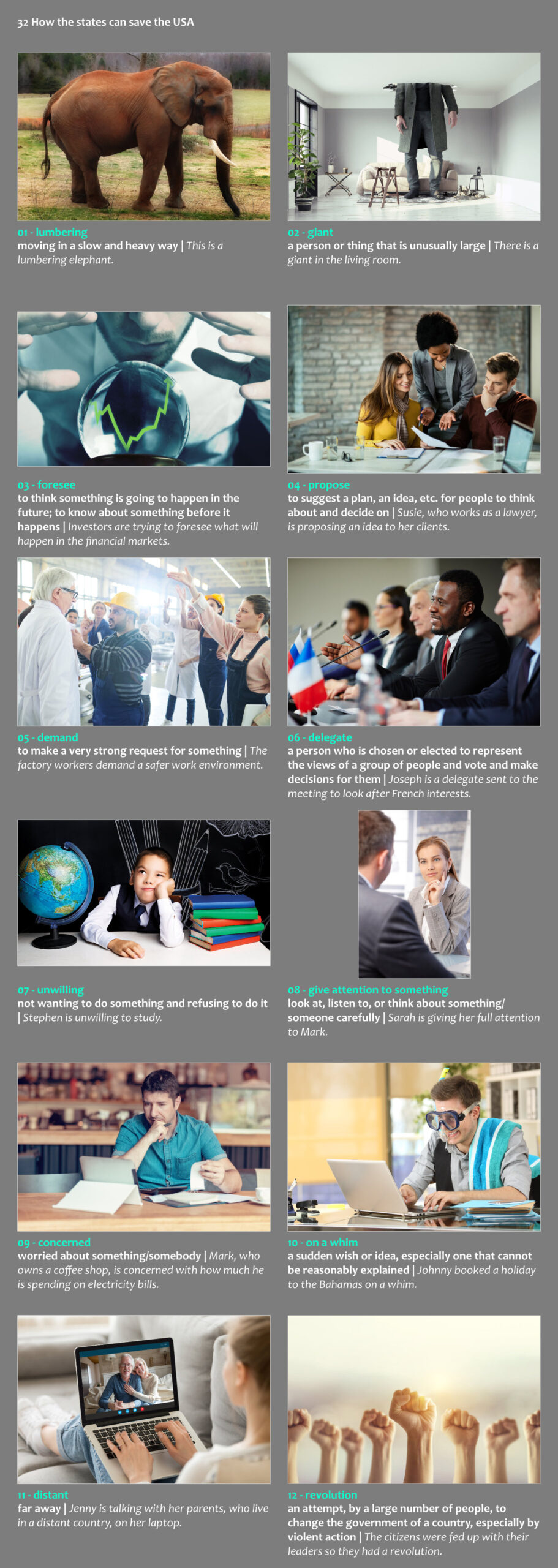
lumbering1: moving in a slow and heavy way | This is a lumbering elephant.
If the government spent only the money it collected in taxes, that would be one thing. But it always spends more—which is why we’re $20 trillion dollars in debt. That’s 13 zeroes. Count ‘em: Thirteen.
debt: a sum of money that somebody owes | Sam is in $3000 in debt.
But the crazy spending isn’t even the worst of it. Washington is involved in every part of our lives.
Think about anything you do, from driving your car to buying your groceries to mowing your lawn. Whatever it is—your education, your job, your health— the government has its hands on your shoulder, if not on your throat.
As a congressman and senator for 14 years, I know this only too well.
So, how do we cut this giant down to size? Is it even possible?
giant2: a person or thing that is unusually large | There is a giant in the living room.
Yes. And the amazing thing is, the answer is right in front of us.
The Founding Fathers, in their wisdom, foresaw the situation we find ourselves in today. They wrote into the Constitution a way to repair Washington…not from the inside, because that will never happen but from the outside, where it might. It’s right there in Article 5. Most people are familiar with the first part: “The Congress, whenever two thirds of both houses shall deem it necessary, shall propose amendments to this Constitution…”
wisdom: good judgment | In the movie Star Wars, Yoda is considered to be a figure of wisdom.
foresee3: to think something is going to happen in the future; to know about something before it happens | Investors are trying to foresee what will happen in the financial markets.
deem: to consider or judge | George Bush deemed it necessary to declare a War On Terror(ism) after September 11th 2001.
propose4: to suggest a plan, an idea, etc. for people to think about and decide on | Susie, who works as a lawyer, is proposing an idea to her clients.
amendments: a small change or improvement that is made to a document or proposed new law; the process of changing a document or proposed new law | The Fourteenth Amendment to the US Constitution (1868) gave citizenship and equal civil and legal rights to African Americans and slaves.
All 27 Amendments we have now started this way. Congress proposed them and at least three-quarters of the states ratified them.
ratify: (especially of governments or organizations) to make an agreement official | The new law will have to be ratified (= approved) by the EU states.
But is this the only way to amend the Constitution?
Well, let’s read the next clause: It says that Congress, “…on the application of the legislatures of two thirds of the several states, shall call a convention for proposing amendments…”
legislatures: a group of people who have the power to make and change laws | Part of the United Kingdom’s legislature consists of the House of Commons.
convention: a large meeting of the members of a profession, a political party, etc. | In August 2020 the Democratic Party Convention gathered to nominate the next president and vice president.
Did you catch that?
Congress must call a convention to amend the Constitution if two-thirds of the states—that’s 34 states—demand it.
The time has come to demand it.
demand5: to make a very strong request for something | The factory workers demand a safer work environment.
The time has come to propose amendments that will restore meaningful limits on federal power and authority.
restore: to bring somebody/something back to a former condition, place or position | Politician’s often talk in different ways about restoring their country to its former glory.
meaningful: serious and important | The parents wanted to have a meaningful conversation with their son about playing video games.
The time has come for a convention of states.
Here’s how it would work: Once the 34 states call a convention, all 50 states send a delegate to represent their interests. For any constitutional amendments proposed, each state gets one vote. And an amendment only passes out of the convention and to the states for ratification if a majority of the states’ delegates vote in the affirmative. In this scenario, Congress has no say. It is completely in the hands of the states, which means it’s a whole lot closer to the hands of the people.
delegate6: a person who is chosen or elected to represent the views of a group of people and vote and make decisions for them | Joseph is a delegate sent to the meeting to look after French interests.
ratification: the act or process of making an agreement legally valid by voting for or signing it | The agreement is subject to ratification by the Senate.
affirmative: an affirmative word or reply means ‘yes’ or expresses agreement | Jack asked Christy to marry him; she gave an affirmative response to the question.
have no say: have no active role in making or influencing a decision about something | Jill wants a blue wedding dress, and Jack has no say in the matter.
We’ve never once amended the Constitution this way—but that doesn’t mean we can’t.
But, you might ask, doesn’t this open the door to rewriting the entire Constitution?
Antonin Scalia, the late Supreme Court justice, acknowledged this risk, but regarded it as a “minimal” and “reasonable” one. Why? Because to be ratified, a proposed amendment would need the approval of 38 states. That’s a high bar. Thirty-eight states would never agree to something radical like abolishing freedom of speech. “The Founders,” Scalia said, “knew the Congress would be unwilling to give attention to many issues the people are concerned with, particularly those involving restrictions on the federal government’s own power… they provided the convention as a remedy.”
acknowledge: to accept that something is true | Harry acknowledged that he did not behave well in school during his science lesson.
regard: to look at somebody/something, especially in a particular way | The jury regarded Larry to be a criminal.
reasonable: acceptable and appropriate in a particular situation | The teacher found Harry’s reason for being late reasonable.
high bar: something that prevents a particular event or development from happening | Mark wants to buy a luxury car; however, $500,000 for a Lamborghini is a high bar.
abolish: to officially end a law, a system or an institution | Slavery was abolished in the US in 1865.
unwilling7: not wanting to do something and refusing to do it | Stephen is unwilling to study.
give attention to something8: look at, listen to, or think about something/someone carefully | Sarah is giving her full attention to Mark.
concerned9: worried about something/somebody | Mark, who owns a coffee shop, is concerned with how much he is spending on electricity bills.
restriction: a rule or law that limits what you can do or what can happen | There is a restriction on how much I can withdraw from my bank account in a day: the limit is $500.
remedy: a way of dealing with or improving an unpleasant or difficult situation | Jenny is failing her French class so her parents are paying for a private teacher as a remedy.
This should not be a partisan, left/right, Democrat/Republican issue. This should be a “who controls your life” issue: you or the government?
partisan: involving loyal support of a person, principle, or political party | Sue tends to be very open to voting for different political parties because she hates partisan politics.
Today, politicians can turn your life upside down on a whim, kind of like King George in 1775. Being at the mercy of distant, disconnected rulers was why the American Revolution was fought in the first place!
on a whim10: a sudden wish or idea, especially one that cannot be reasonably explained | Johnny booked a holiday to the Bahamas on a whim.
mercy: a kind or forgiving attitude towards somebody that you have the power to harm or right to punish | The king showed mercy to the thief, who stole bread from his castle, and let him go without punishment. | On the day of the tornado, we were at the mercy of the weather.
distant11: far away | Jenny is talking with her parents, who live in a distant country, on her laptop.
disconnected: not related to or connected with the things or people around | The king was disconnected from his people: he rarely left the castle and didn’t understand what his people were going through.
ruler: the leader of a country | The rulers of some countries are democratically elected.
revolution12: an attempt, by a large number of people, to change the government of a country, especially by violent action | The citizens were fed up with their leaders so they had a revolution.
But we don’t need a revolution. We have Article Five.
So, what amendments might a Convention of States propose to limit Washington’s power?
Term limits, for one.
term: a period of time for which something lasts; a fixed or limited time | The US president is elected for a four-year term. After this he/she may be elected to another term at most.
No one should be in Congress for 20 or 30 years. The only people who disagree have been in Congress for 20 or 30 years.
And how about a limit on taxes, spending and borrowing? Since you began this video, the national debt has gone up $8.4 million dollars.
Here’s one more idea: A constitutional amendment that Congress can’t exempt itself from the laws it passes—something it’s done dozens of times, from insider trading to Obamacare.
exempt: if somebody/something is exempt from something, they are not affected by it, do not have to do it, pay it, etc. | Some of the corporation’s income is exempt from taxation.
Now, I don’t believe a Convention of States will solve all of America’s problems. But the Founders put it in the Constitution for a reason. They knew a time would come when Washington would become so big, and so intrusive, that only we the people could cut it down to size.
intrusive: being involved in a situation where someone/something is not wanted or does not belong | Some people believe that their government is too intrusive into both people’s lives and businesses’ affairs.
That time is now.
I’m Jim DeMint for Prager University.
33 Dark art of framing (steps 1, 3 and 5)
If you’re a movie buff, you’ve probably seen a picture of a director, thumbs joined together, index fingers forming a square, showing the camera operator how to frame the shot.
The camera can’t see everything, right? The art of directing is framing every shot so the audience sees exactly what the director wants them to see.
We all do something like this in making arguments, whether personal or political. It’s not necessarily a bad thing. We only have so much time to make our points.
But there is a downside. Often arguments end up unfairly skewed by the information they include or leave out. If you understand how framing works, you’ll have a better chance of seeing through weak arguments and appreciating good ones.
Let’s look at some examples.
Take socialism. Socialism is enjoying renewed popularity, especially among young people. Why is this, given the failure of the socialist model in places like the former Soviet Union, Cuba, and Venezuela?
The answer is that socialism has been very cleverly framed by its proponents.
Socialism, we are told, is morally superior because it makes people “more equal.” Those who have more than their fair share have to give it back. What could possibly be wrong with leveling the playing field? Who’s against equality?
When framed that way, socialism is made to seem the only moral choice. So if you’re opposed to it, you’re framed as regressive, selfish, and pretty much a jerk.
Another example of framing is the issue of religious freedom. The American Civil Liberties Union website says that “The Free Exercise Clause of the First Amendment gives you the right to worship or not as you choose. The government can’t penalize you because of your religious beliefs.”
It sounds good—but only because of the framing. The Constitution doesn’t speak about the right to worship and to hold beliefs. Those are a given. The Constitution specifically defends the free exercise of religion. And that means freedom to act on your religious beliefs and not to be forced to violate them. And that also includes the right to influence others—just as secular people can.
Yet people who want to exercise their religion in these ways are framed as bigots. Martin Castro, former chair of the U.S. Commission on Civil Rights for the Obama Administration, wrote that religious freedom is a “code word” for “discrimination, intolerance, racism, sexism, homophobia, and Islamophobia.” So even if courts uphold your religious freedom, you’re still a “hater.”
Speaking of hate, “hate speech” is another example of framing. “Hate speech is not free speech” is a common refrain on college campuses. And what counts as “hate speech”? Whatever people who say “hate speech is not free speech” find hateful. And that number is growing at an alarming pace, according to several recent studies.
There are many other examples. People who question climate change policies are framed as “science deniers”; people who oppose abortion—even late-term abortion in a healthy pregnancy—are framed as “waging a war on women.”
So how does someone who wants to present the other side of these arguments deal with this framing tactic?
First, reject biased framing. Now that you know what framing is, you’ll be able to spot it. That’s half the battle. Say something like, “Do you think that’s the whole story? Let me suggest another way of looking at it.”
Second, get yourself up to speed on the big issues. Don’t expect someone else to fight your battles. Read up. Memorize some bullet points. You know what they’re going to say. You hear their arguments all day in the major media and in your classrooms. But here’s where you have an edge: it is unlikely they’ve ever heard your arguments. You might be surprised what happens when they do.
Third, set some basic ground rules. Bury the insults: no name calling. General statements are fine, but they need to be backed up with examples. Make it clear that you’re prepared to hear their arguments. In turn, they have to commit to hear yours.
And then, may the best argument win. If nobody budges, that’s fine. You’ve had a respectful exchange of ideas. If nothing else, that’s a victory for civil discourse—and we certainly could use more of that!
Just don’t forget to look out for biased frames. They’re great for making movies, but not for finding truth.
I’m Jeff Myers, president of Summit Ministries, for Prager University.
If you’re a movie buff, you’ve probably seen a picture of a director, thumbs joined together, index fingers forming a square, showing the camera operator how to frame the shot.
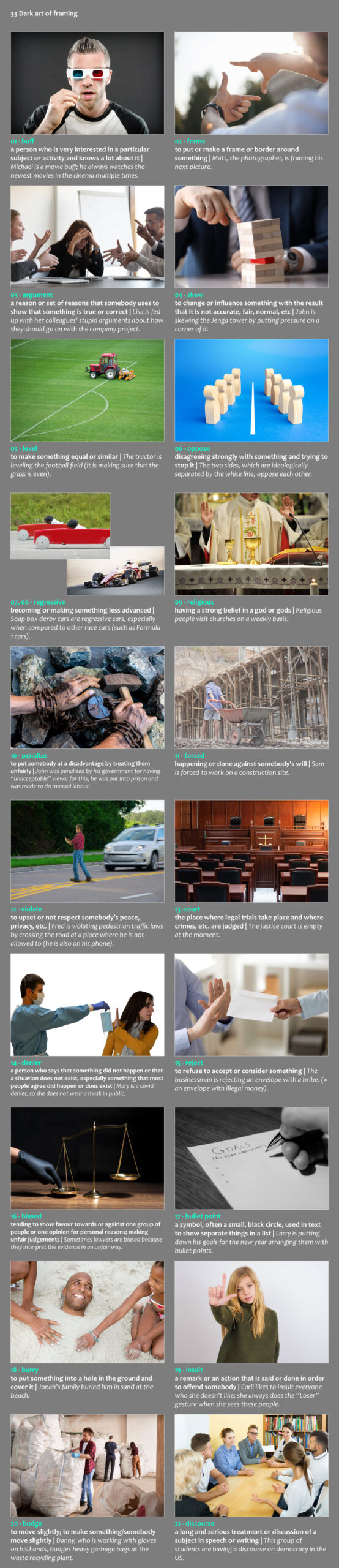
buff1: a person who is very interested in a particular subject or activity and knows a lot about it | Michael is a movie buff; he always watches the newest movies in the cinema multiple times.
The camera can’t see everything, right? The art of directing is framing every shot so the audience sees exactly what the director wants them to see.
frame2: to put or make a frame or border around something | Matt, the photographer, is framing his next picture.
We all do something like this in making arguments, whether personal or political. It’s not necessarily a bad thing. We only have so much time to make our points.
argument3: a reason or set of reasons that somebody uses to show that something is true or correct | Lisa is fed up with her colleagues’ stupid arguments about how they should go on with the company project.
But there is a downside. Often arguments end up unfairly skewed by the information they include or leave out. If you understand how framing works, you’ll have a better chance of seeing through weak arguments and appreciating good ones.
skew4: to change or influence something with the result that it is not accurate, fair, normal, etc. | John is skewing the Jenga tower by putting pressure on a corner of it.
include: to make somebody/something part of something | Jeremy’s monthly household cost is roughly £4000; this includes rent, car insurance and the utility bills (water, electricity and internet bills).
see through: to realize the truth about somebody/something | Jesse sees through the tricks of scammers (= persons that cheat people out of their money in a “clever” way).
appreciate: to recognize the good qualities of somebody/something | The costumer’s of many local bakeries appreciate the range of freshly baked bakeries (such as bread) that are available.
Let’s look at some examples.
Take socialism. Socialism is enjoying renewed popularity, especially among young people. Why is this, given the failure of the socialist model in places like the former Soviet Union, Cuba, and Venezuela?
The answer is that socialism has been very cleverly framed by its proponents.
proponents: a person who supports an idea or course of action | Proponents of free market capitalism usually disagree with Socialism.
Socialism, we are told, is morally superior because it makes people “more equal.” Those who have more than their fair share have to give it back. What could possibly be wrong with leveling the playing field? Who’s against equality?
level5: to make something equal or similar | The tractor is leveling the football field (it is making sure that the grass is even).
When framed that way, socialism is made to seem the only moral choice. So if you’re opposed to it, you’re framed as regressive, selfish, and pretty much a jerk.
oppose6: disagreeing strongly with something and trying to stop it | The two sides, which are ideologically separated by the white line, oppose each other.
regressive7-8: becoming or making something less advanced | Soap box derby cars are regressive cars, especially when compared to other race cars (such as Formula 1 cars).
jerk: a stupid person who often says or does the wrong thing | Fred is a jerk; he is always insulting his classmates.
Another example of framing is the issue of religious freedom. The American Civil Liberties Union website says that “The Free Exercise Clause of the First Amendment gives you the right to worship or not as you choose. The government can’t penalize you because of your religious beliefs.”
religious9: having a strong belief in a god or gods | Religious people visit churches on a weekly basis.
penalize10: to put somebody at a disadvantage by treating them unfairly | John was penalized by his government for having “unacceptable” views; for this, he was put into prison and was made to do manual labour.
It sounds good—but only because of the framing. The Constitution doesn’t speak about the right to worship and to hold beliefs. Those are a given. The Constitution specifically defends the free exercise of religion. And that means freedom to act on your religious beliefs and not to be forced to violate them. And that also includes the right to influence others—just as secular people can.
given: already decided, arranged, or agreed | For Rebecca, finishing school before going to work is a given (= she decided to finish school years ago).
forced11: happening or done against somebody’s will | Sam is forced to work on a construction site.
violate12: to upset or not respect somebody’s peace, privacy, etc. | Fred is violating pedestrian traffic laws by crossing the road at a place where he is not allowed to (he is also on his phone).
influence: to have an effect on the way that somebody behaves or thinks | Most parents tend to directly or indirectly influence the way their child thinks about school.
Yet people who want to exercise their religion in these ways are framed as bigots. Martin Castro, former chair of the U.S. Commission on Civil Rights for the Obama Administration, wrote that religious freedom is a “code word” for “discrimination, intolerance, racism, sexism, homophobia, and Islamophobia.” So even if courts uphold your religious freedom, you’re still a “hater.”
bigot: a person who has very strong, unreasonable beliefs or opinions about race, religion or politics and who will not listen to or accept the opinions of anyone who disagrees | Gary is a racial bigot.
court13: the place where legal trials take place and where crimes, etc. are judged | The justice court is empty at the moment.
uphold: (especially of a court of law) to agree that a previous decision was correct or that a request is reasonable | The court upheld the complaint made by Jordan.
Speaking of hate, “hate speech” is another example of framing. “Hate speech is not free speech” is a common refrain on college campuses. And what counts as “hate speech”? Whatever people who say “hate speech is not free speech” find hateful. And that number is growing at an alarming pace, according to several recent studies.
refrain: a comment or complaint that is often repeated | Complaints about traffic jams in the morning have become a familiar refrain since cars became available to most of the public.
alarming: causing worry and fear | There has been an alarming increase in violent crimes in the city last year.
There are many other examples. People who question climate change policies are framed as “science deniers”; people who oppose abortion—even late-term abortion in a healthy pregnancy—are framed as “waging a war on women.”
denier14: a person who says that something did not happen or that a situation does not exist, especially something that most people agree did happen or does exist | Mary is a covid denier, so she does not wear a mask in public.
wage: to begin and continue a war, a battle, etc. | George W. Bush, during his presidency, waged a War on Terrorism.
So how does someone who wants to present the other side of these arguments deal with this framing tactic?
First, reject biased framing. Now that you know what framing is, you’ll be able to spot it. That’s half the battle. Say something like, “Do you think that’s the whole story? Let me suggest another way of looking at it.”
reject15: to refuse to accept or consider something | The businessman is rejecting an envelope with a bribe. (= an envelope with illegal money).
biased16: tending to show favour towards or against one group of people or one opinion for personal reasons; making unfair judgements | Sometimes lawyers are biased because they interpret the evidence in an unfair way.
Second, get yourself up to speed on the big issues. Don’t expect someone else to fight your battles. Read up. Memorize some bullet points. You know what they’re going to say. You hear their arguments all day in the major media and in your classrooms. But here’s where you have an edge: it is unlikely they’ve ever heard your arguments. You might be surprised what happens when they do.
up to speed: (of a person) having the most recent and accurate information or knowledge | Johnny is always up to speed with the latest current events in politics.
bullet point17: a symbol, often a small, black circle, used in text to show separate things in a list | Larry is putting down his goals for the new year arranging them with bullet points.
have an edge: to get or have an advantage in a particular situation | Jerry’s parents have been training him to play chess from a very young age so that he will have an edge in competitions over other players.
Third, set some basic ground rules. Burry the insults: no name calling. General statements are fine, but they need to be backed up with examples. Make it clear that you’re prepared to hear their arguments. In turn, they have to commit to hear yours.
burry18: to put something into a hole in the ground and cover it | Jonah’s family buried him in sand at the beach.
insult19: a remark or an action that is said or done in order to offend somebody | Carli likes to insult everyone who she doesn’t like; she always does the “Loser” gesture when she sees these people.
name calling: the act of using rude or offensive words about somebody | Susie is subjected to name calling by her parents every time she does something wrong.
backed up: to provide support for somebody/something | The terrorists backed up their demands (= what they asked for/ their wants) with threats.
commit: to promise or give your loyalty, time, or money etc. to a particular principle, person, or plan of action | Once we have committed to carrying out the plan, there is no going back.
And then, may the best argument win. If nobody budges, that’s fine. You’ve had a respectful exchange of ideas. If nothing else, that’s a victory for civil discourse—and we certainly could use more of that!
budge20: A) to move slightly; to make something/somebody move slightly | Danny, who is working with gloves on his hands, budges heavy garbage bags at the waste recycling plant.
- B) to change your opinion about something; to make somebody change their opinion | Kathy had an argument with her husband about where they would go on holiday; however, they both refused to budge.
respectful: showing politeness or honour to someone or something | The professors had a respectful conversation about global warming.
discourse21: a long and serious treatment or discussion of a subject in speech or writing | This group of students are having a discourse on democracy in the US.
Just don’t forget to look out for biased frames. They’re great for making movies, but not for finding truth.
I’m Jeff Myers, president of Summit Ministries, for Prager University.
34 True for You but Not for Me (steps 1, 3 and 5)
Is there such a thing as truth?
Or is everything, including truth, a statement of personal opinion or preference? In other words, is truth relative?
For our purposes here, let’s put aside the science angle. Yes, you can sit on a couch and not appear to be moving, but since the earth, at the equator, is rotating at 1100 miles per hour, you are, from that perspective, moving—and very fast. I’m not talking about that kind of relative.
Let’s confine ourselves to the more everyday questions of truth. Like, does it exist?
Once, the answer to this question was obvious—usually confined to late-night discussions in college dorm rooms. But no longer.
Truth is going through a tough time.
A white woman feels black and represents herself to be so. She rises in the leadership ranks of the NAACP until her fiction is exposed. She refuses to go quietly, however. She feels black, and so she is black.
A 69 year-old man in the Netherlands petitions the court to legally change his age to 49 because that’s how he feels.
And, of course, seemingly on a daily basis, men (and more and more boys), with all the chromosomes and body parts that make them distinctly male, declare themselves to be female; and women (and more and more girls) likewise declare themselves to be male. They feel they are one sex or the other; therefore, they are that sex. And we must accept that, regardless of what the truth is.
In a viral video, a 5-foot, 9-inch American Caucasian male asks students at the University of Washington to acknowledge that he’s Chinese, or six-foot-five, or a woman. Some hesitate, but no one will tell him what he’s saying is not true – that he’s not what he says he is. That would be “mean”—and “intolerant.”
This “true for you, but not for me” relativism is disconcerting because it requires the acceptance of obvious contradictions, denial of reality, and common sense. Rather than adjusting our lives to the truth, the truth has to adjust itself to us.
But it’s very difficult to live this way, not to mention it being highly impractical. We rely on mind-independent universal truths in order to think clearly, to navigate life. Otherwise, we quickly get lost. There must be some things that just are—things that are true. This way points North for everybody, no matter what anyone happens to prefer or sincerely believe.
So, what is truth?
At its root, truth is a match-up with reality. A story, a statement, or belief is only true if it lines up with what’s real. It’s like a socket wrench fitting perfectly onto a bolt. Reality is the truth-maker; reality makes something true. To say “the earth is flat” or “the moon is made of green cheese” is false. Why? Because it doesn’t match up with reality.
Until quite recently, the purpose of all education in large part was the pursuit of truth. The motto of Harvard University, for example, is “veritas,” Latin for “truth.”
No more. Anyone who says education should be about the pursuit of truth is immediately shot down with the comeback: “Whose truth?”
Increasingly, people speak of “my truth,” or say “it’s true for me,” or “your reality”—as though truth is merely a matter of opinion or perspective. At the 2018 Golden Globe awards, Oprah Winfrey famously said that “speaking your truth is the most powerful tool we all have.”
Now, you can have your experience or your perspective. But there is no such thing as “your truth” or “my truth.” There is only the truth—that which is true for everyone.
As Wall Street Journal writer Byron Tau noted, “Oprah employed a phrase that I’ve noticed a lot of other celebrities using these days: ‘your truth’ instead of ‘the truth.’” But, he added, “’your truth’ undermines the idea of shared common facts.”
And here’s another problem with “your truth”: If “your truth” is truth, anyone who doesn’t hold that truth must be wrong. This sounds a lot like narcissism. And it’s intellectual bullying. “Believe ‘my truth’—or else.” Not exactly a positive, pro-truth message.
Yeah, truth is going through a tough time.
So let’s review: Truth can’t be relative. If it is relative, it’s not truth. To say “there is no truth for all people” is to declare a truth for all people. In effect, you’re saying, “It’s true that there is no truth!” And to declare that both your and my opinions are true even if they contradict one another is to speak nonsense.
Truth isn’t opinion or preference. It’s not subjective or relative. It is inescapable because reality is inescapable.
No amount of double-talk will change that.
And that’s the truth.
I’m Paul Copan, author of True for You, But Not for Me, for Prager University.
Is there such a thing as truth?
Or is everything, including truth, a statement of personal opinion or preference? In other words, is truth relative?
preference: a thing that is liked better or best | John has a preference for vanilla flavored ice cream.
For our purposes here, let’s put aside the science angle. Yes, you can sit on a couch and not appear to be moving, but since the earth, at the equator, is rotating at 1100 miles per hour, you are, from that perspective, moving—and very fast. I’m not talking about that kind of relative.
angle: a particular way of presenting or thinking about a situation, problem, etc. | Johnny did not consider looking at the problem from different angles.
couch1: a long comfortable seat for two or more people to sit on | Lizzie is having a good time sitting on the couch.
equator2: an imaginary line around the earth at an equal distance from the North and South Poles | The equator passes through Kenya.
Let’s confine ourselves to the more everyday questions of truth. Like, does it exist?
confine3: to keep somebody/something inside the limits of a particular activity, subject, area, etc. | The worker is confined in a small space.
Once, the answer to this question was obvious—usually confined to late-night discussions in college dorm rooms. But no longer.
dorm4-5: a building for university or college students to live in | Beth is studying for her exam in her dorm room.
Truth is going through a tough time.
tough: difficult to do or to deal with | Mary is going through a tough time in her marriage.
A white woman feels black and represents herself to be so. She rises in the leadership ranks of the NAACP until her fiction is exposed. She refuses to go quietly, however. She feels black, and so she is black.
rise6: to come or go upwards; to reach a higher level or position | Mark is rising up in the corporate ladder; today he is being promoted.
rank7: the position, especially a high position, that somebody has in a particular organization, society, etc. | Mark and Cassie, who have the highest ranks in the company (the owner and CEO), are visiting factory workers.
NAACP: National Association for the Advancement of Colored People | The NAACP pushed for the desegregation (ending the act or policies of separating people based on race) of all schools in the US.
expose8: to tell the true facts about a person or a situation, and show them/it to be dishonest, illegal, etc. | Larry is being exposed to be a thief.
A 69 year-old man in the Netherlands petitions the court to legally change his age to 49 because that’s how he feels.
And, of course, seemingly on a daily basis, men (and more and more boys), with all the chromosomes and body parts that make them distinctly male, declare themselves to be female; and women (and more and more girls) likewise declare themselves to be male. They feel they are one sex or the other; therefore, they are that sex. And we must accept that, regardless of what the truth is.
distinctly: in a way that shows a quality that is easy to recognize | Michael has a distinctly French accent.
regardless (of something): paying no attention to something/somebody; treating something/somebody as not being important | All guests are welcome to the Christmas party regardless of age (= age is not an important factor so people of every age can enter).
In a viral video, a 5-foot, 9-inch American Caucasian male asks students at the University of Washington to acknowledge that he’s Chinese, or six-foot-five, or a woman. Some hesitate, but no one will tell him what he’s saying is not true – that he’s not what he says he is. That would be “mean”—and “intolerant.”
acknowledge: to accept that something is true | Daniel, who stopped playing the piano ten years ago, acknowledged that he is no longer as good a pianist as he used to be.
mean9: (of people or their behaviour) unkind, for example by not letting somebody have or do something | Sam is being mean to Marcus.
This “true for you, but not for me” relativism is disconcerting because it requires the acceptance of obvious contradictions, denial of reality, and common sense. Rather than adjusting our lives to the truth, the truth has to adjust itself to us.
disconcert: to make someone feel suddenly uncertain and worried | Rachel’s experience of going to a new workplace disconcerted her.
contradiction10: a lack of agreement between facts, opinions, actions, etc. | There is a contradiction between Claire’s thoughts as she thinks that she both loves and really hates Chris.
denial11: a statement that something is not true or does not exist | Fred is in denial about his lack of success, so he pretends that everything is fine by ignoring reality.
adjust12: to change something slightly to make it fit, work better, or be more suitable | Fred is adjusting his sense of fashion to the style of a modern television star.
But it’s very difficult to live this way, not to mention it being highly impractical. We rely on mind-independent universal truths in order to think clearly, to navigate life. Otherwise, we quickly get lost. There must be some things that just are—things that are true. This way points North for everybody, no matter what anyone happens to prefer or sincerely believe.
impractical: impractical arrangements, ideas, or methods cannot be done or used easily or effectively | It is impractical for 10 office workers to use the same computer at the same time.
mind-independent: not connected with or influenced by people’s thoughts and emotions | The laws of physics are mind-independent.
So, what is truth?
At its root, truth is a match-up with reality. A story, a statement, or belief is only true if it lines up with what’s real. It’s like a socket wrench fitting perfectly onto a bolt. Reality is the truth-maker; reality makes something true. To say “the earth is flat” or “the moon is made of green cheese” is false. Why? Because it doesn’t match up with reality.
root13: A) the part of a plant that grows under the ground and takes in water and minerals that it sends to the rest of the plant | These are the roots of a plant in the soil.
- B) the main cause of something | At its root, people lose weight as a result of exercise and good nutrition.
line up: match | Rachel’s argument about what she did last year lines up with reality.
socket wrench14: a ratchet tool with a series of detachable sockets for tightening and loosening nuts of different sizes | This socket wrench is usually used for repairing cars.
bolt15: a piece of metal like a thick nail without a point which is used with a circle of metal (= a nut) to fasten things together | This is a metal bolt.
Until quite recently, the purpose of all education in large part was the pursuit of truth. The motto of Harvard University, for example, is “veritas,” Latin for “truth.”
pursuit16: the act of following or going after somebody, especially in order to catch them | This is a high speed police pursuit showing a police car chasing a stolen car.
No more. Anyone who says education should be about the pursuit of truth is immediately shot down with the comeback: “Whose truth?”
Increasingly, people speak of “my truth,” or say “it’s true for me,” or “your reality”—as though truth is a matter of opinion or perspective. At the 2018 Golden Globe awards, Oprah Winfrey famously said that “speaking your truth is the most powerful tool we all have.”
Now, you can have your experience or your perspective. But there is no such thing as “your truth” or “my truth.” There is only the truth—that which is true for everyone.
As Wall Street Journal writer Byron Tau noted, “Oprah employed a phrase that I’ve noticed a lot of other celebrities using these days: ‘your truth’ instead of ‘the truth.’” But, he added, “’your truth’ undermines the idea of shared common facts.”
employ: to use something | John employed advanced mathematical arguments to make his point.
undermine17-18: to make something weaker at the base, for example by digging under it | Tom (in blue) and Jeff (in red) are undermining each other’s career. | Ants have undermined this tree.
And here’s another problem with “your truth”: If “your truth” is truth, anyone who doesn’t hold that truth must be wrong. This sounds a lot like narcissism. And it’s intellectual bullying. “Believe ‘my truth’—or else.” Not exactly a positive, pro-truth message.
Yeah, truth is going through a tough time.
narcissism: the habit of admiring yourself too much | Looking too much in the mirror can be said to be a form of narcissism.
bully19: to frighten or hurt a weaker person; to use your strength or power to make somebody do something | Mike’s classmates are bullying him.
So let’s review: Truth can’t be relative. If it is relative, it’s not truth. To say “there is no truth for all people” is to declare a truth for all people. In effect, you’re saying, “It’s true that there is no truth!” And to declare that both your and my opinions are true even if they contradict one another is to speak nonsense.
declare20: to announce something clearly, firmly, publicly, or officially | Phil is declaring that he is happy to the world.
contradict21: (of statements or pieces of evidence) to be so different from each other that one of them must be wrong | You can’t feel happy and sad at the same time as these emotions contradict each other.
Truth isn’t opinion or preference. It’s not subjective or relative. It is inescapable because reality is inescapable.
No amount of double-talk will change that.
inescapable: (of a fact or a situation) that you cannot avoid or ignore | Harry came to the inescapable conclusion that he must wear a mask on buses because of Covid and government laws.
double-talk: language that is intended to make people believe something that is not true, or that can be understood in two different ways | The government used double-talk to confuse the public on the issue.
And that’s the truth.
I’m Paul Copan, author of True for You, But Not for Me, for Prager University.
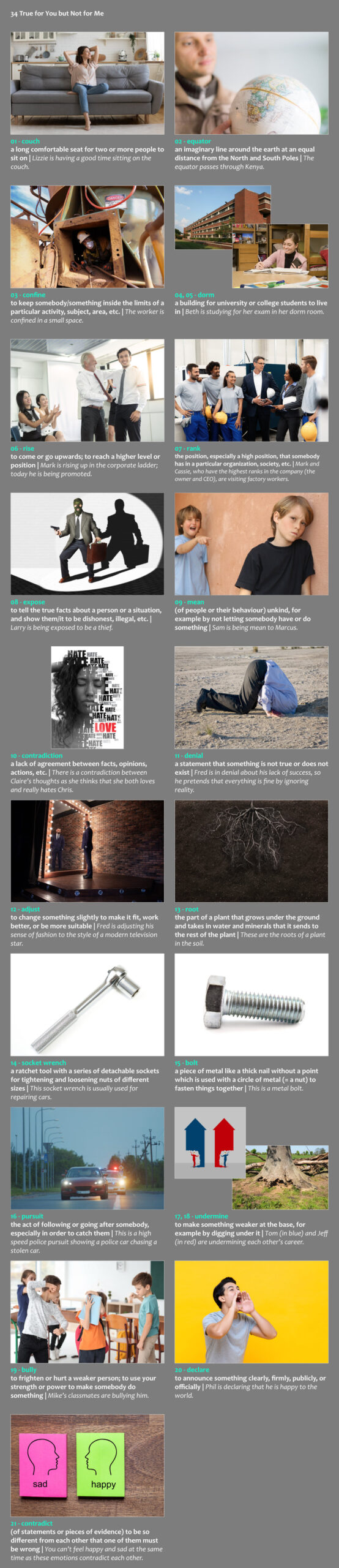
35 The key to unhappiness (steps 1, 3 and 5)
How many times have you heard someone say they want to make a better world? It is a noble sentiment, but very hard to achieve, right?
Well, actually, it’s quite easy. All we have to do is increase just one human trait. This trait is so powerful that it alone can make people happier without working on their happiness, and make them better – and by “better,” I mean more generous, more honest, more kind, more everything good – without a single lesson in morality.
So, then, what is this one almost magical thing? Drumroll, please.
It’s gratitude.
You can’t be a happy person if you aren’t grateful, and you can’t be a good person if you aren’t grateful. Almost everything good flows from gratitude, and almost everything bad flows from ingratitude.
Let’s begin with ingratitude. Here’s a rule of life: ingratitude guarantees unhappiness. It is as simple as that. There isn’t an ungrateful happy person on Earth. And there isn’t an ungrateful good person on Earth. There are two reasons.
Reason one is victimhood. Ingratitude always leads to or comes from victimhood. Ungrateful people—by definition—think of themselves as victims. And perceiving oneself as a victim or perceiving oneself as a member of a victim group may be the single biggest reason people hurt other people—from hurtful comments to mass murder. People who think of themselves as victims tend to believe that because they’ve been hurt by others, they can hurt others.
And the second reason ungrateful people aren’t good people is that ingratitude is always accompanied by anger. The ungrateful are angry, and angry people lash out at others. If ingratitude makes people unhappy and mean, then gratitude must make people happy and kind.
And so it does. Think of the times you have felt most grateful—were they not always accompanied by a feeling of happiness? Weren’t they also accompanied by a desire to be kinder to other people? The answer, of course, is yes. Grateful people aren’t angry and they also don’t see themselves as victims.
The problem, however—and it’s a big one, is that in America and much of the rest of the world, people are becoming less grateful. Why? Because people are constantly told that they are entitled to things they haven’t earned—what are known as “benefits” or “entitlements.” And the more things that people think they should get, the less grateful they will be for whatever they do get. And the more angry—and therefore unhappy—they will be when they don’t get them.
Here are two rules of life. Rule number one: The less you feel entitled to, the more gratitude you will feel for whatever you get and the happier you will be. Rule number two: The more you feel entitled to, the less happy you will be. That’s why, for example, children who get whatever they want are usually less happy children. We have a word for such children: spoiled. And no one thinks of a spoiled child as a happy child, and certainly not a kind one.
The more that you feel that life or society owes you, the angrier you will get, the less happy you will be. As a result, we are increasing the number of angry, unhappy, and selfish people. The other way we are making people unhappy, and even meaner, is by cultivating a sense of victimhood. People are constantly told that they are victims because of their upbringing, because of past prejudice against their group, because of material inequality, because they are female, and for many other reasons.
Next time you want to assess any social policy, ask this question first: Will this policy increase or decrease gratitude among people? You will then know whether it is something that will bring more goodness and happiness to the world—or less.
If I were granted one wish, it would be that all people be grateful. Gratitude is the source of happiness, and the source of goodness; and the more good people, and the more happy people there are walking around, the happier and better our world will be. If you have a way of achieving such a world without increasing gratitude, let me know what it is.
I’m Dennis Prager.
How many times have you heard someone say they want to make a better world? It is a noble sentiment, but very hard to achieve, right?
noble: having or showing fine personal qualities that people admire, such as courage, honesty and care for others | Many warriors have died fighting for a noble cause.
sentiment: a feeling or an opinion, especially one based on emotions | Hitler wanted to reawaken the nationalist sentiments of Germany after WW1.
Well, actually, it’s quite easy. All we have to do is increase just one human trait. This trait is so powerful that it alone can make people happier without working on their happiness, and make them better – and by “better,” I mean more generous, more honest, more kind, more everything good – without a single lesson in morality.
trait: a particular quality in your personality | Lisa’s sense of humour is one of her best traits.
generous1: kind in the way you treat people | Tessa is generous to her younger brother; he is thirsty and she is giving him some of her orange juice.
So, then, what is this one almost magical thing? Drumroll, please.
It’s gratitude.
drumroll2: A) the sound of many quick beats played one after the other on a drum | Drummers, such as this one, in outdoor parade’s sometimes play drumrolls.
- B) used when you wait before telling people something that you think they will really want to know | And the winner of the quiz is … drumroll … Suzy!
gratitude: the feeling of being grateful and wanting to express your thanks | Joseph expressed his gratitude to his grandmother for all her hard work.
You can’t be a happy person if you aren’t grateful, and you can’t be a good person if you aren’t grateful. Almost everything good flows from gratitude, and almost everything bad flows from ingratitude.
grateful3: feeling or showing thanks because somebody has done something kind for you or has done as you asked | Fred’s mother is grateful for the tea that her son has brought her.
flow4: the steady and continuous movement of something/somebody in one direction | Fresh motor oil flows from the bottle.
Let’s begin with ingratitude. Here’s a rule of life: ingratitude guarantees unhappiness. It is as simple as that. There isn’t an ungrateful happy person on Earth. And there isn’t an ungrateful good person on Earth. There are two reasons.
Reason one is victimhood. Ingratitude always leads to or comes from victimhood. Ungrateful people—by definition—think of themselves as victims. And perceiving oneself as a victim or perceiving oneself as a member of a victim group may be the single biggest reason people hurt other people—from hurtful comments to mass murder. People who think of themselves as victims tend to believe that because they’ve been hurt by others, they can hurt others.
victimhood: the condition of having been hurt, damaged, or made to suffer | Despite being robbed, John carries himself without a hint of victimhood (= John doesn’t act as if he got robbed).
victim5-6: a person who has been attacked, injured or killed as the result of a crime, a disease, an accident, etc. | Molly is a victim of pickpocketing. Also, Eve is a victim of bullying.
perceive: to understand or think of somebody/something in a particular way | Michelle perceives herself to be a great chef, and it’s true.
hurtful7: (of comments) making you feel upset and offended | Stephen said hurtful things to Sarah whilst they were having a heated argument.
tend: to be likely to behave in a particular way; to often do so | Lisa tends to avoid eating seafood (= she often stays away from eating it).
And the second reason ungrateful people aren’t good people is that ingratitude is always accompanied by anger. The ungrateful are angry, and angry people lash out at others. If ingratitude makes people unhappy and mean, then gratitude must make people happy and kind.
lash out8: to criticize somebody in an angry way | Sue and Mark do not like each other’s work, so they are lashing out at each other.
mean9: (of people or their behaviour) unkind | Claire is mean to everyone she meets; right now, she’s making fun of her classmate.
And so it does. Think of the times you have felt most grateful—were they not always accompanied by a feeling of happiness? Weren’t they also accompanied by a desire to be kinder to other people? The answer, of course, is yes. Grateful people aren’t angry and they also don’t see themselves as victims.
desire10: a strong wish to have or do something | Lucy desires chocolate.
The problem, however—and it’s a big one —, is that in America and much of the rest of the world, people are becoming less grateful. Why? Because people are constantly told that they are entitled to things they haven’t earned—what are known as “benefits” or “entitlements.” And the more things that people think they should get, the less grateful they will be for whatever they do get. And the more angry—and therefore unhappy—they will be when they don’t get them.
entitled: feeling that you have a right to the good things in life without necessarily having to work for them | Some people feel entitled to special treatment from others.
benefit: money provided by the government to people who need financial help because they are unemployed, ill, etc. | The government of the United Kingdom decided to cut benefits (= reduce benefits).
entitlement: a government system that provides financial support to a particular group of people | Some politicians in the US want to reform entitlements, such as Medicare (a national health insurance in the US).
Here are two rules of life. Rule number one: The less you feel entitled to, the more gratitude you will feel for whatever you get and the happier you will be. Rule number two: The more you feel entitled to, the less happy you will be. That’s why, for example, children who get whatever they want are usually less happy children. We have a word for such children: spoiled. And no one thinks of a spoiled child as a happy child, and certainly not a kind one.
spoiled11: a spoiled child is allowed to do or have anything that they want, usually so that they behave badly and do not show respect to other people | Walter has a spoiled child.
The more that you feel that life or society owes you, the angrier you will get, the less happy you will be. As a result, we are increasing the number of angry, unhappy, and selfish people. The other way we are making people unhappy, and even meaner, is by cultivating a sense of victimhood. People are constantly told that they are victims because of their upbringing, because of past prejudice against their group, because of material inequality, because they are female, and for many other reasons.
owe12: to have the responsibility to pay or give back something you have received | Many people owe Julia money, so she is visiting them in person to collect it.
cultivate13: A) to prepare and use land for growing plants or crops | The farmer is cultivating the field by using a tractor.
- B) to develop an attitude, a way of talking or behaving, etc. | The company is trying hard to cultivate eco-friendly company practices like using printers less frequently or selectively collecting waste.
sense: a feeling about something important | Sally feels a sense of sadness every time she attends a funeral.
upbringing: the way in which a child is cared for and taught how to behave while it is growing up | Johnny did not have a nice childhood because he had a tough upbringing.
prejudice: to influence somebody so that they have an unfair or unreasonable opinion about somebody/something; bias | The lawyers were trying to prejudice the jury against Mark.
inequality14: the unfair difference between groups of people in society, when some have more wealth, status or opportunities than others | Reducing income inequality may be an important goal of governments if they do not wish to see more social unrest.
Next time you want to assess any social policy, ask this question first: Will this policy increase or decrease gratitude among people? You will then know whether it is something that will bring more goodness and happiness to the world—or less.
assess15: to judge or decide the amount, value, quality, or importance of something | It may be important to assess the value of new employees. Benefits show what the company gains while cost shows what the company has to give in return.
policy16: a plan of action agreed or chosen by a political party, a business, etc. | There are many business policies that employees have to follow.
If I were granted one wish, it would be that all people be grateful. Gratitude is the source of happiness, and the source of goodness; and the more good people, and the more happy people there are walking around, the happier and better our world will be. If you have a way of achieving such a world without increasing gratitude, let me know what it is.
I’m Dennis Prager.
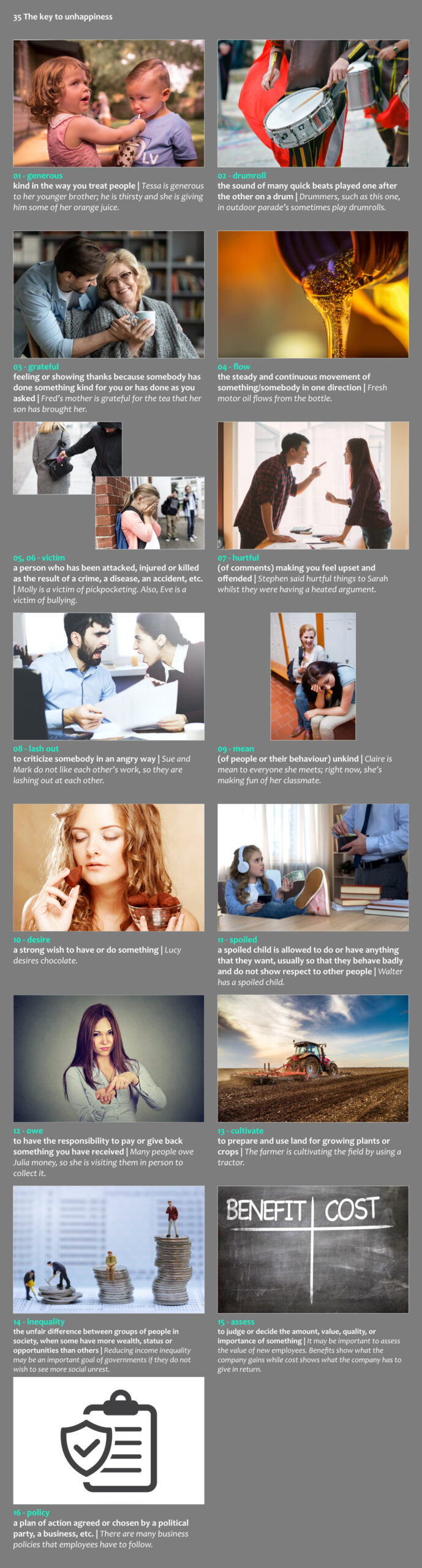
36 Capitalism vs. Socialism (steps 1, 3 and 5)
Capitalism versus socialism. We can sum up each economic system in one line:
Capitalism is based on human greed. Socialism is based on human need.
Right?
No. Wrong.
So wrong, it’s exactly backwards. And I’ll prove it to you.
Been on Amazon lately? Each of the thousands of products Amazon offers represents the work of people who believe they have something you want or need. If they’re right, they prosper. If they’re wrong, they don’t.
That’s how the free market works. It encourages people to improve their lives by satisfying the needs of others. No one starts a business making a thing or providing a service for themselves. They start a business to make things or provide services for others.
I speak from personal experience.
When I was the CEO of the company that owns Carl’s Jr. and Hardee’s restaurant chains, we spent millions of dollars every year trying to determine what customers wanted. If our customers didn’t like something, we changed it–and fast, because if we didn’t, our competitors would (pun intended) eat us for lunch.
The consumer–that’s you–has the ultimate power. In effect, you vote with every dollar you spend.
In a socialist economy, the government has the ultimate power. It decides what you get from a limited supply it decides should exist.
Instead of millions of people making millions of decisions about what they want, a few people–government elites–decide what people should have and how much they should pay for it. Not surprisingly, they always get it wrong. Have you ever noticed that late-stage socialist failures always run out of essential items like toilet paper?
Of course, this isn’t a problem for those who have the right connections with the right people. Those chosen few get whatever they want. But everyone else is out of luck.
Venezuela, once the richest country in South America, is the most recent example of socialism driving a prosperous country into an economic ditch. Maybe you think it’s an unfair example. I’m not sure why, but okay. We’ll ignore the fact that leftist activists celebrated it as a great socialist success–right up until it wasn’t.
But what about Western European countries? Don’t they have socialist economies? People seem pretty happy there. Why can’t we have what they have–free health care, free college, stronger unions?
Good question. And the answer may surprise you.
There are no socialist countries in Western Europe. Most are just as capitalist as the United States. The only difference–and it’s a big one–is that they offer more government benefits than the U.S. does.
We can argue about the costs of these benefits and the point at which they reduce individual initiative, thus doing more harm than good. Scandinavians have been debating those questions for years. But only a free-market capitalist economy can produce the wealth necessary to sustain all of the supposedly “free stuff” Europeans enjoy. To get the “free stuff,” after all, you have to create enough wealth to generate enough tax revenue to pay for everything the government gives away.
Without capitalism, you’re Venezuela.
In a 2015 speech at Harvard, Denmark’s prime minister took great pains to make this point: “I know that some people in the U.S. associate the Nordic model with… socialism, therefore I would like to make one thing clear. Denmark is far from a socialist planned economy. Denmark is a market economy.”
So when you point to Denmark as a paragon of socialism, you’re really singing the praises of capitalism.
The more capitalism, the less “socialism” you need. Look at America since 2017. A policy of lower taxes and less government regulation (that’s more capitalism) has led to a robust economic expansion, something thought impossible just a few years earlier. Unemployment, notably among minority groups typically most at risk for poverty, is at a generational low. Economic expansion gets people off welfare and into work (that’s less “socialism”).
None of this requires a degree in economics. Common sense is all you need. That’s why it’s so frustrating to see young people praising socialism and criticizing capitalism. It’s bad enough that they’re working against their own interest–better job prospects, better wages, personal freedom–but they are also working against the interest of the less fortunate.
Capitalism leads to economic democracy. Socialism leads to the economic dictatorship of the elite. Always. And everywhere.
So beware what you ask for. You just might get it.
I’m Andy Puzder, author of The Capitalist Comeback, for Prager University.
Capitalism versus socialism. We can sum up each economic system in one line:
Capitalism is based on human greed. Socialism is based on human need.
greed1: a strong desire (= want) for more wealth, possessions, power, etc. than a person needs | Lisa and Matt each brought a sandwich for themselves; however, Matt’s greed is now being shown as he is taking a bite out of Lisa’s sandwich.
Right?
No. Wrong.
So wrong, it’s exactly backwards. And I’ll prove it to you.
prove:2 to use facts, evidence, etc. to show that something is true | Michael is proving an idea in physics using mathematical formulas.
Been on Amazon lately? Each of the thousands of products Amazon offers represents the work of people who believe they have something you want or need. If they’re right, they prosper. If they’re wrong, they don’t.
represent3: A) to show somebody/something, especially in a picture | In these graphs, blue represents men while pink represents women.
- B) to be an example or expression of something | The new novel was well liked by most civilians because it represented the lives of ordinary people.
prosper4: to be successful, especially in making money | Marie’s business selling vintage (= antique, old) handbags is prospering.
That’s how the free market works. It encourages people to improve their lives by satisfying the needs of others. No one starts a business making a thing or providing a service for themselves. They start a business to make things or provide services for others.
encourage5: to persuade somebody to do something by making it easier for them and making them believe it is a good thing to do | Jerry, who is Brian’s basketball coach, is encouraging Brian to play professionally when he grows up.
satisfying6: giving pleasure (= making you feel happy) because it provides something you need or want | Brian, who was hungry all day, just finished eating a satisfying meal.
I speak from personal experience.
When I was the CEO of the company that owns Carl’s Jr. and Hardee’s restaurant chains, we spent millions of dollars every year trying to determine what customers wanted. If our customers didn’t like something, we changed it–and fast, because if we didn’t, our competitors would (pun intended) eat us for lunch.
determine: to discover the facts about something; to calculate something exactly | After putting out a fire, firefighters look to determine how the fire started and how much damage it caused.
pun intended: the deliberate use of a clever or humorous word that has more than one meaning, or of words that have different meanings but sound the same | Inspecting mirrors is a job I could really see myself doing – pun intended.
The consumer–that’s you–has the ultimate power. In effect, you vote with every dollar you spend.
In a socialist economy, the government has the ultimate power. It decides what you get from a limited supply it decides should exist.
Instead of millions of people making millions of decisions about what they want, a few people–government elites–decide what people should have and how much they should pay for it. Not surprisingly, they always get it wrong. Have you ever noticed that late-stage socialist failures always run out of essential items like toilet paper?
late-stage: used to describe a time near the end of an organization’s, product’s etc. development | Some people find it risky to invest in young companies, so instead they focus on late-stage companies (= already well established companies).
failure7: a person or thing that is not successful | Johnny, as a boxer, is a failure: he loses all his matches.
essential: completely necessary; extremely important in a particular situation or for a particular activity | In general, having fresh drinking water to drink is an essential human need to live.
Of course, this isn’t a problem for those who have the right connections with the right people. Those chosen few get whatever they want. But everyone else is out of luck.
Venezuela, once the richest country in South America, is the most recent example of socialism driving a prosperous country into an economic ditch. Maybe you think it’s an unfair example. I’m not sure why, but okay. We’ll ignore the fact that leftist activists celebrated it as a great socialist success–right up until it wasn’t.
prosperous8: rich and successful | Jack, a prosperous businessman, is flying on his private jet.
ditch9: a long channel dug at the side of a field or road, to hold or take away water | Sam is digging a ditch.
ignore10: to pay no attention to something | Bill is ignoring his daughter because he is busy on his phone.
But what about Western European countries? Don’t they have socialist economies? People seem pretty happy there. Why can’t we have what they have–free health care, free college, stronger unions?
Good question. And the answer may surprise you.
There are no socialist countries in Western Europe. Most are just as capitalist as the United States. The only difference–and it’s a big one–is that they offer more government benefits than the U.S. does.
benefit: money provided by the government to people who need financial help because they are unemployed, ill, etc. | The French government decided to cut unemployment benefits (= reduce unemployment benefits).
We can argue about the costs of these benefits and the point at which they reduce individual initiative, thus doing more harm than good. Scandinavians have been debating those questions for years. But only a free-market capitalist economy can produce the wealth necessary to sustain all of the supposedly “free stuff” Europeans enjoy. To get the “free stuff,” after all, you have to create enough wealth to generate enough tax revenue to pay for everything the government gives away.
argue11: to speak angrily to somebody because you disagree with them | Fred and Daniella always argue about the same thing in the park.
reduce12: to make something less or smaller in size, quantity, price, etc.; to become less or smaller in size, quantity, etc. | Over the last week, Sally has reduced the number of sugar cubes that she puts in her tea.
initiative: the ability to decide and act on your own without waiting for somebody to tell you what to do | Kyle is lazy and has no initiative.
debate13: to discuss something (= talk about something with someone), especially formally, before making a decision or finding a solution | These business partners always debate the risk and reward of starting a new project.
sustain: to make something continue for some time without becoming less | Jill is a great public speaker. She always manages to sustain the interest of the audience until her speech ends.
supposedly: according to what is generally thought or believed but not known for certain | Jack, who writes the lyrics to all his band’s songs, supposedly bases them on Shakespeare’s poetry. (= we think so, but we can’t be sure)
tax revenue: the money that a government receives from individuals, businesses etc. so that it can pay for public services | There was a decrease (= a fall) in the western governments’ tax revenues last year.
Without capitalism, you’re Venezuela.
In a 2015 speech at Harvard, Denmark’s prime minister took great pains to make this point: “I know that some people in the U.S. associate the Nordic model with… socialism, therefore I would like to make one thing clear. Denmark is far from a socialist planned economy. Denmark is a market economy.”
associate: to make a connection between people or things in your mind | Some people associate Jimi Hendrix with being the greatest guitar player of all time.
So when you point to Denmark as a paragon of socialism, you’re really singing the praises of capitalism.
paragon: a person who is perfect or who is a perfect example of a particular good quality | Mother Teresa is a paragon of human kindness.
sing the praises (of): to express admiration or approval of the achievements or characteristics of a person or thing | Dennis likes to sing the praises of free market capitalism.
The more capitalism, the less “socialism” you need. Look at America since 2017. A policy of lower taxes and less government regulation (that’s more capitalism) has led to a robust economic expansion, something thought impossible just a few years earlier. Unemployment, notably among minority groups typically most at risk for poverty, is at a generational low. Economic expansion gets people off welfare and into work (that’s less “socialism”).
robust14: A) strong; able to survive being used a lot and not likely to break | This robust table has concrete legs.
- B) (of a system or an organization) strong and not likely to fail or become weak | There was robust economic growth following the president’s policies.
expansion15: an act of increasing or making something increase in size, amount or importance | Expansion of his business is an important strategy for Jeff’s business; he is using a world map to plan it.
notably: used for giving a good or the most important example of something | There were many bloody wars in the 20th century, notably World War 2.
poverty16: the state of being poor | Joseph lives in poverty; he has no food.
welfare: money that the government pays regularly to people who are poor, unemployed, sick, etc. | Julia is on welfare as she is poor.
None of this requires a degree in economics. Common sense is all you need. That’s why it’s so frustrating to see young people praising socialism and criticizing capitalism. It’s bad enough that they’re working against their own interest–better job prospects, better wages, personal freedom–but they are also working against the interest of the less fortunate.
common sense: the ability to think about things in a practical way and make sensible decisions | It is common sense to keep sharp objects, like knives, away from children.
prospects: the chances of being successful, especially at work | Mary is hoping the accounting course will increase her career prospects.
Capitalism leads to economic democracy. Socialism leads to the economic dictatorship of the elite. Always. And everywhere.
So beware what you ask for. You just might get it.
I’m Andy Puzder, author of The Capitalist Comeback, for Prager University.
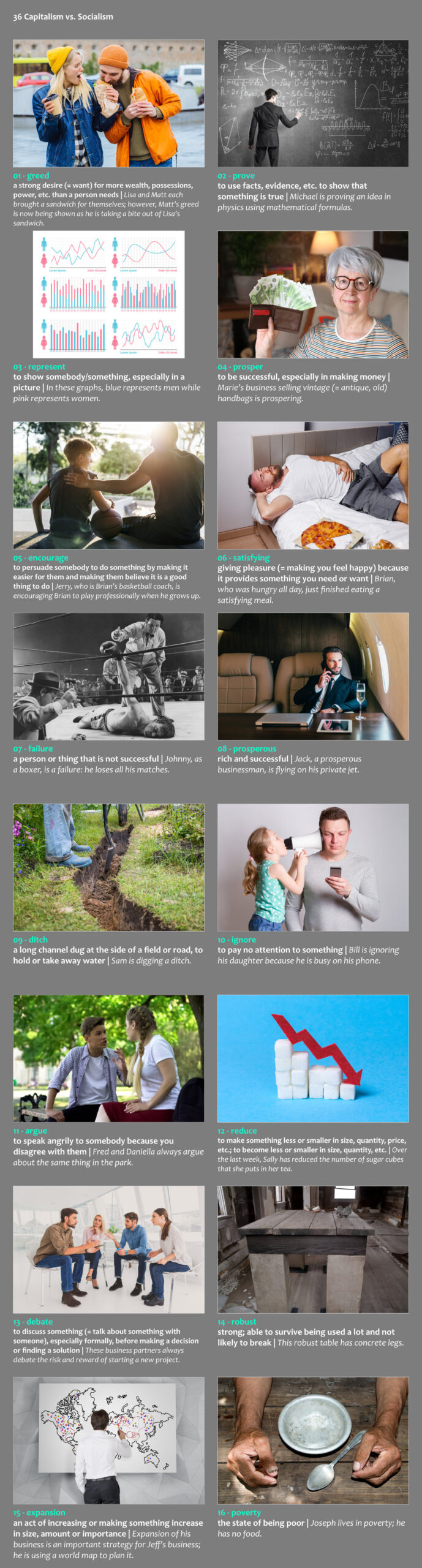
37 Social security Won’t Give You Security (steps 1, 3 and 5)
If you’re counting on Social Security to finance your retirement, you’re in for a big surprise—and not the good kind.
Let me give you two reasons why.
One: Social Security is going broke.
And, two: Even if it weren’t going broke, it couldn’t possibly cover the cost of a decent retirement.
Let’s look at these two reasons in a little more detail, and then I’ll propose a solution.
Social Security is going broke.
When this government program was set up in 1935, the average life expectancy was 60. But you couldn’t collect your first check until you reached 65. In other words, most people didn’t live long enough to receive Social Security. And most of those who did, didn’t collect it for very long. Today, the average lifespan is 79. So now, most people do live long enough to receive Social Security—for 10, or 20, or even 30 years.
Here’s another important piece of information: When the program started, the ratio between worker and retiree was 159 to 1. That means for every one person drawing benefits, 159 were paying in. Today the ratio is 2.8 to 1. Get that? We’ve gone from 159 workers supporting every retired person to fewer than three workers supporting every retiree. And it’s going down.
You don’t need an advanced math degree to figure this one out: Social Security is spending more than it’s bringing in. Far more. Its own Board of Trustees has said that it will be bankrupt within twenty years.
That doesn’t mean it won’t exist. It means that either the government will pay you less than it promised, or it will have to raise taxes to make up the shortfall. Most likely, both.
Sounds about right for an entitlement program, doesn’t it? Starts out small, but just keeps growing and growing until it collapses under its own weight.
But let’s indulge in a fantasy and say that Social Security is perfectly designed, perfectly balanced, and efficiently run. And that you would get every dollar you were promised.
You’d still have a major problem if that’s all that you’re relying on.
To illustrate, in 2017 the average monthly Social Security check was a little over $1,400. That’s under $17,000 a year—barely above the poverty line for a two-person household. Do you really want to live at the poverty line in retirement? Why in the world would you plan for that?
But sadly, many people are. According to a recent study, 53 percent of un-retired baby boomers have no retirement savings. That means they’re planning to rely on Social Security for their retirement income.
That’s them.
Don’t let it be you.
Here’s the right way to prepare for retirement:
First, get on a budget. I don’t care if you’re 55 or 25. I don’t care if you’re making $400,000 a year or $40,000 a year. You need to have a plan for your money. I love motivational speaker John Maxwell’s line that “a budget is simply telling your money where to go instead of wondering where it went.”
That means knowing, before the month starts, where every dollar you make is headed. Whether it’s the mortgage or rent or groceries or a car payment or whatever, you need to give every dollar an assignment.
Second, attack and avoid debt like the plague. Most Americans spend 25% of their income paying off debt. Imagine how much money you could save if you didn’t have this albatross around your neck.
Well, actually, you don’t have to imagine. Again, it’s simple math. A 30-year-old investing $500 a month in an investment fund with a six percent annual return will have over a million dollars by the time he’s 70.
So make a plan to get rid of your debt for good. I like the “snowball method.” List your debts, smallest to largest, putting every extra dollar you have toward the smallest while making minimum payments on the rest. Once the smallest is paid off, roll that payment into the next-smallest. And do this until all of your debt is paid.
Finally, put Social Security in perspective. Anything you get from it should be considered a fringe benefit—icing on the cake, not the cake itself. There’s nothing wrong with getting Social Security checks. After all, you earned it by contributing to the system all those years. But there is nothing “secure” about Social Security. The last thing you want to do is rely on it.
If you do, well—good luck.
I’m Chris Hogan for Prager University.
If you’re counting on Social Security to finance your retirement, you’re in for a big surprise—and not the good kind.
social security: money that the government pays regularly to people who are poor, unemployed, sick, etc. | Jason no longer lives on social security.
retirement: the fact of stopping work because you have reached a particular age; the time when you do this | David is 63, so he’s very close to his retirement age.
Let me give you two reasons why.
One: Social Security is going broke.
broke1: having no money | Lisa’s business has gone broke recently, so she is closing her shop down.
And, two: Even if it weren’t going broke, it couldn’t possibly cover the cost of a decent retirement.
decent2: of a good enough standard or quality | Mark is getting a decent salary; the skills he brings to the business are compensated for by his pay (he is paid fairly in exchange for work done at his skill level).
Let’s look at these two reasons in a little more detail, and then I’ll propose a solution.
solution: a way of solving a problem or dealing with a difficult situation | The countries failed to find a peaceful solution to the problem.
propose a solution: suggest a solution | The United Nations proposed a solution to resolve the conflict between the countries.
Social Security is going broke.
When this government program was set up in 1935, the average life expectancy was 60. But you couldn’t collect your first check until you reached 65. In other words, most people didn’t live long enough to receive Social Security. And most of those who did, didn’t collect it for very long. Today, the average lifespan is 79. So now, most people do live long enough to receive Social Security—for 10, or 20, or even 30 years.
life expectancy: the number of years that a person is likely to live; the length of time that something is likely to exist or continue for | The life expectancy for the average person in the west has increased over the last 100 years.
Here’s another important piece of information: When the program started, the ratio between worker and retiree was 159 to 1. That means for every one person drawing benefits, 159 were paying in. Today the ratio is 2.8 to 1. Get that? We’ve gone from 159 workers supporting every retired person to fewer than three workers supporting every retiree. And it’s going down.
retiree3: a person who has stopped working because of their age | Janet is a retiree; she now spends most of her time at a beach in Spain.
draw4: to take money or payments from a bank account or post office; withdraw | Lucas is drawing €150 from his bank account using an ATM.
You don’t need an advanced math degree to figure this one out: Social Security is spending more than it’s bringing in. Far more. Its own Board of Trustees has said that it will be bankrupt within twenty years.
degree5: the qualification obtained by students who successfully complete a university or college course | These five friends have each received their university degrees.
figure out: to think about somebody/something until you understand them/it | Johnny has figured out how to use the newest iPhone without reading the instruction manual.
bankrupt6: without enough money to pay what you owe | Billy’s small business went bankrupt after a massive error in the accounting department.
That doesn’t mean it won’t exist. It means that either the government will pay you less than it promised, or it will have to raise taxes to make up the shortfall. Most likely, both.
shortfall: if there is a shortfall in something, there is less of it than you need or expect | The company’s estimated shortfall in revenue (= regular income) for this year is £200,000.
Sounds about right for an entitlement program, doesn’t it? Starts out small, but just keeps growing and growing until it collapses under its own weight.
entitlement: a government system that provides financial support to a particular group of people | Some entitlement programs have been reduced by the newly elected government.
collapse7: A) to fall down or fall in suddenly, often after breaking apart | This old wooden shed is collapsing.
- B) to fail suddenly or completely | Negotiations between John and Fred have collapsed after an argument.
weight8: how heavy somebody/something is | Lisa’s body weight (with shoes on) is around 54kgs.
But let’s indulge in a fantasy and say that Social Security is perfectly designed, perfectly balanced, and efficiently run. And that you would get every dollar you were promised.
Indulge9: to allow yourself to have or do something that you like, especially something that is considered bad for you | Rachel is indulging in eating cake while she is on a diet.
indulge in a fantasy: indulge in a pleasant situation that you imagine but that is unlikely to happen | Xavier, who is ten years old, is indulging in fantasy when he thinks about being able to fly like superman.
efficiently: in a good and careful way, with no waste of time, money or energy | The factory was run efficiently by the manager.
You’d still have a major problem if that’s all that you’re relying on.
rely on: to need or depend on somebody/something | Babies usually rely on their mothers after they are born.
To illustrate, in 2017 the average monthly Social Security check was a little over $1,400. That’s under $17,000 a year—barely above the poverty line for a two-person household. Do you really want to live at the poverty line in retirement? Why in the world would you plan for that?
poverty:10 the state of being poor | Evelyn lives in poverty; she only has half a pair of shoes.
But sadly, many people are. According to a recent study, 53 percent of un-retired baby boomers have no retirement savings. That means they’re planning to rely on Social Security for their retirement income.
baby boomer: a person born during a baby boom, especially after the Second World War | Marie, who was born in 1947, is a baby boomer.
That’s them.
Don’t let it be you.
Here’s the right way to prepare for retirement:
First, get on a budget. I don’t care if you’re 55 or 25. I don’t care if you’re making $400,000 a year or $40,000 a year. You need to have a plan for your money. I love motivational speaker John Maxwell’s line that “a budget is simply telling your money where to go instead of wondering where it went.”
budget11: the money that is available to a person or an organization and a plan of how it will be spent over a period of time | Ron has written his personal budget on a whiteboard in order to see it.
wonder12: to think about something and try to decide what is true, what will happen, what you should do, etc. | Dan and his wife are wondering if they have paid too much for their car insurance this month.
That means knowing, before the month starts, where every dollar you make is headed. Whether it’s the mortgage or rent or groceries or a car payment or whatever, you need to give every dollar an assignment.
head13: to move in a particular direction | Lucy is heading out the door.
assignment14: a task or a piece of work that is given to someone to do, often for a limited period of time: | The university students were given an assignment to finish, which they did. Their teacher is now marking these (= checking and correcting the written work of the students).
Second, attack and avoid debt like the plague. Most Americans spend 25% of their income paying off debt. Imagine how much money you could save if you didn’t have this albatross around your neck.
debt15: the situation of owing money | Susan is deep in credit card debt (= she owes a lot of money).
plague: any disease that spreads quickly and kills a lot of people | The Great Plague of London, which started in 1665 and lasted a year, has killed many people.
avoid someone or something like the plague: to try very hard not to meet somebody, do something, etc. | They avoided Fred like the plague.
albatross16: a very large white bird with long wings that lives in the Pacific and Southern Oceans | This albatross is flying above the ocean.
albatross around your neck: an annoying burden (= a duty, responsibility, etc. that causes worry, difficulty or hard work)| My old motorbike is an albatross around my neck.
Well, actually, you don’t have to imagine. Again, it’s simple math. A 30-year-old investing $500 a month in an investment fund with a six percent annual return will have over a million dollars by the time he’s 70.
So make a plan to get rid of your debt for good. I like the “snowball method.” List your debts, smallest to largest, putting every extra dollar you have toward the smallest while making minimum payments on the rest. Once the smallest is paid off, roll that payment into the next-smallest. And do this until all of your debt is paid.
get rid (of)17: to make yourself free of somebody/something that is annoying you or that you do not want; to throw something away | Fred is getting rid of his old glasses because he has bought himself new contact lenses.
for good: permanently; for ever | After the argument she has left for good (= she will never return).
snowball18: a ball that you make out of snow to throw at somebody/something in a game | Mary has made a snowball so that she can throw it at her brother.
roll that payment: move payment somewhere else | Jason rolled the payment of his credit card debt, which he had just paid off, into paying his mortgage.
Finally, put Social Security in perspective. Anything you get from it should be considered a fringe benefit—icing on the cake, not the cake itself. There’s nothing wrong with getting Social Security checks. After all, you earned it by contributing to the system all those years. But there is nothing “secure” about Social Security. The last thing you want to do is rely on it.
put in perspective: look at how something fits into the whole picture so that you have an accurate and fair understanding of it | Jason and Matt, who had a heated argument about politics, were told by a friend to look at other points of view to try to put the issue in perspective.
fringe benefit: a less important (compared to something else) advantage that something gives you | Becoming famous after winning the Olympic 100m run, is a fringe benefit that John received; he mainly cared about getting the gold medal.
icing19: a sweet mixture of sugar and water, milk, butter or egg white that is used to cover and decorate cakes | Susan is putting icing on the muffins.
icing on the cake: something extra and not essential that is added to an already good situation or experience and that makes it even better | Fred got a high paying job where he gets a new company car, which is just icing on the cake for him.
contribute: to give something, especially money or goods, to help achieve or provide something | Mark contributed to the earthquake fund which was set up after the Haiti earthquake in 2010.
secure: likely to continue or be successful for a long time; safe | The future of the company seems secure.
If you do, well—good luck.
I’m Chris Hogan for Prager University.
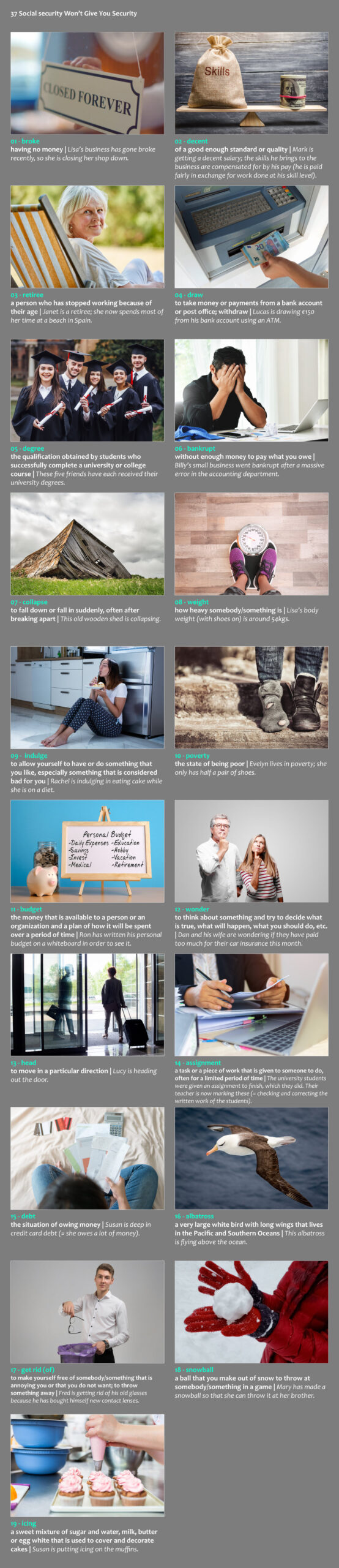
38 Churchill the man who saved the free world (steps 1, 3 and 5)
In May 1940, Adolf Hitler and his Nazi war machine were sweeping across the European continent.
The future of the free world hung in the balance.
An isolationist-leaning United States was an ocean away. There was one man who stood between Hitler’s seemingly invincible army and crushing defeat.
That one man was Winston Churchill.
He was born on November 30, 1874. Though we think of him as the quintessential Englishman, he was actually half American.
His mother, Jennie, was the daughter of a wealthy New York stock speculator. His father, Lord Randolph Churchill, was of English nobility and a major political figure.
From his early school days, Churchill recognized the power of words. Throughout his life, he used them with consummate skill. They never let him down.
He first made a name for himself as a war correspondent in the 1890s, covering conflicts in Cuba, Northern India, the Sudan, and South Africa. Though he never abandoned journalism, and became one the greatest historians of his age, Churchill used his family connections and his own fame to launch himself into politics. His confident manner and matchless oratory marked him as a natural leader.
1914 and World War I found him in the key position of First Lord of the Admiralty where he did much to modernize Britain’s navy. In 1915, Churchill thought he could bring a speedy end to the war by opening a new front in Turkey, which he perceived as the weak link in the German alliance against the allies.
This led to the infamous Gallipoli campaign.
Badly underestimating the fighting strength of the Turks, thousands of British, Australian and New Zealand soldiers were killed in battles that proved to be every bit as indecisive and bloody as the campaigns on Europe’s Western front.
Churchill took the blame.
This was perhaps the low point of his life. Dismissed from the war cabinet, five months later he enlisted in the army, where he saw action in France.
He rose again in British politics throughout the 1920s, making money—as he always did—through his writing and speaking. As Adolph Hitler took power in Germany in the 1930s, Churchill was one of the first and certainly the loudest voice in England sounding the alarm. But it was an alarm few in England wanted to hear.
The English had been traumatized, as had all of Europe, by the shocking amount of death and destruction of the First World War. No one wanted to face the possibility that it could happen again.
Churchill, however, saw that a new confrontation with Germany was inevitable. And when the inevitable arrived with the stunning German attack on France in May 1940, a desperate nation turned to him. He was ready.
His weapons were his pen, his voice and his words. “I have nothing to offer but blood, toil, tears and sweat,” he told the House of Commons in his first speech as Prime Minister.
Things quickly turned from bad to worse. France collapsed, Belgium surrendered, and a quarter of a million British soldiers barely managed to escape from Dunkirk. Even as the war news moved from dangerous to desperate to disastrous, Churchill never wavered. In speech after speech, he infused the British with the spirit to fight on against Hitler’s monstrous tyranny.
“We shall not flag or fail,” he said after Dunkirk. “We shall go on to the end. We shall defend our island, whatever the cost may be…we shall never surrender.”
The point about Churchill in 1940 is not that he stopped a German invasion, but that he stopped the British Government making peace. If Churchill had not been Prime Minister, the pro-appeasement foreign secretary Lord Halifax would have been.
We know that Halifax was open to negotiating with Hitler. We’d be mistaken to assume that the German Fuhrer’s terms would not have been reasonable; they would probably have been very reasonable, as Hitler wanted to fight a one-front war against Russia. And an agreement with Britain would have allowed him to do just that.
Churchill made this impossible.
Had he not rallied the British people in the face of defeat after defeat, preventing Hitler from concentrating his full efforts on Russia, the entire history of the free world would have been much different. And, undoubtedly, much darker.
Because of Churchill’s efforts and the marvelous resilience of the British people, the United States had an unsinkable “aircraft carrier” —Britain— from which to mount the liberation of the European continent in June of 1944.
For this and so much more, free people everywhere can thank the greatest man of his age—Winston Churchill.
I’m Andrew Roberts for Prager University.
In May 1940, Adolf Hitler and his Nazi war machine were sweeping across the European continent.
sweeping1: affecting many things or people; large | The new presidential candidate wants to make sweeping changes to gas and oil policy; for this reason, many are voting for him.
The future of the free world hung in the balance.
hang in the balance2: if the future of something/somebody, or the result of something hangs in the balance, it is not certain | According to some, the future of the dollar hangs in the balance (it could increase or decrease in value).
An isolationist-leaning United States was an ocean away. There was one man who stood between Hitler’s seemingly invincible army and crushing defeat.
isolationist: showing interest only in your own country and not being involved in international activities | Paraguay followed isolationist policies from 1814 for a few decades, after gaining their independence.
isolationist-leaning: having a tendancy towards showing interest only in your own country and not being in international activities (such as economic trade) | It is argued by some that isolationist-leaning governments reduce economic growth.
invincible: too strong to be defeated or changed | Goliath seemed invincible to most people around him.
crush3: to use violent methods to defeat people who are opposing you | Fred wants to crush Justin.
crushing: used to emphasize how bad or severe something is | The news of Bella’s death came as a crushing blow to the morale of her family.
defeat4: failure to win or to be successful | Larry suffered defeat in the boxing match.
That one man was Winston Churchill.
He was born on November 30, 1874. Though we think of him as the quintessential Englishman, he was actually half American.
quintessential: representing the perfect example of something | Julie lives in a quintessential small village with only a few hundred people and a couple of small shops.
His mother, Jennie, was the daughter of a wealthy New York stock speculator. His father, Lord Randolph Churchill, was of English nobility and a major political figure.
stock speculator5: a person who buys and sells goods or shares in a company in the hope of making a profit | Chris, who is a stock speculator, works from home using his computer.
nobility6: the class or group of people who have a high social rank, esp. from birth | Hannah, who is part of the English nobility, is enjoying a new play in the theater.
From his early school days, Churchill recognized the power of words. Throughout his life, he used them with consummate skill. They never let him down.
consummate: showing great skill; perfect | James, who is an actor, is a consummate performer.
He first made a name for himself as a war correspondent in the 1890s, covering conflicts in Cuba, Northern India, the Sudan, and South Africa. Though he never abandoned journalism, and became one the greatest historians of his age, Churchill used his family connections and his own fame to launch himself into politics. His confident manner and matchless oratory marked him as a natural leader.
correspondent7: a person who reports news from a particular country or on a particular subject for a newspaper or a television or radio station | Larry is a correspondent reporting on the covid situation.
cover (something)8: to report on an event for television, a newspaper, etc.; to show an event on television etc. | Lisa is covering the opening of a new corporation in the city.
abandon (something)9: to stop doing something, especially before it is finished; to stop having something | Michael has abandoned playing the violin due to the lack of time for practising.
fame10: the state of being known and talked about by many people | Marcus has risen to fame through his acting in big movies. Now paparazzi follow him every time he leaves his house.
launch yourself: to start a new job, to start work in a new industry, or to start a new part of your work life | After a few years as a photographer, Wilma launched herself as a movie director.
confident11: feeling sure about your own ability to do things and be successful | Martin is a confident businessman.
matchless: of a very high standard or quality and better than everything else | Lisa has matchless beauty in her town (= she is the most beautiful in her town).
oratory: skilful and effective public speaking | Maggie had a reputation for making powerful oratory.
marked: to give somebody/something a particular quality or character; characterise | Mother Teresa was marked as the friend of the poor.
1914 and World War I found him in the key position of First Lord of the Admiralty where he did much to modernize Britain’s navy. In 1915, Churchill thought he could bring a speedy end to the war by opening a new front in Turkey, which he perceived as the weak link in the German alliance against the allies.
perceive: to understand or think of somebody/something in a particular way; see | Johnny was perceived as being intelligent by his peers.
weak link12: the point at which a system or an organization is most likely to fail | It is easy to see the weak link in Sally’s argument.
alliance: an agreement between countries, political parties, etc. to work together in order to achieve something that they all want | NATO is a military alliance between 30 countries.
This led to the infamous Gallipoli campaign.
infamous: well known for being bad or evil | Danny is an infamous criminal known for his brutality.
Badly underestimating the fighting strength of the Turks, thousands of British, Australian and New Zealand soldiers were killed in battles that proved to be every bit as indecisive and bloody as the campaigns on Europe’s Western front.
underestimate: to not realize how good, strong, determined, difficult, etc. somebody/something really is | Many boxers have underestimated the strength of Mike Tyson’s punch.
indecisive13: A) (of a person) not able to make decisions quickly and effectively | Lucy is indecisive; she has been trying to choose an outfit to wear for 45 minutes.
- B) not providing a clear and definite answer or result | Many thought that the battle would play an important role in winning the war; however, it was an indecisive battle.
Churchill took the blame.
take the blame14: if you take the blame for something, you say that you did it or that it is your fault | Mike, whose car crashed into Thomas’ car, is taking the blame for the accident. He is also letting Thomas take pictures of the damages.
This was perhaps the low point of his life. Dismissed from the war cabinet, five months later he enlisted in the army, where he saw action in France.
dismiss: to officially remove somebody from their job; fire | Janet was dismissed from her job as an accountant.
enlist15: to join the armed forces | Larry is enlisting in the army.
He rose again in British politics throughout the 1920s, making money—as he always did—through his writing and speaking. As Adolph Hitler took power in Germany in the 1930s, Churchill was one of the first and certainly the loudest voice in England sounding the alarm. But it was an alarm few in England wanted to hear.
sound the alarm: to cause a noise to be made or say or shout a message to warn people about something | Larry was sounding the alarm as soon as he realized that there was someone stealing from the shop.
The English had been traumatized, as had all of Europe, by the shocking amount of death and destruction of the First World War. No one wanted to face the possibility that it could happen again.
traumatize: to shock and upset somebody very much, often making them unable to think or work normally | Jill was traumatized by the train accident she witnessed (=saw) as a child.
destruction16: the act of destroying something; the process of being destroyed | The destruction of the building wall could be heard in the neighbouring houses.
Churchill, however, saw that a new confrontation with Germany was inevitable. And when the inevitable arrived with the stunning German attack on France in May 1940, a desperate nation turned to him. He was ready.
inevitable: that you cannot avoid or prevent | Once the cars were close to each other, the accident was inevitable.
stunning: that surprises or shocks you very much | The candidate suffered a stunning defeat in the election.
His weapons were his pen, his voice and his words. “I have nothing to offer but blood, toil, tears and sweat,” he told the House of Commons in his first speech as Prime Minister.
toil17: hard, unpleasant work that makes you very tired | Working in a mine makes Chris’s days filled with hardship and toil.
sweat18: drops of liquid that appear on the surface of your skin when you are hot, ill or afraid | Sweat is falling off Matt’s face because he has been running for hours.
Things quickly turned from bad to worse. France collapsed, Belgium surrendered, and a quarter of a million British soldiers barely managed to escape from Dunkirk. Even as the war news moved from dangerous to desperate to disastrous, Churchill never wavered. In speech after speech, he infused the British with the spirit to fight on against Hitler’s monstrous tyranny.
collapse19: A) to fall down or fall in suddenly, often after breaking apart | The house on the left (with the brown roof) has collapsed.
- B) to fail suddenly or completely | Negotiations about the divorce between John and his wife have collapsed after an argument.
surrender20: to admit that you have been defeated and want to stop fighting | The army’s general is surrendering.
barely: in a way that is just possible but only with difficulty | Joseph, who was in class doing his homework, barely had time to finish it before the teacher walked in. (= he had just enough time to finish, but he almost ran out of time)
desperate21: (of a situation) extremely serious or dangerous | The situation on the ground was desperate, so the soldiers tried to call for more help.
disastrous: very bad, harmful or unsuccessful | There was a disastrous earthquake in Chile.
waver: to be or become weak or unsteady | The more time he spent thinking about possible answers to the essay question, the more John’s concentration wavered.
monstrous: considered to be shocking and unacceptable because it is morally wrong or unfair | The managers told a monstrous lie about how the company treats its workers.
tyranny22: unfair or cruel use of power or authority | When facing her father’s tyranny, Janet usually puts her hands to her ears.
“We shall not flag or fail,” he said after Dunkirk. “We shall go on to the end. We shall defend our island, whatever the cost may be…we shall never surrender.”
flag23: to become tired, weaker or less enthusiastic | Suzie has started to flag early in the morning. She is trying to pour some coffee to energise herself.
The point about Churchill in 1940 is not that he stopped a German invasion, but that he stopped the British Government making peace. If Churchill had not been Prime Minister, the pro-appeasement foreign secretary Lord Halifax would have been.
appeasement: the practice of giving a country what it wants in order to avoid war | Chamberlain adopted a policy of appeasement towards Nazi Germany.
We know that Halifax was open to negotiating with Hitler. We’d be mistaken to assume that the German Fuhrer’s terms would not have been reasonable; they would probably have been very reasonable, as Hitler wanted to fight a one-front war against Russia. And an agreement with Britain would have allowed him to do just that.
reasonable: acceptable and appropriate in a particular situation | Jerry, who wanted to buy a house, made a reasonable offer for it which the owner of the house accepted.
Churchill made this impossible.
Had he not rallied the British people in the face of defeat after defeat, preventing Hitler from concentrating his full efforts on Russia, the entire history of the free world would have been much different. And, undoubtedly, much darker.
undoubtedly: used to emphasize that something exists or is definitely true | If you are reading this, then you have undoubtedly learnt how to read.
Because of Churchill’s efforts and the marvelous resilience of the British people, the United States had an unsinkable “aircraft carrier” —Britain— from which to mount the liberation of the European continent in June of 1944.
resilience: the ability of people or things to recover quickly after something unpleasant, such as shock, injury, etc. | After 9/11 (the attack against the Twin Towers in the US), the American people showed resilience by bouncing back in a relatively short time.
aircraft carrier24: a large ship that carries aircraft that use it as a base to land on and take off from | The aircraft carrier is on its way to its designated position (= to the position that has been ordered for it to take).
mount: to organize and begin something | There was an attack mounted by terrorists, but the police were able to respond quickly and no one was hurt.
For this and so much more, free people everywhere can thank the greatest man of his age—Winston Churchill.
I’m Andrew Roberts for Prager University.

39 Let kids be kids (steps 1, 3 and 5)
Summer—glorious summer!
Time to dig in the sand, gulp from the hose, play at the park, and leap with joy! Unless you’re a kid—in which case, find yourself a comfy sofa in a dark, quiet room and settle in.
This is the season your parents are bombarded with the kind of warnings previously associated with incoming torpedoes.
The basic message: Don’t have fun—it’s too dangerous.
“Remember when digging in the sand at the beach was a fun activity for young children?” asks the website KidsTravelDoc. “Sorry. No more. Based on recent findings, only with lots of do’s and don’ts is frolicking in the sand a healthy activity.”
The blog’s author, Karl Neumann of the American Academy of Pediatrics, lays out his own don’ts: “Studies show that children playing in the sand are more likely to become ill than children merely walking on it. And the risk of illness increases with digging in the sand, being ‘buried’ in it, and digging in wet sand.”
Got it. Keep your kids on dry sand. No, wait—“Dry sand presents problems, too.” So, Dr. Neumann warns: “Discourage children from lying directly on the sand.”
While you’re at it, “Walking barefooted is another ‘don’t.’ Have children wear lightweight, ventilated, hard-soled footwear that covers the toes. This helps prevent stubbed toes, lacerations, puncture wounds, and burns from hot sand. Ideally, footwear should be worn for wading in the water.”
In fact, why take your kids to the beach at all? Better to keep them at home on a hard, nonporous surface, free of dirt and obstacles, checking frequently for venomous spiders, disease-bearing insects, and sewage. Children should also be in steel-toed work boots. Come to think of it, chain-mail wouldn’t be a bad idea.
But even that isn’t enough. Simply keeping the kids at home doesn’t ensure they’re safe either, especially if they make it into the backyard. Parents Magazine warns that “bees are attracted to flowers, so don’t put fragrances or floral-patterned clothing on kids.” Surely, you’ve seen swarms of bees chasing children in floral prints.
The American Academy of Pediatrics suggests that if your moppets still insist on playing outside, the little daredevils at least should “limit sun exposure during peak intensity hours—between 10 a.m. and 4 p.m.” That shouldn’t put a crimp in anyone’s day, should it?
The Academy is afraid that kids will get too much sun. It’s also afraid they’ll get too little sun and end up with rickets. A related fear is that kids won’t get enough water because…everyone is obsessed with “hydration” these days.
It’s always seemed to me that drinking when thirsty does the trick. Apparently, I was wrong. Now there’s a product on the market—a water bottle with a wi-fi connection. The app allows parents to monitor how much water their child is drinking. The obsessive little gadget even knows if the kids are secretly not drinking—pouring out water to stop their parents from texting them to drink more. And an animated character on the bottle’s built-in screen grows healthier and happier the more the child drinks. Let’s hear it for more screen time!
The wi-fi water bottle has yet another great advantage: it keeps the little ones from drinking the wrong sort of water. Google “hose water” and you will be drowning in stories linking the stuff to just about every illness except gout. Some study, endlessly reported, found that hose water contained “PVC plastic additives, which can cause birth defects, liver toxicity, and cancer.” Naturally, in these stories there is no mention of how many gallons of water a child would have to guzzle for any of these issues to ever develop.
Being a kid these days is no walk in the park. But that’s just as well. Yet another Parents Magazine piece warns that to keep children safe at the playground, you should “walk away if you see cement, asphalt, dirt, or grass: these surfaces are linked to head injuries.” So are walls, if you bang your head against them.
My advice to parents is therefore short and sweet: Tell your kids they can’t swim alone or get into a stranger’s car. And then stop reading other safety tips and, maybe—just, maybe—kids can have a real childhood.
I’m Lenore Skenazy, President of Let Grow, for Prager University.
Summer—glorious summer!
glorious: extremely pleasant | We went on a glorious vacation to Hawaii.
Time to dig in the sand, gulp from the hose, play at the park, and leap with joy! Unless you’re a kid—in which case, find yourself a comfy sofa in a dark, quiet room and settle in.
dig1: to make a hole in the ground | Ray is digging in the sand.
gulp2: to eat or drink food or liquid quickly by swallowing it in large amounts | Michael is gulping from the hose.
hose: a long tube made of rubber, plastic, etc., used for putting water onto fires, gardens, etc. | Some people use hoses to water the plants in their gardens while others just let rainfall do this.
leap3: to jump high or a long way | Sally and her daughter are leaping with joy.
comfy4: comfortable | Lisa sipping her coffee in her parked car is comfy.
settle in5: to become familiar with somewhere new, such as a new house, job, or school, and to feel comfortable and happy there | This couple have just moved into their new house. They have not even unpacked everything but they are starting to settle in.
This is the season your parents are bombarded with the kind of warnings previously associated with incoming torpedoes.
bombard6: to attack somebody with a lot of questions, criticisms, etc. or by giving them too much information | Larry was bombarded with telephone calls from interested citizens after he had put out an ad for his law firm.
warning7: a statement, an event, etc. telling somebody that something bad or unpleasant may happen in the future so that they can try to avoid it | A World Health Organisation spokesman gave a warning about the virus on TV.
associated: if one thing is associated with another, the two things are connected because they happen together or one thing causes the other | For many people, Ice cream is associated with happiness. So, ice-cream = happiness 🙂
The basic message: Don’t have fun—it’s too dangerous.
“Remember when digging in the sand at the beach was a fun activity for young children?” asks the website KidsTravelDoc. “Sorry. No more. Based on recent findings, only with lots of do’s and don’ts is frolicking in the sand a healthy activity.”
frolic8: to play and move around in a lively, happy way | Susie and her children are frolicking barefoot in the kitchen.
The blog’s author, Karl Neumann of the American Academy of Pediatrics, lays out his own don’ts: “Studies show that children playing in the sand are more likely to become ill than children merely walking on it. And the risk of illness increases with digging in the sand, being ‘buried’ in it, and digging in wet sand.”
merely: ‘only’ or ‘simply’ – used to emphasize a fact or something that you are saying | When Joseph walked in, he merely said (= only said) that he was tired and went straight to his bed.
bury9: to put something into a hole in the ground and cover it | The children were buried in the sand on the beach.
Got it. Keep your kids on dry sand. No, wait—“Dry sand presents problems, too.” So, Dr. Neumann warns: “Discourage children from lying directly on the sand.”
discourage10: to try to prevent something or to prevent somebody from doing something, especially by making it difficult to do or by showing that you do not approve of it | Mark and Marie always discourage their daughter from going out after 10pm. They usually stop her by the door to show their disapproval (= to show that they do not think it is a good idea).
While you’re at it, “Walking barefooted is another ‘don’t.’ Have children wear lightweight, ventilated, hard-soled footwear that covers the toes. This helps prevent stubbed toes, lacerations, puncture wounds, and burns from hot sand. Ideally, footwear should be worn for wading in the water.”
barefooted11: not wearing anything on your feet | Lisa is walking on the grass barefooted.
hard-soled12-13: footwear with thicker bottom part that protects the sole | Jimmy wears elegant hard-soled footwear for work; however, he loves wearing comfy, soft-soled slippers at home.
stub14: to hurt your toe by accident by hitting it against something hard | Lisa has stubbed her toe on a rock; now she is receiving medical care.
laceration15: a cut to the skin or body made with something sharp | Joe has suffered lacerations to his fingers.
puncture wound16: a forceful injury caused by a sharp, pointed object that penetrates (= goes into/through) the skin | This X-ray shows a puncture wound caused by a nail.
wade17: to walk with an effort through something, especially water or mud | Susie is wading in the water.
In fact, why take your kids to the beach at all? Better to keep them at home on a hard, nonporous surface, free of dirt and obstacles, checking frequently for venomous spiders, disease-bearing insects, and sewage. Children should also be in steel-toed work boots. Come to think of it, chain-mail wouldn’t be a bad idea.
nonporous: (of a substance) not allowing liquid or air to pass through it; not porous | Jack found a nonporous rock in the mountains.
obstacle18: an object that is in your way and that makes it difficult for you to move forward | Matt found an obstacle in his way, a mountain.
venomous19: poisonous | This is a venomous snake.
disease-bearing: carrying or causing or capable of carrying or causing any disease to human beings or domestic animals (= animals around the house) | There may be many disease-bearing insects in the jungle.
sewage20: used water and waste substances that are produced by human bodies, that are carried away from houses and factories through special pipes | The sewage is very dirty.
steel-toed21: used for describing a shoe or boot with a metal part in the end to protect your toes, worn especially by people in the building industry | Wearing steel-toed boots and helmets are an important part of following the health and safety policies on construction sites.
chain-mail22: armour (= clothing to protect the body when fighting) made of small metal rings linked together | This medieval soldier is wearing chain-mail on top of his normal clothes.
But even that isn’t enough. Simply keeping the kids at home doesn’t ensure they’re safe either, especially if they make it into the backyard. Parents Magazine warns that “bees are attracted to flowers, so don’t put fragrances or floral-patterned clothing on kids.” Surely, you’ve seen swarms of bees chasing children in floral prints.
attract23: (of people, things, places, etc.) to pull or draw someone or something towards them, by the qualities they have | These bees are attracted to flowers.
fragrance: a liquid that you put on your skin in order to make yourself smell nice; perfume | Many women use fragrances, in addition to doing their make-up.
floral-patterned24: decorated with or consisting of flowers or patterns of flowers | Mary has a floral-patterned dress which she takes with her whenever she goes on holiday.
swarm25: a large group of insects, especially bees, moving together in the same direction | This swarm of wasps are attacking.
The American Academy of Pediatrics suggests that if your moppets still insist on playing outside, the little daredevils at least should “limit sun exposure during peak intensity hours—between 10 a.m. and 4 p.m.” That shouldn’t put a crimp in anyone’s day, should it?
moppet: an attractive young child, especially a girl | Mary is a curly-haired moppet.
exposure (to something): the state of being in a place or situation where there is no protection from something harmful or unpleasant | Gary, who worked in a nuclear plant, was worried about his prolonged (= continuing for a long time) exposure to nuclear radiation.
peak26: A) the pointed top of a mountain; a mountain with a pointed top | Harry has finally reached the peak of the mountain after days of struggling to move up.
- B) the point when somebody/something is best, most successful, strongest, etc. | Karen is at the peak of her career.
put a crimp: to have a bad or negative effect on something | The storm, which made the airlines delay their flights, has put a crimp in Tom’s travel plans.
The Academy is afraid that kids will get too much sun. It’s also afraid they’ll get too little sun and end up with rickets. A related fear is that kids won’t get enough water because…everyone is obsessed with “hydration” these days.
rickets27: a disease which children who do not have enough vitamin D can suffer from, in which the bones become soft and not shaped correctly | This person has rickets as shown in the first X-ray. The second X-ray shows the improvement after surgery.
It’s always seemed to me that drinking when thirsty does the trick. Apparently, I was wrong. Now there’s a product on the market—a water bottle with a wi-fi connection. The app allows parents to monitor how much water their child is drinking. The obsessive little gadget even knows if the kids are secretly not drinking—pouring out water to stop their parents from texting them to drink more. And an animated character on the bottle’s built-in screen grows healthier and happier the more the child drinks. Let’s hear it for more screen time!
do the trick: If something does the trick, it has the necessary or wanted effect | Janet’s, who’s feet are cold, wants her feet to be warmer. Putting on a pair of socks should do the trick. (= it should help her feet to warm up)
gadget28: a small tool or device that does something useful | There is a large number of electronic gadgets which can be used by the modern person.
pour29: to make a liquid or other substance flow from a container in a continuous stream, especially by holding the container at an angle | James is pouring water into a glass.
The wi-fi water bottle has yet another great advantage: it keeps the little ones from drinking the wrong sort of water. Google “hose water” and you will be drowning in stories linking the stuff to just about every illness except gout. Some study, endlessly reported, found that hose water contained “PVC plastic additives, which can cause birth defects, liver toxicity, and cancer.” Naturally, in these stories there is no mention of how many gallons of water a child would have to guzzle for any of these issues to ever develop.
drown (in something): to have more of something than you are able to deal with | Jenny is drowning in unpaid bills (= she has more bills than she can pay).
gout30: a disease that causes painful swelling (= the condition of being larger or rounder than normal) in the joints, especially of the toes, knees and fingers | A person who gets gout in one of the places circled in this diagram, may get it treated with special drugs/medicine.
additive: a substance that is added in small amounts to something, especially food, in order to improve it, give it colour, make it last longer, etc. | Some people do not like to eat foods with additives because they believe they are unhealthy.
defect: a fault in something or in the way it has been made that means that it is not perfect | There was a defect in the window, which allowed air to go through it into the room.
liver31: a large organ in the body that cleans the blood and produces bile (= the liquid produced by the liver to help deal with the things we eat) | Suzie’s liver hurts for some reason.
guzzle32: to drink something quickly and in large amounts | Samantha is very thirsty so she is guzzling water.
develop (something): to begin to have something such as a disease or a problem; to start to affect somebody/something | Danny developed asthma at a young age, but he is doing fine.
Being a kid these days is no walk in the park. But that’s just as well. Yet another Parents Magazine piece warns that to keep children safe at the playground, you should “walk away if you see cement, asphalt, dirt, or grass: these surfaces are linked to head injuries.” So are walls, if you bang your head against them.
walk in the park: (idiom) a thing that is very easy to do or deal with | Playing rugby against toddlers is a walk in the park for most people older than them.
surface: the outside or top layer of something | The surface of the table is not clean; do not put food on it.
My advice to parents is therefore short and sweet: Tell your kids they can’t swim alone or get into a stranger’s car. And then stop reading other safety tips and, maybe—just, maybe—kids can have a real childhood.
I’m Lenore Skenazy, President of Let Grow, for Prager University.

40 Happiness Equation U = I – R (steps 1, 3 and 5)
You know, everybody wants to be happy, so why isn’t everybody happy? The obvious answer is, it’s not easy. And one of the single biggest obstacles to being happy is that people naturally compare themselves to other people and assume nearly all of them are happier than they are. This is a big problem. So, how would like an equation to determine the exact amount of unhappiness in your life?
Well, I am here to tell you that I have developed an equation. It is U=I-R. U is unhappiness, I is image and R is reality. The difference between the images you have had for your life and the reality of your life is the amount of unhappiness in your life, which gives you an idea of how powerful images are in hurting us.
It’s inevitable, everybody has an image. As you grow up, you imagine what life will be when you get older. I had very, very powerful images — if I may be personal, and it’ll help here to be personal, because I have gone through this. I imagined that I would be happily married, never divorced, have four perfect children sitting around the table discussing politics and theology, every meal. Well, it didn’t quite turn out that way. I was divorced. I was divorced with a child, and my kids didn’t always want to talk about theology and politics. Sometimes they didn’t want to talk at all. Sometimes they wanted to talk about sports, or about music that I couldn’t stand.
Now, I had to realize very early in my life that I would either have to abandon my image or I would be miserable the rest of my life. And this is true for just about everybody, very few people live out the image that they had assumed their life would follow and become. That’s what the mid-life crisis in so many people is about — whether it is male or female — especially for men. They reach 35, 45, 55 and then they think, “wait a minute, I’m not nearly what I had assumed I would be in terms of accomplishment and achievement. I thought I would be the CEO; I thought I would be a president; I thought I’d be the president of the United States; I thought I would be earning this amount of money; I thought I would be one of the most respected members of my community.” And then I would say every man ultimately fails the image that he has had for himself.
That’s the biggest part of what mid-life crisis is about. Images kill people. Think of anorexia. Some teenage girls and young women have an image of how they want to look, and in some cases they will starve themselves to meet that image. This is true for whatever images we have in our life. People imagine family life a certain way, they imagine a spouse a certain way, they imagine their children a certain way, they imagine their job a certain way, they imagine a whole host of things, and then those images are very often shattered.
So, what do you do about it? Well, there are two things. One, either develop a new image and enjoy that, or just celebrate the reality that you now have. Maybe the reality you now have is pretty darn good. You don’t need an image to ruin it, because I promise you, that that’s exactly what the image will do. And that is why U=I-R. Unhappiness = Image – Reality.
I’m Dennis Prager.
You know, everybody wants to be happy, so why isn’t everybody happy? The obvious answer is, it’s not easy. And one of the single biggest obstacles to being happy is that people naturally compare themselves to other people and assume nearly all of them are happier than they are. This is a big problem. So, how would you like an equation to determine the exact amount of unhappiness in your life?
obvious: easy to see or understand | It is obvious that the current policies are not working well; they should be changed.
obstacle1: an object that is in your way and that makes it difficult for you to move forward | Jason faces many obstacles on his way to success in his career; he has to get past these if he wants to succeed.
assume: to think or accept that something is true but without having proof of it | Before even meeting him, Joseph assumed that Mark is a good person.
equation2: a mathematical statement in which you show that two amounts are equal using mathematical symbols | Johnny has to solve these equations for his homework.
Well, I am here to tell you that I have developed an equation. It is U=I-R. U is unhappiness, I is image and R is reality. The difference between the images you have had for your life and the reality of your life is the amount of unhappiness in your life, which gives you an idea of how powerful images are in hurting us.
image3: a picture in your mind or an idea of how someone or something is | Chris had an image of how happy he will be as a father once he had his children.
It’s inevitable, everybody has an image. As you grow up, you imagine what life will be when you get older. I had very, very powerful images — if I may be personal, and it’ll help here to be personal, because I have gone through this. I imagined that I would be happily married, never divorced, have four perfect children sitting around the table discussing politics and theology, every meal. Well, it didn’t quite turn out that way. I was divorced. I was divorced with a child, and my kids didn’t always want to talk about theology and politics. Sometimes they didn’t want to talk at all. Sometimes they wanted to talk about sports, or about music that I couldn’t stand.
inevitable: that you cannot avoid or prevent; that must happen | Once Johnny woke up, it was inevitable that his dream would end.
discuss: to talk about something with somebody, especially in order to decide something | Jill loves to discuss movie endings with her husband.
couldn’t stand4 (someone/something): used for saying that a person dislikes someone or something very much | Jerry couldn’t stand the sight and taste of tomatoes on food (= he hated seeing and tasting it).
Now, I had to realize very early in my life that I would either have to abandon my image or I would be miserable the rest of my life. And this is true for just about everybody, very few people live out the image that they had assumed their life would follow and become. That’s what the mid-life crisis in so many people is about — whether it is male or female — especially for men. They reach 35, 45, 55 and then they think, “wait a minute, I’m not nearly what I had assumed I would be in terms of accomplishment and achievement. I thought I would be the CEO; I thought I would be a president; I thought I’d be the president of the United States; I thought I would be earning this amount of money; I thought I would be one of the most respected members of my community.” And then I would say every man ultimately fails the image that he has had for himself.
abandon5: to stop supporting or helping somebody; to stop believing in something | Mark is sad because he has abandoned the idea of Santa Claus; he was made fun of in school all day long for still believing in him.
miserable6: very unhappy or uncomfortable | Larry is miserable because his wife left him.
in terms of: used to show what aspect of a subject you are talking about or how you are thinking about it | The wedding cake was great in terms of decorations, but it was rather small in terms of its size.
accomplishment: an impressive thing that is done or achieved after a lot of work; (also: achievement) | Becoming a president was one of Obama’s greatest accomplishments.
achievement: a thing that somebody has done successfully, especially using their own effort and skill; (also: accomplishment) | Running the 100 metre sprint in 10 seconds was a great achievement for Jim Hines.
earn: to get money for work that you do | Evelyn earns a lot of money for her work as a lawyer.
respected: to have a very good opinion of somebody/something; to admire somebody/something | Danny is a respected teacher in his school; people think highly of him.
ultimately: in the end; finally | Bad eating habits may ultimately lead to illness.
That’s the biggest part of what mid-life crisis is about. Images kill people. Think of anorexia. Some teenage girls and young women have an image of how they want to look, and in some cases they will starve themselves to meet that image. This is true for whatever images we have in our life. People imagine family life a certain way, they imagine a spouse a certain way, they imagine their children a certain way, they imagine their job a certain way, they imagine a whole host of things, and then those images are very often shattered.
starve7: to suffer or die because you do not have enough food to eat | In the early times of American colonies, people may have starved when there was a bad harvest at their local farms.
a certain way: one specific way and not others | Lisa likes her coffee a certain way: with two sugars (= this is the only way she likes her coffee).
spouse8: a husband or wife | Lisa and her spouse are watching TV.
whole host (of something): a very large number or collection of people or things | Abby has a whole host of health problems.
shatter9: to destroy something completely, especially somebody’s feelings, hopes or beliefs | Jim’s feelings were shattered after the breakup.
So, what do you do about it? Well, there are two things. One, either develop a new image and enjoy that, or just celebrate the reality that you now have. Maybe the reality you now have is pretty darn good. You don’t need an image to ruin it, because I promise you, that that’s exactly what the image will do. And that is why U=I-R. Unhappiness = Image – Reality.
darn: used as a mild swear word to mean ‘extremely’ or ‘very’ | It is darn cold outside, in Russia, today.
ruin10: to damage something so badly that it loses all its value, pleasure, etc. | Gary is ruining his lunch by putting too much salt on it.
I’m Dennis Prager.
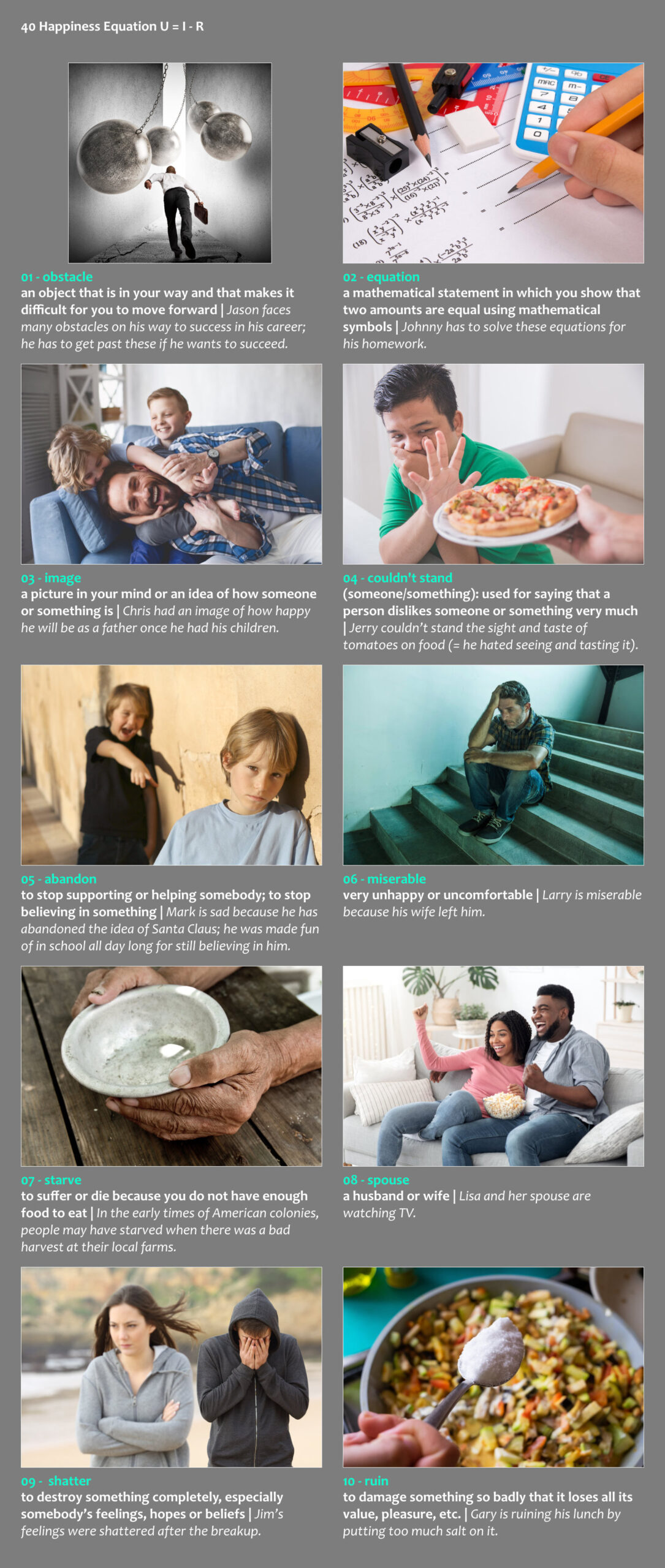
41 As the rich get richer, the poor get richer (steps 1, 3 and 5)
“The rich are getting richer and the poor are getting poorer.”
“The top one per cent of people on the planet have half the wealth.”
“Western corporations are plundering developing countries.”
“Capitalism is on its last legs.”
Really?
The truth is that global inequality is tumbling. Yes, the rich are getting richer—but the poor are getting richer faster. And what’s driving that process? The market.
Look at the most basic measures: Literacy. Longevity. Infant mortality. Calorie intake. Height. More and more people are being lifted out of poverty.
I think of the changes just in my lifetime.
When I was born, in 1971, an American worker had to earn a month’s salary to be able to afford a TV set. Now, it’s two days.
In 1971, fewer than half of girls worldwide completed at least primary education. Now, it’s more than 90 percent.
In 1971, a stationary car emitted more pollution than a car moving at full speed today.
Go a little further back. In the seventeenth century, the most powerful man in the world was Louis XIV of France. Every night, he’d have 40 dishes prepared for his dinner, and he’d pick the one he felt like. Think about it: A receptionist today can stop off at a store on her way home and have not only a wider choice than that king, but a fresher one and a healthier one. We all live better than Louis XIV.
What has caused that miracle? Not any UN development program. Not any government aid scheme.
What caused it was the market.
The most rapid falls in poverty are happening in countries that are joining the global trading system. Compare growth rates in free-trading Colombia and protectionist Venezuela; or in free-trading Vietnam and protectionist Laos; or in free-trading Bangladesh and protectionist Pakistan.
It’s the same story every time.
China after 1979, India after 1991. You remove barriers to trade. Prices fall. Your people no longer have to work every hour just to afford food and basic commodities. They have time to invent and make and buy and sell other things. The whole economy is stimulated. Poverty falls.
OK, you might say, so maybe capitalism works; maybe people are better off. But isn’t there a cost? Doesn’t it make us more materialistic? Doesn’t it make us greedier?
If by “greed” you mean a desire for material wealth, that’s part of the human condition. It’s in our DNA or, if you prefer, it’s in our fallen nature. Under any system—socialism, communism, fascism, absolute monarchy, theocracy—people want more stuff.
The unique quality of capitalism is that it structures the incentives so that the way to succeed—the way to be “greedy,” if you insist on using that vocabulary—is to offer a service to the people around you.
Under every other system, you get on by sucking up to those in power: commissars, or kings, or dictators.
But under a free market system, you get on by offering consumers something they want.
As the economist Joseph Schumpeter put it, the achievement of capitalism is not to provide more silk stockings for princesses, but to bring them within the reach of the shop girl.
So, why can’t we see it? Why do well-intentioned, idealistic young people oppose free trade and market liberalization, thinking that they’re standing up for the poorest people on the planet, when in fact they’re doing the opposite?
A big part of the answer is aesthetic. As the Victorian novelist, Anthony Trollope, wrote, “Poverty, to be scenic, should be rural.”
I grew up in Lima, Peru which, in those days, was surrounded by shantytowns known as las barriadas.
Western visitors would come, and they’d visit Machu Picchu, and then they’d ask in bewilderment why people would migrate from the Andes to the slums.
Why did they swap the clean air and the mountain scenery for open sewers and traffic fumes?
It’s a very first world question. No Peruvian ever needed to ask why you’d leave a place with no electricity, no school, no clinic, and no jobs.
Those shantytowns, those barriadas, for most of their residents, are transitional. They’re busy places, humming with enterprise, and the people in them sense that they’re on their way up. If we want to help those people, the best thing we can do is let them sell us their stuff.
Capitalism has achieved things which earlier ages ascribed to gods and magicians. It’s abolishing hunger and disease and want.
It’s led to an unprecedented enrichment that is the central fact of your life. The fact that you’re watching this video is enough to tell me that.
Now let it work its magic in the rest of the world.
I’m Daniel Hannan for Prager University.
“The rich are getting richer and the poor are getting poorer.”
“The top one per cent of people on the planet have half the wealth.”
“Western corporations are plundering developing countries.”
“Capitalism is on its last legs.”
Really?
wealth1: a large amount of money, property, etc. that a person or country owns | Jackson has inherited his father’s wealth.
plunder2: to steal or take large amounts of money or goods from a place | The bandits are plundering the village.
developing country: a country with little industrial and economic activity and where people generally have low incomes | Brazil is a developing country according to the International Monetary Fund (IMF).
on its last legs: to be going to die or stop functioning very soon; to be very weak or in bad condition | My retro TV, which I bought 20 years ago, is on its last legs.
The truth is that global inequality is tumbling. Yes, the rich are getting richer—but the poor are getting richer faster. And what’s driving that process? The market.
inequality3: the unfair difference between groups of people in society, when some have more wealth, status or opportunities than others | There is inequality of income between some of those doing manual labour and those doing high-skilled labour.
tumble: to fall rapidly in value or amount | The price of gas is tumbling.
Look at the most basic measures: Literacy. Longevity. Infant mortality. Calorie intake. Height. More and more people are being lifted out of poverty.
measure4: a way of judging something (= deciding how good or bad something is) | The tape (the long yellow metal) provides a good measure to check the accuracy of size of the counter.
literacy: the ability to read and write | Literacy rates have increased in the past 100 years.
longevity: long life; the fact of lasting a long time | I wish you longevity and happiness.
infant mortality: the death of children under the age of one year | Infant mortality has decreased over the world.
poverty5: the state of being poor | Ellie lives in poverty.
I think of the changes just in my lifetime.
When I was born, in 1971, an American worker had to earn a month’s salary to be able to afford a TV set. Now, it’s two days.
In 1971, fewer than half of girls worldwide completed at least primary education. Now, it’s more than 90 percent.
In 1971, a stationary car emitted more pollution than a car moving at full speed today.
stationary: not moving; not intended to be moved | I remained stationary while everyone else was crossing the road.
emit6: to send out light, sound, or a smell, or a gas or other substance | The power plant is emitting carbon dioxide.
Go a little further back. In the seventeenth century, the most powerful man in the world was Louis XIV of France. Every night, he’d have 40 dishes prepared for his dinner, and he’d pick the one he felt like. Think about it: A receptionist today can stop off at a store on her way home and have not only a wider choice than that king, but a fresher one and a healthier one. We all live better than Louis XIV.
feel like (something): to have a wish for something, or to want to do something, at a particular moment | I feel like eating chocolates now.
wide choice7-8: a lot of different things from which you can choose | Lisa is the daughter of a billionaire. She has a much wider choice of shoes than Maggie, who lives on the streets (Lisa has a shoe collection while Maggie doesn’t have any shoes).
What has caused that miracle? Not any UN development program. Not any government aid scheme.
miracle9: an act or event that does not follow the laws of nature and is believed to be caused by God | It’s a miracle! Marcus, who the doctors said could never walk, can actually walk again.
aid10: money, food, etc. that is sent to help countries in difficult situations | These sacks of rice are being sent to a village, where there is a famine (= a lack of food during a long period of time in a region), as aid .
scheme: a plan or system for doing or organizing something | The company introduced a new training scheme to help the salesmen become more effective.
What caused it was the market.
The most rapid falls in poverty are happening in countries that are joining the global trading system. Compare growth rates in free-trading Colombia and protectionist Venezuela; or in free-trading Vietnam and protectionist Laos; or in free-trading Bangladesh and protectionist Pakistan.
rapid: fast or sudden | There was a rapid rise in oil prices after the OPEC meeting.
growth rate: a measurement of how fast something increases in size during a particular period | The economy’s growth rate has been increasing rapidly for the past 2 years.
free-trade: a system of international trade in which there are no restrictions or taxes on imports and exports | The country where he comes from is free-trading.
protectionist: based on the principle or practice of protecting a country’s own industry by taxing foreign goods | Some countries have practiced protectionist policies before adopting free-trade based policies.
It’s the same story every time.
China after 1979, India after 1991. You remove barriers to trade. Prices fall. Your people no longer have to work every hour just to afford food and basic commodities. They have time to invent and make and buy and sell other things. The whole economy is stimulated. Poverty falls.
barrier: a problem, rule or situation that prevents somebody from doing something, or that makes something impossible | There was a language barrier between Joe and Fred (= they could not communicate because they don’t speak the same language).
trade: the activity of buying and selling or of exchanging goods or services between people or countries | Trade (exports and imports) may be an important part of the economic growth of most countries.
commodity: a product or a raw material that can be bought and sold | Oil is an important commodity to those who own cars.
stimulate: to encourage something to grow, develop, or become active | Higher government spending may stimulate the economy during an economic downturn.
OK, you might say, so maybe capitalism works; maybe people are better off. But isn’t there a cost? Doesn’t it make us more materialistic? Doesn’t it make us greedier?
greedy11: wanting more money, power, food, etc. than you really need | Danny is greedy.
If by “greed” you mean a desire for material wealth, that’s part of the human condition. It’s in our DNA or, if you prefer, it’s in our fallen nature. Under any system—socialism, communism, fascism, absolute monarchy, theocracy—people want more stuff.
desire12: a strong wish to have or do something | The kitten desires the fresh fish on the corner of the table.
fallen nature: man’s built-in bias (= preference/tendency) away from what is morally good and toward what is wrong | According to the Bible, we all have a fallen nature.
theocracy: a country that is ruled by religious leaders | According to the CIA World Factbook, Iran is a theocracy.
The unique quality of capitalism is that it structures the incentives so that the way to succeed—the way to be “greedy,” if you insist on using that vocabulary—is to offer a service to the people around you.
incentive13: something that encourages you to do something | Money is one of the incentives that makes people work.
insist: to state or demand forcefully, esp. despite opposition (= to say or make a strong request often repeatedly especially when others disagree) | Lisa insisted on having steak in a five star restaurant.
Under every other system, you get on by sucking up to those in power: commissars, or kings, or dictators.
get on: to manage or survive | The children can get on without watching any TV for a few days.
suck up: to try to please somebody in authority by praising them too much, helping them, etc., in order to gain some advantage for yourself | Stop sucking up to your boss.
commissar14: an officer of the Communist Party, especially in the past in the Soviet Union | The military commissar was in charge of drafting men into the military service (= choosing people and sending them to war).
But under a free market system, you get on by offering consumers something they want.
consumer15: a person who buys goods or services for their own use | This family are regular consumers for this local supermarket.
As the economist Joseph Schumpeter put it, the achievement of capitalism is not to provide more silk stockings for princesses, but to bring them within the reach of the shop girl.
achievement: a thing that somebody has done successfully, especially using their own effort and skill | When Einstein discovered the theory of General relativity, it was a great achievement for him.
provide16: to give something to somebody or make it available for them to use; supply | The primary school provides lunch to school children.
silk stockings17: one of a pair of tight-fitting coverings for the feet and legs made of light material and worn by women | This is a pair of vintage silk stockings.
So, why can’t we see it? Why do well-intentioned, idealistic young people oppose free trade and market liberalization, thinking that they’re standing up for the poorest people on the planet, when in fact they’re doing the opposite?
well-intentioned: intending to be helpful or useful but not always succeeding very well | The teacher gave well intentioned feedback on Mark’s homework. (= S/He was helpful, but the feedback didn’t help Mark much.)
oppose18: to disagree strongly with somebody’s plan, policy, etc. and try to change it or prevent it from succeeding | This group of protesters oppose their government’s environmental policies.
market liberalization: the act of allowing more freedom in the market; deregulation of the market | Policies of market liberalization were implemented in India in 1991.
A big part of the answer is aesthetic. As the Victorian novelist, Anthony Trollope, wrote, “Poverty, to be scenic, should be rural.”
aesthetic: connected with beauty and art and the understanding of beautiful things | There is an aesthetic appeal of Classical music.
scenic:19 having or allowing you to see beautiful natural features | There are quite some scenic places in Italy.
rural20: in, of, or like the countryside | Areas such as this one with old buildings, in the UK, are rural.
I grew up in Lima, Peru which, in those days, was surrounded by shantytowns known as las barriadas.
shantytown21: an area in or on the edge of a city, in which poor people live in small, very cheaply built houses; similar to slums | Kenny lives in a shantytown.
Western visitors would come, and they’d visit Machu Picchu, and then they’d ask in bewilderment why people would migrate from the Andes to the slums.
bewilderment22: a feeling of being completely confused | Mary is filled with bewilderment about how she can finish her homework.
slums21: an area of a city that is very poor and where the houses are dirty and in bad condition | It can be difficult to live in the slums.
Why did they swap the clean air and the mountain scenery for open sewers and traffic fumes?
swap23: to give something to somebody and receive something in exchange | Mary and her daughter are swapping Christmas presents.
scenery24: the general appearance of the natural environment, especially when it is beautiful | Claire is enjoying the scenery at the top of the mountain.
sewer25: a large pipe, usually underground, that is used for carrying waste water and human waste away from buildings to a place where they can be safely got rid of | Dirty water flows through sewer pipes.
fumes26: smoke, gas, or something similar that smells strongly or is dangerous to breathe in | Fumes from the truck filled the street.
It’s a very first world question. No Peruvian ever needed to ask why you’d leave a place with no electricity, no school, no clinic, and no jobs.
first world: the rich industrial countries of the world | Jason lives in a first world country.
Those shantytowns, those barriadas, for most of their residents, are transitional. They’re busy places, humming with enterprise, and the people in them sense that they’re on their way up. If we want to help those people, the best thing we can do is let them sell us their stuff.
resident27: a person who lives in a particular place or who has their home there | Sam and Janet are residents in the newly built apartment complex.
transitional: being in or having a process of change from one form or type to another | Living in a hotel is only transitional for us (it is temporary), until we find an apartment near our workplace.
hum28: to be full of activity | The high street is humming with life.
enterprise: the development of businesses by the people of a country rather than by the government | It is paramount (= most important) to encourage enterprise in difficult economic times.
Capitalism has achieved things which earlier ages ascribed to gods and magicians. It’s abolishing hunger and disease and want.
ascribe: to consider something to be caused, created, or owned by someone or something | Mary ascribed the success of her cooking book to the wide range of recipes that she explained inside it.
abolish: to officially end a law, a system or an institution etc | Slavery was abolished in the USA, in 1865.
It’s led to an unprecedented enrichment that is the central fact of your life. The fact that you’re watching this video is enough to tell me that.
unprecedented: never having happened or existed in the past | The invention of the internet has led to an unprecedented increase in communication between people all over the world.
enrichment: A) the act of improving the quality of something often by adding something to it | The enrichment in the taste of the dish is the result of a secret mixture of Indian spices and herbs.
- B) the act of making somebody/something rich or richer | Many people enter politics merely for personal enrichment.
Now let it work its magic in the rest of the world.
I’m Daniel Hannan for Prager University.

42 Do We Have to Destroy the Earth to Save It (steps 1, 3 and 5)
Do we need to destroy the environment to save it?
That’s the question I faced a few years ago. I co-founded a movement that was the precursor to the Green New Deal. It was called “The New Apollo Project.” If we could send a man to the moon, we reasoned, surely we could save our own planet. All we had to do was harness the power of the wind and the sun and get rid of fossil fuels. Compared to the original Apollo mission, how hard could that be?
Well, it turned out to be very hard—practically impossible, in fact. The basic laws of physics and chemistry proved to be very stubborn. But, as I did more and more research, something else began to trouble me: the prospect that pushing the planet toward wind and solar energy would actually cause more harm to the environment than good. There’s no better example of this than what wind and solar energy do to birds.
Industrial wind turbines—those giant generators of wind power—are the greatest new threat to golden and bald eagles. But the eagles are hardly the only ones threatened. Condors, owls, hawks and falcons all fall prey to the turbines’ mighty blades.
Big Wind—and believe me, there’s a Big Wind industry now, just like there’s Big Oil and Big Pharma—claims that house cats kill more birds than wind turbines. That’s true. But whereas cats kill small, common birds like sparrows, wind turbines kill big, threatened-with-extinction and slow-to-reproduce species like bald eagles and condors.
Indeed, industrial wind farms are killing fields for birds. The more turbines you put up, the more birds you’re going to slaughter.
According to the American Bird Conservancy in 2017, “Research shows that hundreds of thousands of birds and bats die every year when they accidentally collide with the…turbine blades. That number grows with each turbine built.” The Royal Society for the Preservation of Birds reports that wind farms built off the coast of Britain could be the “final nail in the coffin” for endangered sea birds. The Center for Biological Diversity calls the Altamont Pass wind farm in California “a population sink for golden eagles as well as burrowing owls.”
As for solar farms, they produce an entirely different set of problems, although they also are very harmful for birds. In California, according to a federal report, massive solar arrays produce heat up to 900 degrees. When birds fly into those arrays, they simply burn up.
Building a solar farm is a lot like building any other kind of massive industrial facility. You have to clear the whole area of wildlife. For example, in order to construct the Ivanpah solar farm in California near the Nevada border, developers hired biologists to pull threatened desert tortoises from their burrows. The tortoises were then loaded on the back of pickup trucks and caged in pens where many ended up dying.
Solar farms also need millions and millions of gallons of water to clean the mirrors and to generate power. Since most solar farms are built in the desert, we’re talking about a precious resource already in short supply. “When push comes to shove, water could become the real throttle on renewable [solar] energy,” according to Michael Webber, professor of mechanical engineering at the University of Texas at Austin.
Then there’s the issue of what to do with solar panels that wear out. The panels contain lead and other toxic chemicals that can’t be removed without breaking up the entire panel. Since it’s far cheaper for solar manufacturers to just buy the raw materials than recycle old panels, those old panels end up in landfills—or, as the New York Times discovered in a 2019 investigation, dumped in poor African nations.
Wind turbines may have an even worse disposal problem than solar panels. First, they are gigantic—a single blade can be longer than a wing on a jumbo jet. Second, they are made of fiberglass, which has to be cut by a diamond-studded saw to be carted away on giant trucks. And, as with solar panels, the only thing to do is to bury them, toxic materials and all. This is done, as you can imagine, in enormous pits, creating yet another landfill problem.
All this environmental degradation is happening on a relatively small scale right now because we get less than ten percent of our electricity from wind and solar sources. If we really were to embark on a wind and solar buildout of the kind environmentalists advocate, the damage would be much, much greater.
Consider this: Today’s energy system requires just a half a percent of the land in the US. If we were to get all the energy we now use from wind and solar, at least 25% of all land in the US would be required.
That’s a lot of dead wildlife.
Doesn’t sound very green, does it?
I’m Michael Schellenberger, founder and president of Environmental Progress and author of Apocalypse Never, for Prager University.
Do we need to destroy the environment to save it?
environment: the natural world in which people, animals and plants live | People have different views on to what extent humans are damaging the environment.
That’s the question I faced a few years ago. I co-founded a movement that was the precursor to the Green New Deal. It was called “The New Apollo Project.” If we could send a man to the moon, we reasoned, surely we could save our own planet. All we had to do was harness the power of the wind and the sun and get rid of fossil fuels. Compared to the original Apollo mission, how hard could that be?
precursor: a person or thing that comes before somebody/something similar and that leads to or influences its development | The fall of the Berlin Wall in 1989 was the precursor to the reunification of Germany.
harness1 (something): to control and use the force or strength of something to produce power or to achieve something | There is a debate about whether solar power can be harnessed effectively.
fossil fuel2: fuels, such as gas, coal, and oil, that were formed underground from plant and animal remains millions of years ago | Fossil fuels have been the primary sources of power for the world since the Industrial Revolution.
Well, it turned out to be very hard—practically impossible, in fact. The basic laws of physics and chemistry proved to be very stubborn. But, as I did more and more research, something else began to trouble me: the prospect that pushing the planet toward wind and solar energy would actually cause more harm to the environment than good. There’s no better example of this than what wind and solar energy do to birds.
proved to be: to show or provide evidence of having a particular quality (= characteristic or feature) | Making a cake for the first time proved to be more difficult than Jeremy thought. (= Making the cake really was difficult for Jeremy.)
stubborn3: difficult to move, change, or deal with | This donkey is stubborn; it just laid down and stopped moving so its owner left it there.
research4: to study something carefully and try to discover new facts about it | Stephen is a doctor. He is researching the effect of viruses on the immune system in a lab.
prospect: an idea of what might or will happen in the future | The prospect of going back to school after the summer holiday filled Johnny with sadness.
Industrial wind turbines—those giant generators of wind power—are the greatest new threat to golden and bald eagles. But the eagles are hardly the only ones threatened. Condors, owls, hawks and falcons all fall prey to the turbines’ mighty blades.
industrial5: connected with industry (the production of goods from raw materials, especially in factories) | This is an industrial oil refinery.
golden eagle6.
bald eagle7.
threatened: in danger, or likely to stop existing | The snow leopard is one of the threatened species on earth.
condor8.
owl9.
hawk10.
falcon11.
prey12: an animal, a bird, etc. that is hunted, killed and eaten by another | The hog is the lion’s prey.
fall prey to something/somebody: to be harmed or deceived by someone or something | Elderly people often fall prey to scammers on the Internet.
mighty: very large, powerful, or important | Watch out! It’s the mighty German tank “Panzer VIII Maus”!
Big Wind—and believe me, there’s a Big Wind industry now, just like there’s Big Oil and Big Pharma—claims that house cats kill more birds than wind turbines. That’s true. But whereas cats kill small, common birds like sparrows, wind turbines kill big, threatened-with-extinction and slow-to-reproduce species like bald eagles and condors.
sparrow13.
extinction14: a situation in which something no longer exists | Dinosaurs faced extinction.
Indeed, industrial wind farms are killing fields for birds. The more turbines you put up, the more birds you’re going to slaughter.
indeed: really or certainly, often used to emphasize something | Indeed, many kids like chocolate.
slaughter: the killing of animals for their meat, or the killing of large numbers of animals in a cruel manner | There was a slaughter of pigs in the farm.
According to the American Bird Conservancy in 2017, “Research shows that hundreds of thousands of birds and bats die every year when they accidentally collide with the…turbine blades. That number grows with each turbine built.” The Royal Society for the Preservation of Birds reports that wind farms built off the coast of Britain could be the “final nail in the coffin” for endangered sea birds. The Center for Biological Diversity calls the Altamont Pass wind farm in California “a population sink for golden eagles as well as burrowing owls.“
collide15: two or more things crash into each other | Mel’s car collided with Susan’s car as he failed to keep his distance.
nail16: a small, thin piece of metal with one pointed end and one flat end that you hit into something with a hammer | There are some nails under the hammer.
coffin17: a box in which a dead body is buried or cremated | This wooden coffin is empty.
final nail in the coffin: an event that causes the failure, death, extinction of something that had already started to fail, die or go extinct | The news of corruption was the final nail in the coffin for the politician’s political career.
population sink: low quality habitat (= a place where particular animals or plants are normally found) leading to a deficit | This forest is a population sink for foxes due to all the man made traps that kill them.
burrowing owl18.
As for solar farms, they produce an entirely different set of problems, although they also are very harmful for birds. In California, according to a federal report, massive solar arrays produce heat up to 900 degrees. When birds fly into those arrays, they simply burn up.
array: a group or collection of things or people | There is a wide array of wines available at the restaurant.
Building a solar farm is a lot like building any other kind of massive industrial facility. You have to clear the whole area of wildlife. For example, in order to construct the Ivanpah solar farm in California near the Nevada border, developers hired biologists to pull threatened desert tortoises from their burrows. The tortoises were then loaded on the back of pickup trucks and caged in pens where many ended up dying.
facility19: a place, usually including buildings, used for a particular purpose or activity | Employees worked long hours in the car manufacturing facility.
desert tortoise20.
burrow21: a hole in the ground dug by an animal such as a rabbit, especially to live in | The local people think that a fox lives in this burrow.
caged22: put or kept in a cage (a structure made of metal bars or wire in which animals or birds are kept) | Bears in the city are usually caged in the zoo.
pen23: a small piece of land surrounded by a fence in which farm animals are kept | Lucy is staying near the pen that has been built for chickens.
Solar farms also need millions and millions of gallons of water to clean the mirrors and to generate power. Since most solar farms are built in the desert, we’re talking about a precious resource already in short supply. “When push comes to shove, water could become the real throttle on renewable [solar] energy,” according to Michael Webber, professor of mechanical engineering at the University of Texas at Austin.
resource: a useful or valuable possession or quality of a country, organization, or person | Copper and water are two important natural resources that Canada has.
in short supply: to be few or not enough in number or amount | Sunshine is usually in short supply in Britain.
when push comes to shove: when there is no other choice; when everything else has failed | When push comes to shove and home treatment no longer helps, we will have to go to the hospital.
throttle: A) a device that controls how much fuel goes into an engine | The race cars speed through the finish line at full throttle (= at maximum speed because the highest amount of fuel is flowing into the engine).
- B) something that accelerates (= speeds up) or decelerates (= slows down) a process | The school budget is the throttle on how much a school can spend on extracurricular activities and modernisation.
Then there’s the issue of what to do with solar panels that wear out. The panels contain lead and other toxic chemicals that can’t be removed without breaking up the entire panel. Since it’s far cheaper for solar manufacturers to just buy the raw materials than recycle old panels, those old panels end up in landfills—or, as the New York Times discovered in a 2019 investigation, dumped in poor African nations.
wear (something) out24: to use something so much that it is damaged sometimes so much that it cannot be used any more | Sally’s shoes always wear out after a year of usage.
lead25: a chemical element (Pb); it is a heavy, soft grey metal, used especially in the past for water pipes or to cover roofs | Thanks to its heaviness, lead is often used in fishing.
landfill26: an area of land where large amounts of waste material are buried under the earth | This is a solid waste landfill.
dump27: to get rid of something you do not want, especially in a place that is not suitable | Evelyn is dumping an empty bottle.
Wind turbines may have an even worse disposal problem than solar panels. First, they are gigantic—a single blade can be longer than a wing on a jumbo jet. Second, they are made of fiberglass, which has to be cut by a diamond-studded saw to be carted away on giant trucks. And, as with solar panels, the only thing to do is to bury them, toxic materials and all. This is done, as you can imagine, in enormous pits, creating yet another landfill problem.
fiberglass28: a material made from small threads of glass twisted together, used within the walls of houses to keep out cold and pressed into hard plastic for use in boats and other structures | This is white glass fiber composite raw material.
diamond-studded saw29: a tool that has a long blade (= metal cutting part) with sharp points (called teeth) along one of its edges hardened with diamond particles | Diamond-studded saws are sometimes used to cut concrete.
cart away: take away by a vehicle e.g. car, motorbike, lorry etc. | They carted away the TV from the store.
bury30: to put something into a hole in the ground and cover it | Matt is digging a hole in the sand to bury a secret note in a bottle.
pit31: a large deep hole in the ground | Someone left a spade inside this huge pit.
All this environmental degradation is happening on a relatively small scale right now because we get less than ten percent of our electricity from wind and solar sources. If we really were to embark on a wind and solar buildout of the kind environmentalists advocate, the damage would be much, much greater.
degradation32: the process of something being damaged or made worse | Bottles being left in lakes lead to environmental degradation.
embark33 (on/upon something): to start to do something new or difficult | Danny embarked on his first major home improvement project.
advocate: to publicly support or suggest an idea, development, or way of doing something | The protesters advocated prison reform.
Consider this: Today’s energy system requires just a half a percent of the land in the US. If we were to get all the energy we now use from wind and solar, at least 25% of all land in the US would be required.
That’s a lot of dead wildlife.
Doesn’t sound very green, does it?
I’m Michael Schellenberger, founder and president of Environmental Progress and author of Apocalypse Never, for Prager University.