Modul 6: PragerU Videos Set 6. Videos 71-84
Ez a videóválogatás 14db izgalmas, gondolatébresztő témát jár körül 5 perces prezentációkban. A gyakorlat végeztével közel 600 szóval növeled szókincsedet. Fontos, hogy a kézikönyvekben leírtak szerint dolgozz az anyagon.
71 Why You Shouldn’t Live In Fear (steps 1, 3 and 5)
The most famous words of Franklin Roosevelt, America’s longest-serving president, were “The only thing we have to fear is fear itself.”
One wonders if any world leader would or even could say that today. We live in the Age of Fear.
All of my life, I thought love and hate were the two most powerful emotions.
But owing to recent events, I have changed my mind.
I now understand that for most people, fear is the strongest emotion.
In fact, I’ve come to realize that it is possible to get people to do anything if you instill enough fear in them. Specifically, irrational fear.
Fear of Covid, for example, is rational. But media and governments induced irrational fears. That’s why millions of healthy people stayed indoors for a year or more, why a vast number of people have worn masks while walking or sitting alone outdoors, and why so many parents did not allow their young children to play with other children for a year or more, despite the fact that the Covid mortality rate among children is considerably less than the flu’s mortality rate among children.
All of this was caused by irrational fear. It turns out that fear is not only more powerful than love and hate, in most people it is more powerful than reason. And when it is, it is far more destructive—to the individual and to society—than rational fear.
What is rational fear? When a soldier fears going into battle, that’s rational. Soldiers cannot allow fear to control their behavior, but their fear is not irrational. If a mugger points a gun at you, it is rational to feel fear. If you are diagnosed with cancer, it is rational to experience fear.
Rational fear is not necessarily a bad thing. It is irrational fear that does the most harm—to yourself, to others, and to all of society.
The Salem witch trials of the seventeenth century were an example of irrational fear leading to evil—the killing of women who were believed to be witches.
You would think that the Enlightenment of the 18th century, with its focus on reason and science, would have led to a great lessening of irrational fear.
It hasn’t.
To take one contemporary example, many people have decided not to have children because they fear that a warming planet represents an “existential threat” to life. Now, it is rational to be concerned about climate change; it is irrational not to have children because of it. But it gets even more irrational. Their parents often support this decision, despite their deep yearning to be grandparents.
Irrational fear is also a major source of hatred. People hate what they fear. It was Germans’ irrational fear of Jews—people who made up under one percent of the German population—that led to the unique evil known as the Holocaust.
Given the awful power of fear, what can you do to be less fearful?
The first thing you must do is determine whether your fears are rational, or irrational.
And that can only be accomplished by thoroughly studying the issue—whatever it happens to be: global warming, a pandemic, racism, or any other controversial subject.
For example, blacks are told to fear white police because white police are racist and want to do them harm. This is largely an irrational fear. It is well-documented that in any given recent year, the number of unarmed blacks killed by police is approximately twenty—nearly all of whom seriously threatened the lives of the policemen who killed them.
Another example: Credible scientists who acknowledge that global warming is taking place, but contend that it is not an existential threat to life, are dismissed as “anti-science” and their views largely suppressed. Read them, and many of your fears will be allayed. (You might even decide to have children).
Most fears are stoked by governments and their allies in the mass media and in big tech, who in turn suppress contrary opinions. Therefore, please understand that when you hear only one side of the story, and that opinion is designed to make you afraid, there is a good chance that your fears are unwarranted.
Determining whether your fears are rational or irrational is one of the most important things you will ever do. The quality of your life and the life of your society depend on your making that distinction.
I’m Dennis Prager.
The most famous words of Franklin Roosevelt, America’s longest-serving president, were “The only thing we have to fear is fear itself.”
One *wonders if any world leader would or even could say that today. We live in the Age of Fear.
wonder1: to think about something and try to decide what is true, what will happen, what you should do, etc. | Max and Lisa are wondering if they should switch to cheaper car insurance.
All of my life, I thought love and hate were the two most powerful emotions. But owing to recent events, I have changed my mind.
owing to: because of | Owing to Joe’s good performance at the entrance exam, he was able to get into a great school.
I now understand that for most people, fear is the strongest emotion.
In fact, I’ve come to realize that it is possible to get people to do anything if you *instill enough fear in them. Specifically, irrational fear.
come to: if you come to a decision, arrangement, etc., you make a decision or decide what to think about something | Janet came to a conclusion about Steve after 5 minutes of meeting him.
instill2: to gradually put an idea or attitude into somebody’s mind; to make somebody feel, think or behave in a particular way over a period of time | Susan’s mother instills discipline in her by always making sure that she has done her homework well.
Fear of Covid, for example, is rational. But media and governments *induced irrational fears. That’s why millions of healthy people stayed *indoors for a year or more, why *a vast number of people have worn masks while walking or sitting alone outdoors, and why so many parents did not allow their young children to play with other children for a year or more, despite the fact that the Covid mortality rate among children is considerably less than the flu’s mortality rate among children.
induce3: to cause something | Listening to loud music for a long time may induce hearing loss.
indoors4: inside a building | Jimmy always plays indoors, which sometimes worries his mother.
a vast number5: extremely large in amount or size | There are a vast number of trees in this forest.
despite the fact that: although; used for saying that something happens even though something else might have prevented it | Jack is still not a famous musician despite the fact that he is one of the best guitarists in America.
mortality rate: the number of deaths from a particular cause or during a particular period of time among a particular group of people | It is said that the mortality rate of the virus is not increasing.
considerably: much; a lot | The air outside became considerably colder during the night.
All of this was caused by irrational fear. It turns out that fear is not only more powerful than love and hate, in most people it is more powerful than reason. And when it is, it is far more *destructive—to the individual and to society—than rational fear.
reason: the power of the mind to think in a logical way, to understand and have opinions, etc. | Human beings are capable of reason but animals are not.
destructive6: causing destruction or damage | Anxiety (feeling nervous or worried) can be destructive to sleep patterns.
What is rational fear? When a soldier fears going into battle, that’s rational. Soldiers cannot allow fear to control their behavior, but their fear is not irrational. If a *mugger points a gun at you, it is rational to feel fear. If you are diagnosed with cancer, it is rational to *experience fear.
mugger7: a person who threatens or attacks somebody in order to steal their money, jewellery, etc., especially in a public place | Matt is a mugger.
experience8: to have and be aware of (know about) a particular emotion or physical feeling | Sally experiences joy every time she gets a package from the mail.
Rational fear is not necessarily a bad thing. It is irrational fear that does the most harm—to yourself, to others, and to all of society.
The Salem witch *trials of the seventeenth century were an example of irrational fear leading to evil—the killing of women who were believed to be *witches.
trial9: a formal examination of evidence in court by a judge to decide if somebody is guilty of a crime or not | Jen, who is facing the judge, is attending her trial for fraud charges.
witch10: a woman who is believed to have magic powers, especially to do evil things. | Jessica is a witch.
You would think that the Enlightenment of the 18th century, with its focus on reason and science, would have led to a great lessening of irrational fear.
It hasn’t.
Enlightenment: the period in the 18th century in Europe when many writers and scientists began to argue that science and reason were more important than religion and tradition | Russeau lived during the Enlightenment.
lessening: the fact or process of becoming or making something become smaller, weaker, less important, etc. | There was a lessening of enthusiasm in the crowd when the lead singer forgot the lyrics of the song.
To take one contemporary example, many people have decided not to have children because they fear that a warming planet represents an “existential threat” to life. Now, it is rational to be concerned about climate change; it is irrational not to have children because of it. But it gets even more irrational. Their parents often support this decision, despite their deep *yearning to be grandparents.
contemporary: belonging to the present time; modern | Contemporary music is played on most radio stations.
threat11: danger | Stray dogs pose a threat to local people in the streets.
existential threat: the possibility of a person’s, country’s, idea’s etc. complete destruction | There was a real existential threat in the 1960s during the Cuban missile crisis, a conflict between the USA and the Soviet Union.
yearning12: to want something very much | Janet is yearning for a boyfriend.
Irrational fear is also a major source of hatred. People hate what they fear. It was Germans’ irrational fear of Jews—people who made up under one percent of the German population—that led to the unique evil known as the Holocaust.
Given the awful power of fear, what can you do to be less *fearful?
fearful13: nervous and afraid | Jack is fearful because there have been many house robberies in his neighbourhood recently.
The first thing you must do is *determine whether your fears are rational, or irrational.
determine14: to decide and/or arrange something | Web designers have the task of determining the colour scheme.
And that can only be *accomplished by thoroughly studying the issue—whatever it happens to be: global warming, a pandemic, racism, or any other controversial subject.
accomplish15: to succeed in doing or completing something | Bill accomplished winning the gold medal in the 100m running at the Olympics.
controversial: causing a lot of angry public discussion and disagreement | There is a controversial plan to build a new airport.
For example, blacks are told to fear white police because white police are racist and want to do them harm. This is largely an irrational fear. It is well-documented that in any given recent year, the number of unarmed blacks killed by police is approximately twenty—nearly all of whom seriously *threatened the lives of the policemen who killed them.
threaten (something)16: to be a danger to something | Susie’s life is threatened.
Another example: Credible scientists who acknowledge that global warming is taking place, but contend that it is not an existential threat to life, are *dismissed as “anti-science” and their views largely suppressed. Read them, and many of your fears will be *allayed. (You might even decide to have children).
acknowledge: to accept that something is true | Harry acknowledged that he was partly to blame for the ending of his marriage.
contend: to say that something is true, especially in an argument | Susan contends that she is not responsible for the failure of her business.
dismiss17: to decide that somebody/something is not important and not worth thinking or talking about | Susan’s ideas are being dismissed by her boss.
suppress: to prevent something from being published or made known | The corrupt police officer suppressed some relevant information.
allay18: to make something, especially a feeling, less strong | This mother is trying to allay her daughter’s fear after a nightmare by staying in her room until she falls asleep.
Most fears are *stoked by governments and their allies in the mass media and in big tech, who in turn suppress contrary opinions. Therefore, please understand that when you hear only one side of the story, and that opinion is designed to make you afraid, there is a good chance that your fears are unwarranted.
stoke19-20: A) to add fuel to a fire, etc. | The fire is being stoked.
- B) to make people feel something more strongly | Janet’s happiness stokes envy of her friend. (Sool: ez 2 külön kép: szó és def mindkettő alá, A és B jelzéssel, ahogy itt van.)
ally: someone who helps and supports someone else | Reagan and Thatcher were considered to be allies.
contrary opinions: the opposite opinion of the sentiment (= a thought, opinion, or idea) held by the majority | Dictatorships usually eliminate contrary opinions.
unwarranted: not reasonable or necessary; not appropriate | Some of the criticism of the president was unwarranted.
Determining whether your fears are rational or irrational is one of the most important things you will ever do. The quality of your life and the life of your society depend on your making that distinction.
distinction (between A and B): a clear difference or contrast especially between people or things that are similar or related | The distinction between a wasp and a bee is not always clear to people.
I’m Dennis Prager.


72 How Lincoln changed the world in two minutes? (steps 1, 3 and 5)
President Abraham Lincoln’s Gettysburg address is one of the most famous speeches ever given. It is stunning in its brevity: ten sentences—272 words—and delivered in just over two minutes…few have said more with less.
Lincoln delivered the address on November 19, 1863. He was in Gettysburg to dedicate a national military cemetery to the Union soldiers who fell at the Battle of Gettysburg four months earlier. The North’s victory here was one of the pivotal battles of the American Civil War.
Lincoln begins this way: “Four score and seven years ago our fathers brought forth on this continent a new nation conceived in liberty and dedicated to the proposition that all men are created equal.”
Lincoln goes back in time—not to the signing of the Constitution, but to the Declaration of Independence. The Constitution, in forming our government, was the product of many compromises…most notably, slavery. In contrast, the Declaration of Independence declares our enduring national values. In one sentence, Lincoln summarizes the American project: liberty for all and equality of all.
“Now we are engaged in a great civil war testing whether that nation, or any nation so conceived and so dedicated, can long endure.”
Lincoln’s assertion is two-fold. First, the United States is unique. No nation was ever founded on a commitment to liberty and equality. And the Civil War was a trial to see if a nation based on such lofty ideals could survive.
“We are met on a great battlefield of that war.” Gettysburg, Pennsylvania, was the site of the bloodiest battle of America’s bloodiest war. In three days of fighting, 51,000 Americans on both sides—Union and Confederate—were killed, wounded, captured, or missing.
“We have come to dedicate a portion of that field, as a final resting place for those who here gave their lives that that nation might live. It is altogether fitting and proper that we should do this. But, in a larger sense, we cannot dedicate—we cannot consecrate—we cannot hallow—this ground. The brave men, living and dead, who struggled here, have consecrated it, far above our poor power to add or detract.”
Lincoln is not in Gettysburg to celebrate the Union victory. Rather, he explains that those who fought were the loyal guardians of the American Experiment. With their blood, they watered the tree of liberty. As Lincoln himself knew, how could his words ever compare to that sacrifice?
He even speculates that, “The world will little note, nor long remember what we say here, but it can never forget what they did here.”
Ironically, the world remembers what our sixteenth president said, but do we remember the actions of those who fought at Gettysburg?
Lincoln answers that question with a challenge: “It is for us the living, rather, to be dedicated here to the unfinished work which they who fought here have thus far so nobly advanced. It is rather for us to be here dedicated to the great task remaining before us—that from these honored dead, we take increased devotion to that cause for which they gave the last full measure of devotion…”
Those who fought and died shouldered our nation’s enduring values through the refining fire of Gettysburg and the Civil War. Lincoln points to them, and challenges the living. Are we prepared to heed their example to do what is necessary to advance the founding ideals of the Declaration of Independence?
Remember, the Gettysburg Address is a wartime speech. Lincoln is steeling his contemporaries for the many battles, burdens, and responsibilities still ahead. But he’s also looking to the future—he is looking to us.
Lincoln concludes: “…that we here highly resolve that these dead shall not have died in vain—that this nation, under God, shall have a new birth of freedom—and that government of the people, by the people, for the people, shall not perish from the earth.”
The Union won the Civil War. Slavery ended. And with it, the values of liberty and equality were given a “new birth.” However, the struggle for liberty and equality continued…and persists today. Lincoln foresaw this.
To remain a nation “dedicated to the proposition that all men”—all people—“are created equal” and that “government of, by, and for the people shall not perish from the earth”—these are the “unfinished work” and the “great task remaining” of every generation.
Ours is no exception. Are we up to President Lincoln’s challenge?
I’m Professor Doug Douds of the Army War College for Prager University.
President Abraham Lincoln’s Gettysburg address is one of the most famous speeches ever given. It is *stunning in its brevity: ten sentences—272 words—and delivered in just over two minutes … few have said more with less.
address: a formal speech that is made in front of an audience | Martin Luther King gave his famous “I have a dream” address in front of a huge crowd.
stunning1: extremely attractive or impressive; beautiful | Joe thinks that the view of the mountains is stunning.
brevity: the quality of using few words when speaking or writing; shortness | Mary’s poetry is becoming known for its brevity.
Lincoln delivered the address on November 19, 1863. He was in Gettysburg to dedicate a national military cemetery to the Union soldiers who fell at the Battle of Gettysburg four months earlier. The North’s victory here was one of the pivotal battles of the American Civil War.
pivotal: of great importance because other things depend on it | The USA’s involvement in Worl War 2 was pivotal in the fall of Nazi Germany.
Lincoln begins this way: “Four score and seven years ago our fathers brought forth on this continent a new nation conceived in liberty and dedicated to the proposition that all men are created equal.”
score : a set or group of 20 or approximately 20 | Ted was three score years old. (= 60 years old).
conceive: to form an idea, a plan, etc. in your mind | My architect friend’s idea to build a skyscraper was conceived as he was on holiday in Japan.
proposition: a statement that expresses an opinion | My proposition at the company meeting was to postpone the launching of the new product (= to introduce the new product into the market later).
Lincoln goes back in time—not to the signing of the Constitution, but to the Declaration of Independence. The Constitution, in forming our government, was the product of many compromises … most notably, slavery. In contrast, the Declaration of Independence *declares our enduring national values. In one sentence, Lincoln summarizes the American project: liberty for all and equality of all.
Constitution: the system of laws and basic principles that a state, a country or an organization is governed by | There have been 27 amendments to the US Constitution (as of 2022).
most notably: used for giving the most important example of something | Having good hygiene is an important part of preventing diseases from spreading; most notably, washing your hands prevents the spread of germs.
declare2: to say something officially or publicly | Maggie is on the stage to declare that her company is going to release a new product.
enduring: lasting for a long time | Mozart’s musical work is enduring.
“Now we are engaged in a great civil war testing whether that nation, or any nation so conceived and so dedicated, can long endure.”
Lincoln’s assertion is two-fold. First, the United States is unique. No nation was ever founded on a commitment to liberty and equality. And the Civil War was a trial to see if a nation based on such *lofty ideals could survive.
assertion: a statement saying that you strongly believe something to be true | Janet’s assertion that the baby will break the glass plate was true.
lofty3: impressive; deserving praise because of its high moral quality | The frescos on the ceiling of St Peter Cathedral in Italy are lofty.
ideal: an idea or standard that seems perfect, and worth trying to achieve or obtain | Danny’s ideal car is a BMW.
“We are met on a great battlefield of that war.” Gettysburg, Pennsylvania, was the site of the bloodiest battle of America’s bloodiest war. In three days of fighting, 51,000 Americans on both sides—Union and Confederate—were killed, *wounded, *captured, or missing.
wounded4: injured by a weapon, for example in a war | Mark is a wounded soldier.
capture5: to catch a person or an animal and keep them as a prisoner or shut them in a space that they cannot escape from | This red squirrel has been captured.
“We have come to dedicate a portion of that field, as a final resting place for those who here gave their lives that that nation might live. It is altogether fitting and proper that we should do this. But, in a larger sense, we cannot dedicate—we cannot consecrate—we cannot hallow—this ground. The brave men, living and dead, who *struggled here, have consecrated it, far above our poor power to add or detract.”
fitting: suitable or right for the occasion; appropriate | It was fitting that Lisa got a good grade after how hard she studied for her exams.
consecrate: to state officially in a religious ceremony that something is holy and can be used for religious purposes | “Do not damage anything; you are standing in a consecrated church!”
hallow: to make something holy | The bread and wine has been hallowed by being dedicated to God.
struggle6: to try very hard to do something when it is difficult or when there are a lot of problems | Stephen is struggling to pay his rent, so he got another job washing dishes.
detract: to make something seem less valuable or less deserving of admiration; to take away from | Jane’s small personality flaws do not detract from her overall positive attitude.
Lincoln is not in Gettysburg to celebrate the Union victory. Rather, he explains that those who fought were the loyal guardians of the American Experiment. With their blood, they watered the tree of liberty. As Lincoln himself knew, how could his words ever compare to that sacrifice?
experiment: a test done in order to learn something or to discover if something works or is true | Experiments on animals are mostly unethical.
He even speculates that, “The world will little note, nor long remember what we say here, but it can never forget what they did here.”
Ironically, the world remembers what our sixteenth president said, but do we remember the actions of those who fought at Gettysburg?
Lincoln answers that question with a challenge: “It is for us the living, rather, to be dedicated here to the unfinished work which they who fought here have thus far so nobly advanced. It is rather for us to be here dedicated to the great task remaining before us—that from these honored dead, we take increased *devotion to that cause for which they gave the last full measure of devotion …”
thus far: until now | Thus far, Johnny has been successful at selling vegetables at the market.
nobly: in a way that shows fine personal qualities that people admire, such as courage, honesty and care for others | Danny always reacted nobly to disappointments in his life; most notably, he has never given in.
devotion7: great love, care and support for somebody/something | George’s devotion to his job – and also to his family – is obvious.
Those who fought and died shouldered our nation’s enduring values through the refining fire of Gettysburg and the Civil War. Lincoln points to them, and challenges the living. Are we prepared to heed their example to do what is necessary to advance the founding ideals of the Declaration of Independence?
shoulder: to accept the responsibility for something | Jane shouldered the blame for her mistake (= she didn’t try to avoid the responsibility).
refine: to make something pure or improve something, especially by removing unwanted material | The process of refining oil produces some useful chemicals.
heed: to pay careful attention to somebody’s advice or warning | “Heed the warnings given by your grandfather,” my mum always said to me.
Remember, the Gettysburg Address is a wartime speech. Lincoln is steeling his contemporaries for the many battles, *burdens, and responsibilities still ahead. But he’s also looking to the future—he is looking to us.
steel8: to prepare yourself to deal with something unpleasant | Stephen is steeling himself for a cold winter.
contemporaries: a person who lives or lived at the same time as somebody else, especially somebody who is about the same age | Haydn and Mozart were contemporaries.
burden9: a duty, responsibility, etc. that causes worry, difficulty or hard work | Some people say that the burden of bringing up a child should fall on the parents and not the state.
Lincoln concludes: “…that we here highly resolve that these dead shall not have died in vain—that this nation, under God, shall have a new birth of freedom—and that government of the people, by the people, for the people, shall not *perish from the earth.”
in vain: unsuccessfully; without a good result | Stephen tried to call his friend in vain.
perish10: to be lost or destroyed | The building has perished.
The Union won the Civil War. Slavery ended. And with it, the values of liberty and equality were given a “new birth.” However, the struggle for liberty and equality continued … and *persists today. Lincoln *foresaw this.
persist11: to continue to do something despite difficulties or opposition | Carl is persisting in climbing the mountain even if he is tired.
foresee12: to think something is going to happen in the future; to know about something before it happens; predict | The weatherman foresaw the storms.
To remain a nation “dedicated to the proposition that all men”—all people—“are created equal” and that “government of, by, and for the people shall not perish from the earth”—these are the “unfinished work” and the “great task remaining” of every generation.
Ours is no exception. Are we up to President Lincoln’s challenge?
up to: capable of or fit for | John is up to the job.
I’m Professor Doug Douds of the Army War College for Prager University.

73 Ronald Reagan: The Great Communicator (steps 1, 3 and 5)
Ronald Reagan fashioned his political career and his presidency around three things.
Lower taxes
Smaller government
Strong defense
In doing so, he almost single-handedly resurrected and redefined the modern conservative movement. But he did much more than that—he resurrected and redefined America.
If that sounds like an impressive feat, it was. And it’s hard to imagine anyone other than Reagan who could have done it. Known by friend and foe alike as The Great Communicator, even Democrats conceded that no one could connect with the American people like Reagan. Whenever he went on TV—which was often—to promote a policy, he invariably swung the American people his way. When he explained something, it just made sense.
Fittingly, it was a TV speech in 1964 entitled “A Time for Choosing” that launched his political career. He delivered it on behalf of Republican Presidential candidate, Barry Goldwater. Here’s just one of his many memorable passages.
“No government ever voluntarily reduces itself in size… Actually, a government bureau is the nearest thing to eternal life we’ll ever see on this earth.”
This was pure Reagan: a basic truth delivered with humor.
Born in a small Midwestern town on February 6th, 1911, Reagan honed his communication skills as a radio announcer and then, as an actor. He was a genuine Hollywood star and celebrity for over two decades before he got into politics. Tall, broad-shouldered, and handsome with a golden voice, he was well-respected and well-liked by his peers. He was also seen as a natural leader. From 1947-52, he was President of the Screen Actors Guild, deftly guiding it through the blacklist era.
In 1965, encouraged by the positive response to his “A Time for Choosing” speech, Reagan decided to run for governor of California. He won easily. The victory immediately established him as a major figure in the Republican party. By 1980, he was their overwhelming choice for President.
That year, he soundly defeated President Jimmy Carter. The incumbent lost because his pessimistic approach to problem-solving mirrored the justifiably sour mood of the country. The economy was going nowhere, caught in the double grip of inflation and stagnation.
In contrast, Reagan—ever the optimist—offered a way out. It wasn’t the American people who were to blame, he told voters, it was the government. Reagan would get it out of the way. He would lower taxes and cut red tape.
He did both.
The media dismissed his plan, calling it “Reaganomics.” But it worked.
From 1982 to ’87, the American economy, defined as GDP adjusted for inflation, rose an astonishing 27 percent, manufacturing 33 percent, and the median income by 12 percent.
An estimated 20 million new jobs were created. All income classes and all racial and ethnic groups benefited from the Reagan economy.
The dark decade of the seventies, a time in which it looked like America was in a terminal eclipse, faded away. It was, as Reagan put it, during his 1984 re-election campaign, “Morning in America” again.
Every bit as transformational as his work on the economy, was his approach to foreign policy, specifically the Soviet Union. It’s easy to forget, but when Reagan came to office in 1981, Soviet-style communism appeared to be as strong, if not stronger, than American-style democracy.
Whereas Reagan’s predecessor had taken a “we just need to get along” approach, Reagan saw it much differently. He didn’t mince words. In March of 1983, he called the Soviet Union an “evil empire.” The media and the Democrats wailed that the phrase was reckless, but it was typical Reagan. Simple, clear, and true. What else do you call a totalitarian system that had deprived millions of people across the globe of their freedom?
When asked what his strategy was for fighting the Cold War, Reagan replied. “We win. They lose.”
It wasn’t just a glib line. He meant it. He expanded the US defense budget to unprecedented levels, in part to develop a ballistic missile shield his critics dubbed “Star Wars.” The strategy was to pressure the Soviets to try and keep up—which he knew they couldn. He was right. They didn’t have the money or the technology. Soviet premier Mikhail Gorbachev did all he could to pressure Reagan to drop it, but he would not budge.
To drive home his point, Reagan went to the Berlin Wall, a symbol of Communist oppression, and delivered one of his most famous lines: “Mr. Gorbachev, tear down this wall!”
By the end of the decade, a year after Reagan left office, the Soviet Union collapsed, an outcome no one could have imagined—except possibly Reagan himself. There are many reasons why this happened, but no one played a bigger role than our 40th President.
We won. They lost.
Before the Reagan era, Americans were depressed and uncertain. By the end of it, they were optimistic and confident. Reagan had stuck to his formula: lower taxes, less government, strong defense. It worked.
And it still does today.
I’m Scott Walker, president of Young America’s Foundation and former governor of Wisconsin, for Prager University.
Ronald Reagan fashioned his political career and his presidency around three things.
fashioned: to make or shape something | Susie fashioned her poetry out of the works of Shakespeare.
Lower taxes
Smaller government
Strong *defense
defense1: the organization of the people and systems that are used by a government to protect a country from attack | Billions are spent by some countries on drones because they believe that these help to improve their countries’ defense.
In doing so, he almost single-handedly resurrected and redefined the modern conservative movement. But he did much more than that—he resurrected and redefined America.
single-handedly: on your own with nobody helping you | Danny single-handedly revolutionised the phone market.
resurrect: to bring back into use something such as a belief, a practice, etc. that had disappeared or been forgotten | James resurrected the practice of taking one’s shoes off when entering someone’s house.
If that sounds like an impressive *feat, it was. And it’s hard to imagine anyone other than Reagan who could have done it. Known by friend and *foe alike as The Great Communicator, even Democrats conceded that no one could connect with the American people like Reagan. Whenever he went on TV—which was often—to promote a policy, he invariably *swung the American people his way. When he explained something, it just made sense.
feat2: an action or a piece of work that needs skill, strength or courage | Building the Golden Gate Bridge was a great feat.
foe3: an enemy | The medieval knight fought his foe.
alike: used after you have referred to two people or groups to mean ‘both’ or ‘equally’; too | Excellent management benefits employers and employees alike.
concede: to admit that something is true, logical, etc. after first denying it or resisting it | After seeing the evidence, Carl conceded that rats laugh when they are tickled.
invariably: always | Jackie invariably goes to the same restaurant on Sundays to buy lunch.
swing4: to move backwards or forwards or from side to side while hanging from a fixed point; to make something do this | Marie is swinging on a swing.
swing his way: to change or make somebody/something change from one opinion, mood, etc. to another | The salesman managed to swing the opinion of the consumer around.
make sense: to have a meaning that you can easily understand | The sentences that 6-year-olds write do not always make sense.
Fittingly, it was a TV speech in 1964 entitled “A Time for Choosing” that launched his political career. He *delivered it on behalf of Republican Presidential candidate, Barry Goldwater. Here’s just one of his many memorable *passages.
fittingly: in a way that is suitable/appropriate (= right/correct/best) in a given situation | People fittingly described Einstein as a genius.
launch: to start an activity, especially an organized one | Susie launched her campaign for free school meals.
deliver a speech5: to give a speech | Maggie delivered a speech at a business conference last month.
passage6: a short section from a book, piece of music, etc. | This passage is often quoted.
“No government ever voluntarily reduces itself in size… Actually, a government bureau is the nearest thing to eternal life we’ll ever see on this earth.”
This was pure Reagan: a basic truth delivered with humor.
eternal life: spiritual existence after the death of the body | Jesse has a belief in eternal life.
Born in a small Midwestern town on February 6th, 1911, Reagan *honed his communication skills as a radio announcer and then, as an actor. He was a genuine Hollywood star and celebrity for over two decades before he got into politics. Tall, broad-shouldered, and handsome with a golden voice, he was *well-respected and well-liked by his *peers. He was also seen as a natural leader. From 1947-52, he was President of the Screen Actors Guild, *deftly guiding it through the blacklist era.
hone one’s skill7: to develop and improve something, especially a skill, over a period of time | Lee is honing his skills in the martial art of Wing Chun.
radio announcer: someone who introduces or gives information about programmes on radio | Joey is a radio announcer.
well-respected8: highly regarded or admired | Stephen, who is teaching his grandson, is well-respected in his family.
peer9: a person who is the same age or who has the same social status as you | Lisa gets on well with some of her peers in her class.
guild: an organization of people who do the same job or who have the same interests or aims | Janet is part of the Writers’ Guild.
deftly10: in a way that shows skill | Jeremy deftly took his opponent down.
In 1965, *encouraged by the positive response to his “A Time for Choosing” speech, Reagan decided to run for governor of California. He won easily. The victory immediately established him as a major figure in the Republican party. By 1980, he was their *overwhelming choice for President.
encourage11: to give somebody support, courage or hope; motivate | Billy is encouraging his son to become a gardener.
established: (of a person) well known and respected in a job, etc. that they have been doing for a long time | There are many established singers in the music industry.
overwhelming12: very great or very strong; so powerful that you cannot resist it or decide how to react | An overwhelming majority of people at the meeting voted for a new business strategy.
That year, he soundly defeated President Jimmy Carter. The incumbent lost because his pessimistic approach to problem-solving mirrored the justifiably *sour *mood of the country. The economy was going nowhere, caught in the double grip of inflation and *stagnation.
soundly: completely and by a large amount | My local baseball team was soundly defeated (= they lost).
incumbent: a person who has an official position | The incumbent president faces new problems each day.
justifiably: for a good reason, and therefore in a way that is acceptable | Mark felt angry, justifiably, at the shop assistant who was rude to him.
sour13: having a taste like that of a lemon or of fruit that is not ready to eat | Lemons are sour.
sour mood14: (of people) not cheerful; unfriendly and unpleasant | Suzy is in a sour mood.
stagnation15: a state in which growth or development stops | This graph shows stagnation of growth in relation to time on the X axis.
In contrast, Reagan—ever the optimist—offered a way out. It wasn’t the American people who were to blame, he told voters, it was the government. Reagan would get it out of the way. He would lower taxes and cut red tape.
red tape: official rules that seem more complicated than necessary and prevent things from being done quickly; bureaucracy | Most Conservatives hate red tape.
He did both.
The media *dismissed his plan, calling it “Reaganomics.” But it worked.
dismiss16: to decide that somebody/something is not important and not worth thinking or talking about | Nick dismissed Matt’s ideas.
From 1982 to ’87, the American economy, defined as GDP *adjusted for inflation, rose an astonishing 27 percent, manufacturing 33 percent, and the median income by 12 percent.
adjust17: to change something slightly to make it more suitable for a new set of conditions or to make it work better | Steven adjusted the volume.
An estimated 20 million new jobs were created. All income classes and all racial and ethnic groups benefited from the Reagan economy.
class: one of the groups of people in a society that are thought of as being at the same social or economic level | Terrence’s family are part of the middle class.
benefit: to be useful to somebody or improve their life in some way | The project is designed to benefit everyone in the neighborhood.
The dark decade of the seventies, a time in which it looked like America was in a terminal eclipse, faded away. It was, as Reagan put it, during his 1984 re-election campaign, “Morning in America” again.
in eclipse: much less successful and important than before | Susie’s career was in eclipse.
terminal: certain to get worse and come to an end | “The Steel industry is in terminal decline.”
Every bit as transformational as his work on the economy, was his approach to foreign policy, specifically the Soviet Union. It’s easy to forget, but when Reagan came to office in 1981, Soviet-style communism appeared to be as strong, if not stronger, than American-style democracy.
transformational: connected with a complete change in somebody/something, especially a positive change | The advice that Joe got from his grandparents was transformational (= their advice positively changed Joe’s life or thinking).
Whereas Reagan’s predecessor had taken a “we just need to *get along” approach, Reagan saw it much differently. He didn’t mince words. In March of 1983, he called the Soviet Union an “evil empire.” The media and the Democrats *wailed that the phrase was *reckless, but it was typical Reagan. Simple, clear, and true. What else do you call a totalitarian system that had *deprived millions of people across the globe of their freedom?
predecessor: a person who did a job before somebody else | The predecessor of Joe Biden was Donald Trump.
get along18: to have a friendly relationship with somebody | Janet and Chloe get along.
not mince (your) words: to say something in a direct way even though it might offend other people | Sally does not mince her words when someone is rude to her.
wail19: to cry or complain about something in a loud high voice | Carly is wailing about being late for school again.
reckless20: showing a lack of care (= no care) about danger and the possible results of your actions | Kyle is reckless; he is eating Sushi using both of his hands while driving fast.
deprive21: to take something, especially something necessary or pleasant, away from someone | Stephan has been deprived of his freedom.
When asked what his strategy was for fighting the Cold War, Reagan replied. “We win. They lose.”
It wasn’t just a glib line. He meant it. He expanded the US defense budget to unprecedented levels, in part to develop a ballistic missile *shield his critics dubbed “Star Wars.” The strategy was to pressure the Soviets to try and keep up—which he knew they couldn’t. He was right. They didn’t have the money or the technology. Soviet premier Mikhail Gorbachev did all he could to pressure Reagan to drop it, but he would not *budge.
glib: using words that are clever, but are not sincere, and do not show much thought | The politician thought that his glib explanations would convince everyone.
unprecedented: that has never happened, been done or been known before | Unemployment rose to unprecedented levels.
shield22: a person or thing used to protect somebody/something, especially by forming a barrier | The knight has a sword in one hand and a shield in the other.
dubbed: to give somebody/something a particular name, often in a humorous or critical way | Genetically modified products have been dubbed ‘Frankenfoods’ in the popular press.
budge23: to change your opinion about something; to make somebody change their opinion | Jerry’s teacher has told him that he has done a terrible job at creating his code, but Jerry won’t budge: he still thinks that his code is great.
To drive home his point, Reagan went to the Berlin Wall, a symbol of Communist oppression, and delivered one of his most famous lines: “Mr. Gorbachev, *tear down this wall!”
tear down24: to pull or knock down a building, wall, etc.; demolish | They are tearing this house down.
By the end of the decade, a year after Reagan left office, the Soviet Union *collapsed, an outcome no one could have imagined—except possibly Reagan himself. There are many reasons why this happened, but no one played a bigger role than our 40th President.
collapse25: A) falling down suddenly, often after breaking apart | This shed has collapsed.
- B) fail suddenly or completely | The investment bank collapsed and became bankrupt.
We won. They lost.
Before the Reagan era, Americans were depressed and uncertain. By the end of it, they were optimistic and confident. Reagan had stuck to his formula: lower taxes, less government, strong defense. It worked.
stick to: to continue doing or using something and not want to change it | “Remember to stick to the plan once we are in the meeting.”
And it still does today.
I’m Scott Walker, president of Young America’s Foundation and former governor of Wisconsin, for Prager University.
74 Why isn’t there a Palestinian state? (steps 1, 3 and 5)
If Israel just allowed the Palestinians to have a state of their own, there would be peace in the Middle East, right? That’s what you hear from UN ambassadors, European diplomats and most college professors.
But what if I told you that Israel has already offered the Palestinians a state of their own – and not just once, but on five separate occasions?
Don’t believe me?
Let’s review the record.
After the breakup of the Ottoman Empire following World War I, Britain took control of most of the Middle East, including the area that constitutes modern Israel.
Seventeen years later, in 1936, the Arabs rebelled against the British, and against their Jewish neighbors.
The British formed a task force – the Peel Commission – to study the cause of the rebellion. The commission concluded that the reason for the violence was that two peoples – Jews and Arabs – wanted to govern the same land.
The answer, the Peel Commission concluded, would be to create two independent states – one for the Jews, and one for the Arabs. A two-state solution. The suggested split was heavily in favor of the Arabs. The British offered them 80 percent of the disputed territory; the Jews, the remaining 20 percent. Yet, despite the tiny size of their proposed state, the Jews voted to accept this offer. But the Arabs rejected it and resumed their violent rebellion. Rejection number one.
Ten years later, in 1947, the British asked the United Nations to find a new solution to the continuing tensions. Like the Peel Commission, the UN decided that the best way to resolve the conflict was to divide the land.
On November 7, 1947, the UN voted to create two states. Again, the Jews accepted the offer. And again, the Arabs rejected it, only this time, they did so by launching an all-out war. Rejection number two.
Jordan, Egypt, Iraq, Lebanon and Syria joined the conflict. But they failed. Israel won the war, and got on with the business of building a new nation. Most of the land set aside by the UN for an Arab state – the West Bank and east Jerusalem – became occupied territory; occupied not by Israel, but by Jordan.
Twenty years later, in 1967, the Arabs, led this time by Egypt and joined by Syria and Jordan, once again sought to destroy the Jewish State.
The 1967 conflict, known as the Six Day War, ended in a stunning victory for Israel. Jerusalem and the West Bank, as well as the area known as the Gaza Strip, fell into Israel’s hands. The government split over what to do with this new territory. Half wanted to return the West Bank to Jordan and Gaza to Egypt in exchange for peace. The other half wanted to give it to the region’s Arabs, who had begun referring to themselves as the Palestinians, in the hope that they would ultimately build their own state there.
Neither initiative got very far. A few months later, the Arab League met in Sudan and issued its infamous “Three No’s:” No peace with Israel. No recognition of Israel. No negotiations with Israel. Again, a two-state solution was dismissed by the Arabs, making this rejection number three.
In 2000, Israeli Prime Minister Ehud Barak met at Camp David with Palestinian Liberation Organization Chairman Yasser Arafat to conclude a new two-state plan. Barak offered Arafat a Palestinian state in all of Gaza and 94% of the West Bank with East Jerusalem as its capital. But the Palestinian leader rejected the offer. In the words of US President Bill Clinton, Arafat was “Here 14 days and said ‘no’ to everything.”
Instead, the Palestinians launched a bloody wave of suicide bombings that killed over 1,000 Israelis and maimed thousands more – on buses, in wedding halls, and in pizza parlors. Rejection number four.
In 2008, Israel tried yet again. Prime Minister Ehud Olmert went even further than Ehud Barak had, expanding the peace offer to include additional land to sweeten the deal. Like his predecessor, the new Palestinian leader, Mahmoud Abbas, turned the deal down. Rejection number five.
In between these last two Israeli offers, Israel unilaterally left Gaza, giving the Palestinians complete control there. Instead of developing this territory for the good of its citizens, the Palestinians turned Gaza into a terrorist base, from which they have fired thousands of rockets into Israel.
Each time Israel has agreed to a Palestinian state, the Palestinians have rejected the offer, often violently.
So, if you’re interested in peace in the Middle East, maybe the answer is not to pressure Israel to make yet another offer of a state to the Palestinians. Maybe the answer is to pressure the Palestinians to finally accept the existence of a Jewish State.
I’m David Brog, Executive Director of the Maccabee Task Force, for Prager University.
If Israel just allowed the Palestinians to have a state of their own, there would be peace in the Middle East, right? That’s what you hear from UN *ambassadors, European diplomats and most college professors.
But what if I told you that Israel has already offered the Palestinians a state of their own – and not just once, but on five separate occasions?
ambassador1: an official who lives in a foreign country as the representative of their own country | The UK’s ambassador is shaking the hand of his American counterpart because they have agreed on an economic deal.
on five occasions: five times when something happens | On five occasions my friend made a funny joke about a train to Spain.
Don’t believe me?
Let’s review the record.
After the breakup of the Ottoman Empire following World War I, Britain took control of most of *the Middle East, including the area that constitutes modern Israel.
breakup: the division of a large organization or country etc into smaller parts | The breakup of the company did not take a long time.
the Middle East2: an area that covers south-west Asia and north-east Africa, stretching from the Mediterranean to Pakistan and including the Arabian peninsula | The country of Iraq is in the Middle East.
constitute: to be the parts that together form something; make up | Male workers constitute the majority of workers in the company.
Seventeen years later, in 1936, the Arabs *rebelled against the British, and against their Jewish neighbors.
rebel3: to fight against or refuse to obey an authority, for example a government, a system, your parents, etc. | Sophia is rebelling against her mother.
The British formed a *task force – the Peel Commission – to study the cause of the rebellion. The *commission concluded that the reason for the violence was that two peoples – Jews and Arabs – wanted to govern the same land.
task force4: a group of people who are brought together to deal with a particular problem | The Financial Action Task Force was set up to make policies to combat money laundering (= the crime of moving illegally made money into foreign bank accounts or legal businesses).
cause: to make something happen, especially something bad or unpleasant; to make somebody do something | Tony is the cause of a lot of trouble.
commission5: an official group of people who have been given responsibility to control something, or to find out about something, usually for the government | Only two members of the commission on religious education have voted in favour of the new proposal (= for the proposal).
conclude: to decide or believe something as a result of what you have heard or seen | Nancy’s essay concluded that there are now too many insects in the city.
people: all the people who live in a particular place or belong to a particular country, ethnic group, etc. | “American people are cool.”
govern: to legally control a country or its people and be responsible for introducing new laws, organizing public services, etc. | John said that the political party in power in his country cannot govern properly.
The answer, the Peel Commission concluded, would be to create two independent states – one for the Jews, and one for the Arabs. A two-state solution. The suggested *split was heavily *in favor of the Arabs. The British offered them 80 percent of the disputed territory; the Jews, the remaining 20 percent. Yet, despite the tiny size of their proposed state, the Jews voted to accept this offer. But the Arabs rejected it and resumed their violent rebellion. Rejection number one.
split6: to divide something into two or more parts and share it between different people, activities, etc. | The children agreed to split the apple into two equally sized parts.
in favor of somebody7: if you are in favour of somebody/something, you support and agree with them/it | Tom’s got a red card because the referee is in favour of the opposing team.
disputed territory: land that that different countries claim belongs to them, so that there is a disagreement or war between them disputed region/territory/waters | The Russian-Ukrainian border is disputed territory.
propose: intended or planned | £15000 will be used by the company to pay for the proposed new equipment.
resume: continuing an activity after it has been interrupted | The music resumed, louder than before.
Ten years later, in 1947, the British asked the United Nations to find a new solution to the continuing *tensions. Like the Peel Commission, the UN decided that the best way to resolve the conflict was to divide the land.
tension8: a situation in which people do not trust each other, or feel unfriendly towards each other, and that may cause them to attack each other | There are rising tensions between George and his son.
resolve: to find an acceptable solution to a problem or difficulty | Sally joined in the talks to resolve the conflict.
On November 7, 1947, the UN voted to create two states. Again, the Jews accepted the offer. And again, the Arabs rejected it, only this time, they did so by *launching an all-out war. Rejection number two.
launch9: to start an activity, especially an organized one | The USA and its allied forces launched numerous air-strikes against Berlin towards the end of WW 2.
all-out: using or involving every possible effort and done in a very determined way | The press started an all out attack on the prime minister.
Jordan, Egypt, Iraq, Lebanon and Syria joined the conflict. But they failed. Israel won the war, and got on with the business of building a new nation. Most of the land set aside by the UN for an Arab state – the West Bank and east Jerusalem – became *occupied territory; occupied not by Israel, but by Jordan.
occupied10: controlled by people from another country, etc., using military force | These soldiers are trying to free an occupied country.
Twenty years later, in 1967, the Arabs, led this time by Egypt and joined by Syria and Jordan, once again *sought to destroy the Jewish State.
seek (past: sought)11: A) try to find; | Mark sought to find the restaurant, without success.
- B) to try to do something; attempt | Lions often seek to capture wild pigs.
The 1967 conflict, known as the Six Day War, ended in a *stunning victory for Israel. Jerusalem and the West Bank, as well as the area known as the Gaza Strip, fell into Israel’s hands. The government split over what to do with this new territory. Half wanted to return the West Bank to Jordan and Gaza to Egypt in exchange for peace. The other half wanted to give it to the region’s Arabs, who had begun referring to themselves as the Palestinians, in the hope that they would ultimately build their own state there.
stunning12-13: A) extremely attractive or impressive | This waterfall in Iceland is stunning.
- B) that surprises or shocks you very much | “The president is going to suffer a stunning defeat (= he is going to lose) in the presidential election.”
split over: to be unable to agree about something | Johny was split over where to go to university.
ultimately: in the end; finally | John ultimately lost the race.
Neither initiative got very far. A few months later, the Arab League met in Sudan and *issued its *infamous “Three No’s:” No peace with Israel. No recognition of Israel. No *negotiations with Israel. Again, a two-state solution was dismissed by the Arabs, making this rejection number three.
initiative: a new plan for dealing with a particular problem or for achieving a particular purpose | There was a new government initiative to reduce poverty.
issue14: to make something known formally | The president issued a statement yesterday afternoon, warning the local people and companies of hackers.
infamous15: well known for being bad or evil | Fred is infamous in the military for his brutality.
recognition: the act of accepting that something exists, is true or is official | Some countries seek international recognition as a sovereign state from the UN.
negotiation16: discussion between people who are trying to reach an agreement | The owners of the two companies are having negotiations.
In 2000, Israeli Prime Minister Ehud Barak met at Camp David with Palestinian Liberation Organization Chairman Yasser Arafat to conclude a new two-state plan. Barak offered Arafat a Palestinian state in all of Gaza and 94% of the West Bank with East Jerusalem as its capital. But the Palestinian leader rejected the offer. In the words of US President Bill Clinton, Arafat was “Here 14 days and said ‘no’ to everything.”
Instead, the Palestinians launched a bloody wave of suicide bombings that killed over 1,000 Israelis and maimed thousands more – on buses, in wedding halls, and in *pizza parlors. Rejection number four.
wave: a sudden increase in a particular activity or feeling | There was a wave of scandals related to politicians spending money.
maim: to injure somebody seriously, causing permanent damage to their body | A lot of people were maimed during the war.
pizza parlor17: a restaurant that serves mainly pizzas; pizzeria | Jack works as a chef in a local pizza parlour.
In 2008, Israel tried yet again. Prime Minister Ehud Olmert went even further than Ehud Barak had, *expanding the peace offer to include additional land to *sweeten the deal. Like his predecessor, the new Palestinian leader, Mahmoud Abbas, turned the deal down. Rejection number five.
expand18: to add more details to what you are saying | Stephan is expanding the original business contract with Joseph.
sweeten19: A) to make food or drinks taste sweeter by adding sugar, etc. | Jane is sweetening her tea with sugar.
- B) to make something more pleasant or acceptable | Phil tried to sweeten the contract of his employee by adding free gym membership on top of it.
predecessor: a person who did a job before somebody else | The predecessor of Joe Biden as president was Donald Trump.
In between these last two Israeli offers, Israel unilaterally left Gaza, giving the Palestinians complete control there. Instead of developing this territory for the good of its citizens, the Palestinians turned Gaza into a terrorist base, from which they have fired thousands of rockets into Israel.
unilaterally: by one person, group or country involved in a situation without the agreement of the others | The robbers unilaterally declared surrender to the police.
Each time Israel has agreed to a Palestinian state, the Palestinians have rejected the offer, often violently.
So, if you’re interested in peace in the Middle East, maybe the answer is not to pressure Israel to make yet another offer of a state to the Palestinians. Maybe the answer is to pressure the Palestinians to finally accept the existence of a Jewish State.
pressure: the act of trying to persuade or to force somebody to do something | Mike is pressured to do well in school by his parents.
I’m David Brog, Executive Director of the Maccabee Task Force, for Prager University.
75 There Is Only One Way Out of Poverty (steps 1, 3 and 5)
What’s the best way to help poor people escape poverty?
Progressives and conservatives have very different answers to this question, but before we explore those answers, let’s agree on this:
Both progressives and conservatives believe that the government has a moral obligation to help those who, through bad luck or unfortunate circumstances, can’t help themselves.
Here’s what a conservative icon, Nobel Prize-winning economist, Frederic Hayek, said on the subject:
“There is no reason why, in a society that has reached the general level of wealth ours has attained, the first kind of security should not be guaranteed to all…some minimum of food, shelter, and clothing sufficient to preserve health and the capacity to work.”
Whatever the media might tell you, there isn’t a conservative out there who would not agree with Hayek’s statement.
As I have documented in my book, Who Really Cares, when it comes to philanthropy and charitable giving, conservatives actually out-give progressives — by a lot.
Where the two sides disagree is on the role the government plays – not in protecting the poor from poverty, but in lifting them out of it.
Here’s a disturbing piece of data: On balance, since President Lyndon Johnson’s War on Poverty programs came fully online in 1966, the poverty rate in America has hardly budged.
That rate, as computed by the United States government, was 14.7 percent in 1966.
And today?
It’s 13.5 percent.
The rate has fluctuated a few points up and down over the decades. The net result is just one percentage point of progress. And this is after the government has spent over 20 trillion dollars on poverty relief programs.
20 trillion dollars – the current size of the US debt — and the needle has barely moved.
Now, it’s true that the official poverty rate doesn’t measure consumption. Certainly, poor people today have many more things than poor people did in 1970.
Across all income levels, including the poor, Americans are likely to have cell phones, air conditioners, flat screen TVs, computers and a car. And life expectancy has lengthened considerably thanks to overall improvements in health care.
But it demeans poor people to say that this material progress makes poverty less of a problem. Our goal should never be to merely make poverty less miserable for people. Our goal must be to make poverty more escapable.
Many progressives offer a straightforward solution: more funding for poverty programs. They believe that we need to transfer more wealth – through government taxation — from people who have money to people who don’t. This is the income inequality argument.
Conservatives have a different answer: more opportunity.
Conservatives define success by how few people need help from the government, not by how many people we can enroll in government programs. When they see sixty percent more people on food stamps after the recession than we had before it started, conservatives say, “That’s not success. That’s failure!”
You see, conservatives believe that simply giving people money doesn’t help them escape poverty; on the contrary, it can keep them locked into it. Getting things without working for them is a very hard habit to break – so much so, that it can become a way of life.
According to my research, earning your way out of poverty is much more empowering and enduring than being supported by a variety of government programs, which do little more than maintain people in their poverty.
This doesn’t mean that government doesn’t have a role to play.
Indeed, wherever possible, the government and private charities should require people to work in exchange for social assistance. When we do this, we help people in two ways. First, through welfare, we are helping them meet their immediate material needs. And second, through work, we are helping them earn their own success—the key to a fulfilling and dignified life.
Whether we’re progressive or conservative, shouldn’t that be what we want for our fellow citizens?
I’m Arthur Brooks, President of the American Enterprise Institute, for Prager University.
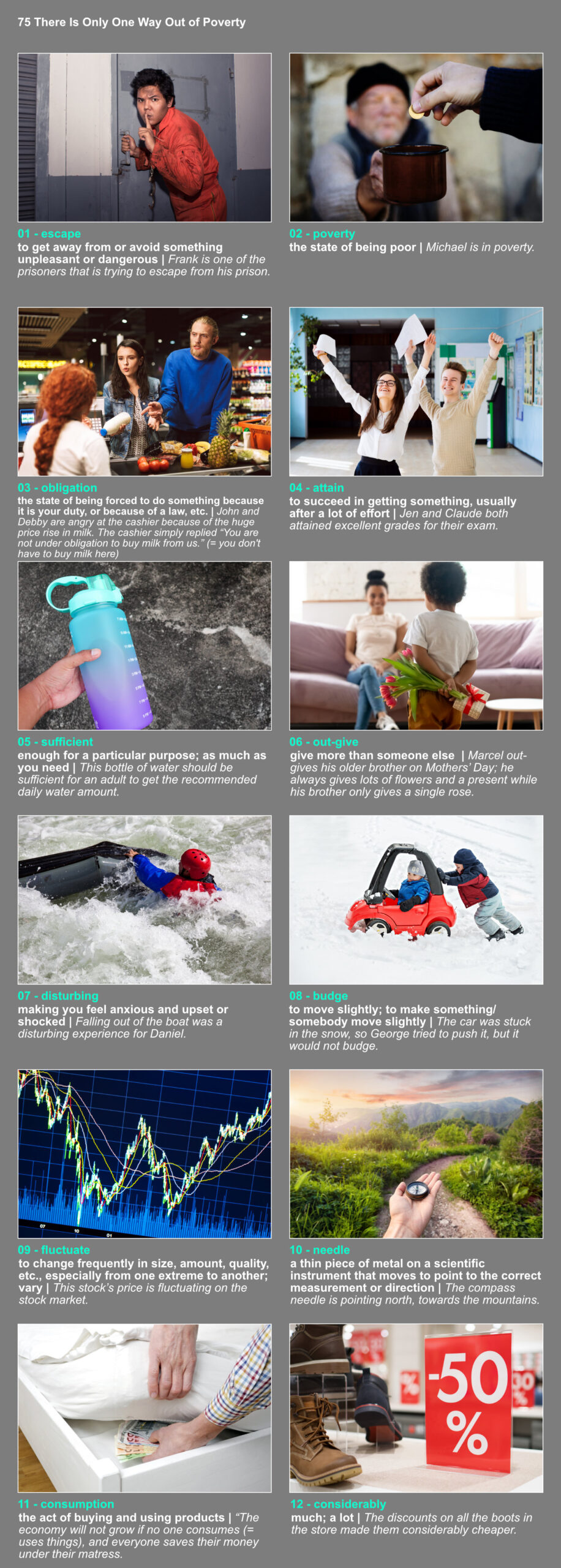
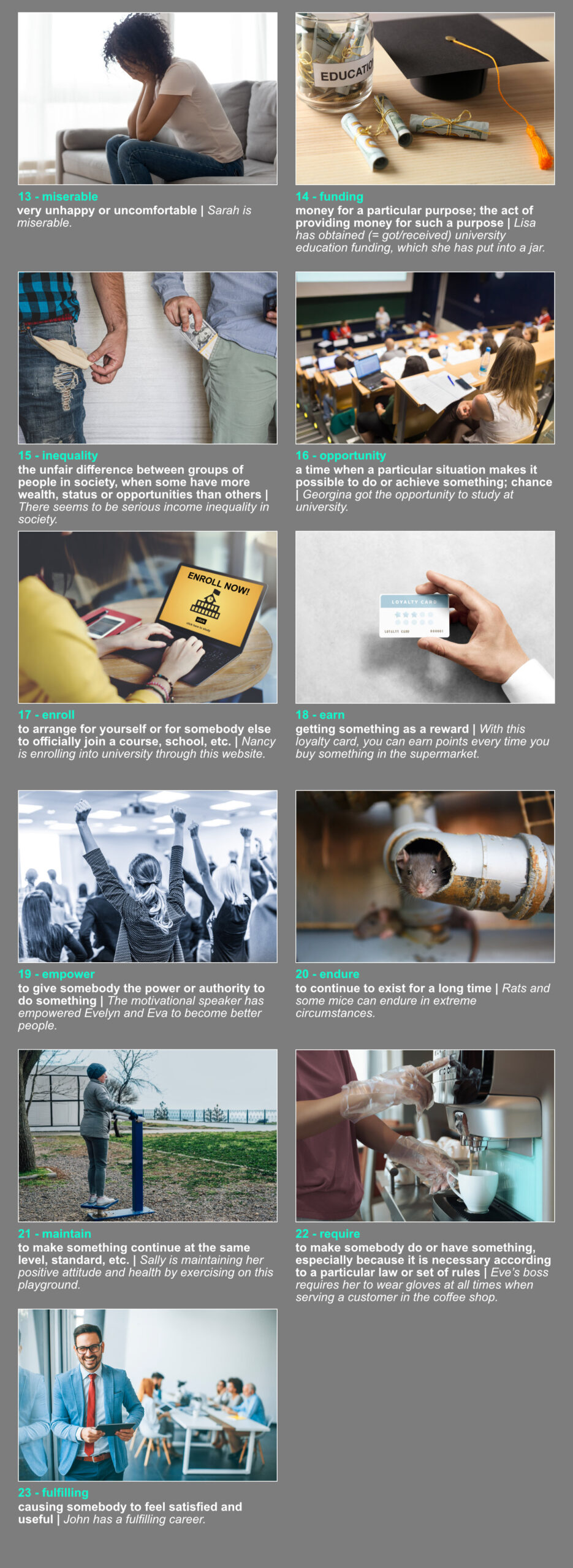
What’s the best way to help poor people *escape *poverty?
escape1: to get away from or avoid something unpleasant or dangerous | Frank is one of the prisoners that is trying to escape from his prison.
poverty2: the state of being poor | Michael is in poverty.
Progressives and conservatives have very different answers to this question, but before we explore those answers, let’s agree on this:
Both progressives and conservatives believe that the government has a moral *obligation to help those who, through bad luck or unfortunate circumstances, can’t help themselves.
progressives: a person who is in favour of new ideas, modern methods and change | The disagreements between progressives and conservatives continue.
obligation3: the state of being forced to do something because it is your duty, or because of a law, etc. | John and Debby are angry at the cashier because of the huge price rise in milk. The cashier simply replied “You are not under obligation to buy milk from us.” (= you don’t have to buy milk here)
circumstances: the conditions of a person’s life, especially the money they have | Some governments aim to help those in very difficult circumstances.
Here’s what a conservative icon, Nobel Prize-winning economist, Frederic Hayek, said on the subject:
“There is no reason why, in a society that has reached the general level of wealth ours has *attained, the first kind of security should not be guaranteed to all…some minimum of food, shelter, and clothing *sufficient to preserve health and the capacity to work.”
attain4: to succeed in getting something, usually after a lot of effort | Jen and Claude both attained excellent grades for their exam.
sufficient5: enough for a particular purpose; as much as you need | This bottle of water should be sufficient for an adult to get the recommended daily water amount.
preserve: to keep a particular quality, feature, etc.; to make sure that something is kept | Celine wanted to preserve her reputation.
Whatever the media might tell you, there isn’t a conservative out there who would not agree with Hayek’s statement.
As I have documented in my book, Who Really Cares, when it comes to philanthropy and charitable giving, conservatives actually *out-give progressives — by a lot.
philanthropy: the practice of helping the poor and those in need, especially by giving money | Philanthropy is seen as important by some.
charitable: helping people who are poor or in need | When Jake reached his 70s he focused mainly on charitable giving.
out-give6: give more than someone else | Marcel out-gives his older brother on Mothers’ Day; he always gives lots of flowers and a present while his brother only gives a single rose.
Where the two sides disagree is on the role the government plays – not in protecting the poor from poverty, but in lifting them out of it.
Here’s a *disturbing piece of data: On balance, since President Lyndon Johnson’s War on Poverty programs came fully online in 1966, the poverty rate in America has hardly *budged.
disturbing7: making you feel anxious and upset or shocked | Falling out of the boat was a disturbing experience for Daniel.
on balance: after considering all the information | “On balance Lincoln was a great president.”
hardly: almost no; almost not; almost none | Hardy anyone heard the band’s new song.
budge8: to move slightly; to make something/somebody move slightly | The car was stuck in the snow, so George tried to push it, but it would not budge .
That rate, as computed by the United States government, was 14.7 percent in 1966.
compute: to calculate something | Mary does not always need a calculator to compute complex calculations.
And today?
It’s 13.5 percent.
The rate has *fluctuated a few points up and down over the decades. The net result is just one percentage point of progress. And this is after the government has spent over 20 trillion dollars on poverty relief programs.
fluctuate9: to change frequently in size, amount, quality, etc., especially from one extreme to another; vary | This stock’s price is fluctuating on the stock market.
20 trillion dollars – the current size of the US debt — and the *needle has barely moved.
needle10: a thin piece of metal on a scientific instrument that moves to point to the correct measurement or direction | The compass needle is pointing north, towards the mountains.
barely: in a way that almost does not happen or exist | Steve barely finished the marathon; he nearly quit.
Now, it’s true that the official poverty rate doesn’t measure *consumption. Certainly, poor people today have many more things than poor people did in 1970.
consumption11: the act of buying and using products | “The economy will not grow if no one consumes (= uses things), and everyone saves their money under their matress.
Across all income levels, including the poor, Americans are likely to have cell phones, air conditioners, flat screen TVs, computers and a car. And life expectancy has lengthened *considerably thanks to overall improvements in health care.
likely: having a good chance of happening or being something; probable or expected | Lisa is likely going to be fine after a dog bit her.
life expectancy: the number of years that a person is likely to live; the length of time that something is likely to exist or continue for | The life expectancy of Jen’s dog is lower than Jen’s life expectancy.
considerably12: much; a lot | The discounts on all the boots in the store made them considerably cheaper.
But it demeans poor people to say that this material progress makes poverty less of a problem. Our goal should never be to merely make poverty less *miserable for people. Our goal must be to make poverty more escapable.
demean: to make people have less respect for somebody/something | Behaviour like John’s demeans politics.
merely: used meaning ‘only’ or ‘simply’ to emphasize a fact or something that you are saying | “Leave her alone, she is merely saying what everyone is thinking.”
miserable13: very unhappy or uncomfortable | Sarah is miserable.
escapable: capable of being escaped; avoidable | Horror movies are mostly escapable; you merely have to not watch any.
Many progressives offer a straightforward solution: more *funding for poverty programs. They believe that we need to transfer more wealth – through government taxation — from people who have money to people who don’t. This is the income *inequality argument.
straightforward: easy to do or to understand; not complicated | It is straightforward to get to my house; just go straight from the bus stop until you see a yellow house.
funding14: money for a particular purpose; the act of providing money for such a purpose | Lisa has obtained (= got/received) university education funding, which she has put into a jar.
inequality15: the unfair difference between groups of people in society, when some have more wealth, status or opportunities than others | There seems to be serious income inequality in society.
Conservatives have a different answer: more *opportunity.
opportunity16: a time when a particular situation makes it possible to do or achieve something; chance | Georgina got the opportunity to study at university.
Conservatives define success by how few people need help from the government, not by how many people we can *enroll in government programs. When they see sixty percent more people on *food stamps after the recession than we had before it started, conservatives say, “That’s not success. That’s failure!”
enroll17: to arrange for yourself or for somebody else to officially join a course, school, etc. | Nancy is enrolling into university through this website.
food stamp: (in the US) a piece of paper that is given by the government to people on low income, which they can exchange for food | Joseph ran out of food stamps and has no money, so now he is very hungry.
recession: a difficult time for the economy of a country, when there is less trade and industrial activity than usual and more people are unemployed | The country is now in a recession.
You see, conservatives believe that simply giving people money doesn’t help them escape poverty; on the contrary, it can keep them locked into it. Getting things without working for them is a very hard habit to break – so much so, that it can become a way of life.
on the contrary: used to introduce a statement that says the opposite of the last one | “You must have been very scared. On the contrary I enjoyed it very much.”
so much so, that: to such an extent that | I was scared; so much so, that I couldn’t move.
According to my research, *earning your way out of poverty is much more *empowering and *enduring than being supported by a variety of government programs, which do little more than *maintain people in their poverty.
earn18: getting something as a reward | With this loyalty card, you can earn points every time you buy something in the supermarket. .
empower19: to give somebody the power or authority to do something | The motivational speaker has empowered Evelyn and Eva to become better people.
endure20: to continue to exist for a long time | Rats and some mice can endure in extreme circumstances.
maintain21: to make something continue at the same level, standard, etc. | Sally is maintaining her positive attitude and health by exercising on this playground.
This doesn’t mean that government doesn’t have a role to play.
Indeed, wherever possible, the government and private charities should *require people to work in exchange for social assistance. When we do this, we help people in two ways. First, through welfare, we are helping them meet their immediate material needs. And second, through work, we are helping them earn their own success—the key to a *fulfilling and dignified life.
charity: an organization for helping people in need | Steve works in a local charity.
require22: to make somebody do or have something, especially because it is necessary according to a particular law or set of rules | Eve’s boss requires her to wear gloves at all times when serving a customer in the coffee shop.
welfare: practical or financial help that is provided, often by the government, for people or animals that need it | Child welfare has been reduced in Marie’s country.
immediate: existing now and needing attention quickly | The group of enemy soldiers were an immediate threat to the villagers.
fulfilling23: causing somebody to feel satisfied and useful | John has a fulfilling career.
dignified: calm and serious and deserving respect | Marty tried to look as dignified as possible after the embarrassing event.
Whether we’re progressive or conservative, shouldn’t that be what we want for our fellow citizens?
I’m Arthur Brooks, President of the American Enterprise Institute, for Prager University.
76 Are You on the Wrong Side of History? (steps 1, 3 and 5)
The wrong side of history:” it’s one of President Barack Obama’s favorite expressions.
He’s not alone, of course. It’s a perennial favorite of liberal politicians and activists. Oppose gay marriage? You’re on the wrong side of history. Against pot legalization? You’re stuck in the past.
It’s used a lot in foreign policy, too. In his first inaugural address, for example, President Obama said, “To those who cling to power through corruption and deceit and the silencing of dissent, know that you are on the wrong side of history…”
As Hosni Mubarak’s regime in Egypt disintegrated in 2011 and the United States stood by and watched, Obama fell back on the comforting thought that “History will end up recording that at every juncture … we were on the right side of history.” As Libyan dictator, Muammar Qaddafi’s chapter on this earth came to an end, President Obama justified American policy in Libya by saying, “I believe that Qaddafi is on the wrong side of history.” Speaking more broadly about the then still young “Arab Spring” he said, “I think that the region will be watching carefully to make sure we’re on the right side of history.” When Vladimir Putin started carving up Ukraine, the president insisted that America wouldn’t actually do anything about it, but fear not — because Putin is on the wrong side of history. The “long moral arc of the universe” — another of Obama’s favorite phrases — will “bend toward justice.” In the meantime: Tough luck, Ukrainians.
You may not have noticed, but the phrase has opposite meanings when used at home and abroad. Domestically, telling someone they are on “the wrong side of history” means “You’re going to lose eventually, so why don’t you give up now?” But in foreign policy, it means, “I’m powerless to stop you, but one day, long after I have any responsibility to do anything at all, someone else will say you were wrong.”
In other words, when used at home “the wrong side of history” is a sign of strength — our activism is vindicated; things are going our way! — But internationally the phrase is a sign of weakness — “you’re winning and I can’t, or won’t stop you!”
What unites both terms is arrogance — actually, arrogance and cowardice.
The notion that History is moving in an inevitable direction is ancient, but in modern times its main champion was Karl Marx. Marx argued that socialism was inevitable according to some scientific principle. Therefore any objection to its unstoppable triumph was not only morally wrong but anti-intellectual and even unscientific.
This is what the great historian of Communism, Robert Conquest, meant when he said that the phrase “the wrong side of history” has a “Marxist twang” to it. It was the atheist’s answer to the religious notion that “God is on our side,” and it led to millions dying as socialists desperately tried to steam roll the future with the Wheel of History.
The idea has non-Marxist proponents, too. There is what the renowned Cambridge historian, Herbert Butterfield, called the “Whig School of history” which holds that democracy — though not necessarily socialism — is inevitable.
This is a much nicer thought, to be sure. But being nicer doesn’t make it any more true (and, to be honest, many people have died in service to this idea as well).
At home and abroad, for socialists and democrats alike, the problem is the same: The future is a blank page and we don’t know what will be written on it. But one thing is certain: when people come to believe that they are not masters of their own fate — because history is not on their side — they will be less likely to take their fate into their own hands.
Pick your issue: It may well be true that same-sex marriage is here to stay, that Americans will never relinquish their gun rights or, heck, that soccer might actually become America’s pastime.
But the only way such victories are assured is if those opposing them preemptively surrender based upon some potted assertions that defeat is inevitable. That is what is so undemocratic about the idea that there is a right side to history — it amounts to saying “shut up” to anyone who wants to keep the argument going.
Freedom has no meaning if we give over to the idea that we are powerless against the cold impersonal forces that shape our destiny. In life, but particularly in a democracy, defeat only comes when the losing side accepts defeat.
For generations those on the right side of slavery and civil rights were told they were on the wrong side of history. They proved history wrong by refusing to surrender to it.
To paraphrase the English poet, T.S. Eliot, “There is no such thing as a truly lost cause because there is no such thing as a truly won cause.” So long as you are willing to fight for what you believe in, the cause endures.
Let history take care of itself.
I’m Jonah Goldberg of the American Enterprise Institute for Prager University.
“The wrong side of history”: it’s one of President Barack Obama’s favorite expressions.
He’s not alone, of course. It’s a perennial favorite of liberal politicians and activists. Oppose gay marriage? You’re on the wrong side of history. Against *pot legalization? You’re *stuck in the past.
perennial: continuing for a very long time; happening again and again | The perennial problem of water shortage is the theme of Steven’s essay.
pot1: cannabis (= a drug, illegal in many countries, made from the dried leaves and flowers of the hemp plant, which gives the person smoking it a feeling of being relaxed) | This is a pot leaf.
stuck2: unable to move or to be moved | This car is stuck in the mud.
It’s used a lot in foreign policy, too. In his first inaugural address, for example, President Obama said, “To those who *cling to power through corruption and deceit and the silencing of dissent, know that you are on the wrong side of history…”
inaugural: (of an official speech, meeting, etc.) first, and marking the beginning of something important, for example the time when a new leader or parliament starts work, when a new organization is formed or when something is used for the first time | The professor’s inaugural lecture was a great success.
cling3: to hold on tightly to somebody/something | Feeling desparate about his father going on a business trip, Jonah is clinging to his leg.
deceit: dishonest behaviour that is intended to make somebody believe something that is not true; an example of this behaviour | Jonah was accused of lies and deceit.
dissent: the fact of having or expressing opinions that are different from those that are officially accepted | Political dissent was not tolerated in Jen’s country.
As Hosni Mubarak’s regime in Egypt *disintegrated in 2011 and the United States stood by and watched, Obama fell back on the comforting thought that “History will end up recording that at every *juncture … we were on the right side of history.” As Libyan dictator, Muammar Qaddafi’s *chapter on this earth came to an end, President Obama justified American policy in Libya by saying, “I believe that Qaddafi is on the wrong side of history.” Speaking more broadly about the then still young “Arab Spring” he said, “I think that the region will be watching carefully to make sure we’re on the right side of history.” When Vladimir Putin started *carving up Ukraine, the president insisted that America wouldn’t actually do anything about it, but fear not — because Putin is on the wrong side of history. The “long moral *arc of the universe” — another of Obama’s favorite phrases — will “bend toward justice.” In the meantime: Tough luck, Ukrainians.
juncture4: a particular point in time | At this juncture, it is impossible to say if Sally will be fully healthy by tomorrow.
chapter5: A) a separate section of a book, usually with a number or title | All the readers found Chapter 1 of the book very interesting.
- B) a period of time in a person’s life or in history | The chapter of her life with her pet ended.
broadly: generally, without considering details | Lisa and Jen have broadly general worldviews.
carve 6: to cut a large piece of cooked meat into smaller pieces for eating | Sam carved up the meat for the BBQ.
carve up: to divide a company, an area of land, etc. into smaller parts in order to share it between people | The banks carved up the bankrupt company.
arc7: a curved shape | The arc of a rainbow is fascinating.
tough luck: A) used to show sympathy for somebody that something bad that has happened to | “I fell down the stairs.” “That’s tough luck. You okay, though?”
- B) (ironic) used to show that you do not feel sorry for somebody who has a problem | “Sorry for being late. I missed the bus this morning”. “Tough luck. You’re fired.”
You may not have noticed, but the phrase has opposite meanings when used at home and abroad. Domestically, telling someone they are on “the wrong side of history” means “You’re going to lose eventually, so why don’t you give up now?” But in foreign policy, it means, “I’m *powerless to stop you, but one day, long after I have any responsibility to do anything at all, someone else will say you were wrong.”
domestically: inside a particular country; not abroad or internationally | Domestically produced meat was cheaper than meat from outside the country.
powerless8: without power to control or to influence somebody/something | Steve is powerless.
In other words, when used at home “the wrong side of history” is a sign of strength — our activism is vindicated; things are going our way! — But internationally the phrase is a sign of weakness — “you’re winning and I can’t, or won’t stop you!”
vindicate: to prove that something is true or that you were right to do something, especially when other people had a different opinion | Max’ opinions were vindicated many years later.
What unites both terms is arrogance — actually, arrogance and *cowardice.
unites: to make people or things join together to form a unit; to join together | Lisa aimed to unite her country.
cowardice9: fear or lack of courage | Vin and Zane were accused of showing cowardice because when the shooting started they hid in the bushes.
The notion that History is moving in an inevitable direction is ancient, but in modern times its main champion was Karl Marx. Marx argued that socialism was inevitable according to some scientific principle. Therefore any objection to its unstoppable *triumph was not only morally wrong but anti-intellectual and even unscientific.
notion: an idea, a belief or an understanding of something | She had no notion of how difficult it would be to unite her country.
inevitable: that you cannot avoid or prevent | It is inevitable that gravity would pull anyone who jumps up back down to earth.
argue: to give reasons why you think that something is right/wrong, true/not true, etc., especially to persuade people that you are right | Elizabeth successfully argued that Timmy is innocent.
objection: a reason why you do not like or are opposed to something; a statement about this | John gave no objection to the idea of sharing his football.
triumph10: a great success, achievement or victory | It was exciting to see Gary’s triumph in a chess match.
This is what the great historian of Communism, Robert Conquest, meant when he said that the phrase “the wrong side of history” has a “Marxist twang” to it. It was the atheist’s answer to the religious notion that “God is on our side,” and it led to millions dying as socialists desperately tried to *steam roll the future with the *Wheel of History.
twang: used to describe a way of speaking, usually one that is typical of a particular area and especially one in which the sounds are produced through the nose as well as the mouth | George spoke with a cockney twang, while Lisa with an American twang.
steam roll11: A) a large slow vehicle with a heavy roller, used for making roads flat | The orange steam roller is not moving.
steam roll (AmE); steamroller (BrE): to defeat somebody or force them to do something, using your power or authority | Phil was steamrollered in the business meeting by his coworker.
wheel12: one of the round objects under a car, bicycle, bus, etc. that turns when it moves | This jeep has a broken front wheel.
The idea has non-Marxist proponents, too. There is what the *renowned Cambridge historian, Herbert Butterfield, called the “Whig School of history” which holds that democracy — though not necessarily socialism — is inevitable.
proponents: a person who supports an idea or course of action | Jack is a proponent of Conservative ideas.
renowned13: famous and respected | Nelson Mandela was and still is renowned in political and activist circles.
Whig: in Britain in the past, a member of a party that supported progress and change and that later became the Liberal Party | Fred was a Whig.
This is a much nicer thought, to be sure. But being nicer doesn’t make it any more true (and, to be honest, many people have died in service to this idea as well).
At home and abroad, for socialists and democrats alike, the problem is the same: The future is a *blank page and we don’t know what will be written on it. But one thing is certain: when people come to believe that they are not masters of their own fate — because history is not on their side — they will be less likely to take their fate into their own hands.
Pick your issue: It may well be true that same-sex marriage is here to stay, that Americans will never relinquish their gun rights or, heck, that *soccer might actually become America’s *pastime.
blank page14: an empty page, with nothing written, printed or recorded on it | Lisa is holding a blank page.
masters of their own fate: to be in complete control of what happens to you | John believes that he is the master of his fate.
relinquish: to stop having something, especially when this happens unwillingly; give sth up | Jack relinquished control of the company.
soccer15: BrE football | Phil is a professional soccer player.
pastime16: something that you enjoy doing when you are not working; hobby | Watching television is one of the most popular pastimes.
But the only way such victories are *assured is if those opposing them *preemptively surrender based upon some potted assertions that defeat is inevitable. That is what is so undemocratic about the idea that there is a right side to history — it amounts to saying “shut up” to anyone who wants to keep the argument going.
assured17: certain to happen; guaranteed | The fall of the ball to the ground is assured; gravity makes sure of this.
preemptively18: done so as to prevent something from happening by taking action first | Mark preemptively called the police when he saw a gang of hooligans start looking at his neighbour’s car. This way, he successfully prevented vandalism or car theft.
potted: briefly and superficially summarized | Seeing potted ideas annoys Stephanie.
assertions: a statement that you strongly believe is true | Mark’s assertion about rain coming soon was heard by everyone in the classroom.
amount: a quantity of something | An unknown amount of money has been spent on candy by Lily; she didn’t count it.
Freedom has no meaning if we give over to the idea that we are powerless against the cold impersonal forces that shape our destiny. In life, but particularly in a democracy, defeat only comes when the losing side accepts defeat.
For generations those on the right side of slavery and civil rights were told they were on the wrong side of history. They proved history wrong by refusing to *surrender to it.
surrender19: to admit that you have been defeated and want to stop fighting; to allow yourself to be caught, taken prisoner, etc. | Gary surrendered to the pirates.
To paraphrase the English poet, T.S. Eliot, “There is no such thing as a truly lost *cause because there is no such thing as a truly won cause.” So long as you are willing to fight for what you believe in, the cause *endures.
cause20: an organization or idea that people support or fight for | These activists got together to protest for the cause of sustainable (= that you can keep up for a longer period of time) environmental policies.
paraphrase: to express what somebody has said or written using different words, especially in order to make it easier to understand | “You should paraphrase great writers if you want to be a great writer.”
endure21: to continue to exist for a long time; last | The dove endures as a symbol of freedom and peace in many cultures.
Let history take care of itself.
I’m Jonah Goldberg of the American Enterprise Institute for Prager University.


77 Eye for an eye: one of the greatest ideas in human history (steps 1, 3 and 5)
Even atheists acknowledge that the book that is most responsible for creating Western civilization is the Bible.
Until very recently, that was considered quite an achievement.
After all, it was Western civilization that created societies rooted in individual liberty, rooted in democracy, that affirmed the equality of all people, and which gave the world the notion of universal human rights.
Of course, these unique moral ideals took centuries to be realized, and the ideals were often violated. But only the West formulated these ideals, let alone achieved them — and then spread them around the world.
In the last half century, however, many of the recipients of these gifts — especially the well-educated — no longer regarded Western civilization as morally superior to any other. And as reverence for Western civilization fell, so did reverence for the source of that civilization.
The Bible has not only been neglected, but reviled — as a foolish fairy tale at best, and as an immoral work at worst. This view springs not from intellectual rigor, but from intellectual laziness.
People throw out all sorts of objections to the Bible as if there are no rational and moral responses to those objections. But the fact is there are rational and moral responses to all those objections.
I give many of them in my book, The Rational Bible, but let me offer two here.
In the biblical book of Deuteronomy, it says if someone has a rebellious son who does not obey his father and mother, his parents can take him to the elders of the city for judgment. And if the son is found guilty, the citizens are to stone him to death.
Sounds pretty primitive, doesn’t it?
In fact, however, it was an enormous moral leap forward. This law ended — forever — parental ownership of their children, and with it the right to kill them. The brilliance of this law was that it seemed to preserve the absolute authority of parents, but in fact ended it.
But, you will respond, the citizens of the city could still kill the child. Theoretically, that was true. But we have no instance of it ever happening in the history of the Jews — the people who brought the book into the world and lived by its rules.
Critics of Western religion also often cite the famous biblical law, “an eye for an eye, tooth for tooth, hand for hand,” etc. as another example of an immoral biblical law.
But this law — known by its Latin name, lex talionis, the law of retaliation — was another great moral advance. It was not meant to be taken literally, and it never was — for the simple reason that it’s impossible to exactly duplicate bodily harm. Only “a life for a life” was meant literally and taken literally: there is capital punishment for premeditated murder.
So, then, what did it mean?
For one thing, lex talionis is the ultimate statement of human equality. Every person’s eye is as precious as anyone else’s. The eye of a prince is worth no more than the eye of a peasant. This was completely new in history. The Babylonian Code of Hammurabi, for example, legislated that the eye of a noble was of much greater value than the eye of a commoner.
Second, the principle of “an eye for an eye” ensured only the guilty party was punished for his crime. In other law codes and in common practice, if you killed someone’s daughter, your daughter would be killed. That was expressly prohibited in the Bible and by the “eye for an eye” code. Now the killer would be punished, not the killer’s daughter.
Third, lex talionis prohibited unjust revenge. In the ancient world, if a man gouged out another man’s eye, the victim, if he could, would gouge out both the attacker’s eyes, or kill him, or hurt his children, and so on. In contrast, “eye for an eye” ensured the victim receive appropriate compensation for the damages he suffered, but the punishment had to fit the crime.
The next time you read or hear someone argue that the Bible is irrational or immoral, tell them how the stone-the-rebellious-son law ended parental killing of children and how the “eye for an eye” law struck a unique blow for human equality and justice.
If they’re intellectually honest, they’ll admit that they have learned something new.
I’m Dennis Prager.
Even atheists acknowledge that the book that is most responsible for creating Western civilization is the Bible.
acknowledge: to accept that something is true | Lily acknowledged that she was partly responsible for the mistake.
Until very recently, that was considered quite an *achievement.
consider: to think of somebody/something in a particular way | Phil considers himself an expert on Biology.
achievement1: something that a person, company, etc. has done or finished successfully | “Mike finally climbed the mountain on his own. What a huge achievement!”
After all, it was Western civilization that created societies *rooted in individual liberty, rooted in democracy, that *affirmed the equality of all people, and which gave the world the notion of universal human rights.
rooted2: A) have roots in soil | This small tree is firmly rooted.
- B) developing from or being strongly influenced by something | The doctor believes that his pain stems from a childhood injury.
affirm3: to state clearly or publicly that something is true or that you support something strongly; confirm | Jack is affirming that his company’s products are environmentally friendly.
notion: an idea, a belief or an understanding of something | “We should have a political system based on free choice.”
Of course, these unique moral ideals took centuries to be realized, and the ideals were often *violated. But only the West formulated these ideals, let alone achieved them — and then spread them around the world.
ideal: an idea or standard that seems perfect, and worth trying to achieve or obtain | Steve betrayed his moral ideals.
realize: to understand or become aware of a particular fact or situation | Danny only realized his mistake weeks later.
violate4: to go against or refuse to obey a law, an agreement, etc. | This group of soldiers violated international law by entering a political leader’s home.
In the last half century, however, many of the *recipients of these gifts — especially the well-educated — no longer regarded Western civilization as morally superior to any other. And as reverence for Western civilization fell, so did reverence for the source of that civilization.
recipient5: a person who receives something | Joe is the recipient of the award.
regard: to think about somebody/something in a particular way | Stella is regarded by many people as one of the greatest writers.
reverence: a feeling of admiring and respecting somebody/something very much | The essay conveyed Steve’s reverence for the country’s leader.
The Bible has not only been *neglected, but *reviled — as a foolish fairy tale at best, and as an immoral work at worst. This view *springs not from intellectual rigor, but from intellectual laziness.
neglect6: to not give enough attention to something | Mark is neglecting his studies.
revile7: to criticize somebody/something in a way that shows how much you dislike them | Video game developers were reviled in several newspapers for making violent games for kids.
spring (from sth)8: to be caused by something; to start from something | The idea for the novel sprang from her taking a day off and resting on her sofa at home one day.
rigor: the fact of being careful and paying great attention to detail | “Scientific rigor is very important in the creation of new theories.”
People throw out all sorts of objections to the Bible as if there are no rational and moral responses to those objections. But the fact is there are rational and moral responses to all those objections.
objection: a reason why you do not like or are opposed to something; a statement about this | “I have many objections to testing products on animals.”
I give many of them in my book, The Rational Bible, but let me offer two here.
In the biblical book of Deuteronomy, it says if someone has a *rebellious son who does not obey his father and mother, his parents can take him to the elders of the city for judgment. And if the son is found guilty, the citizens are to stone him to death.
rebellious9: unwilling to obey rules or follow generally accepted standards of behaviour, dress, etc. | Tommy is a rebellious teenager, so he has to see a psychologist.
stone: to throw stones at somebody/something | Mark was stoned to death.
Sounds pretty primitive, doesn’t it?
In fact, however, it was an enormous moral *leap forward. This law ended — forever — parental ownership of their children, and with it the right to kill them. The brilliance of this law was that it seemed to *preserve the absolute authority of parents, but in fact ended it.
leap10: to jump high or a long way | Jen leaped over the small stream of water.
preserve11: to keep a particular quality, feature, etc.; to make sure that something is kept | With no one around to preserve the peace, the boys always start fighting over their basketball.
But, you will respond, the citizens of the city could still kill the child. Theoretically, that was true. But we have no instance of it ever happening in the history of the Jews — the people who brought the book into the world and lived by its rules.
Critics of Western religion also often cite the famous biblical law, “an eye for an eye, tooth for tooth, hand for hand,” etc. as another example of an immoral biblical law.
But this law — known by its Latin name, lex talionis, the law of *retaliation — was another great moral *advance. It was not meant to be taken literally, and it never was — for the simple reason that it’s impossible to exactly duplicate bodily harm. Only “a life for a life” was meant literally and taken literally: there is capital punishment for premeditated murder.
retaliation12: action that a person takes against somebody who has harmed them in some way | The cat’s retaliation was to attack the other cat with its paw.
advance13: progress or a development in a particular activity or area of understanding | The research into the virus has led to an advance in finding a cure to a completely different disease.
literally: in a literal way; exactly | Translating idioms into other languages is usually impossible.
capital: (of a crime) that can be punished by death | The crime he committed was a capital offense.
premeditated: (of a crime or bad action) planned in advance | “It was a premeditated attack.”
So, then, what did it mean?
For one thing, lex talionis is the ultimate statement of human equality. Every person’s eye is as precious as anyone else’s. The eye of a prince is worth no more than the eye of a *peasant. This was completely new in history. The Babylonian Code of Hammurabi, for example, legislated that the eye of a noble was of much greater value than the eye of a commoner.
peasant14: a farmer who owns or rents a small piece of land | The young peasant is working out in the fields.
legislate: to make a law | The Iraq Resolution legislated the US army’s use against Saddam Hussein’s Iraq government.
commoner: a person who does not come from a royal or noble family | “Fred is just a commoner.”
Second, the principle of “an eye for an eye” *ensured only the guilty party was punished for his crime. In other law codes and in common practice, if you killed someone’s daughter, your daughter would be killed. That was expressly *prohibited in the Bible and by the “eye for an eye” code. Now the killer would be punished, not the killer’s daughter.
Third, lex talionis prohibited unjust revenge. In the ancient world, if a man *gouged out another man’s eye, the victim, if he could, would gouge out both the attacker’s eyes, or kill him, or hurt his children, and so on. In contrast, “eye for an eye” ensured the victim receive *appropriate compensation for the damages he suffered, but the punishment had to fit the crime.
ensure15: to make sure that something happens or is definite | The vet (= animal doctor) is ensuring that the dog has healthy skin and no insects on it.
expressly: clearly; definitely | Veronica was expressly told to stay away from Mike.
prohibited16: not allowed; banned | Fishing is prohibited at the beach.
unjust: not deserved or fair | Josh received unfair punishment.
revenge: something that you do in order to make somebody suffer because they have made you suffer | Sam wants to take his revenge on his enemy.
gouge out17: to remove or form something by digging into a surface | The river gouged out a valley from the hills.
appropriate18: suitable, acceptable or correct for the particular circumstances | Steve’s family are appropriately dressed for the funeral.
The next time you read or hear someone argue that the Bible is irrational or immoral, tell them how the stone-the-rebellious-son law ended parental killing of children and how the “eye for an eye” law *struck a unique *blow for human equality and justice.
strike (past tense struck)19: to hit somebody/something hard or with force | Carl was struck during a prank by his colleague.
blow20: a hard hit with the hand, a weapon, etc. | Frank received a severe blow to the head.
If they’re intellectually honest, they’ll admit that they have learned something new.
I’m Dennis Prager.
78 The Myth of the Gender Wage Gap (steps 1, 3 and 5)
Women in the United States and in Western Europe are the freest and most liberated in human history. In many ways they are not merely doing as well as men, they are doing better. Women’s emancipation is one of the glories of Western civilization and one of the great chapters in the history of freedom.
So, why then are those in the women’s movement, such as the leaders and members of activist groups like the National Organization for Women, the professors in Women’s Studies departments at our colleges, and many women in the media, why are they still so dissatisfied?
These feminists hardly acknowledge women’s progress.Yes, they concede, that some advances have been made, but the fact that most women reject their activist brand of feminism and think of themselves as free is, for this crowd, proof of just how entrenched patriarchy and inequality truly are: women are so oppressed, they don’t even know it.
Year after year these activists make claims about women and violence, women and depression, women and eating disorders, women and workplace injustice — to support their views. Over the years, I have looked carefully at many of these claims. What I have found is that much of the supporting evidence, mostly victim statistics, is misleading and often flat out wrong.
Consider the issue of the so-called gender wage gap. How many times have you heard that, for the same work, women receive 77 cents for every dollar a man earns? This charge is constantly repeated by feminist activists and their supporters, yet it is so deeply misleading as to border on outright falsehood.The 23-cent gender pay gap is simply the difference between the average earnings of all men and women working full-time. It does not take account for differences in occupations, positions, education, job tenure, or hours worked per week.
Now, wage-gap activists in groups like the American Association of University Women or the National Women’s Law Center they say, no, no — even when you control for these factors, women still earn less. Well it always turns out that they have omitted one or two crucial data points.
Take the case of doctors. On the surface, it looks like female physicians are clearly victims of wage discrimination — they appear to earn less for the same work. But dig a little deeper beneath the surface and you find that women are far more likely than men to enter lower paying specialties like pediatrics or family medicine than higher-paying cardiology or anesthesiology. They are also more likely to work part time. And even women who work full time put in about 7 percent fewer hours than men. Women physicians are also far more likely to take long leaves of absence — usually to start a family. Now, there are exceptions, but most workplace pay gaps narrow to the point of vanishing when one accounts for all of these relevant factors.
Now, how do the women’s advocacy groups react to this? They insist that women’s choices are not truly free. Women who decide, say, to stay home with children, or to work fewer hours, or to become pediatricians rather than heart surgeons, are held back by “invisible barriers” or internalized oppression.According to the National Organization for Women, powerful sexist stereotypes “steer” women and men “toward different education, training, and career paths” and family roles.” But is it really social conditioning that explains women’s vocational preferences and their special attachment to children?
Perhaps in the pursuit of happiness, men and women take somewhat different paths. And, isn’t it more than a little patronizing to suggest that most American women are not free? They’re not self-determining human beings?
And here is a common sense proof that the male-female wage gap is untrue. If it were really true that an employer could get away with paying Jill less than Jack for the exact same work, wouldn’t most employers fire as many of their male employees as possible, and replace them with females, and enjoy a huge market advantage?
As a regular campus lecturer, I routinely encounter students who have fully accepted the feminist propaganda. American college women are arguably the most fortunate, liberated beings on the planet — yet in their feminist theory classes they are likely to learn that they are put upon and tyrannized by men. And the more elite the school, the more advanced the degree, the more likely they are to take such feminist propaganda seriously.
But this doesn’t have to continue. The time has come for young woman to take back feminism. Reform it. Correct its excesses. Repudiate the victim propaganda. Get rid of the “women are from Venus, men are from hell” storylines. Begin the arduous task of correcting almost three decades of feminist misinformation.
Women who are plagued by workplace injustice or sexual violence will be best helped by truth and solid research — not by hysteria and hype.
And a final piece of personal advice for young women: appreciate, and make good use of, the unprecedented freedom that you have.
I’m Christina Hoff Sommers of the American Enterprise Institute for Prager University.
Women in the United States and in Western Europe are the freest and most *liberated in human history. In many ways they are not merely doing as well as men, they are doing better. Women’s emancipation is one of the glories of Western civilization and one of the great chapters in the history of freedom.
liberated1: not following traditional ways of behaving or old ideas | Lisa decided to work full time as a lawyer instead of having children. She feels like a liberated woman.
merely: used meaning ‘only’ or ‘simply’ to emphasize a fact or something that you are saying | Her mum said nothing, merely smiled and watched her daughter try to cook.
emancipation: the act of freeing somebody, especially from legal, political or social controls that limit what they can do | The emancipation of slaves is one of the great things that happened throughout history.
So, why then are those in the women’s movement, such as the leaders and members of activist groups like the National Organization for Women, the professors in Women’s Studies departments at our colleges, and many women in the media, why are they still so *dissatisfied?
dissatisfied2: not happy or satisfied with somebody/something | Steve is really dissatisfied with his internet provider; his internet connection is too slow.
These feminists hardly *acknowledge women’s progress. Yes, they concede, that some *advances have been made, but the fact that most women reject their activist brand of feminism and think of themselves as free is, for this crowd, proof of just how entrenched patriarchy and inequality truly are: women are so oppressed, they don’t even know it.
hardly: almost no; almost not; almost none | Sally and Michael hardly know each other.
acknowledge3: to accept that something is true | Alice publicly acknowledged that her company needed to produce safer products.
concede: to admit that something is true, logical, etc. after first denying it or resisting it | Greg conceded the point to me.
advances4: progress or a development in a particular activity or area of understanding | Technological advances, such as the creation of electric cars, may change the way we live.
proof: information, documents, etc. that show that something is true | There is proof that Fred committed the robbery on Thursday night.
entrench: establish something very strongly so that it is very difficult to change | Corruption was entrenched in the company’s culture.
patriarchy: a society, system or country that is ruled or controlled by men | “There is a patriarchy where I live.”
Year after year these activists make claims about women and violence, women and depression, women and *eating disorders, women and workplace injustice — to support their views. Over the years, I have looked carefully at many of these claims. What I have found is that much of the supporting evidence, mostly victim statistics, is *misleading and often flat out wrong.
make claims: demanding it or saying it’s true | Joseph made claims about his innocence.
eating disorder5: a condition in which somebody develops eating habits that are not healthy as a way of dealing with difficult feelings or situations | There are quite a few people with eating disorders.
misleading6: giving the wrong idea or impression and making you believe something that is not true | There was misleading information on TV about what was going on; the news reporter was lying.
flat out wrong: completely or simply untrue | “Saying that the sky is not blue is flat out wrong”.
*Consider the issue of the so-called gender wage gap. How many times have you heard that, for the same work, women receive 77 cents for every dollar a man earns? This charge is constantly repeated by feminist activists and their supporters, yet it is so deeply misleading as to border on outright falsehood.The 23-cent gender pay gap is simply the difference between the average earnings of all men and women working full-time. It does not take account for differences in occupations, positions, education, job tenure, or hours worked per week.
consider7: to think about something carefully, especially in order to make a decision | Sally is considering the business deal.
gender wage gap: the difference between the amounts of money paid to women and men, often for doing the same work | “The gender wage gap has decreased.”
charge: a statement accusing somebody of doing something wrong or bad | Suzy rejected the claim that she did wrong.
yet: (and) despite that; used to add something that seems surprising because of what you have just said | A simple yet effective solution to the problem.
border: the line that divides two countries or areas; the land near this line | The border between the two countries is in question.
border on: to come very close to being something, especially a strong or unpleasant emotion or quality | Sally felt an anxiety bordering on hysteria.
falsehood: a statement that is not true; a lie | “His final statement is a serious falsehood.”
take account: to consider particular facts, circumstances, etc. when making a decision about something | The company takes account of environmental issues wherever possible.
tenure: the period of time when someone holds a job, esp. an official position, or the right to keep a job permanently | During Jonah’s tenure as mayor, relations with the public improved.
Now, wage-gap activists in groups like the American Association of University Women or the National Women’s Law Center they say, no, no — even when you control for these factors, women still earn less. Well, it always turns out that they have *omitted one or two crucial data points.
omit8: to not include something/somebody, either deliberately or because you have forgotten it/them | Sarah omitted her answer to question 1 of the survey.
crucial: extremely important, because it will affect other things | The ability to write well is a crucial requirement of being a good poet.
Take the case of doctors. On the surface, it looks like female *physicians are clearly victims of wage discrimination — they appear to earn less for the same work. But *dig a little deeper beneath the surface and you find that women are far more likely than men to enter lower paying specialties like *pediatrics or family medicine than higher-paying cardiology or anesthesiology. They are also more likely to work part time. And even women who work full time put in about 7 percent fewer hours than men. Women physicians are also far more likely to take long *leaves of absence — usually to start a family. Now, there are exceptions, but most workplace pay gaps narrow to the point of *vanishing when one accounts for all of these relevant factors.
on the surface: when not thought about deeply or carefully and completely; when not looked at carefully | On the surface it looked like he was winning but in reality he wasn’t.
physician9: a doctor, especially one who is a specialist in general medicine and not surgery | Marie is a physician.
dig10: to make a hole in the ground or to move soil from one place to another using your hands, a tool or a machine | Mike is digging a hole in his garden.
dig a little deeper: to search for more information in a careful way | “I thought the company was suspicious so i dug a little deeper.”
pediatrics11: the branch of medicine that deals with children and their diseases | Daniella is at pediatrics right now.
cardiology: the study and treatment of heart diseases | Sammy is passionate about cardiology.
anesthesiology: the science and practice of giving anaesthetics (= substances to stop patients feeling pain, for example during operations) | Peter had to learn some anesthesiology to become a doctor.
leave of absence12: a permitted period of time away from work | These people are all on leave of absence so that they can be on jury duty (a period of time spent as a member of a jury in court).
exception: a person or thing that is not included in a general statement | Most people failed the biology exam but Martha is an exception (= she did not fail).
vanish13: to disappear suddenly and/or in a way that you cannot explain | Parts of this old zebra crossing are vanishing.
accounts: a statement or exposition of reasons, causes, or motives | There was a satisfactory account of the phenomena.
Now, how do the women’s *advocacy groups react to this? They insist that women’s choices are not truly free. Women who decide, say, to stay home with children, or to work fewer hours, or to become pediatricians rather than heart surgeons, are held back by “invisible barriers” or internalized oppression. According to the National Organization for Women, powerful sexist stereotypes “*steer” women and men “toward different education, training, and career paths” and family roles.” But is it really social conditioning that explains women’s vocational preferences and their special *attachment to children?
advocacy14: support, advice and help given to people, often with special needs or aims, who are unable to speak for themselves | Mario runs a family advocacy programme – it helps give expert advice to families who need it.
internalize (BrE: internalise): to make a feeling, an attitude, or a belief part of the way you think and behave | Sally internalised the beliefs of her parents.
steer15: A) to control the direction in which a boat, car, etc. moves | Joe is steering his car.
- B) to take control of a situation and influence the way in which it develops | Sally steered her baseball team to victory.
conditioning: the training or experience that an animal or a person has that makes them behave in a particular way in a particular situation | There was a debate in the class about the effects of social conditioning on the happiness of people.
vocational: connected with the skills, knowledge, etc. that you need to have in order to do a particular job | “Susie’s vocational qualifications are impressive.”
attachment16: a feeling of love for somebody/something | Maggie’s attachment to her father is strong.
Perhaps in the *pursuit of happiness, men and women take somewhat different paths. And, isn’t it more than a little *patronizing to suggest that most American women are not free? They’re not self-determining human beings?
pursuit17: the act of looking for or trying to get something | Karl’s pursuit for knowledge is sometimes very intense.
patronizing18: showing that you think you are better or more intelligent than somebody else | Francesca gave a patronizing smile as Jack was working out (= trying to understand) how to use the new oven.
self-determining: capable of determining (= deciding definitely to do something) one’s or its own acts | Tom believes that he is self-determining.
And here is a common sense proof that the male-female wage gap is untrue. If it were really true that an employer could *get away with paying Jill less than Jack for the exact same work, wouldn’t most employers fire as many of their male employees as possible, and replace them with females, and enjoy a huge market advantage?
get away with19: to do something wrong and not be punished for it | Steve, who’d stolen a TV, got away with it because no one saw him.
As a regular campus lecturer, I routinely *encounter students who have fully accepted the feminist propaganda. American college women are arguably the most fortunate, liberated beings on the planet — yet in their feminist theory classes they are likely to learn that they are put upon and *tyrannized by men. And the more elite the school, the more advanced the degree, the more likely they are to take such feminist propaganda seriously.
campus lecturer: a person who holds lessons before an audience or class in a university, college or school | Ted is a campus lecturer.
encounter20: to meet somebody, or discover or experience something | The two men first encountered each other at a small business conference.
arguably: used when stating an opinion or belief that you think can be shown to be true | Ronaldo is arguably one of the greatest football players.
put upon: treated in an unfair way by somebody because they take advantage of the fact that you are kind or willing to do things | Johnny was put upon.
tyrannize21: to use your power to treat somebody in a cruel or unfair way | Some police officers may tyrannize civilians.
But this doesn’t have to continue. The time has come for young woman to take back feminism. Reform it. Correct its *excesses. Repudiate the victim propaganda. Get rid of the “women are from Venus, men are from hell” storylines. Begin the arduous task of correcting almost three decades of feminist misinformation.
excesses22: extreme behaviour that is unacceptable, illegal or morally wrong | “We need a free press to stop the government from its excesses.”
repudiate: to refuse to accept something; reject | The legitimacy (legality) of the dictatorship was repudiated by the people.
arduous: involving a lot of effort and energy, especially over a period of time | “It was an arduous journey to get here from the other side of the continent.”
Women who are plagued by workplace injustice or sexual violence will be best helped by truth and solid research — not by hysteria and hype.
And a final piece of personal advice for young women: appreciate, and make good use of, the unprecedented freedom that you have.
appreciate: to be grateful for something | Mark is grateful for the good teachers that he had in his childhood.
I’m Christina Hoff Sommers of the American Enterprise Institute for Prager University.

79 Forgiveness (steps 1, 3 and 5)
Anyone familiar with Italian opera or the plays of Shakespeare knows the terrible price paid for grudges, vendetta, and revenge. Under the sway of these emotions painful incidents linger in the mind, sapping our ability to find peace and happiness. The 18th century English poet, Alexander Pope, gave us the antidote: “ to err is human, to forgive divine.” But finding a way to forgive without giving up our principles is often no easy task. In this course, I am going to address what forgiveness is and how to implement it.
I’ll be speaking here about forgiveness where it most often is needed — in the context of your every day personal life with family members, friends, co-workers, and business associates.
One of our challenges in understanding this process is that the word — forgiveness — is inadequate to explain a very complex concept. Forgiveness actually embodies three different things, each of which applies to different situations and provides different results.
The three types of forgiveness are: exoneration, forbearance and release.
Let’s take each in turn.
Exoneration is the closest to what we usually think of when we say “forgiveness”. Exoneration is wiping the slate entirely clean and restoring a relationship to the full state of innocence it had before the harmful actions took place. There are three common situations in which exoneration applies.
The first takes place when you realize that the harmful action was a genuine accident for which no fault can be assigned.
The second is when the offender is a child or someone else who, for whatever reason, simply didn’t understand the hurt they were inflicting, and toward whom you have loving feelings.
The third situation occurs when the person who hurt you is truly sorry, takes full responsibility (without excuses) for what they did, asks forgiveness, and gives you confidence that they will not knowingly repeat their bad action in the future.
In all such situations it is essential to accept their apology and offer them the complete forgiveness of exoneration. You’ll feel better and so will the person who hurt you. In fact, not to offer forgiveness in these circumstances would be harmful to your own well-being. It might even suggest that there is something more wrong with you than with the person who caused you pain.
The second type of forgiveness I call “forbearance.” And here things get a little more complicated.
Forbearance applies when the offender makes a partial apology or mingles their expression of sorrow with blame that you somehow caused them to behave badly. An apology is offered but it’s not what you had hoped for and may not even be fully authentic. While you should always reflect on whether there was a provocation on your part, even when you bear no responsibility you should exercise forbearance if the relationship matters to you. Cease dwelling on the particular offense, do away with grudges and fantasies of revenge, but retain a degree of watchfulness. This is similar to “forgive but not forget” or “trust but verify.” By using forbearance you are able to maintain ties to people who, while far from perfect, are still important to you.
Furthermore, in some cases after a sufficient period of good behavior, forbearance can rise to exoneration and full forgiveness.
But what do you do when the person who hurt you doesn’t even acknowledge that they’ve done anything wrong or gives an obviously insincere apology, making no reparations whatsoever? These are the cases of forgiveness that are the most challenging. In my practice, I find this in such examples as adult survivors of child abuse, business people who have been cheated by their partners, or friends or relatives who have betrayed one another. Still, even here there still is a solution. I call it “release” — the third type of forgiveness.
Release does not exonerate the offender. Nor does it require forbearance. It doesn’t even demand that you continue the relationship. But it does ask that instead of continuing to define much of your life in terms of the hurt done, you release your bad feelings and your preoccupation with the negative things that have happened to you. Release does something that is critically important: it allows you to let go of the burden, the “silent tax” that is weighing you down and eating away at your chance for happiness. If you do not release the pain and anger and move past dwelling on old hurts and betrayals, you will be allowing the ones who hurt you to live, rent free, in your mind, reliving forever the persecution that the original incident started.
Whether you get there through your own efforts, through psychotherapy, through religion or some other method, release liberates you from the tyranny of living in the traumatic past even when the other forms of forgiveness, exoneration and forbearance, are not possible.
Exoneration, Forbearance, Release.
To forgive may be divine, but when we understand its dimensions we find that it is within our ability to do it.
I’m Dr. Stephen Marmer of UCLA Medical School, for Prager University.
Anyone *familiar with Italian opera or the plays of Shakespeare knows the terrible price paid for *grudges, *vendetta, and revenge. Under the sway of these emotions painful incidents *linger in the mind, *sapping our ability to find peace and happiness. The 18th century English poet, Alexander Pope, gave us the antidote: “ to err is human, to forgive divine.” But finding a way to forgive without giving up our principles is often no easy task. In this course, I am going to address what forgiveness is and how to *implement it.
familiar1: knowing something very well | Steve is familiar with the softwares on his laptop.
grudge2: a feeling of anger or dislike towards somebody because of something bad they have done to you in the past | Tony has a grudge against Victoria; she also has a grudge against him.
vendetta3: a long and violent argument between people or families, in which one group tries to harm the other in order to punish them for things that happened in the past | Susie is taking part in a personal vendetta by writing lies.
revenge: something that you do in order to make somebody suffer because they have made you suffer | Jenna wants to take revenge on her enemy.
sway: control or influence | Greg’s parents no longer seem to have much sway over him anymore.
linger4: to continue to exist for longer than expected | Lucy, who doesn’t smoke, can smell the lingering smell of a cigarette from yesterday.
sap5: to make something/somebody weaker; to destroy something gradually | The sun and the intense heat have sapped Stephen’s energy; it is very difficult for him to move.
antidote: a way of preventing or acting against something bad | Running and eating healthy foods may be natural antidotes to depression.
err: to make a mistake | Max erred in buying a “golden toilet” from a guy he met yesterday; it wasn’t made of gold.
divine: coming from or connected with God or a god | Francis believes in divine love.
implement6: to start using a plan or system; carry out | The new business strategy on the board will be implemented tomorrow.
I’ll be speaking here about forgiveness where it most often is needed — in the context of your every day personal life with family members, friends, co-workers, and business associates.
One of our challenges in understanding this process is that the word — forgiveness — is inadequate to explain a very complex concept. Forgiveness actually embodies three different things, each of which applies to different situations and provides different results.
inadequate: not enough; not good enough | The current political party in power is inadequate.
embodies: to include or contain something | The new phone embodies new features.
The three types of forgiveness are: exoneration, forbearance and release.
Let’s take each in turn.
Exoneration is the closest to what we usually think of when we say “forgiveness”. Exoneration is wiping the *slate entirely clean and restoring a relationship to the full state of *innocence it had before the harmful actions took place. There are three common situations in which exoneration applies.
slate7: in the past, a small, thin, rectangular piece of slate (= rock), usually in a wooden frame, used for writing on, especially by children | Lisa is holding up an empty slate.
innocence8: the fact of not being guilty of a crime, etc. | New evidence was presented in court by the attorney which showed Steve’s innocence.
common: happening often; existing in large numbers or in many places | The illness was common with young kids.
apply: to make use of something for a practical purpose or in a real situation | The rules apply to everyone.
The first takes place when you realize that the harmful action was a genuine accident for which no fault can be assigned.
genuine: being what something or someone appears or claims to be; real, not false | Olivia showed genuine sadness when her dog died.
The second is when the offender is a child or someone else who, for whatever reason, simply didn’t understand the hurt they were *inflicting, and toward whom you have loving feelings.
offender: a person or thing that does something wrong | Five people robbed a bank; only one of the offenders was caught. / When it comes to pollution, the chemical industry is a major offender.
inflict9: to make somebody/something suffer something unpleasant | This dog’s teeth can inflict a lot of pain on someone if they are bitten.
The third situation occurs when the person who hurt you is truly sorry, takes full responsibility (without excuses) for what they did, asks forgiveness, and gives you *confidence that they will not knowingly repeat their bad action in the future.
excuse: a reason, either true or invented, that you give to explain or defend your behaviour | “Stop giving excuses about why you are late and just arrive to meetings on time.”
confidence10: the feeling that you are certain about something | This couple have confidence that they will stay together through good and bad times.
knowingly: while knowing the truth or likely result of what you are doing; deliberately | Francis knowingly lied to the police.
In all such situations it is essential to accept their apology and offer them the complete forgiveness of exoneration. You’ll feel better and so will the person who hurt you. In fact, not to offer forgiveness in these circumstances would be harmful to your own well-being. It might even suggest that there is something more wrong with you than with the person who caused you pain.
suggest: to state something indirectly; imply | “Are you suggesting that his new book is boring?”
The second type of forgiveness I call “forbearance.” And here things get a little more complicated.
Forbearance applies when the offender makes a partial apology or *mingles their expression of sorrow with *blame that you somehow caused them to behave badly. An apology is offered but it’s not what you had hoped for and may not even be fully authentic. While you should always reflect on whether there was a provocation on your part, even when you bear no responsibility you should exercise forbearance if the relationship matters to you. *Cease *dwelling on the particular offense, *do away with grudges and fantasies of revenge, but retain a degree of watchfulness. This is similar to “forgive but not forget” or “trust but verify.” By using forbearance you are able to maintain ties to people who, while far from perfect, are still important to you.
partial: not complete or whole | Heather’s idea was only a partial solution to the problem.
mingle11: to combine or make one thing combine with another | The sound of music and laughter mingled in the air at the picnic.
blame12: to think or say that somebody/something is responsible for something bad | Frank is being blamed.
provocation: the act of doing or saying something deliberately in order to make somebody angry or upset; something that is done or said to cause this | The teacher remained calm and did not respond to the children’s provocations.
bear responsibility for sth: accept responsibility for something | “Steve, start bearing responsibility for your actions.”
bear no responsibility: not accept any responsibility for something | “She bears no responsibility for the consequences of her lies.”
cease13: to stop something | The shop ceased operating in the city.
dwell14: to live somewhere | Mark dwells on the top floor of one of these block.
dwell on sth: to think or talk about something a lot of the time | “Stop dwelling on the past”.
do away with15: to stop doing or having something; to make something end | Steve believes that government bureaucracy should be done away with.
retain: to keep something; to continue to have something | The president managed to retain control of the room.
verify: to check that something is true or accurate | Always verify your house address when ordering things online.
tie: a strong connection between people or organizations | There is an unquestionable tie between Maggie and her daughter.
Furthermore, in some cases after a *sufficient period of good behavior, forbearance can rise to exoneration and full forgiveness.
sufficient16: enough for a particular purpose; as much as you need | “Always leave sufficient time to get to work; count on the possibility of traffic jams.”
But what do you do when the person who hurt you doesn’t even acknowledge that they’ve done anything wrong or gives an obviously *insincere apology, making no *reparations whatsoever? These are the cases of forgiveness that are the most *challenging. In my practice, I find this in such examples as adult survivors of child abuse, business people who have been cheated by their partners, or friends or relatives who have betrayed one another. Still, even here there still is a solution. I call it “release” — the third type of forgiveness.
insincere17: saying or doing something that you do not really mean or believe | Frederica – the woman in white – is insincere.
reparation18: the act of giving something to somebody or doing something for them in order to show that you are sorry that you have caused them to suffer | Steve is making reparation to Olivia for his unfriendly behaviour last night.
challenging19: difficult in an interesting way that tests your ability | Tim is concentrating on a challenging homework problem.
cheat: to trick somebody or make them believe something that is not true | Mary often tries to cheat the system.
betray: to hurt somebody who trusts you, especially by lying to or about them or telling their secrets to other people | Steven betrayed Anna.
Release does not exonerate the offender. Nor does it *require forbearance. It doesn’t even *demand that you continue the relationship. But it does ask that instead of continuing to define much of your life in terms of the hurt done, you *release your bad feelings and your preoccupation with the negative things that have happened to you. Release does something that is critically important: it allows you to *let go of the *burden, the “silent tax” that is weighing you down and eating away at your chance for happiness. If you do not release the pain and anger and move past dwelling on old hurts and betrayals, you will be allowing the ones who hurt you to live, rent free, in your mind, reliving forever the persecution that the original incident started.
require20: to need something; to depend on somebody/something | “Babies require a lot of care and looking after.”
demand21: things that somebody/something makes you do or strongly wants you to do | Frank demands better customer service.
in terms of: used to show what aspect of a subject you are talking about or how you are thinking about it | “In terms of costs, that is a terrible idea.”
release22: to express feelings such as anger or worry in order to get rid of them | Natasha is releasing her sadness by crying.
preoccupation: a state of thinking about something continuously; something that you think about frequently or for a long time | Sam’s current preoccupation is about finishing his novel.
let go of sth 23: to stop holding somebody/something | Tommy, who is also holding his mum’s hand, let go of his only balloon.
burden24: A) a heavy load that you carry | Larry is carrying a heavy burden.
- B) something difficult or unpleasant that you have to deal with or worry about | Buying a house often places a large financial burden on people.
eat away: to reduce or destroy something gradually | Mark’s teacher ate away at his confidence.
persecution: the act of treating somebody in a cruel and unfair way, especially because of their race, religion or political beliefs etc | Lisa’s family fled to America to escape persecution.
Whether you get there through your own *efforts, through psychotherapy, through religion or some other method, release liberates you from the tyranny of living in the traumatic past even when the other forms of forgiveness, exoneration and forbearance, are not possible.
effort25: the physical or mental energy that you need to do something; something that takes a lot of energy | A great deal of effort went into making this small cake; it took Greg a lot of concentration to make it beautiful.
Exoneration, Forbearance, Release.
To forgive may be divine, but when we understand its dimensions we find that it is within our ability to do it.
I’m Dr. Stephen Marmer of UCLA Medical School, for Prager University.


80 How Do you deal with painful truths? (steps 1, 3 and 5)
At the core of left-wing thought is a denial of painful realities, the denial of what the French call les faits de la vie, facts of life. Conservatives, on the other hand, are all too aware of the painful realities of life, and base many of their positions on them.
One example of this left-right difference is the differing attitudes toward human nature and responsibility for evil. When liberals blame violent crime on poverty, one reason they do is that ever since the Enlightenment the Left has posited that human nature is good. So, then, when people do bad things to other people, the Left argues that some outside forces — usually poverty and, in the case of non-white criminals, racism — are responsible, not human nature.
Why? Because people on the Left find it too painful to look reality in the eye and acknowledge that human nature is deeply flawed.
Another fact of life that the Left finds too painful to acknowledge is the existence of profound differences between men and women. There is no other explanation for the denial of what has been obvious to every previous generation in history — that men and women are inherently different. This denial is certainly not the result of scientific inquiry. The more science learns about the male brain and the female brain, not to mention male and female hormones, the more it confirms important built-in differences between the sexes.
Yet many people, influenced by left-wing thought, believe that girls are as happy to play with trucks as are boys, and boys are as happy to play with dolls and tea sets as are girls.
Why do they believe such silliness? Because acknowledging many of those differences is painful.
For example, feminists and others on the Left do not want to acknowledge that men are far more capable of having emotionally meaningless sex than women. Therefore, feminism has taught generations of young women that they are just as capable of enjoying emotionless sex with many partners as are men. The fact is that the great majority of women are deeply dissatisfied with the hook up culture and yearn to bond with a man even more than they yearn for professional success. But feminism came up with the famous and false phrase, “A woman without a man is like a fish without a bicycle” to counter the painful reality that most women feel incomplete without a man in their life — just as, I might add, most men feel incomplete without a woman. Ironically, however, most men have no trouble acknowledging this.
This is what the notion of Political Incorrectness is all about. The very definition of “Politically Incorrect” is a truth that people on the Left find too painful to acknowledge — and therefore do not want expressed.
To cite yet another example, why are many young black males in prison? The reason is too painful for the Left to acknowledge and therefore it is politically incorrect to say it: Young black males commit a disproportionate amount of violent crime. And why are there speech codes on virtually all college campuses? Because the Left doesn’t want to hear facts or opinions that cause them pain.
That’s why the Left developed what it calls “trigger warnings.” A “trigger warning,” as defined by the Oxford Dictionary, is “a statement at the start of a piece of writing, video, etc. alerting the reader or viewer to the fact that it contains potentially distressing material.” That’s why the Left constantly speaks about being made “uncomfortable” and about feeling “offended.” Being made uncomfortable or feeling offended, is, after all, painful.
Take the left-wing bumper sticker idea, “War Is not the Answer.” The painful truth is that war is often the only answer to great evil. Nazi death camps were liberated by soldiers fighting a war, not by peace activists or by peaceful dialogue with the German regime. But having to acknowledge the moral necessity of war is too painful a truth for many on the Left.
One might say that Leftism appeals to those who wish to remain innocent. Growing up and facing the fact that life is messy, difficult and painful is increasingly a conservative point of view.
I’m Dennis Prager.
At the *core of left-wing thought is a *denial of painful realities, the denial of what the French call les faits de la vie, facts of life. Conservatives, on the other hand, are all too aware of the painful realities of life, and base many of their positions on them.
core1: the most important or central part of something | Sally is a lawyer. Her core feature is her love of justice; this is why she only defends those who she believes are innocent.
denial2: a statement that something is not true or does not exist; the action of denying something | Max’s denial of being guilty is being questioned by the judge (= Max says that he is not guilty but the judge thinks that he might be guilty).
aware: knowing or realizing something | Sally’s daughter put more sugar in her tea without Sally being aware of it.
One example of this left-right difference is the differing *attitudes toward human nature and responsibility for evil. When liberals blame violent crime on *poverty, one reason they do is that ever since the Enlightenment the Left has posited that human nature is good. So, then, when people do bad things to other people, the Left argues that some outside forces — usually poverty and, in the case of non-white criminals, racism — are responsible, not human nature.
differing: to be not like something or someone else, either physically or in another way | Mark’s views on life differ from his son’s.
attitude3: the way that you think and feel about somebody/something; the way that you behave towards somebody/something that shows how you think and feel | Evelyn’s attitude towards school is bad; she doesn’t care about schoolwork.
poverty4: the state of being poor | Some pensioners fall into poverty.
(the) Enlightenment: the period in the 18th century in Europe when many writers and scientists began to argue that science and reason were more important than religion and tradition | Mary is a historian who specialises in the Enlightenment period.
posit: to suggest or accept that something is true so that it can be used as the basis for an argument or discussion | Francis posits that the earth does not have unlimited resources
Why? Because people on the Left find it too painful to look reality in the eye and *acknowledge that human nature is deeply *flawed.
Another fact of life that the Left finds too painful to acknowledge is the existence of profound differences between men and women. There is no other explanation for the denial of what has been obvious to every previous generation in history — that men and women are inherently different. This denial is certainly not the result of scientific inquiry. The more science learns about the male brain and the female brain, not to mention male and female hormones, the more it confirms important built-in differences between the sexes.
acknowledge5: to accept that something is true | This politician is acknowledging that he didn’t do a lot of good while he was in office the last time.
flawed6: having a flaw; not perfect or correct | Carl’s spelling in his homework is flawed. Also in his other essays the conclusions are often flawed.
profound: very great | “There were profound changes in the world’s climate.”
inherently: according to or because of the basic nature of somebody/something | Harry felt that the system was inherently unfair.
inquiry: the act of asking questions or collecting information about somebody/something | “Scientific inquiry is a major part of how progress is made in the world.”
Yet many people, influenced by left-wing thought, believe that girls are as happy to play with trucks as are boys, and boys are as happy to play with dolls and tea sets as are girls.
Why do they believe such silliness? Because acknowledging many of those differences is painful.
For example, feminists and others on the Left do not want to acknowledge that men are far more *capable of having emotionally meaningless sex than women. Therefore, feminism has taught generations of young women that they are just as capable of enjoying emotionless sex with many partners as are men. The fact is that the great majority of women are deeply dissatisfied with the hook up culture and *yearn to *bond with a man even more than they yearn for professional success. But feminism came up with the famous and false phrase, “A woman without a man is like a fish without a bicycle” to counter the painful reality that most women feel incomplete without a man in their life — just as, I might add, most men feel incomplete without a woman. Ironically, however, most men have no trouble acknowledging this.
capable7: having the ability or qualities necessary for doing something | Steve is capable of playing professional rugby and he does play.
meaningless: without any purpose or reason and therefore not worth doing or having | Jack had a lot of meaningless tasks to do.
hook up: a meeting for sex | Sally dislikes hook-up culture.
yearn8: to want something very much | Lisa is yearning to have a child of her own.
bond9: something that forms a connection between people or groups, such as a feeling of friendship or shared ideas and experiences | Janet has an emotional bond with her baby.
counter: to react to something with an opposing opinion or action; to defend yourself against something | To counter the bad press, Sally decided to hold a press conference.
I might add: used for emphasizing a new piece of information | “Lola has had an offer – a very generous offer, I might add.”
This is what the notion of Political Incorrectness is all about. The very definition of “Politically Incorrect” is a truth that people on the Left find too painful to acknowledge — and therefore do not want *expressed.
notion: an idea, a belief or an understanding of something | Stuart had some notion of what would happen if he failed his school test.
express10: to show or make known a feeling, an opinion, etc. by words, looks or actions | Josh is expressing interest in buying white trainers.
To *cite yet another example, why are many young black males in prison? The reason is too painful for the Left to acknowledge and therefore it is politically incorrect to say it: Young black males commit a *disproportionate amount of violent crime. And why are there speech codes on virtually all college campuses? Because the Left doesn’t want to hear facts or opinions that cause them pain.
cite11: to mention something as a reason or an example, or in order to support what you are saying | The book Helen is reading cites the tragedy in Shakespeare’s Romeo and Juliet as a story that is interesting to read and was originally written in English.
therefore: used to introduce the logical result of something that has just been mentioned | Jack is just a child therefore he cannot vote in the election.
disproportionate12: too large or too small when compared with something else | This small university class has a disproportionate number of girl students inside it.
speech code: any university regulation or policy that prohibits expression that would be protected by the First Amendment in society at large | The university implemented new speech codes.
virtually: almost or very nearly, so that any slight difference is not important | It was virtually impossible to find an empty taxi in New York.
That’s why the Left developed what it calls “trigger warnings.” A “trigger warning,” as defined by the Oxford Dictionary, is “a statement at the start of a piece of writing, video, etc. *alerting the reader or viewer to the fact that it contains potentially *distressing material.” That’s why the Left constantly speaks about being made “uncomfortable” and about feeling “*offended.” Being made uncomfortable or feeling offended, is, after all, painful.
alert13: to make somebody aware of something | Susan’s laptop is alerting her about a possible virus that might be on her laptop.
distressing14: making you feel extremely upset, especially because somebody is suffering | Lisa turned away from the TV and put her hand in front of her own face because she found a distressing documentary about poverty.
offended15: feeling upset because of something said or done that is rude or embarrassing | Maggie looks offendeed.
Take the left-wing bumper sticker idea, “War Is not the Answer.” The painful truth is that war is often the only answer to great evil. Nazi death camps were *liberated by soldiers fighting a war, not by peace activists or by peaceful dialogue with the German regime. But having to acknowledge the moral necessity of war is too painful a truth for many on the Left.
liberate16: to free a country or a person from the control of somebody else | The prisoners of war were liberated.
One might say that Leftism appeals to those who wish to remain innocent. Growing up and facing the fact that life is messy, difficult and painful is increasingly a conservative point of view.
One might say: someone might say | One might say that the moon landings were one of humanity’s greatest achievements.
appeal: to interest or attract someone | The band appealed to teenagers.
I’m Dennis Prager.

81 How Dark Were the Dark Ages? (steps 1, 3 and 5)
No period of history is more misunderstood or underappreciated than The Middle Ages, the ten centuries from the fall of the Roman Empire in the 5th century to the start of the Renaissance in the 15th.
This is especially true between the year 1000, when global warming brought grapes to England and grain to the coasts of Greenland, doubling the population and reviving town life all across the Europe, and 1348, after the warming had ended and the Black Death arrived from the east.
Let’s take a closer look at these years. We’ll make a good start by dispelling some nonsense.
The people of the Middle Ages did not believe the earth was flat. They knew it was round. The ancients said it was round, the Fathers of the Church said it was round; they saw its shadow during an eclipse of the moon, and the shadow was round; they saw masts of ships sinking below the horizon — round!
More nonsense: the Middle Ages were cheerless. Quite the reverse! They were full of color, of celebrations involving everybody in town; they invented the carnival; they revived popular drama, which had lain dormant for a thousand years; whatever they did, whether it was sinning or fighting or repenting or falling in love, or traveling thousands of miles to Rome or to the Church of the Holy Sepulcher they did it with energy and gusto.
What do we owe to the Middle Ages?
How about the university? Medieval man invented it. For the first time in the history of the world, you could go to Paris or Bologna or Padua or Oxford or Prague or Cologne and study under masters of law, medicine, philosophy, and theology, and your degree — designating you as a master or a doctor — would hold good anywhere in Europe. It was an international community of scholars. A young Thomas Aquinas, born in southern Italy at the beginning of the 13th century, would travel to Cologne to study philosophy under the philosopher-biologist Albert the Great, then to Paris where he taught theology and philosophy, then to Rome, and back to France — and this sort of thing was the rule among scholars, not the exception.
How about modern science? Thomas’s teacher Albert was a biologist. Why should that surprise us? Medieval man believed that God made the world as an ordered whole. They learned it both from Scripture and from pagan thinkers such as Aristotle. Science did not burst on the scene with Galileo. Copernicus died in the sixteenth century, but he was a priest-astronomer at a Polish university founded in the Middle Ages. He wasn’t even the first man to suggest that the earth orbited the sun. Others had ventured the suggestion. Most prominent was the late medieval Nicholas of Cusa — a philosopher and a cardinal in the Church.
How about architecture? If the Middle Ages were dark and ignorant, how come ordinary people — masons, carpenters, painters, sculptors, glazers — erected the most beautiful and majestic buildings to grace the earth, the Gothic cathedrals? Without power tools, with pulleys and winches and scaffolding and their bare hands, they built up lacework in stone and glass, flooding vast interior spaces with color and light; we have nothing to match their complexity and beauty.
And art? Studying the ancients, Medieval man produced whole genres of art that the world had never seen. There had never been anything like Dante’s Divine Comedy or Chaucer’s Canterbury Tales, or the Arthurian legends of Chretien de Troyes; or the paintings of Giotto, or the astonishingly beautiful and precise work of the illuminators of manuscripts.
What else do we owe to them? Western music — they invented our musical notation, and western harmony; not to mention the humble carols we enjoy at Christmastime. A tradition of local self-government — witness the chartered towns all over Europe. Free associations of men united for the common good: friars, guildsmen, members of lay orders devoted to good works; people who established schools, orphanages, and hospitals.
Far from the Dark Ages to which it is popularly called, The Middle Ages might better be described as the Brilliant Ages, a startling epoch of progress from science to art, from philosophy to medicine.
Indeed, in one crucial way, we are less civilized than those who enhanced human existence over a thousand years ago: we dismiss the achievements of our ancestors, and fall short of them; they honored their ancestors, and surpassed them.
I’m Anthony Esolen of Providence College for Prager University.
No period of history is more misunderstood or underappreciated than The Middle Ages, the ten centuries from the fall of the Roman Empire in the 5th century to the start of the Renaissance in the 15th.
underappreciated: not valued or appreciated highly enough | Sally said that she feels underappreciated.
This is especially true between the year 1000, when global warming brought *grapes to England and *grain to the coasts of Greenland, *doubling the population and *reviving town life all across the Europe, and 1348, after the warming had ended and the Black Death arrived from the east.
grape1: a small, round, purple or pale green fruit that you can eat or make into wine | These grapes will be used to make wine.
grain2: the small hard seeds of food plants such as wheat, rice, etc.; a single seed of such a plant | There are many wheat grains in the farmer’s hand.
double3 : to become, or make something become, twice as much or as many | A few hours ago Bill played a game of poker and doubled his $100 dollars (he now has $200).
revive4: A) to become, or to make somebody/something become, conscious or healthy and strong again | The flowers soon revived in the water.
- B) to make something start being used or done again | Marie has been trying to revive the debate over climate change again.
Black Death: the name used for the very serious disease that can spread very quickly, (called bubonic plague), which killed millions of people in Europe and Asia in the 14th century | The Black plague killed a lot of people.
Let’s take a closer look at these years. We’ll make a good start by dispelling some nonsense.
dispel: to make something, especially a feeling or belief, go away or disappear | The prime minister’s speech dispelled any fears about giving during WW2.
The people of the Middle Ages did not believe the earth was flat. They knew it was round. The ancients said it was round, the Fathers of the Church said it was round; they saw its shadow during an *eclipse of the moon, and the shadow was round; they saw *masts of ships sinking below the horizon — round!
ancients: the people who lived in ancient times, especially the Egyptians, Greeks and Romans | Sam wishes that he could meet with the ancients.
eclipse5: an occasion when the moon passes between the earth and the sun so that you cannot see all or part of the sun for a time; an occasion when the earth passes between the moon and the sun so that you cannot see all or part of the moon for a time | The eclipse has just finished.
mast6: a tall pole on a boat or ship that supports the sails | The mast of the ship is one of the ship’s most important parts.
More nonsense: the Middle Ages were cheerless. Quite the reverse! They were full of color, of celebrations involving everybody in town; they invented the *carnival; they revived popular drama, which had lain *dormant for a thousand years; whatever they did, whether it was sinning or fighting or *repenting or falling in love, or traveling thousands of miles to Rome or to the Church of the Holy Sepulcher they did it with energy and *gusto.
cheerless: (of a place, etc.) not being warm or brightly coloured so it makes you feel depressed | Frank lives in a cheerless apartment.
invent: to produce or design something that has not existed before | It is said that Charles Babbage invented the computer.
carnival7: a public festival, usually one that happens at a regular time each year, that involves music and dancing in the streets, for which people wear brightly coloured clothes | These friends are part of a Brazilian carnival.
revive: to produce again a play, etc. that has not been performed for some time | An old 1940s play was revived on Broadway.
dormant8: not active or growing now but able to become active or to grow in the future | This is a dormant volcano.
sin: to break a religious or moral law | “He keeps on sinning.”
repent9: to feel and show that you are sorry for something bad or wrong that you have done | Susie went into a church to repent for her sins.
Holy Sepulcher: the tomb in which the body of Christ was laid after the Crucifixion | Mark went to see the holy Sepulcher.
gusto10: enthusiasm and energy in doing something | Joe is eating the watermelon with gusto.
What do we owe to the Middle Ages?
owe: to feel that you ought to do something for somebody or give them something, especially because they have done something for you | “Kenny owes me a favour.”
How about the university? Medieval man invented it. For the first time in the history of the world, you could go to Paris or Bologna or Padua or Oxford or Prague or Cologne and study under masters of law, medicine, philosophy, and theology, and your degree — designating you as a master or a doctor — would hold good anywhere in Europe. It was an international community of scholars. A young Thomas Aquinas, born in southern Italy at the beginning of the 13th century, would travel to Cologne to study philosophy under the philosopher-biologist Albert the Great, then to Paris where he taught theology and philosophy, then to Rome, and back to France — and this sort of thing was the rule among scholars, not the exception.
designate: to choose or name somebody for a particular job or position | Frank was the man designated to succeed the deputy manager.
hold good: remain true or valid | “Some of his views still hold good today.”
How about modern science? Thomas’s teacher Albert was a biologist. Why should that surprise us? Medieval man believed that God made the world as an ordered whole. They learned it both from *Scripture and from pagan thinkers such as Aristotle. Science did not burst on the scene with Galileo. Copernicus died in the sixteenth century, but he was a *priest-astronomer at a Polish university founded in the Middle Ages. He wasn’t even the first man to suggest that the earth *orbited the sun. Others had ventured the suggestion. Most prominent was the late medieval Nicholas of Cusa — a philosopher and a cardinal in the Church.
ordered: carefully arranged or organized | “People want a well ordered society.”
Scripture11: the Bible | Having the Scripture is an important part of Christianity.
burst on the scene: to emerge or appear suddenly | As soon as the babies started crying their mother burst on the scene.
priest12: a person who is qualified to perform religious duties and ceremonies in the Roman Catholic, Anglican and Orthodox Churches | Frank is a priest.
orbit13: to move in an orbit (= a curved path) around a much larger object, especially a planet, star, etc. | Mars orbits around the sun.
venture: to say or do something in a careful way, especially because it might upset or offend somebody | Ben ventured an unpopular opinion.
cardinal: a priest of the highest rank in the Roman Catholic Church. Cardinals elect and advise the Pope | “Cardinal Smith attended our church today.”
How about architecture? If the Middle Ages were dark and ignorant, how come ordinary people — *masons, *carpenters, painters, *sculptors, *glazers — *erected the most beautiful and majestic buildings to grace the earth, the Gothic cathedrals? Without *power tools, with *pulleys and *winches and *scaffolding and their *bare hands, they built up *lacework in stone and glass, *flooding vast interior spaces with color and light; we have nothing to match their complexity and beauty.
mason14: a person who builds using stone, or works with stone | James is a mason.
carpenter15: a person whose job is making and repairing wooden objects and structures | The carpenter is working on creating a table.
sculptor16: a person who makes sculptures out of material such as wood, clay, metal, or stone | The sculptor is creating a statue’s head.
glazer17: someone who cuts flat glass to size | The glazers are now installing the glass windows.
erect18: to build something | The cranes are helping to erect a new building.
grace: to make something more attractive; to decorate something | Bella’s room was graced with a beautiful wooden table.
power tools19: a tool that has an electric motor and is held in the hand | There are a wide variety of power tools on this table .
pulley20: a wheel or set of wheels over which a rope or chain is pulled in order to lift or lower heavy objects | Pulleys can be quite useful in lifting heavy objects.
winch21: a machine that lifts heavy objects by turning a chain or rope around a tube-shaped device | This is a metal winch.
scaffolding22: poles and boards that are joined together to make a structure for workers to stand on when they are working high up on the outside wall of a building | These construction workers are working on scaffolding.
bare hands23: without weapons or tools | Steve had to defend himself with his bare hands against the attacker who had a knife.
lacework24: fabric or decorative items made of lace | The lacework here is beautiful.
flood25: to spread suddenly into something; to cover something | Sunlight floods the tiny room in the apartment every morning when it is not cloudy.
vast: extremely large in area, size, amount, etc | There is a vast amount of information on the internet.
And art? Studying the ancients, Medieval man produced whole genres of art that the world had never seen. There had never been anything like Dante’s Divine Comedy or Chaucer’s Canterbury Tales, or the Arthurian legends of Chretien de Troyes; or the paintings of Giotto, or the astonishingly beautiful and precise work of the illuminators of *manuscripts.
genre: a particular type or style of literature, art, film or music that you can recognize because of its special features | Pat particularly enjoys the horror genre.
manuscript26: a very old book or document that was written by hand before printing was invented | This is a medieval manuscript. .
illuminated manuscript27: a formally prepared document where the text is often supplemented with flourishes such as borders and miniature illustrations. | Sally is drawing an illuminated manuscript.
What else do we owe to them? Western music — they invented our *musical notation, and western harmony; not to mention the humble *carols we enjoy at Christmastime. A tradition of local self-government — witness the chartered towns all over Europe. Free associations of men united for the common good: *friars, *guildsmen, members of lay orders devoted to good works; people who established schools, *orphanages, and hospitals.
musical notation28: symbols and markings that inform musicians how to perform a composition | This piece of paper has the musical notation of a famous song.
humble: having or showing a modest or low estimate of one’s importance | Steve feels humble every time he goes to a city centre.
carol29: a Christian religious song sung at Christmas | John and his family are singing carols.
chartered: qualified according to the rules of a professional organization that has a royal charter (= a written statement describing the rights that a particular group of people should have) | Marry is a chartered accountant.
association: an official group of people who have joined together for a particular purpose | “Many people belong to trade associations.”
friar30: a member of one of several Roman Catholic religious communities of men who in the past travelled around teaching people about Christianity and lived by asking other people for food (= by begging) | Tom is a friar.
guildsmen31: a member of a guild (= an organization of people who do the same job or who have the same interests or aims) | Harry, a blacksmith, was part of the medieval craft guildsmen in London.
lay: not having expert knowledge or professional qualifications in a particular subject | They created a new science book for the lay public.
orphanage32: a home for children whose parents are dead | This is a room of an orphanage.
Far from the Dark Ages to which it is popularly called, The Middle Ages might better be described as the Brilliant Ages, a startling epoch of progress from science to art, from philosophy to medicine.
epoch: a period of time in history, especially one during which important events or changes happen; era | The prime minister thought that his country was moving into a new epoch.
Indeed, in one crucial way, we are less civilized than those who enhanced human existence over a thousand years ago: we dismiss the *achievements of our ancestors, and *fall short of them; they honored their ancestors, and *surpassed them.
dismiss: to decide that somebody/something is not important and not worth thinking or talking about | Rob was quick to dismiss Wendy’s idea.
achievement33: a thing that somebody has done successfully, especially using their own effort and skill | One of the biggest achievements of the team was finishing the project.
fall short34: to fail to reach the standard that you expected or need | Gary fell short of his goal to get to the top of the stairs first (he is still climbing it).
surpass35: to do or be better than somebody/something | Gina surpassed Jessica in the race.
I’m Anthony Esolen of Providence College for Prager University.


82 How Iraq was won and lost? (steps 1, 3 and 5)
The Iraq War was an absolute disaster – a historic mistake.
That’s probably what most Americans – not to mention most people around the world – would say. But is it true?
President George W. Bush’s decision to invade Iraq in 2003 is subject to fair debate. But it’s important to recall that, at the time, the war had overwhelming bi-partisan support in the House and Senate. Dozens of allied countries joined the coalition. That support, however, quickly faded as casualties mounted and the war started to bog down.
Criticism then turned to blame when the weapons of mass destruction that were expected to be found were not. Nothing seemed to be going right. I know – I was there, serving as a lieutenant in the United States Army.
As 2007 dawned, President Bush faced a near total collapse in both public and political support for the war. He had to make an impossibly difficult decision: accept strategic defeat and leave Iraq in chaos, or send even more troops into battle. He chose the latter, a decision that came to be known as “The Surge.”
The Democrats predicted disaster. Senator Harry Reid, the majority leader at the time, said, “This war is lost and the surge is not accomplishing anything.” Senators Joe Biden, John Kerry and Hillary Clinton agreed.
They were all wrong.
Led by General David Petraeus, and supplemented by 30,000 additional troops, American forces and their Iraqi counterparts reversed the course of the war. It was one of the most stunning and successful turnabouts in modern military history.
In 2008, I returned to the country to see for myself. I had seen the “before.” I could hardly believe the “after.”
Attacks on US forces were down 90%. American casualties were rare. Baghdad’s most dangerous neighborhoods were secure. Al Qaeda in Iraq was decimated. The oil was flowing again. Iraqis were rebuilding. And new elections were held.
This was the Iraq that President Barack Obama inherited when he took the oath of office on January 20, 2009.
Now, Iraq was certainly no Western-style democracy, but it was—as General Petraeus dubbed it—a functioning “Iraqracy.” So much so that, in a February 2009 speech to Marines at Camp Lejeune, President Obama said: “The relative peace and strong participation in January’s provincial elections sent a powerful message to the world about how far Iraqis have come.”
Vice President Joe Biden was even more enthusiastic a year later, when he said in February 2010: “I am very optimistic about Iraq. I think it’s going to be one of the greatest achievements of this administration.”
To put it mildly, it wasn’t.
So, what went wrong?
It started when the Obama Administration got into a dispute with the Iraqi government over something called a “Status of Forces Agreement.” The Iraqis said they wanted to be able to prosecute American soldiers who broke Iraqi law. Appropriately, the Obama Administration said no; we will prosecute our own law-breakers. But instead of continuing to work towards an agreement, the president, against the advice of his own generals, ended negotiations.
President Obama had said during his campaign that he would bring all the troops home, and the status-of-forces dispute gave him the perfect excuse to do just that.
On Dec. 18, 2011, the last U.S. soldiers crossed the border into Kuwait. The United States military was out of Iraq. The Iraq War was over for America, but it was about to begin again for Iraqis.
Islamist terror, which U.S. soldiers had successfully crushed, returned with a new vengeance, most prominently in the form of ISIS. And the fragile peace between Sunnis and Shia fell apart.
With America nowhere to be seen, Iraq’s neighbor to the east and America’s mortal enemy, Iran, filled the political vacuum while ISIS brutally exploited the security vacuum.
Initially dismissed by President Obama as the “jayvee team,” ISIS took control of a large part of the country. Its black flag soon flew over Mosul, Fallujah, Ramadi, and many other cities that American troops had secured at such great cost.
The war that George W. Bush had won, Barack Obama had lost.
The painful lesson is this: resolve works, and retreat doesn’t. When America commits to military victory, as it did during the Surge, it can defeat its enemies. But when America retreats for political reasons, it loses. And so do millions of others.
I’m Pete Hegseth for Prager University.
The Iraq War was an absolute disaster – a historic mistake.
That’s probably what most Americans – not to mention most people around the world – would say. But is it true?
President George W. Bush’s decision to invade Iraq in 2003 is subject to fair debate. But it’s important to recall that, at the time, the war had *overwhelming bi-partisan support in the House and Senate. Dozens of allied countries joined the coalition. That support, however, quickly faded as casualties *mounted and the war started to bog down.
subject to: cause or force someone or something to undergo (a particular experience or form of treatment, typically an unwelcome or unpleasant one) | He was subject to protests.
debate: an argument or a discussion expressing different opinions | There was a debate in Tom’s school about what type of language subjects should be taught.
recall: to remember something | “Do you recall our last meeting Mr Smith?”
overwhelming1: very great or very strong; so powerful that you cannot resist it or decide how to react | Huge waves are so overwhelming that over time they slowly destroy rocks.
bi-partisan: involving two political parties | There was a bi-partisan committee created to investigate the incident.
casualty: a person who is killed or injured in war or in an accident | Steve is a casualty of war.
mount2: to increase gradually | Pressure is mounting on the government to stop the war.
bog down: to prevent somebody from making progress in an activity | “Focus on the big picture and do not get bogged down by the details.”
Criticism then turned to blame when the weapons of mass destruction that were expected to be found were not. Nothing seemed to be going right. I know – I was there, serving as a lieutenant in the United States Army.
As 2007 *dawned, President Bush faced a near total collapse in both public and political support for the war. He had to make an impossibly difficult decision: accept strategic defeat and leave Iraq in chaos, or send even more troops into battle. He chose the latter, a decision that came to be known as “The Surge.”
dawn3: A) the time of day when light first appears | It is dawn.
- B) (of a period of time) to begin | A new technological age is dawning.
latter: used to refer to the second of two things or people mentioned | Drink later or drink now- Mike chose the latter.
surge: a sudden increase in the amount or number of something | There was a surge in the sales of candy during Christmas time.
The Democrats predicted disaster. Senator Harry Reid, the majority leader at the time, said, “This war is lost and the surge is not *accomplishing anything.” Senators Joe Biden, John Kerry and Hillary Clinton agreed.
majority: the largest part of a group of people or things | The majority of people who bought from the store were women.
leader: a person in control of a group, country, or situation | The leader of the country was the president.
majority leader: the leader of the political party that has the majority in either the House of Representatives or the Senate in the US | Michael is the majority leader
accomplish4: to succeed in doing or completing something | Sarah accomplished her monthly goal of writing a new chapter of her book.
They were all wrong.
Led by General David Petraeus, and supplemented by 30,000 additional troops, American forces and their Iraqi counterparts reversed the course of the war. It was one of the most stunning and successful turnabouts in modern military history.
supplement: to add something to something in order to improve it or make it more complete | Greg’s diet is being supplemented with vitamin pills.
counterpart: a person or thing that has the same position or function as somebody/something else in a different place or situation | The prime minister went to meet his European counterparts in a hotel.
turnabouts: a sudden and complete change in somebody/something; reversal | There was a dramatic turnabout in Carl’s views on immigration.
In 2008, I returned to the country to see for myself. I had seen the “before.” I could hardly believe the “after.”
Attacks on US forces were down 90%. American casualties were rare. Baghdad’s most dangerous neighborhoods were secure. Al Qaeda in Iraq was decimated. The oil was flowing again. Iraqis were *rebuilding. And new elections were held.
decimate: to severely damage something or make something weaker | The economy had been decimated by the economic crisis.
rebuild5: to build or put something together again | These construction workers are talking about whether it is possible to rebuild this building which has been destroyed by an earthquake.
This was the Iraq that President Barack Obama inherited when he took the oath of office on January 20, 2009.
inherited: if you inherit a particular situation from somebody, you are now responsible for dealing with it, especially because you have replaced that person in their job | Sam inherited many issues from his predecessor.
Now, Iraq was certainly no Western-style democracy, but it was—as General Petraeus dubbed it—a functioning “Iraqracy.” So much so that, in a February 2009 speech to Marines at Camp Lejeune, President Obama said: “The relative peace and strong participation in January’s provincial elections sent a powerful message to the world about how far Iraqis have come.”
dub: to give somebody/something a particular name, often in a humorous or critical way | “Genetically modified products have been dubbed ‘Frankenfoods’ in the popular press.”
so much so that: to such a great degree that | It was a very good project, so much so that it won first prize.
participation: the act of taking part in an activity or event | The magic show had lots of participation from the crowd.
Vice President Joe Biden was even more enthusiastic a year later, when he said in February 2010: “I am very optimistic about Iraq. I think it’s going to be one of the greatest achievements of this administration.”
To put it mildly, it wasn’t.
to put it mildly: used to show that what you are talking about is much more extreme, etc. than your words suggest | The test results of the class were bad, to put it mildly.
So, what went wrong?
It started when the Obama Administration got into a *dispute with the Iraqi government over something called a “Status of Forces Agreement.” The Iraqis said they wanted to be able to *prosecute American soldiers who broke Iraqi law. Appropriately, the Obama Administration said no; we will prosecute our own law-breakers. But instead of continuing to work towards an agreement, the president, against the advice of his own generals, ended negotiations.
dispute6: an argument between two people, groups or countries; discussion about a subject on which people disagree | These businessmen are having a dispute over a business document.
prosecute7: to officially charge somebody with a crime in court | Sam is being prosecuted.
appropriately: in a way that is suitable, acceptable or correct for the particular circumstances | The government has not responded appropriately to the needs of the people.
President Obama had said during his campaign that he would bring all the troops home, and the status-of-forces dispute gave him the perfect excuse to do just that.
On Dec. 18, 2011, the last U.S. soldiers crossed the border into Kuwait. The United States military was out of Iraq. The Iraq War was over for America, but it was about to begin again for Iraqis.
Islamist terror, which U.S. soldiers had successfully *crushed, returned with a new vengeance, most prominently in the form of ISIS. And the *fragile peace between Sunnis and Shia *fell apart.
crush8: to break something into small pieces or into a powder by pressing hard | Lisa, my daughter, is crushin spice in a stone pot.
vengeance: the act of punishing or harming somebody in return for what they have done to you, your family or friends | Sally has a desire for vengeance.
prominently: in a way that is easily seen or noticed | The newspaper featured the apology prominently on its cover.
fragile9: easily broken or damaged | This wine glass is so fragile that it broke in the dishwasher.
fall apart10: A) to break into pieces | Larry’s boots are falling apart.
- B) If an organization, system, or agreement falls apart, it fails or stops working effectively | The business deal fell apart because of a lack of agreement.
With America nowhere to be seen, Iraq’s neighbor to the east and America’s mortal enemy, Iran, filled the political vacuum while ISIS brutally *exploited the security vacuum.
Initially dismissed by President Obama as the “jayvee team,” ISIS took control of a large part of the country. Its black flag soon flew over Mosul, Fallujah, Ramadi, and many other cities that American troops had secured at such great cost.
mortal: lasting until death; deadly | Sam and Jay are mortal enemies.
exploit11: to treat a person or situation as an opportunity to gain an advantage for yourself | The hacker is exploiting a weakness in a company’s security system.
jayvee team: JV (Junior varsity) team are the members of a team who are not the main players in a competition (such as any football, basketball, or baseball game), usually at the high school level | Bill is part of the jayvee team.
The war that George W. Bush had won, Barack Obama had lost.
The painful lesson is this: resolve works, and retreat doesn’t. When America commits to military victory, as it did during the Surge, it can defeat its enemies. But when America retreats for political reasons, it loses. And so do millions of others.
resolve: a determined desire to achieve something | Climbing the mountain was a test of his stamina and resolve.
retreat: a movement away from a place or an enemy because of danger or defeat | “The general’s army is in full retreat (= retreating very quickly).”
I’m Pete Hegseth for Prager University.
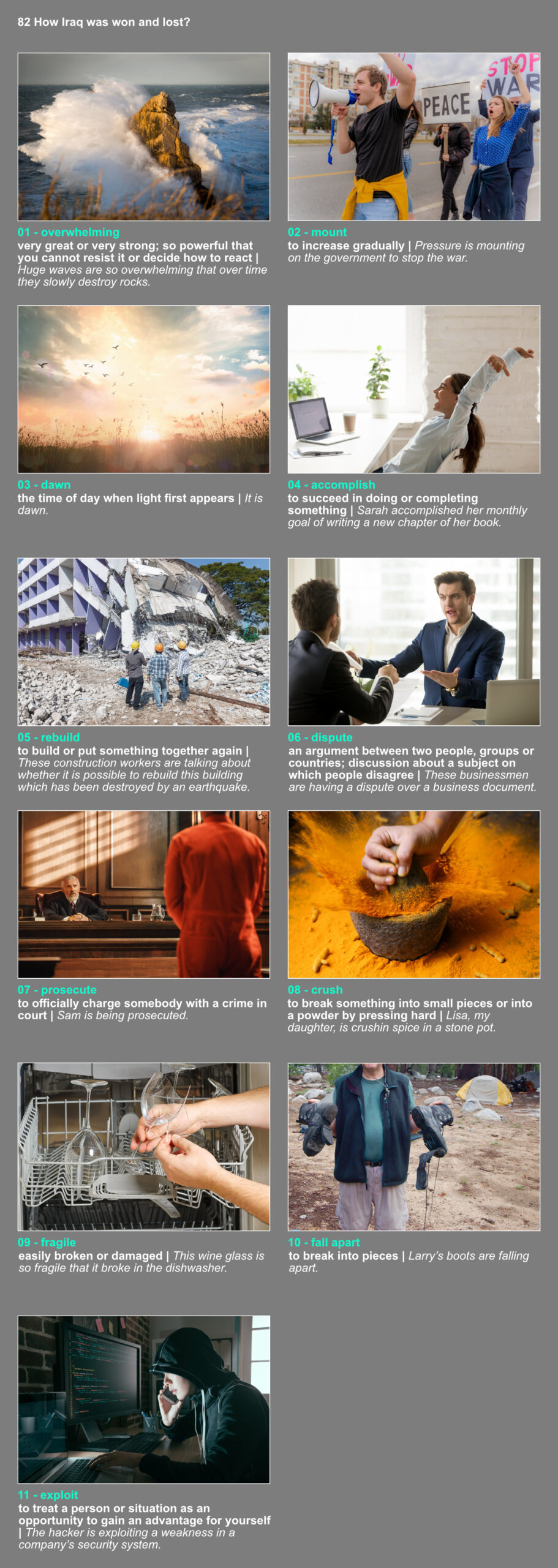
83 Public Pensions: An Economic Time Bomb (steps 1, 3 and 5)
I want to talk to you about three words that should scare the heck out of you, especially if you’re young: public pension liabilities.
Okay, I know you probably have about a hundred things you’re worried about, and public pension liabilities likely aren’t one of them.
But that’s the reason this is so scary—because almost no one is paying attention.
Unless you’re okay with your city going full Detroit and giving more of your hard-earned money to pay off someone else’s debts, stay with me.
So what is a public pension liability?
A pension is a guaranteed, lifetime payment to someone after they retire. Pensions used to be a big deal in the private sector. Every major American company had them. But they became too expensive, and companies have taken steps to phase them out.
However, pensions still live on in the public sector—among employees of the government—and they’re eating city and states’ budgets alive. More and more money that could go to tax cuts or better services is instead being shoveled aside to pay for these benefits.
Why is this happening? Over decades, politicians have promised trillions of dollars in pensions to government workers. That includes police, firefighters, teachers, and city and state officials. You name a government job, and there’s a pension associated with it.
Now, you may be wondering, “How big are these payments?” Many pensions are quite large. In California, more than 62,000 retired public employees are receiving pensions of over $100,000 per year. Sometimes, it’s even crazier. A retired New York City sanitation worker is getting $285,000 per year. A retired county administrator in California receives over $400,000 per year.
Remember, these are guaranteed lifetime yearly payouts.
Now, we love our public employees. They do vital work for our local communities and the wider society. They deserve competitive pay and retirement benefits. But currently, many cities are, in effect, paying for multiple public departments at the same time: the department that’s working now and, because people are living longer, a generation or two of retirees.
The system amounts to a self-perpetuating, corrupt merry-go-round. Public-sector unions give large donations to candidates, who are then responsible for negotiating how much of your money goes to public sector workers. These arrangements not only promise high salaries in the short-term, but they also hide the payments that will be due down the road when it will be much too late.
The results are predictable.
State and local governments across the U.S. openly admit to 1.4 trillion dollars of unfunded pension liabilities, or $11,000 per household. “Unfunded” means dollars that have been promised, but there’s no actual money in the bank. And that’s just the amount they admit to. The real number, according to the Federal Reserve, is much larger—around 4 trillion dollars, or $32,000 per household.
Pensions have already thrown California cities like San Bernardino and Vallejo into bankruptcy. And the entire state of Illinois is teetering on the edge.
So how do politicians get away with this? They use a time-tested political strategy: they lie.
They lie by saying they can pay for more and more generous pensions—not by collecting more taxes, but by making investments at a “guaranteed” 7.5% return.
But this is nonsense. It’s less and less likely they’ll meet their 7.5% goal over time, and their investment behavior—pouring ever more funds into ever riskier investments—suggests they know it. But if they were to use a more realistic assessment, they’d need to raise taxes dramatically. And they love their jobs too much for that.
We can, however, turn the odds in our favor—with public pressure, discipline, and common sense. Here’s what needs to happen:
First, we need state and local governments to report unfunded liabilities honestly: the real numbers—using the 2-3% yields that sound financial reporting would require. No more pie-in-the-sky stuff. The truth should shock voters into demanding action.
Second, we must phase out the guaranteed pension programs as quickly as possible and introduce 401K plans. 401K plans, if designed properly, can provide excellent and sustainable retirement benefits. These plans also have the advantage of being portable. If you leave the public sector and go work in the private sector, you get to take your money with you. In other words, you don’t have to be locked-in to a lifetime government job to receive retirement benefits. Win-win.
Let’s end the current structure of public sector pensions and move to a sustainable way of compensating our public workforce.
Save your city. Save your state. Save your money.
I’m Joshua Rauh, professor of finance at Stanford and Senior Fellow at the Hoover Institution, for Prager University.
I want to talk to you about three words that should *scare the heck out of you, especially if you’re young: public pension liabilities.
scare1: to frighten somebody | Dennis got scared by his friend.
liability: the amount of money that a person or company owes | The company has liabilities of £50000.
Okay, I know you probably have about a hundred things you’re worried about, and public pension liabilities likely aren’t one of them.
But that’s the reason this is so scary—because almost no one is paying attention.
Unless you’re okay with your city going full Detroit and giving more of your hard-earned money to pay off someone else’s debts, stay with me.
going full Detroit: becoming bankrupt; like Detroit did in 2013 | They did everything to avoid their city from going full Detroit.
So what is a public pension liability?
A pension is a guaranteed, lifetime payment to someone after they *retire. Pensions used to be a big deal in the private sector. Every major American company had them. But they became too expensive, and companies have taken steps to phase them out.
retire2: to leave your job and stop working, especially because you have reached a particular age or because you are ill | Michael is retired.
phase out: to stop using something gradually in stages over a period of time | The airline is planning to phase out the aircraft at the end of the month.
However, pensions still live on in the public sector—among employees of the government—and they’re eating city and states’ *budgets alive. More and more money that could go to tax cuts or better services is instead being *shoveled aside to pay for these benefits.
budget3: the money that is available to a person or an organization and a plan of how it will be spent over a period of time | Cassie keeps the budget for her pension in this yellow piggy bank.
shovel4: A) to move with a shovel | Mike is shoveling snow from his car.
- B) shovel (money): spend a lot of money without careful thinking | People shovel loads of money into entertainment.
benefit: money provided by the government to people who need financial help because they are unemployed, ill, etc. | Bill wants the government to cut benefits.
Why is this happening? Over decades, politicians have promised trillions of dollars in pensions to government workers. That includes police, firefighters, teachers, and city and state officials. You name a government job, and there’s a pension associated with it.
Now, you may be wondering, “How big are these payments?” Many pensions are quite large. In California, more than 62,000 retired public employees are receiving pensions of over $100,000 per year. Sometimes, it’s even crazier. A retired New York City *sanitation worker is getting $285,000 per year. A retired county administrator in California receives over $400,000 per year.
sanitation5: the equipment and systems that keep places clean, especially by removing human waste | Nathaniel is a sanitation worker.
Remember, these are guaranteed lifetime yearly payouts.
Now, we love our public employees. They do *vital work for our local communities and the wider society. They deserve competitive pay and retirement benefits. But currently, many cities are, in effect, paying for multiple public departments at the same time: the department that’s working now and, because people are living longer, a generation or two of *retirees.
vital6: necessary or essential in order for something to succeed or exist | Vitamins are vital for health.
competitive pay: what’s being offered as pay is equal to (or more than) the industry average for similar positions in the same location | The accounting job has competitive pay.
retiree7: a person who has stopped working because of their age | Maggie is a retiree.
The system amounts to a self-perpetuating, corrupt *merry-go-round. Public-sector unions give large donations to candidates, who are then responsible for negotiating how much of your money goes to public sector workers. These arrangements not only promise high salaries in the short-term, but they also hide the payments that will be *due down the road when it will be much too late.
The results are predictable.
self-perpetuating: continuing without any outside influence | Revenge leads to a self-perpetuating cycle of hatred.
merry-go-round8: (British English also roundabout) a round platform with model horses, cars, etc. that turns around and around and that children ride on at a fairground | Billy wants to get on the merry-go-round but cannot afford it.
due9: arranged or expected | Fred’s train is now due.
down the road: at some time in the future | This movie will not be scary a couple of years down the road.
predictable: something that happens in a way or at a time that you know about before it happens | The result of the match was predictable; the kids team lost against the adult team.
State and local governments across the U.S. openly admit to 1.4 trillion dollars of unfunded pension liabilities, or $11,000 per household. “Unfunded” means dollars that have been promised, but there’s no actual money in the bank. And that’s just the amount they admit to. The real number, according to the Federal Reserve, is much larger—around 4 trillion dollars, or $32,000 per household.
admit: to agree that something is true, especially unwillingly | Sally admitted that she made a mistake.
Pensions have already thrown California cities like San Bernardino and Vallejo into *bankruptcy. And the entire state of Illinois is *teetering on the edge.
bankruptcy10: the state of being bankrupt (= without enough money to pay what you owe) | There could be more bankruptcies among small shops.
teeter11: to stand or move in an unsteady way so that you look as if you are going to fall | Danny is teetering on the street.
teetering on the edge: to be very close to a very unpleasant or dangerous situation | Europe was teetering on the edge of war.
So how do politicians get away with this? They use a time-tested political strategy: they lie.
They lie by saying they can pay for more and more *generous pensions—not by collecting more taxes, but by making *investments at a “guaranteed” 7.5% return.
generous12: more than is necessary; large | The car has a generous amount of space in its trunk.
investment13: the act of putting money, effort, time, etc. into something to make a profit or get an advantage, or the money, effort, time, etc. used to do this | A lot of people are looking for investments which have high returns.
But this is nonsense. It’s less and less likely they’ll meet their 7.5% goal over time, and their investment behavior—*pouring ever more funds into ever riskier investments—suggests they know it. But if they were to use a more realistic assessment, they’d need to *raise taxes dramatically. And they love their jobs too much for that.
pour14: A) to make a liquid or other substance flow from a container in a continuous stream, especially by holding the container at an angle | The waiter is pouring red wine from a bottle.
- B) pour (money): spend a lot of money on sth | “Pouring more money into this project will not help.”
assessment: the process of calculating how much tax someone must pay, or the amount that must be paid | Nancy worked for the office which did Greg’s tax assessment.
raise15: to lift or move something to a higher level | The weightlifter raised the weight above his head.
We can, however, turn the odds in our favor—with public pressure, *discipline, and common sense. Here’s what needs to happen:
turn the odds in our favor: to make it more likely for someone to win, succeed, etc | We tried to turn the odds in our favour by visualising driving down the racetrack in our heads before the race.
discipline16: the ability to control your behaviour or the way you live, work, etc. | Going for a run every morning requires discipline.
First, we need state and local governments to report unfunded liabilities honestly: the real numbers—using the 2-3% yields that sound financial reporting would require. No more pie-in-the-sky stuff. The truth should shock voters into demanding action.
yield: the total amount of crops, profits, etc. that are produced | “Good idea, doing that will give you a 16% yield on your investment.”
pie-in-the-sky: an event that somebody talks about that seems very unlikely to happen | Stop all this pie-in-the-sky talk of becoming an astronaut.
Second, we must phase out the guaranteed pension programs as quickly as possible and introduce 401K plans. 401K plans, if designed properly, can provide excellent and sustainable retirement benefits. These plans also have the advantage of being *portable. If you leave the public sector and go work in the private sector, you get to take your money with you. In other words, you don’t have to be locked-in to a lifetime government job to receive retirement benefits. Win-win.
portable17: that is easy to carry or to move | Portable heaters are practical appliances (= tools in homes) in guest rooms.
locked-in: not subject to adjustment; unable to be changed | The loan has a fixed locked-in interest rate.
Let’s end the current structure of public sector pensions and move to a sustainable way of compensating our public workforce.
Save your city. Save your state. Save your money.
I’m Joshua Rauh, professor of finance at Stanford and Senior Fellow at the Hoover Institution, for Prager University.

84 How Big Should Government Be? (steps 1, 3 and 5)
One of the most important differences between the Left and the Right is how each regards the role and the size of the government.
The Left believes that the state should be the most powerful force in society. Among many other things, the government should be in control of educating every child; should provide all health care; and should regulate often to the minutest detail how businesses conduct their business — in Germany, for instance, the government legislates the time of day stores have to close. In short, there should ideally be no power that competes with Government. Not parents, not businesses, not private schools, not religious institutions; not even the individual human conscience.
Conservatives, on the other hand, believe the government’s role in society should be limited to absolute necessities such as national defense and to being the resource of last resort to help citizens who cannot be helped by family, by community, or by religious and secular charities.
Conservatives understand that as governments grow in size and power, the following will inevitably happen:
- There will be ever-increasing amounts of corruption. Power and money breed corruption. People in government will sell government influence for personal and political gain. And people outside government will seek to buy influence and favors. In Africa and Latin America, government corruption has been the single biggest factor holding nations back from progressing.
- Individual liberty will decline. With a few exceptions such as an unrestricted right to abortion, individual liberty is less important to the Left than to the Right. This is neither an opinion nor a criticism. It is simple logic. The more control the government has over people’s lives, the less liberty people have.
- Countries with ever expanding governments will either reduce the size of their government or eventually collapse economically. Every welfare state ultimately becomes a Ponzi Scheme, relying on new payers to pay previous payers; and when it runs out of the new payers, the scheme collapses. All the welfare states of the world, including wealthy European countries, are already experiencing this problem to varying degrees.
- In order to pay for an ever-expanding government, taxes are constantly increased. But at a given level of taxation, the society’s wealth producers will either stop working, work less, hire fewer people, or move their business out of the state or out of the country.
- Big government produces big deficits and ever increasing — and ultimately unsustainable — debt. This, too, is only logical. The more money the state hands out, the more money people will demand from the state. No recipient of free money has ever said, “Thank you. I have enough.”
Unless big governments get smaller, they will all eventually collapse under their own weight — with terrible consequences socially as well as economically.
- The bigger the government, the greater the opportunities for doing great evil. The twentieth century was the most murderous century in recorded history. And who did all this killing? Big governments. Evil individuals without power can do only so much harm. But when evil individuals take control of a big government, the amount of harm they can do is essentially unlimited. The Right fears Big Government. The Left fears Big Business. But Coca-Cola can’t break into your house or confiscate your wealth — only Big Government can do that. As irresponsible as any Big Business has ever been, it is only Big Government that can build concentration camps and commit genocide.
- Big government eats away at the moral character of a nation. People no longer take care of other people. After all, they know the government will do that. That’s why Americans give far more of their money and volunteer far more of their time to charity than do Europeans at the same economic level.
Without the belief in an ever-expanding government, there is no left. Without a belief in limited government, there is no right.
I’m Dennis Prager.
One of the most important differences between the Left and the Right is how each regards the role and the size of the government.
regard: to think about somebody/something in a particular way | Sally regards her grandfather in a very positive light.
The Left believes that the state should be the most powerful force in society. Among many other things, the government should be in control of educating every child; should provide all health care; and should regulate often to the minutest detail how businesses conduct their business — in Germany, for instance, the government legislates the time of day stores have to close. In short, there should ideally be no power that competes with Government. Not parents, not businesses, not private schools, not religious institutions; not even the individual human *conscience.
regulate: to control something by means of rules | The activities of banks are regulated by law.
minutest: extremely small | The toilet on the train is minute.
conduct: to organize and/or do a particular activity | “There has been concern over how the large oil company conducts its activities/business.
conscience1: the part of your mind that tells you whether your actions are right or wrong | Steven does not have a clear conscience (= he feels guilty about something).
Conservatives, on the other hand, believe the government’s role in society should be limited to absolute necessities such as national *defense and to being the resource of last resort to help citizens who cannot be helped by family, by community, or by religious and secular *charities.
necessity: a thing that you must have and cannot manage without | Shelter and food are necessities.
defense2: the organization of the people and systems that are used by a government to protect a country from attack | Some people argue that the government should increase its spending on defense.
last resort: the only choice that remains after all others have been tried | “As a last resource you can try asking your local government for help.”
charity3: an organization for helping people in need | This charity will give every item away to the poor.
Conservatives understand that as governments grow in size and power, the following will inevitably happen:
inevitably: as is certain to happen | Inevitably, the kids went toward the candy shop.
- There will be *ever-increasing amounts of corruption. Power and money *breed corruption. People in government will sell government influence for personal and political *gain. And people outside government will *seek to buy influence and favors. In Africa and Latin America, government corruption has been the single biggest factor holding nations back from progressing.
ever-increasing4: something that continues to grow or prosper in size or scope | The size of this tree is ever-increasing.
breed5: to be the cause of something | “Negativity breeds more negativity and failure.”
influence: to have an effect on the way that somebody behaves or thinks, especially by giving them an example to follow | He let Julie influence his decisions.
gain6: to get something that is useful, that gives you an advantage, or that is in some way positive, especially over a period of time | The thief somehow gained access to the safe.
seek7: to try or attempt | The spokesperson is seeking to reassure the public about the trustworthiness of the government.
influence: the effect that somebody/something has on the way a person thinks or behaves or on the way that something works or develops | “We are looking to find out about what influence, if any, violent movies have on children?
favor (BrE: favour): treatment that is generous to one person or group in a way that seems unfair to others | The teacher showed favour to Billy when marking his homework.
- Individual liberty will *decline. With a few exceptions such as an unrestricted right to abortion, individual liberty is less important to the Left than to the Right. This is neither an opinion nor a criticism. It is simple logic. The more control the government has over people’s lives, the less liberty people have.
decline8: to become smaller, fewer, weaker, etc. | Billy’s health has declined over the past hours.
unrestricted: not limited or controlled in any way | “As a student here, you have unrestricted access to the library.”
- Countries with ever-expanding governments will either *reduce the size of their government or eventually *collapse economically. Every welfare state ultimately becomes a Ponzi Scheme, relying on new payers to pay previous payers; and when it runs out of the new payers, the scheme collapses. All the welfare states of the world, including wealthy European countries, are already experiencing this problem to varying degrees.
ever-expanding: constantly becoming larger | The county’s debt is ever-expanding.
reduce9: to make something less or smaller in size, quantity, price, etc.; to become less or smaller in size, quantity, etc. | House prices outside the city have been reduced (= they are cheaper).
collapse10: to fall down or fall in suddenly | The shed has collapsed.
to varying degrees: different from each other in amount | The sales people all managed to make money to varying degrees.
- In order to pay for an ever-expanding government, taxes are constantly increased. But at a given level of taxation, the society’s wealth producers will either stop working, work less, hire fewer people, or move their business out of the state or out of the country.
- Big government produces big deficits and ever increasing — and ultimately unsustainable — *debt. This, too, is only logical. The more money the state *hands out, the more money people will *demand from the state. No *recipient of free money has ever said, “Thank you. I have enough.”
deficit: the amount by which money spent or owed is greater than money earned in a particular period of time | The country has a budget deficit.
ultimately: in the end; finally | “When playing the lottery, you buy your ticket and write down your numbers and, ultimately, it depends on your luck if you win or not.”
unsustainable: that cannot be continued at the same level, rate, etc. | “Unsustainable economic growth ultimately leads to environmental issues.”
debt11: a sum of money that somebody owes | Hans has a lot of credit card debt.
hand (sth) out12: to give something to each person in a group or place | Frank often hands out his business card after business meetings.
demand13 : a very strong request for something; something that somebody needs | Rachel demands that she gets another cup of coffee because her coffee tastes bad.
recipient14: a person who receives something | Tim is a recipient of an award.
Unless big governments get smaller, they will all eventually collapse under their own weight — with terrible consequences socially as well as economically.
- The bigger the government, the greater the opportunities for doing great evil. The twentieth century was the most murderous century in recorded history. And who did all this killing? Big governments. Evil individuals without power can do only so much harm. But when evil individuals take control of a big government, the amount of harm they can do is essentially unlimited. The Right fears Big Government. The Left fears Big Business. But Coca-Cola can’t break into your house or *confiscate your wealth — only Big Government can do that. As irresponsible as any Big Business has ever been, it is only Big Government that can build concentration camps and commit *genocide.
murderous: intending or likely to murder | He was a murderous dictator.
essentially: when you think about the true, important or basic nature of somebody/something; basically; fundamentally | “Sam thought that all people are essentially the same.”
confiscate15: to officially take something away from somebody, especially as a punishment | Stella’s phone is being confiscated by her father.
irresponsible: (of a person) not thinking enough about the effects of what they do; not showing a feeling of responsibility | Joey was an irresponsible teenager.
commit: to do something wrong or illegal | Frank committed murder.
genocide16: the murder of a large number of people from a particular nation or ethnic group, with the aim of destroying that nation or group | These are grave stones of victims of the genocide that took place in Potocari.
- Big government eats away at the moral character of a nation. People no longer take care of other people. After all, they know the government will do that. That’s why Americans give far more of their money and *volunteer far more of their time to charity than do Europeans at the same economic level.
eat away at sth: to reduce or destroy something gradually | The worm had eaten away at the wooden chair.
volunteer17: a person who does a job without being paid for it | These volunteers are cleaning their local area.
Without the belief in an ever-expanding government, there is no left. Without a belief in limited government, there is no right.
I’m Dennis Prager.